Research Articles
Establishing a Reliable Chemical Supply Chain Through Quality Assurance


On-time delivery alone doesn’t make a chemical supply chain reliable. Establishing a reliable chemical supply chain means maintaining consistent quality, clear communication, traceable materials, and the ability to respond when supply conditions change. A shipment can arrive on schedule yet still create risk if its contents fail to meet specifications or its documentation is incomplete.
That distinction matters to researchers and lab buyers in Boston, San Diego, and other U.S. research hubs: dependable sourcing starts before an order is placed and continues through receipt, storage, and testing. Quality assurance connects each stage, helping teams assess variability and determine whether materials suit their intended laboratory use.
This guide explains how supplier evaluation, compliance records, facility safety, traceability, and product testing contribute to reliability. It also covers how demand planning and communication can reduce avoidable disruptions, and what batch-specific quality documentation can show when evaluating research materials. Solara Compounds supplies compounds for laboratory research only, not for human or animal consumption.
Key Takeaways
- Assess suppliers against your technical requirements and quality expectations, not delivery availability alone.
- Use clear documentation and traceability to understand a material’s origin, handling, and condition.
- Build contingency plans around demand forecasts, inventory visibility, and alternative sourcing options.
- Compare domestic and international proposals by weighing lead times, payment terms, order volumes, and total logistics considerations.
- Review testing records and batch-specific quality documents to evaluate whether materials meet research requirements.
What Is a Chemical Supply Chain?
A chemical supply chain connects procurement, production, storage, transport, and delivery. Establishing a reliable chemical supply chain means coordinating these stages so materials arrive with consistent quality and usable documentation.
Distribution and Transport Logistics
Distribution and transport logistics determine how chemicals move from production sites through storage points to their destination. Route choice, shipment visibility, and communication with logistics partners all matter: a delay at one handoff can disrupt downstream production. Comparing direct delivery with a route through a warehouse, for example, helps teams weigh urgency, handling requirements, and operational efficiency.
Inventory and Delivery Scheduling
Inventory and delivery scheduling align purchase timing and stock levels with forecast demand and planned use. Monitoring raw materials, work in progress, and finished goods helps identify shortfalls before they affect production. Demand forecasts guide order timing, while delivery schedules help match receiving capacity to expected arrivals. Together, these decisions reduce avoidable stock gaps and excess inventory.
Supplier Performance and Delivery Planning
Supplier performance reviews help teams assess whether supply commitments continue to meet operational needs. Regular meetings provide a structured way to discuss delays, specification changes, and recurring coordination problems. Tracking delivery performance alongside quality and communication can reveal patterns, clarify responsibilities, and prompt adjustments before small issues disrupt production.
Contingency planning prepares a business to respond when a supplier, shipment, or production stage is disrupted. A practical plan identifies critical materials, likely failure points, alternative sourcing options, and the person responsible for each response. If a shipment is delayed, for example, the team can compare inventory with near-term demand, assess whether another supplier can meet the same technical requirements, and revise delivery priorities. Regular risk reviews keep the plan relevant as demand, suppliers, and operating conditions change.
Production planning connects demand forecasts to manufacturing sequence and timing. Chemical production may run continuously or in batches, and schedules must account for constraints such as tanks, filling lines, flow rates, and available crews. If several products need the same filling line, planners can sequence compatible runs and coordinate material arrivals with available capacity. This reduces scheduling conflicts and helps use plant resources efficiently.
Reliability depends on how these activities connect. Forecasts inform procurement; procurement timing affects production; production schedules shape inventory needs; and transport plans determine when materials reach the next operation. Clear milestones and assigned responsibilities help teams identify where a disruption could affect the chain and choose a specific operational response.
Regulatory compliance, traceability, and safety documentation
Compliance and traceability connect a chemical’s identity, handling history, and required records across the supply chain. These controls help buyers clarify what is arriving, how it should be handled, and which documents support its movement and laboratory use.
Documentation that follows the material
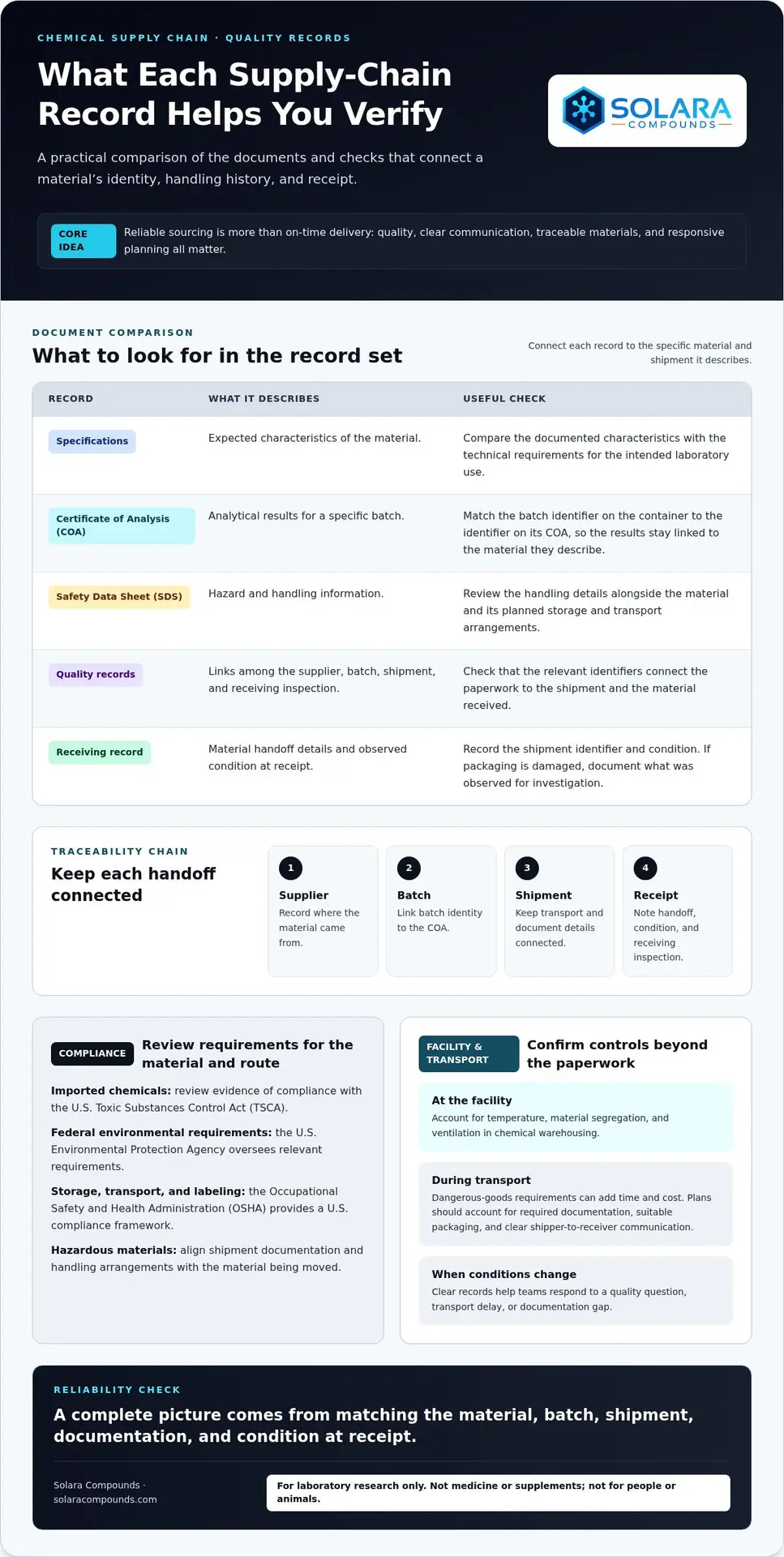
Build a record set around each shipment. Specifications describe expected material characteristics, while a Certificate of Analysis (COA) records analytical results for a batch. A Safety Data Sheet (SDS) provides hazard and handling information. Quality records can link these documents to the supplier, batch, shipment, and receiving inspection. Matching the batch identifier on a container with the one on its COA, for example, helps keep paperwork connected to the material it describes.
Traceability should capture key handoffs, too. Record where materials came from, who handled them, and their condition at receipt. If packaging arrives damaged, a receiving record with the shipment identifier and observed condition gives staff a specific issue to investigate. Clear records support timely decisions when a quality question, transport delay, or documentation gap arises.
Compliance across sourcing and transport
Requirements depend on the material, its hazards, and the jurisdictions involved. For imported chemicals, buyers should review evidence of compliance with the U.S. Toxic Substances Control Act (TSCA). The U.S. Environmental Protection Agency oversees relevant federal environmental requirements. Reviewing supplier compliance histories for violations or enforcement actions adds a meaningful step to procurement, rather than treating paperwork as a final shipping formality.
The Occupational Safety and Health Administration identifies OSHA as a U.S. compliance framework that shapes how chemicals are stored, transported, and labeled. For hazardous materials, shipment documentation and handling arrangements should match the material being moved. Dangerous-goods requirements can add time and cost, so transport plans should account for required documentation, suitable packaging, and clear communication between the shipper and receiving team.
Safe handling and responsive communication
Facility controls matter after delivery, too. Chemical warehousing should account for temperature, material segregation, and ventilation. A receiving team can compare shipment labels with accompanying documents, then route each material to its designated storage area. These checks link the transport record to safe site operations and help prevent incompatible materials from being stored together.
Customer service supports compliance when staff can resolve document or shipment questions clearly. Define who handles requests about SDSs, COAs, labels, and shipment status; then record answers alongside the relevant order or batch information. As demand and product ranges grow, consistent records help teams manage raw materials across global supplier relationships without losing track of changes or open issues. Buyers evaluating research materials can also review the research compound catalog alongside the documentation relevant to their purchasing needs.
Supplier variability and raw-material procurement
Raw-material procurement links supplier capability to the specifications and quantities a business needs. Variability can affect availability, quality consistency, quantity, cost, and lead times, so sourcing decisions have consequences for production planning and operations.
Raw Material Sourcing and Supplier Vetting
Raw-material sourcing identifies suppliers that can meet defined technical and business requirements; vetting evaluates whether they can do so consistently. Start by documenting material specifications, expected demand, and quality criteria. Then compare supplier records, product documentation, and communication practices with those requirements. A supplier that answers specification questions clearly, for example, gives procurement teams better information for assessing fit and managing changes.
Supplier Variability in Procurement
Supplier variability means differences in supply conditions across vendors or orders, including quantity, quality, availability, and delivery timing. These shifts matter because a shortage of one raw material can constrain production even when other inputs are ready. Procurement teams can map critical materials to their current sources, identify exposure from reliance on a single supplier, and develop alternatives where requirements allow.
Feedstock and Raw Material Market Trends
Feedstock trends are changes in the inputs suppliers use to produce raw materials. Monitoring key feedstocks can help teams recognize market signals before they affect procurement needs. Combine supplier updates with industry reports, market analyses, and internal demand forecasts. If a trend could affect a critical input, for example, procurement can review inventory assumptions and discuss supply conditions with partners before finalizing future orders.
Comparing Supplier Costs and Lead Times
Supplier comparisons evaluate proposals against the same material requirements, order assumptions, and delivery expectations. Domestic and international options may differ in lead time, payment terms, volume conditions, and logistics. Use what-if scenarios to compare how each proposal performs at different order volumes or within different delivery windows. This highlights important trade-offs instead of treating quoted purchase cost as the only measure of value.
Supplier relationships also affect how quickly procurement teams can address variability. Regular check-ins create opportunities to discuss upcoming demand, potential shortages, and specification changes. Centralized purchasing can combine raw-material requirements across plants, giving teams a clearer view of shared needs and possible sourcing efficiencies.
A resilient sourcing strategy adapts as market trends and business requirements change. Keep records of approved suppliers, material requirements, and alternative sourcing options. Review them when demand shifts or supplier performance changes. This gives procurement a practical basis for adjusting decisions without losing sight of quality standards or production priorities.
Chemical quality assurance and testing
Testing turns a written specification into evidence about a material or batch. Quality assurance connects that evidence to procurement decisions, inventory control, and production requirements. Without a defined testing purpose, results may be difficult to interpret. Start with the intended laboratory application, identify the material attributes that matter, and align them with the supplier’s specifications before reviewing results.
A useful quality review examines both the result and how it was produced. Check that the test refers to the correct material and batch, uses a method suited to the attribute being assessed, and reports results clearly. An identity result, for example, answers a different question from a concentration measurement. Read a Certificate of Analysis (COA) against the relevant specification; it is not a general guarantee of suitability.
Sampling is another essential control. A test describes only the sample analyzed, so sampling and identification records help connect results to the material received. For a batch shipment, compare the identifier on the container with the one on the COA. If they differ, pause the receiving decision and resolve the mismatch before recording the material as accepted. This check can prevent an unrelated result from entering inventory records.
Third-party testing can add an independent analytical check to supplier quality controls. Its value depends on whether the test scope matches the question being asked. Buyers can assess the laboratory’s methods, report clarity, and quality-management practices; ISO 17025 is a laboratory management certification they may consider. The certificate alone doesn’t show whether a particular test answers a specific material requirement, so the method and reported result still matter.
Quality assurance also requires a defined response to unexpected results. Specify how teams will document a discrepancy, identify affected batches, and decide whether further review is needed. A result outside a stated specification, for example, can trigger a hold while procurement and quality staff compare the report, specification, and receiving record. Clear responsibility supports a faster, more consistent decision.
Reviewing results across batches over time can reveal patterns that individual reports cannot. Teams can compare recurring attributes, supplier documentation, and receiving outcomes to identify variation early. They can then discuss corrective actions with suppliers and adjust purchasing decisions when the evidence supports a change. These quality-focused relationships help align supplier performance with research requirements, while sound logistics keep batch records connected to the correct shipment.
The practical takeaway is to define the attribute, match it to an appropriate test, and link the result to the correct batch. That sequence makes testing useful for procurement and receiving, rather than paperwork gathered after delivery. It also gives research teams a clearer basis for assessing consistency across materials and future orders.
How do chemical sourcing costs and lead times compare across domestic and international suppliers?
Domestic and international sourcing can’t be ranked by purchase price alone. Compare proposals using the same specifications, order quantities, payment terms, lead times, and delivery assumptions. A domestic option may involve a shorter transport route, while an international proposal may differ in production availability, shipment arrangements, or order terms. The better fit depends on the material, timing, and overall supply requirements.
Compare the full purchasing picture
Start with the supplier’s quoted material cost, then identify other factors that affect the purchasing decision. Freight, packaging, order volume, payment terms, and shipment coordination can change how proposals compare. Keep the material specification and requested quantity consistent across bids. Otherwise, an apparent price difference may reflect different requirements rather than a genuine sourcing advantage.
Use what-if scenarios to compare proposals under different purchasing conditions. Assess how each option fits a smaller order, a larger volume, or a delivery window tied to production, for example. Record the assumptions beside each scenario. This gives procurement teams a transparent basis for weighing cost against service and urgency.
Understand what shapes lead time
Lead time depends on more than distance. Production scheduling, supplier capacity, order preparation, transport planning, and receiving arrangements all affect when a material is ready for use. A nearby supplier may still have a longer timeline if production is constrained, while an international route may require extra coordination across shipment stages. Compare the supplier’s stated timing with the date the material must be ready for your operation.
For a time-sensitive input, map the steps from order placement to receipt and internal acceptance. Include preparation, dispatch, transit, receiving, and any quality review. This reveals where the schedule has little flexibility and helps teams plan around the step that most affects readiness, rather than relying on a single headline lead-time estimate.
Balance sourcing choice with operational risk
Domestic sourcing can reduce exposure to some cross-border transport variables, while international sourcing can broaden the supplier base. Neither route eliminates supply risk. Evaluate each proposal against material requirements, delivery timing, supplier communication, and the consequences of a delay. For a critical input with little inventory flexibility, for example, schedule certainty may matter more than a lower quoted purchase cost.
Keep the comparison current as demand and operating conditions change. Review supplier proposals when order quantities, production plans, or delivery priorities shift. A side-by-side record of terms and assumptions helps procurement explain trade-offs and update plans consistently. It also supports contingency decisions if supplier timing or availability changes.
The practical takeaway is to compare equivalent offers, model relevant order scenarios, and assess timing through receipt and acceptance. This makes domestic and international proposals easier to evaluate without relying on purchase price or distance alone.
Solara Compounds: SOL-3RT Retatrutide 10mg
Solara Compounds offers SOL-3RT Retatrutide 10mg for laboratory research only. It is not medicine or a supplement, and it is not for people or animals. For lab buyers evaluating a research material, batch-specific documentation and testing records can support review of the shipment’s identity and quality information. Solara Compounds provides batch-specific Certificates of Analysis and third-party testing, giving researchers documentation to consider alongside their own laboratory requirements and receiving procedures.
If SOL-3RT Retatrutide 10mg fits your research purchasing needs, visit solaracompounds.com.
Make quality criteria part of your next purchasing decision
Assign a clear owner to the purchasing process and set a regular review point. As research priorities shift, that person can keep purchasing decisions aligned with current project needs and prevent outdated assumptions from carrying into new orders. This makes establishing a reliable chemical supply chain an ongoing part of laboratory planning, not a one-time task.
For questions about research materials, contact Solara Compounds at [email protected] or 1 (877) 388-9178, Monday-Friday, 8 AM-5 PM Eastern.
When you’re ready to explore, view the current research catalog. A thoughtful next step can help your team move forward with clarity.
Frequently Asked Questions
What are the key steps to establish a reliable chemical supply chain?
Begin by defining what a successful supply arrangement must deliver for the specific research operation. Identify who is responsible for procurement, quality review, and receiving, then agree on how to escalate exceptions. For a new material, a controlled initial order can help the team assess its purchasing and receiving workflow before routine orders begin. Review the process when requirements or research priorities change.
How do companies qualify and audit chemical suppliers?
Companies qualify suppliers by assessing whether their operating practices support the requirements of the material being purchased. Beyond reviewing records, examine how a supplier manages changes, investigates deviations, and completes corrective actions. An audit can focus on these processes and their supporting records. Ask how a production-process change is approved and communicated, for example, then compare the explanation with documented procedures.
What regulations apply to chemical procurement, transport, storage, and labeling in the United States?
Applicable U.S. requirements depend on the chemical and activity involved. OSHA requirements shape chemical storage, transport, and labeling, while imported chemicals call for review of applicable TSCA compliance evidence. EPA regulations are also relevant to U.S.-based suppliers. A practical starting point is to map each material’s procurement, shipment, and facility-handling stages, then identify the requirements relevant to each stage.
How can buyers verify chemical quality, purity, and certificates of analysis?
Set acceptance criteria before ordering, then evaluate each report against those criteria instead of relying on a headline purity value. Check that the reported units, analytical method, and stated limits suit the intended research question. Assign a reviewer to record whether the evidence meets the purchasing specification, needs clarification, or requires further assessment. This creates a consistent process across orders and helps prevent informal acceptance decisions.
How should companies assess chemical supply chain risks and supplier reliability?
Use a structured risk assessment that considers the potential impact of a failure, its likelihood, and how readily it could be detected. Apply consistent criteria across materials so teams can compare priorities. A low-probability interruption, for example, may still need attention if it would stop a critical experiment. Assign an owner to each high-priority risk and schedule reviews when operating assumptions change.
What inventory, safety stock, and demand forecasting practices prevent chemical shortages?
Improve replenishment decisions by comparing forecast demand with actual consumption and supplier lead-time variability. Check whether purchasing assumptions still match current experimental plans instead of carrying forward an outdated forecast. Storage capacity and material stability also affect practical inventory levels. After a project phase ends, for example, a research team can reconcile usage and adjust future purchasing assumptions before its next order.
How can companies ensure chemical traceability and manage safety data sheets?
Make document retrieval part of routine staff readiness. Receiving and safety teams should be able to locate the relevant Safety Data Sheet using the same product identifier found in internal records. Periodically test the retrieval process with a sample material and correct naming or filing mismatches. Clear access and consistent document control help staff find handling information without relying on one person’s memory.
What strategies reduce disruptions from geopolitical events, natural disasters, and transportation delays?
Use scenario exercises to test how the organization would respond to different disruptions. A tabletop exercise can simulate a closed transport route, a supplier interruption, or a facility outage, then identify who makes decisions and which operations take priority. Record gaps and assign follow-up actions. Repeating the exercise when sourcing arrangements or operating priorities change helps keep response roles practical and current.