Research Articles
Institutional pricing for research peptides and quote terms


Institutional pricing for research peptides has no universal rate card. Eligibility, approval, and quote terms depend on the supplier and purchasing institution. A clear quote explains what it covers, while quality records and product details help researchers determine whether an order meets their laboratory requirements.
Institutional purchasing involves more than choosing a product and submitting payment. Buyers need to know what documentation supports procurement, which details affect a quote, and how to assess batch information while keeping materials strictly within laboratory research.
This guide explains who may qualify for institutional pricing, how account approval and written quotes typically work, and what to review about quality controls and availability. Solara Compounds provides third-party testing and batch-specific Certificates of Analysis for its research materials. Products are for laboratory research only; they are not medicine or supplements and are not for people or animals. Solara Compounds is available at solaracompounds.com.
Key Takeaways
- Institutional quote terms can depend on the buyer’s organization, purchasing requirements, and requested materials, so prepare clear order details when seeking a quote.
- Assess quality documentation by looking for batch-specific records and information about testing, not just broad purity claims.
- Confirm how a quote addresses product selection, order quantities, shipping, and any conditions that could affect fulfillment.
- Compare suppliers by the clarity of their approval process, quote terms, and quality documentation rather than assuming academic pricing follows one standard.
- Research peptides are for laboratory research only, not for people or animals.
Quality controls and purity concerns
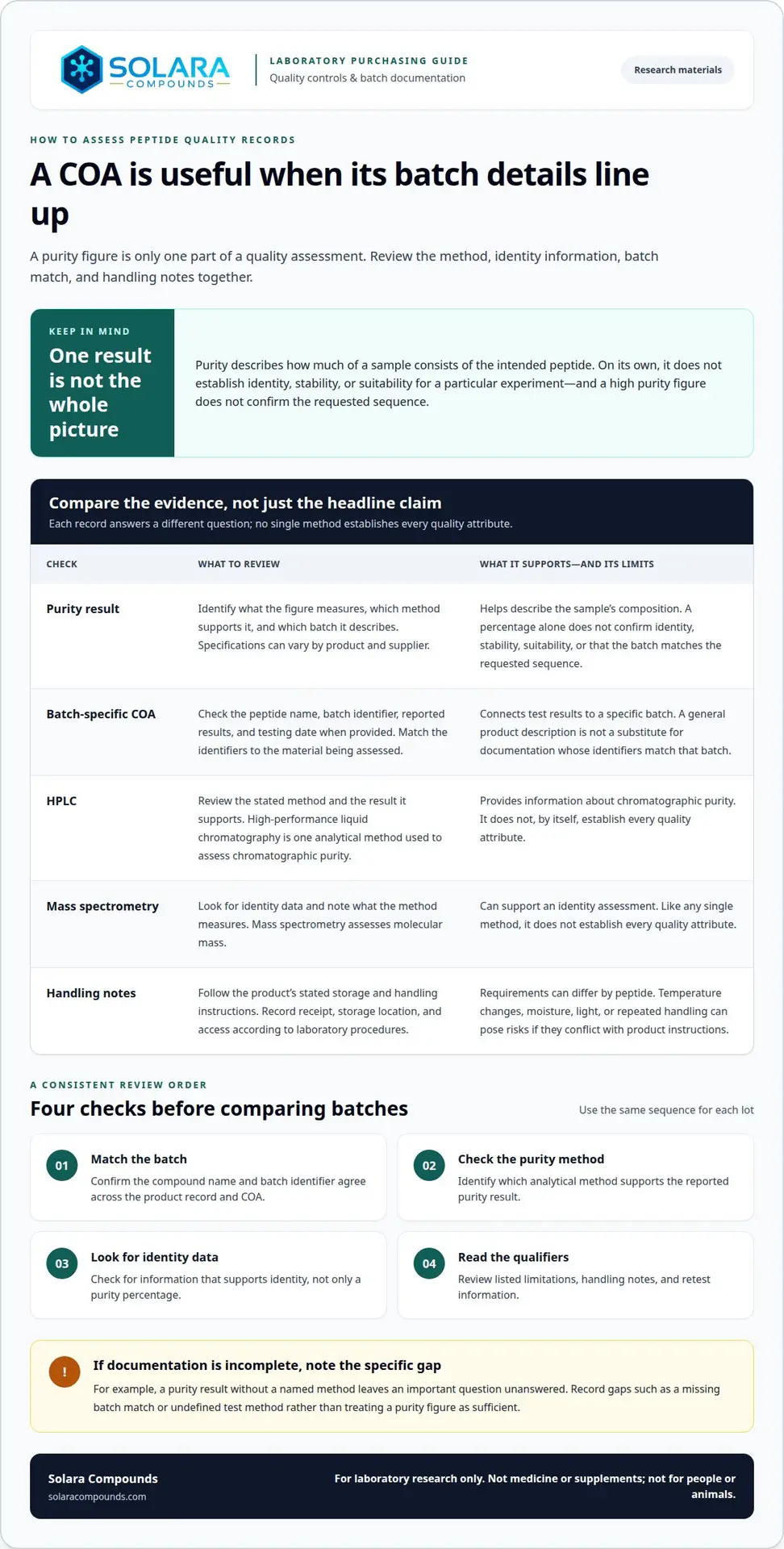
Purity indicates how much of a sample consists of the intended peptide. On its own, it does not establish identity, stability, or suitability for a particular experiment. For example, a high purity figure does not confirm that a batch matches the requested sequence. Assess purity as one part of quality, not as a complete verdict.
Purity specifications vary by product and supplier. A quote or product specification may state a purity figure, but buyers should identify what it measures and which batch it describes. Do not assume that similar percentages reflect the same method or acceptance criteria. Compare the stated measurement, test method, and batch documentation before interpreting the figure.
A Certificate of Analysis (COA) connects test results to a specific batch. Review the batch identifier, peptide name, reported results, and testing date, when provided. These details distinguish batch-specific evidence from a general product description. A COA is useful only when its identifiers match the material being assessed.
Third-party testing can provide an independent analytical check, but the scope of the test matters. High-performance liquid chromatography can assess chromatographic purity, while mass spectrometry can support identity assessment by measuring molecular mass. Neither method alone establishes every quality attribute. Review the methods and results together, noting which questions each test addresses.
Assess documentation in a consistent order:
- Match the compound name and batch identifier across the product record and COA.
- Check which analytical method supports the reported purity result.
- Look for identity data, not only a percentage.
- Review any listed limitations, handling notes, or retest information.
For example, a COA that reports purity without naming the method leaves an important gap. Documentation tied to a batch gives researchers a stronger basis for comparing lots and recording laboratory inputs.
Storage conditions also affect material integrity. Follow the product’s stated handling and storage instructions, and record receipt, storage location, and access according to laboratory procedures. Do not assume that every peptide has the same requirements. Temperature changes, moisture, light, or repeated handling can pose risks if they conflict with product instructions.
Institutions should consider sample identity, batch traceability, handling conditions, and access controls. These products are intended solely for laboratory research and development, not for human or animal consumption. Research-use-only labeling does not replace institutional safety procedures or responsible material handling.
When quality records are incomplete or unclear, pause the assessment rather than treating a purity figure as sufficient. Document the specific gap, such as a missing batch match or an undefined test method. This gives purchasing and research teams a precise basis for evaluating consistency across peptide lots.
Institutional buyer eligibility
Institutional access depends on each supplier’s purchasing process, not on a universal qualification checklist. Researchers can make requests clearer by identifying their organization, laboratory role, and intended research use. A university group, biotechnology company, or independent laboratory should describe its situation accurately rather than assume that an academic affiliation automatically qualifies an order.
Suppliers may distinguish laboratory purchasing from personal requests. A factual description of the work clarifies the purchasing context. For example, a researcher can state that the material is being considered for a controlled laboratory project and identify the department or group involved. Keep the explanation focused on research, not personal use.
Account review and order approval may involve different details. A supplier may need to know who is buying, which organization is responsible, and how the order will be handled internally. A purchasing department might use a designated buyer, while a small research group may coordinate through its laboratory lead. These details clarify the buyer’s role.
Prepare a concise institutional profile:
- State the organization’s operating name.
- Identify the laboratory group or department.
- Describe the research purpose in plain language.
- Name the buyer or other responsible contact.
- Clarify that materials are for laboratory research only.
For example, a university researcher can identify the department and purchasing office involved. A small research company can name its laboratory contact and explain its internal purchasing process. These examples help organize a request but do not guarantee approval. The supplier’s review determines whether the information meets its process.
Keep the intended use unambiguous. Research peptides are intended solely for laboratory research and development, not for human or animal consumption. Describing a product as intended for consumption conflicts with its research-only purpose and is unsuitable for a research-only supplier.
Institutional status does not make every peptide suitable for every project. Buyers should assess whether the material aligns with the planned laboratory work and the supplier’s stated product terms. For example, a group seeking a specific compound should clearly describe the research context rather than rely on its university or company affiliation alone.
A practical first step is to align the organization name, buyer role, and research purpose in the account request. This gives the supplier a coherent basis for review and helps the institution keep its purchasing records consistent. Researchers can then review a research peptide catalog for materials relevant to laboratory work.
Availability and quotation conditions
Availability and quote terms depend on the requested peptide, order format, and fulfillment conditions. A useful quote separates material costs from other terms.
Pricing Across Order Types
Catalog orders cover listed products and quantities, while custom synthesis involves a specified sequence or project. Bulk pricing may reflect larger quantities, but the quote should state the quantity basis. Institutional pricing may involve separate approval or purchasing terms. Compare peptide identity, purity information, quantity, and documentation before assessing differences.
For example, a catalog vial and a custom-synthesized sequence are not directly comparable if their specifications differ. Ask the quote to identify what is included, its validity period, payment terms, and any order minimums. These details explain the offer more clearly than a headline unit price alone.
Price Factors by Peptide and Supplier
There is no single typical price for research peptides across different peptides, purity specifications, quantities, and suppliers. Sequence complexity, requested purity, batch scale, documentation, and supplier terms can all affect a quote. A higher purity specification may require different production or testing, so compare the stated standard and supporting records.
Use identical request details across quotes. Name the peptide, quantity, purity requirement, and needed documentation. This allows a university lab to compare a quote with one from a commercial research group on the same basis. Do not treat a lower unit price as equivalent when the deliverables differ.
Availability can change between quote preparation and order processing. A written quotation should identify the requested item, quoted quantity, and any stated availability limits. If a project depends on a particular batch or specification, include that requirement in the initial request so the response addresses it directly.
Shipping, temperature handling, and fees depend on the shipment and its terms. For applicable domestic orders, review the quote and checkout details for shipping charges, handling conditions, and stated fees. Do not assume temperature-controlled packaging or special charges apply to every order. The quoted shipping method and destination determine which conditions are relevant.
Before approving a purchase, review these quote elements:
- Product identity, quantity, and stated specifications.
- Any documentation included with the order.
- Shipping method, handling notes, and listed charges.
- Payment conditions, quote validity, and order limits.
- Availability wording and any fulfillment conditions.
A quote that lists only a product and total leaves key purchasing details unclear. Request a revised written breakdown if charges or handling terms are bundled without explanation. Separating material, shipping, and any stated temperature-control charge, for example, helps procurement teams document the basis for approval.
All products from Solara Compounds are intended solely for laboratory research and development, not for human or animal consumption. For applicable orders, keep quote comparisons tied to laboratory use and the purchasing terms stated by the supplier.
How to request an institutional quote
A complete request gives the supplier enough information to prepare a useful response. Start with the institution’s name, laboratory contact, and a concise description of the research use. Then identify the peptide and requested quantity. For example, “university laboratory, named research group, peptide name, requested amount” is clearer than a general request for academic pricing.
Specify product requirements that could change the quote. Include the desired purity specification, if applicable, and the documentation needed for procurement. If the project requires batch-specific paperwork or a particular analytical record, state that directly. A clear request distinguishes essential requirements from preferences and reduces avoidable follow-up.
Before sending the request, gather these details:
- Institution or organization name and purchasing contact.
- Peptide name, requested quantity, and product format.
- Research purpose, stated for laboratory use.
- Documentation or quality records required by the lab.
- Shipping destination and any receiving instructions.
- Purchase-order or billing requirements, if relevant.
Use the same specifications for every quote request. A lab comparing two suppliers should request the same peptide, quantity, and documentation from each. If one request asks for a batch record and another does not, the replies may describe different deliverables. Matching details makes the resulting terms easier to evaluate.
Ask for a written response that separates the product, quantity, and fulfillment terms. The quote should clarify which specifications it covers and whether any conditions affect the order. If shipping charges, handling, or availability matter, request those details in the same response. Avoid relying on a verbal summary for institutional procurement records.
Review the reply against the original request. Confirm, for example, that the quoted peptide name and quantity match the laboratory’s submission. Note any changed specification, excluded document, or shipping condition. If an essential requirement is missing, identify it specifically and request a revised written quote. This keeps the discussion focused.
Internal purchasing rules can shape the final request. A university purchasing office may need a purchase order, while a small research organization may use a named buyer and billing contact. Include the applicable process early to help align the supplier’s quote with the institution’s approval workflow.
Keep the request, response, and final order record together. A consistent file name, such as the institution and project reference, helps procurement staff retrieve the quote later. Record the date received and the stated terms. These steps support traceability when a project repeats an order or reviews its purchasing history.
Which suppliers offer institutional or academic pricing for research peptides in the United States?
Institutional or academic pricing is supplier-specific. In the United States, researchers may encounter it through research-peptide manufacturers, specialist distributors, or laboratory-supply catalogs. An academic label alone does not establish eligibility or explain quote terms. The purchasing process and product documentation matter just as much.
Some suppliers publish institutional purchasing information; others handle requests individually. A university laboratory might submit its department name and purchase-order details. A research company could provide its organization and buyer contact. These are common purchasing details, not guaranteed approval criteria or a promise of discounted pricing.
Evaluate suppliers using a consistent set of questions:
- Does the supplier explain how institutional requests are submitted?
- Does the quote state the product, quantity, and applicable terms?
- Can the supplier provide batch-specific documentation?
- Are shipping and handling terms described clearly?
- Does the supplier state the materials are for laboratory research only?
A university purchasing office may prioritize purchase-order compatibility and records. An independent laboratory may focus on ordering steps, batch traceability, and delivery terms. The right comparison depends on the institution’s workflow. For example, a quote without a required purchase-order reference may not fit the university’s approval process.
Distinguish supplier types by what they provide. A manufacturer may support requests involving a custom sequence or production specification. A distributor may offer catalog materials from multiple sources. A laboratory-supply seller may organize products in a broader research catalog. These categories describe business models, not a guarantee that each supplier offers academic pricing.
Do not infer a pricing program from terms such as “academic,” “bulk,” or “institutional.” Ask what the label means in the written quote. It may refer to account eligibility, order terms, or a supplier-specific purchasing process. Compare the same peptide, quantity, purity requirement, and documentation across responses for a consistent evaluation.
Supplier selection also depends on the intended research use. These products are intended solely for laboratory research and development, not for human or animal consumption. Institutional affiliation does not make a material suitable for consumption or change its research-only purpose.
For a practical supplier review, record each response against the same criteria. Note the quoted product, quantity, documentation, fulfillment conditions, and account requirements. A concise comparison helps a lab buyer identify which quote fits procurement needs without assuming that academic pricing means the same thing across suppliers.
Potential sources include research-peptide manufacturers, specialist distributors, and laboratory-supply sellers, but academic pricing is not guaranteed across these categories. Review each supplier’s institutional purchasing process and written quote.
Solara Compounds
Solara Compounds supports laboratory buyers with third-party testing, batch-specific Certificates of Analysis, and fast U.S. shipping. Researchers can review materials such as SOL-3RT Retatrutide 10mg alongside the product and batch information relevant to their laboratory requirements.
All products are for laboratory research only, not medicine or supplements, and not for people or animals. For purchasing questions, support is available at [email protected] or 1 (877) 388-9178, Monday-Friday, 8 AM-5 PM Eastern.
For assistance with a research purchase, contact Solara Compounds.
Set a Clear Standard for Your Next Order
Turn the review into a repeatable purchasing standard. A concise internal brief can record the research purpose, required documentation, acceptable specifications, and procurement terms for future orders. This gives researchers and purchasing staff a shared reference, especially when a project needs consistent materials across multiple stages.
For teams evaluating institutional pricing for research peptides, the next step is to match laboratory requirements with available product information and purchasing details. Keep every material within its stated research-use scope. All products are for laboratory research only, not for human or animal consumption.
Solara Compounds offers research materials including GHK-Cu 50mg. If its catalog fits your laboratory’s research needs, contact Solara Compounds about a research quote. A well-defined request helps make the next purchasing decision more straightforward.
Frequently Asked Questions
What does institutional pricing for research peptides typically include?
Institutional pricing for research peptides describes purchasing terms offered to an organization, which may differ from standard catalog checkout. The written offer should clarify whether it covers a one-time order, recurring procurement, or an approved account arrangement. For example, a lab planning repeat purchases can ask how quoted terms apply to later orders rather than assume one quote governs future purchases.
What minimum order quantities and volume discounts do peptide suppliers offer institutions?
Minimum quantities and volume terms vary by supplier and product, so institutions should not assume a standard threshold. A purchasing team can request quotes for its expected order and a larger planned quantity, then compare the stated terms. For instance, a lab coordinating purchases across projects can assess whether combining requirements fits its budget cycle and storage capacity before selecting an order size.
How can a university, laboratory, or company request an institutional peptide quote?
A university, laboratory, or company can submit a written request through the supplier’s purchasing or sales channel. Identify the organization and authorized contact, then specify the material and research-use context. If a university uses centralized procurement, involve that office early so its purchase order and approval steps align with the request. Keep a copy of the submitted information for the institution’s purchasing records.
What documentation is needed to qualify for institutional pricing, such as tax-exempt or purchase-order forms?
Required documents depend on the supplier’s account process and the institution’s purchasing status. A supplier may request organizational details or a purchase order; a tax-exempt form is relevant when the institution seeks tax-exempt treatment and the supplier accepts it. The purchasing office can identify the organization’s applicable records. Keep account-review paperwork separate from documents needed for a specific purchase.
How do peptide purity, synthesis scale, sequence length, and modifications affect price?
Purity specifications and production complexity can affect the work required to produce and assess a peptide. Synthesis scale affects the requested output, while longer sequences or chemical modifications may require additional production planning. Meaningful price comparisons require matching specifications. For a modified sequence, describe the requested change precisely so the response addresses the material the project requires.
What quality-control documents should institutions request, such as certificates of analysis and mass spectrometry data?
Institutions can request a Certificate of Analysis and relevant identity data, such as mass spectrometry results, then file them with the project’s procurement record. Record the compound name, batch identifier, and document version alongside the order reference. This creates a traceable link between the material and laboratory records. Researchers can also note which analytical questions each document addresses before including it in project documentation.
What supplier requirements apply to purchasing research peptides for laboratory use?
Suppliers set their own account-review and purchasing requirements; buyers should identify their organization, laboratory role, and research purpose. Research peptides are for laboratory use only, not for people or animals.