Research Articles
Peptide Purity and Its Effects on Research Outcomes

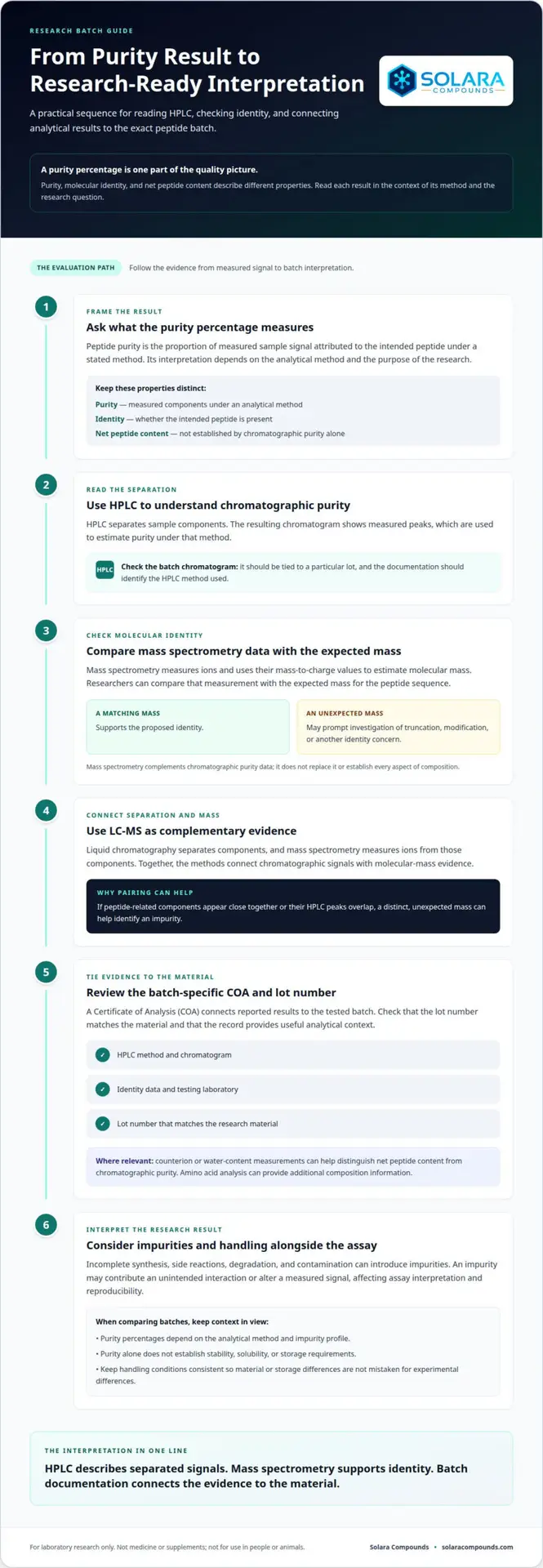
A 99%-pure peptide sample may still contain only about 80% peptide by mass. The impact of peptide purity on research outcomes depends not only on the reported percentage, but also on what the test measures and which impurities are present. Purity, identity, and net peptide content describe different properties.
For researchers, a purity figure is useful, but it does not tell the whole quality story. HPLC separates sample components and estimates purity from measured peaks, while mass spectrometry helps assess whether a peptide has the expected molecular mass and may reveal impurities that overlap in an HPLC result.
This guide explains what peptide purity means, how HPLC and mass spectrometry contribute to characterization, and how synthesis, storage, and contamination can introduce impurities that affect assay interpretation and reproducibility. It also covers the role of batch-specific Certificates of Analysis and quality controls in evaluating research materials. All products discussed are for laboratory research only, not medicines or supplements, and are not for use in people or animals.
Key Takeaways
- Use HPLC results to understand chromatographic purity, and mass spectrometry to assess molecular identity and detect some sequence-related issues.
- Interpret a purity percentage alongside the analytical method and the types of impurities detected; purity alone does not describe identity or net peptide content.
- Consider how incomplete synthesis, side reactions, degradation, or contamination could affect assay interpretation and reproducibility.
- Review batch-specific documentation for chromatograms, identity data, testing details, and a lot number that matches the material.
- Choose quality controls that fit the research question, since purity measurements and complementary analyses provide different kinds of information.
Mass spectrometry and LC-MS characterization
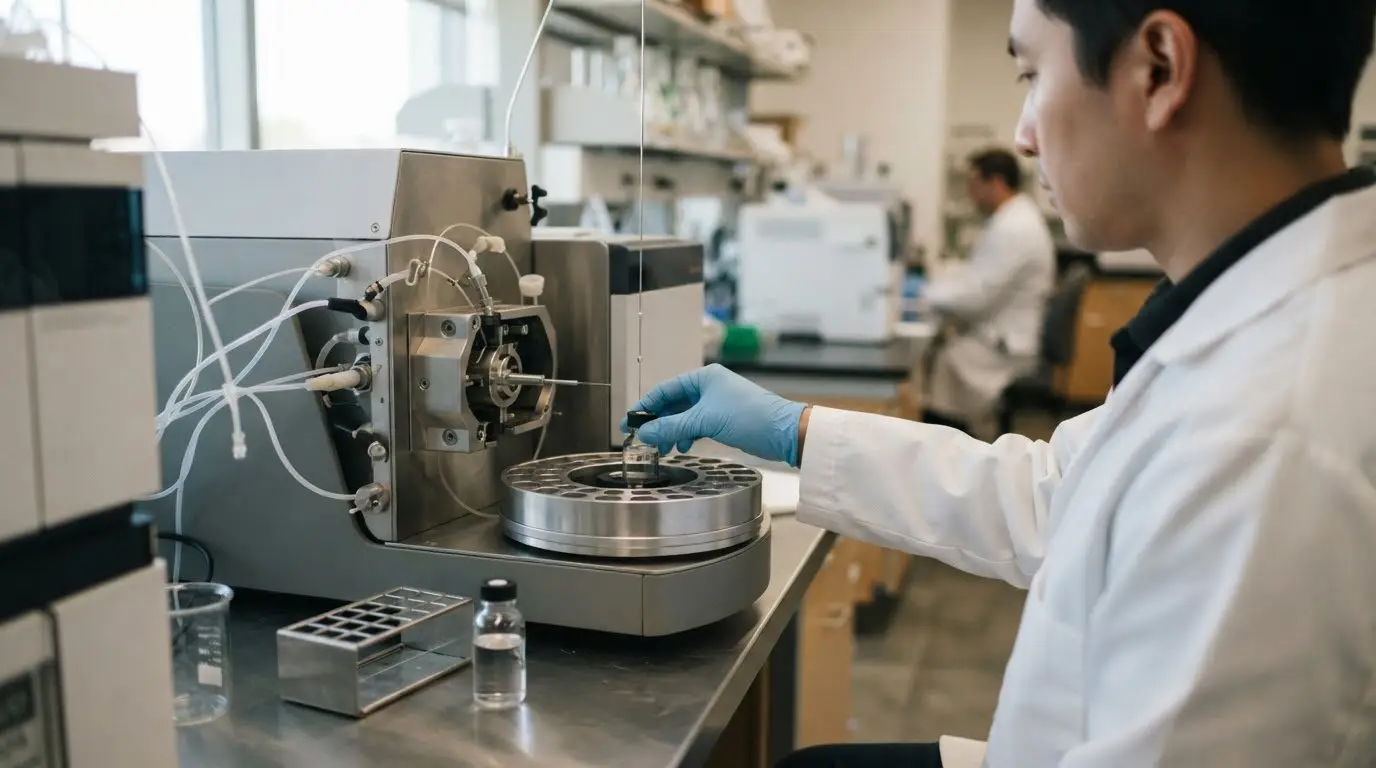
Mass spectrometry helps determine whether a peptide matches its expected molecular weight. That makes it useful for assessing identity, not just sample composition. A purity result and an identity result answer different questions. The first describes detected components under an analytical method. The second asks whether the intended peptide is present. For research materials, both details help interpret a batch record and assess experimental consistency.
Mass spectrometers measure ions and use their mass-to-charge values to estimate molecular mass. Researchers can compare this measurement with the expected mass for a peptide sequence. A match supports the proposed identity; an unexpected value may indicate a modification or sequence issue. Mass spectrometry can help detect incomplete or incorrect sequences, but it does not establish every aspect of composition or purity.
Sequence verification uses mass evidence to assess whether a peptide has the expected structure. An incomplete sequence has a different molecular mass from the complete intended sequence. If the measured mass differs from the expected value, researchers can investigate possible truncation, modification, or another identity concern. This comparison is useful when an assay produces an unusual result and material identity could affect interpretation. It complements, rather than replaces, chromatographic purity data.
Liquid chromatography-mass spectrometry, or LC-MS, combines separation with mass analysis. Liquid chromatography separates components as they pass through the instrument, and the mass spectrometer measures ions from those components. This pairing connects chromatographic signals with molecular-mass evidence. For example, two peptide-related components may appear close together in a chromatogram; a distinct, unexpected mass can help identify an impurity even when their HPLC peaks overlap.
No single analytical method resolves every question. HPLC estimates purity from separated peaks, while mass spectrometry supports identity assessment and may reveal some modifications. Researchers may also use amino acid analysis to assess composition, with counterion or water-content analysis where relevant. These methods provide complementary information and should not be treated as interchangeable measures of one quality attribute.
For practical interpretation, connect each result to the exact batch and its intended sequence. A useful record pairs mass spectrometry identity data with HPLC results and identifies the tested lot. For instance, documentation for a KPV peptide research material should make clear which batch the reported identity applies to. An unexpected mass or unexplained signal warrants careful interpretation before researchers compare assay results across batches.
What Is Peptide Purity?
Purity percentages describe measured components, but their interpretation depends on the analytical method and research purpose. Researchers need to understand that context before deciding whether a reported value fits the intended application.
Interpreting Purity Percentages
Peptide purity is the proportion of measured sample signal attributed to the intended peptide under a stated method. It matters because a percentage doesn’t identify every component or determine whether the material fits a particular experiment. High-purity peptides typically fall between 95% and 99% or higher, depending on the application. A 95% result isn’t automatically inferior to 99% without context.
Compare the analytical method and impurity profile before treating two percentages as equivalent. Two samples both reported at 99% can differ in net peptide content, counter-ion load, and impurity type. Those differences can matter when a study depends on a defined concentration or a particular interaction. The percentage alone doesn’t describe identity, strength, or residual-solvent content.
Reading Chromatograms and COAs
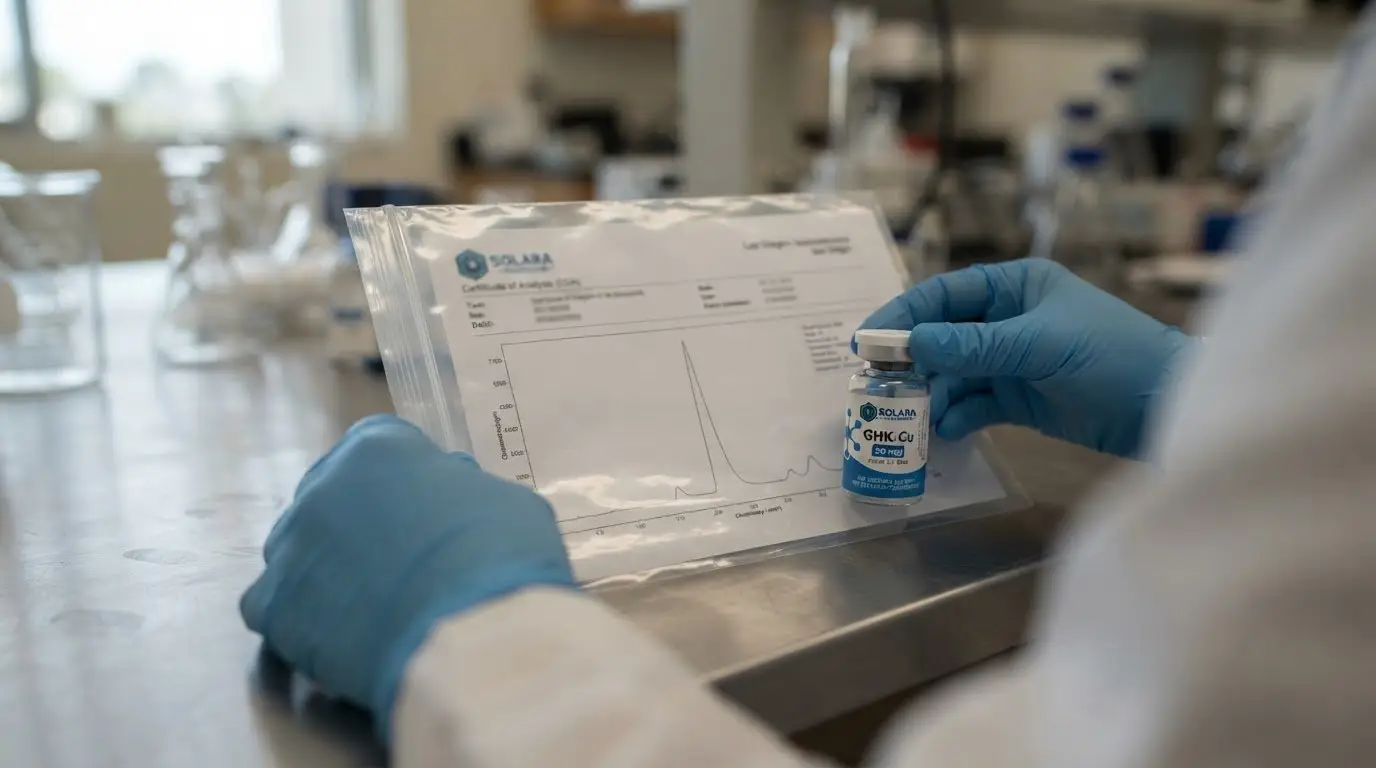
A lot-specific chromatogram displays signals recorded for a particular batch. Its Certificate of Analysis (COA) connects the results to the tested lot. Useful documentation identifies the HPLC method, provides identity data, names the testing laboratory, and includes the matching lot number. These details help researchers assess how reported purity was measured.
Net peptide content is distinct from chromatographic purity. For example, two lots with similar chromatographic results may differ in counterion or water content. A COA reporting relevant measurements helps researchers distinguish these characteristics. Lot identification also supports traceability by linking experimental records to a specific material batch.
Research peptide prices do not follow a universal scale based on purity alone. Sequence, material quantity, production, and testing can all affect price, so a purity percentage by itself is not enough to estimate or compare costs.
Purity alone does not establish stability, solubility, or storage requirements. A peptide’s sequence, chemical form, and surrounding conditions also influence these properties. Counterions and water content can affect composition, while storage conditions can affect stability. Keep handling conditions consistent when comparing batches so that material or storage differences are not mistaken for experimental differences.
Protein-to-protein interaction experiments examine how one protein binds or affects another. An impurity may contribute an unintended interaction or alter the measured signal. In receptor-ligand experiments, a ligand binds a receptor, a cell component that receives a signal. An unintended peptide could bind elsewhere or fail to bind, complicating interpretation of the interaction under study.
For lab buyers considering materials for a planned study, the research peptide catalog offers a starting point for evaluating available options against the study’s requirements.
Measuring peptide purity with reversed-phase HPLC
Researchers assess purity by interpreting a chromatogram alongside its method details and batch records. Evaluate a material by comparing its reported chromatographic result with identity evidence and the analytical conditions used.
Assessing Chromatographic Purity
Reversed-phase HPLC reports chromatographic purity by comparing the intended peptide’s peak area with measured sample peaks. The reported percentage applies to the signal detected under specific conditions, not to every property of the sample.
Research-grade material is commonly reported at ≥98-99% purity by HPLC. A result near 99% means the intended peptide accounts for about 99% of measured chromatographic signal under the stated analytical conditions. USP identifies HPLC chromatographic purity as one method for determining impurities in synthetic peptides.
Interpret a chromatogram with its method, not as a stand-alone percentage. Retention time, peak integration, sample preparation, instrumentation, and analytical standards can all affect evaluation. A peak that appears minor under one set of conditions may be treated differently under another. Batch comparisons are most meaningful when analytical methods are comparable.
Peak area also has limits as a measure. Its calculation represents detected chromatographic signal, so it does not independently establish net peptide content or quantify every material attribute. Distinguish the reported chromatographic percentage from composition measurements and other batch data. This prevents a single purity value from carrying more meaning than its method supports.
Combining HPLC and Mass Spectrometry
For a batch assessment, interpret chromatographic purity together with mass spectrometry data associated with the same lot. This pairing relates a purity result to evidence of material identity, rather than treating the chromatogram as a complete characterization.
Reviewing both records also clarifies the limits of each result. Analytical conditions may affect how clearly a chromatogram separates nearby signals, while mass data provides a separate identity check. Batch documentation helps researchers understand what was measured and which conclusions the results support.
A batch-specific Certificate of Analysis can bring the chromatogram, method, identity data, and lot information together. For research materials, reviewing available options alongside their analytical context helps align material selection with laboratory requirements.
Why Can Peptides Contain Impurities?
Common impurities include truncated or deletion sequences, cleavage-related adducts, degradation products, and solvent or reagent contaminants. Their origins matter because components other than the intended peptide can complicate assay interpretation. The impact of peptide purity on research outcomes depends partly on which impurities are present and how the assay responds to them.
Sources of Peptide Impurities
Solid-phase peptide synthesis builds a chain through repeated amino-acid coupling steps. If a coupling step is incomplete, the growing chain may miss a residue, producing a truncated or deletion sequence. Side reactions during assembly can also create unintended products. Closely related sequences may not behave like the intended material in an assay.
Additional impurities can arise during cleavage and later handling. Protecting groups shield reactive parts of amino acids during synthesis, while scavengers help remove unwanted groups during cleavage; both can contribute to adduct impurities. Degradation during storage or transport can change a peptide, and solvents or reagents can introduce contamination. Each source raises a different analytical concern.
Truncated Sequences in Research Assays
A truncated sequence is a peptide chain missing one or more intended amino acids. In an assay, it may bind an unintended target or fail to bind the intended one. This can shift measured signals, complicate interpretation, or reduce reproducibility. Even small impurity levels may matter in some analytical or biological research settings.
Consider an assay designed around a specific peptide sequence. If a deletion product remains in the sample, its binding behavior may differ from that of the intended peptide. The resulting signal may then reflect more than one component. Researchers may find it harder to distinguish a true experimental effect from a material-related effect, especially when comparing runs that use different batches.
Common Synthetic Peptide Impurities
Typical synthetic-peptide impurities include incomplete or incorrect sequences, side-reaction products, cleavage-related adducts, and degradation products. Residual solvents or reagents may also contribute contaminants. These categories describe possible origins, not a pattern shared by every peptide. Specific impurities depend on synthesis, cleavage, purification, and handling.
A peptide’s structure and interactions with assay targets influence observed activity. An impurity may bind off-target, meaning it interacts with something other than the intended target, or fail to bind. Either outcome can alter observations or obscure the intended signal. Purity results therefore need context: both the impurity’s identity and the assay’s sensitivity affect interpretation.
When evaluating the impact of peptide purity on research outcomes, consider how batch-specific impurity profiles may affect repeated experiments. A batch with a different profile may produce results that do not align with earlier runs. For example, a synthesis-related deletion product could contribute a competing interaction. Distinguishing material composition from the experimental variable helps researchers interpret observations more precisely.
Manufacturing quality control and Certificates of Analysis
Quality control connects manufacturing records with analytical evidence for a specific peptide batch. A Certificate of Analysis (COA) makes that connection visible, helping researchers assess documentation, identity, and consistency before laboratory use.
Quality systems may include raw-material verification, controlled synthesis, purification, and batch-specific analytical testing. Each stage addresses a different source of variation. Raw-material checks assess starting inputs, while purification separates the intended peptide from detectable by-products. Testing records characteristics of the resulting batch. Clear documentation helps researchers understand which controls support the reported results.
A useful COA links its results to the material’s batch or lot number. It should include HPLC purity data, the chromatogram and method, and mass spectrometry data supporting identity. The testing laboratory should be named, and the lot number should match the vial. Net peptide content adds useful information, since chromatographic purity alone does not describe total peptide by mass.
Other analytical methods answer different questions. Amino acid analysis can provide information about a peptide’s amino acid composition. Nuclear magnetic resonance (NMR) can provide structural insight, including information about conformation and integrity. These methods complement HPLC and mass spectrometry; they do not measure the same attribute or replace batch-specific records.
Independent testing and a verifiable report can help researchers evaluate material quality. Documentation is most useful when it clearly links the sample to its test results. For a lot-specific review, consider whether records identify:
- The batch or lot tested, matching the identifier on the vial.
- The HPLC chromatogram, analytical method, and reported purity.
- Mass spectrometry data used to support peptide identity.
- Net peptide content and the testing laboratory.
These details distinguish a general purity claim from evidence tied to a particular lot. Batch consistency matters when comparing assay results across experiments or repeating a study with new material. Storage and handling standards also matter when evaluating supplier quality, because degradation during transport or storage can affect material composition.
For research materials, a COA supports a more complete evaluation, but its value depends on relevant methods and batch-specific traceability. Explore research materials with batch documentation for laboratory research only.
Solara Compounds
Solara Compounds supports laboratory buyers seeking research materials for scientific work. Its catalog is available at solaracompounds.com, with product information for researchers assessing materials for laboratory use.
Research materials are for laboratory research only, not medicines or supplements, and not for use in people or animals. For product or documentation questions, email [email protected] or call 1 (877) 388-9178, Monday-Friday, 8 AM-5 PM Eastern.
For assistance with a research-material question, contact Solara Compounds.
Build consistency into the next study
Make material selection part of study design, not an afterthought. Before comparing experimental runs, define which analytical attributes matter to the research question and apply those criteria consistently across batches. This gives researchers a clearer basis for interpreting variation and deciding whether a result reflects the experimental variable or the material itself.
Consider the impact of peptide purity on research outcomes alongside the assay’s purpose and the evidence available for the specific material. A purity percentage alone cannot answer every question. Use analytical documentation to make informed research-material choices, and keep relevant batch information connected to the resulting observations.
Solara Compounds supplies peptides for laboratory research only. These materials are not medicines or supplements and are not for use in people or animals. When you’re ready to explore materials for laboratory work, see the research catalog at Solara Compounds and choose a starting point that fits your study design.
Frequently Asked Questions
Does 99% Purity Mean the Other 1% Is “Bad”?
No. The remaining signal can represent different components, and the percentage does not classify them as harmful or harmless. An impurity’s relevance depends on its identity and interaction with the assay. For example, an inactive synthesis by-product may affect interpretation differently from a sequence variant that binds the assay target. The reported percentage alone cannot make that distinction; analytical data and experimental context matter.
Is 95% Purity Always Worse Than 99%?
No. A lower percentage is not automatically a poorer choice for every research application. The analytical method, detected impurity profile, and study requirements all affect interpretation. For instance, when comparing batches, a researcher may prioritize consistent identity and impurity characterization over percentages measured under different conditions. Purity figures are most useful when their methods and supporting data allow a meaningful, like-for-like assessment.
Purity vs Identity: What’s the Difference?
Purity describes the measured proportion of components attributed to the target, while identity asks whether the target has the expected molecular structure. A sample could contain a dominant component with the wrong sequence, or the intended peptide alongside impurities. These are separate questions. Keep identity evidence distinct from purity data in research records so that a matching molecular signal is not mistaken for proof of compositional purity.
What Does “99% Pure” Mean?
It usually means the intended peptide accounts for about 99% of the signal measured by a stated analytical method, often chromatographic peak area. It doesn’t necessarily mean 99% of the material’s total mass is peptide. The interpretation depends on the method and conditions used. For example, a chromatographic percentage doesn’t by itself report water, counter-ion, or net peptide content.
What Should Researchers Look For?
Researchers should look for analytical information tied to the exact batch under consideration. Useful records identify the method, show the relevant chromatogram, and provide identity data that can be interpreted alongside purity results. Consider whether reports from batches being compared used compatible analytical conditions. This makes differences easier to assess and reduces the risk of treating a measurement-method change as a material change.
How is peptide purity measured and reported in research-grade peptides?
Reversed-phase HPLC separates detected components and reports chromatographic purity from their relative peak signals. Mass spectrometry provides supporting evidence about molecular identity, while amino acid analysis can examine composition. A report should specify which method produced each result because methods measure different attributes. An HPLC percentage and a mass spectrometry identity result, for example, are not interchangeable measures of overall quality.
How does peptide purity affect assay accuracy and reproducibility?
Unintended components can contribute signals or interactions that complicate an assay’s readout. If impurity profiles vary between batches, repeated experiments may not be directly comparable even when the assay design is unchanged. Keep batch identity connected to each experimental record to help distinguish possible material differences from changes in the assay or other study conditions.
How do peptide impurities affect biological activity and dose-response results?
In laboratory concentration-response experiments, an impurity may bind the intended target, interact elsewhere, or remain inactive. These possibilities can shift the observed signal or make a curve harder to interpret as the intended peptide’s response alone. Interpret response data alongside material characterization and batch records. A purity percentage alone cannot establish which component produced a measured effect.