Research Articles
Bulk Peptide Procurement for U.S. Research Labs

A low unit price is a weak basis for a large peptide order. Reliable bulk peptide procurement starts with batch-specific documentation and lot traceability, then matches the quantity to the lab’s actual demand. Standard catalog peptide minimums can range from 1 mg for a sample to 1 g.
U.S. laboratory buyers need to weigh consistency, quality documentation, and quantity together when considering bulk peptide procurement. A lower unit cost matters only when the material, supporting records, and order size fit the research plan.
This guide explains how to evaluate wholesale suppliers, read batch paperwork such as a Certificate of Analysis, and compare order quantities without losing sight of storage and inventory needs. It also covers practical checks for receiving and tracking a shipment. Peptides discussed here are for laboratory research only, not medicine or supplements, and are not for use in people or animals.
Key Takeaways
- Match order size to planned research use: standard catalog peptide minimums can range from a 1 mg sample to 1 g.
- Evaluate quality evidence by reviewing batch-specific Certificates of Analysis, lot numbers, and supporting analytical data.
- Compare the full procurement picture, including packaging, shipping, storage, receiving work, and the risk of excess inventory.
- Forecast baseline demand separately from one-time project needs, then set reorder points that account for usage, lead time, and a buffer.
- Keep research compounds for laboratory research only, and handle and use them in line with applicable laws and institutional policies.
Which criteria matter most when selecting a supplier for high-volume peptide orders?
For a large order, compare the material specification, minimum order quantity, batch documentation, and shipping plan. These details help determine whether the quantity and purchasing terms fit the research schedule.
Minimum Order Quantities and Batch Sizing
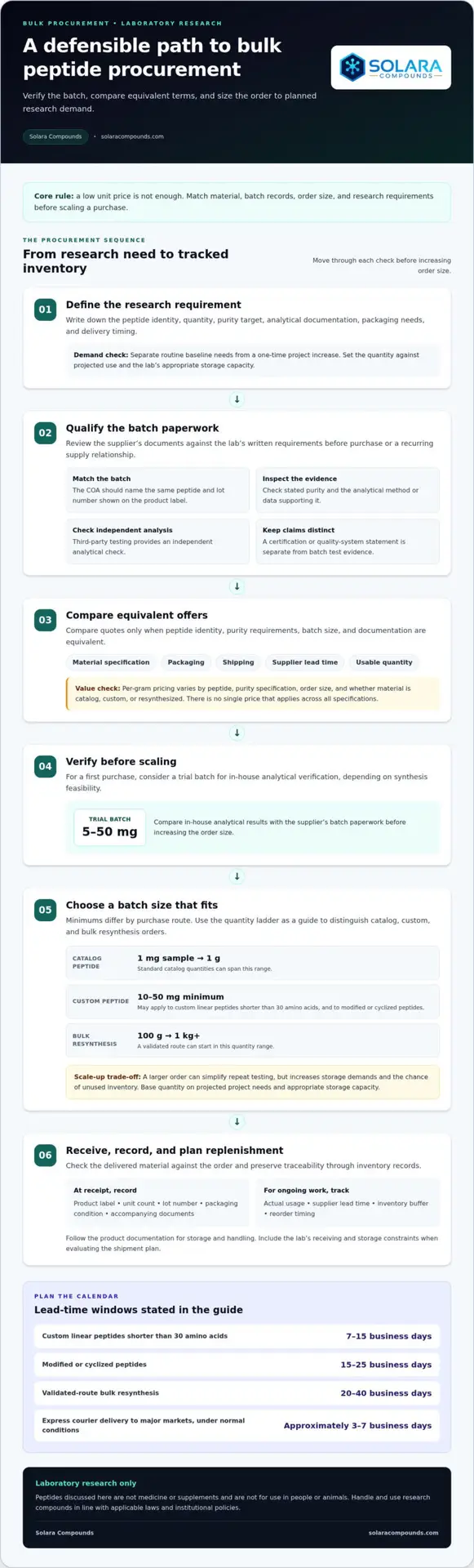
Minimums depend on whether researchers need a catalog item, custom synthesis, or bulk resynthesis. Standard catalog peptide quantities can range from a 1 mg sample to 1 g. Custom linear peptides shorter than 30 amino acids may have minimums of 10-50 mg, as may modified or cyclized peptides. Bulk resynthesis using a validated route can start in the 100 g to 1 kg+ range.
Match the batch to planned use rather than defaulting to the largest available quantity. A larger order can simplify repeat testing, but it also increases storage demands and the chance of unused inventory. Set the quantity based on projected project needs and the lab’s appropriate storage capacity.
Tiered Pricing by Peptide and Order Size
Per-gram pricing varies by peptide, purity specification, order size, and whether the material is catalog, custom, or resynthesized. There is no single per-gram price that applies across all specifications. Compare prices only when peptide identity, purity requirements, batch size, and documentation are equivalent.
Review how each price tier changes with quantity and whether packaging or shipping affects the total. A lower unit price may not represent better value if the order exceeds projected use or requires different packaging. Compare the full order cost with the analytical requirements and usable quantity.
Repeat Orders and Supply Availability
Repeat-order capacity matters when a study requires comparable material across separate runs. Define the required peptide identity, specifications, and documentation for each purchase, then plan orders around projected demand and supplier lead time.
Separate routine demand from a one-time project increase. This prevents an unusually large order from becoming the assumed recurring quantity. For ongoing work, track usage and reorder timing in the inventory plan rather than relying on an undocumented estimate.
Bulk Order Requirements and Handling
Specify the peptide name, quantity, purity target, analytical documentation, packaging needs, and delivery timing in the order request. Include the lab’s receiving and storage constraints so the shipment plan fits the facility. Order cutoffs and fulfillment location also affect scheduling, so compare them with the date the material is needed.
Packaging should protect the material during shipment, while storage and handling should follow the product’s documentation. After reconstitution, 2-8°C is a common storage condition to confirm for research peptide inventory. At receipt, record the product label, unit count, lot number, packaging condition, and accompanying documents. A catalog listing, such as this KPV peptide product page, also illustrates why buyers should distinguish a listed unit from a custom batch quantity.
How do you verify the quality of bulk peptide inventory?
Start a supplier qualification record by reviewing product specifications, batch documents, analytical evidence, and ordering terms before purchase. Assess each against the lab’s written requirements.
Supplier Qualification and Documentation Review
Request batch-specific documents and match the peptide name, lot number, stated purity, and test results to the product being quoted. A COA reports results for a particular batch, while third-party testing provides an independent analytical check. Review the records before establishing a recurring supply relationship, and retain the quotation and documentation together in the purchasing file.
Identity, Purity, and Certification Checks
For identity, confirm that the COA names the same peptide and lot shown on the label. Review the stated purity and the analytical method or data supporting it. Purity targets such as ≥95%, ≥98%, or ≥99% are examples, not interchangeable guarantees; select a target that fits the research requirements. A certification or quality-system statement is separate from batch test evidence, so record what each document actually establishes.
For a first purchase, consider a 5-50 mg trial batch for in-house analytical verification, depending on synthesis feasibility. Compare its results with the supplier’s batch paperwork before scaling the order. Catalog peptides are typically available as standard offerings; custom synthesis can address a specified sequence or modification, but it may require a different production path. Cost depends on peptide complexity, quantity, and required specifications, while the quality decision depends on matching analytical evidence to the same criteria.
Catalog purchasing generally suits a defined listed product; custom synthesis suits a research requirement that the catalog does not meet. Custom linear peptides shorter than 30 amino acids have estimated lead times of 7-15 business days; modified or cyclized peptides, 15-25 business days. A validated-route bulk resynthesis may take 20-40 business days. Express courier delivery to major markets may take approximately 3-7 business days under normal conditions.
Before ordering, forecast demand over the next project cycle. Separate routine requirements from a one-time increase, then set an inventory buffer based on actual usage and delivery timing. Send a clear quotation request specifying peptide identity, quantity, purity target, packaging, documentation, and delivery destination. Compare responses against the same specification, not just the unit price.
Use a trial order to establish a documented qualification process, then review the next batch against the same criteria. Researchers comparing catalog options can review research peptide catalog listings. Research compounds are for laboratory research only, not medicine or supplements, and are not for people or animals.
Bulk discounts for large quantities of the same catalog peptide
Quantity pricing depends on the catalog’s rules and whether the units meet its requirements. Compare any savings with the amount the lab can use and store for the planned work.
Bulk Discount Eligibility
Check how a supplier counts items before comparing quantity breaks. In the stated catalog discount structure, eligible orders of 2 items receive a 5% discount, while eligible orders of 10 or more items receive a 20% discount. Customers ordering 10 or more matching vials are asked to inquire about the discount. These thresholds may describe different order conditions, so distinguish matching vials from eligible catalog items.
For a fair comparison, record the peptide, vial size, number of matching units, purity specification, and applicable price tier. A larger order qualifies only when it meets the relevant rule. Don’t assume different peptides count toward the same threshold as matching vials. Keep the written terms with the purchasing record.
Product Shortlists and Quantity Planning
Build a shortlist around research requirements before calculating order quantity. List each catalog peptide separately, then record its required format, quantity, purity target, and expected use. For example, research listings may offer Retatrutide vials from 10 mg to 50 mg, while BPC-157 and TB-500 may appear as separate 10 mg products. Product format matters when comparing quantities.
Next, estimate demand for each shortlisted item over the project cycle. Separate routine requirements from a temporary increase, then compare the forecast with package sizes and quantity-pricing thresholds. Ordering more than planned can create excess inventory; ordering too little may require another purchase. A quantity worksheet makes these trade-offs clear before the order is placed.
Use one row per peptide, noting the requested vial count, amount per vial, documentation needs, and intended delivery window. This prevents unlike formats from being combined in a misleading total. It also helps the purchasing team compare supplier quotations on the same basis, rather than comparing a single-unit offer with a larger bundle.
Before selecting a price tier, calculate the quantity the lab can use, not just the number of units included. Confirm that the purity specification and batch documents meet internal research criteria. Then compare the proposed order with available storage and projected use. Quantity pricing supports sound purchasing only when the order fits the planned work and inventory controls.
How do you evaluate trustworthy wholesale peptide companies in the United States?
Evaluate sourcing through three connected checks: suitability for the research purpose, supplier documentation, and inventory planning. Before ordering, confirm that the material and planned work comply with applicable federal, state, and local requirements, as well as institutional policies.
Research compounds must be handled and used in accordance with applicable laws and institutional policies. They are not approved for human use. A wholesale listing or certificate of analysis doesn’t establish that a compound is suitable for every project or use. Keep procurement decisions tied to the laboratory’s defined research purpose and internal review process.
Create a supplier record before committing to a large order. Record the supplier’s legal business name, product identity, quoted quantity, batch documents, and delivery communications. Match the COA to the stated peptide and lot, then file it with the purchase record. This connects the sourcing decision to the inventory received.
Forecast demand over the upcoming project cycle before requesting a quotation. Separate routine demand from a one-time project increase. For example, a temporary increase for a defined experiment should not automatically become the recurring order quantity. This distinction helps the lab compare required volume with storage capacity and avoid excess inventory.
Set inventory controls to match the project’s pace. For lower-volume work, regular reviews can compare recorded usage with remaining units, planned experiments, and supplier lead time. Set a reorder point that accounts for receiving time and an appropriate buffer. Update the record when project requirements change rather than relying on an outdated forecast.
A practical qualification sequence can make purchasing more consistent:
- Document the research purpose and institutional requirements.
- Define the peptide, quantity, documentation, and delivery needs.
- Compare supplier records and batch-specific paperwork against those requirements.
- Review received labels, lot numbers, unit count, packaging, and documents.
- Update inventory and reorder plans after receipt.
For recurring supply, retain the approved specifications and review each new batch against them. A previous purchase record is not evidence for a different lot. Clear records help the research team distinguish supplier qualifications, batch documentation, and the institution’s authorization for laboratory use.
Keep the scope clear: research peptides are for laboratory research only, not for human or animal consumption. A sound U.S. wholesale decision connects research-use restrictions, institutional policy, batch records, and forecast inventory rather than relying on volume alone.
Certificates of analysis and lot traceability
A COA is useful only when it links the tested material to the batch received. Trace that connection from the certificate and lot number to the product label, packaging, and internal inventory record.
Match the COA to the Batch
Match the peptide name and lot number on the COA to the container label. Then compare the test results, stated purity, and analytical method with the purchase specification. A certificate for a different batch does not document the material received. Keep the COA with the receiving record so staff can retrieve it by product or lot.
Check whether a supplier provides a COA for each batch and whether the lot number is clearly shown on the packaging. These details support traceability when a lab receives multiple orders of the same peptide. Record the receipt date, unit count, lot number, packaging condition, and certificate location together to distinguish batches during later review.
Read the Analytical Information
Review the COA’s analytical results against the specifications used for purchasing. HPLC peak integration data may be provided at 214 or 220 nm. HPLC is a method that separates components in a sample, helping show the relative signal associated with the main peptide peak and other detected components. The wavelength and reported integration should be interpreted within the document’s stated method, not as a stand-alone quality guarantee.
Use a consistent receiving workflow for every shipment:
- Compare the order record, product label, lot number, and COA.
- Count the units and inspect packaging for damage or mismatched labels.
- File the certificate under the product name and lot identifier.
- Record any discrepancy before placing the material into inventory.
This process makes the relevant batch evidence easier to retrieve during internal reviews or repeat purchasing. If a certificate lists a lot number that differs from the label, isolate the affected shipment under the lab’s receiving procedures and resolve the mismatch before use. A general product sheet is not a substitute for batch-specific evidence; the lot number links the paperwork to the material.
These materials are intended for laboratory research only, and are not for use as medicine or supplements, nor for administration to humans or animals. To browse catalog items alongside their available product information, view the research peptide catalog.
Solara Compounds: SOL-3RT Retatrutide 10mg
Solara Compounds offers SOL-3RT Retatrutide 10mg as a catalog option for laboratory research. Lab buyers evaluating a defined peptide and listed quantity can review its product details and batch-specific documentation as part of their purchasing assessment.
Solara Compounds provides batch-specific Certificates of Analysis and third-party testing to support material review. The catalog also includes SOL-2TZ Tirzepatide 10mg. These products are for laboratory research only, not medicine or supplements, and are not for use in people or animals.
For product details and available research materials, visit solaracompounds.com.
Make your next purchasing decision research-ready
Turn supplier criteria into a repeatable purchasing record. Before the next order, document the research need, approved material specifications, receiving steps, and person responsible for inventory review. This gives the team a consistent starting point for future bulk peptide procurement, even as project requirements change.
Solara Compounds offers SOL-3RT Retatrutide 10mg, SOL-2TZ Tirzepatide 10mg, and GHK-Cu 50mg for laboratory research. Products are for laboratory research only, not medicine or supplements, and not for people or animals. For product questions, contact [email protected].
A careful process can stay straightforward. Clear specifications, documented review, and planned inventory decisions help align each order with the research ahead. Review Solara Compounds’ current research catalog and batch-specific COAs when identifying material for laboratory research.
Shop research peptides at solaracompounds.com
Frequently Asked Questions
What should you know before placing a large research peptide order?
Before releasing a large order, assign an internal owner, purchasing approver, and receiving contact. Confirm the material’s identity and format against the project specification, then map the quantity to planned experimental runs. Decide how the team will handle substitutions, partial shipments, or schedule changes before ordering. Clear responsibilities help prevent administrative delays once the order is underway.
Who Should Open a Bulk Peptide Account?
An authorized purchasing contact should manage any bulk account. The principal investigator or project lead can define the scientific requirements, procurement staff can maintain vendor records, and the lab manager can coordinate receipt. This keeps research specifications distinct from payment and logistics. In an independent laboratory, one person may hold several roles, but approval and receiving responsibilities should still be clear.
What does bulk peptide procurement mean, and what types of peptides are commonly purchased?
Bulk peptide procurement is the coordinated purchase of peptide materials for planned laboratory work, rather than an isolated sample order. Researchers may purchase catalog peptides such as BPC-157, TB-500, or GHK-Cu, depending on their experimental question. Other projects may require a custom sequence or modification. The relevant category follows the research specification, so buyers should define the material’s identity and required form before comparing purchasing options.
What U.S. federal and state rules govern buying, importing, storing, and using peptides?
No single rule applies to every peptide and research activity. Requirements depend on the material and activity, so domestic purchasing, importation, storage, and laboratory use may need separate consideration. Research organizations should assess the federal, state, and local requirements relevant to their circumstances. A research-use label alone does not settle these questions. Internal compliance staff can help interpret organizational policies for a particular project.
What documentation should buyers request, such as certificates of analysis, batch records, and safety data sheets?
Build a documentation file that supports scientific review and routine operations. Alongside batch testing records, retain the product specification, Safety Data Sheet, purchase order, and receiving record. The specification describes the requested material; the Safety Data Sheet supports hazard communication and handling decisions; purchasing records show who ordered and received it. Organize files by product identity so staff can retrieve the right documents without searching unrelated project records.
What are the main risks of bulk peptide procurement, including contamination, mislabeling, and counterfeit products?
Contamination can make experimental results difficult to interpret, and mislabeled material can undermine comparisons between study runs. Counterfeit or impersonation risks can also obscure the stated source. Reduce these risks through authorized purchasing channels, documented supplier identity, and a defined process for recording deviations. If an analytical result conflicts with the expected material identity, pause research use and follow the laboratory’s investigation procedures before drawing conclusions.