Research Articles
How to Properly Aliquot Peptides Into Single-Use Vials


Learning how to properly aliquot peptides starts with a clear plan for the sample’s form, the intended laboratory work, and the product’s storage directions. For dry powder, plan to limit exposure to moisture and air while portioning. For a solution, follow the product-specific handling and storage information rather than assuming that one rule applies to every peptide.
There is no universal refrigerator storage period for reconstituted peptides. Stability depends on the particular material, preparation conditions, diluent, and storage requirements. Use the product’s directions to determine handling and discard timing instead of relying on a general time limit.
This guide explains how laboratory researchers can plan sample portions, reduce repeated opening of a stock vial, and document handling choices. It covers dry material, solutions, container selection, and compatibility considerations without substituting general advice for product-specific directions. Solara Compounds products are for laboratory research only, not for use in people or animals.
Key Takeaways
- Plan aliquot size around the laboratory work so you can limit repeated opening of the stock vial.
- For dry powder, organize the workspace and receiving containers before opening the material to limit exposure to moisture and air.
- Use the product’s own handling, storage, and discard directions rather than applying a general rule to every peptide.
- Choose a diluent or buffer only when it is supported by the product-specific directions and the planned laboratory method.
- Solara Compounds materials are for laboratory research only, not for use in people or animals.
Aliquoting peptides to reduce freeze-thaw cycles
When laboratory work requires a stored solution, dividing it into planned portions can reduce how often a shared stock vial is opened and handled. Before portioning, check the product’s directions and the experimental plan. Aliquoting is useful only when the storage conditions, container, and intended sample amount fit the material.
Prepare for Safe Peptide Handling
Set up a clean work surface and arrange labeled receiving vials before opening the stock. Follow the laboratory’s handling requirements, minimize the time the material is exposed to room air, and keep the stock closed until the workspace is ready. Solara Compounds materials are intended solely for laboratory research and development purposes in controlled in-vitro or ex-vivo settings. They are not intended for human use, veterinary use, or any clinical, diagnostic, therapeutic, or personal application.
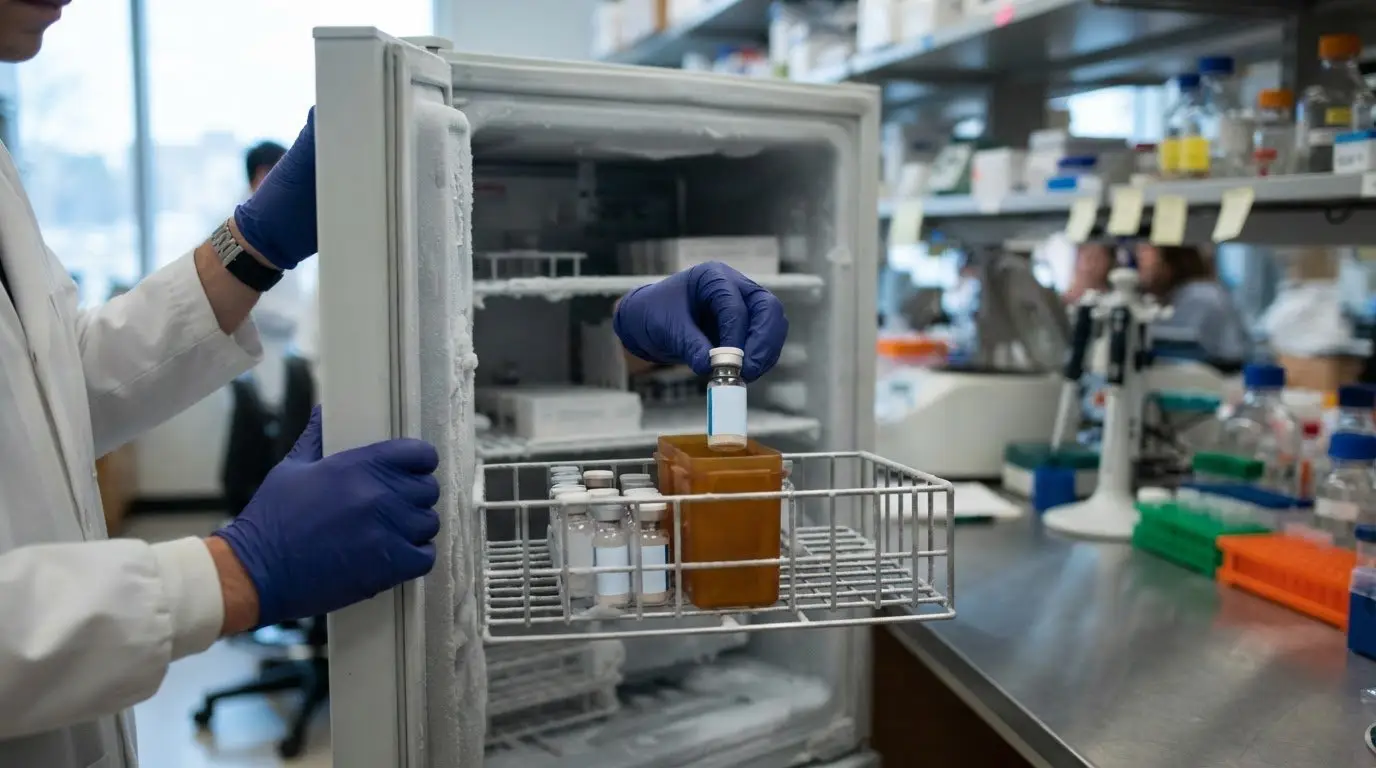
If a stored vial is cold, follow its product-specific handling directions before opening it. Opening a cold container can allow moisture to form on the material as the vial encounters warmer air. Keep the container closed while it adjusts, and avoid unnecessary exposure during preparation.
Consider Freeze-Thaw Cycle Tolerance
Plan portions around the amount required for each laboratory run, then store the remaining sealed portions as directed. There is no single freeze-thaw cycle limit that applies to every peptide. The appropriate handling depends on the material and its specified storage conditions, so do not treat a general cycle count as a guarantee of stability.
Before dividing material, write down the quantities needed and prepare matching containers. For example, separate portions for separate runs can reduce the need to thaw and reopen a shared stock vial. Label each container clearly so researchers can identify the intended sample without opening multiple vials. This makes the workflow easier to follow and helps reduce avoidable handling.
Store Aliquots at Freezer Temperatures
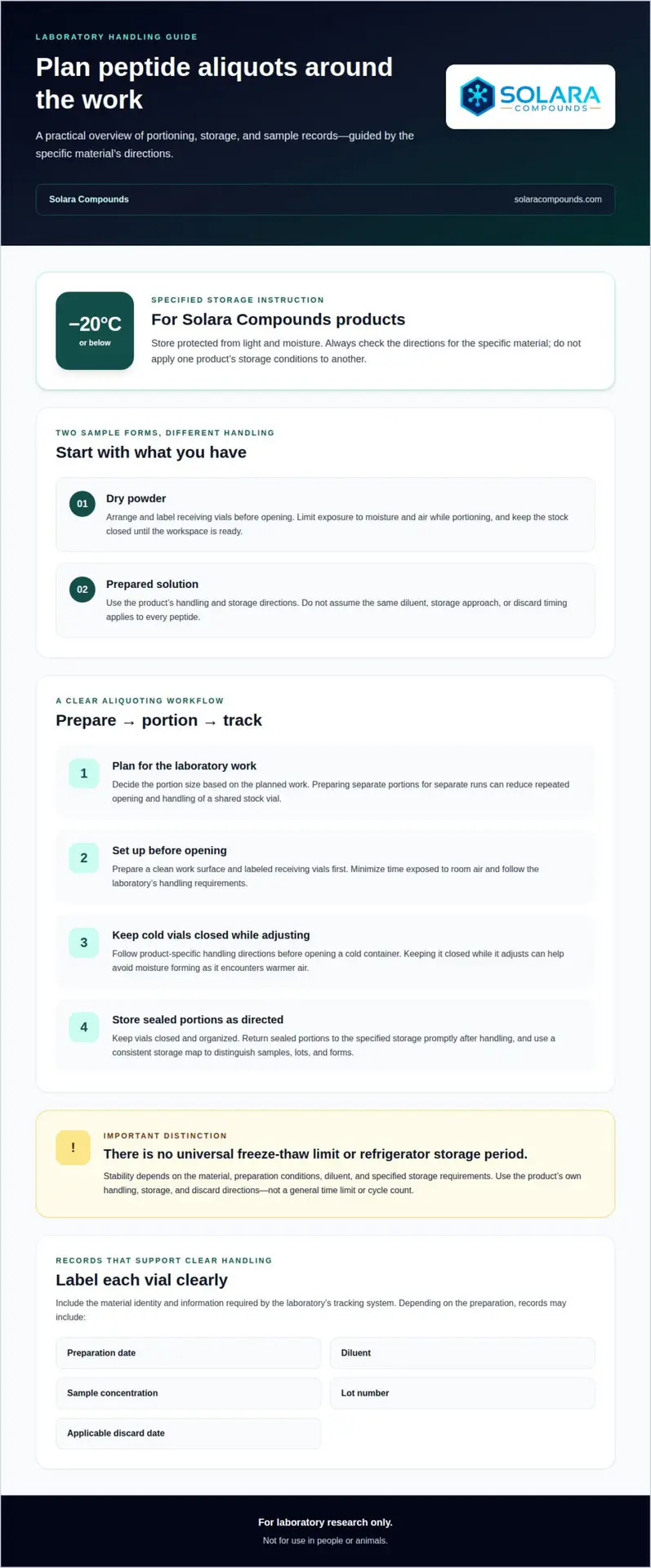
Use the storage temperature and conditions stated for the specific material. For Solara Compounds products, the storage instruction is: “Store at −20°C or below, protected from light and moisture.” Do not substitute a different temperature based on general advice about peptides or apply one product’s storage directions to another material.
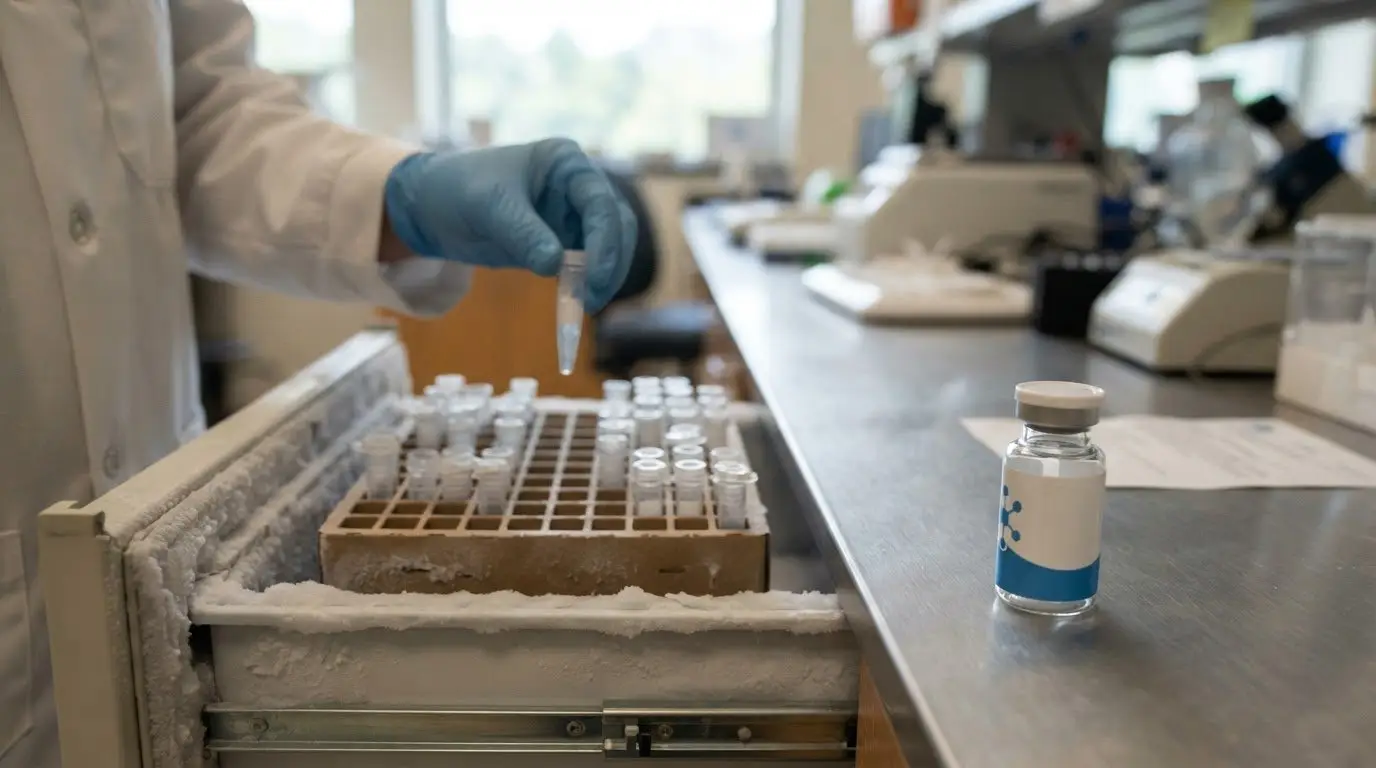
Keep vials closed and organized so the intended aliquot can be retrieved without opening other samples. Avoid repeatedly opening the stock, and return sealed portions to the specified storage promptly after handling. Use labels and a consistent storage map to distinguish samples, lots, and sample forms. Dry handling and a steady storage routine help keep sample records clear and reduce unnecessary exposure.
Following product-specific reconstitution directions
For laboratory research, use the product’s directions and the laboratory’s approved procedures when preparing a solution. Instructions for one peptide are not automatically suitable for another. This guidance is for laboratory research only and does not provide instructions for human or animal use.
Choose Compatible Solvents and Buffers
Use a diluent or buffer only when the product-specific directions identify it as appropriate. Peptides differ in their chemical properties, so a liquid used with one sample may not be suitable for another. Check the stated composition and conditions before preparing a solution, and do not substitute a liquid based on another peptide’s directions.
Compatibility matters because the chosen liquid can affect whether a material dissolves under the stated conditions and whether the resulting sample fits the planned laboratory work. Where the directions specify a method of adding liquid, follow that method rather than improvising.
Prepare Before Reconstitution
Read the complete product directions before opening the vial. Identify the specified diluent, volume, handling method, and storage conditions, then prepare the labeled receiving containers and workspace. Having the required materials ready limits delays while the sample is exposed.
Keep unreconstituted material under its specified storage conditions until the workspace is ready. Dry powder and a prepared solution can have different handling requirements. Do not assume that two materials share the same reconstitution needs just because both are supplied as lyophilized powder.
Aliquot Reconstituted Peptide Solutions
Divide a solution only when the product directions and laboratory plan support doing so. Separate, clearly labeled portions can reduce repeated opening of one shared vial. The storage and handling directions for the material should determine whether a solution is suitable for aliquoting and how it should be stored afterward.
Prepare only the amount and form needed for the planned laboratory work, and follow the product’s storage and discard directions. Use only the mixing method specified for the material. Avoid adding unlisted steps or assuming that a method used for another peptide is interchangeable.
Label and Store Reconstituted Vials
Label each vial with the material’s identity and the information required by the laboratory’s tracking system. Depending on the preparation, that record may include the preparation date, diluent, sample concentration, lot number, and applicable discard date. Keep labels readable under the required storage conditions.
Store the prepared sample according to its product-specific directions. A general refrigeration period is not a reliable substitute: stability can vary with the material, diluent, and preparation conditions. Do not apply a generic discard window to every solution.
Match Storage to the Diluent
Do not infer a storage period from the diluent alone. A time limit described for one peptide and preparation does not establish a limit for another material or liquid. Follow the product’s instructions for the relevant sample and record the diluent and storage condition so the sample history remains clear.
Return containers to their specified storage conditions promptly after laboratory handling. Keep labels legible and use the product-specific discard directions. If the information for a material does not address a step needed for the planned work, do not fill the gap by transferring an instruction from a different peptide.
Lyophilized peptide reconstitution
Lyophilized peptides are supplied as dry powders, but the storage and handling requirements still depend on the product. Check the applicable directions before preparing a solution, then protect any remaining material from conditions identified as unsuitable for that product.
- Prepare the workspace and materials before opening the vial. Clean the work surface, arrange the labeled containers, and check the product directions for the specified diluent, volume, and handling method. Do not substitute instructions from another peptide. A planned setup limits delays and unnecessary exposure while the powder is open.
- Follow the product’s directions for handling a vial taken from storage. If the directions call for allowing a cold vial to adjust before opening, keep it closed during that period. This can help limit moisture forming on the powder when a cold container meets warmer air. Avoid extended exposure to conditions outside the stated storage requirements.
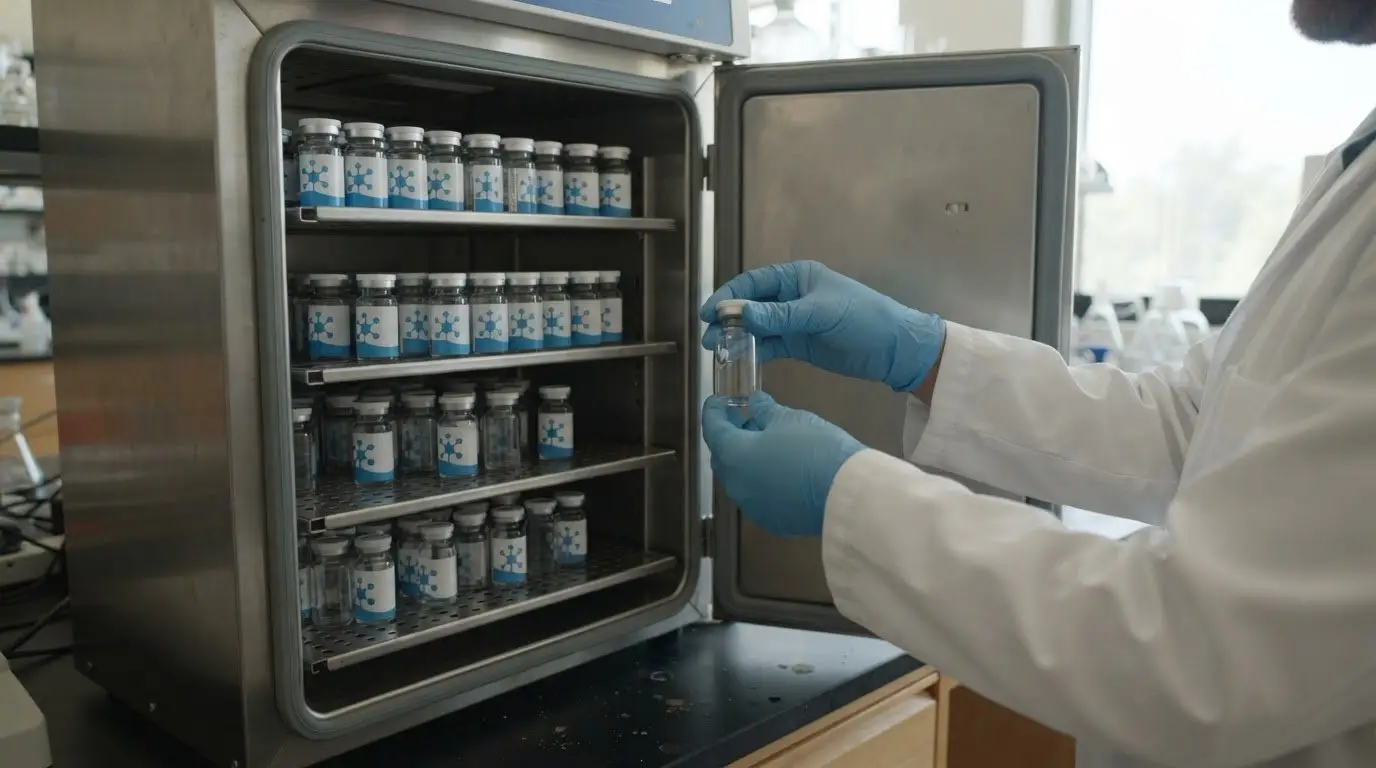
- Protect the vial from the conditions identified in its storage directions. For Solara Compounds products, “Store at −20°C or below, protected from light and moisture.” Keep the container closed when it is not being handled. Do not add storage equipment or assumptions that conflict with the product’s stated requirements.
- Use the temperature stated for the particular material. Solara Compounds products have a specified storage requirement of −20°C or below, protected from light and moisture. General temperature ranges for other materials should not be applied in place of this product-specific instruction. Record the sample form and storage condition in the laboratory’s records.
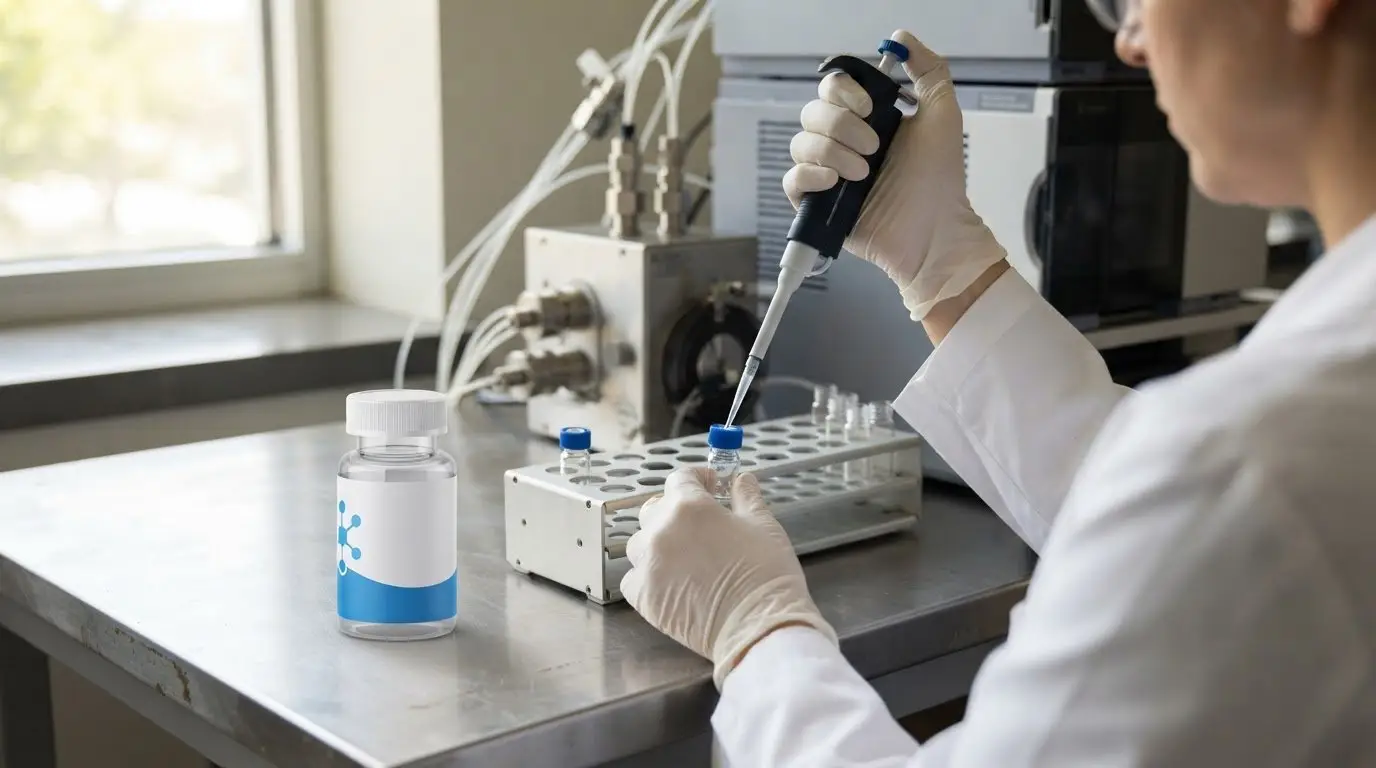
- Prepare a solution only when the laboratory work requires one and the product directions support the planned method. Use the stated diluent, volume, and handling instructions. Do not infer solution storage conditions from dry-powder storage directions, and do not apply another peptide’s preparation method to the sample.
- Keep the vial closed in its original packaging when it is not being handled, and return it to the specified storage conditions after use. Record the material identity, lot number, and relevant handling details so later work can be traced to the correct batch. Solara Compounds products are for laboratory research only, not for human or animal studies, clinical trials, or diagnostic applications.
Aliquoting dry peptides into single-use vials
For dry peptide powder, select clean, tightly closing containers that are appropriate for the material and the laboratory’s handling requirements. Low-binding tubes are more relevant to some solution methods; they are not automatically the right container for dry powder. Follow product directions when selecting containers and planning storage.
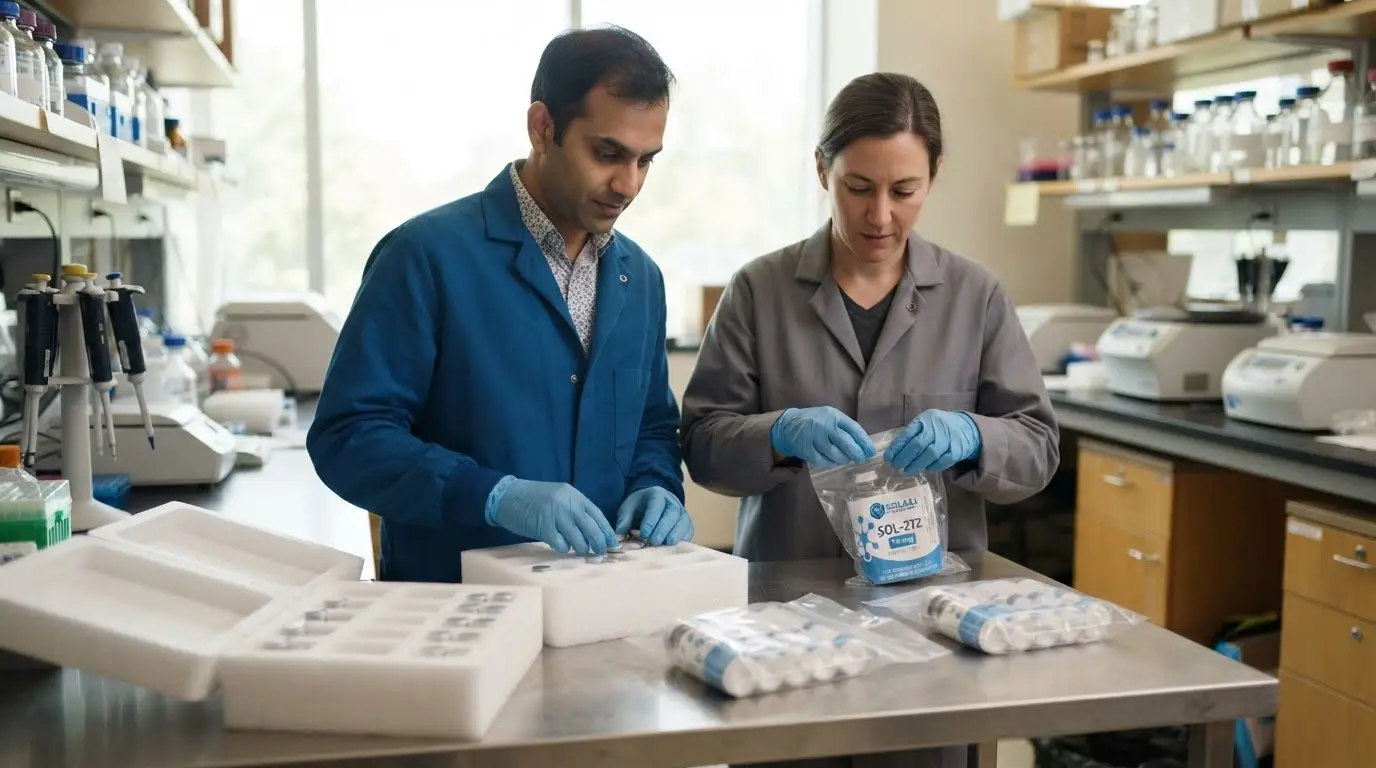
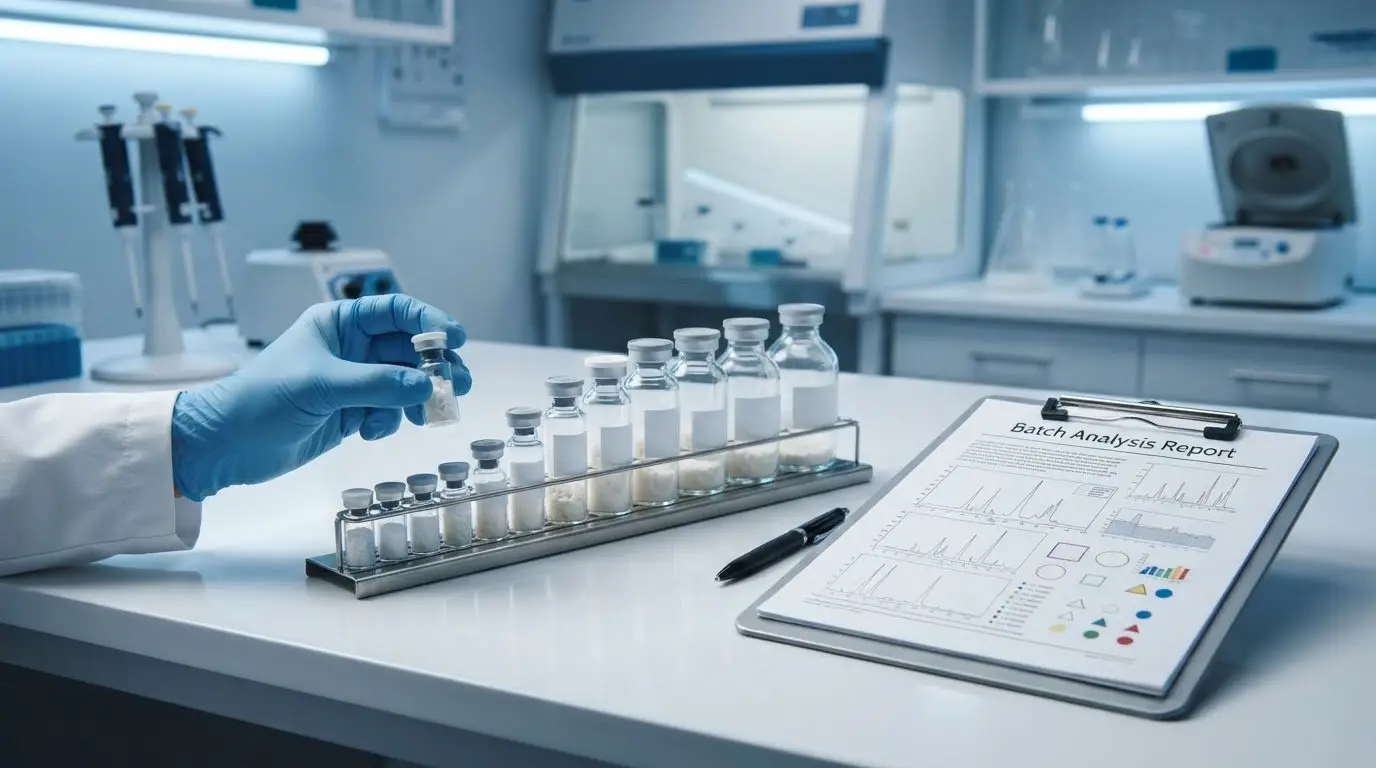
- Plan each portion around a defined laboratory task before opening the stock vial. Write down the amount needed for each planned use, then prepare enough labeled receiving containers. Single-use portions can reduce repeated opening of the stock and help avoid returning unused powder to the main container.
- Set up a dry, organized workspace with receiving vials, labels, and the required weighing equipment ready. Keep the stock vial closed until the setup is complete. Dry powders may be sensitive to exposure conditions, so minimize the time the material is open and avoid unnecessary transfers.
- Open the stock vial only after the workspace is ready, then measure the planned portion using the laboratory’s established method. Limit pauses with the vial open and minimize transfers between containers. A consistent sequence helps researchers repeat the same handling approach across comparable samples.
- Transfer each measured portion directly into its own clean container. For example, prepare separate vials for separate experimental runs instead of repeatedly opening one shared container. Avoid combining leftovers from different portions. Keep the process consistent and record any deviation from the planned handling sequence.
- Close each vial promptly after filling, then label it with the material identity and portion details. Include the lot number and preparation date where required by the laboratory’s tracking system. Clear labels help identify samples without opening containers to inspect their contents.
- Store sealed vials under the conditions specified for the material. For Solara Compounds products, the instruction is “Store at −20°C or below, protected from light and moisture.” Keep the storage area organized so researchers can retrieve the intended aliquot without handling unrelated samples.
- Choose low-binding tubes only when the sample form and laboratory method call for them. For dry powder, prioritize an appropriate clean container that closes securely. For a solution, use a compatible container when the product directions and laboratory method support it. Keep portions separate when that fits the experimental plan.
- Minimize handling of each portion before the planned laboratory work. Single-use vials can be useful because each opening exposes only the sample needed for that task. Keep remaining vials closed and stored as directed. Record the material’s identity, lot number, and storage conditions to make the sample history traceable.
What solvents and buffers are compatible with different peptides?
Match a solvent or buffer to the peptide using its product-specific directions and the requirements of the planned laboratory method. A peptide’s charge and the solution’s pH can matter, but those general properties do not identify a complete preparation method for an individual material.
- Start with the product’s reconstitution instructions. Identify the named diluent, volume, and any buffer requirements before preparing a solution. These details are specific to the material and intended laboratory work. Do not substitute a solvent because it worked with another sample. When the directions specify a particular liquid, follow them rather than relying on a general rule about peptide charge.
- Use peptide charge as a compatibility consideration, not as a complete formulation recipe. Acidic peptides are generally associated with basic buffers, while basic peptides are generally associated with acidic buffers. This describes how charge and the surrounding solution can relate. It does not establish the exact buffer, concentration, or preparation method for an individual peptide.
- Consider pH only within the product’s stated requirements. General pH ranges are not interchangeable directions for every peptide and do not replace the stated diluent or preparation method. Do not select a pH or buffer for a particular material solely from a broad description of its charge.
- Separate dissolution requirements from storage requirements. A buffer that is appropriate for preparation does not automatically establish how the finished solution should be stored. Follow the product’s directions for the solvent, buffer, storage conditions, and any discard instructions. Keep those details with the sample record.
- Use the handling method stated in the product directions. If the instructions specify how to add the liquid or mix the sample, follow that method rather than introducing additional steps. The named liquid and conditions are the key compatibility information; general handling habits should not override them.
- Record the diluent and buffer with the sample details. For example, document the buffer conditions specified for the preparation alongside the material identity, lot number, and preparation information. This makes repeated laboratory preparations easier to compare and helps distinguish a change in solution conditions from a change in the experimental setup.
- Do not infer compatibility from the words “acidic” or “basic” alone. A peptide’s charge can be one consideration, but the product directions determine the applicable diluent and handling requirements. For laboratory research only, use product-specific information to decide whether a solvent or buffer fits the planned work.
Solara Compounds
Solara Compounds supplies research peptides and selected research compounds with batch-specific Certificates of Analysis (COAs) and lot-number traceability. Researchers can review the documentation for a batch before selecting material for laboratory work. Third-party testing is performed by Kovera Labs, and batch COAs are available through the COA verification page.
Researchers in Boston, San Diego, San Francisco, New York, Houston, Miami, Los Angeles, Austin, Raleigh, Seattle, Chicago, Philadelphia, Baltimore, Dallas, Phoenix, Tampa, Atlanta, and Denver can use the online catalog for laboratory research materials. Solara Compounds is a U.S. supplier, and its products are for laboratory research only. They are intended solely for laboratory research and development purposes in controlled in-vitro or ex-vivo settings, and are not intended for human use, veterinary use, or any clinical, diagnostic, therapeutic, or personal application.
For Solara Compounds products, store material at −20°C or below, protected from light and moisture. Products have not been evaluated by the FDA for safety or efficacy. All products are for research use only and must not be used in any human or animal studies, clinical trials, or diagnostic applications. The purchaser assumes full responsibility for ensuring compliance with all applicable federal, state, and local laws and regulations.
For questions about laboratory research materials, contact Solara Compounds.
Build a repeatable sample-handling routine
Make aliquoting part of experimental planning rather than an improvised step at the bench. A written record of material identity, lot number, sample form, preparation details, and storage conditions gives researchers a clearer handling history to review alongside laboratory observations. Keep the product-specific directions with the record so each step remains tied to the material being used.
Knowing how to properly aliquot peptides means making deliberate choices about portion size, containers, labels, and storage. A repeatable approach can reduce unnecessary opening and help researchers compare handling across similar runs. Keep research materials restricted to laboratory use, not use in people or animals.
For materials intended for laboratory research, see the current Solara Compounds research catalog. All products are for Research Use Only (RUO), intended solely for laboratory research and not for human or animal consumption, and are not a drug, medicine, or dietary supplement.
Frequently Asked Questions
How long does reconstituted peptide last in the fridge?
There is no universal refrigerator storage period for reconstituted peptides. Stability depends on the material, diluent, preparation conditions, and storage requirements. Follow the product-specific storage and discard directions rather than applying a general time limit. Solara Compounds materials are for laboratory research only, not for use in people or animals.
How should lyophilized peptides be reconstituted before aliquoting?
Follow the product-specific directions for the diluent, volume, and handling method before dividing a solution. Prepare a clean work area and the required containers first. Do not assume that two lyophilized peptides share the same preparation requirements, even if their packaging looks similar. This is laboratory handling information only, not guidance for human or animal use.
How should peptide stock concentration and aliquot volume be calculated?
For a laboratory sample, divide the peptide mass by the total liquid volume to find the stock concentration, then divide the desired sample amount by that concentration to find the aliquot volume. For example, 5 mg in 2 mL equals 2.5 mg/mL. At that concentration, a 0.1 mL laboratory aliquot contains 0.25 mg, or 250 mcg. These are sample-preparation calculations, not instructions for human or animal use.
How can peptide aliquots be protected from light, moisture, and oxidation?
Follow the product’s storage directions, keep containers closed when they are not being handled, and limit unnecessary exposure during portioning. For Solara Compounds products, store at −20°C or below, protected from light and moisture. Keep labels legible and use a consistent system to retrieve the intended vial without opening other samples. The applicable product directions should guide any additional handling steps.
What temperatures should peptide aliquots be stored at?
Use the temperature specified for the particular material and sample form. For Solara Compounds products, store at −20°C or below, protected from light and moisture. Do not transfer storage directions from a dry material to a prepared solution, or from one peptide to another. Label the sample form and follow the relevant product-specific instructions.
How long do peptide solutions remain stable under different storage conditions?
Stability depends on the material, diluent, preparation conditions, and storage. Do not use a general time limit for every solution. Follow the product-specific storage and discard directions for the laboratory work, and record the sample’s preparation and storage details.
How should peptide aliquots be labeled and documented?
Identify each vial with the material name and sample form. Record the lot number and, where relevant to the laboratory’s system, the preparation date, diluent, concentration, storage condition, and discard date. Keep labels readable under storage conditions, and note handling changes that could affect comparisons between laboratory runs. Batch-specific COAs and lot information support traceability to the source material.