Research Articles
Peptide Stability During Shipping: How Light and Storage Affect Peptides


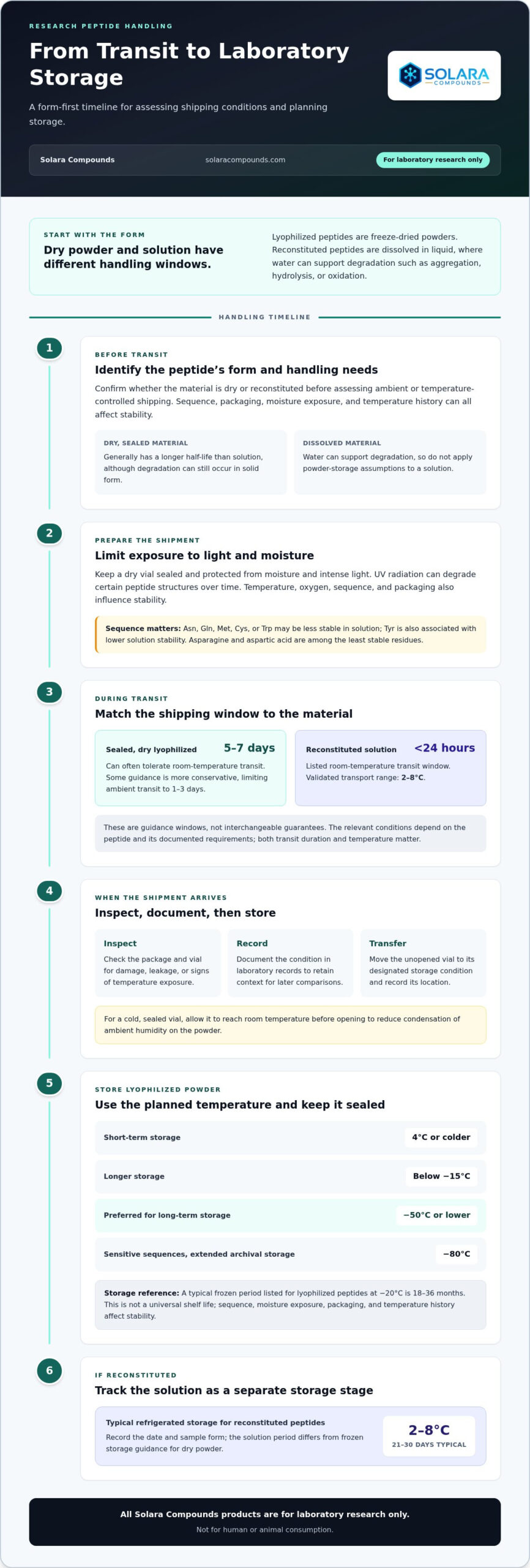
Light can damage some peptide structures, but it’s not the only factor in peptide stability during shipping. Sealed, dry lyophilized peptides can often tolerate room-temperature transit for 5 to 7 days; reconstituted peptides have a listed room-temperature transit window of less than 24 hours, with validated transport at 2 to 8°C. The peptide’s form matters.
Light exposure is one factor to consider: UV radiation can degrade certain peptide structures over time, so protect samples from intense light. Temperature, moisture, oxygen, sequence, and packaging also affect stability, and their impact differs between dry powder and solution.
This guide explains how light exposure and common degradation pathways affect research peptides, why lyophilized and reconstituted forms behave differently, and how packaging can limit exposure to light and moisture during peptide stability during shipping. It also covers what to consider when a research shipment arrives. All Solara Compounds products are for Research Use Only (RUO), intended solely for laboratory research and not for human or animal consumption.
Key Takeaways
- Learn why dry, sealed peptide material and prepared solutions require different handling considerations.
- Recognize how sequence-specific chemistry can shape a peptide’s susceptibility to degradation.
- Understand what protective packaging can help limit during transit, and why each material has a distinct role.
- Use the article’s storage and transit guidance to assess a shipment’s handling needs and plan laboratory storage.
What is the difference in stability between lyophilized and reconstituted peptides?
Lyophilized peptides are dry powders produced by freeze-drying; reconstituted peptides have been dissolved in liquid. This difference affects how temperature and other conditions matter before, during, and after shipment. In aqueous solutions, water can support degradation through aggregation, hydrolysis, or oxidation. Dry peptides generally have a longer half-life, although degradation can still occur in solid form.
For transit, sealed, dry lyophilized peptides can often tolerate room temperature for 5 to 7 days. Some guidance takes a more conservative approach and limits ambient transit to 1 to 3 days. These figures are not interchangeable guarantees: sequence, packaging, moisture exposure, and temperature history affect the outcome. Room-temperature shipping is therefore most appropriate for dry, sealed material when the peptide’s handling guidance supports it.
Reconstituted material is more temperature-sensitive. Its listed room-temperature transit window is less than 24 hours; the recommended validated transport range is 2 to 8°C. A temperature-controlled shipment helps limit exposure to warmer conditions, but the relevant range depends on the peptide and its documented requirements. During transit, both duration and temperature matter: a brief excursion and prolonged warmth do not represent the same exposure.
Sequence also matters. Peptides containing Asn, Gln, Met, Cys, or Trp may be shipped at room temperature in lyophilized form, yet these residues can be less stable in solution. Tyr is also associated with lower solution stability. Asparagine and aspartic acid are among the least stable residues, and higher temperatures are associated with protein instability. Amino acid composition helps explain why two peptides in the same shipment may respond differently.
Before shipment, keep the dry vial sealed and protected from moisture and intense light. During transit, identify whether the peptide is dry or dissolved before selecting ambient or temperature-controlled handling. After delivery, inspect the packaging for damage or signs of temperature exposure, then follow the compound’s storage guidance. Let a cold, sealed vial reach room temperature before opening to reduce condensation of ambient humidity on the powder.
For a product-specific example of material details used in laboratory purchasing, review the research peptide listing. This comparison framework clarifies why form and temperature history belong in any assessment of peptide stability during shipping.
Lyophilized powder versus reconstituted solution
Lyophilized powder is freeze-dried material, while a reconstituted peptide is dissolved in liquid. Their different physical states influence storage choices and how researchers plan sample use across a study.
Storage stability of lyophilized peptides
Storage stability describes how well a lyophilized peptide retains its properties under defined conditions. Dry form often has a longer half-life than solution, but the molecule can still degrade in solid form. This distinction matters when selecting storage conditions and planning for comparable material across experimental runs.
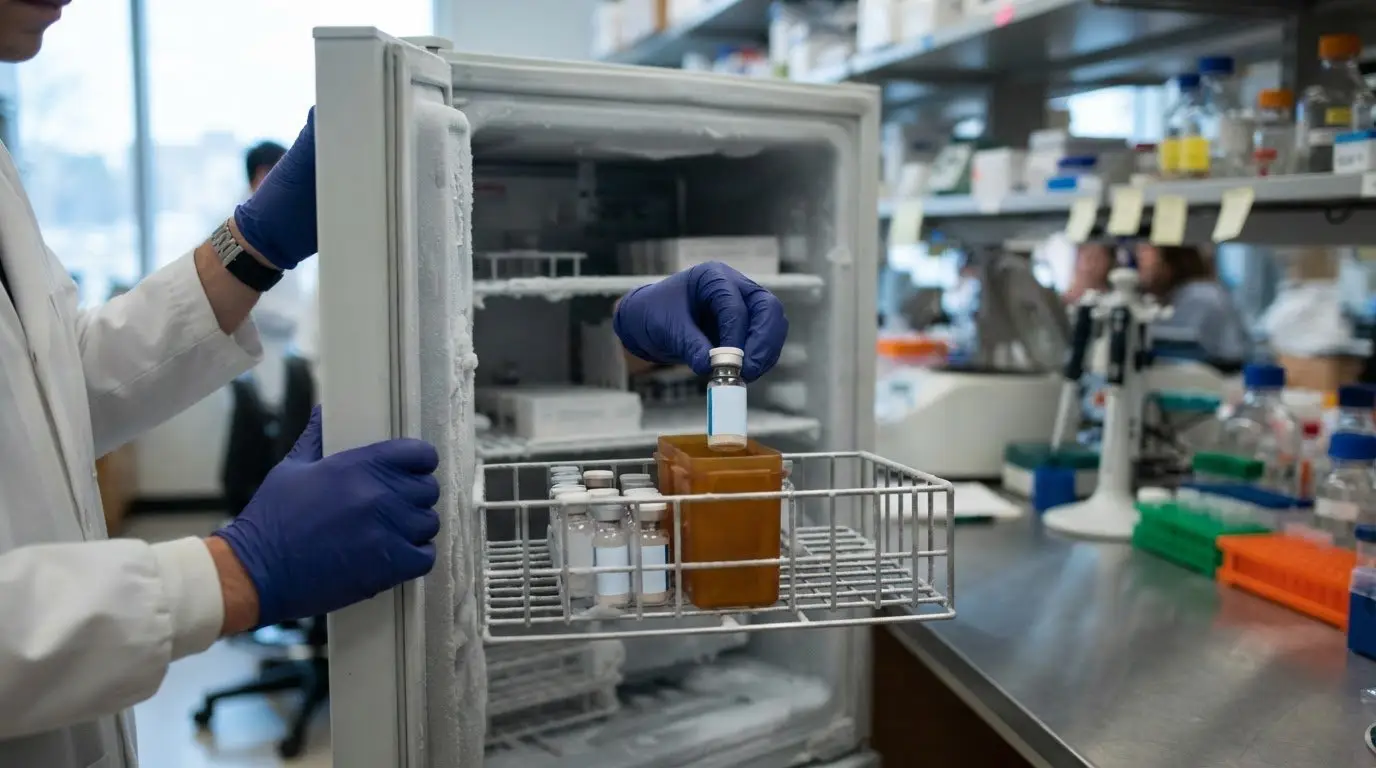
For short-term storage, lyophilized material may be kept at 4°C or colder, depending on experimental needs. Some peptides containing Asn, Gln, Met, Cys, or Trp may be stored at 4°C for short-term use. For longer storage, keep the powder in a tightly closed container below −15°C; −50°C or lower is preferred for long-term storage. Sensitive sequences may be kept at -80°C for extended archival storage.
A typical frozen period listed for lyophilized peptides at -20°C is 18 to 36 months. Treat that as a storage reference, not a universal shelf life. Amino acid sequence, moisture exposure, packaging, and temperature history influence stability. For a study with multiple experimental runs, selecting one storage condition and applying it consistently helps researchers compare samples under a defined handling history.
Reconstituting the powder changes the storage context because the peptide is now in solution. Reconstituted peptides are typically refrigerated at 2 to 8°C for near-term use. A typical refrigerated period listed for these solutions is 21 to 30 days. That period differs from the frozen storage reference for dry powder, so researchers should record the date and form of each sample rather than applying powder-storage assumptions to a solution.
Receiving lyophilized peptide powders
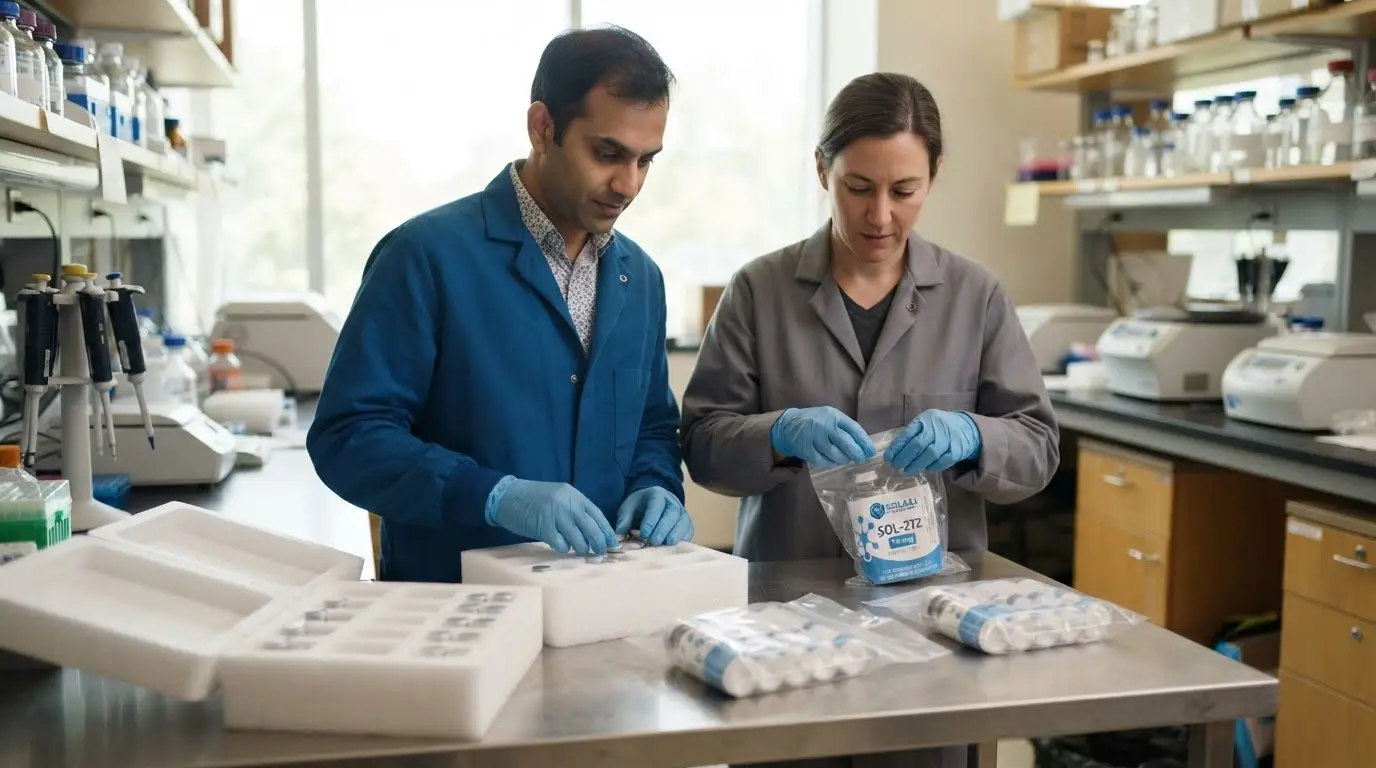
When receiving lyophilized powder, document its condition and assign it to the planned storage location. Inspect the shipping package and vial for damage, leakage, or signs of temperature exposure, then record the condition in the sample’s laboratory records. This gives researchers context if results later differ between batches or experimental runs.
After inspection, transfer the unopened vial to its designated storage condition, such as -20°C for frozen storage. Keep the vial sealed until the material is needed, and note its storage location in the sample record. This creates a traceable path from receipt to laboratory use without confusing storage history with the solution-handling period.
Researchers planning laboratory work can review research peptides while determining storage needs for each sample. These materials are for laboratory research only, not medicines or supplements, and not for people or animals.
What are the main degradation pathways to be aware of?
For shipped peptides, review the batch-specific Certificate of Analysis (COA), evidence of third-party testing, and stability information relevant to the peptide’s form and transport conditions. Documentation helps researchers assess chemical identity and purity alongside structural integrity; a COA alone does not prove stability under every shipping condition.
Degradation can change a peptide’s chemical composition or physical structure, affecting its suitability for a planned experiment. The pathway depends partly on its amino acid sequence and whether it is dry or dissolved. For example, peptides containing asparagine or aspartic acid can be more chemically vulnerable, while solution-phase degradation can include hydrolysis, aggregation, and oxidation.
Moisture is a concern for hygroscopic peptides, which absorb water from the surrounding air. Absorbed water can enable unwanted reactions, especially if a vial is opened and left exposed. Light adds another risk: UV radiation can degrade certain peptide structures over time. Opaque or amber containers limit light exposure, while a tight seal helps reduce contact with moisture and oxygen.
Oxidation depends on the residues present. Free cysteine contains a thiol group, a sulfur-containing part of the molecule that can oxidize rapidly above pH 7. For laboratory work involving free cysteine peptides, the supplied guidance calls for carefully degassed acidic buffers. This example shows why buffer selection and oxygen exposure can matter after receipt, not just the shipping container.
Assessment should distinguish chemical identity from structural and functional integrity. A useful evaluation considers identity and purity, structural integrity, biological function, and, where relevant, mass recovery and release behavior. These measures answer different questions: identity checks what material is present, while structural and functional assessments examine whether it retains properties required for the experiment. A room-temperature transit history alone cannot establish these outcomes.
Chemical modifications can influence stability, but that does not mean every modified peptide resists every degradation pathway. Sequence, formulation, and test conditions still matter. Interpret stability results for the specific peptide and conditions studied.
Freezing cycles may alter a peptide’s crystalline structure and reduce potency, making repeated freeze-thaw handling a separate concern from chemical oxidation. For frozen solutions, dividing samples into single-use aliquots before freezing limits each portion to one thaw. Protecting samples from light, moisture, and unnecessary handling supports more consistent comparisons across laboratory experiments.
Stability windows in candidate delivery materials
Packaging design should match the peptide’s physical form and the exposures expected along its route. Each layer has a distinct role in preserving sample condition.
Stability windows during transit
A transit stability window describes the conditions a peptide can tolerate while moving between facilities. It matters because a package must protect the sample throughout handling, not just during storage at either endpoint. Before dispatch, compare the peptide’s documented requirements with the route, packaging, and expected exposure.
Evaluate the complete package as a system. The primary vial contains the material; secondary packaging limits movement and contact; the outer container buffers the sample from the environment. Dry powder and prepared solution place different demands on that system. Sequence sensitivity matters too, since peptides with oxidation-prone residues may need greater protection from air exposure.
Delivery times and shipping strategies
A delivery strategy aligns the shipment’s expected duration with the peptide’s handling requirements. Shorter transit can reduce exposure to fluctuating conditions, but speed alone does not establish that a sample remained within its appropriate range. Route, handling transfers, and package performance all affect the journey.
For a temperature-sensitive solution, plan for controlled transport and packaging that maintains the required conditions. For dry material, focus on keeping the vial sealed and limiting environmental exposure. Select materials for their intended function, then assess whether each layer remains effective through dispatch, transit, and receipt.
Handling peptides after delivery
After arrival, document the package condition and place the sample into its assigned storage workflow. Record visible damage, unusual packaging conditions, and the time the shipment was received. These details can help researchers interpret later experimental variation without assuming that appearance alone establishes chemical integrity.
Keep the handling record with the sample’s lot and experiment notes. If a package is damaged or shipment conditions appear inconsistent with the peptide’s documented requirements, preserve those observations for laboratory review. This creates traceability from receipt to the point the material enters the study.
Shipping requirements for peptides and materials
U.S. requirements depend on how a shipment’s contents are classified and packaged. Peptides, dry ice, and biological materials may involve different shipping considerations, so they should not be treated as one universal category. Classification and transport method determine which requirements apply.
For dry ice or biological materials, identify the contents and packaging needs before preparing the shipment. Do not infer handling rules from the word “peptide” alone; the specific material and shipment configuration matter. Researchers can review research peptides while planning laboratory storage and shipment handling.
How long can common research peptides remain stable during transit?
There is no single transit lifetime that applies to every research peptide. A useful stability window describes a particular peptide in a particular form under defined conditions. Treating a general storage period as a shipping limit can mislead: laboratory storage and commercial transit involve different handling histories, and results for one peptide cannot automatically be applied to another.
Researchers can assess a transit claim by asking what material was evaluated and what outcome counted as stable. A study may track chemical identity, structural integrity, or retained function, and those measures answer different questions. A peptide may retain its expected identity while structural changes affect its performance in an experiment. The endpoint matters as much as the stated duration.
For a planned study, distinguish the time between dispatch and receipt from the time a sample spends in its intended storage condition. These are separate parts of the sample’s history. A stability result for stored material does not establish how it responds to an untested route or handling pattern.
A practical comparison can strengthen interpretation after delivery. Reserve a control sample from the same lot under the laboratory’s planned storage conditions, then compare it with the received material using the study’s established analytical methods. This helps separate variation associated with the shipment from variation already present between samples or experimental runs.
Useful questions for evaluating a stated transit window include:
- Which form was evaluated? Powder and solution results should not be treated as interchangeable.
- What endpoint was measured? Identity, structural integrity, and experimental function represent distinct criteria.
- How closely does the test resemble the actual journey? A result applies most directly when the tested conditions resemble the shipment being assessed.
- Does the information apply to the same material? Sequence and formulation can affect how well a result transfers.
These distinctions turn a broad duration claim into a more useful question: does the available evidence match this sample, its form, and the planned analysis? Keep the reasoning tied to the experimental objective rather than treating one transit duration as a universal guarantee.
For laboratory research only. These materials are not medicines or supplements and are not for people or animals. Researchers can view research peptide options as they plan laboratory work.
Solara Compounds: SOL-3RT Retatrutide 10mg
SOL-3RT Retatrutide 10mg is a research peptide option for laboratory buyers assessing materials and their handling requirements. Solara Compounds provides batch-specific Certificates of Analysis and third-party testing, giving researchers documentation to review alongside storage and transit considerations.
A COA supports batch-level review, while the shipment’s form, packaging, and temperature history remain important when evaluating handling. All Solara Compounds products are for Research Use Only (RUO), intended solely for laboratory research and not for human or animal consumption.
Researchers can review SOL-3RT Retatrutide 10mg and its batch documentation as part of laboratory planning. Visit solaracompounds.com to explore the research catalog.
Build shipping conditions into your next research plan
Make shipment handling part of the experimental record, not an afterthought. A consistent record of the material received and its handling gives researchers useful context when comparing results across runs. This habit supports clearer interpretation without assuming that every peptide responds identically to transit.
For laboratory research only, Solara Compounds offers SOL-3RT Retatrutide 10mg, SOL-2TZ Tirzepatide 10mg, and GHK-Cu 50mg. These research materials are not medicines or supplements and are not for people or animals. Consider the specific material and its documentation when selecting inputs for laboratory work; stability depends on the peptide and the conditions it experiences.
Use this guidance to shape a handling plan that fits your research workflow. Careful attention to peptide stability during shipping makes sample handling a more deliberate part of laboratory practice.
Explore research peptides at Solara Compounds, and take your next laboratory project forward with a considered plan.
Frequently Asked Questions
Why are freeze-thaw cycles discouraged for peptide solutions?
Repeated freezing and thawing can alter a peptide’s crystalline structure and reduce potency. In a laboratory comparison, this can introduce a handling difference between samples intended to be treated alike. Divide a solution into single-use aliquots before freezing so each portion is thawed only once. Keep the aliquot record with the experiment to help distinguish handling differences from changes observed during analysis.
Why should a cold peptide vial be brought to room temperature before opening?
Letting a cold, sealed vial warm before opening reduces condensation of ambient humidity on the powder. Opening a vial straight from cold storage, for example, can expose its contents to moisture in room air. Keep the cap closed while the vial reaches room temperature, then open it when laboratory work is ready to proceed. This helps prevent avoidable moisture exposure during handling.
How should peptides be packaged for shipping to maintain stability?
Use packaging that protects the sealed vial from light, moisture, oxygen, and temperature shifts relevant to the peptide. Each layer has a different role: a sealed vial limits air and humidity exposure, an opaque or amber container blocks harmful light wavelengths, and a desiccant absorbs stray moisture. An inert nitrogen or argon atmosphere can further exclude oxygen and moisture. Match these protections to the peptide’s form and sequence.
What shipping temperature do peptides require: ambient, refrigerated, or frozen?
The appropriate temperature depends on whether the peptide is dry or dissolved and on its sequence-specific handling guidance. Sealed, dry lyophilized peptides can often tolerate room-temperature transit for 5 to 7 days. Reconstituted peptides have a listed room-temperature transit window of less than 24 hours, with validated transport at 2 to 8°C. These are handling references, not interchangeable assurances for every peptide or shipment.
Which packaging materials and cold packs are best for shipping peptides?
No single packaging material or cold pack suits every peptide. For a solution requiring temperature control, choose insulated packaging and cooling materials suited to its validated transport range. A light-blocking outer container and a desiccant address separate risks; neither replaces temperature control. Packaging should also keep the vial sealed and protected from physical damage. The peptide’s form, sequence, and documented handling conditions guide material selection.
How do lyophilized and reconstituted peptides differ in shipping stability?
Lyophilized peptides are dry powders, while reconstituted peptides are dissolved in liquid. The liquid environment can support hydrolysis, oxidation, or aggregation, so solution handling requires closer attention to conditions. Do not automatically apply the same shipment plan to a dry vial and a prepared solution. Assessing peptide stability during shipping starts with identifying the sample’s form and matching transit conditions to its handling guidance.
How do heat, light, moisture, and freeze-thaw cycles affect peptide stability?
Heat is associated with increased protein instability, UV radiation can degrade certain structures, and moisture can initiate unwanted chemical reactions in hygroscopic peptides. Freeze-thaw cycles can alter crystalline structure and reduce potency. These exposures can interact: a vial exposed to moisture and warmth may behave differently from one kept sealed and protected. Record packaging condition and handling events to support interpretation of laboratory results.
What shipping methods and delivery times reduce peptide degradation?
Choose a shipping method that keeps the peptide within its appropriate conditions for the full journey; shorter transit limits exposure time but cannot establish stability by itself. Whether your laboratory is in Boston, San Diego, San Francisco, New York, Houston, Miami, Los Angeles, Austin, Raleigh, Seattle, Chicago, Philadelphia, Baltimore, Dallas, Phoenix, Tampa, Atlanta, or Denver, plan receipt and storage around the material’s documented requirements.