Research Articles
Cryoprotectants for Peptide Storage and Freeze-Thaw Care


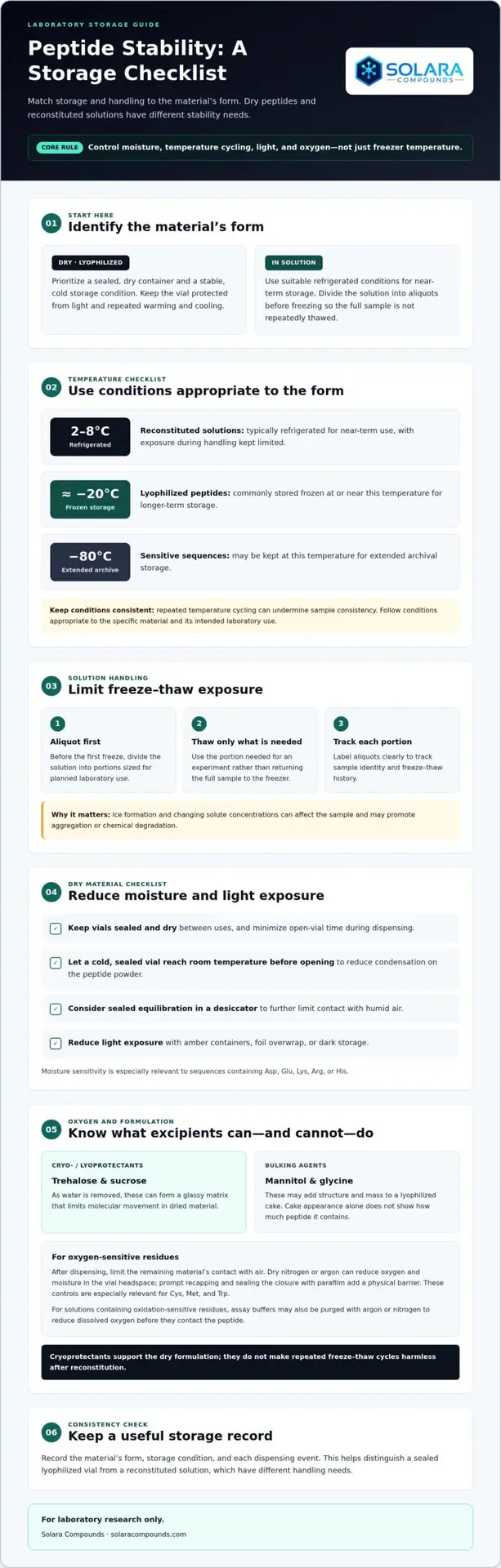
Frozen storage is only part of peptide stability; moisture and repeated freeze-thaw cycles matter too. Cryoprotectants for peptide storage, including trehalose and sucrose, can form a glassy matrix during water removal, helping limit molecular movement and degradation. Lyophilized research peptides are commonly stored sealed and dry at or near -20°C, while reconstituted solutions should be divided into aliquots before freezing to reduce repeated freeze-thaw exposure.
That distinction is easy to miss: a protective excipient may support a lyophilized cake, but it does not replace careful handling or controlled storage. The right approach depends on whether the peptide is dry or in solution, its chemical properties, and its storage conditions.
This guide explains how cryoprotectants work, why freeze-thaw cycling can affect peptide solutions, and how temperature, light, moisture, and oxygen influence stability. It also reviews common physical and chemical degradation pathways to help researchers make more consistent decisions for laboratory research.
Key Takeaways
- Divide reconstituted peptide solutions into single-use aliquots before freezing to limit repeated freeze-thaw exposure.
- Trehalose and sucrose can help stabilize freeze-dried peptides by forming a glassy matrix as water is removed.
- Keep lyophilized vials sealed, dry, and protected from light and temperature cycling; frozen storage is commonly near -20°C.
- Moisture and oxygen can contribute to degradation, especially for sequences containing oxidation-prone or moisture-sensitive residues.
- Ice formation and changes in solute concentration can affect peptide structure, so storage conditions and handling matter in laboratory research only.
Why are freeze-thaw cycles discouraged for peptide solutions?
Each freeze-thaw cycle exposes a peptide solution to changing ice formation and solute concentrations. Researchers can limit repeated exposure by dividing a solution into aliquots before freezing, sized for planned laboratory use.
Cryoprotectants and Lyoprotectants
Cryoprotectants and lyoprotectants are excipients used to protect peptides during freezing or freeze-drying. As water is removed, trehalose and sucrose can form a glassy matrix that limits molecular movement in the dried material. Mannitol and glycine may serve as bulking agents, adding structure and mass to a lyophilized cake. These roles differ, so the cake’s appearance alone cannot show how much peptide it contains.
Lyophilization removes water by freezing a solution and sublimating the ice under vacuum. Formulation matters: mannitol can crystallize and add mechanical strength, while trehalose and sucrose can form an amorphous glass. These ingredients affect the dry formulation, but do not make repeated freeze-thaw cycles harmless after reconstitution. Cryoprotectants for peptide storage are one part of a broader stability strategy.
Effects of Freeze-Thaw Cycling
Freeze-thaw cycling means repeatedly freezing and thawing the same peptide solution. Ice crystals can stress the sample, while freezing concentrates solutes in the liquid that remains. These changing conditions may promote aggregation or chemical degradation, making a repeatedly handled sample less stable than one kept under consistent conditions.
Aliquot the solution before its first freeze. Divide it into portions sized for individual laboratory use, then thaw only the portion needed for an experiment. This avoids returning the entire sample to the freezer after each use and reduces extra handling and open-vial time. Label aliquots clearly so researchers can track sample identity and freeze-thaw history.
Solution pH During Freezing
Solution pH describes how acidic or alkaline a sample is and can influence peptide solubility and stability. As ice forms, solute concentrations change, so the chemical environment in the remaining liquid may differ from the starting solution. A pH measurement at room temperature may not represent every condition experienced during freezing.
Solvent choice, pH, and ionic environment should be considered together for a specific peptide. Avoid assuming that one buffer condition suits every sequence. For example, if a peptide becomes cloudy or aggregates after freezing, compare the starting formulation and handling history before attributing the change to temperature alone. A peptide’s identity also matters; the KPV peptide research listing is one example of a specific material for laboratory research only.
Temperature, light, moisture, and oxygen control
Storage conditions affect lyophilized peptides and reconstituted solutions differently. For dry material, prioritize a sealed, dry container and stable temperature. For solutions, use suitable refrigerated conditions for near-term storage and limit exposure during handling. Light, moisture, and oxygen create separate degradation pressures, so controlling one factor does not replace managing the others.
For near-term use, reconstituted peptide solutions are typically refrigerated at 2-8°C. Lyophilized peptides are commonly stored frozen at or near -20°C, with sensitive sequences sometimes kept at -80°C for extended archival storage. Temperature cycling can undermine consistency, so keep dry vials protected from repeated warming and cooling. Follow storage conditions appropriate to the specific material and its intended laboratory use.
Moisture can enter whenever a vial is opened. Let a cold, sealed vial reach room temperature before opening to reduce condensation on the peptide powder. Equilibrating it while sealed in a desiccator can further limit contact with humid air. This is particularly relevant to peptides containing Asp, Glu, Lys, Arg, or His, which can absorb moisture from the atmosphere.
- Keep lyophilized vials sealed and dry between uses.
- Minimize open-vial time during dispensing.
- Use amber containers, foil overwrap, or dark storage to reduce light exposure.
After dispensing, limit the remaining material’s contact with air. A dry nitrogen or argon purge can reduce oxygen and moisture in the vial headspace; recapping promptly and sealing the closure with parafilm adds a physical barrier. Store the container under dry, frozen conditions, commonly at -20°C. These controls are especially relevant for Cys, Met, and Trp residues, which are prone to oxidation.
For solutions containing oxidation-sensitive residues, assay buffers may also be purged with argon or nitrogen to reduce dissolved oxygen before they contact the peptide. An inert-gas headspace and a desiccant can help protect lyophilized material, but cannot correct poor sealing or repeated temperature changes. Amber glass or foil helps limit light-driven degradation, particularly when vials are exposed to laboratory lighting.
Keep storage records useful by noting the material’s form, storage condition, and each dispensing event. A log can distinguish a sealed lyophilized vial from a reconstituted solution, which have different handling needs. For researchers sourcing laboratory materials, the research peptide catalog is a starting point for aligning material selection with a consistent storage workflow.
Frozen storage of lyophilized peptides
Lyophilized research peptides are commonly kept frozen at or near -20°C for longer-term storage. Sensitive sequences may be held at -80°C for extended archival storage. The purpose is to preserve the dry material under controlled conditions, not to treat every peptide as equally stable. Sequence sensitivity, moisture exposure, and temperature cycling all affect how well the stored sample retains its properties.
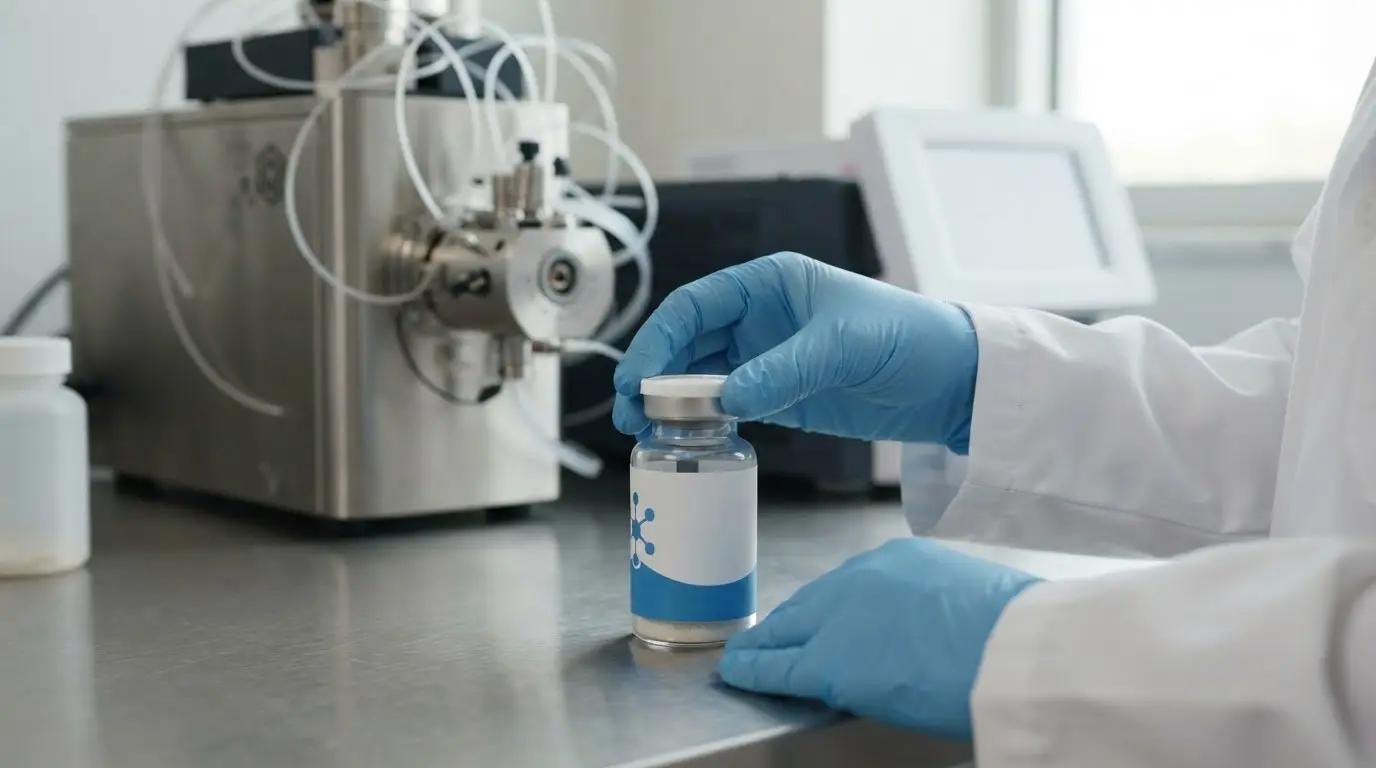
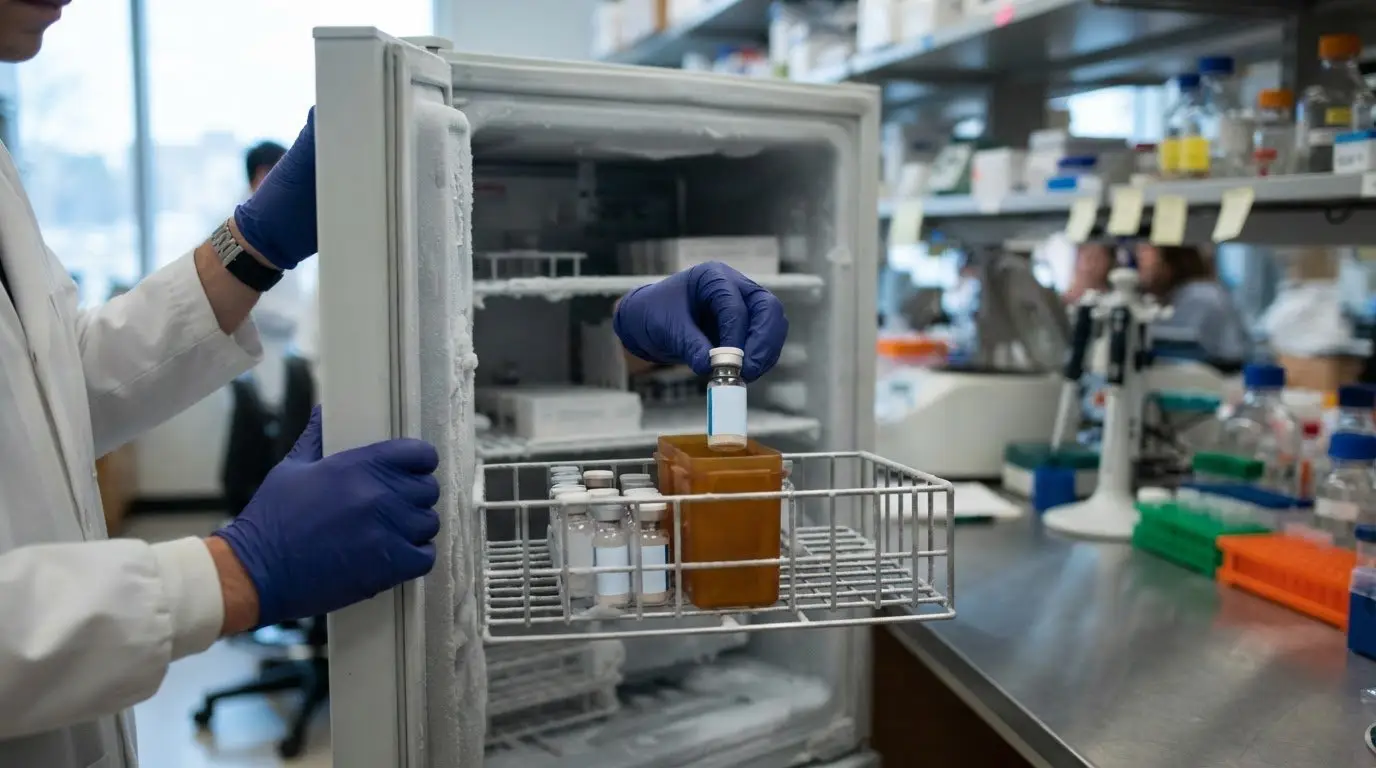
Keep the vial sealed and dry in the freezer. Before opening a cold vial, allow it to reach room temperature while still sealed to reduce condensation on the powder. Opening a vial straight from frozen storage can expose its contents to moisture in the surrounding air. For repeatable experiments, use the same equilibration and handling procedure each time.
Temperature stability matters as much as the freezer setting. Repeated warming and cooling expose a vial to changing conditions, while moisture absorbed by a lyophilized cake can allow molecular movement and degradation to resume, even in cold storage. Keep vials in a protected, dry environment and avoid unnecessary moves between storage locations. A consistent freezer position and clear records help track storage conditions across experiments.
For an experimental archive, distinguish unopened vials from containers that have been accessed. Label each vial with the peptide identity and relevant sample details, then record when it leaves frozen storage and when it returns. Remove only the vial needed for planned work. This limits handling of the remaining archive and helps researchers separate storage history from differences observed in experimental results.
- Use -20°C as a common frozen-storage condition for lyophilized peptides.
- Reserve -80°C storage for extended archiving of sensitive sequences.
- Keep each vial sealed, dry, and protected from temperature cycling.
- Allow cold vials to reach room temperature before opening.
Lyophilized peptides may remain stable for extended periods under recommended storage conditions, but stability varies by sequence. Cys, Met, and Trp residues can increase oxidation sensitivity, while moisture-sensitive sequences need particular care during access. Consider a stored sample’s performance alongside its sequence and handling record, rather than inferring stability from freezer temperature alone.
When removing a vial for an experimental session, keep exposure brief and return the remaining sealed material to controlled frozen storage. Avoid opening it in humid conditions, where moisture can collect on the dry cake. A repeatable routine, from freezer removal through resealing, supports more consistent comparisons between archived material and later experiments.
Long-term peptide storage
For long-term storage, lyophilized material generally offers a more stable starting point than peptide in solution. Solutions are typically kept refrigerated at 2-8°C for near-term use, and should not be stored for more than a few days. For maximum stability, peptide solutions should be frozen and kept frozen. The suitable approach depends on the peptide sequence and the intended experimental schedule.
Some residues are associated with reduced stability in solution. Cys, Met, and Trp can be prone to oxidation; Asp, Gln, and N-terminal Glu also warrant attention. For example, a peptide containing Met may call for closer oxygen control than a sequence without that residue. Sequence composition, solvent, pH, and ionic environment all influence solubility and stability, so consider storage conditions as a connected set rather than isolated choices.
Lyophilization can support longer-term storage by removing water from a frozen solution through sublimation under vacuum. If excess solution remains, re-lyophilization may help maintain peptide stability. Formulations are not interchangeable: solvent selection and the peptide’s chemical properties influence how well it dissolves and remains stable after reconstitution.
Formulation additives also affect dry material. Trehalose and sucrose can form a glassy matrix during water removal, limiting molecular movement. Mannitol can crystallize and add mechanical strength to a lyophilized cake. Glycine and mannitol may also act as bulking agents, providing visible mass and structure. Their presence means the total cake weight may not equal the peptide mass, an important distinction when calculating experimental concentrations.
Protected amino acid derivatives have different storage needs from peptide solutions. Boc- or Fmoc-protected amino acid derivatives are recommended for long-term storage at 5°C in tightly sealed containers. That specific condition applies to those derivatives, not automatically to every finished peptide. Identify the material form first, then align temperature and packaging with that form.
- Keep lyophilized peptide sealed, dry, and protected from temperature cycling.
- Use refrigerated 2-8°C conditions for near-term storage of solutions.
- Keep frozen solutions frozen when maximum stability is required.
- Consider sequence residues, solvent, pH, and ionic conditions when evaluating stability.
Record the peptide identity, physical form, storage conditions, and reconstitution date in laboratory records. For example, noting that a sample contains Trp and is stored in solution provides useful context when comparing later experimental observations. Clear records also distinguish a peptide solution from a Boc- or Fmoc-protected derivative, which may have different storage requirements.
Physical degradation pathways
Freezing and drying change a peptide’s physical environment, not just its temperature. Ice crystals may stress peptide molecules, while solutes become concentrated in the liquid that remains unfrozen. During drying, mechanical stress and changing concentrations can contribute to aggregation, partial unfolding, or chemical degradation. These effects may reduce consistency across laboratory experiments.
Aggregation occurs when peptide molecules associate into larger assemblies rather than remaining dispersed. A sample may become cloudy or show reduced solubility, though appearance alone cannot identify the cause. For example, ice formation can concentrate solutes around a peptide, increasing interactions between molecules. Subsequent drying adds another potential stress, so both the process and formulation matter.
Hydrophobic or aggregation-prone peptides may require a small fraction of a co-solvent to form a clear solution. Hydrophobic sequences interact poorly with water. A co-solvent changes the liquid environment and may support dissolution, but the choice depends on the peptide’s properties. Consider solubility alongside pH and ionic conditions when assessing a formulation, rather than assuming water works equally well for every sequence.
Container choice can affect how much peptide is available for an experiment. Polypropylene vials may adsorb hydrophobic peptides onto their surfaces. This loss can matter in dilute samples, where a small amount adhering to the vial represents a larger share of the total peptide. For comparisons involving dilute solutions, use consistent containers and handling to limit variation in surface-related losses.
- Watch for changes in clarity or solubility after freezing or drying.
- Consider ice formation, concentration changes, and drying stress together.
- Assess a suitable co-solvent when hydrophobic material does not dissolve clearly.
- Account for possible adsorption when storing dilute, hydrophobic samples in polypropylene.
A clear vial does not prove that a peptide is unchanged, and a visible cake does not establish its peptide content. Bulking agents such as mannitol or glycine add to the dry material’s mass, while chromatographic purity describes relative peptide-related peaks rather than total vial composition. For concentration calculations, distinguish peptide mass from other vial contents and consider mass-balance information where available.
Good experimental comparisons depend on controlling these physical variables, including formulation, container material, and the freeze-drying process. For laboratory research only, browse research peptides for laboratory use as part of planning a consistent sample workflow.
Solara Compounds: SOL-3RT Retatrutide 10mg
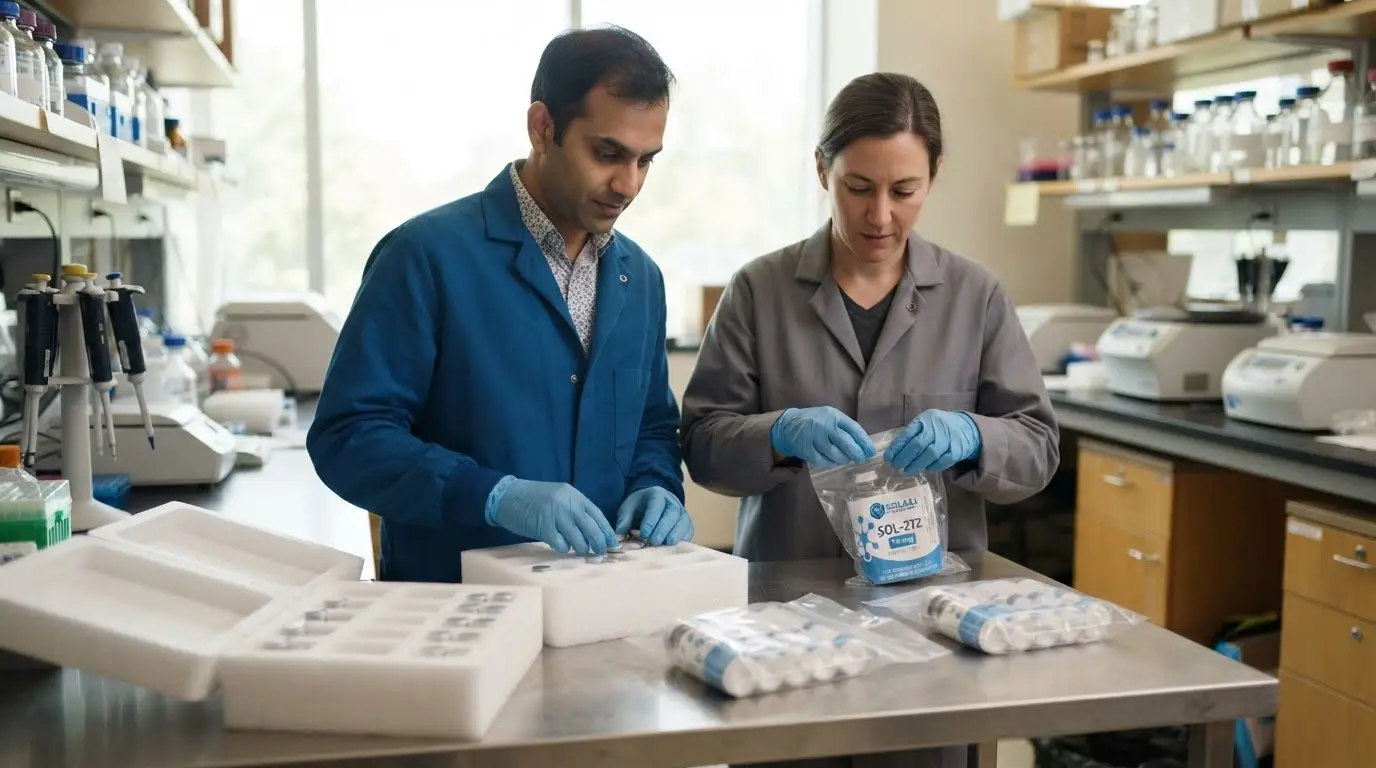
SOL-3RT Retatrutide 10mg is one option for researchers sourcing peptide material for laboratory work. Careful storage remains essential after sourcing, since handling conditions can affect sample consistency and experimental records.
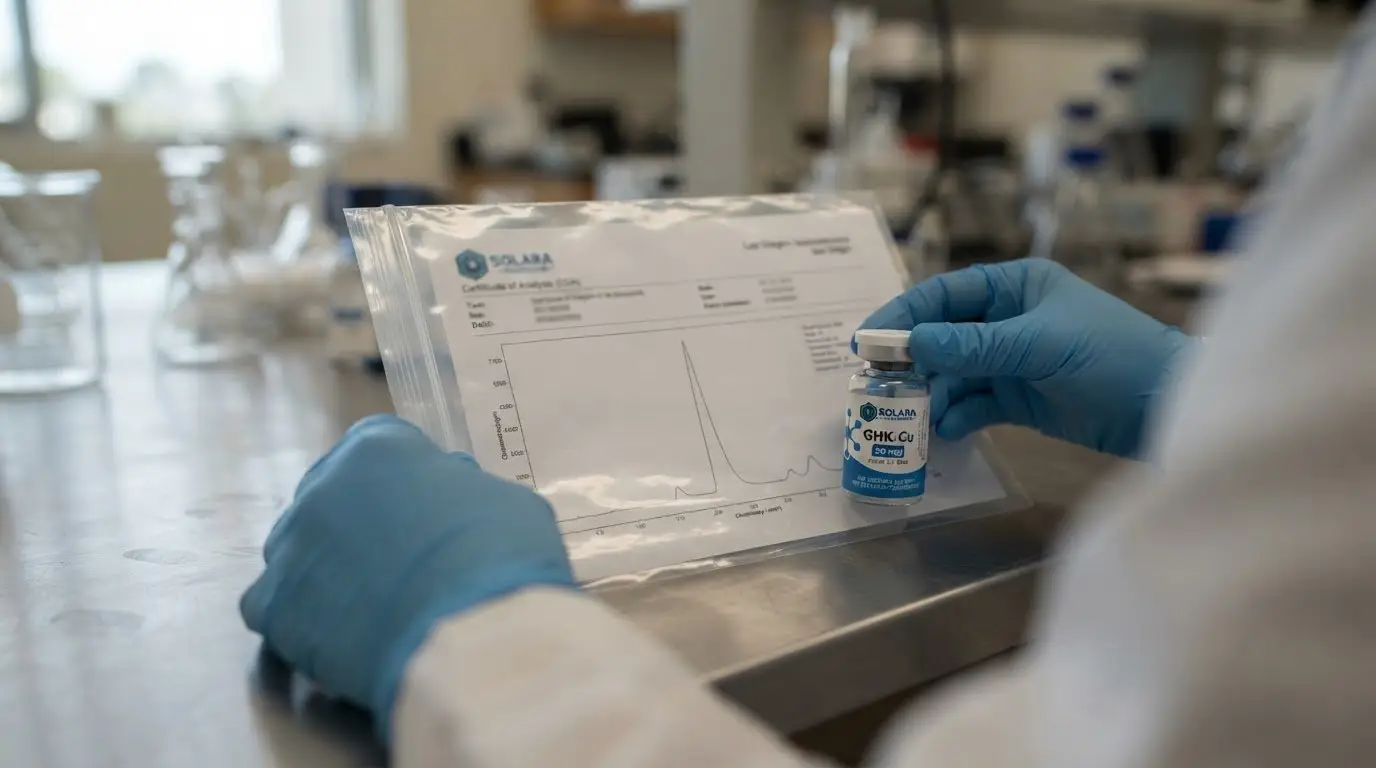
Solara Compounds provides third-party testing and batch-specific Certificates of Analysis (COAs) to support documentation review. Products are for laboratory research only, not for people or animals. For product information, contact [email protected].
Visit solaracompounds.com to review research materials for laboratory work.
Build a more consistent storage workflow
Make storage choices a repeatable part of experimental planning. Document material identity, handling history, and storage conditions so researchers can interpret results in context. Selecting cryoprotectants for peptide storage is one formulation decision; consistent records and appropriate materials also support a controlled workflow.
For laboratory research only, Solara Compounds offers SOL-3RT Retatrutide 10mg, SOL-2TZ Tirzepatide 10mg, and GHK-Cu 50mg. Batch-specific Certificates of Analysis and third-party testing support review of these research materials. They are not medicines or supplements and are not for use in people or animals.
Explore the catalog to find materials relevant to your laboratory work: Shop research peptides. A careful workflow starts with informed selection and continues through every storage and handling step.
Frequently Asked Questions
How should peptides be handled?
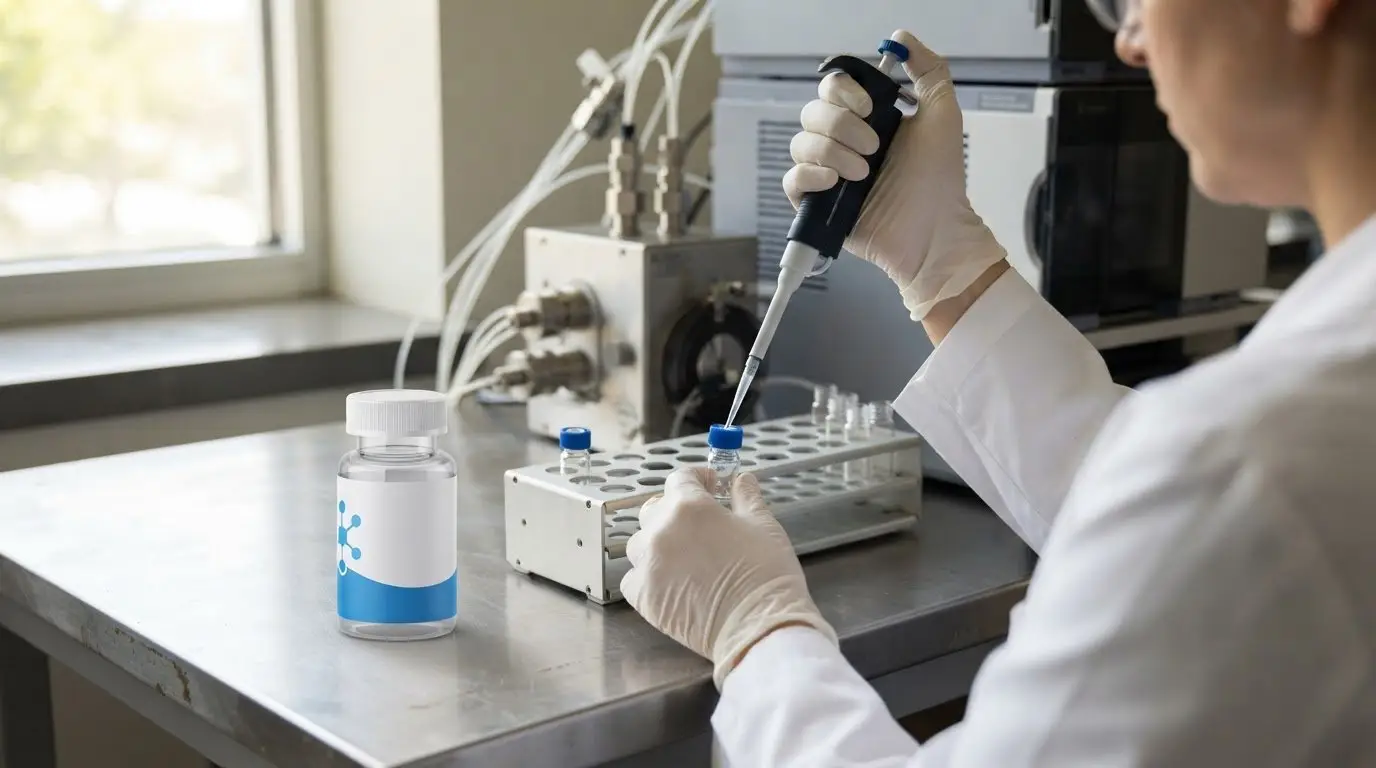
Use clean tools and gloves, and prepare the workspace before opening a sample. For reconstitution, add solvent gently down the vial wall rather than directing a forceful stream onto powder. Hydrophilic peptides often dissolve readily in aqueous solvents. If a solution needs filtration to remove potential bacterial contamination, a 0.2 µm filter is one option. Keep handling consistent between experimental samples.
What are the main degradation pathways to be aware of?
Distinguish physical changes from chemical changes when interpreting sample data. An appropriate analytical comparison can help assess whether a change involves aggregation or a shift in the peptide’s chemical profile. Include a suitable reference sample and record the method used for each comparison. This provides context for interpreting results without treating visual changes as a complete assessment of sample integrity.
What is the difference in stability between lyophilized and reconstituted peptides?
Lyophilized peptides are generally better suited to archival storage, while reconstituted samples are more appropriate for planned, near-term experiments. For studies with multiple measurement points, preserve the dry material and prepare working solution close to the relevant analysis. Record the reconstitution date and formulation in the experiment log. This helps distinguish storage-related variation from differences in timing or assay conditions.
Why should a cold peptide vial be brought to room temperature before opening?
Allowing a sealed vial to equilibrate before opening helps reduce abrupt environmental changes during handling. It also supports more comparable measurements by reducing temperature differences between sample preparations. Keep the cap closed during equilibration, then open the vial only when the workspace and required materials are ready. This promotes consistent handling while limiting unnecessary exposure during a laboratory session.
Which cryoprotectants are commonly used for peptide storage?
Trehalose, sucrose, and mannitol are common formulation excipients discussed for peptide freezing or freeze-drying; glycerol may also be considered in frozen aqueous formulations. Their use depends on the material and process, and their presence should not be inferred from a vial’s appearance. Cryoprotectants for peptide storage are formulation choices, not a universal ingredient list for every research peptide.
How do glycerol, trehalose, sucrose, and mannitol compare as peptide cryoprotectants?
Glycerol is a liquid additive considered for frozen solutions, while trehalose and sucrose are often used in dried formulations. Mannitol may be selected when the physical structure of a dried cake matters. These choices can affect downstream work, including sample solubility and assay compatibility. Assess the full formulation against the intended analytical method rather than ranking additives in isolation.
What concentration of cryoprotectant is recommended for peptide storage?
No single concentration suits every peptide or storage process. Researchers can assess a formulation by comparing recovery, solubility, and dried-material quality across controlled preparations. Keep other variables, including solvent and pH, consistent so the additive’s effect can be evaluated more clearly. The selected concentration should fit the experimental purpose and remain compatible with downstream analysis.
How does cryoprotectant choice depend on peptide sequence and formulation?
Sequence composition and solvent compatibility guide the choice. Hydrophilic peptides often dissolve in aqueous solvents, while hydrophobic sequences may need a different approach. AAPPTec recommends first dissolving peptides with more than 50% hydrophobic residues in a small amount of acetonitrile or isopropanol. Researchers should also consider whether the formulation is intended for freezing or drying and how its ingredients affect the planned assay.