Research Articles
How to Interpret a Peptide COA and Match It to Your Batch

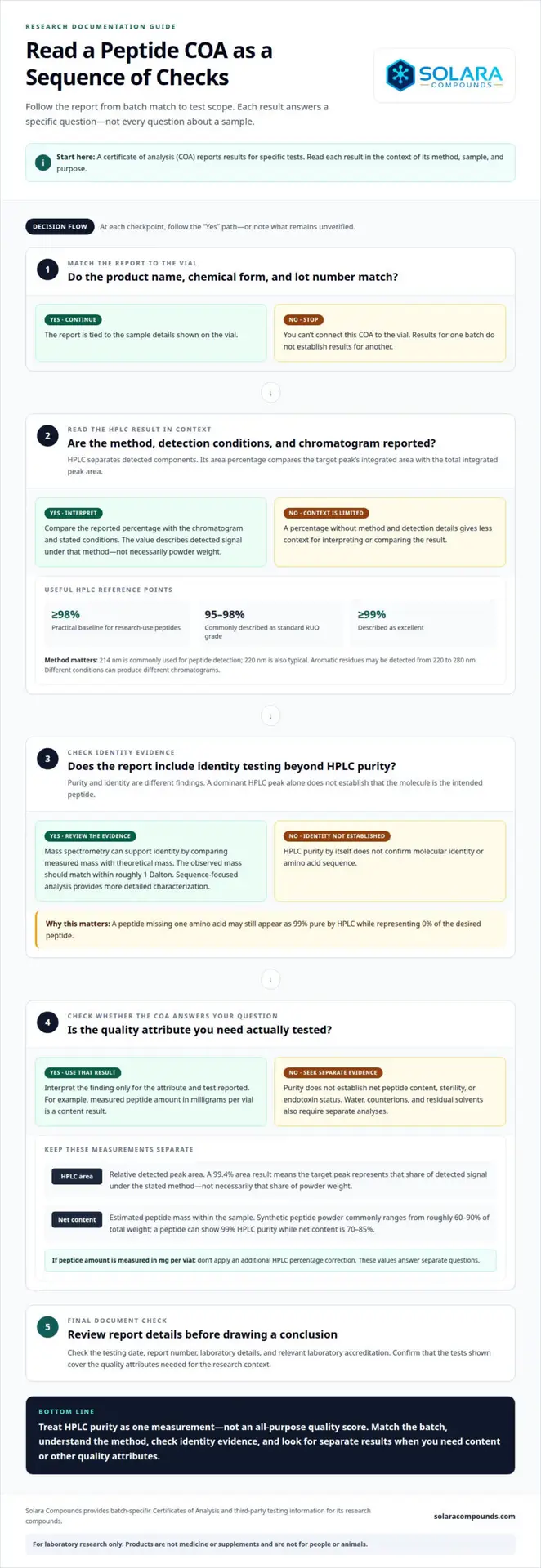
A high HPLC purity result can still leave important questions unanswered. To understand how to interpret a peptide COA, treat ≥98% HPLC area as a practical baseline for research-use peptides, then assess what the result measures, whether the report supports molecular identity, and whether it matches the batch in hand.
That distinction matters: HPLC estimates the relative amount of detected material associated with the target peak, while mass spectrometry can help confirm the molecule’s measured mass. A purity percentage alone does not establish identity, net peptide content, sterility, or endotoxin status. Each depends on the tests actually reported.
This guide explains how to read HPLC purity, assess testing dates and laboratory details, match the COA to a vial’s product and lot number, and work through an example report. Solara Compounds provides batch-specific Certificates of Analysis and third-party testing information for its research compounds, so readers can relate the paperwork to the material being evaluated. Products are for laboratory research only, not for people or animals. Find Solara Compounds at solaracompounds.com.
Key Takeaways
- Read the chromatogram as a pattern of detected peaks, and note the method and detection conditions alongside the reported area percentage.
- Assess whether the report’s identity evidence fits the question: a mass result and sequence-focused analysis provide different levels of characterization.
- Review the test date, report number, and relevant laboratory accreditation, then consider whether the testing covers the quality attribute you need.
- Match the certificate’s product name, chemical form, and lot number to the vial; results for one batch don’t establish results for another.
- Use an example COA to see how purity, identity, content, and other test results answer distinct questions rather than forming one all-purpose quality score.
What HPLC purity is acceptable for research peptides?
For research-use peptides, ≥98% HPLC area is a practical baseline; 95-98% is commonly described as standard RUO grade, while ≥99% is excellent. A certificate of analysis reports results for specific tests. Purity percentages measure relative detected peak area, not vial-wide composition, and don’t establish safety or FDA approval for human use in the United States.
Reading HPLC Chromatograms
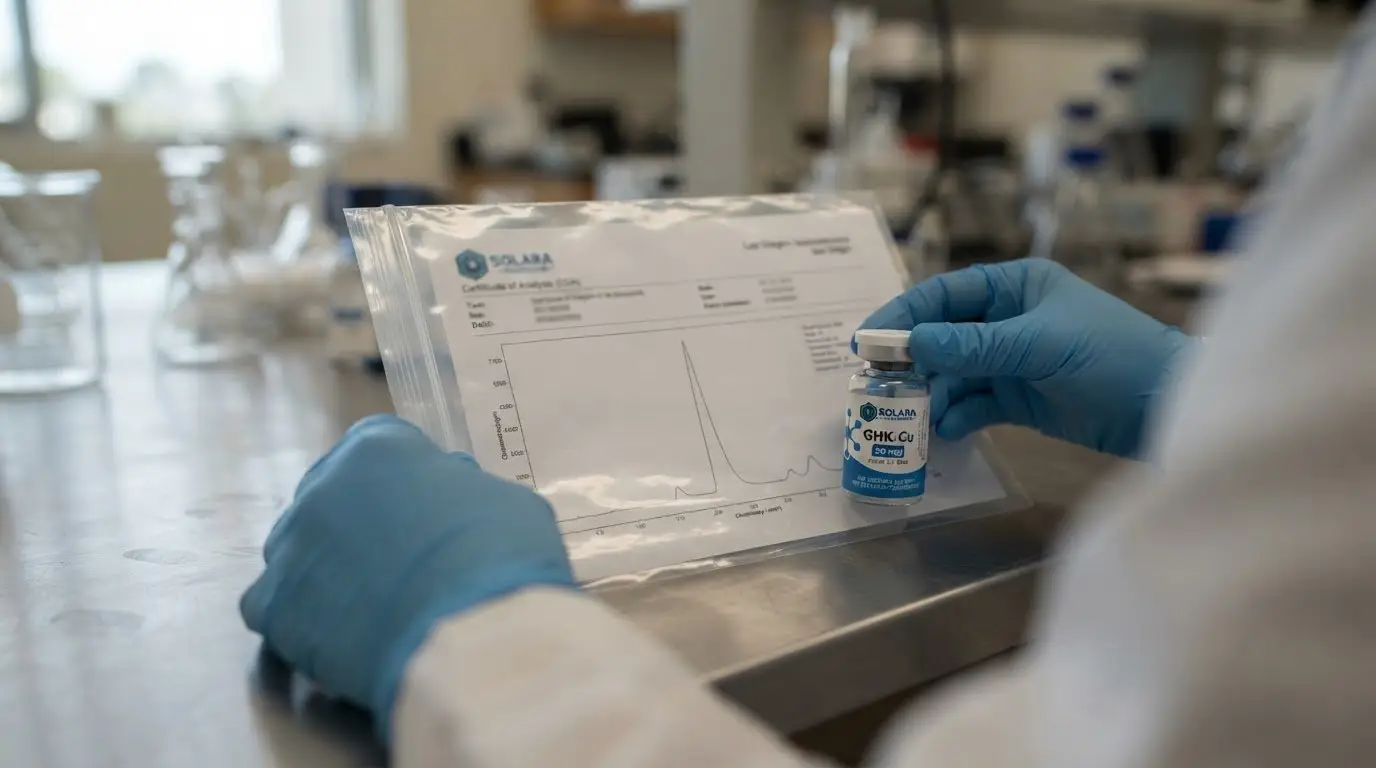
An HPLC chromatogram displays detector responses as sample components pass through the instrument. The reported purity compares the target peak’s area with integrated peak areas. A simplified calculation divides target peak area by total integrated peak area, then multiplies by 100. For example, 99.4% area means the target peak represents that share of detected signal under the stated method, not necessarily that share of powder weight.
Read the chromatogram alongside its reported result. Look for the target peak and other integrated peaks, then note the detection wavelength. A certificate reporting 99.4% should identify the method and signal behind that value. The result is more informative when the chromatogram and reported percentage align.
Purity Versus Net Peptide Content
HPLC purity compares detected components, while net peptide content estimates peptide mass within the sample. The distinction matters when assessing actual peptide amount per vial. A peptide can show 99% HPLC purity while net peptide content is 70-85%, because water, counterions, or other material contribute to total weight.
Synthetic peptide powder’s net peptide content commonly ranges from roughly 60-90% of total weight. If a report gives a measured peptide amount in milligrams per vial, don’t apply an additional HPLC percentage correction. These values answer separate questions. Check whether the COA reports purity, content, or both before comparing results with an experimental requirement.
Method-Dependent Purity Results
Method-dependent purity means the reported area percentage reflects the chromatography conditions used to separate and detect a sample. Different methods can produce different chromatograms for the same material. Reversed-phase chromatography with UV detection around 210-220 nm is standard; peptide detection commonly uses 214 nm, while 220 nm is also typical.
Peptides containing aromatic residues may be detected at wavelengths from 220 to 280 nm. Since wavelength affects which components absorb and appear in the signal, compare percentages alongside method details. A reported 98% without detection conditions offers less context than a result paired with wavelength and chromatogram. Consistent methods also support comparisons across COAs.
What Purity Percentages Exclude
A purity percentage describes relative detected target peak area, not every quality attribute. Even 98% HPLC purity doesn’t establish molecular identity, net content, sterility, or endotoxin status. A peptide missing one amino acid may register as 99% pure by HPLC while representing 0% of the desired peptide.
Knowing how to interpret a peptide COA means connecting each claim with its specific test. Water, counterions, and residual solvents require separate analyses; identity may require another method. A COA supports a claim only when the relevant test appears on the report. A peptide certificate of analysis is most useful when its sample details, method, and result can be considered together.
Read purity as one measurement, not a complete quality verdict. Use the reported method and chromatogram to understand the percentage, then distinguish it from content and other test results. This helps researchers judge whether the documentation addresses their laboratory requirements.
Why do some vendors claim high purity without Mass Spectrometry?
High HPLC purity and confirmed molecular identity describe different findings. A COA can report purity from high-performance liquid chromatography without including mass spectrometry: chromatography separates components and estimates their relative abundance. Without identity evidence, a sample could contain one dominant component that is not the intended peptide.
To assess identity and sequence, compare the peptide named on the COA and any sequence information with the analytical results. Mass spectrometry can support identity by comparing measured molecular mass with theoretical mass; sequence-focused analysis offers more detailed characterization. A purity result alone does not establish the amino acid sequence.
Purity Does Not Establish Identity
HPLC separates components in a mixture and detects their signals to estimate relative purity. Mass spectrometry measures ions’ mass-to-charge ratios, helping determine whether the observed molecular mass matches the expected peptide. These techniques answer different questions, so a high purity value alone cannot confirm that the dominant peak is the desired molecule.
For example, a peptide missing one amino acid may still appear as 99% pure by HPLC, yet be 0% the desired peptide. The chromatogram may show one dominant peak because the altered molecule is also a major component. Identity testing adds a separate line of evidence that helps distinguish this case from the correct sequence.
What Mass Spectrometry Can Confirm
Mass spectrometry can support molecular identity when the observed mass aligns with the theoretical mass. A peptide’s observed mass should match its theoretical mass within roughly 1 Dalton. A difference of 16 daltons can be a common sign of oxidation, a chemical change that adds oxygen to the molecule.
That comparison is useful, but it has limits. A matching mass supports the expected molecular composition, but does not necessarily prove the order of every amino acid. A mass check and sequence-focused analysis provide different levels of characterization. Read the report’s method and result together rather than treating “MS tested” as complete evidence of identity.
Separate Identity, Purity, and Other Tests
COA terms describe distinct measurements. Purity estimates relative detected components; identity assesses whether the material matches the named molecule; assay or content addresses measured quantity. Sterility testing checks for viable microorganisms, while endotoxin testing measures bacterial toxin residues. One result cannot substitute for another.
For a practical review, connect each research requirement to the relevant reported test. If identity matters, look for mass or sequence analysis. If purity matters, review the HPLC method and result. If a COA lists only HPLC purity, do not infer content, sterility, or endotoxin results from that figure. Those tests must be reported separately.
Researchers comparing materials for laboratory work can browse the research peptide catalog and assess each item’s available batch documentation against the testing needs of their study.
Checking COA testing dates and laboratory credentials
A COA’s value depends on more than its result. Review the testing date, laboratory identity, report number, method, and acceptance limits together. A test dated within the last 12 months is a useful preference, but the date alone doesn’t show whether the tested sample matches the material under review. The report’s laboratory and report number should also be independently verifiable.
For each result, identify the method and specification, then compare the measured value with its stated acceptance limit. A method describes how the laboratory measured an attribute; the limit defines the result considered acceptable for that test. If the COA lists a result without its method or criterion, it is harder to assess what the result means. Apply this review separately to purity, identity, endotoxin, and other impurities.
Laboratory credentials should relate to the test being reported. ISO/IEC 17025 is an example of a standard to check when assessing laboratory accreditation for the relevant test, according to the International Organization for Standardization. Accreditation provides context about laboratory competence for a defined scope. It doesn’t establish that every method or result on a COA falls within that scope.
Endotoxin, sterility, and heavy-metal results address distinct quality questions. According to the U.S. Food and Drug Administration, its guidance on pyrogen and endotoxins testing refers to USP <85> as the basis for bacterial endotoxins test methods and acceptance criteria. Endotoxin results may appear in EU/ml or EU/vial. Sterility testing, such as USP <71> or an equivalent method, evaluates viable microorganisms. ICP-MS can measure elemental impurities at parts-per-billion levels.
A COA supports only the tests it actually reports. For example, an HPLC purity result does not establish sterility or endotoxin status. Check whether each expected attribute has its own method, result, and acceptance criterion. Other analyses may cover water, counterions, or residual solvents. These measurements can help characterize a sample, but they answer different questions from identity or purity testing.
Third-party testing adds independent analytical data, but the report still needs a clear link to the tested sample. Compare the laboratory name, report number, sample description, and testing date. For recurring research, consistent methods can make results more useful across batches. Incoming testing can add another comparison point: a researcher may test received material using a defined method and assess whether the result aligns with the supplier’s report.
For research use only, a COA documents specific reported measurements, not every quality attribute. A practical review records the method, specification, result, and laboratory for each relevant test. If the report’s acceptance limits are unclear, interpret the result cautiously instead of treating a passing label as a substitute for the underlying data.
Batch-specific COAs and lot-number matching
A peptide COA records results for a specific sample or batch, not every batch sold under one product name. That makes the lot or batch number essential: it connects the report to the tested material in the vial. A general product name and high purity percentage cannot establish that the report describes the vial in hand.
Compare the vial and document across three identifiers: product name, chemical form, and lot or batch number. The product name should identify the peptide, while the chemical form distinguishes the material described. The lot number should match exactly, including letters, numbers, and hyphens. For example, a report marked “Research Peptide A, lot EXAMPLE-01” applies to that named sample or batch, not a different lot of Research Peptide A.
Dates provide another traceability check. The testing date should fit the manufacturing timeline, not precede it. A date mismatch can signal that the report and vial may refer to different material. The date alone does not establish a match, however; read it alongside the product and lot identifiers. A report number can also distinguish one laboratory document from another.
- Product: The vial and report identify the same peptide.
- Chemical form: The form named on the document matches the material description.
- Lot: Every character in the vial’s lot number matches the report.
- Timeline: The test date follows a plausible manufacturing sequence.
Batch-specific verification also means interpreting results within the document’s scope. A measured HPLC percentage describes the tested sample under its stated method; it does not prove separate lots share that percentage. Likewise, a COA supports identity, purity, quantity, sterility, or endotoxin claims only when those tests appear in the report. Do not infer results for tests that are not listed.
Even a correctly matched COA has limits. It describes the tested batch and listed analyses, not other lots or changes that may occur during later storage and shipping. For consistent laboratory comparisons, keep the vial identifier and corresponding report together in your records. If material from another lot enters a study, treat its documentation separately rather than carrying forward the first batch’s results.
This matching process makes a report useful for traceability: each result stays connected to a specific product, form, lot, and test record. If an identifier differs, the paperwork no longer clearly matches that vial. Resolve the mismatch before using the document to characterize the batch, and do not treat a shared product name or purity percentage as a substitute for exact lot correspondence.
Interpreting an example peptide COA
A useful example shows why a COA is a collection of separate measurements, not one overall quality score. Consider an illustrative report for Research Peptide A, lot EXAMPLE-01, with 99.0% HPLC-UV area purity. That percentage describes the target peak’s share of integrated UV signal under the stated analysis. It doesn’t, by itself, establish molecular identity, actual peptide content, sterility, or endotoxin status.
A peptide Certificate of Analysis should identify the sample or product, lot or batch, testing date, laboratory, and report number. It should also state each test method, measured result, and applicable acceptance limit. These details show researchers what the document covers and connect the results to the specific material tested.
Read the example’s HPLC result together with its chromatogram and method. A result such as 98.5% Area% means about 98.5% of detected UV-absorbing material is the target peptide. The remaining signal represents other detected components under those conditions. It isn’t a direct measurement of total sample weight, and it doesn’t identify every impurity.
Next, look for identity analysis. In a separate worked example, ESI-MS reports an observed mass of 4813.5 Da for LY3298176. Mass spectrometry supports identity by comparing observed molecular mass with the expected mass. It provides a different kind of verification from HPLC purity; the two results answer complementary questions.
Other fields may characterize sample composition. One example reports 4.2% water by Karl Fischer testing and 6.1% TFA counterion content. These results describe components that HPLC area purity doesn’t quantify as total peptide content. A separate example gives 80% net peptide content for a 5 mg vial, yielding 4 mg actual peptide mass. That content figure is not an extra correction to apply to an HPLC area percentage.
Use the report’s date and identifiers to judge whether its findings apply to the vial under review. For example, a worked report date of 2026-04-18 is meaningful alongside the sample name and lot number. Results apply to the listed sample and tests, not automatically to later batches or unreported attributes. Treat every line as evidence for one defined measurement.
The practical takeaway is to read across the document: sample identity, lot, date, method, result, and test scope. A high percentage can be useful, but it cannot replace mass spectrometry, content analysis, or other relevant testing. For research materials, browse research compounds with the batch documentation in mind.
Solara Compounds
Solara Compounds provides batch-specific Certificates of Analysis and third-party testing information for research compounds, helping lab buyers connect documentation with the material they are evaluating. When a peptide is being considered for laboratory work, its COA can clarify which batch was tested and which results the report covers. Available research compounds include SOL-3RT Retatrutide 10mg, SOL-2TZ Tirzepatide 10mg, GHK-Cu 50mg, and TB-500 5mg. Products are for laboratory research only, not for people or animals, and are not medicines or supplements. For questions about batch documentation, contact Solara Compounds.
Build a More Traceable Research Workflow
Make COA review part of the process for bringing each new research material into your laboratory workflow. Recording the document alongside the material’s identifier helps keep analytical decisions connected to the sample used in an experiment. Over time, this practice can make comparisons across research runs clearer and easier to interpret.
A careful approach to how to interpret a peptide COA supports informed material selection, but the COA should remain evidence for laboratory research only. Solara Compounds offers research compounds including SOL-3RT Retatrutide 10mg, SOL-2TZ Tirzepatide 10mg, and GHK-Cu 50mg. Choose materials with documentation that fits your research needs, then keep the related paperwork with your records.
Explore research compounds and take the next step toward a more organized, evidence-led workflow.
Frequently Asked Questions
How recent should the COA testing date be?
A COA dated within the last 12 months is a useful preference for research peptide documentation. Consider the date alongside the batch identifier and the timing of material handling. A recent report can still be irrelevant if it describes a different lot, while an older result cannot document changes after testing. Treat the date as one part of assessing how well the report represents the material under review.
What Is a Certificate of Analysis (COA)?
A Certificate of Analysis is a laboratory document reporting analytical results for a specified sample or batch. It can list the tests performed, their methods, and measured findings. For a peptide, results might cover purity or molecular identity. The document’s scope matters: a result supports only the attribute tested, so distinguish measured data from broader claims about the material.
What does COA stand for?
COA stands for Certificate of Analysis. The term describes a document presenting analytical findings, not a general product brochure or a statement covering every quality attribute. For example, a COA may include a test result for one sample and identify the analysis used. The abbreviation alone does not show which tests are included; the report’s contents define the evidence it provides.
A Peptide COA Example: What Can You Conclude?
Draw conclusions only from the listed results. If a report gives a passing result for a specified analysis, that finding applies to the tested sample and stated criterion. It does not establish unreported attributes or automatically apply to material from another batch. For a study decision, separate documented results from assumptions, then determine whether the reported tests address your laboratory’s research question.
Chromatogram or No Chromatogram?
A chromatogram visually records detector signals as sample components separate during analysis. It can help readers assess whether the reported peak pattern is consistent with the accompanying purity calculation. Without the graphic, a percentage alone offers less detail about the signal pattern. Treat the chromatogram as supporting context, not a substitute for method information, sample identification, or other analyses needed for your assessment.
What do HPLC purity and chromatogram results mean on a peptide COA?
HPLC purity reports the relative target signal among the components detected under that test’s conditions. The chromatogram shows the signals contributing to the analysis. For comparisons across research runs, use results generated with comparable methods and detection settings. A percentage can help characterize a sample, but it is not a direct measure of experimental performance or a standalone measure of total vial contents.
How to check a peptide COA for batch number, testing date, and laboratory credentials?
Compare the vial label with the report’s sample identity and lot details, then review the testing date and laboratory information. For laboratory buyers in Boston, San Diego, San Francisco, New York, Houston, Miami, Los Angeles, Austin, Raleigh, Seattle, Chicago, Philadelphia, Baltimore, Dallas, Phoenix, Tampa, Atlanta, and Denver, the same document review applies. A report number and relevant accreditation scope add context to the laboratory’s reported work.
What contaminants and residual solvents should peptide COAs test for?
The relevant tests depend on the material and research question. Analyses may include elemental impurities, residual solvents, endotoxin, sterility, water, and counterion content. These are distinct measurements, not one universal “contaminant” result. For example, a heavy-metal analysis does not establish solvent levels, and a purity result does not establish sterility. Review the COA for the specific tests and results relevant to your laboratory assessment.