Research Articles
Peptide Handling: A Reference for Storage and Solution Stability

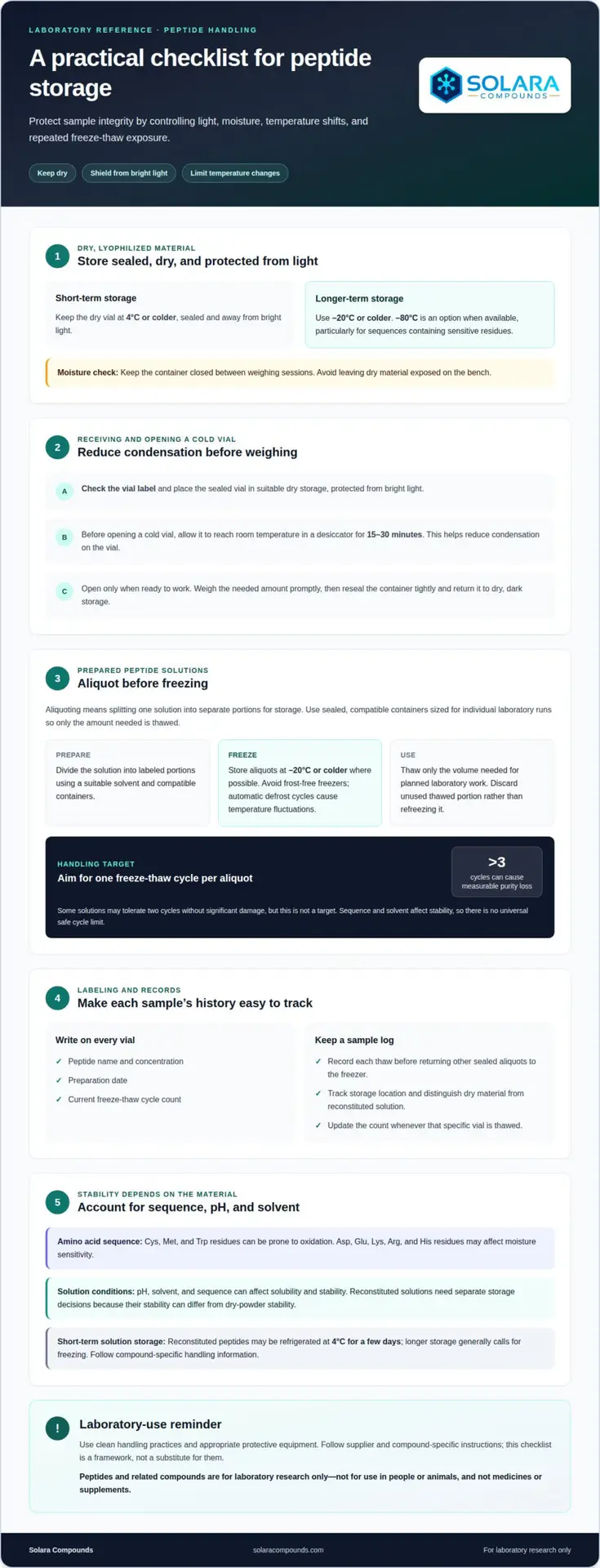
Light can degrade lyophilized peptides, so protect them from intense light and keep them dry; for longer-term storage, −20°C or colder is preferred. These peptide handling best practices help preserve sample integrity, but light is only one factor: temperature shifts, moisture, solution pH, amino acid sequence, and repeated freeze-thaw cycles can also affect stability.
Storage temperature matters, but so does careful handling before and after storage. This reference explains how to limit exposure, why sequence and pH affect solution stability, and how aliquoting can reduce freeze-thaw cycles. It also outlines practical laboratory safety steps, including clean work areas and appropriate protective equipment.
Use the guidance as a framework for laboratory research, not as a substitute for compound-specific handling information. Peptides and related compounds discussed here are for laboratory research only, not for use in people or animals, and are not medicines or supplements.
Key Takeaways
- Aliquot peptide solutions to limit repeated freeze-thaw exposure, and label each portion so handling history stays clear.
- Keep lyophilized peptides dry and protected from bright light; colder storage is generally suited to longer-term preservation.
- Use refrigeration for short-term storage only, recognizing that solution stability depends on the peptide’s sequence and storage conditions.
- Consider how pH and amino acid composition affect solubility and stability before preparing a peptide solution.
- Use clean handling practices and appropriate protective equipment. Peptides from Solara Compounds are for laboratory research only, not for use in people or animals.
How many freeze-thaw cycles can a peptide solution tolerate?
Before freezing a peptide solution, divide it into single-use aliquots. Aim for one freeze-thaw cycle per aliquot, since repeated thawing can compromise sample integrity. These peptide handling best practices limit avoidable temperature changes and make each sample’s history easier to track.
Aliquoting Peptide Solutions
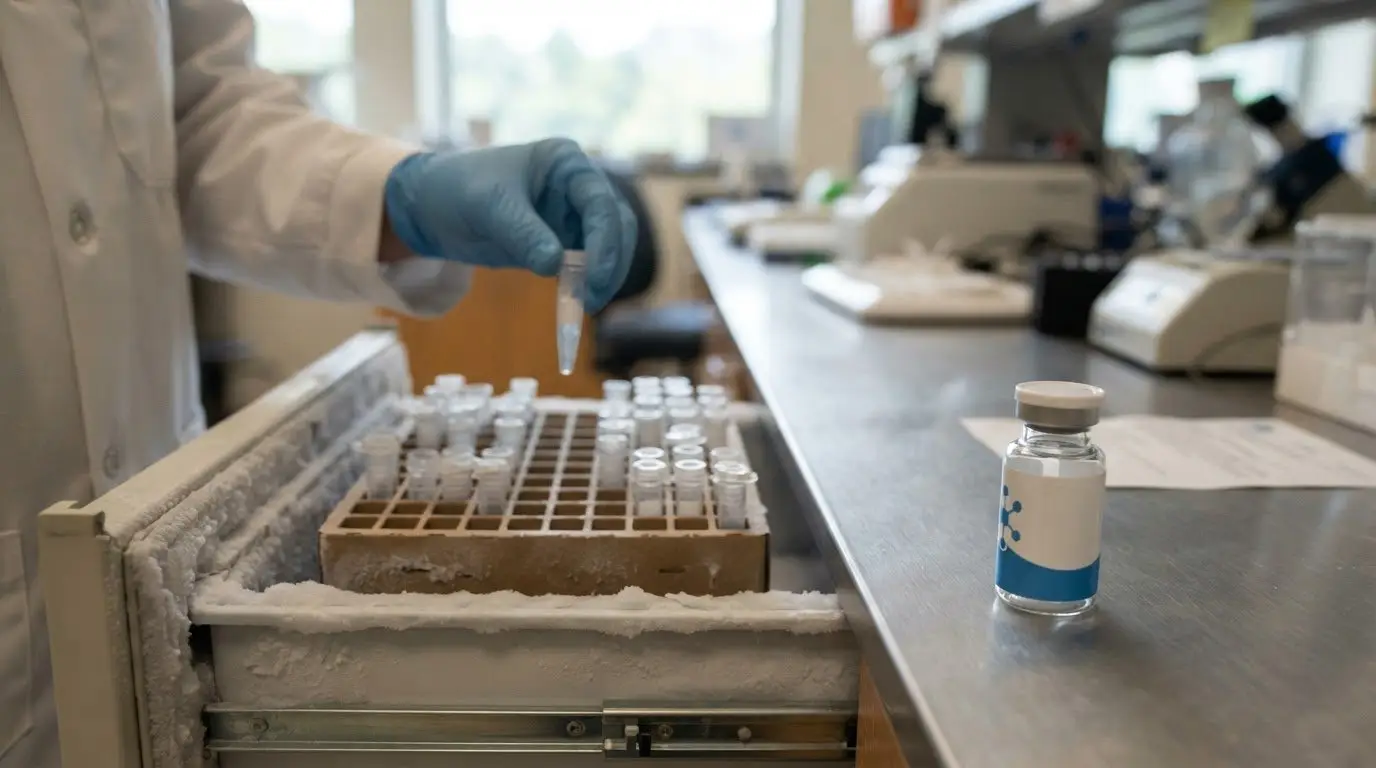
Aliquoting means splitting one peptide solution into separate portions for storage. Prepare sealed portions sized for individual laboratory runs, using a suitable solvent and compatible containers. Store aliquots at −20°C or colder where possible. This keeps the main stock frozen while researchers thaw only the amount needed for a planned experiment.
For example, divide a prepared solution among several labeled vials rather than repeatedly thawing one large container. Choose containers that seal securely and keep them closed during storage. Avoid frost-free freezers for peptide aliquots because automatic defrost cycles cause temperature fluctuations that can add stress to samples.
Avoiding Repeated Freeze-Thaw Cycles
Freeze-thaw management means recording each thaw and avoiding refreezing a used portion. Aim for one cycle per aliquot. Repeated cycles are deleterious, and more than three cycles can cause measurable purity loss. Most peptide solutions can tolerate two cycles without significant damage, but researchers should not treat that observation as a target.
Thaw only the volume needed for the planned laboratory work. Use that aliquot for the work, then discard any unused portion rather than refreezing it. Peptide sequence and solvent affect stability, so there is no universal safe cycle limit. Good peptide handling best practices keep thaw events deliberate and minimal.
Accurate labels make a sample’s freeze-thaw history visible. Record the peptide name, concentration, preparation date, and cycle count on every vial. For example, include the KPV peptide name with its concentration and handling details. Update the recorded count whenever that specific vial is thawed.
- Mark each sealed aliquot with its peptide name and concentration.
- Add the preparation date and current freeze-thaw cycle count.
- Keep unused aliquots frozen at −20°C or colder where possible.
Use a sample log to connect each vial label with its storage history. Record a thaw before returning other sealed aliquots to the freezer. This workflow helps identify samples exposed to repeated temperature changes and keeps experimental records clear.
Peptide handling & storage guidelines – How to store a peptide?
Lyophilized peptides are freeze-dried materials that need protection from moisture, light, and heat. For laboratory research materials, follow the supplier’s handling information and compound-specific documentation, since formulations and storage instructions can differ.
Storing Lyophilized Peptides
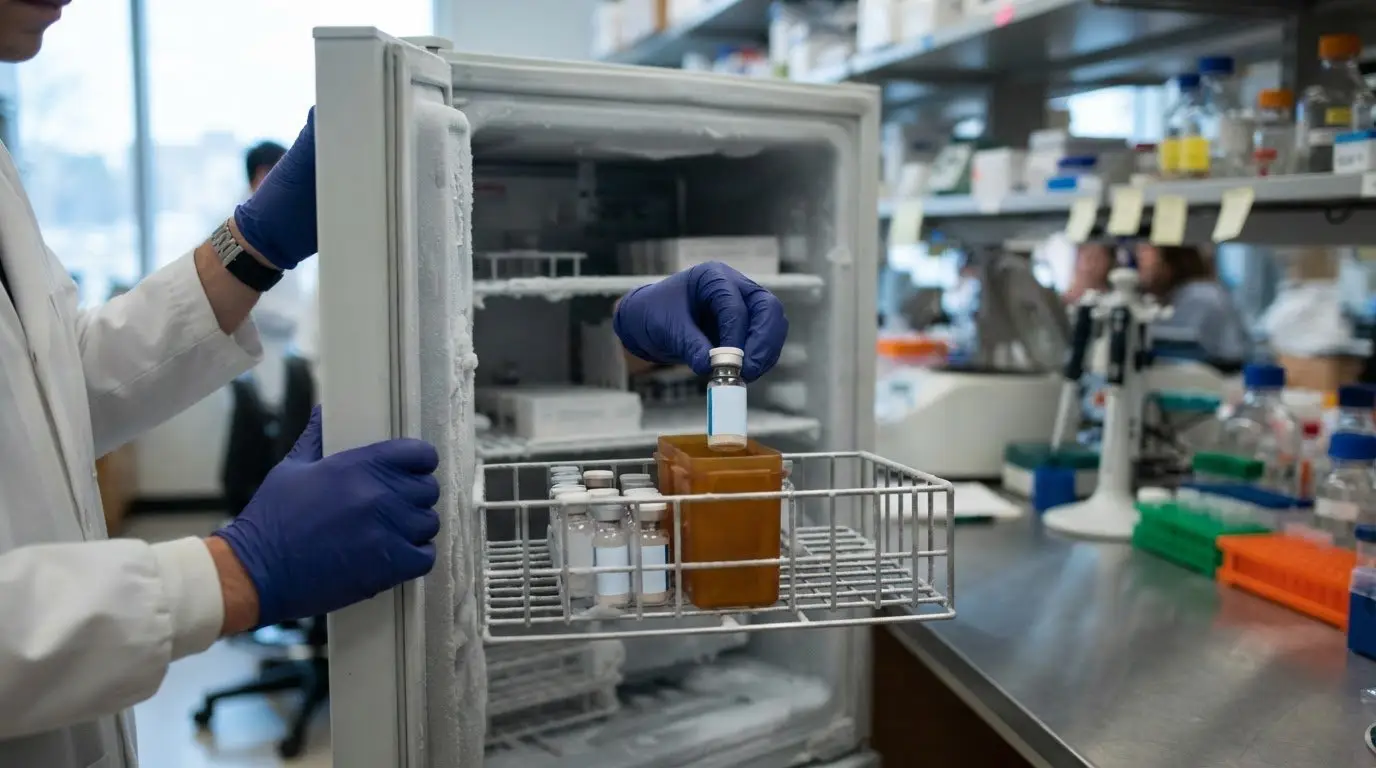
Lyophilized peptide storage means keeping the dry material sealed under conditions that limit degradation. For short-term storage, keep peptides at 4°C or colder, away from bright light. For longer-term storage, use −20°C or colder; −80°C is an option when available, particularly for sequences containing sensitive residues.
Moisture matters. Allow the closed container to reach room temperature in a desiccator for 15-30 minutes before opening. This reduces condensation on the cold vial. Once open, weigh the needed amount promptly, then reseal the container tightly and return it to dry, dark storage. Reconstituted peptide solutions need separate storage decisions because solution stability can differ from dry-powder stability.
Receiving Lyophilized Peptides
Receiving lyophilized peptides means inspecting and placing the sealed dry vial into suitable storage before opening it. After arrival, keep the vial closed while it adjusts to the storage environment. Before weighing, let the closed vial reach room temperature in a desiccator for 15-30 minutes, then open it only when ready to work.
Use a practical sequence: check the vial label, move it to dry storage at 4°C or colder, and protect it from bright light. For longer-term storage, transfer it to −20°C or colder. If the vial is cold, don’t open it immediately; humid air can condense inside and expose the peptide to moisture. After weighing, reseal it promptly.
A peptide’s sequence also informs storage planning. Cys, Met, and Trp residues can be prone to oxidation, while residues such as Asp, Glu, Lys, Arg, and His may affect moisture sensitivity. Keep the vial tightly closed between weighing sessions, and avoid leaving dry material exposed on the bench. Shield light-sensitive samples during storage and routine handling.
For laboratory research, record the peptide name, receipt date, and storage location in the sample log. This helps researchers distinguish unopened lyophilized material from reconstituted solutions and track each form under its appropriate conditions. To source materials for research, browse the research peptide catalog. Products are for laboratory research only, not for use in people or animals, and are not medicines or supplements.
Refrigeration and short-term storage
Storage temperature and light exposure affect how quickly peptides degrade. For dry peptides, use 4°C or colder and avoid bright light; for longer-term storage, use −20°C or colder. Reconstituted solutions need separate handling because their stability depends on sequence and solvent.
For short-term dry storage, keep the vial sealed, dry, and shielded from light. Reconstituted peptides may be refrigerated at 4°C for a few days, while longer storage generally calls for freezing.
Short-Term Storage of Dry Peptides
Short-term dry storage means keeping an unopened or resealed peptide vial cool and protected until laboratory use. Dry peptides can remain stable at room temperature for days to weeks, but 4°C or colder is preferred. Keep the container tightly closed and away from bright light, since moisture exposure and heat can promote degradation.
For example, if a vial is needed soon, store it in a refrigerator rather than leaving it on a bench. The exact stability depends on its amino acid sequence, including sensitive residues. Keep the vial sealed between weighing sessions to limit humidity exposure.
Reconstituted Peptide Storage
Reconstituted peptide storage means maintaining a peptide after it has been dissolved in a solvent or buffer. For short-term use, refrigerate at 4°C; solutions may be kept there for a few days, depending on peptide stability. If storage in solution is unavoidable, frozen aliquots at −20°C are preferred.
Refrigerated solution stability varies. Peptide solutions are generally stable for 1-2 weeks at +4°C, but sequence and solvent matter. Solutions containing Asn, Gln, Cys, Met, or Trp can be less stable. Avoid treating a general guideline as a fixed shelf life for every peptide.
Storage Temperatures and Light Conditions
Temperature and light conditions are the controlled environment used to slow peptide degradation. Store dry peptides at 4°C or colder for short-term preservation, and at −20°C or colder for longer-term storage. Protect samples from bright light during storage and handling.
For reconstituted solutions intended for use within 1-2 weeks, refrigeration at 4°C is a practical option. Longer storage calls for −20°C or −80°C, depending on the sequence and experimental purpose. Keep samples in sealed containers and avoid repeated temperature changes that can compromise consistency.
Choose conditions according to whether the sample is dry or dissolved. A dry peptide stored at 4°C and a reconstituted solution held at the same temperature do not necessarily share the same stability. Record the form, storage temperature, and intended use in laboratory notes so researchers can interpret results against the correct handling conditions.
Effects of pH and amino acid sequence on solution stability
Solution stability describes how well a dissolved peptide retains its structure over time. Both pH and amino acid sequence affect solubility and degradation, so a buffer suitable for one peptide may not suit another. Before selecting a solvent or storage condition, review the sequence and compound-specific documentation.
pH measures how acidic or basic a solution is. A pH of 5-6 is often used when storing peptides in solution, while acidic conditions around pH 4-6 can help reduce aggregation and deamidation risk. Avoid pH above 8 where possible, because strongly basic conditions can increase instability.
Sequence matters because individual residues respond differently to their chemical environment. Peptides containing Asn, Gln, Cys, Met, Trp, or Tyr tend to be less stable in solution. Methionine, cysteine, and tryptophan are prone to oxidation; asparagine can undergo hydrolysis. These differences help explain why peptides in solution can lose integrity at different rates.
Free cysteine needs particular attention. Its thiol group can oxidize rapidly above pH 7, so carefully degassed acidic buffers are recommended for sequences with free cysteine. Peptides containing methionine or tryptophan also warrant attention to oxidation during preparation and storage. Repeated thaw cycles add another source of stress, making an aliquoted solution easier to manage than a repeatedly thawed stock.
Reconstitution is the process of dissolving a dry peptide in a selected solvent or buffer. Start with the sequence’s charge and hydrophobicity: basic peptides may dissolve in a small amount of acidic solvent before dilution, while hydrophobic peptides may need a small amount of organic solvent followed by water or buffer. For peptides with fewer than 10% charged residues, organic solvents may aid dissolution.
For a peptide with a net positive charge at neutral pH, dilute acetic acid can support solubility. Acidic peptides may start in a small amount of 0.1 M ammonium bicarbonate; PBS at pH 7.0-7.4 may suit acidic or basic peptides when 1 mg/mL or less is sufficient. Allow time for dissolution, since reconstitution may take several hours.
When storing peptides in solution, choose a buffer around pH 5-6 if the experiment permits. Keep the solvent, pH, concentration, and preparation date in the sample record. For example, record whether a solution used PBS or an acidic buffer, since those conditions can influence solubility and experimental consistency. Sequence-specific stability remains central to interpreting storage decisions.
Peptide handling safety
Safe peptide handling relies on protective equipment, clean work practices, and a controlled response to spills. For spills, contaminated materials, and expired samples, follow the laboratory’s waste procedures and the product’s safety information. Keep material contained until the correct disposal route is established.
Peptide Spill Response
Peptide spill response is the controlled containment and cleanup of accidentally released material. Stop work, keep others away from the affected area, and use gloves, a mask, and safety glasses. In a well-ventilated space, follow the laboratory’s cleanup procedure and product safety information rather than improvising a cleaning agent.
Place cleanup materials in a sealed, clearly identified container for handling under laboratory waste procedures. Avoid actions that could spread powder or create aerosols. If the material or amount is uncertain, pause cleanup and follow the laboratory’s established escalation process.
Clean handling helps keep samples stable and reduces contamination risks during preparation. Use sterile technique for laboratory procedures requiring it, and work in a laminar flow hood or biosafety cabinet when available. Filter tips can help reduce aerosol contamination during pipetting. For cell culture, peptide solutions may be passed through a 0.22 µm sterile filter before use.
Before reconstitution, sanitize the vial stopper with 70% isopropanol and let it dry. Keep containers sealed when not in use, and use clean equipment for each sample. Peptides containing different amino acid sequences can have distinct handling characteristics, so avoid assuming one compound’s handling conditions apply to another.
Expired Sample Disposal
Expired sample disposal means removing material that is past its intended storage or use period. Keep the sample sealed and separate from active stock while identifying its contents and condition. Then follow the laboratory’s waste procedure and product safety information to determine the appropriate disposal route.
Do not pour a peptide solution down a drain or place an unidentified sample in ordinary waste. Keep contaminated gloves, tips, and other materials contained, and route them through the laboratory’s established waste process. Record the sample identity and disposal date in the relevant laboratory log.
Contamination control matters even when a peptide remains chemically stable. Peptide solutions may be susceptible to bacterial degradation, so use clean handling practices and do not return unused material to a stock container. A sterile filter may be appropriate for cell-culture work, but filtration does not replace clean preparation or suitable sample storage.
Researchers can make handling more consistent by separating clean and contaminated work areas, keeping waste sealed, and recording deviations. These steps support repeatable laboratory procedures without assuming that every peptide or solvent presents identical risks. For laboratory research materials, view the research catalog. Products are for laboratory research only, not for people or animals.
Solara Compounds
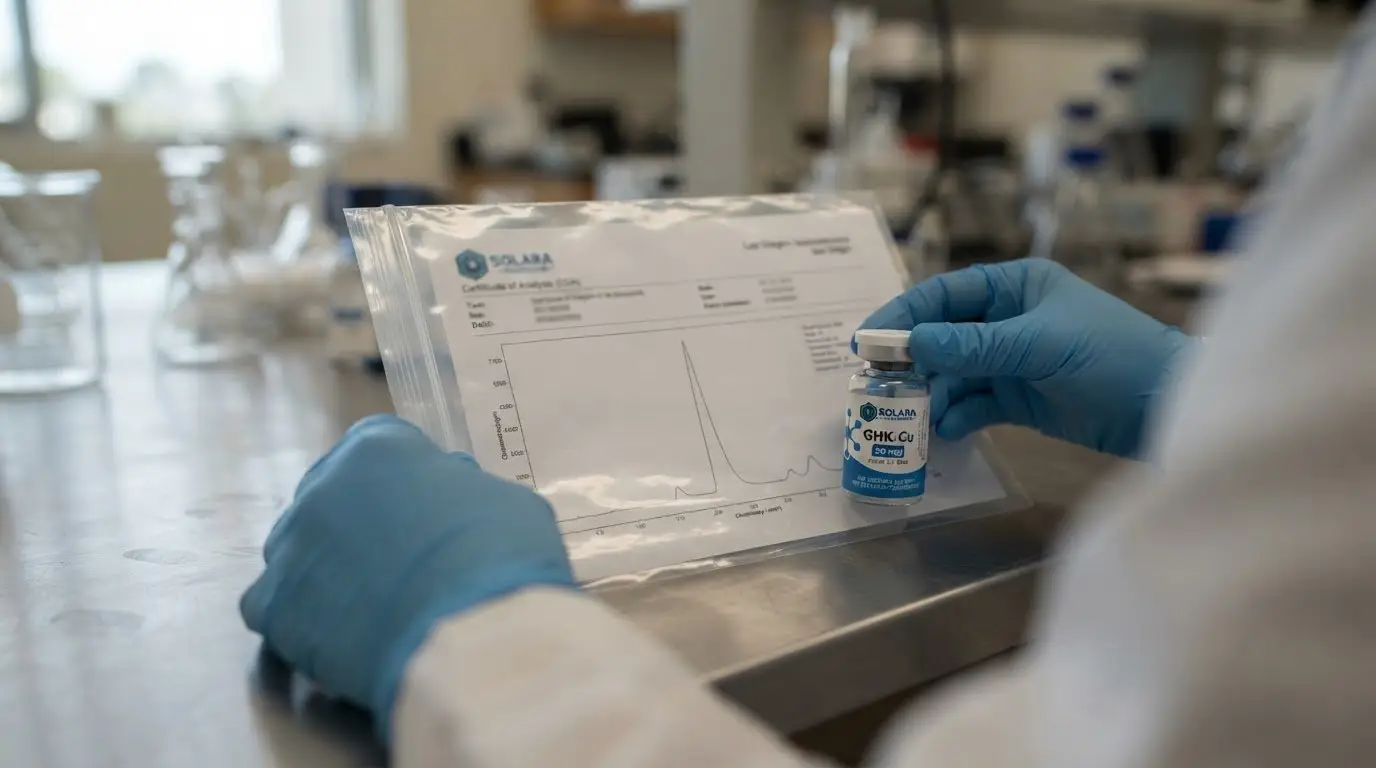
Solara Compounds supplies research materials with batch-specific Certificates of Analysis and third-party testing performed by Kovera Labs. Each batch has a unique lot number and a COA available for verification. Review the documentation when assessing material identity and purity as part of laboratory planning.
The catalog includes SOL-3RT Retatrutide 10mg, SOL-2TZ Tirzepatide 10mg, and GHK-Cu 50mg. Products are for laboratory research only, not for use in people or animals, and are not medicines or supplements. The catalog is available at solaracompounds.com.
For questions about research materials or batch documentation, contact Solara Compounds at [email protected] or 1 (877) 388-9178, Monday-Friday, 8 AM-5 PM Eastern.
Build a Consistent Plan for Your Next Study
Before beginning a laboratory study, turn the information in this reference into a handling plan. Align it with the experimental design, product documentation, and storage controls available in the lab. Record decisions and deviations to help interpret results in context.
Consistency comes from the workflow, not from an end-stage check. Establish who records sample details, where records are kept, and how handling changes are documented. These steps make peptide handling best practices part of routine research operations and support careful review of experimental results.
For laboratory research materials, explore the catalog and select options relevant to your work. Browse research peptides and continue planning your next study with care and precision.
Frequently Asked Questions
Does light damage lyophilized peptides?
Intense light can contribute to degradation, so protect lyophilized peptides from direct exposure. During bench work, keep the vial in its carton or another light-shielding covering when practical, then return it to dark storage promptly. Light sensitivity varies by peptide; follow the compound’s documentation and use consistent light conditions across samples in comparative experiments.
Should I store lyophilized peptides in the freezer or refrigerator?
Use the freezer for longer-term storage and the refrigerator for short-term holding. Dry peptides are generally kept at 4°C or colder for short-term use, while −20°C or colder is preferred for longer storage. Some sensitive sequences may benefit from −80°C storage. Keep the vial sealed and dry, and avoid repeated temperature changes that can introduce condensation or complicate sample records.
What’s the safest storage container for reconstituted peptides?
Use a clean, tightly sealed container compatible with the peptide’s solvent and planned laboratory analysis. Avoid transferring a solution without a clear experimental reason, since each transfer adds handling and potential contamination. At high dilution, some peptide solutions may adsorb to vial surfaces, reducing the amount available for analysis. Record the container type so repeat experiments use comparable materials.
How should peptides be stored before and after reconstitution?
Before reconstitution, keep the dry peptide sealed, protected from moisture and light, and frozen for longer-term storage. After reconstitution, treat the solution as a different sample: select storage based on the sequence, solvent, and intended experiment. For short-term use, refrigeration may be suitable; frozen aliquots are preferred when solution storage is necessary. Keep preparation and storage details in the laboratory record.
How do you safely reconstitute a lyophilized peptide step by step?
For laboratory research, follow the compound documentation and the laboratory’s approved procedure. First, prepare a clean work area and appropriate protective equipment. Let a cold vial warm while sealed, then inspect its label and contents. Use a suitable solvent and sterile handling practices, add liquid carefully, and mix gently. Allow time for dissolution, then label the resulting solution and store it under the selected conditions.
Which solvents and diluents are appropriate for different peptides?
The sequence’s charge and hydrophobicity guide solvent selection. A neutral or basic peptide may dissolve in PBS around pH 7.0-7.4 when a concentration of 1 mg/mL or less is suitable. Basic peptides can also dissolve in a small amount of acidic solvent before dilution. Hydrophobic peptides may need a small amount of organic solvent, followed by water or buffer. Check compatibility with the assay.
What sterile handling practices reduce contamination when preparing peptides?
Use a clean work area, gloves, and sterile equipment suited to the experiment. Disinfect the vial stopper with 70% isopropanol and let it dry before accessing the vial. For cell-culture work, a 0.22 µm sterile filter may be used where the method permits. Filter tips can reduce aerosol transfer during pipetting. Keep reagents closed between steps and avoid reusing contaminated tools.
How should peptide solutions be labeled, dated, and tracked?
Label every solution with the peptide name, concentration, preparation date, solvent or buffer, and storage condition. Add the batch or lot identifier when available, then record each thaw in the sample log. For example, distinguish two vials prepared with different buffers even if they contain the same peptide. These details help researchers trace sample history and interpret variation between experimental runs.