Research Articles
How to Avoid Research Chemical Scams and Check Suppliers


A polished website does not prove that a chemical supplier is legitimate. Knowing how to avoid research chemical scams starts with pausing before payment, verifying the supplier’s identity and product documentation, and treating pressure to pay by cryptocurrency, gift card, or wire transfer as a warning sign. If you suspect a scam, stop sending money, save messages and screenshots, and contact your bank or card provider promptly.
It’s reasonable to expect clear information about a supplier and the material being offered. For laboratory buyers, that means looking beyond claims on a product page and assessing whether the supplier provides consistent, batch-specific documentation. This guide explains practical warning signs, how to assess payment requests and suppliers, and what evidence to preserve if you need to report a suspected scam. Research chemicals are for laboratory research only; they are not medicine or supplements and are not for use in people or animals.
Key Takeaways
- Pause before paying, and treat pressure or requests for gift cards, cryptocurrency, or wire transfers as warning signs.
- Assess a supplier’s identity, website details, product information, and batch documentation together rather than relying on polished marketing alone.
- If you suspect fraud, stop sending money, save messages and screenshots, and promptly contact your bank or card provider.
- Keep a clear record of payment details and communications so you can make a useful report to the appropriate authorities.
- Independent testing can provide useful evidence about a sample, but interpret results alongside batch-specific documentation and the test’s stated scope.
1. Preserving evidence and reporting scams
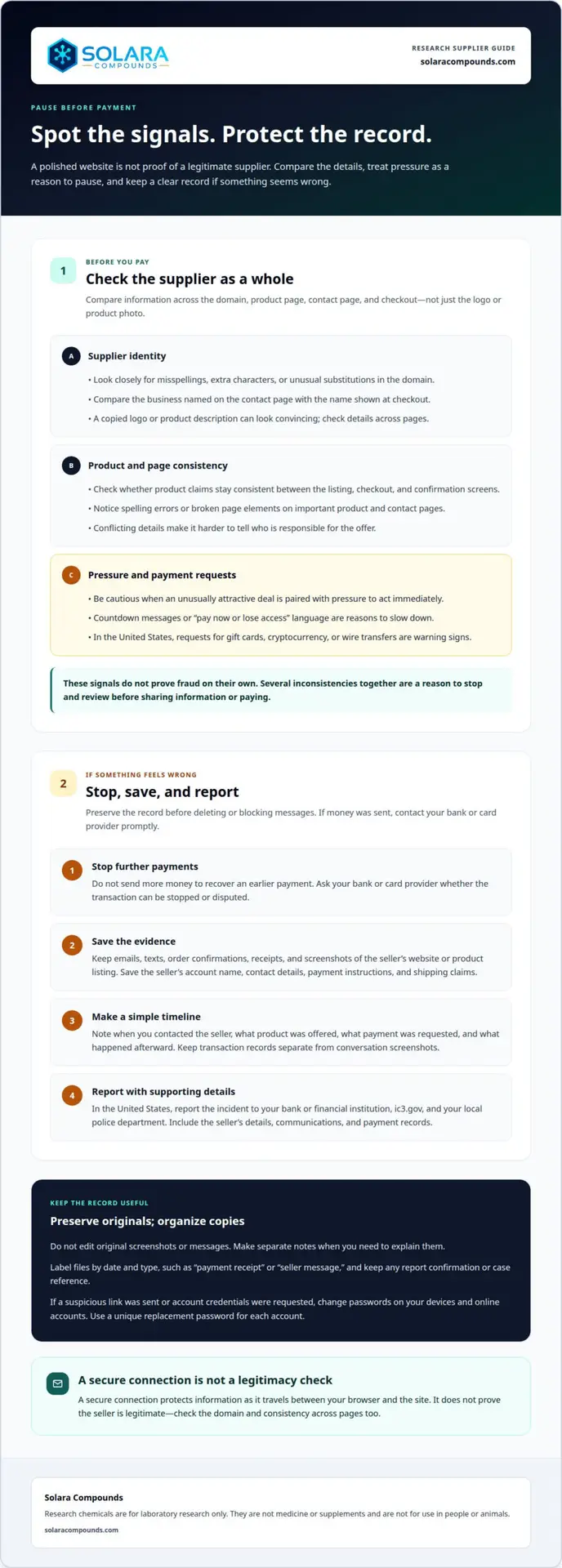
If a research chemical offer seems fraudulent, preserve the record before deleting or blocking anything. Keep emails, text messages, order confirmations, payment receipts, and screenshots of the seller’s website or product listing. Scammers can change pages or remove messages, so capture relevant details while they are visible. Save the sender’s account name, contact information, payment instructions, and any shipping claims.
Make a simple timeline while the events are clear. Record when you contacted the seller, what product was offered, what payment was requested, and what happened afterward. For example, note whether the seller promised shipping and then demanded another transfer before providing tracking information. Save transaction records separately from conversation screenshots so you can find each item quickly when speaking with your bank or making a report.
If you sent money, contact your bank or card provider immediately and ask whether the transaction can be stopped or disputed. Share the payment date, amount, recipient details, and transaction reference from your receipt. If you used a payment app or another method, save its confirmation screen and report the transaction through the provider’s support channel. Do not send more money to recover an earlier payment.
In the United States, scam victims are advised to report the incident to their bank or financial institution, ic3.gov, and their local police department. Give each organization a clear summary supported by your saved records. Include the seller’s name or account, the product listing, communication history, and payment details. Report suspicious offers promptly, even if you haven’t paid; an offer can be relevant evidence of attempted fraud.
After making a report, keep any confirmation or case reference you receive. Do not edit original screenshots or messages; make separate notes if you need to explain them. If the seller sent a suspicious link or asked for account credentials, change passwords on your devices and online accounts. Use a unique replacement password for each account, and do not reply to further messages from the suspected scammer.
A concise evidence folder helps you explain the sequence without relying on memory. Label files by date and type, such as “payment receipt” or “seller message,” and keep the original versions intact. If a bank, ic3.gov, or local police asks for details, provide the timeline and matching records. These steps help victims report suspected chemical-supplier scams clearly while reducing the chance of further payment or account exposure.
2. Common scam warning signs
A professional-looking website can still misrepresent who operates it. Scammers may copy product descriptions, use a similar domain name, or display contact details that do not match the business name. Examine the domain carefully for misspellings, extra characters, and unusual word substitutions. A small difference in a supplier’s name can lead to a different website.
Compare the website’s claims across its pages. If the contact page names one company but checkout identifies another, pause before sharing personal information. The same applies when a product page gives a specification that conflicts with another page. Inconsistent details make it harder to determine who is responsible for the offer.
Look for warning signs such as:
- A domain with misspellings or extra letters that resemble a known name.
- Product claims that change between the listing, checkout, and confirmation screens.
- Deals that seem too good to be true, especially when paired with pressure to act immediately.
- Spelling errors or broken page elements across important product and contact pages.
These signals do not prove fraud on their own, but they justify slowing down. For example, a discount combined with a countdown and a message saying “pay now or lose access” creates pressure instead of allowing careful review. Leave the checkout page and review the supplier’s identity and product information again before proceeding.
Check for a secure connection before entering personal details such as a password, account number, or date of birth. A secure connection protects information as it travels between your browser and the site. It does not prove that the seller is legitimate, so assess the domain and consistency across pages as well.
Evaluate the full page rather than judging it by a logo or product photo. A copied logo can look convincing, while mismatched names, awkward wording, and inconsistent details may be easier to spot across several pages. Read the product listing, contact information, and checkout details separately, then compare their claims.
When several warning signs appear together, do not enter sensitive information or continue to payment. Close the page, avoid links in unexpected emails, and contact the supplier through details you already trust. A deliberate review is a practical way to learn how to avoid research chemical scams without relying on a single visual clue.
3. Suspicious payment methods
A payment request can reveal risk before a product is shipped. In the United States, requests to pay by gift card, cryptocurrency, or wire transfer are scam warning signs. These methods can make it harder to resolve a disputed payment. Treat the request as a reason to pause, not proof of fraud by itself.
Government agencies such as the FDIC do not send unsolicited messages demanding money or sensitive information. They do not threaten people or demand payment by gift card, wire transfer, or digital currency. If a message claims to come from the FDIC and demands payment, do not follow its instructions. Do not share an account number, password, or payment details through the message.
Be especially cautious if a stranger asks you to open a bank account or share access to one. Never hand over a debit card or account credentials to someone you have only met online. For example, a supposed supplier might claim they need your account to process a refund. Do not provide access; contact your financial institution through its established channel.
An accidental-deposit scam may begin with an unexpected payment through an app. The sender then asks you to return the money, although the original payment may have come from a stolen or fake account. Do not send a separate payment to the requester. Contact the payment service through its official app or support process and explain what happened.
Before paying a research chemical supplier, compare the payment recipient with the business name and order details. If checkout names one seller but the payment instructions name another person, stop and assess the mismatch. A last-minute request to change payment methods also deserves scrutiny. Keep the order page and payment instructions available for comparison.
Payment options should be clear before an order is submitted. Review the product listing and the research catalog alongside the checkout details, and don’t proceed if the recipient or instructions change unexpectedly. No supplier should need your account password or debit card access to accept payment for an order.
If you suspect a scam, stop sending money and end contact with the requester. Contact your bank or financial institution promptly, especially if you shared payment information or account access. Save the transaction record and messages explaining the requested payment method. These details can help your financial institution determine whether the payment can be stopped or addressed.
4. Verifying chemical products and suppliers
Start with the supplier’s identity, then compare it across the product page, checkout, and order confirmation. A business name that changes between those pages makes responsibility harder to establish. Look for consistent contact details and clear product descriptions. Search the supplier’s name alongside terms such as “reviews,” “complaints,” and “scam reports” to find public feedback. Treat repeated reports as a reason to pause and examine the details.
Product documentation should identify the material and the batch it describes. A Certificate of Analysis (COA) can connect a test result to a particular batch, but read its scope: a result for one measured property does not establish every possible product attribute. Compare the compound name and batch identifier on the document with the product information. If a supplier offers third-party testing, check that the report identifies the tested material and states what was measured.
Ask what the paperwork actually supports. For example, a page might claim a product was tested, while the document names a different compound or batch. That mismatch matters more than a general quality slogan. Limit personal information to what the transaction requires, and do not give a seller passwords, account access, or unrelated identity details.
In the United States, applicable rules depend on the compound, its legal classification, the transaction, and whether importation is involved. A “for research use” label alone does not establish that a purchase, possession, or import is permitted.
To check state restrictions, identify the compound’s exact name and chemical identity, then review current state controlled-substance schedules and relevant state agency information. Check federal status as well, because state and federal requirements may differ.
Before paying, research the seller and the specific offer rather than relying on a product photograph. Confirm that the listing describes the intended laboratory material, provides traceable batch documentation, and presents consistent business details. If the seller will not provide basic product information or pressures you to pay before assessing the offer, do not proceed. Save the listing and messages if you need to explain why the offer seemed suspicious.
Use a deliberate sequence: confirm the seller’s identity, review the product description, examine the relevant batch paperwork, and then assess the payment instructions. For instance, a COA tied to a different batch does not substantiate the batch being offered. A secure-looking website cannot establish product identity or legality either. Combining these checks gives researchers a clearer basis for deciding whether an offer is suitable for laboratory evaluation.
5. Are independent laboratory tests reliable for checking research chemicals?
Independent testing can provide useful evidence, but a report answers only the questions its methods address. For example, an identity test may indicate whether a sample matches the named compound. It does not automatically establish concentration, purity, or the absence of every contaminant. Read the report’s stated scope before treating a result as a complete product assessment.
Check whether the report identifies the exact compound and sample tested. It should connect the results to a sample or batch identifier that can be compared with the supplier’s paperwork. If the document names a different compound, omits identifying details, or describes another batch, it may not support the material being offered.
Next, review the test method and measured properties. A method designed to assess identity may not measure concentration. A purity result may also depend on the analytical method and the substances it can detect. For example, a report describing one measured property does not establish that other properties were tested.
Testing is only as representative as the sample. A laboratory result describes the sample submitted, so its connection to the product batch matters. Ask whether the report is batch-specific and whether its identifier matches the supplier’s current documentation. A generic report reused across product pages offers less traceability than one tied to the batch being offered.
Assess the laboratory and report together. Look for the laboratory’s name, sample description, test date, method, and result. Check that the report appears complete, with no missing pages or mismatched identifiers. A third-party label alone does not explain what was tested. Clear documentation lets researchers evaluate the evidence instead of relying on a general testing claim.
Use this practical review when examining a report:
- Match the compound name and batch identifier to the product paperwork.
- Identify which properties the method measured, such as identity or concentration.
- Check the laboratory name, sample description, and reported results.
- Note what the report doesn’t evaluate before drawing conclusions about the sample.
Independent results are most useful alongside supplier documentation and a clear sample-to-batch connection. They can help researchers assess a specific sample, but they don’t replace careful review of the supplier, product details, and testing scope. For laboratory research only, compare the documentation and available materials in the research catalog before deciding whether they fit your laboratory needs.
Solara Compounds
Solara Compounds supplies research materials with documentation for laboratory buyers assessing supplier offers. Its product information includes batch-specific Certificates of Analysis and third-party testing records, which researchers can review alongside relevant product details.
The catalog includes SOL-3RT Retatrutide 10mg and SOL-2TZ Tirzepatide 10mg. These products are for laboratory research only, not medicine or supplements, and not for use in people or animals.
For questions, email [email protected] or call 1 (877) 388-9178, Monday-Friday, 8 AM-5 PM Eastern, or contact Solara Compounds.
Make the Next Purchase Evidence-Led
Use the checks in this guide as part of a repeatable purchasing process. Before placing an order, define what your laboratory work requires, then assess whether the product information and supporting records align with that purpose. This keeps the decision focused on traceable evidence rather than urgency or presentation. Learning how to avoid research chemical scams means assessing each offer individually, even when a supplier or product name seems familiar.
For laboratory research only, not for use in people or animals, research materials should fit a clearly defined laboratory need. For example, GHK-Cu 50mg is one of the research compounds available through Solara Compounds. Consider the product information in the context of your research requirements before proceeding.
If you have questions about research materials, contact Solara Compounds through the research catalog. Take the next step at your own pace, with a clear purpose and careful attention to documentation.
Frequently Asked Questions
Why Caution is Crucial?
Caution protects the quality of laboratory conclusions, not just the purchase. If a sample’s identity or handling history is uncertain, results may not be comparable across experiments. Researchers can reduce that uncertainty by recording the supplier, lot, receipt date, and storage conditions in laboratory records. Consistent records make it easier to trace unexpected results to materials or handling conditions instead of drawing conclusions from incomplete information.
How can you verify whether a research chemical vendor is legitimate?
Assess the vendor’s business practices as well as its product information. Read its terms, privacy policy, and refund conditions to understand how orders and personal data are handled. Then ask a specific question about documentation or order records and assess whether the reply addresses it clearly. A thoughtful response can inform your assessment, but it is not proof by itself. Base purchasing decisions on evidence you can independently review.
What warning signs indicate a research chemical website or seller may be a scam?
Be cautious of reviews with nearly identical wording, praise without details about a specific transaction, or accounts with little relevant history. A seller may also display endorsements or laboratory logos without explaining what they relate to. Search distinctive phrases from reviews to see whether they appear elsewhere. Treat testimonials as leads to investigate, not proof that a particular batch was tested or delivered.
How can you verify a vendor’s chemical identity, purity, and certificates of analysis?
A Certificate of Analysis is product documentation, not legal authorization or a guarantee of experimental results. It cannot establish that a compound is lawful to buy in a particular location or suitable for a specific research design. Assess these questions separately: review the document for material information and evaluate applicable requirements independently. Researchers should define in advance which measurements their experiment requires rather than treating one certificate as universal evidence.
What payment methods offer protection when buying research chemicals online?
Payment protections vary by provider, transaction type, and dispute circumstances. Before paying, read the provider’s terms for reporting unauthorized or unfulfilled transactions, and save its dispute instructions. Do not assume that a payment marked “complete” confirms shipment or product identity. If a payment method offers no practical way to dispute a transaction, consider that limitation when assessing the purchase.
How do scam research chemical sellers use fake reviews, copied websites, and tracking numbers?
A tracking page may show only that a shipping label was generated, not that the carrier accepted the parcel. Check for a carrier acceptance scan and whether later tracking events match the stated destination. If the number leads to an unrelated shipment or remains at label creation, contact the carrier through its own tracking service. Save the status and timestamp to distinguish a delay from a shipment that never entered transit.
What should you do if a research chemical order never arrives or the seller disappears?
First, check the delivery address on your order confirmation for a typo, then review the carrier’s delivery details. Ask household members or a receiving desk whether they accepted the parcel, if applicable. If the carrier marks it delivered but you cannot locate it, report the discrepancy through the carrier’s process and note the case reference. These checks may identify a routing or handoff issue without relying on the seller’s account alone.
What health and safety risks come from misidentified or contaminated research chemicals?
In laboratory settings, misidentified material can invalidate an experiment, while contamination can introduce variables researchers didn’t intend to study. Unknown composition also makes it harder to select appropriate laboratory handling controls. Don’t use an uncertain sample in an experiment, and follow the facility’s chemical safety procedures for isolating and documenting it. Research chemicals are for laboratory research only, not medicine or supplements, and not for people or animals.