Research Articles
Buying GHK-Cu for In-Vitro Research: A Lab Buyer’s Guide


What if a GHK-Cu listing looks complete but its paperwork doesn’t match the batch being offered? For lab buyers looking to buy GHK-Cu for research, that distinction matters. Marketing language about purity can’t replace records that identify a specific lot and show which tests were performed.
It’s reasonable to expect clear evidence before evaluating a research material. This guide explains how to review batch-specific Certificates of Analysis (COAs), lot traceability, and identity and purity terminology, so you can assess what the documentation supports without treating a purity claim as proof of identity.
Solara Compounds supplies GHK-Cu in 50 mg and 100 mg formats for laboratory research, with batch-specific COA documentation, lot-number traceability, and third-party testing through Kovera Labs. We’ll outline what to look for in the report, how to connect it to the offered lot, and how supplier transparency can support procurement review. GHK-Cu and all Solara Compounds products are Research Use Only, intended solely for laboratory research, not for human or animal consumption. Product and documentation information is available at solaracompounds.com.
Key Takeaways
- Separate identity results from purity data: each answers a different question about the material.
- Before ordering, match the COA lot number to the GHK-Cu batch on the listing.
- Compare suppliers using specific evidence, including accessible batch reports, traceability, and stated analytical methods, not broad quality language.
- Use a consistent procurement record: note the research requirement, product name, COA details, and lot reference.
- When you buy GHK-Cu for research, evaluate the listing as a laboratory material. Solara Compounds’ products are Research Use Only, for laboratory research only, and not for human or animal consumption.
What GHK-Cu Means in Laboratory Research
GHK-Cu is a copper-binding tripeptide complex: a short chain of three amino acids, commonly identified as GHK, associated with copper. The name describes the peptide and copper association, not a guaranteed level of purity or proof that a particular vial contains the stated material. For laboratory procurement, assess identity using documentation tied to the specific batch.
What does GHK-Cu refer to?
GHK refers to the amino-acid sequence glycyl-L-histidyl-L-lysine. A tripeptide is simply a molecule made from three linked amino acids. The “Cu” indicates copper associated with that peptide. Together, the term names a research material; it doesn’t describe an intended end use or establish how a specific batch will perform in an experiment.
That distinction matters when reviewing a listing. A product name is a starting point, while batch-specific records help connect the named material to the lot offered. Researchers can consult the Copper peptide GHK-Cu Wikipedia article for general background, then use scientific literature and batch documentation for the relevant research and procurement questions.
What is the in-vitro research context?
Dermal and cell-culture research examines materials and biological systems in controlled laboratory settings, such as dermal fibroblast cultures and other cell-based models. In this context, GHK-Cu appears in published in-vitro studies of copper peptide complexes as a research tool. The literature’s subject, methods, and limits should be checked directly; findings from one study cannot automatically be applied to another material, setup, or supplier’s product.
Keep three kinds of evidence separate:
- Published literature: what a particular paper investigated and reported.
- Product documentation: what the supplier states about a specific material or batch.
- Experimental findings: what researchers observe under their own documented laboratory conditions.
One category doesn’t establish the claims of another. Literature about GHK-Cu isn’t evidence of results for a Solara Compounds batch, and a COA doesn’t guarantee experimental outcomes. Lab buyers planning to buy GHK-Cu for research should treat the material as a research input and evaluate its records independently of any marketing language.
Solara Compounds offers GHK-Cu in 50 mg and 100 mg formats for laboratory research. Review the GHK-Cu research listing alongside batch documentation. All products are Research Use Only, for laboratory research only, and not for human or animal consumption.
How to Evaluate GHK-Cu Identity, Purity, and Batch Documentation
A Certificate of Analysis (COA) is useful only when its results can be connected to the material under review. Read it as a record of reported analytical findings, not as a promise about how a research experiment will turn out.
How should researchers read a GHK-Cu COA?
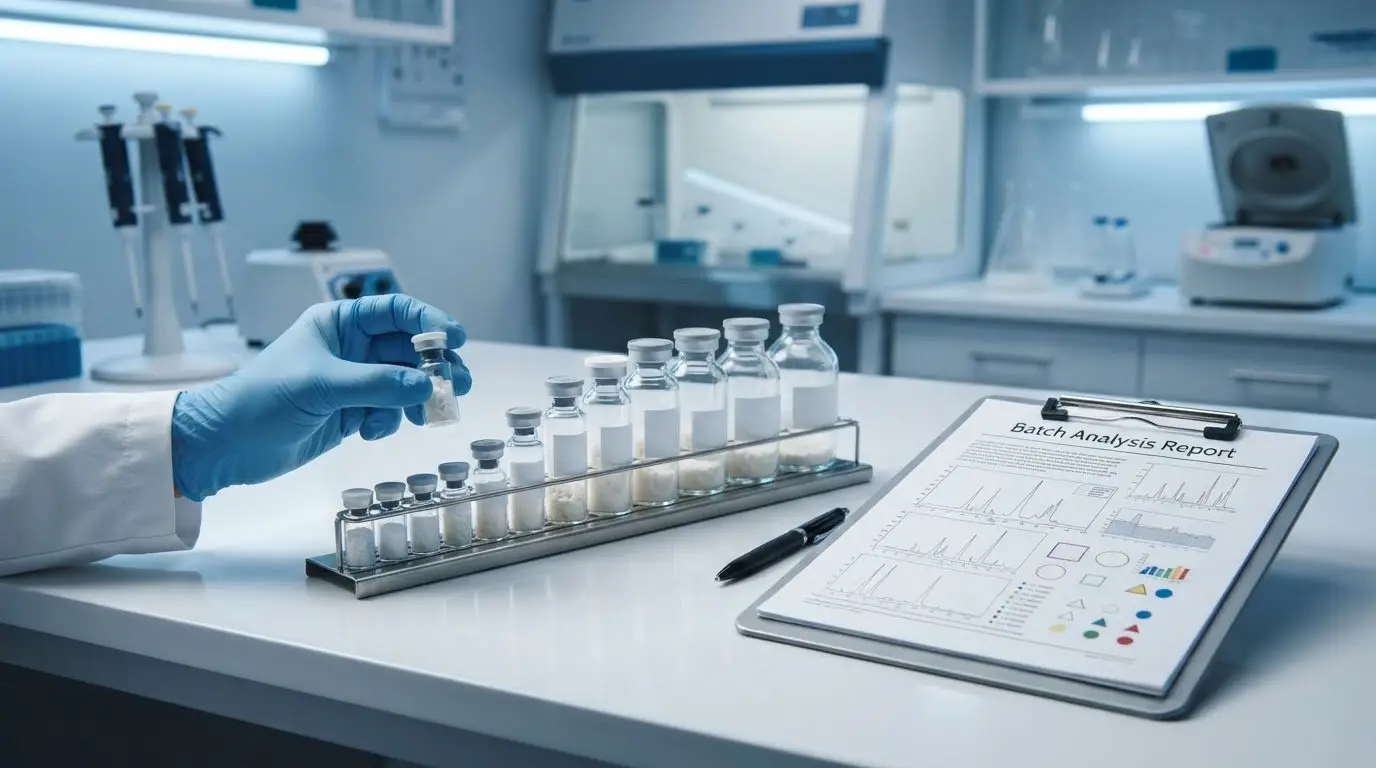
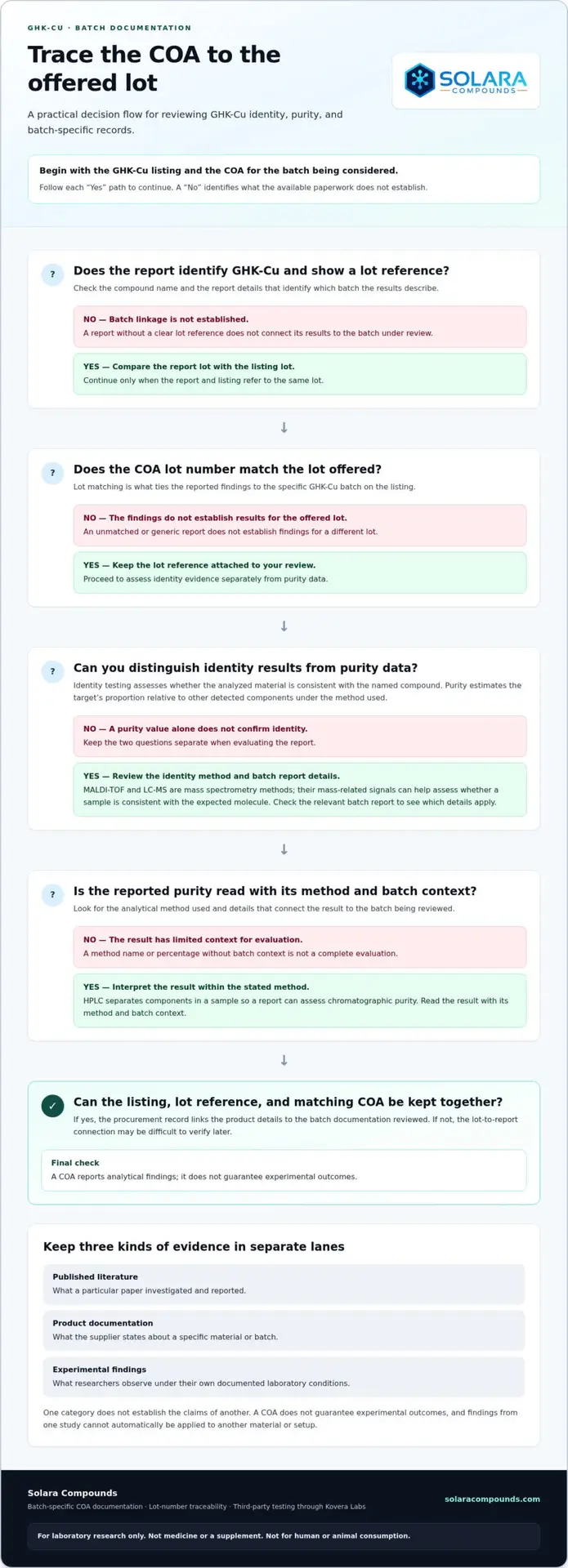
Start by checking the compound name and lot reference. The lot number on the report should match the lot offered for the GHK-Cu listing. Then review the reported purity, the analytical method used, and the date or other report details that help identify which batch the results describe. An unmatched or generic report doesn’t establish findings for a different lot.
Identity and purity answer different questions. Identity testing assesses whether the analyzed material is consistent with the named compound. Purity testing estimates the proportion of the detected material represented by the target relative to other detected components under the method used. A reported purity value alone doesn’t confirm identity.
HPLC, or high-performance liquid chromatography, separates components in a sample so an analytical report can assess chromatographic purity. The result should be read with its method and batch context; a method name or percentage without those details is not a complete evaluation.
What do mass spectrometry results contribute?
MALDI-TOF and LC-MS are mass spectrometry methods. In plain terms, they measure molecular mass-related signals that can help assess whether a sample is consistent with the expected molecule. Solara Compounds’ stated manufacturing information refers to these methods for identity confirmation, but buyers should use the relevant batch report to determine which details apply to the lot being considered.
Method names don’t establish every aspect of quality, nor do they show how a material will behave in a laboratory model. For a broader discussion of testing concepts, see our guide on how to read an HPLC-MS report for peptide research. The article GHK-Cu 50mg for Research: Molecular Properties and Laboratory Applications can provide compound-specific background; interpret any referenced evidence according to its actual scope.
For procurement review, keep the product listing, lot reference, and matching COA together in the lab’s records. Solara Compounds provides batch-specific COA documentation and third-party testing through Kovera Labs. Lab buyers can review the research catalog and compare listing details with the relevant batch paperwork. GHK-Cu is for laboratory research only, not for human or animal consumption.
How to Compare GHK-Cu Research Suppliers Without Relying on Marketing
A supplier comparison is more useful when every listing is assessed against the same evidence. Words such as “premium” and “high quality” are descriptions, not analytical results. For lab buyers deciding where to buy GHK-Cu for research, focus on records that can be tied to the specific product and lot.
Which supplier details are directly verifiable?
Use the same comparison fields for each listing. Record what the supplier documents, rather than filling gaps with assumptions.
- COA access: Is a report available for review, and does it identify the material and the tested lot?
- Lot traceability: Can the lot number on the report be matched to the lot offered?
- Identity methods: Are the analytical methods named and their role described?
- Stated purity: Is a purity result reported with a method and batch reference, rather than as an unqualified marketing claim?
A method name or purity figure is most useful when its connection to the relevant batch is clear. Keep shipping speed, customer service, and other operational claims in a separate part of the comparison. They may matter to procurement, but they don’t establish compound identity or analytical findings.
How can buyers compare product listings consistently?
Capture the exact product name and format shown on each listing, then note documentation access, lot reference, identity methods, and stated purity. If a detail is absent or unclear, mark it as unresolved. Don’t infer a test result, specification, or batch match from a broad quality statement.
This approach also keeps the comparison focused on laboratory procurement. Promotional language isn’t a substitute for compound-specific documentation, and published research doesn’t verify a supplier’s particular batch.
For broader supplier-evaluation context, see Finding Trustworthy Peptide Sources: A Lab Buyer’s Guide. Solara Compounds supplies GHK-Cu with batch-specific COA documentation, lot-number traceability, and third-party testing through Kovera Labs. These are documentation features to review against the listing and matching report, not a guarantee of experimental outcomes. Buyers can review the research catalog as part of their procurement comparison.
All Solara Compounds products are Research Use Only, for laboratory research only, and not for human or animal consumption.
A Practical GHK-Cu Procurement Checklist for Laboratory Buyers
A consistent purchasing record makes it easier to connect a research requirement with the material selected and its supporting documentation. Before placing an order, move through the same review sequence each time, then retain the records according to your institution’s purchasing and laboratory procedures.
What should be recorded before placing an order?
Start with the planned laboratory research and the exact listing format under consideration. Solara Compounds lists GHK-Cu in 50 mg and 100 mg formats. Record the format shown on the listing rather than relying on a shortened description in an email or internal request.
- Define the research requirement. Note why the material is being procured for the laboratory project and any relevant internal purchasing requirements.
- Identify the listing. Record the exact product name and listed format, along with the listing details used for the procurement review.
- Locate the COA. Note the report’s lot reference and retain the report with the listing information.
- Follow institutional procedures. Keep the listing and batch documents in the records system required by your organization.
These steps create a traceable record before the order is placed. They also help prevent a report for one lot from being filed as documentation for another.
How can buyers complete a documentation review?
Compare the COA lot reference with the lot associated with the GHK-Cu listing under consideration. Review the reported identity and purity information, including the analytical methods named in the report. Record what the document states, and don’t infer attributes it doesn’t report. If a detail is unclear, preserve that as an open item in the procurement record rather than treating it as established.
Use the product listing and matching COA together. The listing identifies the research material and format; the batch report provides analytical findings associated with a lot. Neither document guarantees experimental outcomes, so keep procurement evidence distinct from later laboratory observations.
For report access and review, use Solara Compounds’ Batch COA and Lab Reports resource. Buyers preparing to buy GHK-Cu for research can then review the research catalog and keep the selected listing details with the relevant batch paperwork.
Solara Compounds products are Research Use Only, for laboratory research only, and not for human or animal consumption.
GHK-Cu from Solara Compounds: Review the Listing and Batch Evidence
Solara Compounds supplies GHK-Cu in 50 mg and 100 mg formats for laboratory research. For procurement review, consider the listing and its documentation together: the listing identifies the product and format, while the matching batch report provides analytical information tied to a lot.
What documentation does Solara make available?
Batch-specific Certificates of Analysis (COAs) are available for review. Solara Compounds also documents lot-number traceability and third-party testing through Kovera Labs. These features help lab buyers follow the connection between a listed product, its lot reference, and the report associated with that batch.
Review the batch report rather than relying on general descriptions. Check that the lot reference corresponds to the GHK-Cu batch under consideration, then read the reported identity and purity findings in their stated context. Solara’s website-stated manufacturing information includes HPLC purification and MALDI-TOF and LC-MS identity confirmation. The matching report is the place to assess which analytical details apply to a particular batch.
The documentation supports procurement review, but it doesn’t guarantee experimental outcomes. Researchers should retain the listing and applicable COA according to their laboratory’s purchasing and recordkeeping procedures.
Where can laboratory buyers review current information?
The GHK-Cu research listing provides the product-specific reference for Solara Compounds’ 50 mg and 100 mg formats. Lab buyers preparing to buy GHK-Cu for research can compare the current listing with the report for the relevant lot, recording the product name and lot reference in their procurement files.
Use the documents for what they show. A product listing identifies the material being procured; a batch-specific COA presents reported analytical findings for its referenced lot. Neither replaces a laboratory’s own research design, institutional purchasing requirements, or records.
All Solara Compounds products are Research Use Only, for laboratory research only, and not for human or animal consumption. See the current research catalog.
Make Your GHK-Cu Procurement Review Traceable
Reliable procurement starts with evidence tied to the material being considered. Distinguish identity results from purity data, match the COA lot number to the offered batch, and retain the listing and report together in laboratory records. These steps help researchers assess documentation without confusing supplier statements with experimental findings.
Solara Compounds supplies GHK-Cu in 50 mg and 100 mg formats, with batch-specific COA documentation, lot-number traceability, and third-party testing through Kovera Labs. Review the report for the relevant lot; testing documents analytical findings, not guaranteed research outcomes. For anyone planning to buy GHK-Cu for research, this evidence-led approach supports a clearer procurement decision.
For questions about research materials, contact [email protected] or call 1 (877) 388-9178, Monday-Friday, 8 AM-5 PM Eastern. All products are Research Use Only, for laboratory research only, and not for human or animal consumption. View the current research catalog. A careful record today can make future procurement reviews more consistent.
Frequently Asked Questions
What is GHK-Cu in in-vitro research?
GHK-Cu is a copper-binding tripeptide complex discussed in scientific literature. In dermal and cell-culture research, investigators study it in controlled laboratory settings, but literature about a compound shouldn’t be treated as evidence about a specific supplier’s batch. For laboratory procurement, identify the research material and review documentation relevant to the exact batch being considered.
How can I verify a GHK-Cu batch before ordering?
Start with the batch-specific Certificate of Analysis (COA) and compare its lot number with the lot associated with the product listing. Then review the identity and purity findings and note the analytical methods reported. Laboratory purchasing teams in Boston, San Diego, San Francisco, New York, Houston, Miami, Los Angeles, Austin, Raleigh, Seattle, Chicago, Philadelphia, Baltimore, Dallas, Phoenix, Tampa, Atlanta, and Denver can use this same documentation check when they buy GHK-Cu for research.
What should a GHK-Cu Certificate of Analysis include?
Review the compound identification, lot reference, reported purity result, and analytical methods. Confirm that the report is tied to the batch under consideration, rather than relying on a generic example or paperwork for another lot. A COA records the analytical findings it reports. It doesn’t establish unreported product attributes or guarantee how the material will perform in a particular laboratory model.
Can HPLC confirm GHK-Cu identity?
HPLC can assess chromatographic purity, but a purity result is not the same as molecular identity confirmation. Check the complete batch documentation to see which methods support each finding. Don’t infer identity from an HPLC percentage alone if the report doesn’t state that identity was assessed. Reading the result alongside the lot reference and any additional analytical findings gives buyers a more accurate view of the available evidence.
How do MALDI-TOF and LC-MS support peptide analysis?
MALDI-TOF and LC-MS are mass spectrometry methods that measure molecular characteristics and can support molecular identity assessment. In a supplier report, check which method was used, the batch reference, and the conclusion the report actually states. A method name alone doesn’t establish every quality attribute, so interpret it alongside other reported analytical data rather than as a complete assessment of the material.
Is Solara Compounds GHK-Cu intended for personal or consumer use?
No. Solara Compounds products are Research Use Only, intended solely for laboratory research, and not for human or animal consumption. They are not drugs, medicines, or dietary supplements. The GHK-Cu listing and matching batch COA are for laboratory procurement review. Researchers should use product-specific documentation to identify the relevant lot and follow their institution’s purchasing and laboratory procedures.