Research Articles
Where to Buy Lab Peptides in the USA: 2026 Guide


A broad catalog isn’t the strongest reason to buy peptides for laboratory research USA-wide. Clear compound details and batch-level evidence matter more. Lab buyers know that suppliers can vary in how they identify compounds, describe formats, and present analytical records.
This guide offers a practical way to evaluate those details before placing a U.S. laboratory order. It covers product fit, lot-number traceability, batch-specific Certificates of Analysis (COAs), analytical evidence, and procurement information, so you can compare suppliers with fewer unknowns.
Solara Compounds is a U.S. supplier of research peptides and selected research compounds. Its documentation includes unique lot numbers, batch-specific COAs, and third-party testing through Kovera Labs. These records can help researchers review a batch’s reported identity and purity; they don’t guarantee experimental outcomes. Product information is available at solaracompounds.com.
All products are for laboratory research only. They are not for human or animal use, and they are not medicines or supplements. The sections ahead explain what to check in a catalog, how to connect a product listing to its batch paperwork, and which procurement details to consider.
Key Takeaways
- Start with the exact compound and format your study requires, then check whether the product information is clear enough to assess its fit.
- Match a batch COA’s lot number to the product batch, and review purity and identity results as distinct types of evidence.
- Use consistent criteria to compare U.S. sources, including product identification, traceability, analytical methods, and fulfillment information.
- Before you buy peptides for laboratory research USA, define the research need, identify the specific listing, review its records, and prepare procurement details.
- Solara Compounds provides research-focused product information and batch documentation. Products are for laboratory research only, not for people or animals, and not medicines or supplements.
Buying Peptides for Laboratory Research in the USA: Start With Research Fit
Researchers and lab buyers sourcing peptides in the United States need more than a familiar compound name. They need product information that fits the planned laboratory work and batch records they can review. A clear starting point is the research question: identify the material and format under consideration, then check whether the available documentation supports an informed purchasing decision.
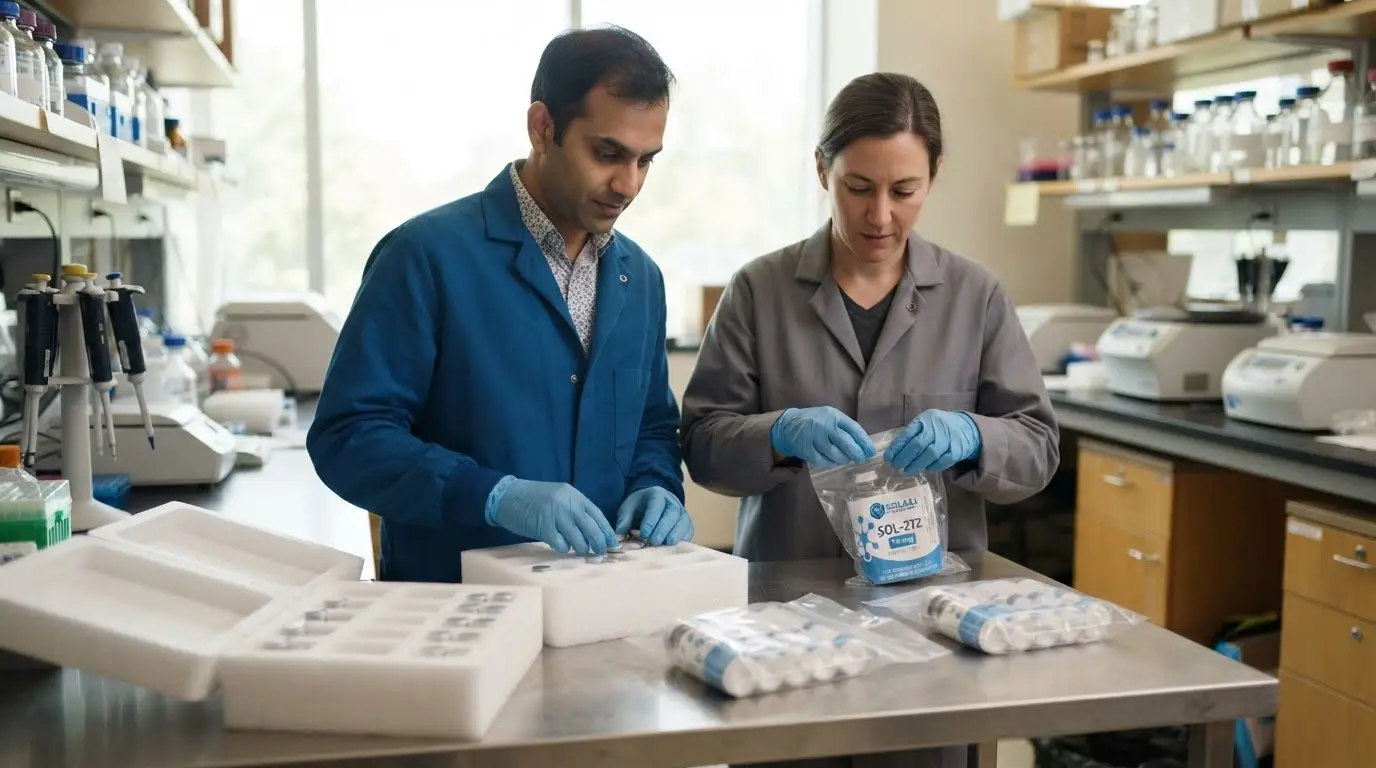
For practical purposes, research-grade sourcing means matching product information to a defined study and being able to review records tied to the specific batch. It does not mean that a catalog label predicts an experimental result. Solara Compounds supplies lyophilized research peptides and selected research compounds, with product information and batch documentation available through the research peptide catalog.
Match the catalog listing to the research question
Start with the compound relevant to the planned laboratory work, rather than choosing by popularity or catalog breadth. A listing name such as SOL-3RT, SOL-2TZ, BPC-157, or GHK-Cu is a catalog identifier. It helps distinguish one offering from another, but it does not establish how a material will perform in a particular experiment.
Check that the listing clearly identifies the compound and its supplied format. Researchers comparing peptide materials can consult What are Peptides? for a general overview of peptide structure and biological functions. That background can help frame terminology, while the specific study design should determine which material is relevant.
Before selecting an item, write down what the study requires: the compound identity, the format needed for the work, and the records required for purchasing or internal review. Then compare those requirements against the listing. If a name or format is unclear, pause rather than infer details from a product title or from an assumed similarity to another catalog item.
Distinguish research sourcing from general online shopping
For laboratory procurement, the product page is only the starting point. A listing can identify an offering, but it does not by itself show the analytical findings for the batch a buyer will receive. Batch records and traceability help connect those two pieces of information, giving lab buyers something concrete to review as part of sourcing.
Research-focused peptide sourcing pairs product details that fit a defined study with batch records that buyers can review. This keeps the decision centered on identity, format, and documentation, not promotional language or implied performance. A certificate or analytical record can inform a purchasing review, but it cannot guarantee an experimental outcome.
- Define the research need before comparing catalog items.
- Separate the compound name and supplied format from claims about results.
- Look for records tied to the batch, not just general product descriptions.
All Solara Compounds products are for laboratory research only. They are not for human or animal consumption and are not medicines or supplements. Keeping that boundary clear helps ensure sourcing decisions stay focused on laboratory use.
How to Evaluate Research Peptide Suppliers: COAs, Lots, and Test Methods
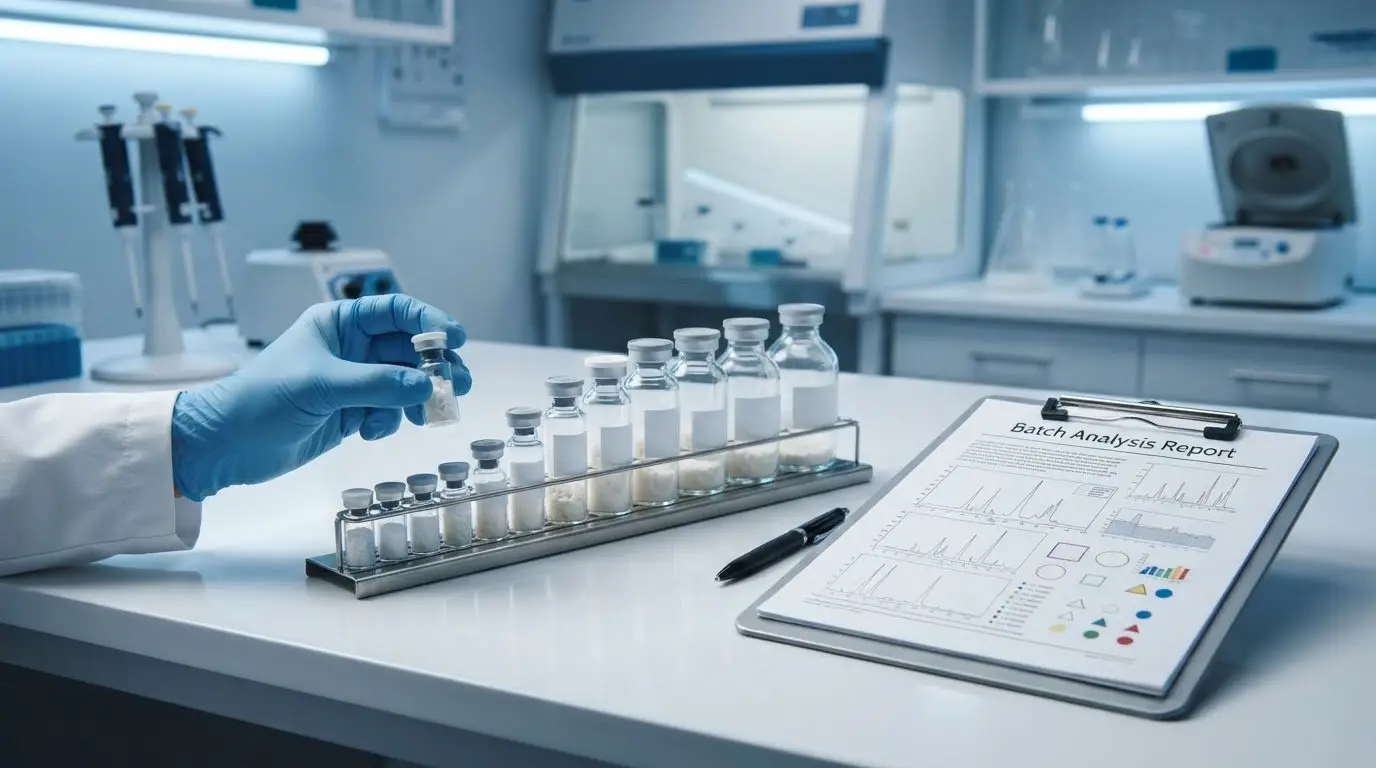
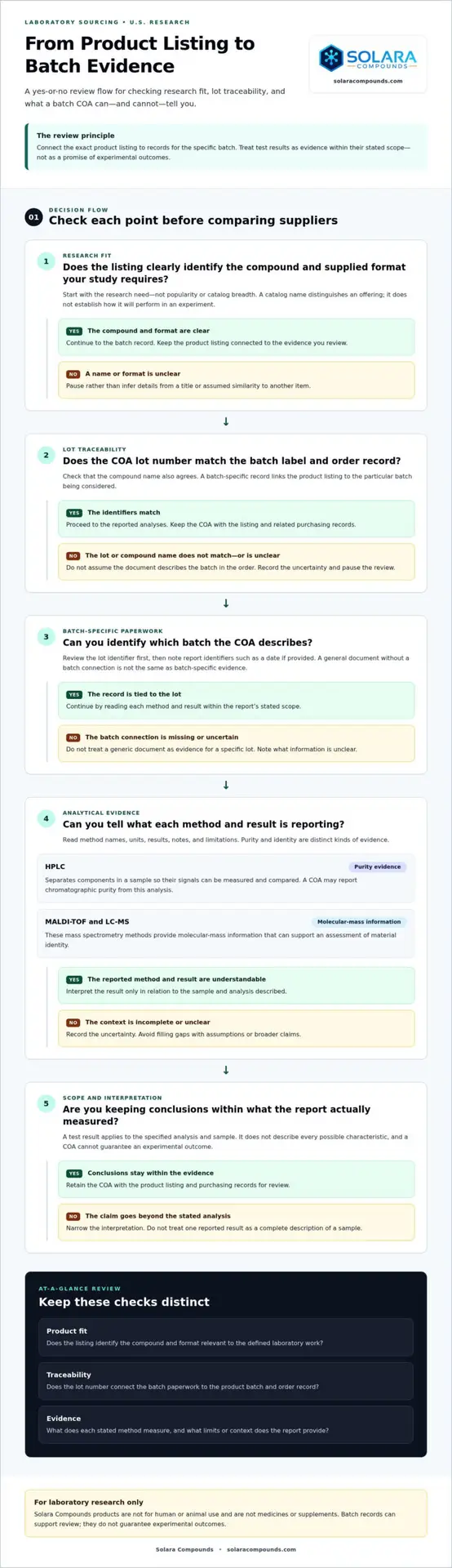
A COA is most useful when a buyer can tell what material it describes, which analyses were performed, and what the reported results mean. Read the document as a record of measurements, not as a general quality promise. Keep the product listing and its batch paperwork together during review so the purchasing record stays connected to the evidence.
Read a batch-specific COA systematically
Begin with the lot identifier. Compare it with the number shown on the material or its accompanying label, and check that the compound name agrees with the order record. Then note the date or other report identifiers if provided, followed by each method and result. If a field is unclear, record the uncertainty rather than filling it with an assumption.
For orderly procurement, retain the COA with the related product listing and purchasing documents under the laboratory’s normal recordkeeping process. Solara Compounds makes batch report information available for review. The key is to use the record that corresponds to the lot being considered, rather than relying on a generic document that doesn’t identify the batch.
Read the report within its stated scope. A test result describes what the specified analysis measured; it doesn’t establish every characteristic of a sample. Pay attention to units, method names, and any notes or limitations included in the document. If the report presents a result without enough context to interpret it, avoid making a broader claim than the report supports.
Understand purity and identity evidence
HPLC separates components in a sample so their signals can be measured and compared. A COA may report a chromatographic purity result from this analysis. That result applies to the method and sample described in the report, so buyers should avoid treating it as a complete description of every possible impurity or property.
MALDI-TOF and LC-MS are mass spectrometry methods. They provide molecular mass information that can support an assessment of whether a sample is consistent with the named compound. A useful review checks which method appears on the record and whether its reported result corresponds to the expected identity, without extending the conclusion beyond the document.
Purity analysis describes the sample’s measured composition, while mass spectrometry provides evidence relevant to molecular identity. Each answers a different question, so one result shouldn’t be used as a substitute for the other. Neither establishes how a material will behave in a specific experiment.
- Match the lot identifier and compound name to the procurement record.
- Note the test method and the result it reports.
- Keep the interpretation within the report’s stated scope.
For buyers comparing where to buy peptides for laboratory research USA-wide, clear documentation supports a more structured review, but doesn’t guarantee experimental outcomes. Solara Compounds products are for laboratory research only, not for human or animal consumption, and are not medicines or supplements. Buyers can review the research catalog as part of their sourcing process.
Compare U.S. Research Peptide Sources by Documentation and Procurement Fit
A useful supplier comparison starts with the project’s requirements, not the number of products in a catalog. A broad selection may offer options, but it doesn’t establish whether a particular listing suits the laboratory’s needs or fits its purchasing process. Apply the same criteria to each source, then record where the available information supports a decision and where it leaves questions unanswered.
Use a consistent supplier comparison framework
Review product identification, traceability, analytical evidence, and fulfillment information side by side. Focus on details you can verify in product records and purchasing information. Specific methods and results are more useful for comparison than broad descriptive claims.
| Criterion | What to review | Why it matters |
|---|---|---|
| Product identification | Does the listing name the exact compound and describe its research format? | Helps determine whether the listed material matches the project’s purchasing requirements. |
| Batch traceability | Can the item be associated with an identifiable lot and its records? | Makes it easier to maintain a clear link between the purchase and its documentation. |
| Analytical evidence | Are the method and reported findings stated clearly? | Allows buyers to assess the information provided without relying on promotional language. |
| U.S. procurement fit | Is relevant fulfillment information available, and can the purchase fit internal procedures? | Supports practical planning for laboratory and institutional procurement. |
Distinguish supplier-provided documentation from information about independent testing. A supplier report identifies data the supplier provides; a third-party report indicates that analysis was conducted externally. Compare what each record actually documents, including the identified material, method, and reported findings. A general statement about testing isn’t a substitute for reviewing the available evidence.
Catalog breadth can be useful when a project has several defined material requirements, but it shouldn’t be treated as a measure of fit on its own. A smaller or larger selection says little about whether a particular listing meets a study’s needs. The comparison should stay focused on the exact material and the records available for review.
Account for U.S. purchasing and institutional needs
Fulfillment information is one part of procurement planning. Institutional buyers may also need to align a request with internal purchasing steps, documentation requirements, or approval workflows. Identify those requirements before submitting an order, and use the information provided for the specific purchase rather than assuming delivery timing or other terms.
For buyers assessing where to buy peptides for laboratory research USA-wide, a short comparison record can make sourcing decisions easier to explain internally. Note the listing reviewed, the documentation available, the analytical information stated, and the relevant fulfillment details. Solara Compounds’ research peptide catalog can be considered alongside those procurement criteria. All products are for laboratory research only, not for human or animal consumption, and are not medicines or supplements.
A Practical Checklist for Ordering Research Peptides Online
A consistent pre-order review helps lab buyers move from a research requirement to a well-documented procurement request. Keep the process straightforward: define the need, identify the exact listing, review the available records, and prepare the order details. Each step reduces the chance of selecting an item based on an unclear name or assumption.
Prepare the order details and documentation review
Before submitting a request, verify that the compound name and listed format match the laboratory’s purchasing requirements. Then review the applicable batch documentation and record the lot details with the product information. Retain records according to the laboratory’s own process, so purchasing and research teams can refer to the same information later.
- Define the research need. Identify the compound relevant to the laboratory work and the product information your purchasing process requires.
- Identify the exact listing. Match the catalog name and listed format to the procurement request. Don’t rely on a similar name or assume two listings are interchangeable.
- Review the records. Check that the batch documentation corresponds to the product being considered. If third-party testing is described, review the reported evidence and methods rather than relying on a general statement.
- Prepare procurement details. Include the exact listing and relevant documentation in the request, then follow the laboratory or institution’s purchasing workflow.
For an additional review of how suppliers present independent analytical evidence, consult the article’s supplier-testing guidance alongside the batch records. Keep those sources of information distinct: the key task is to understand what each record reports, not to infer more than its findings support.
U.S. shipping information may also factor into procurement planning, especially when a laboratory coordinates purchases through an institution. Use the supplier’s stated information and your own organization’s requirements. Don’t assume delivery timing, stock status, pricing, or shipping terms that aren’t provided in current purchasing information.
Keep research-use boundaries explicit
These materials are intended solely for qualified laboratory research. Product listings and purchasing content should remain focused on research use, not human or animal use. Don’t interpret a product description as personal-use guidance, and don’t substitute informal online directions for verified product documentation.
The same discipline applies to laboratory handling or procedures. This checklist is for sourcing and procurement, not an experimental protocol. Follow the documentation and the laboratory’s established processes; don’t add handling instructions that aren’t supported by verified materials.
For teams looking to buy peptides for laboratory research USA-wide, a short written review of the listing, records, and purchasing requirements can make the order easier to assess internally. Solara Compounds products are for laboratory research only, not for human or animal consumption, and are not medicines or supplements. View the current research catalog to review product information as part of your procurement process.
Why Lab Buyers Consider Solara Compounds for U.S. Research Sourcing
A practical sourcing decision begins with whether a supplier’s catalog lets a lab buyer identify the specific item under consideration. Solara Compounds offers research peptides and selected research compounds for laboratory buyers. Exact product names and listed formats give procurement teams a concrete starting point for comparing a catalog item with a defined research requirement.
What Solara’s research-focused catalog provides
Examples include SOL-3RT Retatrutide 10mg, SOL-2TZ Tirzepatide 10mg, BPC-157 10mg, and GHK-Cu 50mg. These names identify catalog offerings, not expected experimental outcomes. Comparing the exact name and stated format with the project’s purchasing request can help prevent ambiguity when researchers and procurement staff discuss the same material.
Solara Compounds’ research peptide sourcing information offers context about the company’s focus and the materials it supplies. For lab buyers, that context is most useful when paired with a specific purchasing need: identify the compound, match the listing details to the request, and keep product selection within the laboratory’s research scope.
Choose a relevant catalog listing and take the next step
Start by narrowing the catalog to the compound relevant to the planned work. Then compare the product name and listed format with the details your laboratory requires for procurement. If a request involves multiple teams, using the exact listing name in internal communications can reduce confusion between similar catalog entries.
This measured approach helps keep the sourcing decision focused on fit and clear product identification rather than broad claims about a supplier or a compound. Solara Compounds presents its research catalog online for lab buyers to review as they prepare a purchase.
View the current research catalog to assess the listings relevant to your laboratory’s requirements. All products are for laboratory research only, not for human or animal consumption, and are not medicines or supplements.
Research Use Only; not for human or animal consumption.
Make Your Next Sourcing Decision Evidence-Led
Choosing where to buy peptides for laboratory research USA-wide is a procurement decision best grounded in records your team can review and evaluate. As you plan the next step, connect the selected listing to the documentation for its batch, then consider whether the reported information fits your laboratory’s purchasing requirements.
Solara Compounds provides batch-specific COAs with lot-number traceability and describes third-party testing through Kovera Labs. The company also states that it uses MALDI-TOF and LC-MS for molecular confirmation. These records offer information for review, not a guarantee of experimental outcomes.
All products are for laboratory research only. They are not for human or animal consumption, and they are not medicines or supplements. With the appropriate research-use boundaries and procurement checks in place, lab buyers can take the next step with greater clarity.
View the current research catalog and review product information as you prepare your laboratory purchase. A careful sourcing process starts with a clear research need and proceeds one documented decision at a time.
Frequently Asked Questions
How can a laboratory buyer check whether a peptide COA matches the product batch?
Compare the lot number on the product label or accompanying material with the lot identifier printed on the COA. Also confirm that the compound name corresponds to the catalog item ordered. If the identifiers differ, or the report doesn’t clearly identify the batch, don’t treat that document as evidence for the material received. Keep a copy of the matched record with the order paperwork for later reference.
What information do HPLC and mass spectrometry reports provide for research peptides?
HPLC results provide a chromatographic profile that can be used to assess the sample’s reported purity. Mass spectrometry reports provide mass-related evidence that can support confirmation of molecular identity. On a COA, note which method was used, what sample or batch it refers to, and what result is actually reported. A method name without its corresponding result doesn’t tell the reader what that batch’s analysis found.
Does a batch-specific COA guarantee a particular experimental result?
No. A COA reports analytical findings for a batch, such as identity and purity information, but it can’t predict how that material will perform in a specific experiment. Research outcomes depend on the study design and conditions as well as the material being evaluated. Use the report to inform sourcing and documentation review, not as a promise of a particular observation or result.
Can U.S. laboratories order research peptides from Solara Compounds?
Yes. Solara Compounds is a U.S. supplier serving laboratory buyers, with U.S. shipping. Researchers and institutional buyers in Boston, San Diego, San Francisco, New York, Houston, Miami, Los Angeles, Austin, Raleigh, Seattle, Chicago, Philadelphia, Baltimore, Dallas, Phoenix, Tampa, Atlanta, and Denver can review the catalog and purchasing information for laboratory procurement. To buy peptides for laboratory research USA-wide, keep the selected listing and relevant records aligned with the institution’s purchasing process.
What does Research Use Only mean when purchasing a peptide for laboratory work?
Research Use Only means the products are intended solely for laboratory research. Solara Compounds products are not for human or animal consumption and are not medicines or dietary supplements. Buyers should keep that boundary clear in purchasing decisions and in how product information is used. Product descriptions aren’t personal-use directions, and this research supply context doesn’t provide human or animal use guidance.
What should an institution retain when purchasing research compounds online?
Follow the institution’s records process and retain the documents needed to identify and account for the purchase. A practical file may include the order confirmation, exact catalog name and format, supplier invoice or receipt, lot identifier, and the relevant COA. If shipping documentation is part of the institution’s workflow, keep that with the order records too. These materials help purchasing and laboratory teams refer to the same item and batch.