Research Articles
Lyophilized Peptides for Research: Format, Quality, and Batch Verification

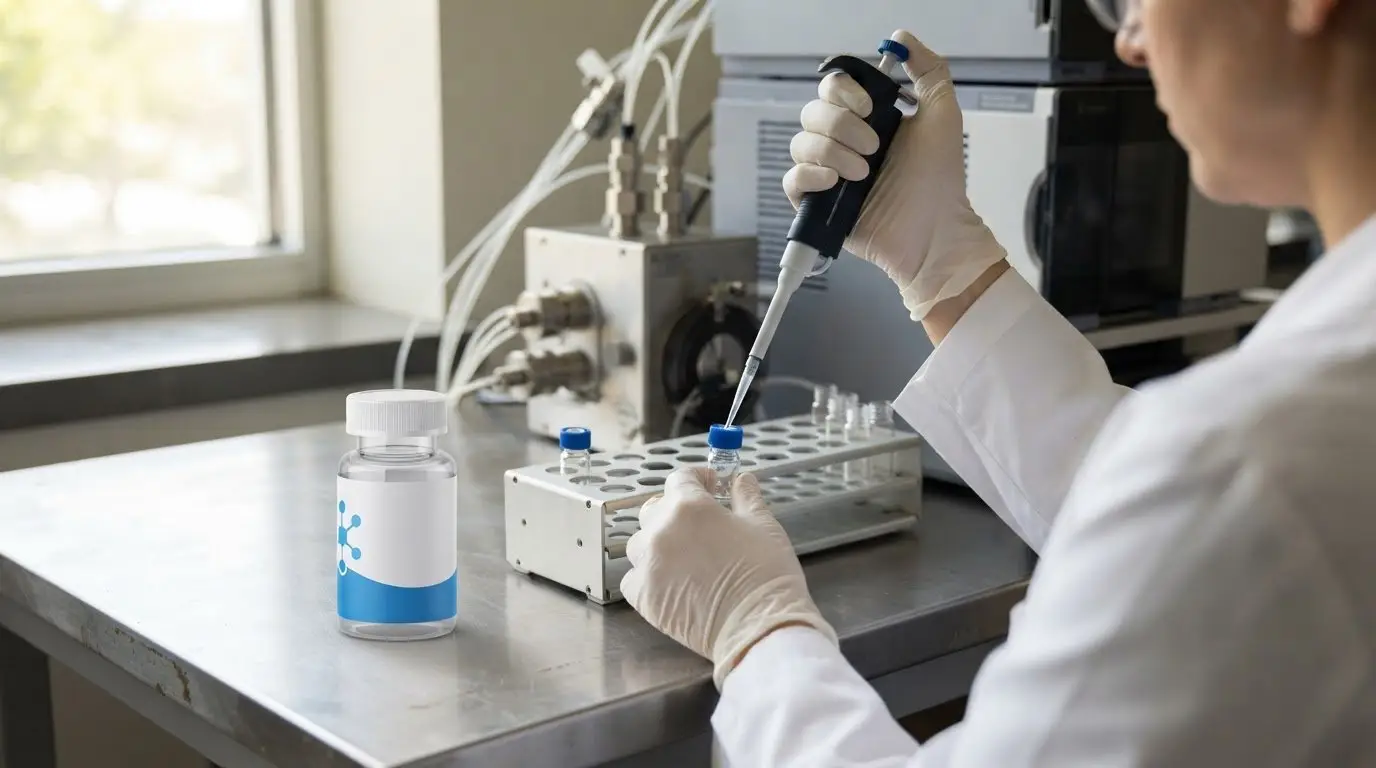
A powder can look consistent and still tell you very little about what is in the vial. Lyophilized peptides for research are freeze-dried to remove water from a frozen sample. This format can support storage and handling, but the process alone does not verify a peptide’s identity, purity, or batch quality. Before selecting a material for laboratory work, look beyond its appearance and confirm what the analytical records show.
This guide explains what lyophilization changes, what it cannot establish, and how to review lot-matched batch documentation, including a Certificate of Analysis (COA) and independent test results. Check that the paperwork identifies the relevant lot and separates identity testing from purity reporting. Solara Compounds provides batch-specific COAs, third-party testing through Kovera Labs, and molecular confirmation using MALDI-TOF and LC-MS. These records help researchers assess a specific batch, but they do not guarantee experimental outcomes. Visit solaracompounds.com to review batch resources. All products are for Research Use Only (RUO): intended solely for laboratory research, not for human or animal consumption, and not a drug, medicine, or dietary supplement.
Key Takeaways
- Lyophilization removes frozen water through sublimation, the direct change from ice to vapor under reduced pressure.
- Lower moisture can support material stability, but powder format alone does not establish identity, purity, or lot details.
- When evaluating lyophilized peptides for research, match the COA to the specific lot and review the reported methods and identifiers.
- Compare identity confirmation and purity results as separate types of evidence. Powder appearance and a COA cannot guarantee experimental outcomes.
- Solara Compounds provides batch-specific COAs and third-party testing through Kovera Labs. All products are for Research Use Only (RUO): intended solely for laboratory research, not for human or animal consumption, and not a drug, medicine, or dietary supplement.
What Are Lyophilized Peptides for Research?
“Lyophilized” describes a peptide’s supplied physical format, not a different peptide sequence. In laboratory product descriptions, the term distinguishes a dried presentation from a liquid solution. It tells researchers how the material is presented, but not every detail of its formulation or how it will behave in a particular research setting.
The term is also known as freeze-dried. The Freeze-drying (Lyophilization) overview provides broader context on the process and its applications. For laboratory work, the key distinction is between the preparation method and the peptide’s name or molecular structure.
How freeze-drying turns a solution into powder
A peptide may begin in solution and be supplied in a dry solid format after processing. The final appearance can vary: some samples look like loose powder, while others form a more cohesive cake. These differences describe physical presentation. They do not identify a new peptide or confirm a change in its molecular sequence.
“Freeze-dried” and “lyophilized” refer to the same general material format. The terms do not specify the processing conditions used for a particular compound. Those details belong in process documentation, rather than being inferred from a label or appearance.
Why laboratories encounter peptides in lyophilized form
Suppliers may provide research materials as dry solids rather than prepared solutions. That distinction can matter when researchers compare product presentations and plan how a material fits into an existing laboratory workflow. It describes the supplied form, not a grade or a standalone measure of suitability.
Keep the terminology within its proper scope: “lyophilized” describes presentation. It does not specify a peptide’s sequence, formulation details, or suitability for a particular research question. Use the product description to identify the format, then assess other relevant attributes through the appropriate documentation. All products are for Research Use Only (RUO): intended solely for laboratory research, not for human or animal consumption, and not a drug, medicine, or dietary supplement.
How Lyophilization Works and What the Process Changes
Lyophilization moves a peptide preparation from frozen solution to dried solid through controlled stages. Each stage has a different purpose, and conditions are selected for the material being processed. Understanding the sequence helps explain why “lyophilized” describes a manufacturing format, while stability claims need evidence specific to the compound and conditions.
Freezing and primary drying
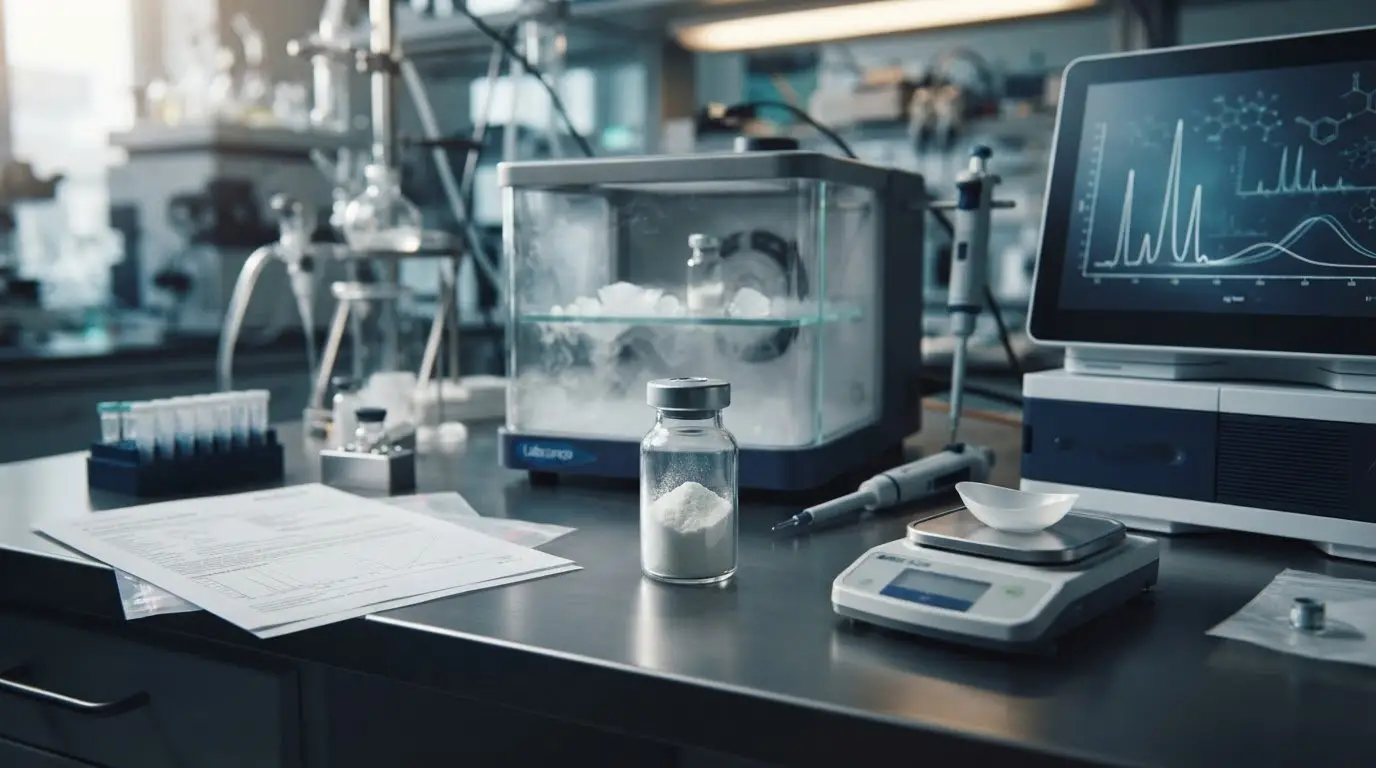
Freezing turns water in the solution into ice. During primary drying, reduced pressure allows that ice to leave the frozen material as vapor. Sublimation is the direct transition from ice to vapor, allowing frozen water to be removed during primary drying. Process design must account for the material’s properties. A general description does not establish how a particular peptide responds.
Secondary drying and the final powder format
After primary drying, secondary drying addresses additional water associated with the material. The resulting solid may be a powder or cake, but its appearance does not reveal residual moisture. Nor does it establish that different compounds have identical stability characteristics.
- Freezing: The solution is prepared as a frozen material for the drying stages.
- Primary drying: Ice is removed from the frozen preparation through sublimation under reduced pressure.
- Secondary drying: Further drying reduces water that remains associated with the material.
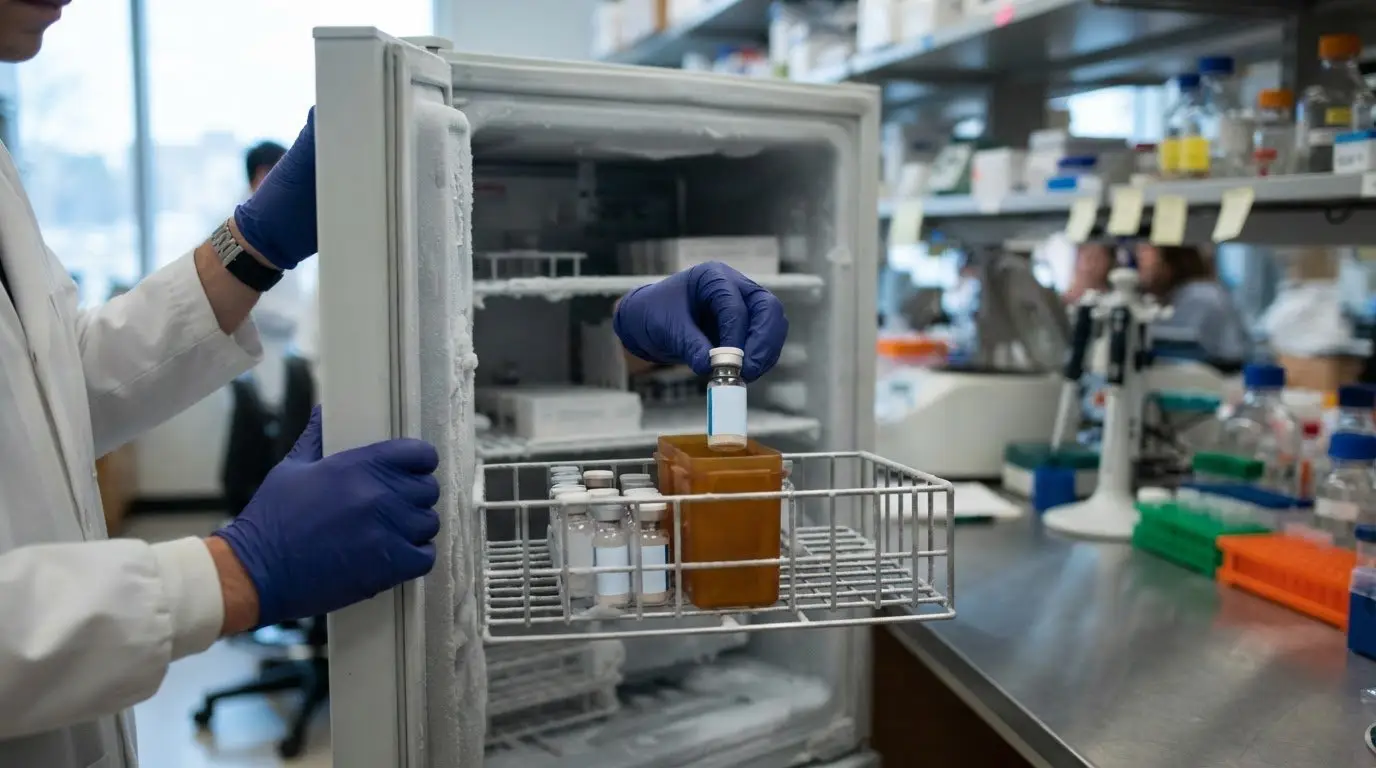
Reducing moisture can support stability because water may participate in chemical degradation, including hydrolysis. This is a general material-science principle, not a promise of a fixed shelf life. Peptides vary, and stability evidence for one compound should not automatically be applied to another. Formulation, processing, packaging, and storage conditions can also affect the evidence needed to support a claim.
Distinguish process descriptions from stability data. Saying a sample was lyophilized explains how it was prepared; it does not show how the compound performs over time or under particular conditions. Those conclusions require suitable evidence tied to the compound and conditions under discussion. Similarly, a dry-looking vial cannot quantify residual moisture. That requires an appropriate analytical measurement reported for the material.
For broader quality context, researchers can consult USP resources, while keeping any supplier or batch claim grounded in relevant documentation. Standards information does not replace results for a specific sample. Lab buyers comparing lyophilized peptides for research can treat the drying process as one part of an evaluation, then review stability and other quality attributes using evidence that addresses those claims directly.
What Lyophilized Powder Can, and Cannot, Tell Researchers
Use each source of information to answer the question it addresses. A product description, visual inspection, and analytical report provide different kinds of evidence. The comparison below helps researchers assess each source without treating one as a substitute for another.
Lyophilized format: Describes the material’s supplied physical form. Check the product description to confirm how it is presented.
Visual appearance: Describes observable features such as color or whether the material appears as a cake or loose powder. Appearance cannot establish sequence, purity, or lot identity.
Purity result: Reports an analytical finding for a specified sample and method. Check what the reported value represents and whether the method is stated.
Identity result: Reports evidence relevant to the expected molecule. Check which identity method was used and what the result supports.
Does a dry powder prove purity or identity?
No. Appearance is not an analytical result. Even a sample that looks consistent from vial to vial cannot confirm its amino acid sequence or distinguish one production lot from another. Use visual inspection to describe visible characteristics, not to draw conclusions about molecular identity or composition.
Analytical methods also have limits. HPLC separates components and can report chromatographic purity, but interpret the result in light of the stated method and reporting basis. Mass spectrometry can support molecular confirmation by measuring mass-related characteristics. That evidence does not automatically answer every question about sequence or composition. The report’s method and stated conclusion matter as much as the method name.
How to read supplier claims without overinterpreting them
Separate three kinds of statements: process descriptions, analytical findings, and broad supplier descriptions. “Purified by HPLC” describes a process. A numerical purity result is an analytical finding that should identify the tested sample and method. A supplier’s general quality statement summarizes an approach; it is not a result for a particular lot.
When reviewing a reported value, check whether the report names the sample or lot, identifies the method, and explains what the result represents. Do not assume a figure from one sample applies to another lot or predicts performance in a research setting. Analytical results describe their stated scope; they do not guarantee experimental outcomes.
This distinction makes documentation more useful. A purity result may support comparison of reported chromatographic findings, while a separate identity result addresses whether the tested material is consistent with the expected molecule. Neither replaces the other, and neither can be inferred from powder appearance.
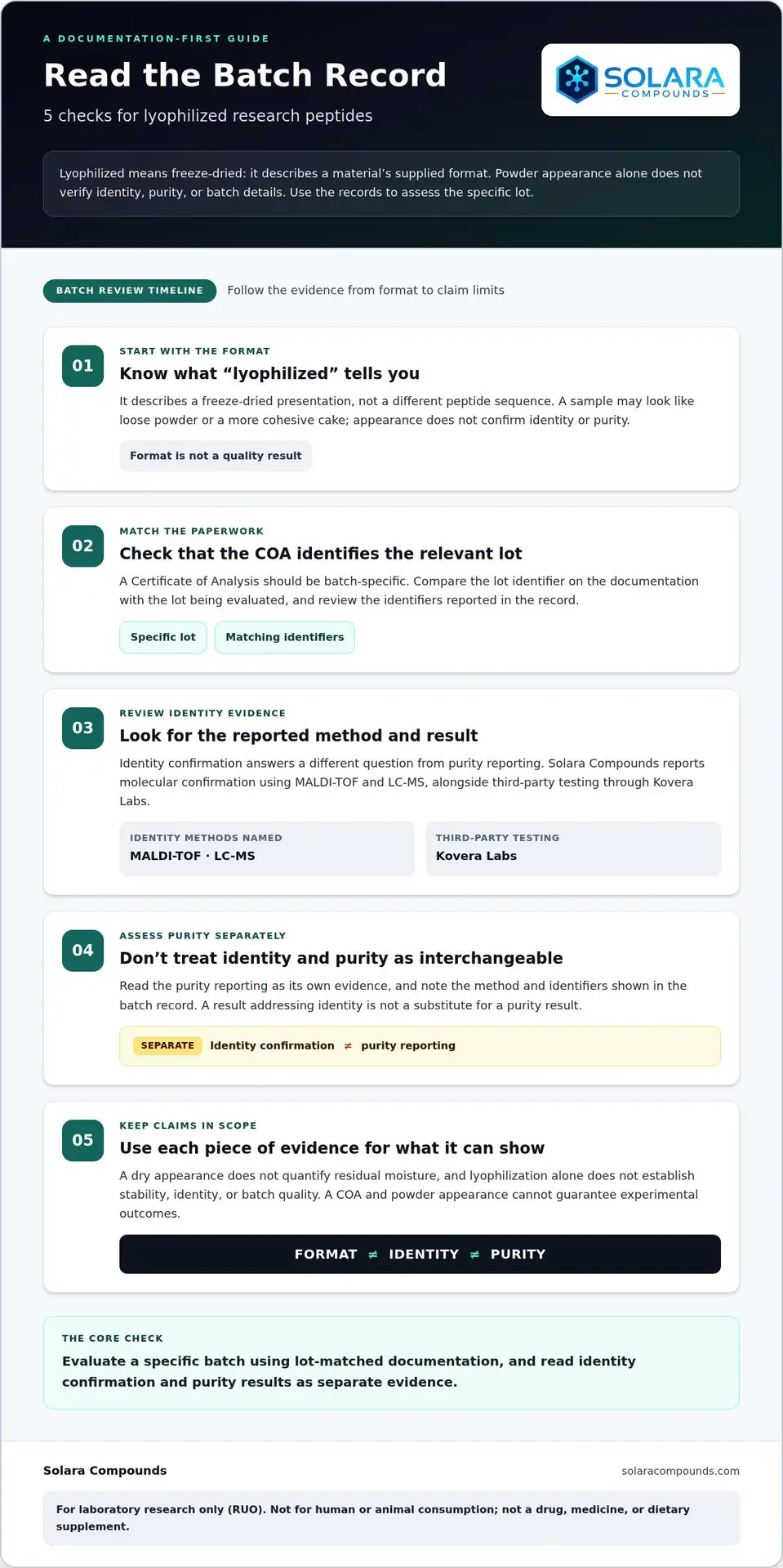
How to Evaluate Lyophilized Peptides for Laboratory Research
A practical review follows a clear sequence: identify the lot, find its Certificate of Analysis (COA), inspect the reported methods, then compare the document’s identifiers with the material being considered. This helps lab buyers assess what the paperwork supports instead of relying on a general product description or the powder’s appearance.
- Identify the lot. Record the unique lot number associated with the batch under consideration.
- Locate the matching COA. Confirm that the document names the same lot, rather than a different batch or a general product sample.
- Inspect the methods and results. Note which analytical method supports each reported finding.
- Compare identifiers. Check that the product and document refer to the same peptide and lot.
Check lot traceability and the batch-specific COA
A lot number links a specific batch to its records. This matters because analytical results describe the sample tested, not automatically every batch with the same product name. A COA without a matching lot identifier may provide background, but it cannot establish that the reported findings apply to the batch being considered.
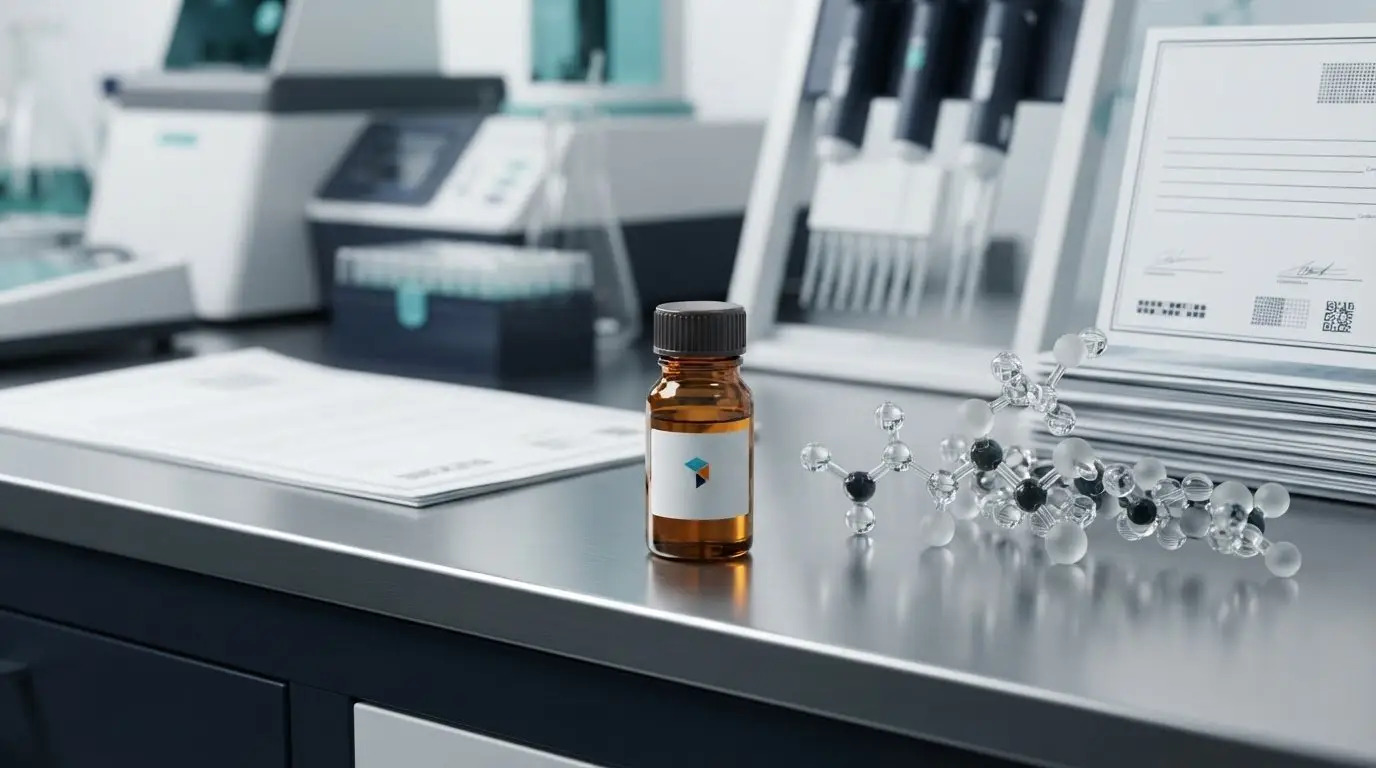
Solara Compounds assigns each batch a unique lot number and makes batch-specific COAs available for review. Compare the lot identifier on the product with the one on the document. Then read the date, sample description, methods, and results together. A COA reports analytical information; it does not guarantee experimental outcomes.
Understand the role of analytical methods
Different methods answer different questions. High-performance liquid chromatography (HPLC) separates components in a sample and can support a chromatographic purity result. Solara Compounds documents a minimum purity standard of >98%. Read that figure as a stated purity standard, not as an identity result or a prediction of laboratory performance. The result’s relevance depends on the method and sample described in the report.
MALDI-TOF and liquid chromatography-mass spectrometry (LC-MS) are used for molecular confirmation. In plain terms, they provide evidence about whether a sample’s measured molecular characteristics are consistent with the expected peptide. Identity confirmation and purity reporting are separate categories, so one should not substitute for the other. A supplier’s process description, such as how a peptide is synthesized or prepared, is not itself an analytical result.
Solara Compounds reports third-party testing through Kovera Labs. Review the batch documentation to see which results and methods are reported for the relevant lot. Do not infer test scope beyond what the document states. This method-by-method review is more useful for comparing lyophilized peptides for research than relying on a broad “high purity” phrase alone.
For laboratory research only, review the batch evidence alongside the product information. Explore Solara Compounds’ research catalog and assess the documentation for the specific lot.
Solara Compounds’ Documentation-First Approach to Lyophilized Research Peptides
For laboratory buyers, a useful quality review starts with evidence tied to the specific material, not just a description of its format. Solara Compounds is a U.S. supplier of lyophilized research peptides. Its documentation approach connects each batch to a unique lot number, supplier Certificate of Analysis (COA), and reported analytical information. This traceability gives researchers a practical way to examine what is documented for the lot under consideration.
What Solara’s batch documentation is designed to show
Batch-specific COAs provide reported purity and identity information. These are separate analytical categories: a purity result describes the sample under a stated method, while identity testing provides evidence about whether molecular characteristics match the expected peptide. Reviewing both helps clarify which quality claims have supporting results and what each result addresses.
Solara Compounds documents HPLC purification and uses MALDI-TOF and LC-MS for molecular confirmation. It also reports third-party testing through Kovera Labs. These details describe the stated approach; they should not be read as evidence for a test category or result that a particular batch document does not report. Check the COA for the lot identifier, methods, and findings relevant to the batch.
The distinction matters. A process description explains how material is produced or assessed, while a batch record reports findings for a defined sample. Neither a process claim nor a COA guarantees a particular laboratory result. Experimental outcomes depend on the research context and are not established by supplier documentation alone.
A practical next step for qualified laboratory buyers
Before selecting a material for laboratory work, compare the product information with the batch record. Confirm the lot number, review the reported identity and purity information separately, and note which methods support each result. If a document describes a result without clearly connecting it to the lot being considered, it may not answer the batch-specific question a researcher needs to resolve.
Solara Compounds’ documentation and research information are available through solaracompounds.com. The supplier overview also describes its research-peptide sourcing and quality approach, including lot traceability and analytical methods.
View the current research catalog.
Make Batch Review Part of Your Research Planning
Set clear material-review criteria before the next purchasing decision. For lyophilized peptides for research, a written checklist can help a lab team keep its evaluation consistent: define which identifiers and analytical findings matter for the project, record the basis for accepting a batch, and retain relevant documentation with research records.
A consistent review makes it easier to compare materials across purchasing decisions without assuming that similar appearance or product descriptions mean equivalent evidence. Keep conclusions tied to what each document reports, and revisit the criteria when research requirements change. Documentation supports an informed selection process, but it cannot predict or guarantee experimental outcomes.
Solara Compounds offers research materials and documentation for laboratory buyers. Review the catalog and relevant batch information as part of your material assessment.
View the current research catalog. A careful review is a practical foundation for laboratory planning.
Frequently Asked Questions
Is lyophilized peptide powder sterile by definition?
No. Freeze-drying removes water, but powder format alone does not establish sterility. Do not infer sterility from a dry appearance or from the fact that material is supplied for research. If sterility is relevant to a laboratory’s requirements, review documentation that specifically addresses this attribute. Purity and identity results answer different questions and are not evidence of sterility.
Can the appearance of a lyophilized peptide confirm its identity?
No. Color, texture, and whether a sample appears uniform cannot show its molecular identity. Even if two vials look alike, their appearance does not establish that they contain the same peptide. Compare the product label with the batch record and look for an identity result tied to the lot, rather than using visual similarities as evidence.
Does lyophilization remove every trace of water from a peptide sample?
No. A lyophilized sample may retain residual moisture after drying. Visual inspection cannot quantify it. A method such as Karl Fischer titration can measure water content, so a researcher evaluating moisture-related requirements should look for an appropriate reported result rather than assume the sample is completely water-free. The significance of a result depends on the material and the laboratory’s research criteria.
Can two lots of the same research peptide have different COA results?
Yes. A COA reports findings for the sample tested, so results can differ between lots. For example, two batches may have different reported chromatographic purity results, or their documents may reflect different test dates or methods. Compare each report with its own lot identifier and read its methods and results together. Do not assume a result for one batch describes another.
What is the difference between HPLC purity and mass spectrometry identity testing?
HPLC separates components in a sample and can support a chromatographic purity result. Mass spectrometry measures molecular mass and can help assess whether a sample matches the expected molecule. These methods answer different questions: a purity result does not automatically confirm identity, and a mass result does not provide the same information as a purity assessment. Review the method attached to each reported finding.
Does a batch-specific COA guarantee a particular laboratory result?
No. A batch-specific COA provides analytical findings for the identified sample and the methods reported; it cannot predict how that material will perform in a particular experiment. Research design, conditions, and measurement choices also shape results. Use the document to assess the batch information it contains, and keep experimental conclusions grounded in the laboratory’s own observations and analysis.
Are lyophilized research peptides intended for human or animal consumption?
No. All products are for Research Use Only (RUO), intended solely for laboratory research and not for human or animal consumption. This applies to research groups in Boston, San Diego, San Francisco, New York, Houston, Miami, Los Angeles, Austin, Raleigh, Seattle, Chicago, Philadelphia, Baltimore, Dallas, Phoenix, Tampa, Atlanta, and Denver.
For laboratory research only, review the batch-specific documentation and view the current Solara Compounds research catalog. For research support, contact [email protected] or call 1 (877) 388-9178, Monday to Friday, 8 AM to 5 PM Eastern.