Research Articles
How to Verify Peptide Supplier Legitimacy: A Research Buyer’s Checklist


A polished product page can make strong claims, but it cannot show whether a test report belongs to the batch a lab buyer is considering. Knowing how to verify peptide supplier legitimacy means looking beyond marketing language and checking whether supplier identity, lot numbers, and testing records connect.
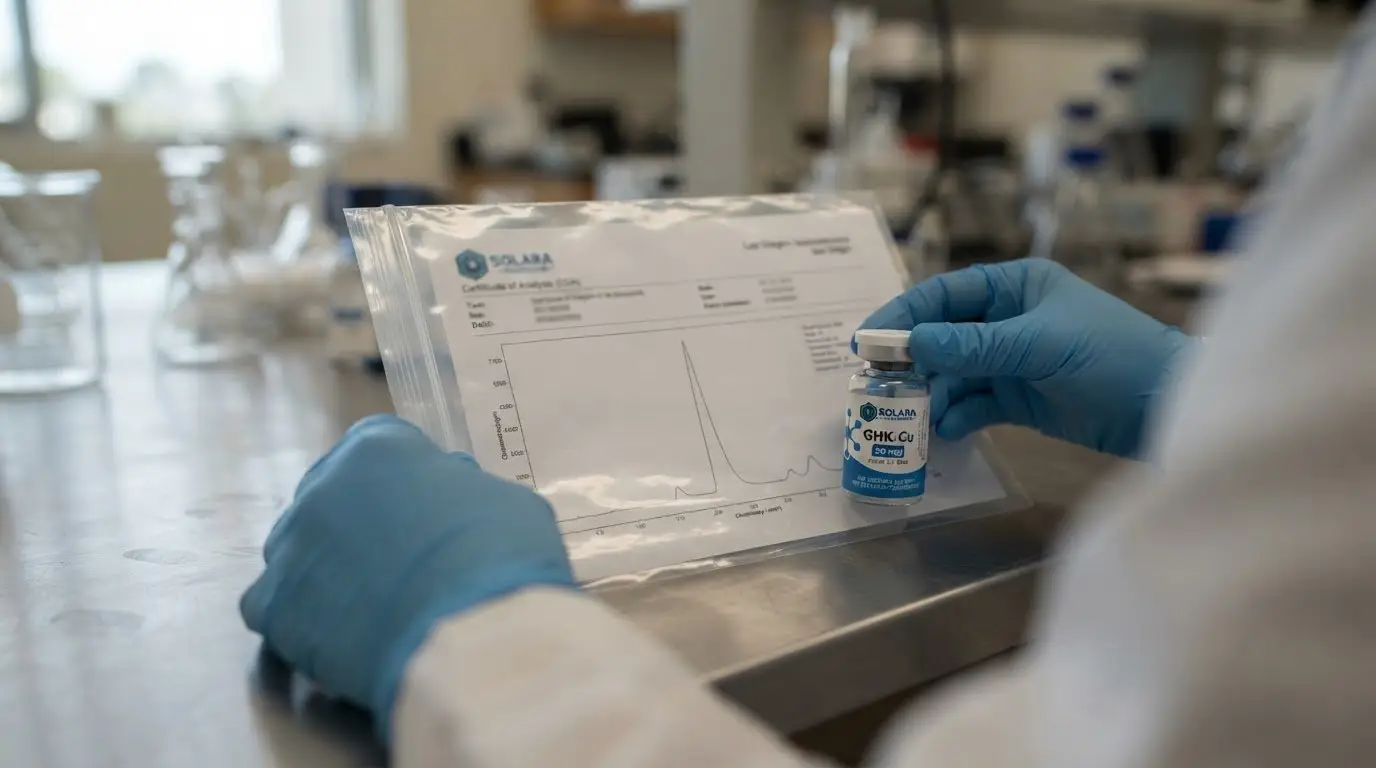
A Certificate of Analysis (COA) is useful when it provides specific, reviewable evidence. Reports can be generic or incomplete, and “third-party tested” has limited value without identifying the testing organization and methods. This guide explains how to review batch documentation, follow a lot number, and assess what analytical methods can establish. HPLC evaluates sample purity, while mass spectrometry helps assess molecular mass. Neither method alone establishes every aspect of a material’s suitability for a particular experiment.
Solara Compounds makes batch-specific COAs available online and states that independent testing is conducted through Kovera Labs. Those records are a starting point for review, not a promise of experimental outcomes. Products at solaracompounds.com are for laboratory research only. All products are for Research Use Only (RUO): intended solely for laboratory research and not for human or animal consumption, not a drug, medicine, or dietary supplement.
Key Takeaways
- Learn how to verify peptide supplier legitimacy by assessing business identity, traceable batches, accessible records, and clear research-use boundaries.
- Match the compound and lot number on a COA to the specific batch under consideration, then review the report date and named methods.
- Understand how HPLC purity profiles and mass spectrometry evidence answer different questions, and why neither method alone establishes every quality attribute.
- Compare suppliers using inspectable evidence, including batch access, lot traceability, and clearly identified testing methods, rather than marketing claims alone.
- Use a repeatable review process to document a sourcing decision. All products are for Research Use Only (RUO): intended solely for laboratory research and not for human or animal consumption, not a drug, medicine, or dietary supplement.
How to Verify Peptide Supplier Legitimacy Before a Laboratory Purchase
Quality language is easy to publish. Evidence is harder to assess unless a supplier connects its claims to records a lab buyer can inspect. A practical approach to how to verify peptide supplier legitimacy starts with that distinction: treat the product page as a source of claims, then look for supporting documents and batch traceability.
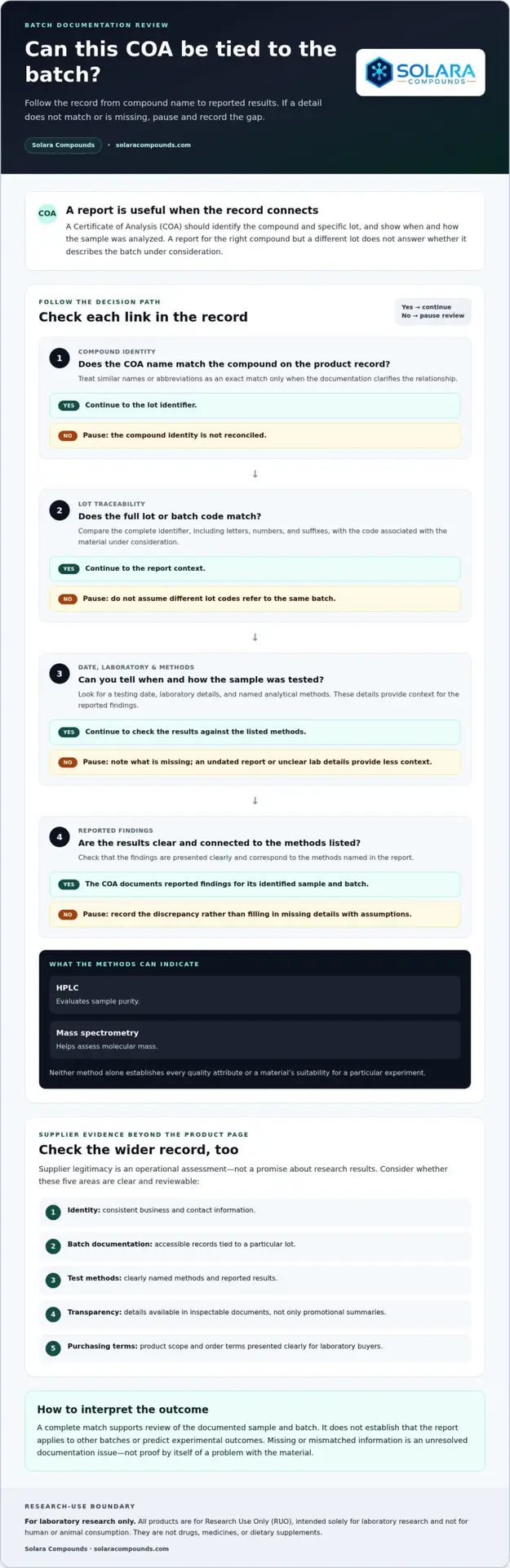
For laboratory purchasing, supplier legitimacy is an operational assessment, not a promise about research results. Review five areas:
- Identity: Is the business clearly identified, with consistent company and contact information?
- Batch documentation: Can buyers access records tied to a particular lot?
- Test methods: Are the methods and reported results named clearly?
- Transparency: Can the information be reviewed in documents, rather than only summarized in promotional language?
- Purchasing terms: Are product scope and order terms presented clearly for laboratory buyers?
What evidence matters more than a polished product page?
Start with the batch record, not a general statement such as “high quality.” Look for the compound name, lot identifier, test date, analytical methods, and reported results. These details help you assess whether the document refers to the material under consideration. Broad superlatives without supporting records are claims, not independently reviewable evidence.
Context matters, too. Peptide synthesis involves chemical processes that require quality controls. An overview of peptide synthesis methods can explain why analytical records matter, but it does not validate a supplier or a specific batch. A description of a method is not a test result for the material being purchased.
How should laboratory buyers define supplier legitimacy?
A credible research supplier makes its laboratory-use scope clear and connects product claims to accessible records. Compare the supplier’s stated identity across its site and documentation, then check whether available paperwork names the compound and lot. For a closer look at Solara Compounds’ research-supplier information, review its research peptide supplier documentation.
Solara Compounds provides batch-specific COAs online and states that independent third-party testing is conducted through Kovera Labs. The documentation supports a buyer’s review, but does not establish how a compound will perform in a particular experiment. Supplier records can reduce information gaps, while experimental outcomes depend on factors beyond those records.
Keep the use boundary explicit throughout the evaluation: All products are for Research Use Only (RUO): intended solely for laboratory research and not for human or animal consumption, not a drug, medicine, or dietary supplement.
How to Match a Peptide COA to the Exact Batch
A Certificate of Analysis (COA) is useful only when it can be tied to the material being considered. A report for the right compound but a different lot leaves a key question unanswered: does this document describe this batch? Use a consistent review sequence before relying on a COA as part of a laboratory purchasing decision.
- Identify the compound. Confirm that the name on the report matches the compound on the product record. Similar names or abbreviations should not be treated as an exact match unless the documentation clarifies the relationship.
- Match the lot identifier. Compare the report’s lot or batch number with the identifier associated with the material under consideration. Check the full code, including letters, numbers, and suffixes.
- Inspect the date and methods. Note when the sample was tested and which analytical methods the report names. The date places the record in context, while the methods show how the reported results were obtained.
- Review the results. Check that results are presented clearly and correspond to the methods listed. A COA documents reported findings for its identified sample and batch, not every batch or an experimental outcome.
Which fields should a batch-specific COA show?
Look for the compound name, unique lot or batch identifier, testing date, laboratory details, methods, and reported results. Each field helps establish what was examined and how the report should be interpreted. If a field is absent, record the gap rather than filling it in with assumptions. A missing or mismatched identifier is an unresolved documentation issue, not proof by itself of a problem with the material.
Compare identifiers exactly. If the product record and COA show different lot codes, do not assume they refer to the same batch because the compound name matches. Pause the review until the documentation reconciles the discrepancy. Likewise, an undated certificate or a report with no clear laboratory information provides less context for assessing when and how the sample was analyzed.
Why does lot-number traceability matter?
A unique lot number links a product record to its batch paperwork. A generic sample report may describe a compound, but without a matching lot identifier, it does not establish that the report belongs to the batch under consideration. Solara Compounds assigns unique lot numbers and provides batch-specific COA documentation online. These records support traceability; they do not guarantee an experimental result.
For a practical check, record the compound name and lot code shown in the product record, then compare both with the COA before making a sourcing decision. Keep the matched document with the buyer’s research records so the basis for the decision remains clear. To apply the same review to Solara Compounds’ research-only offerings, browse research peptides and assess the available batch paperwork for the material being considered.
How HPLC and Mass Spectrometry Help Evaluate Supplier Testing Claims
HPLC and mass spectrometry provide different kinds of evidence. High-Performance Liquid Chromatography (HPLC) separates components in a sample, while mass spectrometry measures the mass of detected molecules. Reviewing both can give researchers a more useful picture than relying on a headline purity figure alone, but neither method answers every question about a sample.
HPLC: Separates sample components and produces a chromatographic profile that can help assess relative purity.
Mass spectrometry: Measures molecular mass, providing evidence that can support an assessment of a peptide’s identity.
For buyers considering how to verify peptide supplier legitimacy, the practical question is whether the methods, results, and report context are clear and linked to the relevant batch. A number without that context is difficult to evaluate.
What does HPLC tell a researcher about a peptide sample?
HPLC passes a sample through a column so its components separate and appear as peaks in a chromatogram, a graph showing the separated signals. The resulting profile can help assess how much of the detected material is associated with the main peak relative to other detected components. Interpretation depends on the method and how results are calculated.
Solara Compounds documents an HPLC purity standard of a minimum above 98%; product pages commonly describe purity as 99%+ or at least 99%. These are distinct statements: a documented minimum and product-page descriptions. A reported purity percentage is not, by itself, confirmation of molecular identity, every possible impurity, or experimental performance.
What can MALDI-TOF and LC-MS add to the review?
Mass spectrometry measures the mass-to-charge behavior of ions, which helps estimate molecular mass and can support identity assessment. MALDI-TOF and LC-MS are analytical methods Solara states it uses. Read their results in the context of the report, including the stated method and the sample or batch documented. A mass result is useful evidence, not a complete assessment of every quality attribute.
Use the methods as complementary checks. HPLC’s profile and mass-spectrometric evidence address different questions, and a strong result in one area does not replace missing information in another. Review the batch association, method names, and reported findings rather than comparing isolated numbers. Solara’s testing records provide a place to examine documented batch results. Documentation supports evaluation, not a guarantee of experimental outcomes.
How to Compare Supplier Transparency Without Relying on Marketing Claims
Supplier comparisons are more useful when they focus on records a researcher can inspect, not adjectives on a product page. For laboratory buyers in the United States, the same documentation questions can help compare suppliers without making assumptions about legal status or experimental performance. The aim is to distinguish evidence that can be reviewed from claims that the available documents do not support.
Batch access: Are batch records available for the material being considered, or is the certificate generic?
Lot traceability: Can the lot identifier connect the product record to the supporting report?
Named methods: Does the documentation identify analytical methods and present results in context?
Research-use scope: Does the supplier clearly describe products as intended for laboratory research only?
Apply each criterion consistently. A supplier may provide accessible records but omit a method, or name testing methods without connecting a report to a specific lot. Those are different documentation gaps. Record them separately rather than reducing the comparison to a single label such as “tested.”
Which supplier warning signs deserve a closer document review?
A generic certificate with no visible lot connection is incomplete evidence for a batch-level decision. Vague phrases such as “independently tested” also need context if the available paperwork does not identify methods, results, or the batch represented. These gaps do not prove misconduct or establish that material is unsuitable; they show what the documentation does and does not support.
Check for consistency across the catalog entry and report. If one uses a different compound name, abbreviation, or identifier, pause the procurement review until the records can be reconciled. A mismatch may be an administrative issue, but proceeding without resolving it weakens traceability and makes later recordkeeping less reliable.
How can buyers assess transparency and traceability?
Review how easily a buyer can find batch documents and whether those records are clearly associated with catalog materials. Then assess whether the supplier explains its laboratory-use scope and describes its documentation practices in concrete terms. Solara Compounds states that unique lot numbers support traceability, batch-specific COAs are available online, and independent third-party testing is conducted through Kovera Labs. These are documented practices, not proof of experimental outcomes.
For a useful comparison, keep a short record for each supplier: document access, lot linkage, named methods, and research-use language. Note which points are supported directly by records and which rely only on general claims. This approach makes the basis for a purchasing decision clearer and easier to revisit.
Products at Solara Compounds are for laboratory research only, not for human or animal use. To compare catalog materials alongside available documentation, shop research peptides at solaracompounds.com.
A Practical Supplier Verification Workflow for Research Buyers
A repeatable process helps lab buyers make sourcing decisions from records instead of impressions. To assess how to verify peptide supplier legitimacy, move from the research requirement to the product record, then check the batch evidence and document the reasoning. The result is a more consistent review, not a guarantee that an experiment will produce a particular outcome.
- Identify the laboratory need. Record the compound name and specific research purpose so the material under review matches the planned work.
- Review the product record. Confirm that the catalog entry uses the same compound name and clearly states its laboratory-use scope.
- Match the batch. Compare the lot identifier in the product record with the one shown on the COA. Treat any mismatch as unresolved until the records align.
- Inspect the methods and findings. Note the analytical methods named and what the reported data supports. Do not treat a single result as a complete assessment of every quality attribute.
- Document the decision. Save the records reviewed and note any gaps, questions, or limits relevant to the laboratory’s procurement review.
What should a buyer record before procurement?
Keep a concise record of the exact compound name, lot identifier, COA version or date, and methods shown. Note whether the report is batch-specific and whether its identifiers align with the product record. If a field is missing or inconsistent, describe the gap plainly rather than interpreting it as proof of a broader issue. Retain the record according to the laboratory’s own review procedures.
This creates a clear audit trail for the purchasing decision. Another researcher can see which document was assessed and what information informed the choice, without confusing a general supplier statement with batch-level evidence.
How does Solara Compounds present batch documentation?
Solara Compounds is a U.S. supplier serving qualified laboratory research buyers. The company assigns unique lot numbers, provides batch-specific COAs, and conducts independent third-party testing through Kovera Labs. A COA can document reported purity and identity data for the batch it identifies; it does not predict or guarantee experimental outcomes.
Use those records within the same review framework: compare the compound and lot, examine the documented methods and findings, and retain the basis for the decision. Keep the intended-use boundary clear throughout procurement. All products are for Research Use Only (RUO): intended solely for laboratory research and not for human or animal consumption, not a drug, medicine, or dietary supplement.
For laboratory research only, View the current research catalog.
Make Your Next Research Purchase Evidence-Led
A sourcing decision is strongest when its reasoning can be revisited. Treat documentation as part of laboratory planning: keep a clear record of what was reviewed, distinguish measured findings from supplier claims, and note any limits relevant to the work. This makes future comparisons more consistent without mistaking a supplier’s records for a prediction of experimental performance.
That is the practical value of learning how to verify peptide supplier legitimacy. It gives researchers a repeatable way to assess information before committing material to qualified laboratory work. Solara Compounds provides lot-linked records and batch COAs, and states that it conducts third-party testing through Kovera Labs using HPLC, MALDI-TOF, and LC-MS methods. These records support review, not guaranteed outcomes. All products are for laboratory research only, not for people or animals.
Use the same evidence-led standard for your next sourcing decision. View the current research catalog and review the research-use scope and available documentation.
Frequently Asked Questions
How can I verify that a peptide supplier is legitimate?
Use a documented review process and preserve what you checked. For example, save a dated copy of the catalog entry and related records, then note any discrepancy between them before placing an order. This makes it easier for a research team to revisit its decision or compare suppliers later. Lab buyers in Boston, San Diego, San Francisco, New York, Houston, Miami, Los Angeles, Austin, Raleigh, Seattle, Chicago, Philadelphia, Baltimore, Dallas, Phoenix, Tampa, Atlanta, and Denver can apply the same process.
What should a peptide Certificate of Analysis include?
Beyond checking the basic report details, consider whether the COA provides enough context for your lab’s recordkeeping. Note the document date or revision, retain the original file, and record which product listing it was reviewed against. If a report contains unfamiliar abbreviations or unclear units, mark them for technical review rather than interpreting them by guesswork. A concise note explaining how the document was assessed can help maintain consistent procurement records.
Can a COA prove that a peptide is suitable for every laboratory experiment?
No. Suitability depends on the requirements of the specific research design, and a supplier document cannot replace a laboratory’s own material acceptance process. Before purchasing, define the characteristics that matter to the planned work and decide how the lab will assess them. If the available records do not address a requirement, note that limitation in the purchasing file instead of assuming the material will meet it.
What is the difference between HPLC and mass spectrometry in peptide testing?
For practical report review, focus on whether each method’s reported data is presented in a form your research team can assess. A brief summary may not contain enough context or detail for technical review, so record what the report actually provides and what remains unclear. Avoid comparing results as though reports were interchangeable when their analytical conditions or reporting conventions differ.
Does third-party testing make a peptide supplier automatically reliable?
No. Consider whether the report identifies the testing organization and whether the supplier’s description matches the report itself. Do not infer accreditation, a particular scope of work, or independent verification from the phrase “third-party tested” alone. Solara Compounds states that testing is conducted through Kovera Labs; buyers can assess the available documentation on its own terms, without treating a testing claim as a guarantee of research performance.
Why should a researcher check the lot number on a peptide COA?
Checking the lot number during receiving helps maintain an accurate record of what entered the laboratory. Compare the identifier on the received material with the version documented in the procurement file, and record the result using the lab’s standard receiving process. If the identifiers differ, document the discrepancy and resolve it through the organization’s review procedure before relying on the paperwork for that material.
What does a high peptide purity percentage tell a laboratory buyer?
A high percentage is one reported measurement, not a direct statement of the total amount of target compound in a container. The way the percentage is calculated and the method used affect its meaning, so buyers should interpret it within the report’s stated context. For internal comparison, research teams can define consistent criteria for reviewing purity results and avoid ranking materials by a headline percentage alone.