Research Articles
Lab Manager Chemical Sourcing for Smarter Ordering

The easiest chemical order to place isn’t always the right one for a lab. A lab manager’s guide to sourcing chemicals starts with fit: the intended application, hazard profile, storage conditions, documentation, and delivery needs.
Price and availability matter, but they’re only part of the decision. Confirm that the product grade suits the work, the safety data sheet is current and accessible, and the package can be stored and handled safely. A similar product isn’t automatically a suitable substitute, so scientific review matters whenever an order changes.
This guide explains how to assess hazards, review safety data sheets, evaluate supplier documentation, and compare products and delivery options. It also outlines how Solara Compounds supports laboratory buyers with research compounds, third-party testing, and batch-specific Certificates of Analysis. Products from Solara Compounds are for laboratory research only, not medicine or supplements, and are not for use in people or animals. The company’s research catalog is at solaracompounds.com.
Key Takeaways
- Match each chemical’s hazard and storage needs to your lab’s facilities, handling capacity, and available protective equipment.
- Review the current safety data sheet when a chemical arrives, and keep it accessible to the people who handle or store it.
- Before ordering, define the required grade, quantity, package size, expected use, and storage conditions.
- Compare supplier documentation, batch-specific reports, product suitability, and delivery fit, not just price or availability.
- Research compounds from Solara Compounds are for laboratory research only, not for people or animals.
Chemical hazards and storage requirements
In the United States, requirements depend on the chemical and the activity. OSHA Lab Standards address laboratory chemical hazards and safety practices; purchasing, shipping, and storage require separate review under applicable institutional procedures and rules.
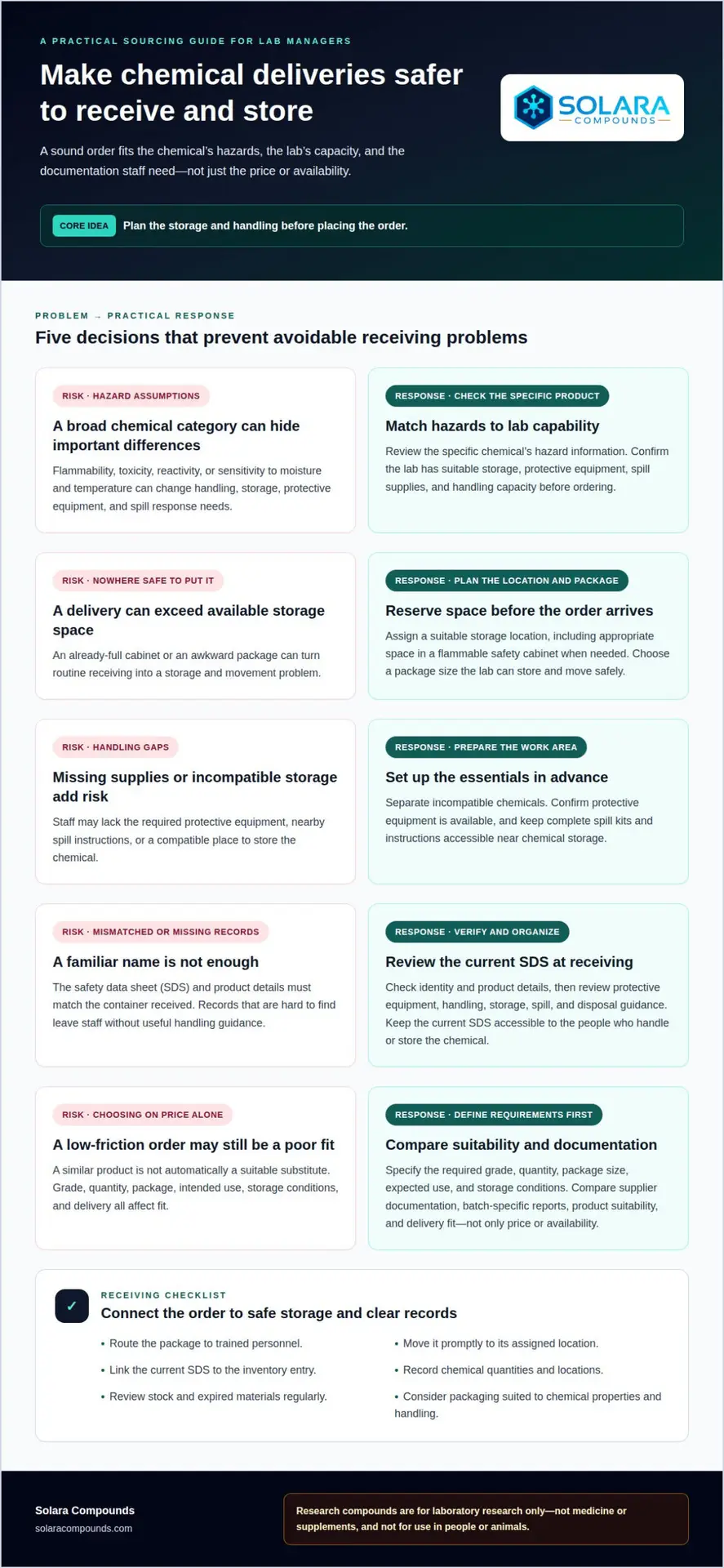
Start with hazard information for the specific chemical, not its broad category. Flammability, toxicity, reactivity, and sensitivity to moisture or temperature can change how staff handle and store a product. Those differences affect compatible storage, protective equipment, spill response, and the space needed when an order arrives.
Before ordering, match the planned quantity and package to the lab’s actual capacity. Check that the designated storage area has room, including appropriate space in a flammable safety cabinet when needed. An already-full cabinet can turn a routine delivery into an unsafe storage problem.
- Identify the designated location. Assign an appropriate storage area before ordering so the chemical can be put away promptly.
- Separate incompatible chemicals. Store each product with compatible chemicals to reduce risks from leaks, spills, or unintended reactions.
- Confirm protective equipment. Identify the equipment needed for handling and keep sufficient supplies available for lab members.
- Place spill supplies nearby. Keep complete spill kits and instructions readily accessible near chemical storage.
- Check environmental conditions. Use temperature or humidity controls when the chemical’s storage needs call for them.
- Maintain an inventory. Record chemical quantities and locations, then review stock and expired materials regularly.
Packaging affects both storage and safe movement. A 20-liter container of ACS-grade solvent, for example, may be difficult to handle because of its size, shape, and weight. Consider whether the package fits the storage area and can move safely through the laboratory. A smaller container may better match the work and available space, while bulk purchasing can create expiry and disposal concerns.
Ask how packaging protects the chemical during storage and transit. Vacuum sealing, temperature control, or desiccants may matter for sensitive materials. Septum-sealed bottles can limit environmental exposure when extracting anhydrous solvents. Packaging should suit the chemical’s properties and the lab’s handling process, not just the order quantity.
Plan receiving as part of storage. Reserve space before delivery, route the package to trained personnel, and move it promptly to its assigned location. Keep spill instructions accessible, maintain stock and location records, and clear out expired chemicals regularly for safe, responsible disposal. These steps connect purchasing decisions with workplace safety and reliable experimental conditions.
Safety data sheets
A safety data sheet (SDS) provides chemical-specific information for safe handling. Review the current sheet before work begins, then revisit it when a product arrives. A familiar chemical name is no substitute for checking the documentation: product details and hazards must match the container being used.
Use the SDS to connect hazard information with practical laboratory steps. Identify required protective equipment, handling precautions, storage conditions, and spill or disposal guidance. If the sheet calls for particular protective equipment, confirm the lab has it before assigning work. Keep the document accessible to the people handling the chemical, not only in a buyer’s inbox.
At receiving, match the supplier’s documentation to the product and container. Electronic records help lab members retrieve current safety information and share it with personnel. A product barcode may also provide access to specifications, Certificates of Analysis, safety sheets, and packaging details. Keep relevant files together so staff can quickly locate the right information.
- Match the sheet to the product. Confirm the chemical identity and product details correspond to the container received.
- Review hazards before use. Identify handling and protective measures so personnel can prepare before beginning work.
- Check storage and spill guidance. Use the sheet’s instructions to support the lab’s storage arrangements and spill response.
- Make documentation accessible. Store current electronic or printed records where relevant laboratory staff can find them.
- Update records after receiving. Connect the SDS to the inventory entry for that chemical and its location.
A chemical safety checklist makes documentation a repeatable process. Include product identification, SDS access, required protective equipment, storage compatibility, spill instructions, and disposal considerations. A checklist helps staff spot missing information before work starts and gives managers a consistent way to review routine handling practices.
Safety audits can examine how a laboratory identifies hazards and makes safety information available. Review the process as well as the files: can staff locate the correct SDS, understand the precautions, and find the related spill instructions? OSHA Lab Standards are among the topics addressed in laboratory safety discussions, so keep hazard information organized for review.
Use a maintained SDS management system or a clearly organized shared location. Assign responsibility for adding documents when chemicals arrive and replacing outdated files. When a product changes, update its record and inform affected personnel. This keeps safety documentation connected to laboratory work, rather than leaving it as paperwork detached from the bench.
Purchasing chemicals from trusted sources
For restricted, hazardous, or controlled chemicals in the United States, identify the substance classification and applicable federal, state, local, and institutional controls before ordering. Purchasing, shipment, and receipt must follow the requirements that apply to the chemical, with approvals and records matched to its classification.
Start supplier evaluation with traceable product information and usable safety documentation. A reliable source should provide enough detail to identify the exact chemical, grade, and package, along with relevant safety and product records. Vague or missing documentation makes it harder to assess whether an order matches the research requirement. Consider institutional purchasing policies, too: some laboratories must use approved manufacturers or a central purchasing service.
Document the scientific requirement, requested product, quantity, delivery date, and required approvals. Keep this information with the requisition, purchase order, receiving record, and invoice so staff can trace what was requested and received.
- Define the request clearly. Include product identity, grade, quantity, package, and required delivery date to reduce ordering ambiguity.
- Route it through the correct approval path. Confirm that scientific, safety, and procurement reviews occur before an order is placed.
- Track receipt separately from approval. An approved request does not mean the supplier order has been placed; retain order confirmation and receiving records.
- Preserve the purchasing trail. Connect requisitions, purchase orders, receiving documents, and invoices so discrepancies can be resolved accurately.
Purchasing systems can connect requisitions with inventory, supplier records, receiving, and accounts payable. A complete electronic request helps identify the intended reagent and reduces the chance of a substitute entering the process unnoticed. Keep product requirements and delivery needs attached as the request moves between lab managers, procurement teams, and finance staff.
Separate scientific review from commercial approval. Researchers define requirements and assess whether a proposed alternative suits the experiment. Procurement teams manage suppliers, purchasing channels, and policies, while finance teams handle invoice reconciliation and payment records. If an urgent order proposes a different product, obtain scientific review before proceeding; a similar product is not automatically a suitable substitute.
Measure purchasing performance with consistent start and end points. APQC defines purchase-order cycle time as the period between receiving a purchase requisition line item and sending the purchase order to the supplier. Track that interval alongside order accuracy, receiving discrepancies, and delivery against the requested date. Consistent measures help teams find delays without confusing requisition approval with order placement.
Comparing suppliers, products, and delivery options
Compare suppliers against the same research requirement, not just their quoted product names. Confirm chemical identity, grade, package, documentation, and delivery date for each option. Then assess whether the supplier can meet expected demand and provide electronic product records. A lower-cost alternative is useful only if it meets the experiment’s scientific requirements.
For safer or greener sourcing, assess whether a less hazardous chemical can achieve the same experimental purpose. Researchers should review scientific suitability before making substitutions, since similar products aren’t automatically interchangeable. Reusable labware can reduce plastic waste, while careful quantity planning can limit expired stock and disposal needs.
Choose a chemical grade based on its intended application and the experiment’s tolerances. Request batch-specific reports rather than relying only on a generic typical analysis sheet. Check which impurities, such as residual solvents or heavy metals, are tested, and review information about raw material origin and processing. Relevant certifications and records should support the lab’s documented requirements.
Assess lead times and availability by comparing the supplier’s ability to meet the required delivery date and ongoing demand. Keep that date attached to the order through purchasing and receiving. Electronic product documentation helps personnel prepare for delivery and manage product records. If a supplier proposes a different product, have researchers review its scientific suitability before ordering.
- Compare equivalent requirements. Align chemical identity, grade, package, quantity, and documentation across supplier offers.
- Review batch records. Prefer reports tied to the specific batch and relevant impurity testing.
- Assess delivery fit. Consider the required arrival date, demand reliability, and electronic documentation.
- Evaluate alternatives scientifically. Keep the original product specification in view when assessing substitutes.
- Consider sustainability. Assess reusable labware, suitable lower-hazard alternatives, and quantities that match expected use.
Supplier warning signs include unavailable lab reports, vague safety documentation, unusually low prices, and pressure to buy in bulk without a sample option. An absent physical business address is another concern. These signals don’t replace product assessment, but they highlight gaps that warrant careful review before purchase.
Compare overall operational fit, not one isolated attribute. A pre-blended solvent, for example, may reduce preparation work, but the laboratory must still confirm that its composition suits the method. Consider product cost, packaging, documentation, delivery reliability, and scientific suitability together. Record the comparison so future orders can draw on receiving and performance records.
What information should a lab manager gather before sourcing chemicals?
A lab manager’s guide to sourcing chemicals should begin with the experiment’s documented requirements. Record the chemical identity, intended application, required grade, and specifications researchers use to assess results. A reagent suitable for one method may not meet another method’s tolerance requirements. Include the manufacturer or product already used when consistency across experiments matters. This gives purchasing staff a precise basis for evaluating options.
Next, estimate actual demand. Combine the quantity needed for planned experiments with how often the lab expects to use the chemical. Compare that estimate with package sizes and expected shelf life. Bulk ordering can appear efficient, but unused material may expire and require disposal. Choose an amount the lab can use within its expected storage period.
- Application and grade: State the experiment, required chemical grade, and relevant product specification.
- Quantity and use rate: Estimate the amount needed and how frequently the laboratory will use it.
- Expiry considerations: Compare expected use with the product’s shelf life to limit expired stock.
- Package format: Select a size that supports planned use and safe handling.
- Storage conditions: Identify the required conditions and confirm the lab can maintain them.
- Handling measures: Determine the protective measures and equipment needed for staff.
- Delivery timing: Record when the material is required for the planned work.
Storage capacity is part of the purchase decision. Identify the designated location and assess whether it can accommodate the selected package under appropriate conditions. For a temperature-sensitive chemical, confirm the lab can maintain the required environment. For a bulky container, consider whether staff can move it safely through the laboratory and place it in storage.
Document who will use the chemical and what handling preparations are necessary. Identify required protective equipment, staff training needs, and the location of relevant safety instructions. These details help the lab prepare for receiving and handling, rather than discovering a practical gap after delivery. Consider disposal needs when estimating quantity, especially if demand is uncertain.
Check existing inventory before requesting another order. Record quantity and location, then compare available stock with upcoming experiments. This avoids duplicate purchases and helps the lab distinguish routine replenishment from a new requirement. Past product performance matters too: note whether previously used brands or grades met the experiment’s standards, and keep that information for future purchasing decisions.
Finally, bring these details together in the purchase request: identity, grade, quantity, package, application, storage needs, handling measures, and required delivery date. A practical guide to sourcing chemicals for lab managers keeps these requirements clear as the request moves through approvals and ordering. Researchers should assess scientific suitability before any product change.
Solara Compounds
Solara Compounds supports lab buyers sourcing research peptides with product information and batch-specific Certificates of Analysis. Third-party testing and batch documentation help researchers assess materials for their laboratory requirements.
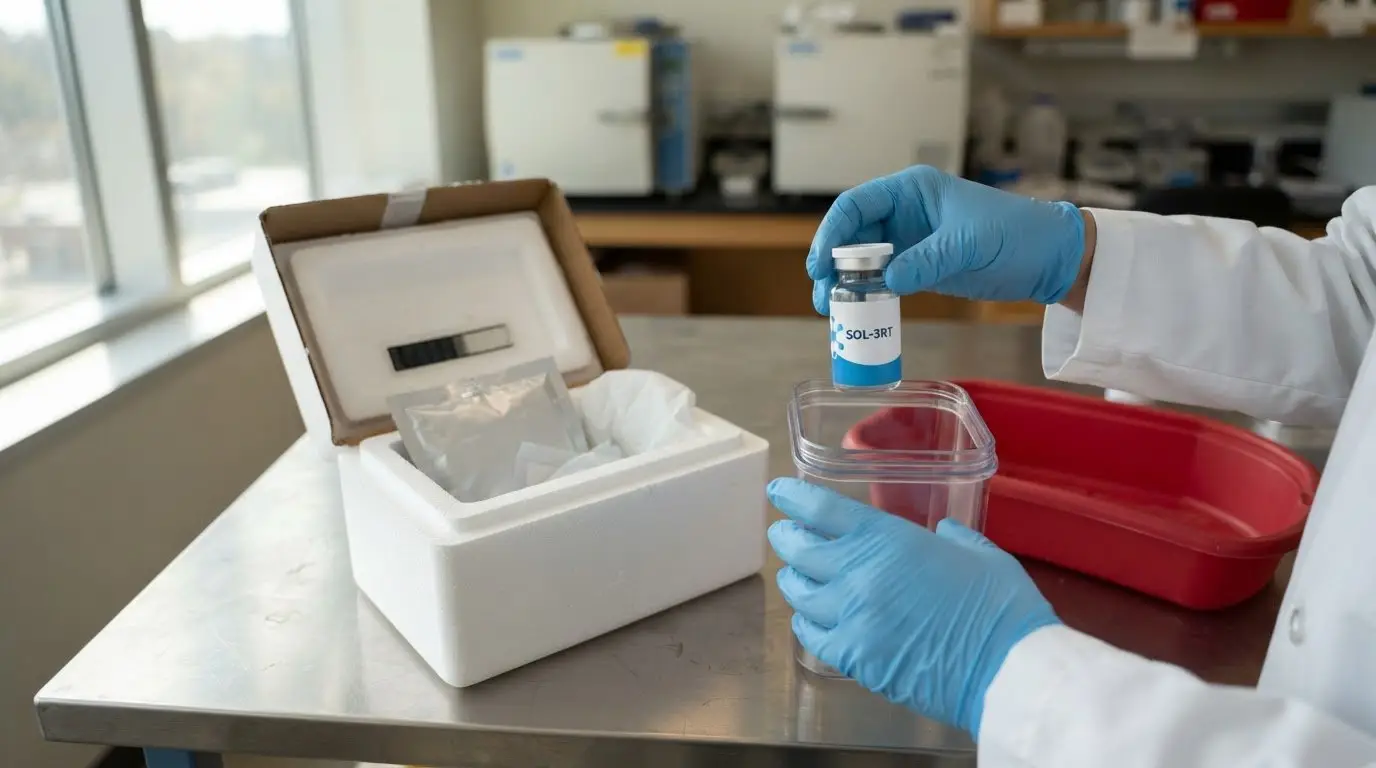
The catalog includes SOL-3RT Retatrutide 10mg and SOL-2TZ Tirzepatide 10mg, with additional listed strengths for both compounds. These products are for laboratory research only, not medicine or supplements, and not for use in people or animals.
Consider Solara Compounds when your sourcing requirements call for research compounds with batch-specific paperwork. Review the product documentation alongside your experiment’s specifications and institutional purchasing process. For questions about research materials or documentation, contact Solara Compounds.
Make Your Next Research Order Deliberate
Make sourcing a repeatable decision grounded in the experiment’s requirements and the laboratory’s capacity. Use this lab manager guide to sourcing chemicals to set priorities, document decisions, and keep scientific suitability central when options change.
For lab buyers sourcing research peptides, Solara Compounds offers SOL-3RT Retatrutide 10mg, SOL-2TZ Tirzepatide 10mg, and GHK-Cu 50mg. These products are for laboratory research only, not medicine or supplements, and not for use in people or animals. Their relevance depends on the laboratory’s research requirements and product specifications.
When a research peptide fits your work, explore the research catalog at Solara Compounds. Keep the order tied to a defined laboratory purpose and a considered purchasing decision. Careful sourcing begins with clarity, and that clarity can support more consistent lab operations.
Frequently Asked Questions
How can labs improve purchasing?
Labs can improve purchasing by linking orders to project plans and actual consumption. Compare planned reagent use with inventory withdrawals before setting reorder points. Review recurring delays and receiving errors with lab operations and procurement together. This helps distinguish a supplier issue from an internal approval bottleneck. Record why a product was selected so future researchers can make informed decisions without repeating earlier evaluation work.
How can technology support lab purchasing?
Inventory software can connect product records with quantities, locations, expiry dates, and reorder activity. Barcode scans help staff identify a container and retrieve its associated records. Shared purchasing platforms can also show whether an order is awaiting approval, has been placed, or has arrived. Assign responsibility for updating records after receipt; otherwise, digital tracking may reflect outdated stock and prompt avoidable duplicate requests.
Should labs buy supplies in bulk?
Buy in bulk only when expected use, shelf life, and storage capacity support the larger quantity. A frequently used consumable may suit bulk purchasing, while a specialized reagent for occasional experiments may expire before use. Compare the full implications, including storage demands and disposal of unused material. Review actual usage between orders and adjust future quantities when project plans or consumption patterns change.
What if a required product is not in the purchasing catalog?
Use the institution’s non-catalog purchasing process rather than selecting a substitute solely because it is listed. Prepare the product identity, scientific rationale, required specifications, quantity, and needed date for the requisition. Follow institutional review and approval steps, then connect the approved request to the resulting order and receiving records. If an alternative is proposed, researchers should assess its fit for the experiment before procurement proceeds.
What is lab supply purchasing?
Lab supply purchasing involves identifying a laboratory need, requesting and ordering specified materials, and recording their receipt. It includes more than placing an order: the request must retain product requirements and timing as it moves through approvals. Receiving records should connect with purchasing and payment documentation. Broader procurement strategy also covers supplier relationships and purchasing policies, while finance teams manage invoices and financial records.
How can laboratories identify reputable chemical suppliers?
Assess whether suppliers provide product-specific documentation, identifiable business information, and a clear way to trace the material supplied. Evaluate consistency across previous orders, including whether delivered products match specifications and arrive with usable records. Ask scientific and procurement teams to document supplier performance after receiving. Missing reports, vague safety information, or pressure to accept an unsuitable substitute warrant closer review before an order proceeds.
How can labs compare chemical prices, shipping costs, and minimum order quantities?
Compare equivalent products and packages, then account for shipping charges and minimum quantities shown in each offer. A smaller order may better match near-term use, while a larger minimum can increase storage and expiry concerns. Include delivery timing and documentation in the comparison, not only the quoted product amount. Record assumptions consistently so purchasing staff compare like with like across requisitions and future orders.
How can labs verify supplier safety data sheets and Certificates of Analysis?
Use each document for its intended purpose: an SDS describes hazards and safe handling, while a COA reports analytical information for a product or batch. Match the document’s chemical identity and, for a batch report, its lot identifier to the received material. Save the records with the inventory entry and order file. If identifiers or product details do not align, pause use until the discrepancy is resolved.