Research Articles
MOTS-C Peptide Research Applications: A Guide to Purity and Laboratory Utility


A generic “99% purity” claim on a Certificate of Analysis is often insufficient to guarantee the experimental integrity of a 16-amino-acid mitochondrial-derived peptide. In the specialized field of MOTS-C peptide research applications, the structural arrangement of the sequence is just as vital as the absence of contaminants. You likely understand that even minor degradations during transit or sequence-related impurities can skew metabolic signaling data in your lab models. This article provides a technical framework for verifying HPLC and mass spectrometry data to ensure your investigative results remain repeatable and precise.
In the realm of MOTS-C peptide research applications, it’s essential to consider the implications of purity and its influence on experimental outcomes. For researchers, understanding the nuances of MOTS-C is critical.
We’ll explore the specific mechanisms of MOTS-C within cellular pathways and discuss how to identify high-quality lyophilized compounds that resist degradation. You’ll learn how Solara Compounds maintains structural stability through rigorous third-party testing and climate-controlled logistics to protect your experimental outcomes. By the end of this guide, you’ll have a clear strategy for sourcing MOTS-C 10mg and 40mg vials from solaracompounds.com while maintaining the highest standards for laboratory research only. We focus on the intersection of material science and real-world laboratory utility to support your long-term research success.
The evolving landscape of MOTS-C peptide research applications is significant for future studies.
Key Takeaways
- Understand the unique origin of MOTS-C as a 16-amino acid mitochondrial-derived peptide and its specific role in cellular signaling pathways.
- Explore primary MOTS-C peptide research applications in glucose metabolism, insulin signaling, and cellular longevity models for 2026.
- Learn to verify peptide integrity by interpreting batch-specific HPLC and mass spectrometry data to ensure sequence accuracy and experimental repeatability.
- Identify essential storage and handling protocols, such as -20°C temperature maintenance, to prevent degradation and moisture absorption in lyophilized research compounds.
- Access high-purity MOTS-C 10mg and 40mg vials from Solara Compounds at solaracompounds.com, which are strictly for laboratory research only and include third-party verification.
Defining MOTS-C as a Tool for Mitochondrial Research
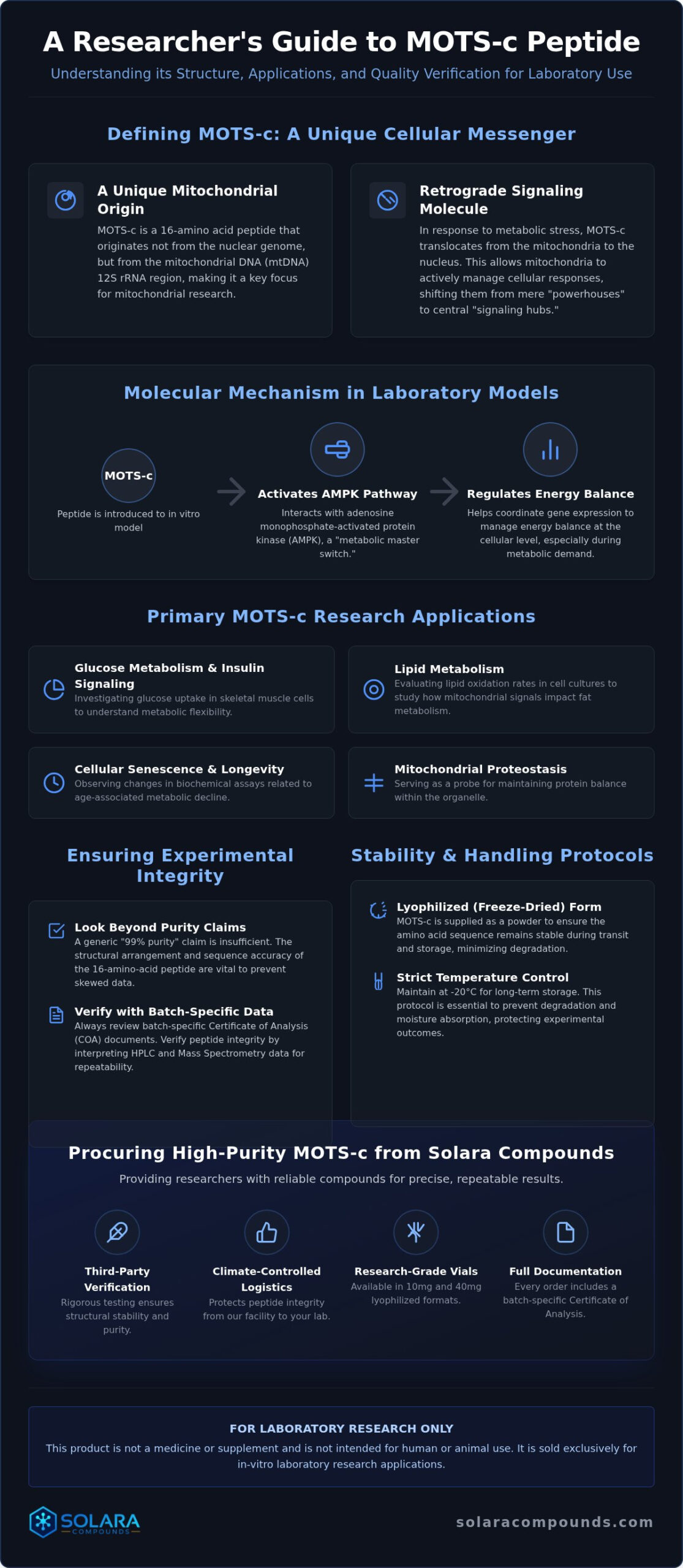
MOTS-C is a 16-amino acid mitochondrial-derived peptide (MDP) that represents a significant shift in how we understand cellular communication. Unlike the majority of peptides encoded by the nuclear genome, this specific molecule originates within the mitochondrial DNA (mtDNA) 12S rRNA region. This unique genetic origin makes the MOTS-c peptide a primary focus for investigators examining mitochondrial-to-nuclear signaling. In laboratory models, it acts as a mobile messenger that translocates from the mitochondria to the nucleus in response to metabolic stress.
Understanding MOTS-C peptide research applications requires a focus on its role as a signaling molecule. When cellular homeostasis is disrupted, MOTS-C moves to the nucleus to coordinate the expression of nuclear genes. This retrograde signaling pathway allows the mitochondria to actively manage cellular responses rather than simply providing ATP. For consistent results in these sensitive assays, researchers require high-purity compounds. Solara Compounds provides MOTS-C in a lyophilized, or freeze-dried, powder format to ensure the 16-amino acid sequence remains stable during transit and storage. It’s strictly for laboratory research only and not for human or animal use.
Many scientists are delving into various MOTS-C peptide research applications to harness its full potential.
The Molecular Mechanism of MOTS-C in In Vitro Models
In cellular research, the primary mechanism of MOTS-C involves the activation of the AMPK signaling pathway. AMPK, or adenosine monophosphate-activated protein kinase, functions as a metabolic master switch; its activation by MOTS-C helps regulate energy balance at the cellular level. This interaction is particularly relevant when studying gene expression during periods of metabolic demand. Because the peptide is relatively short, synthesis precision is paramount. Even a single amino acid substitution can alter its ability to interact with target pathways, which is why batch-specific verification is critical for experimental integrity.
Why Researchers Focus on Mitochondrial-Derived Peptides
Mitochondrial-derived peptides are a relatively new class of bioactive tools that have redefined our view of mitochondria. Previously, these organelles were seen purely as the cell’s “powerhouses,” but they’re now recognized as central signaling hubs. MOTS-C is currently the most studied MDP for metabolic regulation due to its direct influence on nuclear transcription. Lab buyers often choose the MOTS-C 10mg or 40mg vials from solaracompounds.com for their stability and well-documented signaling properties. By utilizing these peptides, investigators can explore how mitochondrial health influences broader cellular functions without the confounding variables found in less stable compounds.
Primary MOTS-C Peptide Research Applications in 2026
In 2026, the scope of MOTS-C peptide research applications continues to expand beyond basic mitochondrial function. Researchers are increasingly focusing on how this peptide regulates systemic metabolism through inter-organ communication. Studies often utilize in vitro models to examine glucose metabolism and insulin signaling pathways. By observing how MOTS-C influences glucose uptake in skeletal muscle cells, investigators can better understand the mechanisms behind metabolic flexibility, which is the cell’s ability to switch between fuel sources. This research is vital for characterizing how cells respond to varied energy demands. For a foundational understanding of the peptide’s regulatory status and function, the USADA provides a summary of What is MOTS-c and its role in biological signaling.
The diverse MOTS-C peptide research applications offer insights that could revolutionize metabolic studies.
Beyond glucose, MOTS-C is a primary tool for investigating lipid metabolism and cellular senescence, the process where cells stop dividing but don’t die. Longevity studies utilize the peptide to observe changes in biochemical assays related to age-associated metabolic decline. It’s often used to evaluate lipid oxidation rates in cell cultures, providing data on how mitochondrial-derived signals impact fat metabolism. Additionally, the peptide serves as a probe for mitochondrial proteostasis, or the maintenance of protein balance within the organelle. These investigative applications are strictly for laboratory research only and are not intended for human or animal use. Solara Compounds provides these materials to support experimental precision in controlled settings.
Understanding the multifaceted nature of MOTS-C peptide research applications is pivotal for advancing the field.
Metabolic Signaling and AMPK Activation Research
Researchers are increasingly focusing on innovative MOTS-C peptide research applications to explore new avenues in science.
MOTS-C is frequently employed to study the activation of the AMPK pathway. AMPK, which acts as a sensor for cellular energy levels, is a major focus in metabolic research. Researchers compare its effects to AICAR, a known AMPK activator, to map out the specific signaling cascades involved in cellular energy regulation. These studies provide insights into how mitochondrial signals can bypass traditional nuclear-driven metabolic controls. To maintain the integrity of these assays, lab buyers often prioritize sourcing high-purity peptides at solaracompounds.com that match the exact 16-amino acid sequence required for precise receptor interaction.
Cellular Stress and Proteostasis Models
Modern research also explores MOTS-C’s role in the integrated stress response (ISR). This pathway helps cells adapt to environmental challenges like nutrient deprivation or oxidative stress. Investigators use the peptide to model nuclear-mitochondrial communication, observing how signals from the mitochondria can alter nuclear gene expression to promote survival. This adaptation is a key area of interest for those studying cellular resilience in controlled laboratory environments. By evaluating how MOTS-C influences these stress pathways, researchers can better understand the complex feedback loops that maintain cellular health under pressure.
Myth-Busting: Peptide Compound Purity for MOTS-C
A common misconception in the research industry is that a static “99% purity” claim on a generic Certificate of Analysis (COA) is sufficient for institutional work. In the field of MOTS-C peptide research applications, this single percentage is often a misleading metric if it isn’t supported by raw data. Purity simply indicates the relative abundance of the primary peak in a chromatogram; it doesn’t verify that the peak is actually the correct 16-amino acid sequence. For researchers, the risk isn’t just a slightly less potent compound, but rather the presence of sequence-related impurities that can produce false positives or unrepeatable data in metabolic signaling assays.
It’s also a mistake to assume that all MOTS-C powders are identical because they share the same chemical name. Synthesis quality varies significantly between manufacturers. Solid-phase peptide synthesis requires precise control over each amino acid coupling step. Without identity confirmation via liquid chromatography-mass spectrometry (LC-MS), you’re essentially trusting a label rather than the material science. Solara Compounds mitigates this risk by providing batch-specific documentation for every lot, ensuring that what you receive at solaracompounds.com matches the rigorous requirements of your laboratory research only.
The ‘99% Purity’ Snapshot vs. Identity
HPLC measures purity by calculating the area under the main peak relative to other peaks, but it doesn’t confirm what that peak is. A compound could be 99% pure but consist of the wrong peptide entirely if the synthesis was flawed. This is why mass spectrometry peptide testing is the gold standard for identity verification. It measures the molecular mass of the compound to ensure it aligns with the theoretical weight of MOTS-C. We utilize both HPLC and MALDI-TOF mass spectrometry to provide a two-tier verification process, confirming both the cleanliness and the identity of the compound before it reaches your lab.
Common Impurities in Synthetic MOTS-C
Synthesis byproducts like truncated sequences or amino acid deletions are common in lower-grade MOTS-C. These “invisible” impurities often elute close to the main peak, making them difficult to detect without high-resolution equipment. They can interfere with receptor binding and skew data in sensitive biochemical models. Additionally, residual trifluoroacetic acid (TFA) from the cleavage process can impact cellular viability in in vitro studies if not properly managed. Relying on verified high-purity sources ensures these variables don’t compromise your experimental outcomes.
Stability and Handling of MOTS-C in Laboratory Settings
The integrity of samples is crucial for successful MOTS-C peptide research applications, as many factors can influence results.
Maintaining structural integrity is a prerequisite for valid data in MOTS-C peptide research applications. When supplied as lyophilized peptides for laboratory use, these compounds are highly stable but remain sensitive to environmental variables. Long-term storage requires a consistent temperature of -20°C to prevent degradation. For shorter intervals, 2-8°C is acceptable, though repeated temperature fluctuations should be avoided. One of the most critical steps in handling is managing hygroscopicity, which is the tendency of the powder to attract moisture from the air. You must allow the vial to reach room temperature before breaking the seal. Opening a cold vial introduces condensation that leads to rapid peptide hydrolysis and compromised results.
In light of these challenges, maintaining quality in MOTS-C peptide research applications is paramount for reliable outcomes.
UV light and moisture are the primary catalysts for MDP degradation. Exposure to these elements can break the peptide bonds, resulting in truncated sequences that no longer interact correctly with cellular receptors. This material is strictly for laboratory research only and requires a controlled environment to ensure the 16-amino acid sequence remains intact for biochemical assays. Solara Compounds provides these materials in vacuum-sealed vials to mitigate these risks before the product reaches your facility.
Preserving Sequence Integrity During Transit
Minimize the risk of degradation by prioritizing domestic U.S. shipping for your laboratory needs. International transit often involves extended delays and uncontrolled storage conditions that can compromise peptide stability. Solara Compounds utilizes secure, opaque packaging to protect the compound from both light and atmospheric moisture during transit. Before beginning your study, inspect the cake within the vial. A high-quality lyophilized product should appear as a solid, uniform cake or a fine powder. Significant clumping or a “melted” appearance often indicates that moisture has breached the seal or that the compound has been exposed to excessive heat.
Best Practices for Reconstitution in Research
The choice of solvent depends on your specific investigative model. Most researchers utilize BAC Water 10ml or sterile saline for initial reconstitution. Use the “gentle swirl” technique rather than vigorous shaking to dissolve the powder. Shaking creates mechanical shearing forces that can physically break the delicate peptide chains, rendering the sample useless for precise signaling studies. For more detailed handling protocols, consult our Identifying High-Grade Laboratory Compounds guide. Ensuring these standards are met is the only way to guarantee the repeatability of your experimental data.
To ensure your lab receives materials handled with professional precision, you can shop research-grade MOTS-C vials at solaracompounds.com.
Procuring High-Purity MOTS-C from Solara Compounds
Solara Compounds serves as a specialized partner for institutional buyers and independent researchers focused on MOTS-C peptide research applications. We provide MOTS-C in both 10mg and 40mg lyophilized vials, with each lot synthesized in ISO 7 cleanrooms using advanced solid-phase techniques. Our commitment to experimental integrity is reflected in our requirement for a minimum purity of ≥99% as verified by High-Performance Liquid Chromatography (HPLC). To ensure total objectivity, every batch undergoes independent third-party verification by Kovera Labs. This rigorous testing confirms both the chemical cleanliness and the molecular identity of the compound, providing you with the stability required for sensitive signaling assays. These materials are strictly for laboratory research only and are not for human consumption, supplements, or medical use.
Transparency and Lot-Number Traceability
Experimental repeatability depends on the consistency of the raw materials used across different phases of a study. Our batch specific COA peptides program ensures that you’re never working with generic data. Each vial is linked to a specific lot number that corresponds to a unique set of analytical reports. Researchers can access these third-party verification documents at solaracompounds.com/coa/ by entering the lot number found on the product packaging. This documentation-first approach addresses a common gap in the research supply chain by connecting raw material properties directly to your lab’s data integrity. By maintaining this level of transparency, we support your ability to publish results based on verified, high-purity compounds.
Logistics and Institutional Support
Efficient procurement is vital for maintaining the momentum of your laboratory work. Solara Compounds offers fast domestic shipping within the United States to minimize the risk of peptide degradation during long transit times. We provide free shipping on all orders over $200 to support large-scale institutional procurement. If you have technical questions regarding our synthesis methods or require assistance with your order, our support team is available Monday through Friday, 8 AM to 5 PM Eastern. You can contact us at support@solaracompounds.com or by calling 1 (877) 388-9178. We invite you to view the current research catalog at solaracompounds.com to review our full selection of high-purity materials, including MOTS-C, SOL-3RT, and other essential research peptides.
Advancing Metabolic Science with Verified Compounds
The investigation of mitochondrial-derived peptides represents a significant shift in cellular biology. As explored, MOTS-C peptide research applications range from studying glucose uptake mechanisms to examining the integrated stress response in longevity models. Precision in these studies is only possible when the 16-amino acid sequence is structurally intact and verified by orthogonal data. Relying on generic claims can compromise your findings; utilizing batch-specific analysis ensures that your results are both repeatable and accurate.
Consequently, the relevance of MOTS-C peptide research applications has never been more crucial for scientific discovery.
Solara Compounds supports your laboratory work by providing batch-specific COAs and independent verification through Kovera Labs for every lot. We prioritize the stability of your materials with fast U.S. shipping and vacuum-sealed packaging. These products are for laboratory research only and aren’t for human consumption or medical use. By choosing high-purity materials from solaracompounds.com, you ensure that your investigative focus remains on the science rather than the variables of compound quality. We’re committed to supporting your long-term research success with precision-engineered materials.
Shop high-purity MOTS-C and research peptides at solaracompounds.com
Frequently Asked Questions
What is the primary mechanism of MOTS-C in metabolic research?
MOTS-C peptide research applications are becoming fundamental in exploring metabolic pathways in greater depth.
MOTS-C activates the AMPK signaling pathway, acting as a metabolic master switch in cellular models. It translocates from the mitochondria to the nucleus to regulate gene expression during metabolic stress. Researchers in biotech hubs like Boston and San Diego use this peptide to study glucose metabolism. This retrograde signaling allows the mitochondria to manage broader cellular responses, providing a unique tool for investigating energy homeostasis in controlled laboratory settings.
Does 99% purity on a MOTS-C COA guarantee experimental success?
No, a 99% purity claim doesn’t guarantee experimental success because it only measures the relative abundance of the main peak, not the molecular identity. If the synthesis is flawed, the 99% could represent an incorrect sequence. For valid MOTS-C peptide research applications, you need orthogonal testing. This includes both HPLC for purity and mass spectrometry for identity confirmation to ensure the 16-amino acid sequence is correct before beginning laboratory assays.
For those involved in MOTS-C peptide research applications, the implications of purity must not be overlooked.
How should MOTS-C be stored to maintain its 16-amino acid sequence integrity?
Long-term storage of lyophilized MOTS-C requires a consistent temperature of -20°C to preserve the 16-amino acid sequence. For short-term use, 2-8°C is acceptable, but you should avoid repeated freeze-thaw cycles. It’s also vital to protect the vials from UV light and moisture. Lab buyers in humid climates like Miami or Houston must allow the vial to reach room temperature before opening to prevent condensation and subsequent peptide hydrolysis.
What is the difference between HPLC and Mass Spectrometry for MOTS-C testing?
Moreover, the differentiation of methods in MOTS-C peptide research applications can significantly impact scientific conclusions.
HPLC measures the purity by determining the amount of the main peptide peak relative to any contaminants. Mass Spectrometry, specifically LC-MS or MALDI-TOF, confirms the molecular weight of the compound to verify its chemical identity. While HPLC tells you how clean the sample is, Mass Spectrometry confirms that the sample is actually MOTS-C. Solara Compounds utilizes both methods to provide researchers in Seattle and Austin with reliable, documented materials for laboratory research only.
Why is MOTS-C referred to as a mitochondrial-derived peptide (MDP)?
MOTS-C is classified as a mitochondrial-derived peptide because it’s encoded within the mitochondrial DNA, specifically the 12S rRNA region, rather than the nuclear genome. This unique origin makes it a primary focus for studies on mitochondrial-to-nuclear signaling. Researchers in San Francisco and New York use MDPs as investigative tools to explore how mitochondria function as signaling hubs, shifting the understanding of these organelles from simple powerhouses to active metabolic regulators.
These factors render MOTS-C peptide research applications a critical focus for researchers in the field.
Can MOTS-C be used in animal or human studies according to Solara Compounds policies?
No, MOTS-C from Solara Compounds cannot be used in animal or human studies under any circumstances. Our policies strictly state that all products are for Research Use Only (RUO). They aren’t medicines, supplements, or drugs, and they’re not intended for diagnostic or veterinary use. We supply these compounds solely for in-vitro and laboratory research to qualified scientific buyers in cities like Chicago, Dallas, and Philadelphia who maintain controlled experimental environments.
How does Solara Compounds verify the identity of its MOTS-C 40mg vials?
Solara Compounds verifies every batch of MOTS-C 40mg vials through independent third-party testing conducted by Kovera Labs. This process includes HPLC purification to target ≥99% purity and molecular confirmation via LC-MS. Each lot is assigned a unique number, allowing lab buyers in Phoenix or Tampa to access batch-specific Certificates of Analysis at solaracompounds.com/coa/. This documentation-first approach ensures that the material science matches the requirements for high-precision MOTS-C peptide research applications.
Commitment to quality in MOTS-C peptide research applications is imperative for advancing our understanding of metabolic health.
What are the common ‘invisible’ impurities found in research-grade peptides?
Common “invisible” impurities in synthetic peptides include truncated sequences, amino acid deletions, and residual trifluoroacetic acid (TFA). These byproducts often elute very close to the main peak during HPLC, making them difficult to detect without high-resolution equipment. These contaminants can interfere with receptor binding and skew signaling data in sensitive assays. Researchers in Atlanta and Denver prioritize high-purity, third-party verified sources to ensure these impurities don’t compromise the integrity of their experimental models.
As interest grows, the role of MOTS-C peptide research applications in science will undoubtedly expand.