
Research Articles
Finding Trustworthy Peptide Sources: A Lab Buyer’s Guide

What if a peptide listing makes clear claims, but the accompanying paperwork doesn’t identify the batch being sold? For lab buyers, finding a trustworthy peptide source means checking the evidence behind the listing, not relying on confident wording alone.
Supplier claims can be difficult to compare when reports omit testing methods or don’t clearly connect results to a specific lot. A useful Certificate of Analysis (COA) should identify the batch and show what was tested. HPLC data helps assess purity, while mass spectrometry helps confirm molecular identity. Method details and sample identity make those results more meaningful.
This guide offers a repeatable checklist for reviewing batch documentation, testing methods, traceability, and procurement transparency. You’ll learn what to inspect in a COA and how to compare suppliers against consistent, evidence-based criteria. Solara Compounds makes batch-specific COAs available and states that independent testing is conducted through Kovera Labs. These are details to evaluate, not guarantees of research outcomes. All products are for laboratory research only, not medicine or supplements, and not for human or animal use.
Key Takeaways
- Start finding a trustworthy peptide source by checking verifiable batch evidence, not broad quality claims.
- Match the product name and lot number across the product record and COA, then check which analytical methods are reported.
- Use a consistent supplier comparison to assess COA access, independent testing disclosure, traceability, product details, and buyer support.
- Define your laboratory requirements first, then review documentation, traceability, support, and ordering information in sequence.
- Solara Compounds describes batch-specific COAs, lot-number traceability, and independent testing through Kovera Labs. Products are for laboratory research only, not for human or animal use.
What Makes a Peptide Source Trustworthy for Laboratory Research?
For lab buyers, a supplier’s claims matter only if they can be checked against clear records. A trustworthy peptide source connects each product claim to verifiable, batch-level evidence that a buyer can review. That means evaluating more than polished product pages or broad phrases such as “research grade.” Look for specific information that links the material offered to its identity, analytical evidence, lot, and procurement support.
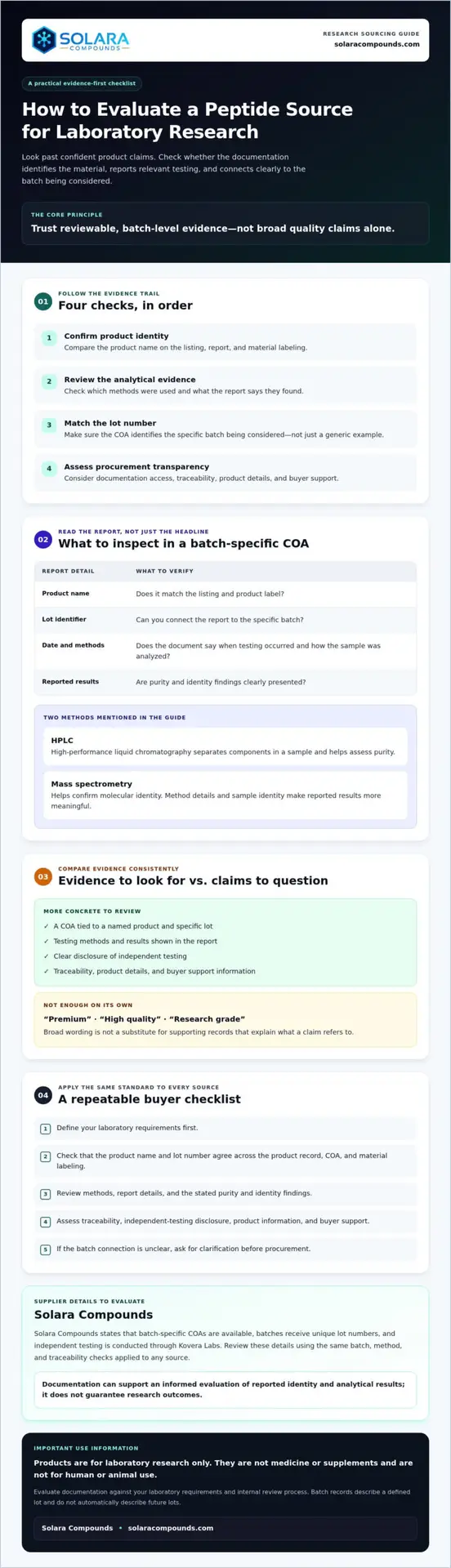
Use a consistent sequence: confirm product identity, review the analytical evidence, check lot traceability, then assess whether the supplier provides clear answers about purchasing and documentation. Learning the basics of chemical peptide synthesis can also help researchers understand why manufacturing details and testing records matter, without treating process descriptions as proof of a particular batch’s quality.
Which supplier claims can a lab buyer verify?
Separate claims that point to reviewable records from general assurances. A documented testing method, an analytical report, or a batch record gives a buyer something concrete to examine. By contrast, words like “premium” or “high quality” are not enough on their own if the supplier doesn’t explain what they refer to or provide supporting documentation.
Check whether the product name on the listing matches the name on its report, and whether that report identifies a specific lot. A product page, such as Solara Compounds’ KPV 10 mg listing, can be a starting point for checking product information; buyers should still review the available batch documentation. Treat statements about research suitability as information to assess against laboratory requirements, not as assurances of experimental results.
Why does batch-level evidence matter?
A batch record applies to a defined production lot. It doesn’t automatically describe future lots, which may have different documentation. The lot number is the link between the material received and the records supplied for that batch. Check that the number on the container or accompanying paperwork matches the number on the relevant report. If the connection isn’t clear, ask the supplier to clarify it before procurement.
Batch documentation supports an informed evaluation of identity and reported analytical results, but it can’t promise a particular experimental outcome. Researchers still need to decide whether the available evidence fits their project requirements and internal review process.
Solara Compounds makes batch-specific COAs available and states that its batches receive unique lot numbers. Buyers can review these details at solaracompounds.com using the same criteria they would apply to any source. Products are for laboratory research only, not medicine or supplements, and not for human or animal use.
How to Read a Peptide COA and Analytical Report
A Certificate of Analysis (COA) is useful only when you can connect it to the material under consideration. For lab buyers finding a trustworthy peptide source, the key task is to follow the record from the product listing to the report and then to the lot received.
What should a batch-specific COA show?
Check the basic identifiers first. The product name and lot number should match the product information and the material’s labeling. Review the report date and the analytical results, and confirm that the document refers to the batch being considered rather than serving as a generic example.
- Product name: Does it match the listing and product label?
- Lot identifier: Can you connect the report to the specific batch?
- Report date and methods: Does the document say when testing occurred and how the sample was analyzed?
- Results: Are the reported purity and identity findings clearly presented?
Solara Compounds makes batch-specific COA records available for review. For a broader example of documentation in a specific research-chemical procurement context, the National Institute on Drug Abuse outlines procurement and documentation standards. Use relevant guidance to inform your own review, while checking that a supplier’s report directly corresponds to the batch being evaluated.
How should buyers interpret purity and identity results?
HPLC, or high-performance liquid chromatography, separates components in a sample. Its reported profile can help assess purity by showing the relative signal associated with the target material and other detected components. Mass spectrometry answers a different question: whether the measured molecular mass is consistent with the expected molecule. MALDI-TOF and LC-MS are mass-spectrometry methods used to support molecular identity confirmation.
A purity result describes the sample’s analytical profile; identity evidence helps assess what the material is, and neither predicts experimental outcomes. These results complement each other, but a percentage alone doesn’t establish whether material fits a particular study’s requirements.
Solara Compounds states a purification target of greater than 98% minimum. Treat that as a company statement to verify against the specific batch report, not as a substitute for reviewing its results. For documentation questions, use the information provided with the COA and ask for clarification if a method, sample identity, or lot connection is unclear. You can also review the research catalog alongside the available batch records.
Solara Compounds products are for laboratory research only, not medicine or supplements, and not for human or animal use.
How to Compare Peptide Suppliers Using Evidence, Not Promises
Finding a trustworthy peptide source is easier when each supplier is assessed against the same evidence categories. Rather than relying on a quality claim, ask what record supports it, whether it applies to the specific product and lot, and whether the supplier can explain it clearly.
Batch COA access
Ask: Can I review a report for the batch being considered?
A clear answer: The supplier provides a report that identifies the product and relevant lot, rather than only a generic sample.
Testing disclosure
Ask: Which methods were used, what material was tested, and who conducted the testing?
A clear answer: The supplier names the methods and identifies whether testing was conducted independently or in-house.
Traceability
Ask: How does the product listing connect to a lot number and its supporting COA?
A clear answer: The supplier explains where to find the lot identifier and how to match it to the report.
Product-page clarity
Ask: Does the listing clearly identify the product and provide relevant documentation access?
A clear answer: Product information is specific enough to compare with the report. A KPV product listing can serve as a page-level example; verify its current details directly rather than assuming what a listing contains.
Procurement support
Ask: Who can clarify report methods, lot matching, or ordering details?
A clear answer: Support explains where documentation is found and responds to the question without substituting broad assurances for evidence.
Which supplier documentation deserves closer review?
Give greater weight to records that identify the test method, tested material, and relevant batch. Current, batch-linked reports are more useful for evaluation than paperwork that isn’t connected to the lot under consideration. A supplier’s description of its own process is not the same as independent confirmation of a batch result, so check who performed each test and what the report actually covers.
Solara Compounds states that independent third-party testing is conducted through Kovera Labs. That disclosure gives buyers a specific testing organization to consider, while the batch report remains the evidence to inspect. The NIDA ordering guidelines offer a reference point for documentation in that federal program’s research-chemical procurement process; they shouldn’t be treated as a universal checklist for every supplier.
Compare answers side by side. Clear documentation and responsive support help buyers evaluate procurement fit, but neither guarantees experimental outcomes. Solara Compounds products are for laboratory research only, not medicine or supplements, and not for human or animal use. To compare listed research products and their available information, visit the research peptide catalog.
A Practical Checklist for Selecting a Research Peptide Source
A repeatable procurement process helps lab buyers move from project needs to an evidence-based purchase decision. Use this sequence for laboratory purchasing, not for personal use or experimental instructions.
- 1. Define project requirements. Identify the compound and documentation your laboratory needs to evaluate it. Set those criteria before comparing product pages, so supplier claims can be assessed against a consistent standard.
- 2. Check the documentation. Record the exact product name and review the available batch report. Compare its stated test methods and results with your laboratory’s purchasing requirements. If a method or result is unclear, note the question rather than assuming what it means.
- 3. Confirm traceability. Check whether the product information connects to a specific lot and supporting COA. Confirm that identifiers match across the records available for review. If information is missing, unclear, or inconsistent, ask the supplier for clarification before proceeding.
- 4. Assess support. See whether the supplier can answer practical questions about where to find paperwork, how lot details are presented, or what ordering information applies. Clear support helps resolve procurement questions; it isn’t a substitute for your laboratory’s technical evaluation.
- 5. Review ordering details. Check current product information, ordering terms, and destination availability before purchase. For U.S. buyers, confirm at checkout that the supplier can ship to the intended destination and review the shipping terms shown there. Don’t assume those details based on an older listing or a general statement.
How can a lab compare documentation before ordering?
Keep a short record for each source: product name, lot details available for review, testing methods, reported results, and questions still outstanding. Compare the information with your laboratory’s own criteria. Pause if the product name doesn’t align, the lot connection is unclear, or a report leaves a key method unexplained. Request clarification before placing an order, then retain the response with your procurement records.
Which purchasing details should be confirmed?
Review live product information and ordering terms, and confirm destination availability at checkout. For company context, look for clear information about documentation and traceability. Solara Compounds lists support at support@solaracompounds.com and 1 (877) 388-9178, Monday-Friday, 8 AM-5 PM Eastern. Contact support with documentation or ordering questions, not for scientific or clinical advice.
Use the same evidence-based checklist for every source. To review Solara Compounds’ current research listings, see the research peptide catalog. Products are for laboratory research only, not medicine or supplements, and not for human or animal use.
Applying the Checklist to Solara Compounds
The same evidence-based review applies to Solara Compounds as to any supplier. For lab buyers finding a trustworthy peptide source, company descriptions are a starting point: match them against the relevant product information and batch documentation before making a procurement decision.
Which Solara documentation can buyers review?
Solara Compounds makes batch-specific Certificates of Analysis available through its current batch COA page. Use the report to check the product and lot details, then review the identity and purity information stated for that batch. Solara also states that each batch has a unique lot number and that independent third-party testing is conducted through Kovera Labs. These are specific points buyers can assess in the available records; testing documentation does not guarantee experimental outcomes.
Solara describes its processes as including ISO 7 cleanrooms and HPLC purification, with MALDI-TOF and LC-MS used for molecular confirmation. Treat these as company statements about its processes and methods. For procurement review, distinguish process descriptions from analytical results for the batch under consideration, and check the report for the information your laboratory requires.
Product information should also be checked against the current listing. SOL-3RT and SOL-2TZ are examples of exact product names in Solara’s catalog, but confirm current listing details and the related batch documentation rather than assuming that information from one listing applies to another product or lot.
What is the next step for a qualified research buyer?
Compare the current catalog with your laboratory’s purchasing requirements, then match the product information to the available COA and lot details. If documentation or ordering information needs clarification, contact Solara Compounds at support@solaracompounds.com or 1 (877) 388-9178, Monday-Friday, 8 AM-5 PM Eastern. Support can help with documentation and procurement questions, not scientific or clinical advice.
All products are for Research Use Only (RUO), solely for laboratory research, and not for human or animal consumption. They are not drugs, medicines, or dietary supplements. To compare current product information with your laboratory’s requirements, View the current research catalog.
Make Your Next Procurement Decision Evidence-Based
Finding a trustworthy peptide source starts with records you can verify. Match the product and lot details to the relevant COA, check which analytical methods are reported, and compare suppliers using the same criteria. Documentation helps researchers evaluate a batch, but it cannot guarantee experimental outcomes.
Solara Compounds makes batch-specific COAs and lot-number traceability available for review, and identifies Kovera Labs as its independent third-party testing provider. Use those details as evidence to inspect alongside the product information and your laboratory’s purchasing requirements.
All products are for laboratory research only. They are not drugs, medicines, or dietary supplements, and are not for human or animal consumption. If the available records fit your procurement criteria, view the current research catalog and review the relevant documentation before ordering. A consistent checklist can help make the next decision clear and well-supported.
Frequently Asked Questions
How can a researcher tell whether a peptide source is trustworthy?
Look for product and batch claims that can be checked against specific records. A researcher should be able to match the product name and lot number to a relevant COA, review the reported testing methods, and understand whether testing was independent or conducted by the supplier. Clear product information and useful answers to procurement questions add context. Finding a trustworthy peptide source means weighing these records together, not relying on a quality phrase alone.
What should a peptide Certificate of Analysis include?
A useful COA identifies the product, batch or lot, report date, analytical methods, and reported results. Check that the product name and lot identifier match the material being considered, rather than a generic sample or another batch. HPLC data can help assess the sample’s purity profile, while mass-spectrometry results can support molecular identity confirmation. If a method or sample identity isn’t clear, ask the supplier for clarification before proceeding with procurement.
Does a high HPLC purity result prove peptide identity?
No. HPLC separates components in a sample and can provide a purity profile, but a high reported purity percentage alone doesn’t establish molecular identity. Mass spectrometry, including methods such as MALDI-TOF or LC-MS, can provide separate evidence by measuring molecular mass. Review both types of results when available, and assess them against laboratory purchasing requirements. Neither a purity figure nor identity data guarantees a particular experimental outcome.
Why does a lot number matter when sourcing research peptides?
A lot number connects a defined batch of material with its supporting records. It helps a buyer check whether the COA under review refers to the same lot as the product information or received material. Since a report for one lot doesn’t automatically document another, confirm that the identifiers match and retain the relevant records for procurement documentation. If the lot connection is missing or ambiguous, ask the supplier to clarify it.
Is third-party testing enough to assess a peptide supplier?
No. Third-party testing is one useful evidence category, but it should be considered alongside the report’s methods, tested material, product identity, and lot details. Check whether the testing organization is named and whether the results apply to the batch under consideration. Also review product-page clarity, traceability, and support for documentation questions. Solara Compounds identifies Kovera Labs as its independent third-party testing provider, but the reports remain evidence to review, not outcome assurances.
What does Research Use Only mean for Solara Compounds products?
Research Use Only (RUO) means Solara Compounds products are intended solely for laboratory research. They are not for human or animal consumption and are not drugs, medicines, or dietary supplements. Researchers and lab buyers in Boston, San Diego, San Francisco, New York, Houston, Miami, Los Angeles, Austin, Raleigh, Seattle, Chicago, Philadelphia, Baltimore, Dallas, Phoenix, Tampa, Atlanta, and Denver should review product information and batch documentation for laboratory procurement needs.