Research Articles
Thymosin Beta-4 Synthetic Peptide: A 2026 Laboratory Research Guide


A familiar peptide label isn’t proof of an exact match. The term thymosin beta-4 synthetic peptide may refer to full-length thymosin beta-4 or be confused with shorter fragments such as TB-500, which are not automatically interchangeable. For laboratory researchers, checking the sequence and batch evidence matters more than relying on a product name alone.
If search results have left you sorting scientific records from commercial listings, that uncertainty is understandable. This guide explains how to distinguish full-length thymosin beta-4 from fragments, what identity and purity information to look for, and how to assess whether a supplier’s documentation supports the specific material being offered. You’ll also learn why a purity figure is most useful when it’s tied to a batch and an identified testing method.
Solara Compounds reports offering batch-specific COAs, lot-number traceability, and third-party testing through Kovera Labs. Its catalog includes TB-500, but that does not establish that the item is full-length thymosin beta-4 or an interchangeable material. See the current catalog at solaracompounds.com. All products are for Research Use Only (RUO) – intended solely for laboratory research and not for human or animal consumption, not a drug, medicine, or dietary supplement.
Key Takeaways
- Evaluate a thymosin beta-4 synthetic peptide by its stated sequence and product specification, not by a familiar label alone.
- Compare full-length material and shorter fragments carefully; similar names do not establish matching sequences or research evidence.
- Learn how to review identity methods, HPLC results, and purity claims without treating a purity figure as proof of identity.
- Check that supplier documentation identifies the relevant batch, and review what the COA and testing methods actually confirm.
- All products are for Research Use Only (RUO), intended solely for laboratory research and not for human or animal consumption, not a drug, medicine, or dietary supplement.
What Does Thymosin Beta-4 Synthetic Peptide Mean in Laboratory Research?
A thymosin beta-4 synthetic peptide is a peptide material described as matching some or all of the thymosin beta-4 sequence and produced through chemical synthesis rather than isolated directly from a biological source. The name alone doesn’t establish which sequence, length, or formulation a supplier is offering. Researchers need the product specification to identify the material under consideration.
This distinction matters when comparing research records with commercial listings. A study using a full-length peptide may not describe a shorter fragment, even if a listing uses a similar name. The supplied PubMed extraction for this guide shows a cookie notice but not the article content, so it can’t verify sequence details or support scientific claims. Check accessible primary literature and the specific product documentation before drawing conclusions.
How should researchers interpret the thymosin beta-4 name?
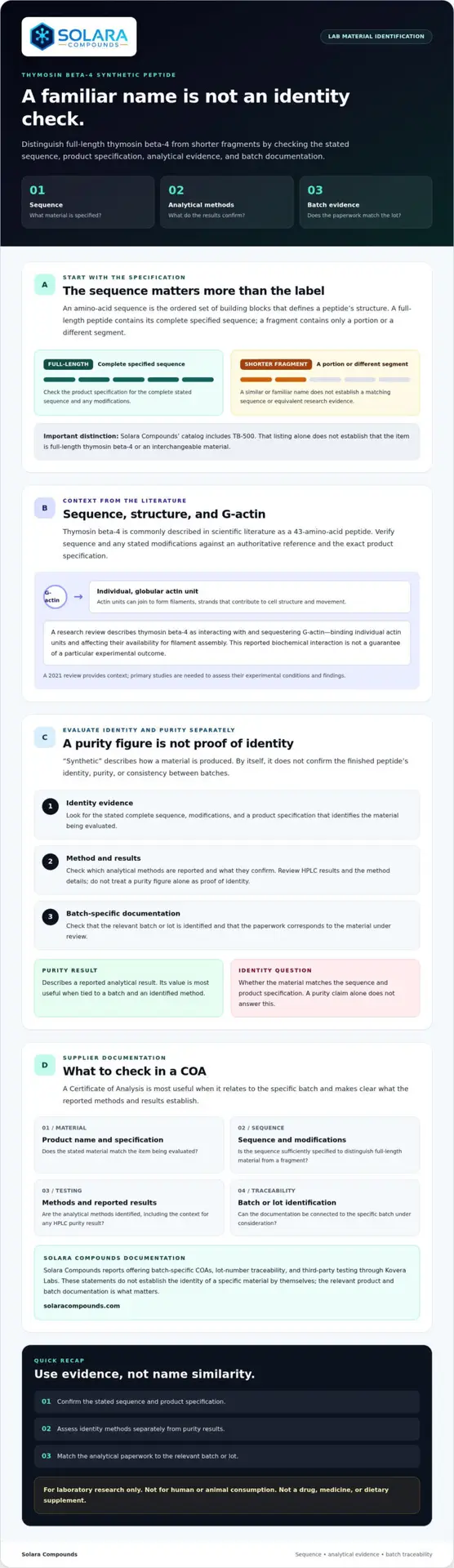
An amino-acid sequence is the ordered set of building blocks that defines a peptide’s structure. A full-length peptide contains its complete specified sequence; a short fragment contains only a portion or a different segment. The sequence, modifications, and product specification are therefore more informative than a familiar label.
Thymosin beta-4 offers general background on the protein, but an encyclopedic overview isn’t a substitute for primary literature or batch-level material evidence. In the supplied information, Solara Compounds’ catalog includes TB-500; that listing does not establish that it is full-length thymosin beta-4 or an interchangeable material.
What does synthetic indicate about a research material?
“Synthetic” describes how a material is produced. It doesn’t, by itself, confirm the finished peptide’s identity, purity, or consistency between batches, and it doesn’t establish whether the material suits a particular experiment. Those questions require evidence tied to the exact product and batch.
For a laboratory evaluation, researchers can check whether the supplier documentation states the complete sequence and any modifications, identifies the material and batch, and explains the analytical methods used. Treat an unexplained name or purity figure as incomplete information, not as proof of identity. Solara Compounds describes lot traceability and batch-specific COAs; consult the relevant paperwork for the material being evaluated at solaracompounds.com. A separate KPV research product page concerns a different catalog material and does not verify thymosin beta-4 identity.
All products are for Research Use Only (RUO) – intended solely for laboratory research and not for human or animal consumption, not a drug, medicine, or dietary supplement.
Thymosin Beta-4: Sequence, Structure, and G-Actin
Sequence gives researchers a structural reference; it doesn’t, by itself, prove what’s in a vial. Thymosin beta-4 is commonly described in scientific literature as a 43-amino-acid peptide. Any sequence or molecular-weight value used to identify a research material should still be checked against an authoritative reference and the exact product specification, including any stated modifications.
What is G-actin, and why is it mentioned in peptide research?
Actin is a structural protein inside cells. G-actin is the individual, globular form of actin that hasn’t joined other actin units to form a filament. Filaments are assembled strands that contribute to cell structure and movement.
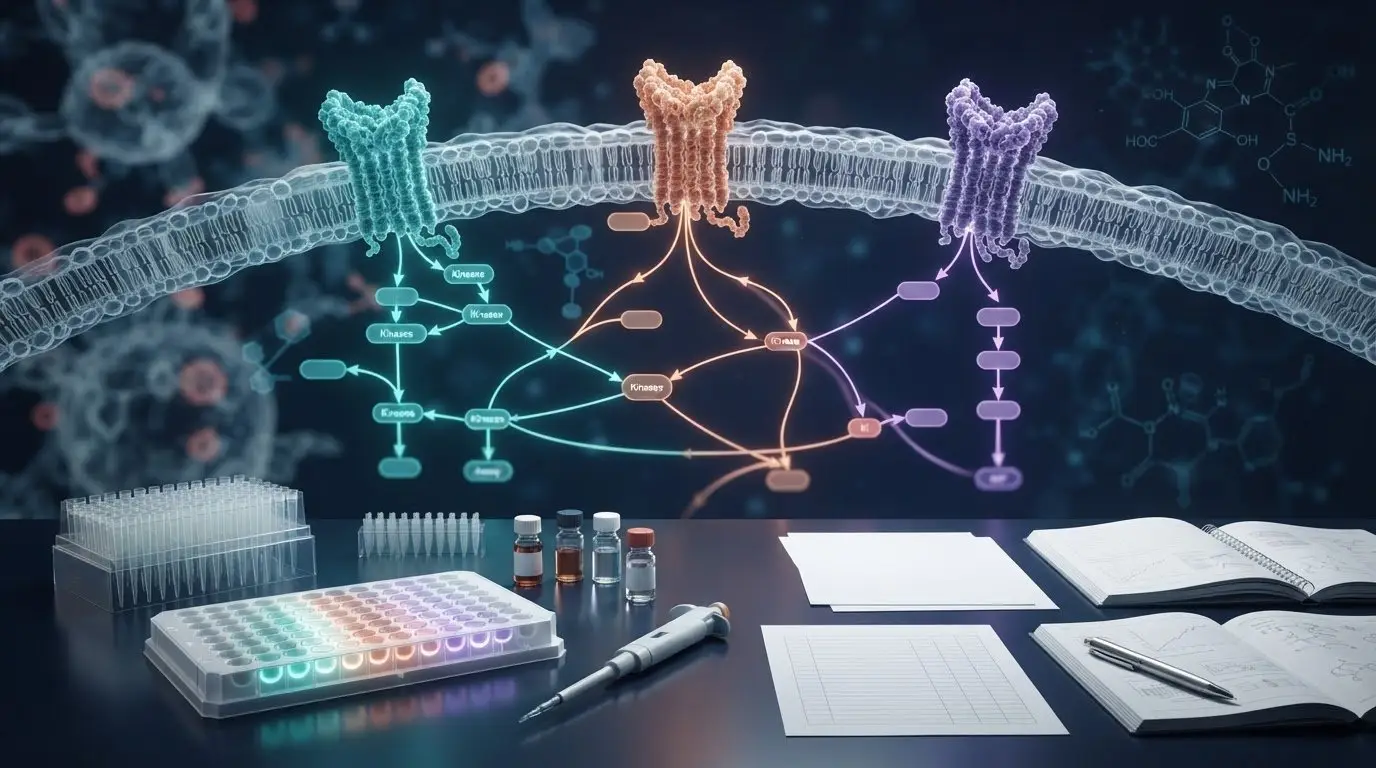
A review of the research describes thymosin beta-4 as interacting with G-actin and sequestering it, meaning the peptide binds individual actin units and can affect their availability for filament assembly. This is a reported biochemical interaction, not a guarantee of a particular outcome in an experiment. The Thymosin β4 in Tissue Repair review provides context, but researchers should consult the primary studies it cites to assess experimental conditions and findings.
Citation-ready summary: “Thymosin beta-4 has been described as sequestering G-actin, or binding individual actin units before they assemble into filaments, in research summarized in a 2021 review.” This wording attributes the mechanism to the literature rather than presenting it as a universal effect.
Why do sequence and molecular weight support identification?
Sequence length and molecular weight provide complementary checks. Length describes how many amino-acid units are in the specified chain; predicted molecular weight estimates the mass associated with that structure. A sequence change, an added chemical group, or a different fragment can alter the expected mass, so a number detached from its sequence isn’t a complete identifier.
Some product descriptions report a 43-residue sequence and a molecular weight of 4963.55 Da for thymosin beta-4. Treat those figures as claims to verify, not as stand-alone proof. Compare the stated sequence and any modifications with an authoritative reference, then check that the product records describe the same material. The supplied PubMed extraction doesn’t expose article content, so it can’t independently confirm the sequence or mechanism.
For broader background on Solara Compounds’ research catalog, review the current research materials; a catalog listing doesn’t establish that an item is full-length thymosin beta-4. All products are for Research Use Only (RUO) – intended solely for laboratory research and not for human or animal consumption, not a drug, medicine, or dietary supplement.
Thymosin Beta-4 vs. Short Peptide Fragments: What Should Researchers Compare?
Peptide names can overlap while the molecules do not. Compare the stated sequence, length, intended laboratory role, and supporting evidence before treating two listings as comparable. Matching labels do not establish matching molecular identity.
Material name
Sequence length
Stated purpose
Evidence to review
Full-length thymosin beta-4
Commonly described as 43 amino acids; confirm the sequence for the exact material.
Research involving the full-length peptide.
Primary literature and Thymosin Beta-4 Chemical Data, checked against the product specification.
AcSDKP
Four amino-acid residues, with an acetyl group indicated by “Ac.”
The supplied Abcam listing describes it as a synthetic blocking peptide.
The listing’s sequence and stated use; verify directly before citing it.
TB-500, Solara catalog item
Not established by the supplied Solara information.
Do not infer a research purpose from the name alone.
Exact product specification and batch documentation.
How does a short blocking peptide differ from full-length thymosin beta-4?
The supplied Abcam example is a short AcSDKP blocking peptide, not a full-length sequence. Its four-residue sequence is distinct from the full-length peptide’s sequence. A blocking peptide listing also has a stated experimental role that shouldn’t be assumed to match the role of a full-length material. Before publication or procurement, confirm the sequence and product description on the source page and compare them with the cited research.
Does the TB-500 name confirm thymosin beta-4 identity?
No. The supplied Solara Compounds information confirms a catalog item named TB-500, but doesn’t establish that it is full-length thymosin beta-4 or interchangeable with it. Researchers should compare the exact sequence, product specification, and batch records rather than infer equivalence from terminology. Review Solara’s current research catalog for catalog descriptions, not as evidence that the TB-500 item is the keyword material.
All products are for Research Use Only (RUO) – intended solely for laboratory research and not for human or animal consumption, not a drug, medicine, or dietary supplement.
How Can a Laboratory Evaluate Synthetic Peptide Identity and Purity?
Use a consistent review order. First confirm the stated identity, then inspect the analytical methods, match the paperwork to the lot, and only then assess any reported purity figure. This sequence helps lab buyers separate evidence about what a material is from evidence about how much of a sample meets a stated analytical criterion.
- Confirm identity: Compare the product name and stated sequence, including any modifications, with the material required for the study.
- Inspect methods: Check which analytical technique was used and what its result can support.
- Match the lot: Make sure the COA identifies the same product and lot as the label and procurement records.
- Assess purity: Review the reported result in context, including the method and the exact material tested.
What should a batch-specific COA show?
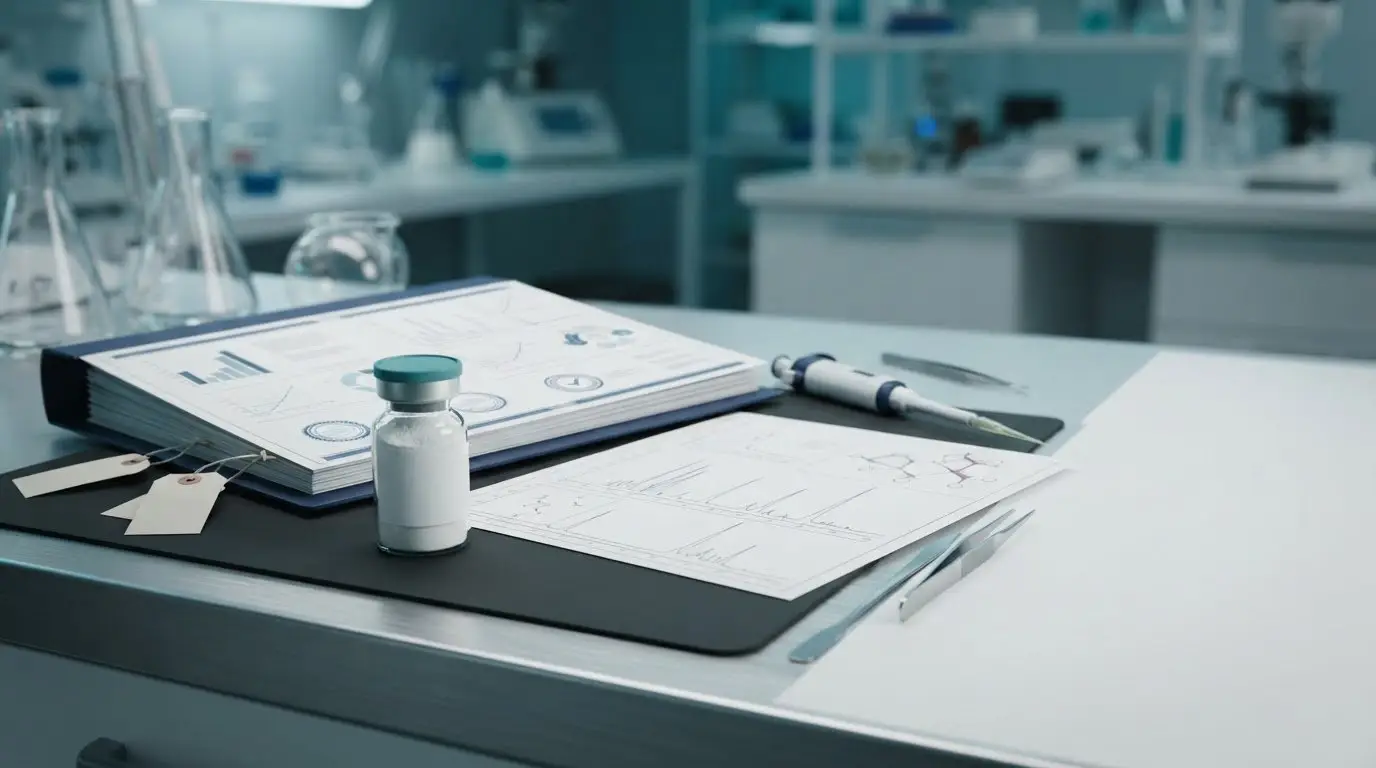
A useful COA should identify the exact product and lot number, name the test method, and report the results in a form researchers can interpret. Compare those details against the product label and procurement records. If a document doesn’t identify the batch or leaves the method unclear, ask what material and test the result refers to before relying on it.
A COA supports material evaluation; it doesn’t establish how a compound will behave in an experiment or predict an outcome. For a thymosin beta-4 synthetic peptide, the sequence and any stated modifications should align with the identity information in the documentation. A purity value alone cannot confirm that the material is the intended peptide.
How do HPLC and mass spectrometry provide different evidence?
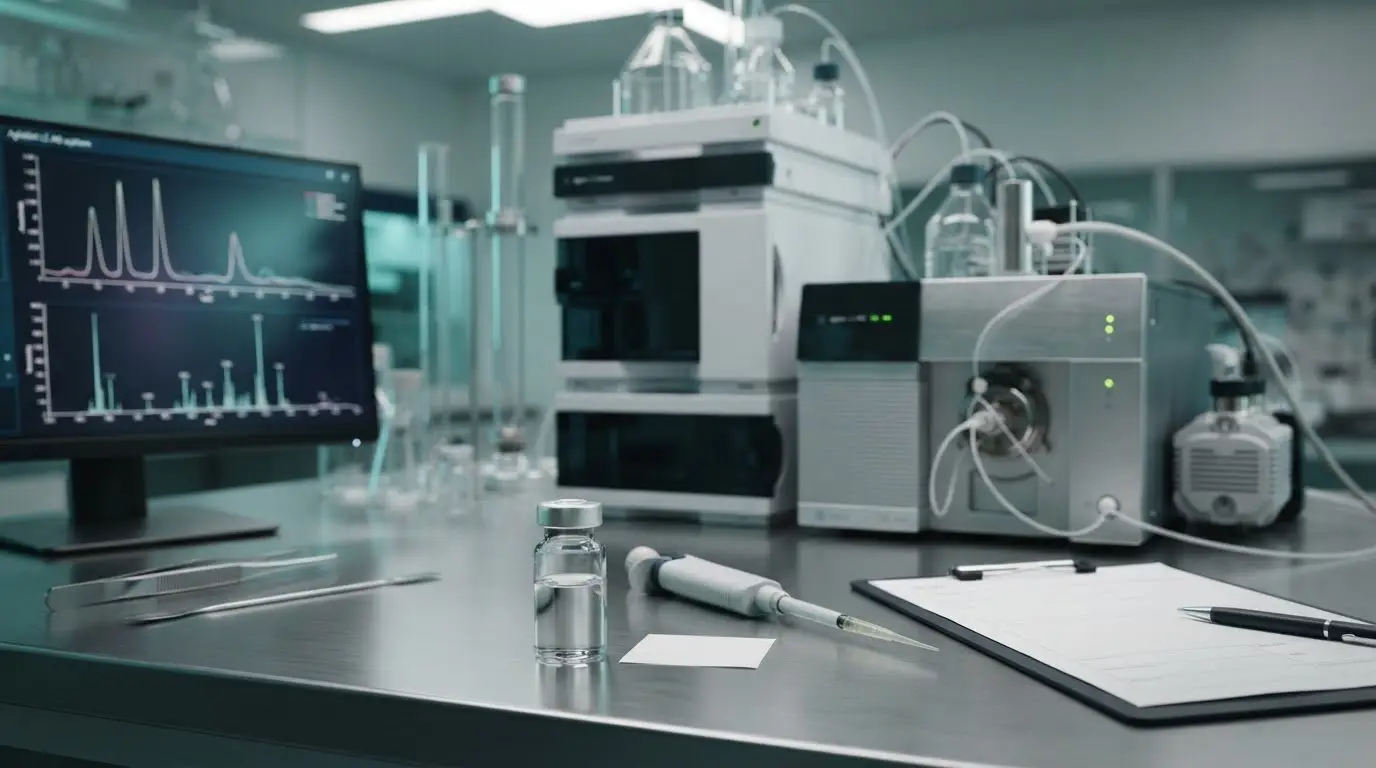
High-performance liquid chromatography (HPLC) separates components in a sample so they can be assessed individually. A reported purity value may be derived from this separation, but it should be interpreted with the method details and the tested sample in view. HPLC purity is not, by itself, complete proof of molecular identity.
Mass spectrometry provides evidence related to molecular mass. Researchers can compare the measured result with the expected mass for the specified material, while qualified analysts interpret the method and any limitations. HPLC and mass spectrometry answer different questions, so one result shouldn’t be substituted for the other.
Solara Compounds reports lot-number traceability, batch-specific COAs, and third-party testing through Kovera Labs. The company also describes molecular confirmation by MALDI-TOF and LC-MS; these are general company statements, not confirmation that a particular method or result applies to every compound or batch. Review the documentation for the exact material under consideration, and see the current research catalog for catalog details.
All products are for Research Use Only (RUO) – intended solely for laboratory research and not for human or animal consumption, not a drug, medicine, or dietary supplement.
How Does Solara Compounds Document Its Research Peptide Catalog?
Solara Compounds is a U.S. supplier of laboratory research materials. The company reports lot-number traceability, batch-specific Certificates of Analysis (COAs), and third-party testing through Kovera Labs. These general documentation practices can help researchers evaluate catalog materials, but they don’t establish the identity or specifications of every product.
The supplied information does not confirm that thymosin beta-4 synthetic peptide is listed in the Solara catalog. The catalog includes TB-500, but the available information doesn’t establish that this item is full-length thymosin beta-4 or an interchangeable material. Researchers should verify the exact product name and documentation rather than infer availability or equivalence from related terminology.
What documentation does Solara report for its catalog?
Solara states that batch-specific COAs are available and describes lot-number traceability and molecular confirmation using MALDI-TOF and LC-MS. The company also reports third-party testing through Kovera Labs. These are general company statements, not confirmation that a particular method or result applies to every compound or batch.
For a listed material, check that its COA identifies the product and lot under consideration, then review the methods and results shown. Solara’s COA resource provides information about its documentation. A COA can support material evaluation, but it doesn’t predict experimental outcomes or replace a researcher’s acceptance criteria.
What should a researcher do before selecting a listed compound?
Review the live catalog at solaracompounds.com and confirm the exact product name and current specifications. Then inspect the relevant batch COA and compare its product and lot details with the item being considered. If a listing or document leaves an identity question unanswered, request clarification before procurement.
For catalog or documentation questions, contact Solara Compounds at support@solaracompounds.com or call 1 (877) 388-9178, Monday-Friday, 8 AM-5 PM Eastern.
See the current research catalog.
All products are for Research Use Only (RUO) – intended solely for laboratory research and not for human or animal consumption, not a drug, medicine, or dietary supplement.
Make Your Next Research Material Review Evidence-Led
Reliable evaluation starts with the exact sequence and product specification, not a familiar name. A full-length thymosin beta-4 synthetic peptide and a shorter fragment are distinct materials, and labels alone don’t establish that two products are identical or interchangeable. Check the analytical method, batch-specific results, and lot details together before deciding whether documentation supports your laboratory requirements.
Solara Compounds reports batch-specific COAs, lot-number traceability, and third-party testing through Kovera Labs. These are general company statements, so researchers should review the paperwork for the specific catalog item and batch. The supplied information does not establish that the catalog’s TB-500 item is full-length thymosin beta-4.
All products are for Research Use Only (RUO) – intended solely for laboratory research and not for human or animal consumption, not a drug, medicine, or dietary supplement. For catalog details, see the current research catalog. A careful documentation review helps researchers make a more informed, consistent selection.
Frequently Asked Questions
What is thymosin beta-4 synthetic peptide?
A thymosin beta-4 synthetic peptide is a chemically synthesized peptide described by a specified amino-acid sequence. The name alone doesn’t confirm molecular identity. Supplier descriptions supplied for this guide include both a 43-amino-acid listing and a short blocking-peptide fragment, so researchers should compare primary literature with the exact sequence, modifications, and product specification. Evaluate the material only within an appropriate laboratory research context.
Is a short thymosin beta-4 blocking peptide the same as full-length thymosin beta-4?
No. The supplied Abcam listing describes a four-residue AcSDKP blocking peptide, while ProSpec describes a 43-amino-acid peptide. These different sequence lengths identify distinct materials, and their product descriptions don’t establish the same experimental purpose. Before comparing research records or products, check the exact sequence, stated use, and supporting analytical information. Don’t treat similar names as evidence that the materials are interchangeable.
Does the name TB-500 confirm that a product is thymosin beta-4?
No. The name TB-500 by itself doesn’t verify a product’s sequence or establish equivalence with full-length thymosin beta-4. The supplied Solara Compounds information lists TB-500 in its catalog but doesn’t confirm that it is full-length thymosin beta-4 synthetic peptide. Researchers should compare the product specification and batch documentation directly, and check the live catalog rather than infer availability from a related name.
How can researchers verify the identity of a synthetic peptide?
Start by matching the stated sequence and product specification to the material required for the research. Then review analytical evidence, such as mass-related results, and confirm that the COA identifies the same product and lot number as the label and procurement records. A method name alone doesn’t prove that a specific batch meets a researcher’s requirements. Resolve missing details or discrepancies with the supplier before procurement.
What does an HPLC purity result tell a researcher?
HPLC separates components in a sample and can support a purity assessment under the stated method. Its reported purity result doesn’t, by itself, confirm sequence identity, batch traceability, or suitability for a specific experiment. Review the method, sample identity, and batch-specific result together. Don’t apply purity figures from another supplier or product to Solara materials or to thymosin beta-4 without documentation for that exact material.
What information should a peptide COA include?
Check that the COA names the exact material, identifies its lot number, describes the test method, and reports the analytical results. Compare these details with the product label and procurement record to assess whether the paperwork belongs to the item being considered. A COA supports material evaluation; it doesn’t promise experimental outcomes. If an entry is missing, unclear, or inconsistent, ask the supplier for clarification before procurement.
Does Solara Compounds list thymosin beta-4 synthetic peptide?
Lab buyers in Boston, San Diego, San Francisco, New York, Houston, Miami, Los Angeles, Austin, Raleigh, Seattle, Chicago, Philadelphia, Baltimore, Dallas, Phoenix, Tampa, Atlanta, and Denver can check solaracompounds.com for current catalog details. Solara Compounds lists TB-500, but supplied information doesn’t confirm thymosin beta-4 availability or equivalence; verify specifications and batch paperwork. All products are for Research Use Only (RUO) – intended solely for laboratory research and not for human or animal consumption, not a drug, medicine, or dietary supplement.