Research Articles
How to Convince Your PI to Buy New Research Peptides


A peptide request is strongest when it reads like a reproducibility case, not a product pitch. If you’re working out how to convince your PI to buy new peptides, it’s reasonable to anticipate questions about the research need, supplier, and supporting documentation. A clear case connects the compound to a defined laboratory question and gives your PI practical information to evaluate the purchase.
The goal isn’t to overstate what a peptide might show. It’s to make the proposed next step easy to assess: explain the research rationale, identify the quality checks that matter to your lab, and summarize the procurement details. Solara Compounds provides batch-specific Certificates of Analysis (COAs), lot-number traceability, and independent third-party testing through Kovera Labs, documentation researchers can review as part of supplier assessment.
This guide outlines how to build a concise, evidence-led proposal, present identity and purity information without treating it as a guarantee of experimental results, and make the purchasing request straightforward. Solara Compounds supplies research compounds for laboratory research only. They are not medicines or supplements and are not for human or animal consumption. You can review the research catalog and documentation at solaracompounds.com.
Key Takeaways
- Anchor the request in a specific research gap, not general interest in a newly discussed compound.
- Explain how the proposed work will be interpretable, including the relevant comparison, control, or baseline.
- Use a COA to review batch-level information, not as proof that a material is suitable for a particular experiment or will produce a specific outcome.
- Make the decision straightforward with a one-page brief covering the research question, rationale, supporting documents, and requested approval.
- To understand how to convince your PI to buy new peptides, connect the scientific rationale to clear purchasing details and your institution’s process.
Start with the Research Need: Why Does the Lab Need a New Peptide?
Your PI’s first question is likely to be direct: what specific research need does this purchase address? Start with a defined gap in the lab’s work, not simply that a compound has attracted attention. A clear request shows how the proposed material relates to a research question, what current materials cannot answer, and why evaluating it is a reasonable next step.
Define the research question before naming a product
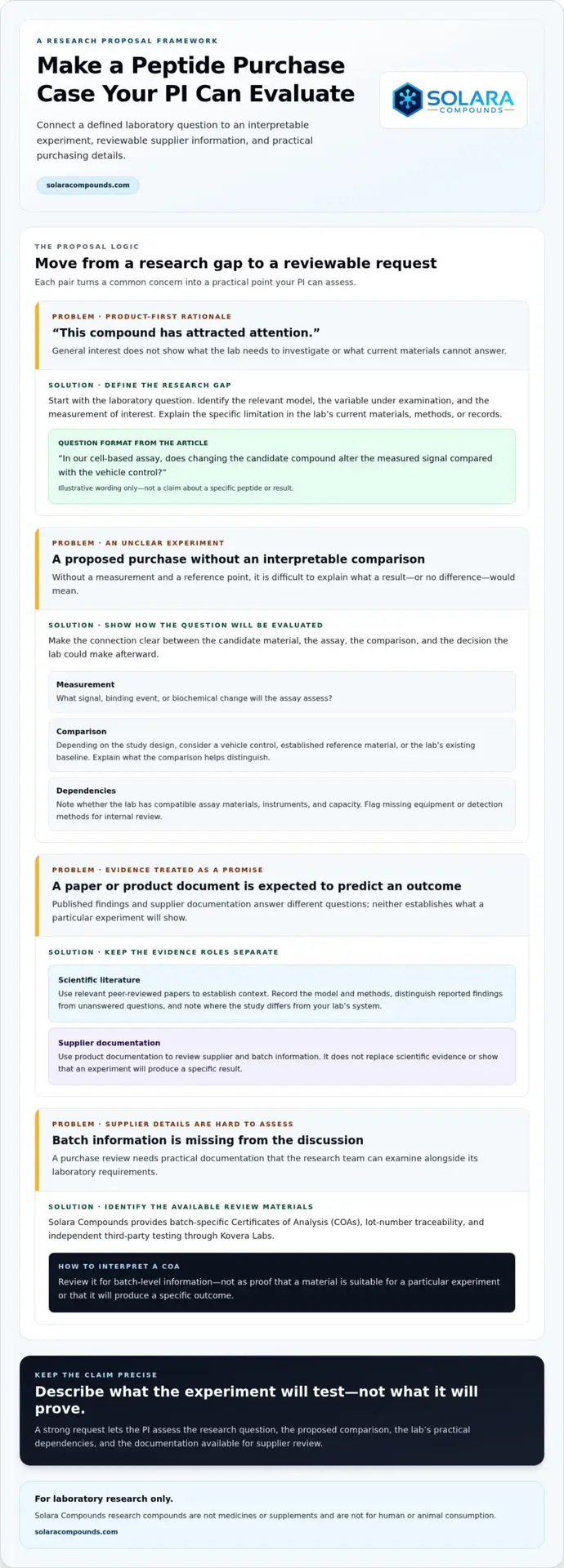
Write the question before you choose the compound. For an in-vitro or biochemical study, make it specific enough to identify the model, the variable under examination, and the measurement of interest. For example: “In our cell-based assay, does changing the candidate compound alter the measured signal compared with the vehicle control?” This is an illustrative question, not a claim about a particular peptide or result.
If the rationale involves a pathway, explain it in plain language immediately. A signaling pathway is a chain of cellular messages that can influence a measured response. Then state what your own records show is missing: perhaps an existing reagent cannot distinguish two possible explanations, or a current method does not test the variable your question focuses on. Refer to relevant assay results, method limitations, or documented gaps in the lab’s existing materials rather than assuming the PI shares your interest.
A concise sentence can make the request easier to discuss: “We’re proposing to evaluate [material] in [laboratory model] to test whether [specific question], because our current methods cannot distinguish [defined gap].” Keep the claim about what the experiment will test, not what it will prove.
Show why the proposal is timely and scientifically relevant
Use published literature to establish context, not to promise an outcome. Separate what the papers report from what remains uncertain and what your proposed experiment would examine. Note the model and methods used in the relevant work, then explain why those findings do or don’t address your lab’s question. If the literature is preliminary or uses a different system, say so plainly. That precision makes the proposal more credible.
Keep supplier information separate from scientific evidence. Literature can support the rationale for investigating a research question; it cannot establish the identity or suitability of a particular supplier’s batch. Likewise, product documentation does not show that an experiment will produce a specific result. Solara Compounds’ catalog can be assessed against laboratory requirements, while supporting scientific claims should come from relevant publications. For background on how synthetic peptides are made, consult this overview of peptide synthesis methods.
Frame the request strictly around laboratory research. Solara Compounds products are for laboratory research only, not for human or animal consumption. A focused rationale is the first step in how to convince your PI to buy new peptides: it gives the PI a research question to evaluate before considering a purchase.
Build the Case: Connect the Compound to a Reviewable Experimental Plan
Once the research gap is clear, show how the proposed material would be evaluated. A PI should be able to see the link between the candidate compound, the assay, the comparison that makes results interpretable, and the decision the lab could make afterward. Keep the plan concise: the purpose is to support a purchasing discussion, not to predict the experiment’s outcome.
Describe the material and laboratory context without making a product claim. Then identify a suitable control or baseline. Depending on the study design, this might mean comparing the candidate condition with a vehicle control, an established reference material, or the lab’s existing baseline measurement. Explain what each comparison helps distinguish. The appropriate choice depends on the assay and should be reviewed by the research team.
- Measurement: What signal, binding event, or biochemical change will the assay assess?
- Comparison: What control or baseline will help interpret a difference, or the absence of one?
- Dependencies: Does the lab have compatible assay materials, instruments, and capacity to evaluate the question?
Flag practical dependencies before making the request. For example, a proposed assay may require a detection method or equipment the lab doesn’t currently use. Note these as items for internal review, not assumptions. This helps the PI weigh whether the purchase fits the available resources and whether additional planning is needed.
Summarize literature without overstating what it establishes
Use relevant peer-reviewed papers to explain why the question merits investigation, and record enough citation information for your PI to locate each source. Separate reported findings from unanswered questions. A paper’s model, assay, and conditions may differ from those in your lab, so identify limits that affect how closely its findings apply. The American Chemical Society’s discussion of the rise of peptide drug discovery offers broad field context; it doesn’t establish what a particular compound or batch will do in your experiment.
Define what the purchase would let the lab evaluate
State the measurable question and how the material fits the study’s existing design. For instance, you might propose comparing an assay readout across defined experimental conditions, provided the method and controls are appropriate for your research question. Clarify what different possible results would help the lab decide, such as whether to refine the assay, investigate another question, or stop pursuing that line of work. Don’t frame one outcome as expected or guaranteed.
A useful sentence for a PI brief is: “This purchase would let our lab evaluate [defined question] under [laboratory research context]; the result will guide whether further investigation is warranted, but it does not predetermine an outcome.” This distinction is central to how to convince your PI to buy new peptides: a defensible rationale explains what the experiment can test, not what it must show.
Researchers can use the Solara Compounds research catalog to identify materials for evaluation against their study requirements, while keeping the experimental rationale grounded in relevant literature and the lab’s own design.
Address the PI’s Main Objection: Can the Material and Supplier Be Evaluated?
A sound research rationale still leaves a practical question: can the lab review the material and trace its supporting records? Make that review straightforward by organizing the available information around the same criteria for each supplier. A Certificate of Analysis (COA) reports data for a particular batch. It can support material review, but it can’t establish whether the material suits a specific assay or predict experimental results.
Identity data: Check whether molecular identity methods are stated and whether the records identify the material being evaluated.
Purity information: Look for the analytical method and reported purity data, while keeping those results distinct from experimental performance.
Lot traceability: Confirm that the lot number links the material to the corresponding records.
Document availability: Note whether batch-level paperwork is accessible for the PI’s review.
Review the batch COA and analytical records
Start by matching the lot number on the product documentation to the lot under consideration. Solara Compounds provides batch-specific COA documentation and lot-number traceability. Its stated quality information includes HPLC purification and molecular identity testing by MALDI-TOF and LC-MS.
HPLC, or high-performance liquid chromatography, separates components in a sample and can be used to assess purity. It doesn’t show how a material will perform in a particular experiment. MALDI-TOF and LC-MS are analytical methods used to examine molecular mass and support identity confirmation. These results inform material review; they don’t replace assay validation or the lab’s own suitability assessment.
Compare suppliers using consistent laboratory criteria
Apply the same review questions across suppliers. Is the lot traceable? Are analytical methods clearly identified? Are relevant records available and specific to the batch? Consistent criteria help the PI compare documentation rather than relying on broad claims.
Keep supplier-provided records distinct from third-party testing documentation. Solara Compounds states that it uses independent third-party testing through Kovera Labs. This describes the stated testing arrangement, not an endorsement of a supplier or a guarantee of experimental performance. In the proposal, identify which information comes from the supplier and which is attributed to third-party testing. A PI can then assess the records in context.
For a concise review, summarize what each document supports and what it cannot establish. That distinction helps keep material identity, purity information, traceability, and experimental suitability from being treated as interchangeable. It also gives the PI a practical basis for follow-up questions about laboratory requirements.
This is a key part of how to convince your PI to buy new peptides: present records that can be evaluated, state their limits clearly, and connect the proposed material to the lab’s documented criteria.
Make the Request Easy to Approve: Prepare a Concise PI Brief
A focused brief makes it easier for your PI to assess the proposal without first piecing together information from emails, papers, and product records. Keep it to one page, lead with the research gap, and end with the decision you’re asking them to make. The aim is a clear review, not pressure for immediate approval.
Organize a PI-ready one-page summary
Use a simple order so the scientific case and purchasing request are easy to follow:
- Research question: State the specific question and the gap in the lab’s current approach.
- Rationale: Explain why the material merits evaluation, distinguishing published context from what remains unknown.
- Study fit: Identify the intended laboratory context, relevant comparison, and any assay or equipment dependencies for review.
- Supporting records: List the relevant literature and available batch documentation, including a COA reference when applicable.
- Requested decision: Say whether you’re asking for scientific review, procurement approval, or a follow-up discussion.
Keep budget and purchasing details aligned with your institution’s established process. Include the information the lab buyer or internal system requires, but don’t guess at costs, approval steps, or procurement rules. If a purchasing detail is still being worked out, mark it as an open item for the appropriate internal review rather than allowing it to obscure the research rationale.
Prepare for questions and revise the request
Before speaking with your PI, consider what they may want to examine: the relevance of the literature, the limits of the available analytical records, the fit with lab resources, and the reason existing materials aren’t sufficient. Bring a short source list and a direct reference to the relevant COA so the supporting information is easy to review. Keep the main brief concise, with additional records ready if requested.
Open the conversation respectfully. For example: “I’ve prepared a short summary of the research question and material for your review. Could we discuss whether it fits our priorities and what information you’d need before deciding?” This invites scientific judgment and makes room for the PI to identify concerns, suggest a narrower scope, or request more documentation.
If the answer is no, or not yet, ask what would make the proposal more suitable for review. Record that feedback and revise the brief. A concern about timing, resources, or evidence is useful direction, not a personal conflict. This measured approach is central to how to convince your PI to buy new peptides: make the reasoning and next decision clear while leaving space for critical review.
Once the research case is ready, review the Solara Compounds research catalog to identify materials for your lab’s supplier and procurement assessment.
Move from Proposal to Supplier Review with Solara Compounds
A strong research case gives your PI a clear question to consider. The supplier review is the next step: compare the material’s available documentation with the lab’s stated requirements, then follow your institution’s purchasing process. This keeps the decision focused on research relevance and reviewable information, which is central to how to convince your PI to buy new peptides without overstating what the evidence can show.
Review available documentation before making a purchasing decision
Solara Compounds provides lot-number traceability and batch-specific Certificates of Analysis (COAs), with stated quality information that includes analytical methods and independent third-party testing through Kovera Labs. Treat these as records to evaluate, not endorsements or guarantees. A COA describes batch-level information; it doesn’t determine whether a material fits a particular assay or establish an experimental outcome.
As you assess the research catalog at solaracompounds.com, keep the supplier review tied to the proposal. Check that the material under consideration aligns with the research need, and examine what its available documentation can support. The PI can then consider those records alongside the study design, assay requirements, and lab resources, rather than relying on general product descriptions alone.
- Research fit: Does the material correspond to the question and laboratory context in the proposal?
- Traceability: Can the lot under consideration be connected to its batch documentation?
- Documentation: Are the available analytical and testing records clear enough for the lab’s review?
Keep remaining questions visible. For example, a PI may want to compare the reported analytical information with the lab’s own material requirements or consider whether additional evaluation is appropriate. That is part of a careful supplier review, not a reason to assume suitability from a document alone.
Take a clear, research-focused next step
Bring the proposal and supplier records together before moving forward. The research question explains why the material is being considered; the study plan shows what the lab intends to evaluate; and the batch documentation gives the PI information to review about the specific material. Institutional purchasing requirements still guide the procurement decision.
Solara Compounds products are for Research Use Only and solely for laboratory research. They are not for human or animal consumption, and are not medicines or supplements. To assess available research materials in that context, view the current research catalog.
Take the Next Step with a Research-Ready Request
A clear request gives your PI a practical starting point for deciding what deserves further discussion. Keep the proposed next step proportionate to the evidence, and remain open to refining the scope based on scientific feedback. That measured approach is central to how to convince your PI to buy new peptides without presenting an investigation as a guaranteed result.
Once your research question and purchasing request are ready, use the catalog to identify materials for your lab’s review. Consider how each option aligns with the study’s defined requirements and your institution’s purchasing process.
All products are for Research Use Only, solely for laboratory research, and not for human or animal consumption. They are not medicines or supplements. View the current research catalog as a next step in preparing a focused, research-led request.
Frequently Asked Questions
How do I explain to my PI why a new peptide is relevant to our research?
Show how investigating the material could distinguish between plausible explanations for an observation in your existing model. For example, if two mechanisms could account for the same assay signal, explain what additional comparison might help separate them. Cite papers that motivate the question, then identify what your lab would learn from different possible results. This makes the request relevant without implying that one outcome is expected.
What should I include in a peptide purchase request for a research lab?
Along with the research rationale, include the requested quantity and a brief note explaining how it relates to the planned work. Identify the lab member responsible for receiving and recording the materials, if your group requires that information. Use the project’s approved purchasing route and include the account or funding details requested by your institution. Avoid adding speculative dates or figures that could be mistaken for confirmed purchasing information.
How can a PI evaluate a research peptide supplier?
In addition to reviewing technical records, a PI can consider whether the supplier’s product identifiers and purchasing documents are clear enough for the lab’s administrative workflow. Compare the information available for the specific material with your institution’s vendor onboarding and recordkeeping needs. A consistent review process helps the lab document why a supplier was considered and what information informed its decision, without treating marketing language as scientific evidence.
What does a batch-specific COA tell a laboratory?
Beyond supporting a purchase review, a COA can help researchers preserve context in their experimental records. Link the report to the lab’s internal sample identifier and note which document version was consulted. A report reflects the information recorded for its batch; it doesn’t describe how the material was handled after receipt or confirm its condition at the point of use. Keep those records distinct.
How do I respond if my PI says the lab already has a suitable material?
Ask whether the existing material has been evaluated for the specific model, assay, and comparison in your proposal. A material may suit one research question but not resolve another, so explain the distinction you hope to examine. If there’s no meaningful difference, consider whether the current inventory can address the question. That discussion can help refine the study rather than turning the purchase request into an argument.
Can researchers use Solara Compounds products for laboratory research?
Yes. Solara Compounds supplies research compounds intended for laboratory research, and researchers should assess each material in relation to their defined study and institutional procedures. Products are for laboratory research only, not for human or animal consumption. The Solara Compounds research catalog lets lab buyers review current product information in the context of their research needs.
How should I discuss research peptide costs with my PI?
Use the current product listing and the total shown through your institution’s purchasing process, rather than relying on an informal estimate. Explain which project budget would cover the purchase and whether the requested quantity matches the planned work. Researchers and lab buyers in Boston, San Diego, San Francisco, New York, Houston, Miami, Los Angeles, Austin, Raleigh, Seattle, Chicago, Philadelphia, Baltimore, Dallas, Phoenix, Tampa, Atlanta, and Denver should follow their institution’s purchasing procedures.