Research Articles
Authentic Research Grade Peptides: A Lab Buyer’s Verification Guide


A high-purity claim can still leave a key question unanswered: does the data match the batch being considered? Lab buyers often find supplier claims difficult to compare, particularly when a Certificate of Analysis (COA) has no clear connection to a specific lot. Authentic research grade peptides are assessed through traceable evidence, not a headline figure alone.
This guide provides a repeatable way to review documentation before procurement. It explains what batch-linked COAs, HPLC purity results, and mass-spectrometry identity testing can show, and where each has limits. Together, these records help clarify the stated identity of a peptide and the test results for a specific lot.
Solara Compounds provides unique lot numbers, batch-specific COAs, and third-party testing through Kovera Labs. COAs are available through the COA Verification page at solaracompounds.com. Listed products have ≥99% HPLC-verified purity. All products are for Research Use Only (RUO), intended solely for laboratory research and not for human or animal consumption. They are not a drug, medicine, or dietary supplement.
Key Takeaways
- Assess authentic research grade peptides through a connected evidence chain: identity, purity data, and traceability to a specific batch.
- Use HPLC results to review sample purity and mass-spectrometry data to support identity checks. Neither guarantees experimental outcomes.
- Compare the product identity and lot number on the listing with those on the batch COA before procurement.
- Follow a consistent review process, from product-page details to batch-level documentation and testing-source information.
- Keep the intended use clear: products are for laboratory research only, not for people or animals, and are not medicines or dietary supplements.
What Makes Research Grade Peptides Authentic and Verifiable?
Authentic research grade peptides are materials whose stated identity, reported purity, and batch traceability are supported by documentation linked to the specific lot being evaluated. This definition distinguishes evidence from a product description. A catalog page can name a peptide and state a purity claim, but those statements alone don’t show that the analytical results belong to the batch a lab buyer is considering.
“Research grade” describes a product’s documented context for laboratory research. It doesn’t guarantee that a material will perform in a particular experiment, produce a specific result, or suit every research design. Authenticity depends on what the records support, not on a promise about experimental outcomes.
Identity, purity, and traceability answer different questions
These three types of evidence are related, but they aren’t interchangeable. Identity testing provides evidence about whether the analyzed material matches its stated identity. For example, mass-spectrometry data can assess molecular mass, which helps support an identity assessment. The result applies to the material analyzed, so the documentation should connect it to the lot under review.
Purity analysis answers a different question: what does the sample’s chromatographic profile show? A reported percentage summarizes the analysis under the stated method. By itself, it doesn’t establish molecular identity or show that the report belongs to a particular batch.
Traceability connects a physical batch to its records, typically through a lot number. For example, a useful comparison is a listing for a named peptide alongside a COA carrying the same product identity and lot number. If the paperwork has no matching lot identifier, it is harder to establish a link between the analyzed sample and the material being considered. The listing is a product description; batch-linked analytical documentation adds evidence.
Manufacturing context can also help researchers understand why analysis matters. Peptides are produced through defined synthesis processes, and those processes can inform questions about material composition and possible impurities. The overview of peptide synthesis methods provides background on how peptide chains are created, but it is not a test report for any particular product or lot.
Why a research-use-only label matters
A research-use-only statement sets the intended context for procurement and handling: qualified research settings and laboratory work. It does not replace identity, purity, or traceability evidence. Lab buyers should evaluate the documentation alongside the stated purpose, rather than treating a label as an analytical result.
Solara Compounds supplies products solely for laboratory research and provides batch-specific COA documentation linked to unique lot numbers. Researchers can review those records through the COA Verification page as part of procurement review. A COA documents reported analytical findings, but it cannot guarantee that an experiment will produce a particular result.
All products are for Research Use Only (RUO) – intended solely for laboratory research and not for human or animal consumption, not a drug, medicine, or dietary supplement.
How COAs, HPLC, and Mass Spectrometry Build an Evidence Chain
A Certificate of Analysis (COA) records analytical findings for a tested sample. It helps lab buyers connect reported results to a product and batch, but it isn’t a promise of research performance or a particular experimental outcome. To assess authentic research grade peptides, read the report as a set of connected evidence, not as a stand-alone quality label.
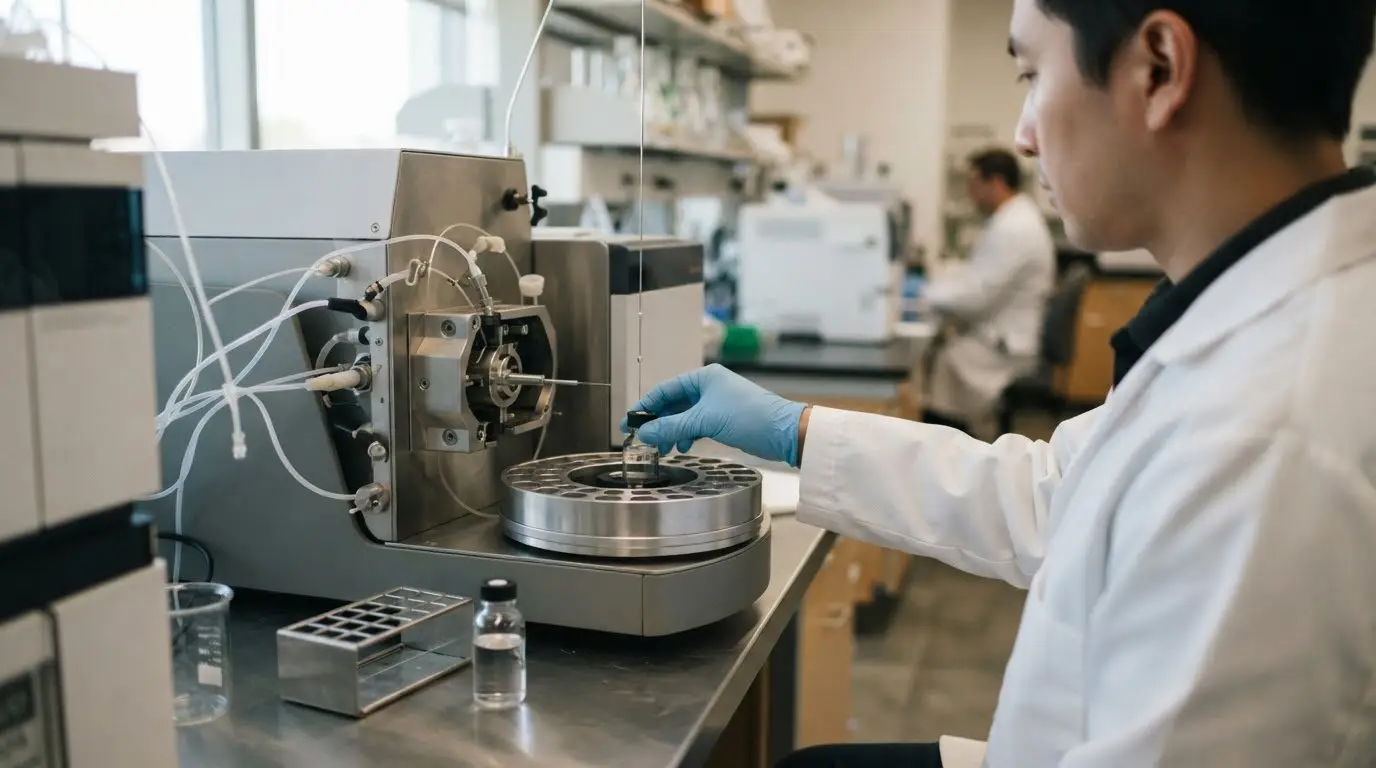
HPLC, or high-performance liquid chromatography, separates components in a sample as they move through a testing system. The resulting chromatogram can be used to assess the sample’s component profile and report a purity value. Mass spectrometry measures the mass-to-charge characteristics of detected molecules, helping assess molecular mass and support identity assessment. HPLC can indicate the sample’s chromatographic profile and reported purity, while mass spectrometry can provide evidence about molecular mass and identity. Neither result alone establishes that a report matches the lot being considered.
What to look for in a batch-specific COA
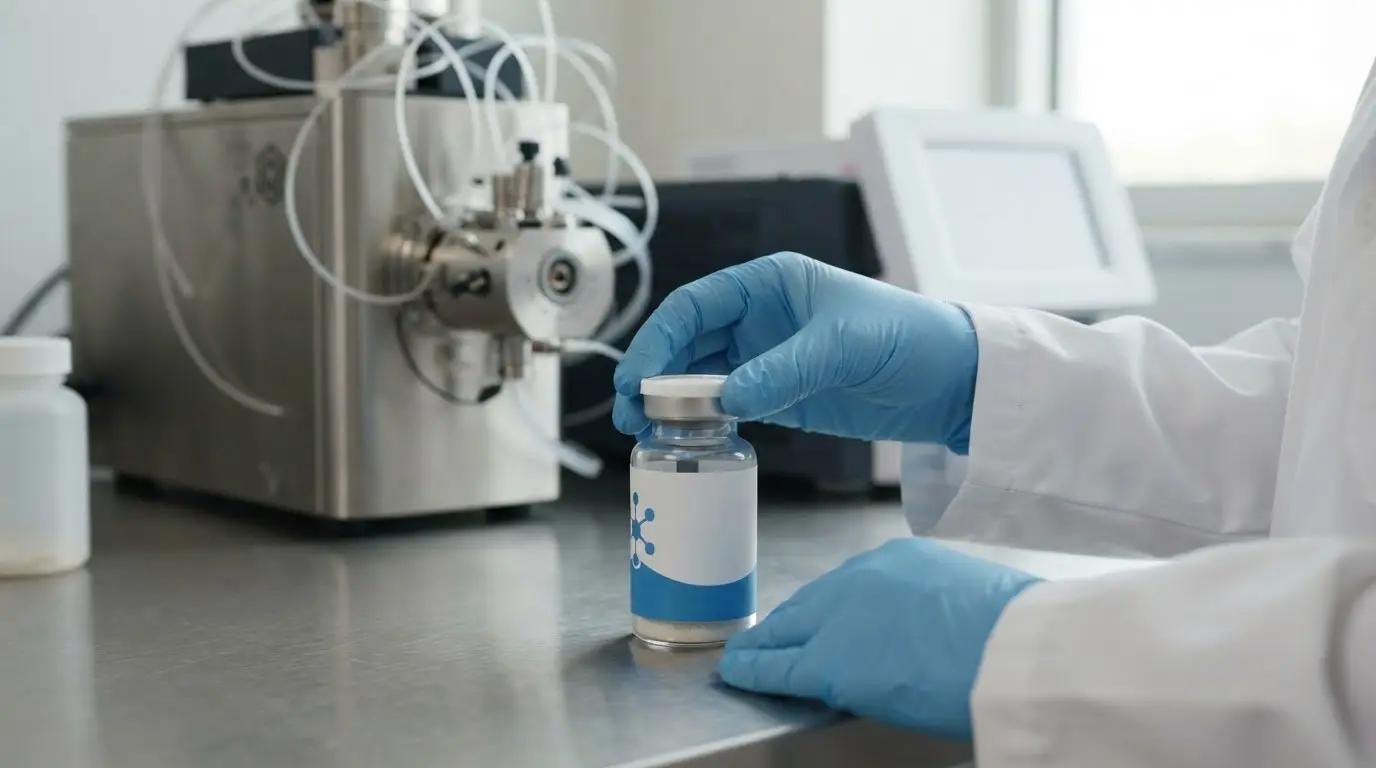
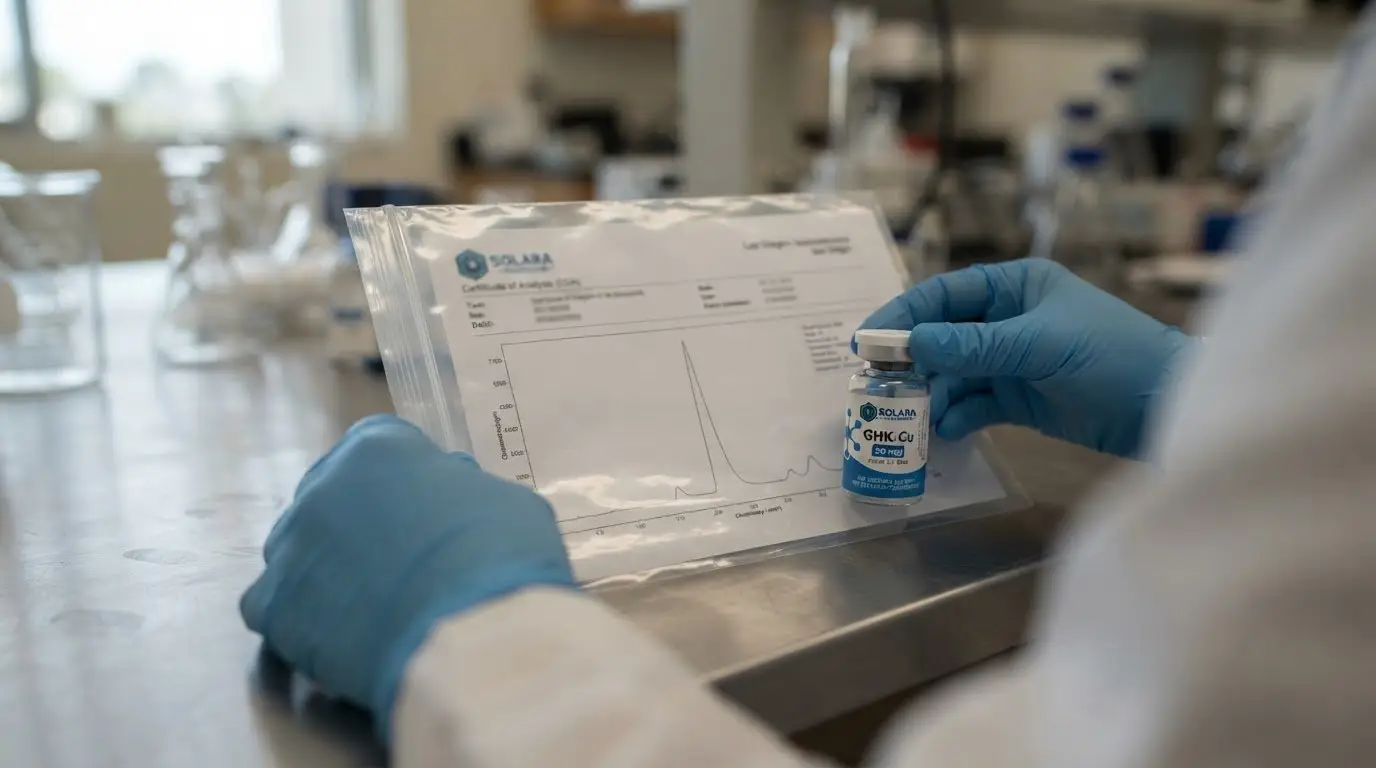
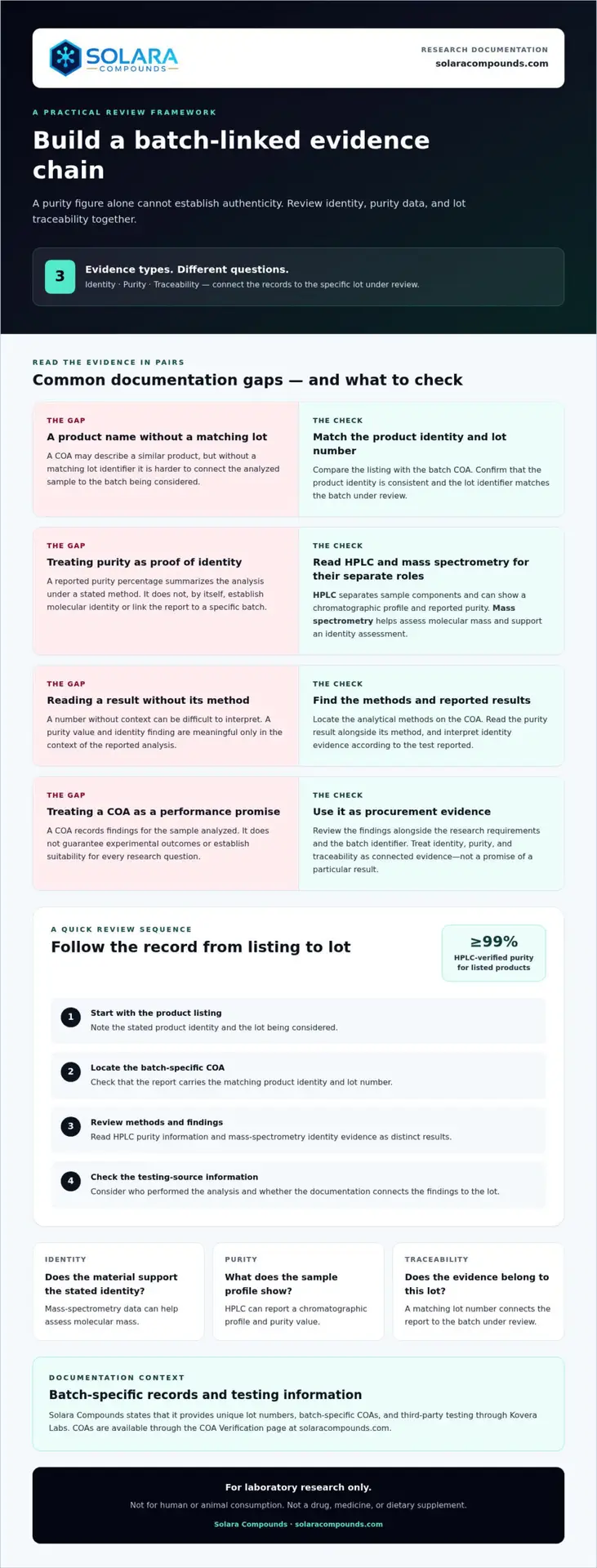
Start with the identifying details. Locate the product name and lot number, then find the analytical methods and reported results. Check that the product identity is consistent across the listing and report, and that the COA’s lot identifier matches the batch under consideration. A similar product name without a matching lot number does not make the report batch-specific.
Next, read the results in the context of the method named. A purity value should be associated with its analytical method, while identity evidence should be interpreted according to the test reported. The FDA Quality Assessment of Peptides provides additional context on quality assessment for peptide and protein drug substances. It isn’t a certificate for a supplier’s product or evidence about a particular lot.
A COA records findings for the sample analyzed. It doesn’t establish suitability for every research question, account for every handling condition, or guarantee that a study will produce a desired result. Treat it as a procurement document to review alongside the research requirements and batch identifier.
What third-party testing adds to supplier documentation
Independent laboratory analysis gives buyers a separate testing source to review alongside supplier information. It can strengthen the documentation trail when the report identifies the tested material and connects results to a specific lot. Its value lies in the ability to examine the methods and batch information, not simply in seeing the phrase “third-party tested.”
Solara Compounds’ listed products are third-party tested through Kovera Labs, with HPLC and mass-spectrometry methods included in the company’s quality information. Batch COAs are available through the COA Verification page. For a broader discussion of testing approaches, see Independent Peptide Lab Testing: Purity & Verification.
Once you understand what each record contributes, apply the same questions to the catalog and its documentation. Review research peptide listings with batch evidence in mind, and distinguish reported analytical findings from claims that go beyond what those results demonstrate.
Why a High Purity Percentage Alone Cannot Establish Authenticity
A high purity percentage can be useful, but it doesn’t answer every procurement question. One impressive figure is not a complete verification record. By itself, it doesn’t establish the material’s molecular identity, connect test results to the lot being considered, or identify who performed the analysis. Lab buyers need to read purity alongside identity evidence, batch information, and the testing source.
Each evidence type answers a different question. Use this comparison to understand what a record can support and what still needs review.
Evidence type | Buyer question | What it helps establish
Purity percentage: What does the sample’s reported chromatographic profile indicate? It summarizes a result from a stated analytical method, but doesn’t identify the peptide by itself.
Identity evidence: Does the analyzed material show characteristics consistent with its stated identity? It supports an identity assessment, but doesn’t confirm that the report matches the lot under consideration.
Lot match: Do the records correspond to this specific batch? A matching lot identifier connects the documentation to the batch named on the listing or packaging.
Testing source: Who generated the analytical result? A named testing source helps buyers understand where the result came from and assess it alongside the method and lot details.
Purity data versus identity and batch evidence
Purity and identity are complementary, not interchangeable. A chromatographic profile can indicate how the detected sample components appear under the stated method. It doesn’t, by itself, prove that the primary component is the peptide named on the listing. Identity data addresses that separate question, while a matching lot number ties the records to a particular batch.
For Solara Compounds’ live-listed products, the stated specification is ≥99% HPLC-verified purity. That figure describes the listed purity claim; it shouldn’t be read as a substitute for identity evidence or batch traceability. Authentic research grade peptides should be evaluated through the full set of records, not a percentage in isolation.
Supplier statements versus independently generated results
A supplier description communicates what the supplier states about a product. An analytical result attributed to an independent laboratory adds a separate testing source for review. Buyers should read the method, batch identifier, and source together: the method gives context for the result, the lot number links it to the batch, and the source identifies who conducted the analysis.
Solara Compounds’ listed products are third-party tested through Kovera Labs. This information supports a more complete review, but no single test answers every quality question or guarantees an experimental outcome. For further discussion of reported purity data, see High Purity Research Peptides: Sourcing & Verification, then focus on whether the available records support the specific claim and lot being assessed.
A Practical Checklist for Evaluating Authentic Research Grade Peptides
A consistent review sequence helps lab buyers catch documentation gaps before procurement. Use the same checks for each candidate so product descriptions, analytical records, and handling information are assessed separately. A single field can be useful without being conclusive.
Checklist summary: review the product page, identify the lot, match its COA, assess the methods and testing source, then record any unresolved documentation questions.
Five checks before laboratory procurement
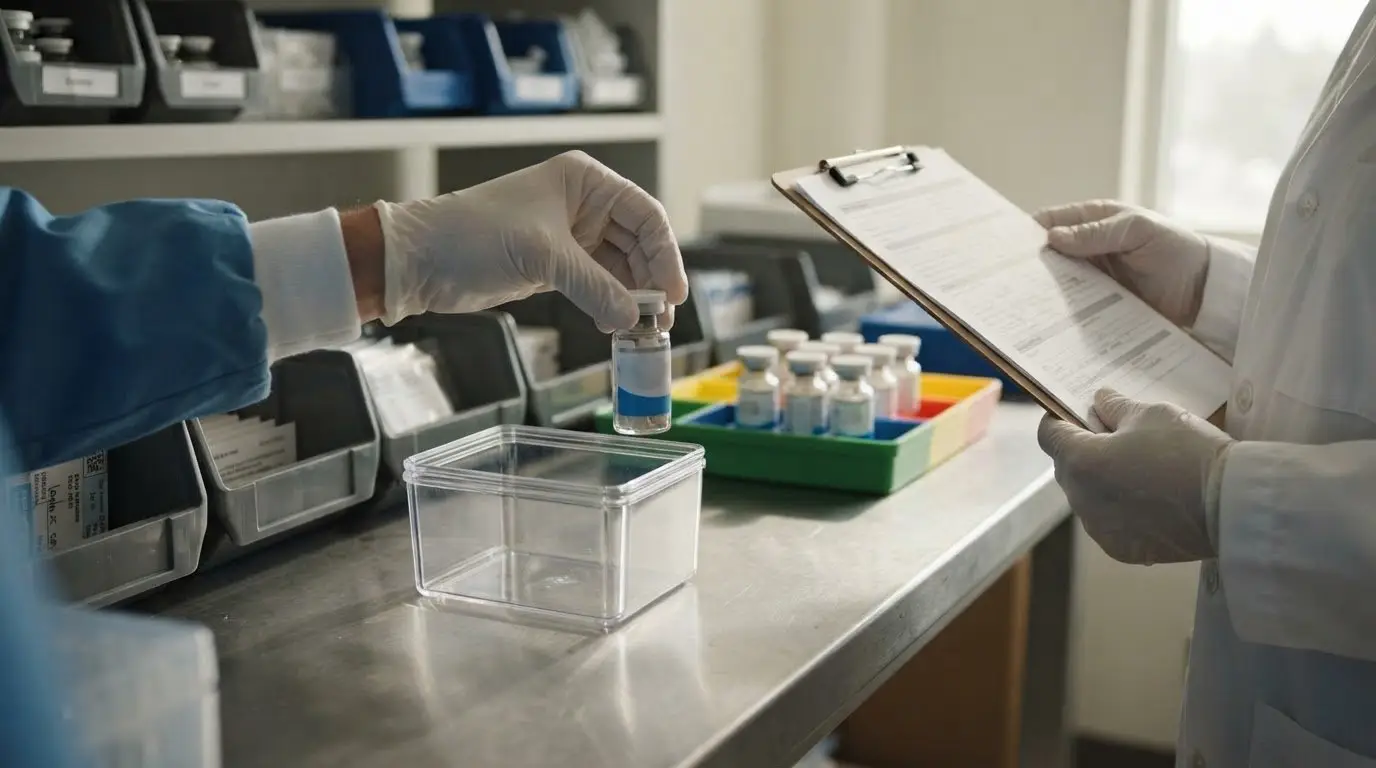
- Read the product page. Confirm that the product name is clear and that the stated context is laboratory research. Keep the listing’s description distinct from evidence generated by analytical testing.
- Find the batch identifier. Locate the lot number for the batch under consideration. A product name alone may identify a compound, but it does not connect a report to a particular lot.
- Locate the corresponding COA. Check that the COA identifies the same product and lot as the listing. Compare the identifiers carefully, including any letters or numbers that distinguish one batch from another.
- Review results and testing details. Note the reported purity, the identity-testing method, and the named testing source. Read these together: no single method or field establishes every aspect of the material’s identity, purity, and provenance.
- Document open questions. Record missing or unclear details in the laboratory’s procurement process before completing the review. This creates a consistent record of what was assessed and what remains unresolved.
For example, if the listing names a peptide and the COA shows a matching product name but a different lot number, the report does not clearly document the batch being considered. If the lot matches but the report doesn’t state the relevant analytical method, note that gap separately rather than treating the matching identifier as a substitute for method information.
How to review storage and handling information
Review storage notes as a separate part of procurement, not as evidence of identity or purity. Listed Solara products specify storage at −20°C or below, protected from light and moisture. Lab buyers can compare those stated conditions with the laboratory’s storage and handling arrangements before procurement, then retain the relevant product information with the records.
These are laboratory handling details only. They are not instructions for human or animal application, and they don’t establish suitability for a particular experiment. Keep product documentation, analytical evidence, and storage information distinct in the procurement review.
Applying this checklist to Solara Compounds’ research peptide catalog gives lab buyers a practical way to review product information alongside batch records before laboratory use.
Solara Compounds’ Documentation-First Approach to Research Peptides
Good procurement doesn’t end when a buyer has read a product description. The next step is to consider how the material and its records fit the laboratory’s study requirements, documentation practices, and inventory workflow. Solara Compounds provides product information to support that review, while research decisions and experimental interpretation remain with the qualified laboratory.
How Solara’s batch documentation supports evaluation
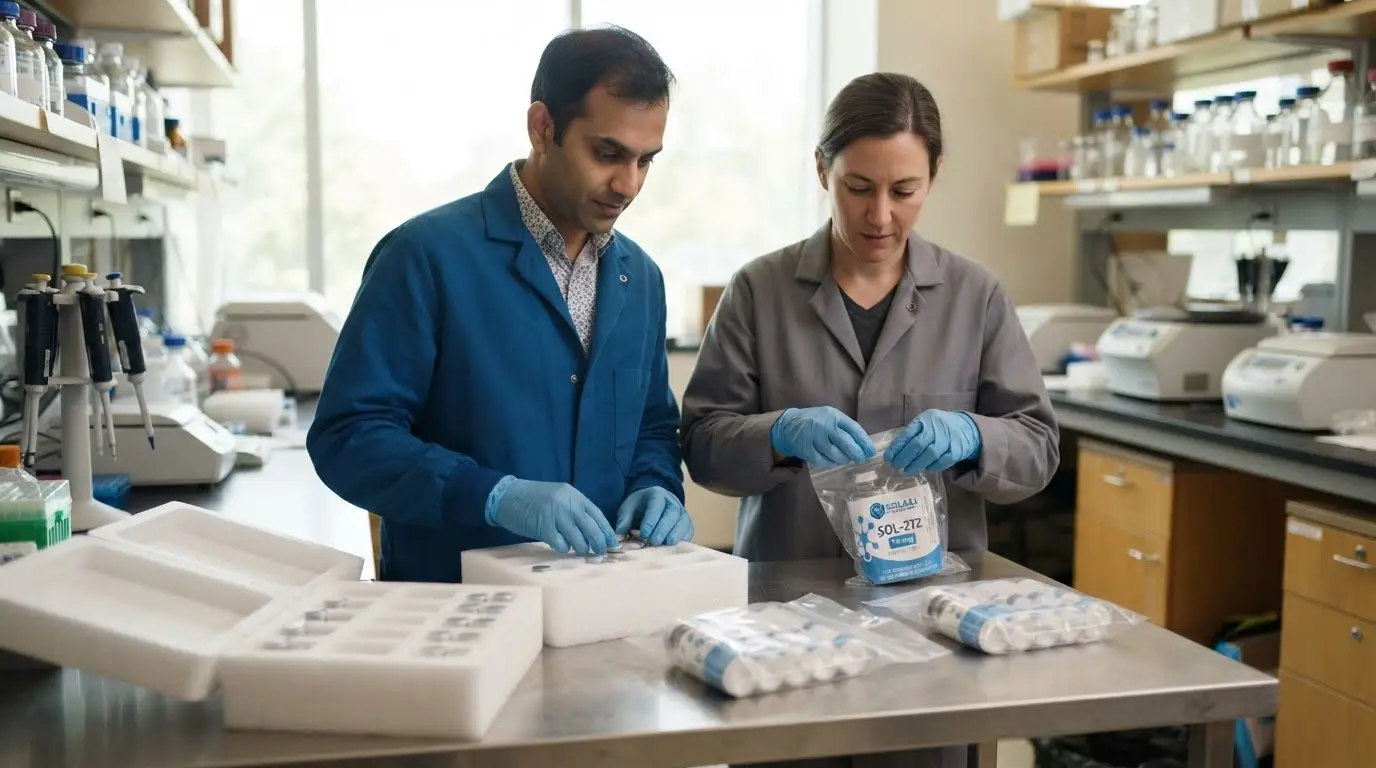
Use the COA Verification page as part of a documented procurement review. After reviewing the relevant record, save it with the purchase documentation and note which material it was evaluated for. This gives the research team a consistent reference as materials move through internal review and inventory processes.
Analytical documentation is one input to a laboratory’s decision, not an assessment of whether a material suits a particular experimental design. Researchers should define their own acceptance criteria and record how the documentation was considered. This keeps supplier information distinct from the lab’s research judgment.
Next steps for qualified laboratory buyers
Before procurement, identify the research context, decide what information the lab needs to retain, and make documentation review part of the purchasing record. Solara Compounds’ research supplier information provides additional context for buyers assessing its approach. Apply the same internal review standards across purchasing decisions to support clarity and consistency.
All products are for Research Use Only (RUO) – intended solely for laboratory research and not for human or animal consumption, not a drug, medicine, or dietary supplement.
When your laboratory is ready to consider available materials, shop research peptides and follow your established procurement review before laboratory use.
Make Documentation Part of Your Next Procurement Decision
Reliable laboratory procurement starts with a review process researchers can apply consistently. Use the same evidence-based approach each time, and retain relevant records with laboratory purchasing documentation. That discipline helps teams make clearer comparisons and supports more consistent procurement decisions without treating paperwork as a prediction of experimental results.
Choosing authentic research grade peptides means assessing whether the available records support the specific batch under consideration. Solara Compounds provides documentation for laboratory buyers to review as part of that process. All products are for laboratory research only, not for human or animal consumption, and are not medicines or dietary supplements.
For questions, contact [email protected] or call 1 (877) 388-9178, Monday to Friday, 8 AM to 5 PM Eastern. For laboratory buyers in Boston, San Diego, San Francisco, New York, Houston, Miami, Los Angeles, Austin, Raleigh, Seattle, Chicago, Philadelphia, Baltimore, Dallas, Phoenix, Tampa, Atlanta, and Denver, the online catalog and batch COA records are available at solaracompounds.com. To review available materials and their documentation, shop research peptides.
Frequently Asked Questions
What does authentic research grade peptides mean?
It means the material is presented for laboratory research and has supporting records that buyers can assess. The phrase itself shouldn’t be treated as a performance rating or a guarantee that a material fits a particular study. Researchers can use it as a starting point, then define the documentation their own procurement review requires and retain those records with the project’s material inventory.
Does a high HPLC purity result prove peptide identity?
No. A purity result alone doesn’t confirm the peptide’s identity. For practical review, consider what the report actually analyzes and whether the method addresses the question the lab needs answered. A chromatographic result is not a complete characterization of every possible feature of a sample, so researchers should avoid treating one reported value as a substitute for a broader analytical record.
How can I tell whether a COA matches a peptide batch?
Compare the lot reference on the COA with the identifier on the batch received, including any letters, suffixes, or formatting differences. If your receiving process records package identifiers, capture the COA alongside that entry so the association remains clear during later inventory review. A saved copy also helps colleagues consult the same record rather than relying on an old email or product-page screenshot.
What does third-party testing add to a peptide COA?
It gives researchers an analytical record attributed to a laboratory separate from the supplier, adding context to the supplier’s product information. For practical documentation, note the laboratory named on the report and keep the report with the procurement file. This makes the source visible to colleagues reviewing the material later, while leaving them to assess the report’s scope against their own research requirements.
How should lyophilized research peptides be stored?
Follow the storage and handling instructions stated for the listed product. For laboratory records, it can be useful to note when a material is received, where it is assigned in inventory, and whether the lab’s storage records show a relevant interruption. These are inventory-management practices, not product-specific guarantees. Don’t infer additional handling conditions from the fact that a material is lyophilized.
Are Solara Compounds products intended for personal use?
No. Solara Compounds products are intended solely for laboratory research, not for personal use or use with people or animals. They are not medicines or dietary supplements. This research-only restriction applies to researchers and lab buyers in Boston, San Diego, San Francisco, New York, Houston, Miami, Los Angeles, Austin, Raleigh, Seattle, Chicago, Philadelphia, Baltimore, Dallas, Phoenix, Tampa, Atlanta, and Denver, as well as elsewhere.