
Research Articles
Laboratory chemical supplier red flags to check in an audit


A supplier audit can miss its purpose if it reviews paperwork without tracing each record to the chemical and batch it describes. The most useful laboratory chemical supplier red flags are gaps in transparency, batch traceability, quality records, labeling, or contamination controls, especially when several occur together.
Certificates and quality claims deserve scrutiny, but records matter only when they are specific, consistent, and supported by a clear follow-up process. This guide explains what to examine, how to assess the seriousness and pattern of findings, and what further research can resolve unanswered questions. Solara Compounds supplies research compounds solely for laboratory research and development in controlled in-vitro or ex-vivo settings. Products are not for human or animal consumption, and have not been evaluated by the FDA for safety or efficacy. Find product and batch information at solaracompounds.com.
Key Takeaways
- Assess whether supplier documents clearly identify the chemical, its source, and the batch they cover.
- Look for a traceable link between batch records, test results, and the material received.
- Evaluate whether quality processes are maintained and whether issues are recorded and addressed.
- Review labeling and contamination controls for gaps that could affect identification, handling, or material integrity.
- Weigh warning signs by their severity, frequency, and whether several appear together before deciding on follow-up.
1. What supply chain transparency issues signal regulatory risk?
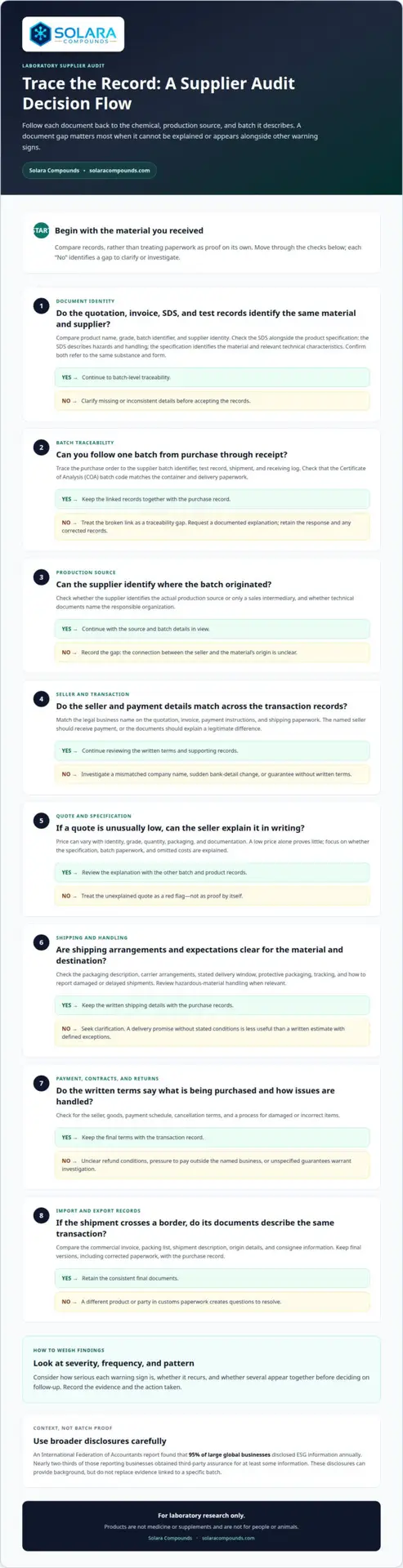
A useful supplier audit starts with a simple test: can each document be tied to the material being purchased? Compare the product name, grade, batch identifier, and supplier identity across the quotation, invoice, Safety Data Sheet (SDS), and test records. Missing or inconsistent details are red flags because buyers need accurate information to assess handling and suitability for laboratory work.
Review the SDS alongside the product specification, not as a substitute for it. The SDS describes hazards and handling information; the specification should identify the material and its relevant technical characteristics. Check that both documents refer to the same substance and form. For example, a product name on the invoice that differs from the SDS needs clarification before accepting the records.
Factory identity matters too. Ask whether the supplier identifies the actual production source or only a sales intermediary, and whether the technical documentation names the responsible organization. A supplier that cannot explain where a batch originated leaves a gap between the seller and the material. The research peptide supplier information illustrates why buyers benefit from clear supplier identity and product documentation.
Verify the seller and transaction as one record. Match the legal business name on the quotation, invoice, payment instructions, and shipping paperwork. Confirm that the named seller receives payment, or that the documents explain a legitimate difference. A sudden change in bank details, a mismatched company name, or a guarantee without written terms warrants investigation.
Chemical prices vary with identity, grade, quantity, packaging, and documentation, so a low price alone proves little. Treat an unusually low quote as a red flag when the seller cannot explain the specification, batch paperwork, or omitted costs in writing.
Evaluate shipping by matching the packaging description, carrier arrangements, and stated delivery window to the material and destination. Look for clear communication about hazardous-material handling when relevant, protective packaging, tracking, and how to report damaged or delayed shipments. A delivery promise without stated conditions is less useful than a written estimate with defined exceptions.
Payment terms, contracts, and returns should identify the seller, goods, payment schedule, cancellation terms, and process for damaged or incorrect items. Be cautious of pressure to pay outside the named business, unclear refund conditions, or a guarantee that does not specify its coverage.
For imports or exports, compare the commercial invoice, packing list, shipment description, origin details, and consignee information for consistency. Customs documents describing a different product or party create avoidable questions. Keep final versions with the purchase record, including any corrected paperwork.
2. Batch-level traceability and supply chain transparency
A batch record should connect the chemical received to its production source. Follow that chain from purchase order to supplier batch identifier, test record, shipment, and receiving log. If a distributor cannot identify which production source supplied a batch, traceability breaks. This gap can slow an investigation when results differ or material needs review.
Use a consistent identifier across records. For example, the batch code on a Certificate of Analysis should match the code on the container and delivery paperwork. Record the supplier name, product identity, batch identifier, receipt date, and any later transfer between storage locations. A code that changes between documents needs a documented explanation, not an assumption that the records refer to the same material.
Traceability also supports focused containment. If a test result raises concern, the lab can use the batch identifier to locate related containers and records. A purchase log that records only a product name cannot distinguish one production batch from another. Retain the supplier’s response and any corrected documents with the affected purchase record.
ESG reporting can offer context about a supplier’s broader controls, but it does not replace batch-level evidence. An International Federation of Accountants report found that 95% of large global businesses disclosed ESG information annually. Nearly two-thirds of those reporting businesses obtained third-party assurance for at least some information. Treat those disclosures as background, then assess whether claims connect to specific supply-chain processes.
Review reputational concerns factually. Separate documented events from allegations, identify the parties and products involved, and consider whether the issue relates to the production source or another part of the supplier’s business. Ask whether a known risk could disrupt the purchased material’s origin, handling, or continuity. Record the evidence and action taken.
Supply-chain risk platforms can organize supplier records, ownership details, risk alerts, and corrective actions. Their value depends on the underlying data. Confirm that an entry refers to the correct legal entity and production source, then preserve the date and basis of any alert. A dashboard label alone cannot establish that a particular batch is affected.
Due diligence should be proportionate to the material and its supply chain. Map direct suppliers, identify important upstream sources, and record unresolved gaps before purchase approval. Reassess the record when the supplier, production source, or batch documentation changes. For lab buyers applying these checks to research materials, the research compounds catalog provides a starting point for reviewing product information alongside purchasing records.
3. How can you tell if a supplier’s quality management system is genuinely robust?
A certificate alone does not show how a supplier controls daily work. Review the procedures behind purchasing, production, testing, storage, and complaint handling. Ask how staff record deviations and who approves changes. For example, a revised test method should have a documented reason, approval, and effective date. Missing records can indicate that written procedures are not consistently followed.
According to the International Organization for Standardization, a chemical supplier audit may check whether the supplier has an actively maintained ISO 9001-certified quality management system. Then examine internal audit records, corrective actions, staff training, and management review. A certificate that doesn’t cover the actual operation offers limited evidence of control.
Environmental controls can also affect material quality and responsible handling. According to the International Organization for Standardization, chemical supplier audits may assess environmental management against ISO 14001 or an equivalent standard, particularly for waste, emissions, and storage. Review how the supplier controls these processes and documents incidents. A policy statement without operating records gives little insight into how procedures work in practice.
Test the quality system against a real example. Select a documented complaint or non-conformance and follow its record from detection through investigation, correction, and effectiveness review. Check whether the responsible team identified a cause, assigned action, and recorded closure. A supplier reporting no quality incidents over recent years may warrant scrutiny because it could indicate that non-conformances are not being recorded.
A Certificate of Analysis (COA) should support a specific material and batch, not serve as a generic quality claim. Review its product identity, batch identifier, test results, and issuing laboratory. Check whether the methods and acceptance criteria are clear enough to interpret. A batch-specific COA is useful only when its details connect to the material under review.
Assess the source of test data as well as its presentation. Ask how samples are selected, how results are approved, and how records are retained. Compare the COA with the supplier’s specification and stated testing process. Investigate any unexplained mismatch. Falsified certificates or test results are grounds for disqualifying a supplier, not merely a minor documentation issue.
Finally, assess whether the system learns from problems. Look for recurring deviations, overdue corrective actions, and changes made after a failure. One isolated issue with a documented resolution differs from repeated findings without effective action. The strongest evidence is a connected record: a defined procedure, reliable execution, reviewable results, and clear follow-up.
4. Chemical labeling and contamination hazards
A container label is a control point, not decoration. During an audit, compare its chemical identity, grade, batch code, and hazard information with the purchase record and accompanying documents. Check that the print is legible, securely attached, and consistent across containers. A smeared label or a name that differs from the paperwork raises concerns about identification, handling, and storage.
Laboratory safety inspections should verify that containers are properly labeled. They should also identify chemicals that are expired, visibly deteriorated, or missing legible labels, since these should be disposed of rather than kept in use. A bottle with an unreadable identity is not made safe by a familiar shelf location or a handwritten guess. Preserve the uncertainty in the incident record.
Storage conditions can reveal weaknesses in supplier and laboratory controls. Inspect containers for damaged closures, leaks, residue, unexpected discoloration, or signs of moisture. Check that incompatible materials are separated according to compatibility and hazard class. A solvent stored beside a reactive material, for example, raises questions about how the storage plan is applied and maintained.
Contamination controls deserve attention even when packaging looks intact. Review how the supplier protects materials during filling, sealing, and shipment, and whether records explain packaging damage. In the lab, use clean, designated equipment and prevent contact between materials during sampling or transfer. Treat a breached seal or unexplained residue as a potential integrity issue, not a cosmetic defect.
If a shipment arrives damaged, mislabeled, or without required documentation, keep it out of use and separate it from accepted materials under established site procedures. Record its condition, preserve the packaging and shipping records, and report the discrepancy through the receiving process before deciding how to handle it.
For each discrepancy, record the product identity, batch code, container condition, receipt date, and action taken. Photographs can document a damaged seal or unreadable label. Link the record to the affected shipment so staff can distinguish the questioned material from other containers during storage or review.
Supplier responses can help determine whether a labeling problem is isolated or reflects a wider process gap. Request corrected documentation tied to the affected material, and record who reviewed it and what decision followed. A generic replacement label does not resolve a mismatch unless it can be reliably linked to the container and its contents.
Finally, compare written procedures with actual practice. Confirm that staff know where to find the chemical safety plan and can identify the steps for receiving, labeling, storing, and reporting questionable materials. A process that depends on memory can fail when personnel change. Clear records and consistent handling make hazards easier to recognize and control.
5. Supplier follow-up and buyer research
An audit finding matters only if the supplier responds with evidence and a defined next step. Send a written question identifying the document, batch, or process at issue. Request an explanation, supporting records, a responsible contact, corrective action, and a way to assess whether the change worked. A useful response addresses the specific concern rather than repeating a general quality statement.
Set a follow-up schedule that matches the finding’s complexity. Corrective action plans commonly use deadlines of 30 to 90 days, depending on the issue. Record the agreed due date, interim updates, submitted evidence, and closure decision. For example, a revised document may resolve a paperwork mismatch, while a recurring process issue may require evidence that the correction was implemented and reviewed.
An 8D problem-solving report uses eight steps to address one specific problem. It can help organize containment, cause analysis, corrective action, and review. The format is useful when a finding has several contributing factors, but the report’s value depends on evidence. Look for a clear link between the stated cause and the action taken.
One warning sign does not automatically disqualify a supplier. Evaluate its severity, frequency, and connection to other findings. A late response to one administrative question differs from repeated gaps in batch records or unsupported test results. Keep a concise risk record showing the evidence, open questions, owner, and decision. This supports consistent review across purchases.
Compare established distributors, online marketplaces, and local suppliers using the same criteria: source identification, batch records, technical support, transaction documentation, and follow-up. An established distributor may provide a defined account process; a marketplace may involve separate sellers; a local supplier may offer direct contact. Treat these as models to evaluate, not guarantees of performance.
For substances subject to REACH, supplier audits may verify registration with the European Chemicals Agency where required. Keep the substance identity and supplier information with the audit record. If a supplier’s explanation conflicts with the documentation, note the discrepancy and request specific supporting evidence before closing the review.
Research beyond the supplier’s own statements. Search its legal business name, production source, and relevant product category in public records and credible reporting. Distinguish allegations from documented findings, and check whether the information concerns the same entity. Record the date and source so future reviewers can understand the basis for the decision.
When follow-up supports a purchase decision, review the research materials in the catalog alongside your laboratory’s documentation and evaluation criteria.
Solara Compounds
Solara Compounds offers research peptides for laboratory use, with third-party testing and batch-specific Certificates of Analysis that support transparent purchasing decisions. When evaluating materials such as SOL-3RT Retatrutide 10mg or SOL-2TZ Tirzepatide 10mg, researchers can use the batch paperwork to review product-specific information alongside their own laboratory requirements.
All products are for laboratory research only. They are not medicines or supplements and are not for use by people or animals. This is a suitable next step for lab buyers seeking documented research materials, not a substitute for an independent supplier audit.
For questions about research materials or batch documentation, contact Solara Compounds.
Make your next purchasing decision evidence-led
An audit is most useful when its findings shape the next purchasing decision. Turn unresolved concerns into clear acceptance criteria, assign responsibility for reviewing them, and keep the reasoning with the purchasing record. This gives your team a consistent basis for future decisions as research needs change.
Use laboratory chemical supplier red flags as prompts for focused follow-up, not as a substitute for evaluating materials against your laboratory requirements. All Solara Compounds products are for laboratory research only and are not for use by people or animals.
When your laboratory is ready to review research materials, explore the research catalog and apply your established evaluation criteria. A deliberate process helps keep material selection aligned with your research needs.
Frequently Asked Questions
What are the regulatory red flags to watch for in a chemical supplier audit?
Look for records that fail to identify the responsible seller, product, or production source, and for explanations that conflict across documents. A missing record may have a limited explanation; repeated gaps combined with unsupported quality claims deserve closer review. Record the specific issue, its potential effect on your work, and the evidence needed to resolve it. Apply requirements relevant to your material, destination, and laboratory activity.
How can you tell if a supplier’s quality management system is genuinely robust?
Look for evidence that procedures guide routine decisions, not just a certificate displayed on a website. Request a sample record showing how a process change was approved, communicated, and incorporated into staff instructions. Then check for a related training or review record. A system is more credible when documents connect to actual decisions and show who owns each action, rather than presenting disconnected policy statements.
What are common red flags on research chemical vendor websites?
Watch for product pages that make sweeping claims but provide little technical context, or show the same generic document for unrelated materials. Check whether the seller’s business identity, contact details, product descriptions, and stated research-use limits remain consistent across pages. A checkout process that changes the seller or payment recipient without explanation also merits scrutiny. Treat website content as an initial screening tool, not proof of material quality.
What documentation gaps most commonly fail a chemical supplier audit?
Common gaps include missing approvals, incomplete change histories, unclosed corrective actions, and training records that do not match current procedures. For example, a revised handling instruction may exist without evidence that affected staff received it. Auditors also need records showing who made a decision and why. A document list can help identify omissions, but the key test is whether each record supports the supplier’s described process.
What supply chain transparency issues signal regulatory risk?
Risk rises when records stop at an intermediary and do not show the relevant production source or material origin. Another concern is a supplier unable to explain who controls a critical step, such as repackaging or storage. Build a simple supplier map showing the seller, known upstream parties, and each party’s role. Mark unknown links for follow-up, and assess whether those gaps affect material identity, handling, or intended laboratory use.
What are common red flags when choosing a laboratory chemical supplier?
The most useful laboratory chemical supplier red flags are patterns, not isolated imperfections. Consider inconsistent company details, vague product information, evasive answers, and records that do not connect to the purchase. A supplier may have a reasonable explanation for one discrepancy, but repeated contradictions raise a different concern. Compare responses with your lab’s requirements, document unresolved issues, and use that assessment to support a clear purchasing decision.
How can I verify a chemical supplier’s legitimacy and business credentials in the US?
For a lab buyer in Boston, start by matching the seller’s stated legal name and address across its website, quotation, invoice, and payment instructions. Search the relevant state business registry for a record under that name, then compare the listed details with the transaction documents. If the seller operates under a different name, request a clear explanation of the relationship. A registry match checks identity, not product quality or regulatory compliance.
What should a compliant chemical supplier provide on safety data sheets and certificates of analysis?
Requirements depend on the substance, transaction, and applicable rules, so do not treat one document format as universal proof of compliance. An SDS should clearly identify the material and present relevant hazard and handling information. A COA should identify the tested material and batch, report the tests performed and results, and name or identify its issuer. Compare each document’s scope with the specific product and laboratory use under consideration.