Research Articles
GLP-1/GIP/Glucagon Receptor Research: Pathways, Models, and Methods


What if three related receptor targets tell different parts of the same research story? GLP-1/GIP/glucagon receptor research examines three distinct signaling pathways, and their names can make it easy to blur what each one contributes. In simple terms, GLP-1 and GIP receptors are studied for how they affect cellular signals linked to nutrient response, while the glucagon receptor provides a separate pathway to investigate. Their combined activity is a research question, not a result researchers should assume.
It’s also true that a mechanism summary means little without knowing the model and assay behind it. This guide explains how the pathways differ, what researchers can investigate in laboratory models, and why assay design matters when comparing findings. It also covers how to interpret batch-level records: documentation can support review of identity and purity, but it can’t establish experimental outcomes.
After introducing the triple-receptor research context, we’ll discuss SOL-3RT, a Solara Compounds research compound relevant to this area, and the role of lot traceability and batch-specific COAs. Products are for laboratory research only, not for use in people or animals. Learn more at solaracompounds.com.
Key Takeaways
- Separate each receptor target from the ligand that binds it and the cellular response measured afterward.
- In GLP-1/GIP/glucagon receptor research, interpret cAMP and other readouts in the context of the selected model and assay.
- Compare single- and multi-receptor study designs by their research question, model requirements, and evidence, not by assuming one approach is always superior.
- Plan experiments in a clear sequence: define the hypothesis, select a model and readout, establish controls, and document materials.
- SOL-3RT batch records, including lot traceability, batch-specific COAs, and third-party testing through Kovera Labs, support material review, not conclusions about experimental outcomes. For laboratory research only, not for people or animals.
What GLP-1, GIP, and Glucagon Receptors Mean in Research
Three terms describe different steps in a signaling experiment. A receptor is a protein that can recognize a signaling molecule. A ligand is the molecule that binds to that receptor. A downstream cellular response is a change measured inside or produced by the cell after receptor activity. Keeping these steps separate helps researchers describe what an experiment tests, rather than treating binding and response as the same evidence.
How the three receptor names relate
GLP-1R, GIPR, and GCGR refer to three distinct receptor proteins: the glucagon-like peptide-1 receptor, the glucose-dependent insulinotropic polypeptide receptor, and the glucagon receptor. Their names reflect related signaling biology, but each is a separate experimental target. GLP-1, GIP, and glucagon are ligands associated with these respective receptors.
A receptor target is the protein an experiment investigates; an assay response is the measured change that follows under specified conditions. Receptor agonism means that a ligand binds and activates a receptor. It describes an interaction, not a guaranteed cellular outcome: the observed response depends on the experimental system and what the assay measures. For general background on GLP-1 receptor agonists, see Glucagon-like peptide-1 receptor agonists.
Why receptor context matters to a research question
The target shapes the hypothesis. A single-receptor investigation can ask whether a ligand activates GLP-1R, GIPR, or GCGR in a defined model. A multi-target design can examine activity across more than one receptor, or investigate how combined receptor activation relates to a selected cellular readout. Those are different questions and require evidence matched to each target.
Related pathways don’t make the receptors interchangeable. A result measured at GLP-1R alone, for example, doesn’t establish activity at GIPR or GCGR. Researchers should identify the receptor, model, and response measured when interpreting a claim. Supplier product descriptions can help identify how a material is presented for laboratory use, but they aren’t independent biological evidence for receptor activity.
GLP-1/GIP/glucagon receptor research is a laboratory subject, not guidance for personal or clinical application. Materials discussed in this context are for laboratory research only and are not for use in people or animals. Keeping target, ligand, and response distinct gives researchers a clearer basis for evaluating what a study can, and cannot, show.
How GLP-1, GIP, and Glucagon Receptor Signaling Connect
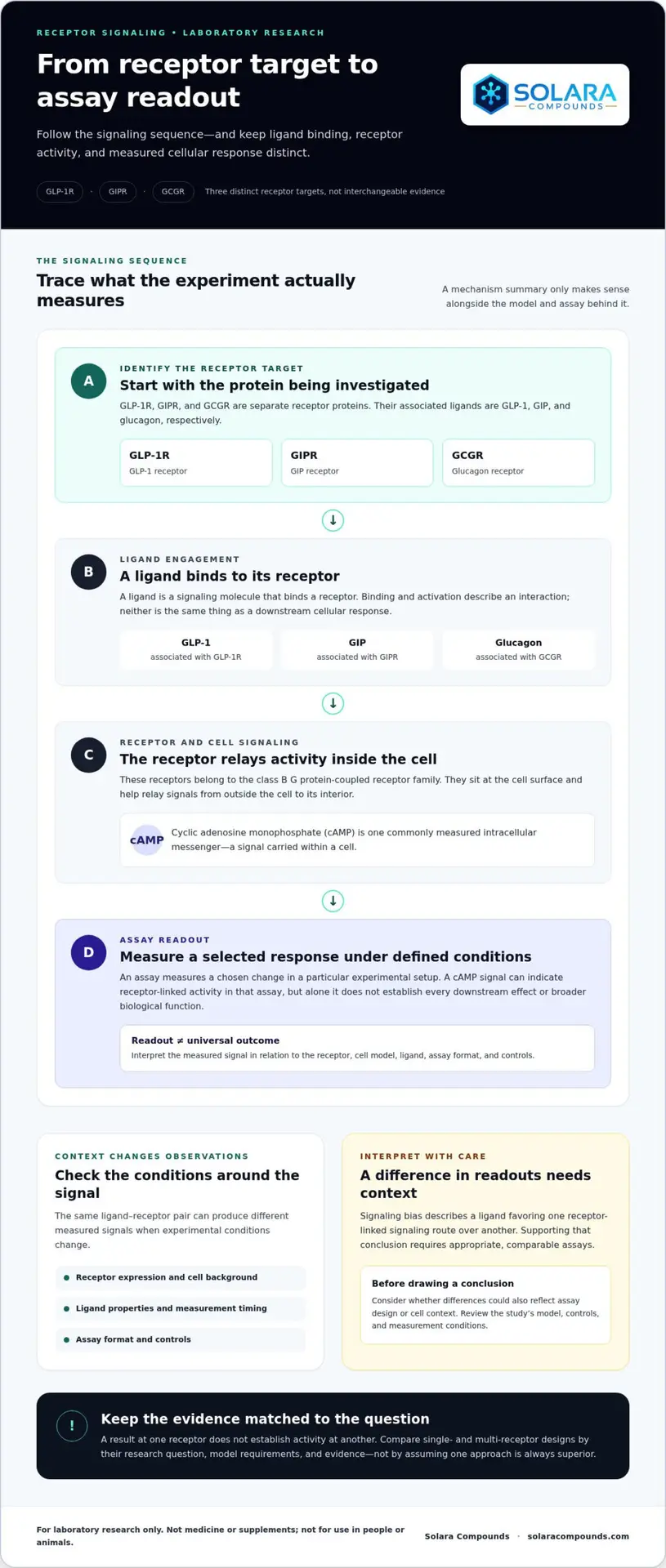
Receptor signaling is best understood as a sequence, not a single event. A ligand first binds a receptor; the receptor then changes activity and interacts with cellular signaling machinery; an assay measures a selected response. Separating these stages helps researchers avoid treating ligand binding, receptor activation, and a downstream signal as interchangeable evidence.
Receptor activation and intracellular signaling
GLP-1R, GIPR, and GCGR belong to the class B G protein-coupled receptor family. In everyday terms, these receptors sit at the cell surface and help relay signals from outside the cell to its interior. “Class B” is a structural grouping of related receptors, not a guarantee that they produce identical responses. After ligand engagement, receptor activity can recruit intracellular partners and initiate signaling pathways.
One commonly measured messenger is cyclic adenosine monophosphate, or cAMP. It carries signals within a cell and can provide a readout of receptor-linked activity in a defined assay. Researchers may compare cAMP signals across conditions, but a change in cAMP alone doesn’t establish every downstream effect or broader biological function. The GIP and GLP-1 pathways also have areas of interaction; this review of GIP and GLP-1 signaling offers additional context.
An assay signal reflects the receptor, cell model, ligand, assay format, and controls used in that experiment. This is why a result should be interpreted alongside its methods, rather than as a universal property of a receptor or ligand.
Why experimental context changes pathway observations
The same ligand-receptor pair can produce different measured signals when experimental conditions change. Relevant factors include how much receptor the cells express, the cell background, ligand properties, measurement timing, assay format, and the controls used to distinguish a specific signal from background. In GLP-1/GIP/glucagon receptor research, these details help determine whether an observed response supports the hypothesis being tested.
Signaling bias is another research concept: a ligand may favor one receptor-linked signaling route over another. That conclusion requires evidence from appropriate, comparable assays. A difference between readouts isn’t enough by itself, since assay design and cell context can also shape the signal. Researchers should consult primary literature for each mechanism claim and examine the model, controls, and measurement conditions described in the study.
For laboratory research only, not for use in people or animals. Researchers looking for materials relevant to receptor-pathway studies can view the research catalog from Solara Compounds.
Comparing Single-Receptor and Multi-Receptor Research Questions
The experimental question should determine the target and model. A focused single-receptor study can isolate a receptor-specific question, while a multi-receptor design can examine responses across targets or test whether their effects interact. Neither approach is universally better. Each supports a different kind of conclusion, and the evidence must match the claim.
| Target | Example research question | Model requirements | Evidence to measure |
|---|---|---|---|
| GLP-1R, GIPR, or GCGR individually | Does a ligand activate the selected receptor in this system? | A model with documented expression of the target; relevant negative controls to assess background or target dependence. | A defined receptor-linked readout, compared across suitable controls. |
| Two or more receptors | How does activity across selected targets compare, or do signals change under combined conditions? | A model and assay plan that can distinguish each target’s contribution, with controls for individual targets and combined conditions. | Comparable measurements for each target and the combined condition, interpreted within the model’s limits. |
When a single-receptor design fits the question
Choose a focused design when the hypothesis concerns one receptor, such as whether a measured signal depends on GLP-1R rather than another pathway. Document receptor expression in the model and include relevant negative controls, such as a system without the target where appropriate. These details help distinguish receptor-linked activity from background. A result at one receptor does not represent the complete biology of another.
What multi-receptor designs add, and what they cannot establish alone
A multi-target experiment can compare activity across receptors or examine whether a combined condition changes a selected assay response. Controls that isolate individual target contributions are important: without them, a combined signal may not reveal which receptor contributed, or whether the measured change depends on more than one target.
Tirzepatide is a related dual-target research context involving GLP-1 and GIP receptors. Published findings for a molecule should be evaluated in light of the study’s model, methods, and materials; they don’t independently establish the properties or performance of a supplier-branded SKU. Solara Compounds’ research-use SOL-2TZ product information describes its offering, not independent experimental evidence.
In GLP-1/GIP/glucagon receptor research, keep the study conclusion proportional to its design. A signal in a particular model supports a conclusion about that model and assay, not automatically about other systems. Research materials are for laboratory research only, not for use in people or animals.
Planning Assays and Interpreting GLP-1/GIP/Glucagon Research
A clear assay plan connects the research question to the evidence collected. In GLP-1/GIP/glucagon receptor research, the same readout can mean different things depending on the model and controls, so define the steps before interpreting a signal.
Match the model and readout to the hypothesis
Start with a specific hypothesis, such as whether a response depends on a particular receptor. Select a model with relevant receptor expression, then choose a readout that tests the intended step. Binding measures ligand interaction; a signaling assay measures receptor-linked activity; a downstream readout measures a later cellular response. These are distinct forms of evidence, not substitutes for one another.
Before comparing results across studies, consult the primary methods sections. Check the cell model, receptor expression, assay format, measurement timing, and analysis approach. A difference in any of these can affect how results should be interpreted.
Set controls and plan replicates
Controls help show whether a measured signal is specific to the target or present as background. Depending on the question, researchers may compare target-expressing and target-negative conditions, include an appropriate reference condition, and assess baseline signal. Replicates help characterize variation within the chosen design; the strategy should be set in advance and reported clearly rather than used to imply certainty from a single result.
Keep evidence and material records interpretable
Document the material identity and lot number alongside model details, assay conditions, control conditions, instrument information, and the analysis used. These records help connect a result to the exact materials and setup, supporting clearer review and repeatability.
Identity and purity documentation can support review of the research material, but it can’t predict a result or establish that a specific assay will work as expected. Solara Compounds provides batch-specific documentation; see the batch COA information for details on material records.
Keep conclusions within the boundaries of the experiment: report what the model and selected readout show, and avoid extending an assay signal into a broader claim without supporting evidence. Research materials are for laboratory research only, not for use in people or animals. To explore materials relevant to laboratory work, review the current research catalog.
Evaluating SOL-3RT Documentation for Laboratory Research
SOL-3RT is a Solara Compounds research compound associated with triple-receptor research. Documentation can help lab buyers assess the material connected to a particular batch before planning work. It serves a specific purpose: supporting review of the material, not demonstrating what an experiment will show.
What batch documentation can show
Solara Compounds provides lot-number traceability and batch-specific Certificates of Analysis (COAs), with third-party testing conducted through Kovera Labs. Start by comparing the lot number on the COA with the lot number for the product batch under review. This helps connect the document to the material being evaluated.
Review the reported identity and purity information in the context of the document. These data can inform a material assessment, while the lot number helps keep records linked to the relevant batch. For documentation details, see Solara Compounds’ batch-specific COA information.
What documentation cannot establish
A COA does not predict assay performance, prove receptor activity in a particular model, or guarantee a research outcome. Those questions require appropriately designed experiments and evidence from the relevant model and assay.
Keep material documentation separate from published biological findings. A paper’s findings for a molecule reflect its own study materials, model, and conditions; they don’t automatically establish results for a Solara-branded SKU. In GLP-1/GIP/glucagon receptor research, a careful review considers both the research question and the evidence available for the specific material and experimental setup.
Solara Compounds’ batch records support traceability and review of reported material identity and purity. They are one part of a research record, alongside documented assay conditions and controls. All products are for laboratory research only, not for human or animal consumption.
For an overview of available research materials, see the current research catalog.
Apply a Clear Framework to Your Next Research Question
Strong GLP-1/GIP/glucagon receptor research begins by keeping receptor targets distinct and matching the model, assay, and controls to the hypothesis. A single-receptor design can isolate a focused question; a multi-receptor design can examine activity across pathways, provided the evidence can distinguish their contributions.
Material records are another part of a sound research process. Solara Compounds provides lot-number traceability, batch-specific COA documentation, and third-party testing through Kovera Labs. These records can support review of reported identity and purity for the batch, but they don’t predict assay performance or establish an experimental outcome. Review the relevant product and batch documents alongside the methods used in the research.
SOL-3RT is associated with triple-receptor research and is for laboratory research only, not for human or animal consumption. To explore research materials and documentation, see the current research catalog. A well-defined question and carefully documented materials give researchers a practical foundation for the work ahead.
Frequently Asked Questions
What are GLP-1, GIP, and glucagon receptors?
They’re three distinct cell-surface proteins that recognize signaling molecules and help relay signals into cells. GLP-1R is the glucagon-like peptide-1 receptor, GIPR is the glucose-dependent insulinotropic polypeptide receptor, and GCGR is the glucagon receptor. Researchers study them as separate targets, even though they participate in related biology. A receptor is the target; a ligand is the molecule that binds it; an assay response is the measured result.
How do GLP-1, GIP, and glucagon receptor pathways differ?
Each pathway begins with a distinct receptor and can lead to different cellular signaling responses. GLP-1R, GIPR, and GCGR may share signaling features, but their effects depend on the ligand, cell model, receptor expression, and assay. Researchers should identify which receptor and readout a study examines before comparing findings. A result at one receptor doesn’t automatically establish activity or function at either of the others.
Can researchers study all three receptors in one experiment?
Yes, if the research question and model support a multi-target design. Researchers need a way to distinguish each receptor’s contribution, such as suitable target-specific conditions and controls, rather than relying only on a combined signal. GLP-1/GIP/glucagon receptor research may also use separate experiments to compare targets. The choice depends on the hypothesis, model capabilities, and readouts; a multi-receptor design isn’t automatically more informative than a focused study.
What does cAMP show in receptor research?
cAMP is an intracellular messenger that can serve as a readout of receptor-linked signaling in a defined assay. A measured change can indicate a response under the tested conditions, but it doesn’t by itself establish every downstream effect or broader biological function. Interpretation depends on the receptor, ligand, cell model, assay format, controls, and measurement timing. Researchers should consult primary study methods before comparing cAMP results across experiments.
What can a batch-specific COA tell researchers about SOL-3RT?
A batch-specific Certificate of Analysis (COA) provides documentation for reviewing reported identity and purity information for the associated lot. Researchers can compare the lot number on the document with the batch under consideration and use that record in material review. Solara Compounds also identifies third-party testing through Kovera Labs. A COA doesn’t predict assay performance or guarantee an experimental outcome. SOL-3RT is for laboratory research only, not human or animal consumption.
Does receptor research on a molecule establish findings for a branded research compound?
No. Published findings apply to the study materials and conditions; they don’t establish results for a supplier-branded SKU. Review literature separately from product and batch records. Solara Compounds supports lab buyers in Boston, San Diego, San Francisco, New York, Houston, Miami, Los Angeles, Austin, Raleigh, Seattle, Chicago, Philadelphia, Baltimore, Dallas, Phoenix, Tampa, Atlanta, and Denver. Contact support@solaracompounds.com or 1 (877) 388-9178, Monday-Friday, 8 AM-5 PM Eastern. All products are for laboratory research only, not human or animal use.