Research Articles
How to Read an HPLC-MS Report for Peptide Research

What does a peptide analysis report actually prove when its purity figure looks reassuring? A guide to HPLC MS report peptide research starts with one distinction: chromatographic purity and molecular identity are related evidence, but they aren’t interchangeable.
It’s understandable to look for a single number that settles the question. HPLC estimates the relative area of detected peaks, while mass spectrometry compares an observed molecular mass with the expected mass. Each result answers a different question, and neither alone establishes every aspect of a sample’s composition or quality.
This guide explains how to read the main chromatogram and MS result, check that the report matches the batch under review, and recognize what the analysis may not show. It also outlines practical questions to raise when a report lacks method details or supporting documentation. Solara Compounds provides batch-specific COA documentation and lot traceability at solaracompounds.com, which can help laboratory buyers connect a report to a specific batch. All products are for laboratory research only, not for human or animal use.
Key Takeaways
- Use an HPLC MS report peptide research workflow to check the sample and lot details before interpreting analytical results.
- Read chromatographic peaks and reported purity in the context of the stated HPLC method; the percentage alone doesn’t describe every aspect of sample composition.
- Assess MS identity evidence separately by comparing the reported observed mass with the theoretical mass, where provided.
- Consider method settings, detection limits, and possible co-eluting signals when judging what the results can support.
- Review batch-specific COA details, including the lot match, methods, results, and report date; documentation records reported findings, not experimental outcomes.
What an HPLC-MS Report for Peptide Research Shows
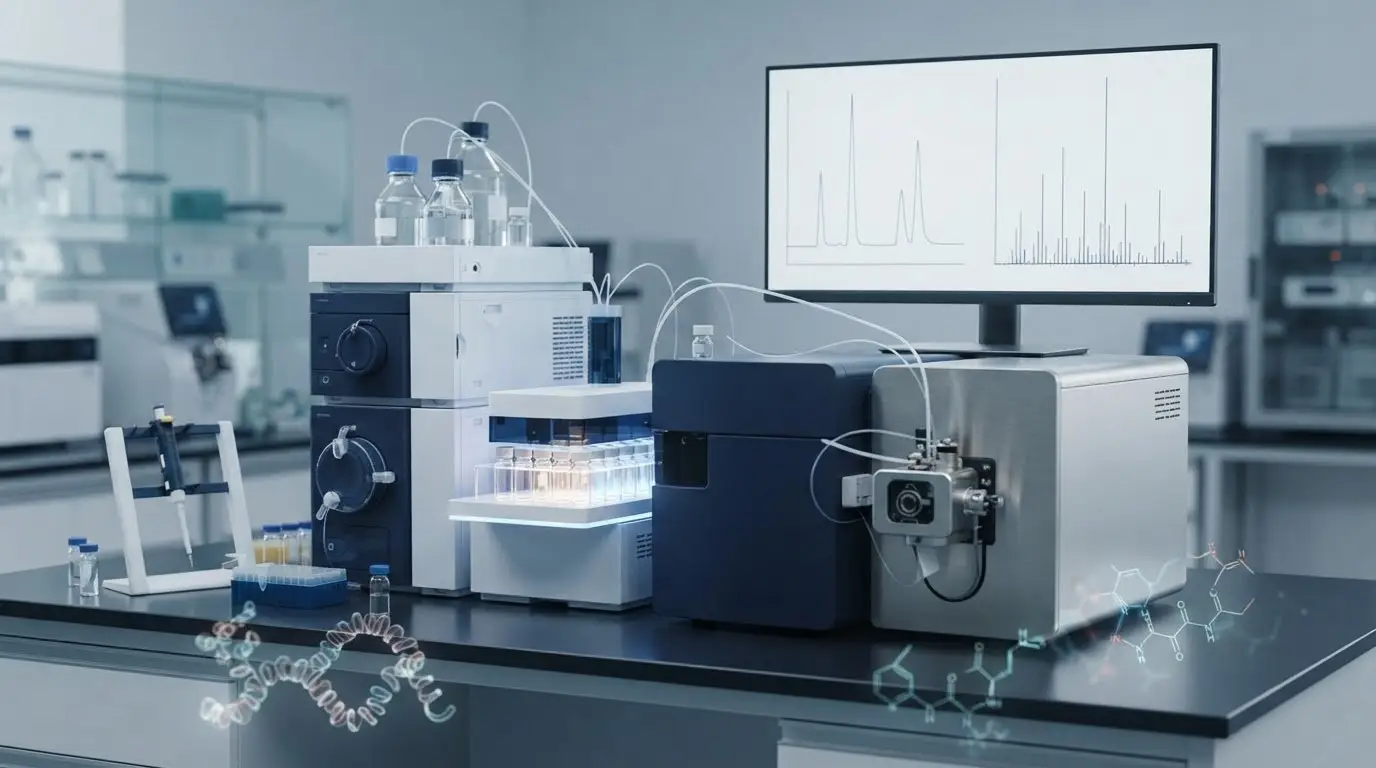
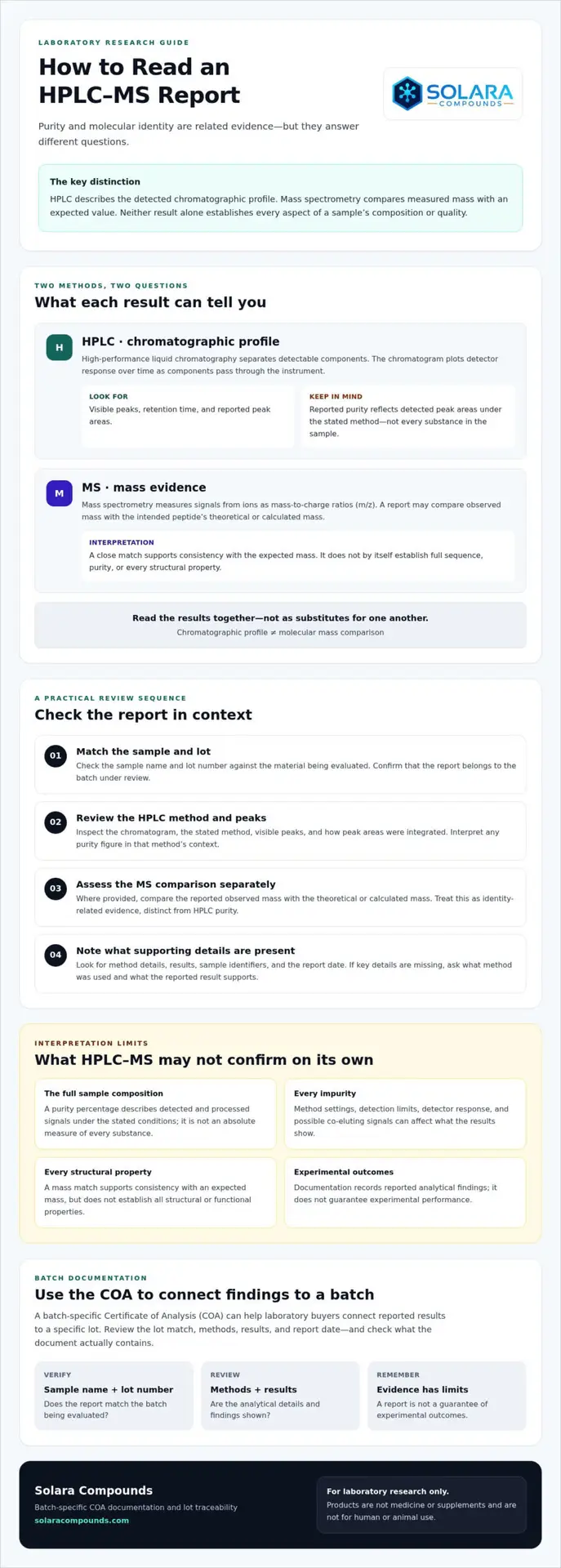
An HPLC-MS report brings together two kinds of analytical evidence: high-performance liquid chromatography (HPLC), which separates detectable components in a sample, and mass spectrometry (MS), which measures the mass-to-charge signals of ions. Together, these methods can help researchers assess a sample’s chromatographic profile and whether measured mass is consistent with an expected peptide. The methods answer different questions, so one result shouldn’t be treated as a substitute for the other.
Purity evidence describes the detected chromatographic profile; identity evidence compares measured mass with an expected value. That distinction is central to interpreting an HPLC MS report peptide research buyers may receive with batch documentation. Results support sample evaluation, but they don’t guarantee experimental performance or establish every quality attribute.
What information may appear in a peptide analysis report?
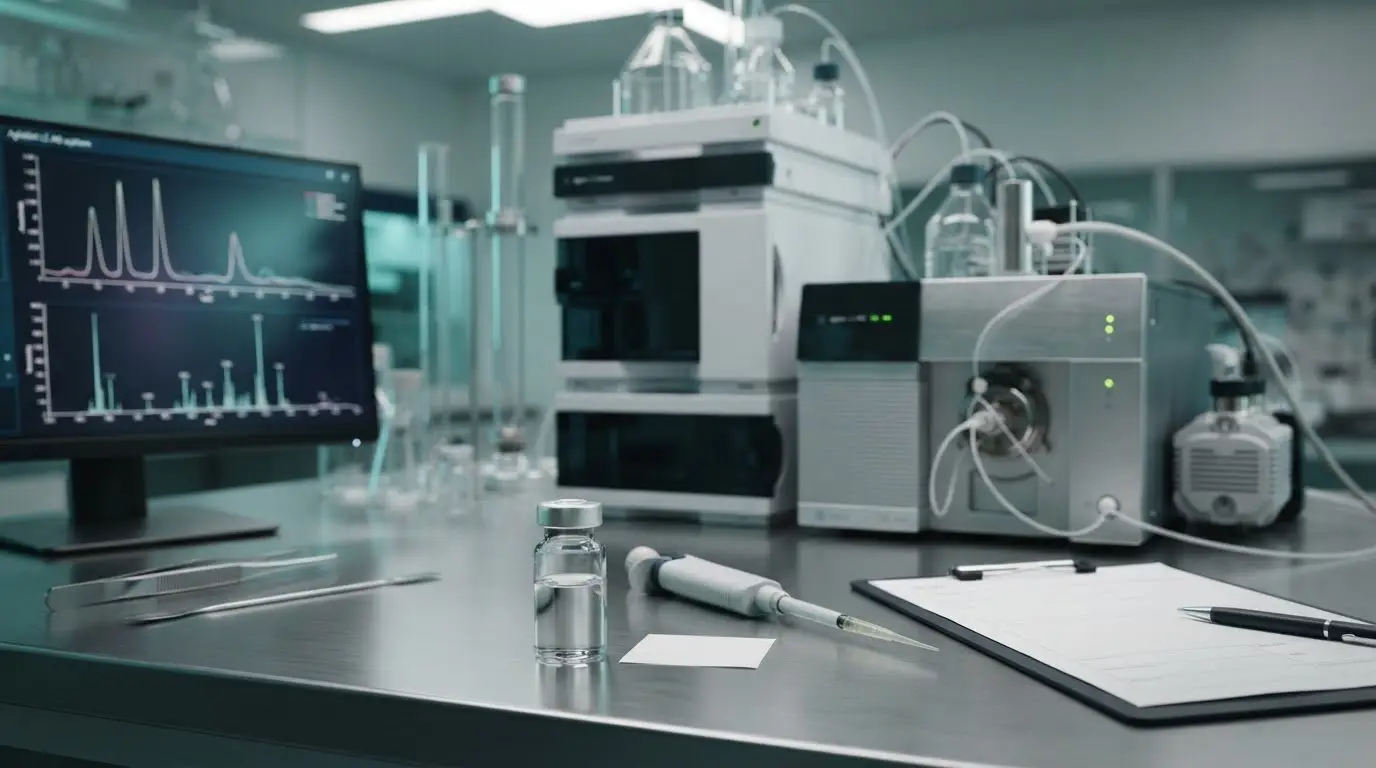
A report may include an HPLC chromatogram, a mass spectrum, method details, and identifiers such as a sample name or lot number. The chromatogram plots detector response over time as separated components pass through the instrument. The spectrum displays signals related to detected ions and their mass-to-charge ratios. Because report formats differ, confirm which fields are present in the specific document you’re reviewing.
Separate instrument results from explanatory notes. A reported peak area or observed mass is a measurement; a supplier’s statement about what that result means is an interpretation. Check that the method and sample identifiers provide enough context to understand the reported data. For a general overview of how the two techniques are combined, see Liquid chromatography-mass spectrometry (LC-MS).
Why purity and identity are different questions
HPLC purity is typically calculated from the relative areas of detected peaks under the stated chromatographic method. It describes the signal captured and processed under those conditions, not an absolute measure of every substance in a sample. Retention time and peak area should therefore be interpreted in the context of the method, including what the detector can detect.
MS identity evidence addresses a different question. The report may compare an observed mass with a theoretical or calculated mass for the intended peptide. A close match supports consistency with that expected mass, but it doesn’t by itself establish all structural or functional properties. Neither an HPLC percentage nor a mass match alone provides a complete account of sample quality.
Solara Compounds provides batch-specific COA documentation and lot-number traceability; lab buyers should verify the lot on a report against the material being evaluated and check the current report for its actual contents. For product context, see the KPV research peptide listing. All products are for laboratory research only and are not for human or animal use.
How HPLC and Mass Spectrometry Contribute Different Evidence
HPLC and MS provide complementary evidence, not interchangeable proof. HPLC separates detectable components under a defined method; MS measures ions to help assess whether a detected molecule’s mass is consistent with the expected peptide. Reading both results together gives a more useful picture than relying on either alone.
HPLC
Measured signal: Detector response plotted over retention time, the time a component takes to pass through the system.
Useful interpretation: Peak positions and integrated areas show the sample’s detected chromatographic profile under the stated conditions.
Limitation: Results depend on the method and detector; peak-area percentage isn’t a universal measure of every impurity.
Mass spectrometry
Measured signal: Mass-to-charge ratio, or m/z, which expresses an ion’s mass relative to its electrical charge.
Useful interpretation: A measured mass can be compared with the expected molecular mass.
Limitation: A mass match alone doesn’t establish full sequence, purity, or every structural property.
Reading an HPLC chromatogram and reported purity
Start with the main peak, then note other visible peaks and whether the report shows how peaks were integrated, meaning how the software assigned and measured their areas. A dominant peak may support a high reported area percentage, but interpretation depends on the method conditions and which signals the detector can register. A component that isn’t detected or separated may not appear as a distinct peak.
Check the method details before comparing chromatograms or purity figures from different reports. Retention time and peak area have meaning within the method used; they aren’t standalone identifiers or a complete inventory of the sample.
Reading an MS spectrum for molecular-mass evidence
Look for the reported observed mass and the expected or theoretical mass, then assess whether they agree within the report’s stated context. In MS, molecules may gain a charge during ionization, the process that converts them into detectable ions. Since the instrument reports mass relative to charge, a peptide can produce signals associated with different charge states. Don’t assume every peak represents a different impurity without understanding the spectrum and method.
Mass agreement supports consistency with the expected molecular mass. It doesn’t independently confirm the full amino-acid sequence or establish chromatographic purity. For an HPLC MS report peptide research review, keep the evidence streams distinct: inspect HPLC for the detected separation profile and MS for mass-based identity evidence.
To review research materials and their available documentation, visit the Solara Compounds research catalog. Products are for laboratory research only, not for human or animal use.
How to Read an HPLC-MS Peptide Report Step by Step
Begin with traceability, not the largest percentage on the page. A result is useful only when you can connect it to the specific sample and lot being evaluated. This stepwise review helps researchers assess the report’s context before weighing its chromatographic and mass-spectrometry evidence.
- Match the sample and lot. Compare the sample name and batch or lot number on the report with the product label or accompanying paperwork. If identifiers are missing or don’t match, pause and ask for clarification rather than assuming the report belongs to that material.
- Locate the method information. Look for the stated analytical method and any available instrument details and analysis date. These fields help establish what was tested and when. If the method or date isn’t shown, note the gap; don’t infer details the report doesn’t provide.
- Review the HPLC result with its chromatogram. Find the reported purity and inspect the corresponding trace. Identify the main peak, note other visible peaks, and check integration notes if included. Ask how the reported figure was calculated if the report doesn’t make that clear. Interpret retention time and peak area within the stated method, not as universal measures.
- Check the MS evidence separately. Compare the reported observed mass with the expected or theoretical molecular mass, if both are listed. Record whether the report explains its interpretation and how any difference is assessed. A mass comparison addresses identity evidence, not chromatographic purity.
- Compare findings and note questions. Consider whether the displayed results support the report’s stated conclusions. Keep measurements distinct from supplier or laboratory explanations, which are interpretations of the data. Write down unclear terms, missing fields, or mismatches and request clarification from the supplier or testing lab.
This workflow keeps the two evidence streams in view without combining their meaning: HPLC describes the detected chromatographic profile under its method, while MS provides mass-based evidence. Neither result alone establishes every attribute of a sample or predicts experimental performance.
Use the batch document as a record, not a guarantee
A batch-specific Certificate of Analysis (COA) can help connect reported results to a lot, but its contents and format may vary. Review the actual document rather than assuming it includes a chromatogram, spectrum, or particular method field. Solara Compounds provides lot-number traceability and batch-specific COA documentation; lab buyers can review available batch COA information and verify the details relevant to their evaluation.
As part of an HPLC MS report peptide research check, make a short list of any unanswered questions and seek clarification before treating an ambiguous field as evidence. Solara Compounds products are for Research Use Only, solely for laboratory research, and not for human or animal consumption.
What HPLC-MS Results Cannot Confirm on Their Own
A reported purity percentage is one piece of analytical evidence, not a complete specification of a batch. It reflects the signals detected and processed under a particular method. Method settings, detector response, detection limits, and how well components separate can all affect what appears in the result.
That distinction matters when reading an HPLC MS report peptide research buyers receive with batch paperwork. A clean-looking chromatogram or mass match can support an assessment, but neither proves every impurity is absent, confirms every element of peptide structure, or predicts how a sample will perform in an experiment.
Why a high HPLC purity value is not the whole report
HPLC area percentages describe the relative areas of detected and integrated peaks under the stated conditions. They don’t necessarily represent an absolute mass fraction or capture substances the detector doesn’t register. If two components behave similarly during separation, they may appear together as one signal rather than as distinct peaks. Method conditions and detection limits therefore shape what the chromatogram can show.
Keep the reported percentage in context. It isn’t a universal measure of every impurity, and it shouldn’t be read as proof of sequence, structural properties, or functional activity. Those are separate questions that may require additional evidence and appropriately designed analytical methods.
How to respond to a mismatch or incomplete report
If the report seems inconsistent, first check for a simple context issue. Confirm the sample and lot identifiers, expected molecular mass, method notes, units, and any stated interpretation. A mismatch can’t, by itself, establish contamination or prove that a sample is the wrong identity. Missing fields also shouldn’t be filled in by assumption.
Record the specific discrepancy and ask the supplier or testing laboratory what the result represents, how it was measured, and whether additional analytical context is available. For consequential research decisions, request review by a qualified analytical professional. Sequence confirmation, detailed impurity profiling, and functional testing address distinct questions; whether they’re appropriate depends on the research requirements.
A COA documents reported batch data, not experimental outcomes. Solara Compounds provides lot-number traceability and batch-specific COA documentation, but lab buyers should evaluate the actual report and ask questions about unclear results. Review research peptides at Solara Compounds. Products are for laboratory research only, not for human or animal consumption.
Using Batch-Specific COAs to Evaluate Research Peptide Documentation
A Certificate of Analysis (COA) is most useful when it connects analytical results to the specific batch a laboratory buyer is evaluating. Treat it as a record of reported batch data, not a guarantee of experimental outcomes. The report’s value depends on whether its identifiers, methods, and results are clear enough to assess.
Batch documentation questions laboratory buyers can ask
Use this checklist to review the document and note any gaps:
- Lot match: Does the COA identify the same product and lot number as the material under review?
- Methods: Does it state which methods were used for identity and purity assessment? Check the actual report rather than assuming particular analyses are included.
- Results: Are the reported measurements and interpretations distinguishable? Can you tell which result relates to chromatographic purity and which supports molecular identity?
- Report date: Is a date provided, and is it clear which sample or batch it applies to?
- Unclear details: Are sample identifiers, method notes, units, or findings ambiguous or missing? Record questions and request clarification from the supplier or testing laboratory.
These checks help keep report interpretation grounded in the document. If a COA doesn’t show a method or result you need, ask whether additional batch-specific context is available instead of assuming it was tested.
How Solara Compounds presents batch-level documentation
Solara Compounds states that it provides batch-specific COA documentation and unique lot-number traceability, with independent third-party testing through Kovera Labs. Its documented company practices include HPLC purification and molecular confirmation by MALDI-TOF and LC-MS. The fields and results shown can depend on the current report format, so lab buyers should review the actual COA for the batch they’re considering.
For a broader quality review, readers may also find it useful to consult established guidance on independent peptide laboratory testing and high-purity research peptide sourcing. Use those resources to frame questions, then assess the specific sample documentation in front of you. A general article or supplier description can’t replace batch-level evidence.
For an HPLC MS report peptide research review, keep the central distinction in view: a COA records reported analytical findings, while researchers determine whether those findings meet their own requirements. Review batch-specific COA information, then see the current research catalog. Products are for Research Use Only, intended solely for laboratory research, and not for human or animal consumption.
Make Batch Documentation Part of Your Review
Read HPLC purity and MS identity as complementary evidence: one describes a chromatographic profile, while the other supports a mass-based identity assessment. Neither result alone confirms every quality attribute or predicts experimental performance. Start with the sample and lot match, then check the methods, results, and report context before drawing conclusions.
A careful HPLC MS report peptide research review also means recognizing what the analysis doesn’t establish and asking for clarification when fields are missing or results appear inconsistent. Solara Compounds documents batch-specific COAs and lot-number traceability, with third-party testing through Kovera Labs. Company-stated practices include HPLC purification and molecular confirmation by MALDI-TOF and LC-MS; review the current batch documentation for its actual contents.
Review batch documentation and shop research peptides at solaracompounds.com. For questions, contact support@solaracompounds.com. Products are for laboratory research only and are not for human or animal use. With an evidence-first review, researchers can make more informed documentation decisions for their work.
Frequently Asked Questions
What does an HPLC-MS report show for a research peptide?
An HPLC-MS report may combine chromatographic results, which show detected components separated under a stated method, with mass-spectrometry results that can be compared with an expected molecular mass. The exact fields depend on the report. For an HPLC MS report peptide research review, first check that the sample or lot identifier matches, then examine the methods, displayed measurements, and stated interpretation before drawing conclusions.
Does HPLC purity confirm peptide identity?
No. HPLC purity describes a chromatographic result within the method and detected signals used; it doesn’t establish molecular identity by itself. Mass spectrometry can provide separate mass-based identity evidence, but that doesn’t automatically confirm every structural property or the full purity profile. Researchers should read both results alongside their method notes and limitations, rather than treating one reported percentage as proof of identity.
Can mass spectrometry confirm peptide purity?
Mass spectrometry can support assessment of molecular mass, but it isn’t a standalone measure of chromatographic purity. The methods detect and describe different aspects of a sample. Review the MS method and results alongside any separately reported HPLC chromatogram or purity analysis. If a report presents only mass evidence, don’t assume it also establishes a complete impurity profile or chromatographic purity.
How do I read a peptide HPLC chromatogram?
Start by matching the sample or lot identifier, then locate the method description, chromatogram, peak labels, and any integration notes or reported purity figure. Check how the report defines the percentage and what method details it provides. Peak area reflects signals detected and integrated under those conditions. It isn’t automatically a complete account of every component, so avoid interpreting it as a universal measure.
What does a peptide MS spectrum confirm?
An MS spectrum displays detected ions by their mass-to-charge ratios, or the relationship between an ion’s mass and its electrical charge. Analysts may compare the observed mass with the expected molecular mass to see whether the result supports the proposed identity. Interpretation depends on the method and spectrum. A matching mass is useful evidence, but doesn’t prove every structural feature or sample characteristic.
Is a batch-specific COA enough to assess a research peptide?
A batch-specific COA is useful when its lot identifier matches the material and its methods and results are clear. It documents reported batch data, not experimental outcomes. Researchers in Boston, San Diego, San Francisco, New York, Houston, Miami, Los Angeles, Austin, Raleigh, Seattle, Chicago, Philadelphia, Baltimore, Dallas, Phoenix, Tampa, Atlanta, and Denver can use the same checks. Solara Compounds products are for laboratory research only, not human or animal consumption.
What should I do if the HPLC result and MS result seem inconsistent?
First verify that both results refer to the same sample or lot. Then check the units, method descriptions, expected mass, and report notes. An apparent mismatch alone doesn’t establish contamination or identity. Record the specific discrepancy and ask the supplier or testing laboratory for clarification and relevant analytical context. If the interpretation is consequential, seek review from qualified laboratory personnel rather than filling gaps with assumptions.