Research Articles
Retatrutide 10mg: Lab Documentation Guide

What does a 10 mg label actually prove? A retatrutide 10mg research peptide listing states a quantity, but it doesn’t by itself confirm the material’s identity, purity, or whether its documentation matches the batch under consideration.
That distinction matters when search results offer limited product details or use broad quality claims. A Certificate of Analysis (COA) can help researchers assess batch-level information, but only when its lot number and reported tests correspond to the material being evaluated. Even then, documentation supports a purchasing decision; it can’t guarantee experimental outcomes.
This guide explains what the 10 mg label means, how to check identity and purity information, and what to verify on a batch-specific COA before laboratory procurement. It also outlines how to approach SOL-3RT documentation without treating marketing language as proof.
Solara Compounds provides lot-number traceability and batch COA information for review at solaracompounds.com. SOL-3RT and other products are intended for laboratory research only, not for human or animal consumption, and are not drugs, medicines, or dietary supplements.
Key Takeaways
- A retatrutide 10mg research peptide label states the listed quantity; it doesn’t establish identity, purity, or concentration.
- Check that the COA’s lot number matches the batch being considered, then review what the reported tests assess.
- HPLC purity analysis and molecular identity confirmation answer different questions, so evaluate them as complementary documentation.
- Use a consistent procurement record: define research requirements, verify the listing, inspect batch paperwork, and retain the lot details.
- SOL-3RT from Solara Compounds is for laboratory research only, not human or animal consumption; review the current listing and applicable batch records at solaracompounds.com.
What does “retatrutide 10mg research peptide” mean on a laboratory listing?
A laboratory listing uses “retatrutide” to identify the research compound being offered, while “10 mg” states the listed quantity. These are separate details, and neither should be read as proof that the material has a particular purity or confirmed molecular identity. A label is a starting point for evaluation, not an analytical result.
The 10 mg label establishes the stated quantity only; it does not establish purity, concentration, verified identity, or experimental performance. For lab buyers, that distinction helps prevent a quantity claim from being mistaken for batch evidence.
What the 10 mg quantity does, and does not, tell a buyer
Milligrams measure mass. A listing that states 10 mg does not, by itself, tell a researcher how much of the stated compound is present in a sample, what its concentration would be in a prepared solution, or how it may perform in an experiment. Those questions require different information and should not be inferred from the product name or label.
Purity and molecular identity also require separate supporting documentation. A batch-specific Certificate of Analysis (COA) can report analytical findings, but buyers should check that the report identifies the batch they’re considering and review which tests were performed. Confirm product-specific details against the current SOL-3RT listing and its corresponding batch records; don’t assume that information for another product or lot applies.
How to keep research context separate from product claims
Retatrutide is described in research as a triple-receptor agonist. In plain language, it interacts with three types of receptors, which are structures cells use to recognize and respond to signals. An overview of Retatrutide can provide background on its mechanism and research history. That context helps explain the compound’s place in research, but it doesn’t verify the identity, purity, or quality of any supplier’s batch.
Keep the evidence categories distinct: scientific literature describes research about a compound, the listing states what a supplier says it is offering, and a batch-specific analytical report provides evidence about a particular lot. None should be substituted for another. SOL-3RT from Solara Compounds is intended for laboratory research only, not for human or animal consumption, and is not a drug, medicine, or dietary supplement. For comparison, the KPV 10 mg product listing is a separate product page; its details should not be used as evidence for SOL-3RT.
Retatrutide research context: separate published literature from product evidence
Research papers can explain why retatrutide is being studied, but they can’t establish what’s in a supplier’s specific batch. Keeping those evidence sources separate helps laboratory buyers assess scientific background without treating it as product verification.
How to summarize a research mechanism without overclaiming
Published research describes retatrutide as acting on GLP-1, GIP, and glucagon receptors. Receptors are cellular signal-recognition sites: they receive particular signals and help a cell respond. A pathway is a linked series of signals inside or between cells. These terms describe biological processes under investigation, not a promised result from a product.
For an example of peer-reviewed research context, Jastreboff and colleagues’ 2023 paper in the New England Journal of Medicine reports a clinical study of retatrutide. Its findings belong to that study and its conditions. They shouldn’t be generalized into claims about a supplier’s research material or used to predict an outcome in a separate laboratory experiment.
For deeper structural and mechanism background, consult the article’s retatrutide chemical-profile discussion alongside primary research. Check what each source actually addresses, and avoid treating a mechanism description as evidence of performance.
Why literature cannot replace batch-level verification
A research paper does not identify or test the particular lot a lab buyer may procure. Supplier documentation has a narrower role: a batch-specific Certificate of Analysis (COA) reports information for the lot named on that document and the analyses it lists. Match its lot identifier to the batch under consideration, then confirm which identity and purity tests are reported. A COA documents those reported results; it doesn’t guarantee experimental outcomes.
This distinction matters for a retatrutide 10mg research peptide listing. Published literature provides compound-level context, while the listing and matching batch paperwork are the sources to examine for supplier- and lot-specific details. One category of evidence can’t stand in for the other.
Solara Compounds identifies SOL-3RT as a research peptide and provides batch documentation for review. Check the current product details and the applicable lot records at Solara Compounds’ research peptide catalog. SOL-3RT is for laboratory research only, not for human or animal consumption, and is not a drug, medicine, or dietary supplement.
How to evaluate a retatrutide 10mg batch COA and testing record
A Certificate of Analysis (COA) is useful only if it can be tied to the material under review. For a retatrutide 10mg research peptide listing, compare the report with the product and batch details rather than treating a document labeled “COA” as proof on its own.
What to check in a batch-specific Certificate of Analysis
Start with the product identifier and lot number. The lot number on the COA should match the batch being considered; a report for a different lot or a generic sample doesn’t establish results for that batch. Also review the report date and the analytical results shown, including which tests were performed. If a result or method isn’t stated, don’t assume it was covered.
Lot matching connects analytical results to the batch being evaluated; without that match, the report may not describe the material under consideration. Solara Compounds provides batch-specific COA documentation for review. Confirm that the available report corresponds to the current SOL-3RT lot before relying on its contents.
How HPLC and mass spectrometry contribute different information
High-performance liquid chromatography (HPLC) separates components in a sample, helping assess chromatographic purity based on the reported method and results. Mass spectrometry measures the mass of detected molecules, which can help support molecular identity when interpreted with suitable reference information. These methods answer different questions, and one result shouldn’t be treated as a substitute for the other.
Read the report’s method names and findings as written. A stated purity result doesn’t, by itself, confirm molecular identity; a mass result alone doesn’t establish purity. For context on independent peptide testing, review the testing information and verify which methods apply to the product and batch at hand. Don’t assume a general quality statement automatically describes SOL-3RT specifically.
A COA records analytical data for the identified batch and the tests reported. It can support traceability and a more informed laboratory procurement decision, but it doesn’t guarantee experimental outcomes. Retain the report with the product listing and lot information so the documentation remains connected to the material being evaluated. SOL-3RT is for laboratory research only, not for human or animal consumption, and is not a drug, medicine, or dietary supplement.
A practical procurement checklist for retatrutide 10mg research peptide orders
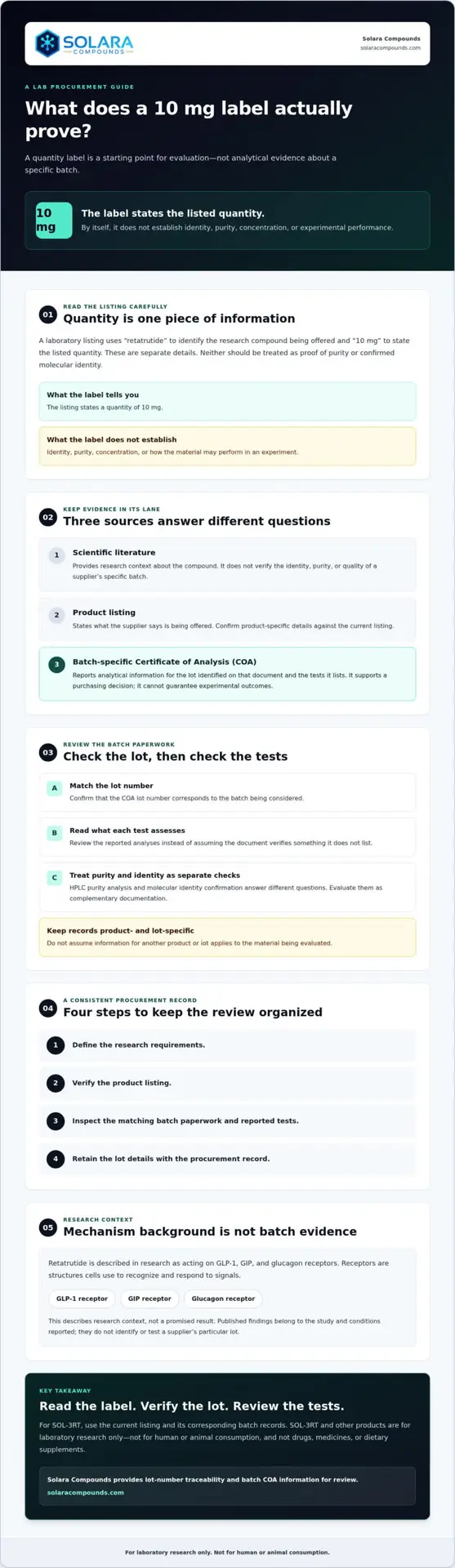
A consistent review sequence makes laboratory purchasing easier to document and repeat. For a retatrutide 10mg research peptide order, assess the listing and its batch paperwork against your lab’s requirements before completing procurement review. Don’t fill gaps in the record with assumptions.
Questions to resolve before selecting a listing
Begin with the research requirements your lab has already defined. Then verify the product name and stated quantity on the current product page, and determine whether the available batch documentation provides the information your internal review requires. If a detail is missing or unclear, ask the supplier instead of treating an unstated specification as confirmed.
A documentation-first purchasing sequence
- Define the requirement. Identify the research material and documentation your laboratory procurement process calls for.
- Verify the listing. Check the exact product identifier and listed quantity on the live page. Confirm the details apply to the product being considered.
- Inspect the matching COA. Compare the batch or lot identifier on the report with the information associated with the listing. Review the report date, tests, and stated results.
- Record the lot. Save the product identifier, lot details, listing information, and COA with your laboratory procurement records.
Keep the product and batch documents together. This creates a traceable record of what was reviewed and helps distinguish one lot from another if purchasing records are revisited later. A COA documents the analyses reported for the batch it identifies; it doesn’t guarantee experimental outcomes.
For SOL-3RT, Solara Compounds provides lot-number traceability and batch COA information for review. Confirm that the documents available for the current listing match the batch under consideration, and contact research support if you need clarification. Don’t assume general product information or paperwork for another lot answers a batch-specific question.
Solara Compounds products are intended for laboratory research only, not for human or animal consumption, and are not drugs, medicines, or dietary supplements. For an overview of the research materials currently listed, see the current research catalog at solaracompounds.com.
SOL-3RT from Solara Compounds: review the listing and batch records
For laboratory buyers, a supplier’s product page and batch records serve different purposes. The listing describes the product being offered; the matching Certificate of Analysis (COA) provides analytical information for the identified batch. Reviewing both helps keep supplier claims distinct from evidence about a specific lot.
What Solara Compounds documents for research buyers
Solara Compounds supplies SOL-3RT for laboratory research and assigns lot numbers for traceability. Batch COA information is available for review. Solara also states that third-party testing is conducted through Kovera Labs. Treat that as supplier-level context, and check the applicable COA and current product information before attributing any particular test or result to a SOL-3RT batch.
The SOL-3RT product listing is the place to confirm current product details. Compare the lot information associated with the product to the identifier on the COA. If a purity statement, analytical method, or other specification isn’t shown for the relevant batch, don’t infer it from a general description. A COA reports the analyses documented for that lot; it doesn’t guarantee experimental outcomes.
Where to review current product and batch information
Before procurement, check the live SOL-3RT listing and review the COA resource at solaracompounds.com/coa/. Confirm that the documentation available for review matches the batch under consideration, and retain the listing and batch records with your laboratory purchasing documentation. This provides a traceable record of the information reviewed without treating product-page language as a substitute for batch-level evidence.
Solara Compounds’ supplier documentation can support an informed, research-focused purchasing decision. It doesn’t replace a lab’s own procurement criteria or establish how a material will perform in an experiment. Researchers considering a retatrutide 10mg research peptide should assess the current listing and applicable batch records together, and seek clarification from the supplier when details are missing.
Research Use Only: SOL-3RT is for laboratory research only, not for human or animal consumption, and is not a drug, medicine, or dietary supplement. To browse current research listings, see the research catalog.
Make Your Next Procurement Review Evidence-Based
A 10 mg label communicates the stated quantity, not verified identity or purity. For a retatrutide 10mg research peptide, review the listing alongside documentation for the relevant batch, and match the COA’s lot number before recording your procurement decision.
Solara Compounds provides batch-specific COA documentation and lot-number traceability. Solara also states that third-party testing is conducted through Kovera Labs. These records can support a traceable laboratory purchasing process, but they don’t guarantee experimental outcomes. Check which analyses and product details apply to the batch being considered.
SOL-3RT is intended for laboratory research only, not for human or animal consumption, and is not a drug, medicine, or dietary supplement. When you’re ready to review current listings, view the current research catalog at solaracompounds.com. A careful, documentation-first review helps keep your sourcing decision clear and research-focused.
Frequently Asked Questions
What does 10 mg mean on a retatrutide research peptide listing?
It states the listed quantity by mass: 10 milligrams. For a retatrutide 10mg research peptide, that figure does not tell researchers the material’s concentration in a solution, purity, or confirmed identity. Treat it as one product attribute to verify against the current listing, then review the batch documentation for analytical information. Don’t infer experimental performance from the quantity shown on the label.
Does a 10 mg label confirm the purity of retatrutide?
No. A quantity label doesn’t confirm purity or molecular identity. Those require supporting analytical documentation, such as a batch-specific Certificate of Analysis (COA) that identifies the lot and reports the tests performed. Review the stated methods and results rather than relying on a general product description. If a purity claim isn’t documented for the batch being considered, don’t assume the label establishes it.
What should researchers look for in a retatrutide batch COA?
Check that the COA identifies the product and includes the lot number that matches the batch under consideration. Review the report date, analytical methods, and stated results, and note which properties the tests address. A COA should provide batch-level information, not just generic product claims. Keep the report with the relevant listing and procurement records so the documentation remains connected to the material evaluated.
How do HPLC and mass spectrometry reports differ for peptide analysis?
HPLC separates components in a sample and can be used to assess chromatographic purity based on the reported method and results. Mass spectrometry measures the mass of detected molecules and can help support molecular identity when interpreted with suitable reference information. The methods provide different kinds of evidence. Review each result separately, and don’t treat one method as a substitute for the other.
Can a COA guarantee the results of a laboratory experiment?
No. A COA documents the analytical information reported for the batch identified in that document. It can support a traceable purchasing review, but it can’t establish how a material will perform in a particular experiment or guarantee an outcome. Researchers should evaluate the report alongside their own requirements and experimental design. Keep the evidence in perspective: documentation informs procurement; it isn’t a prediction of results.
Is SOL-3RT intended for use outside laboratory research?
No. SOL-3RT is intended for laboratory research only and is not for human or animal consumption. It is not a drug, medicine, or dietary supplement. This research-use boundary applies to product references and purchasing decisions. Buyers should keep the material within appropriate laboratory research contexts and should not interpret published scientific literature or supplier descriptions as guidance for personal, medical, diagnostic, or veterinary use.
How can a buyer confirm that a COA matches the retatrutide batch?
Compare the lot number on the COA with the batch identifier shown for the product being considered. Also check the product name and report details; if the identifiers don’t align or the match is unclear, ask the supplier before relying on the document. Solara Compounds provides lot-number traceability and batch COA information. This check is relevant to lab buyers in Boston, San Diego, San Francisco, and other research hubs.