Research Articles
2026 US Research Chemical Procurement Guide

What if the supplier’s headline purity claim tells you less than the paperwork for the specific lot you’re buying? For lab buyers, international orders can bring uncertainty around customs delays or seizures, while inconsistent batches and hard-to-verify testing reports make experimental results harder to reproduce. Choosing a domestic US research chemical supplier is one part of reducing procurement friction, but location alone doesn’t establish quality.
Researchers need evidence they can check: batch-specific Certificates of Analysis, transparent third-party testing, and lot numbers that connect documentation to the material received. HPLC and mass spectrometry (MS) can help assess purity and identity, but the report should clearly show which batch was tested and by whom.
This guide explains how to evaluate suppliers on those points, review documentation, and consider US-based logistics when planning laboratory procurement. It also outlines what to look for in Solara Compounds’ batch COAs at solaracompounds.com/coa/ and how to assess claims without relying on marketing language alone. All products discussed are for laboratory research only, not for human or animal use, and are not medicines or supplements.
Key Takeaways
- Evaluate a domestic US research chemical supplier by checking whether testing documents match the specific lot, not just the product name.
- Learn what HPLC and mass spectrometry reports can help verify, and what details to look for before assessing a purity claim.
- Use lot-number traceability and batch-specific Certificates of Analysis to support consistent records and experimental reproducibility.
- Compare supplier documentation, synthesis environment, and US-based logistics as part of a practical procurement review.
- Explore how Solara Compounds presents research products such as SOL-3RT Retatrutide 10mg, with all products for laboratory research only and not for human or animal use.
The Risks of International Sourcing vs. Domestic US Research Chemical Suppliers
A low purchase price doesn’t account for the cost of a delayed experiment, replacement materials, or extra work to investigate an undocumented batch. International shipments can encounter transit delays or customs holds, making delivery timing less predictable. A US-based supplier can simplify the shipping route, but domestic origin alone doesn’t establish product quality or guarantee delivery by a specific date.
Customs Seizures and Supply Chain Fragility
For time-sensitive laboratory work, an uncertain arrival date can affect planning, sample schedules, and staff time. International procurement may also require extra coordination between the purchasing team, carrier, and supplier if a shipment is delayed or documentation needs review. Requirements vary by institution and material, so lab buyers should confirm procurement and safety expectations with their own institution rather than assume one supplier’s location resolves compliance questions.
Longer transit can mean more handoffs and less visibility into shipping conditions. Lyophilized powders are prepared in a dried form, but that doesn’t make it reasonable to assume every shipment has been handled appropriately. Ask what handling information is available and inspect the lot’s documentation on receipt. A US route to research hubs such as Boston, San Diego, or San Francisco may reduce international transit steps, but it can’t guarantee a particular delivery window.
Domestic Reliability and Fast Shipping
Consider the whole fulfillment process, not just the origin address. Solara Compounds is based in Florida and provides batch-specific Certificates of Analysis through Kovera Labs. A domestic supplier may be easier to contact about an order or its documentation, while lot-level testing gives researchers a concrete record to review. Learn more about Solara Compounds’ research peptide supplier information.
“Purity drift” shouldn’t be treated as an inevitable result of international shipping. The practical concern is whether an unverified batch has clear, lot-specific test results that can be compared with the material received. A product-level or representative report may not establish the composition of a particular lot. Review the batch COA and check that its identifiers match the supplied material. The research chemical category is associated with laboratory investigation; Solara Compounds products are for laboratory research only, not for people or animals.
For domestic laboratory budgeting, Solara Compounds offers free shipping on orders over $200. Don’t assume that means next-day delivery or a particular transit time; confirm current shipping terms before placing a time-sensitive order. Domestic sourcing can reduce some logistical complexity, while batch documentation and careful receipt checks help researchers assess material consistency.
Scientific Quality Standards for High-Purity Research Peptides
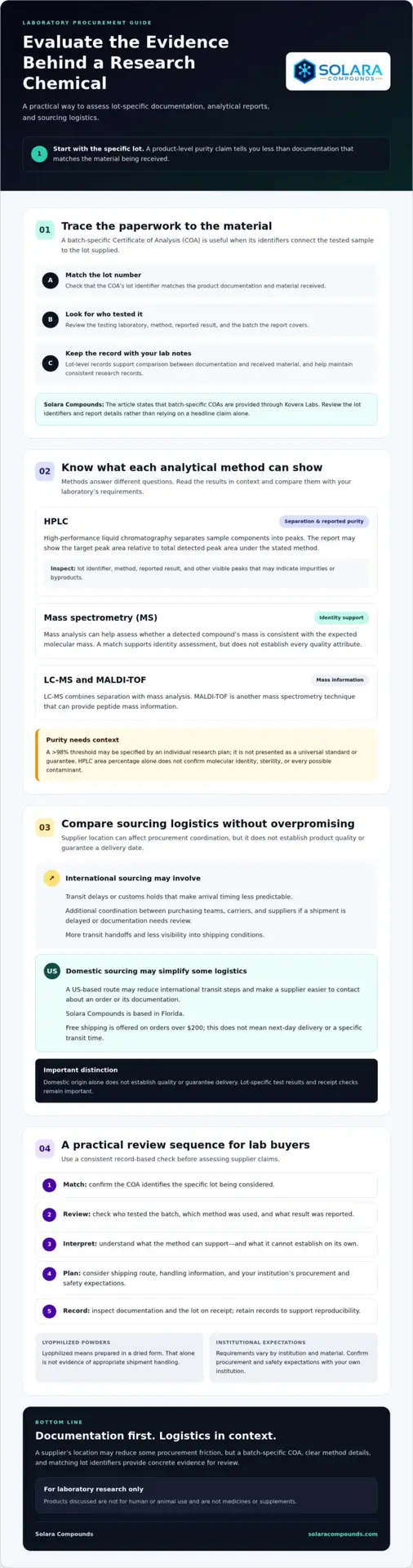
“High purity” is meaningful only when the supplier explains how it was measured and provides results tied to the specific lot. For in-vitro research, HPLC can help quantify detected components, while mass spectrometry can support identity checks. Neither a purity figure nor a test method alone establishes every quality attribute a laboratory may require.
HPLC Purification and Purity Metrics
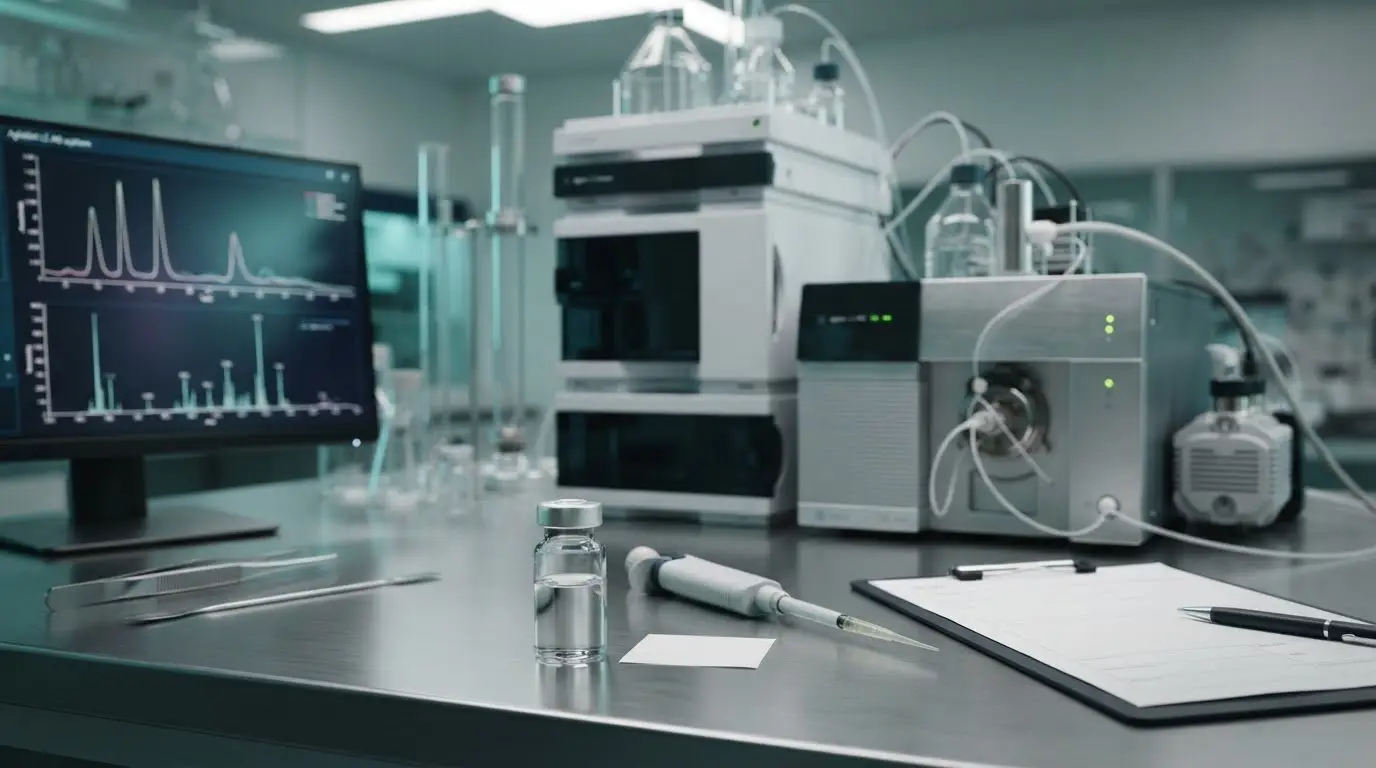
HPLC separates components in a sample so they appear as peaks on a chromatogram. HPLC purity is the ratio of the target peptide peak area to the total peak area detected under the stated method. Researchers can inspect the report for the lot identifier, method, reported result, and other visible peaks that may indicate impurities or byproducts.
A >98% threshold may be specified by an individual research plan, but don’t assume it is a universal industry standard or a guarantee of suitability. Results depend on the analytical method and its limits; HPLC area percentage also doesn’t, by itself, confirm molecular identity, sterility, or every possible contaminant. Compare the reported result with the lab’s defined acceptance criteria.
Molecular Identity Verification
LC-MS combines separation with mass analysis. It can help assess whether a detected compound’s mass is consistent with the expected molecular mass. MALDI-TOF is another mass spectrometry technique that can provide peptide mass information. A mass match supports identity assessment, but it shouldn’t be described as definitive sequence verification without suitable complementary analysis. Review the actual methods and results in the batch paperwork.
For multi-phase studies, retain lot numbers and associated reports so researchers can track which material was used in each phase. Solara Compounds provides batch-specific COAs through Kovera Labs. Its listed production process uses solid-phase peptide synthesis in ISO 7 cleanrooms, which are controlled environments designed to limit particulate contamination. A cleanroom classification describes environmental controls; it isn’t a substitute for batch testing.
Lyophilization removes water by freezing the material and drying it under controlled conditions. It can support storage of a dried peptide, but it doesn’t prove sterility or establish a storage life. Vacuum sealing can help protect packaged material from exposure, yet buyers should review the supplier’s handling and storage information and check whether any sterility claim has separate supporting documentation.
Solara Compounds identifies its products as for laboratory research only, not for human or animal use. Researchers assessing procurement requirements can consult DEA chemical import regulations as a separate import-compliance reference; it doesn’t establish peptide purity or identity. To compare available research materials and documentation, review the research peptide catalog and the lot-specific evidence before selecting a domestic US research chemical supplier.
Evaluating Domestic Suppliers: Documentation and Transparency
A supplier’s quality claims are only useful to a laboratory when researchers can connect them to the material in hand. A Certificate of Analysis (COA) for one sample or an earlier production run may describe that sample, but it doesn’t establish the test results for every later lot. Batch-specific documentation helps close that gap by tying reported results to an identified production lot.
Batch-Specific Certificates of Analysis
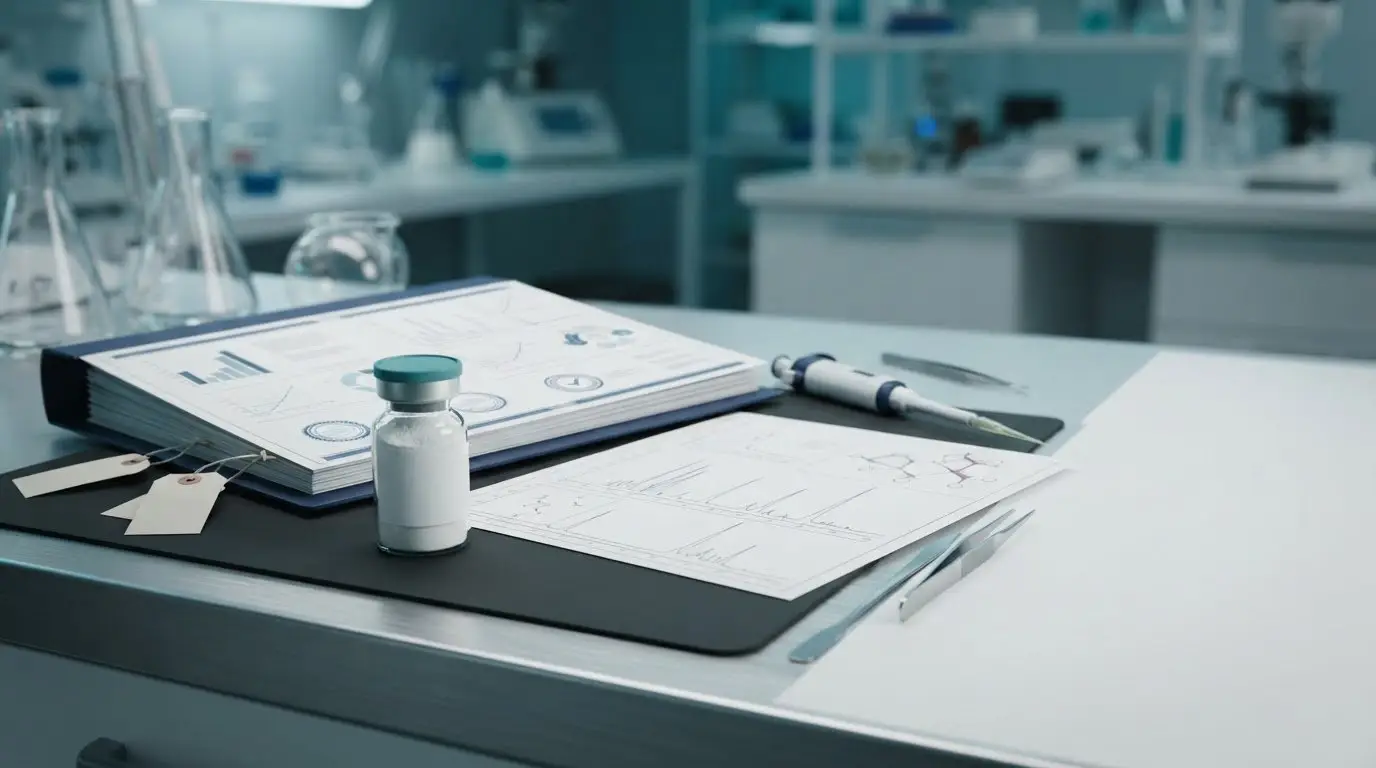
Before ordering, check whether the COA identifies the compound and the lot number that will appear on the supplied material. A useful report should also make its testing information interpretable: look for the analytical method, test date, reported results and units, and the testing laboratory. If a result is unclear, ask the supplier what the method measures and how to interpret it.
Lot numbers provide a reference point across purchasing, storage, and experimental records. For example, a researcher can record the lot associated with a study phase and retain its COA alongside the relevant laboratory notes. If later work uses a different lot, that distinction is visible during review instead of being lost under a general product name.
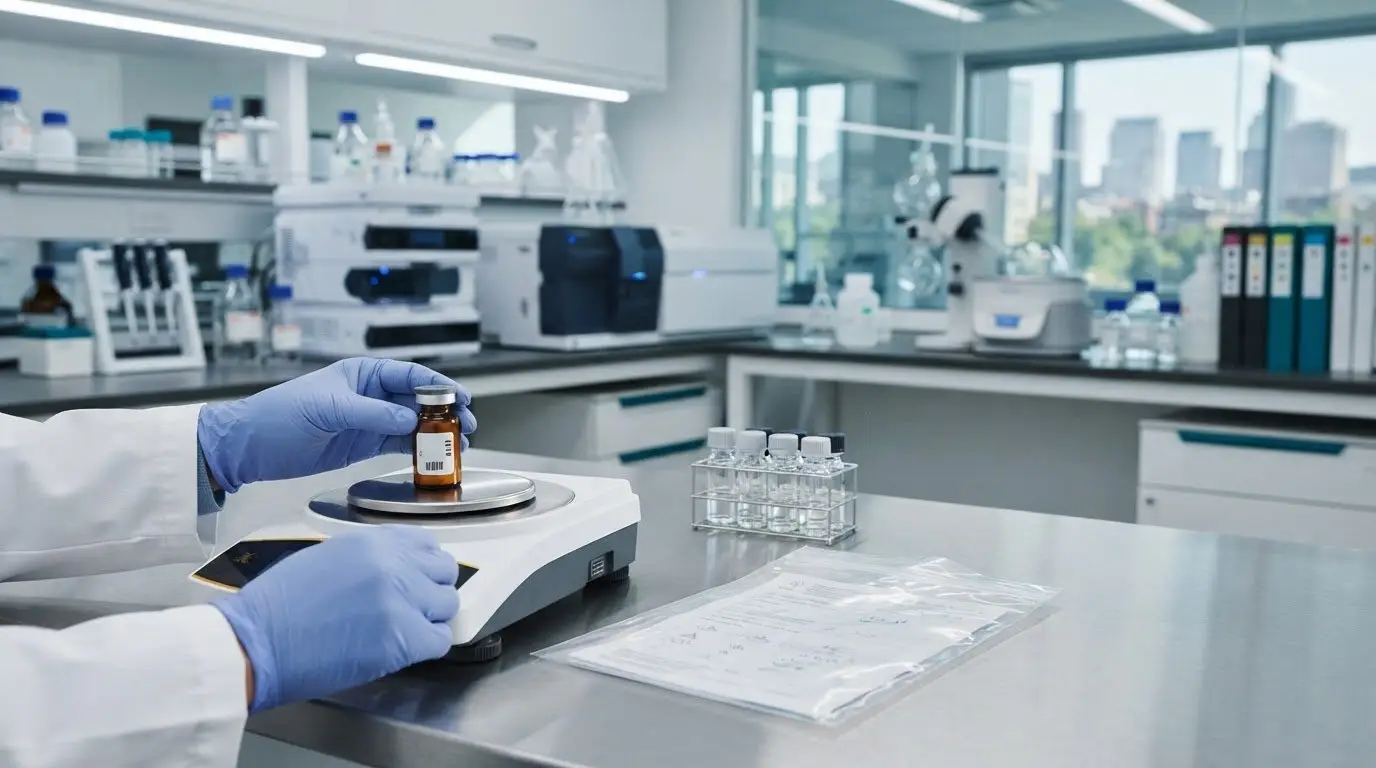
Match the vial or packaging identifier to the COA before filing it. This simple check helps prevent a report for one lot from being mistakenly attached to another and supports consistent records for independent laboratories, internal reviews, or future replication work.
Third-Party Verification Protocols
Testing by an external laboratory adds a check beyond a supplier’s own product description. It doesn’t automatically prove every quality attribute, though. Researchers evaluating a third-party report can confirm the lab named on it, review which methods were used, and check that the report identifies the same compound and lot being considered. Don’t assume accreditation or a particular scope of testing unless supporting documentation says so.
Solara Compounds states that its batches are tested through Kovera Labs and that batch-specific COAs are available for every lot. Researchers can inspect the documentation through the Kovera Labs COA portal and assess the report details directly, rather than relying on a general purity statement. A transparent portal is most useful when lot identifiers and test information are clear and accessible.
For lab buyers comparing a domestic US research chemical supplier, documentation should be treated as part of procurement, not an optional extra. Keep the COA with the receiving record, verify the lot match, and apply the laboratory’s own acceptance criteria before use. Solara Compounds products are for laboratory research only, not for human or animal use.
Procurement Checklist for US-Based Laboratory Buyers
A consistent purchasing review helps researchers catch documentation or logistics gaps before an order affects a study schedule. Use this checklist to assess a domestic US research chemical supplier against your institution’s requirements, rather than relying on product descriptions alone.
- Confirm research-use status. Check that the material is identified for laboratory research only and is not intended for people or animals. Ask your institution’s purchasing, safety, or review staff to confirm whether the proposed work and material meet its requirements.
- Review the synthesis environment. Ask what production controls the supplier can document. For example, Solara Compounds reports solid-phase peptide synthesis in ISO 7 cleanrooms. Treat this as process information, then assess it alongside testing records rather than as a substitute for them.
- Validate the current batch COA. Match the lot number on the report to the lot being ordered or received. Check the named compound, testing laboratory, analytical method, date, and reported results. If a report is representative rather than lot-specific, ask what evidence connects it to the batch.
- Plan shipping and storage. Confirm the available shipping terms and expected handling information before placing a time-sensitive order. For lyophilized powders, follow the supplier’s documented storage instructions and your laboratory’s procedures. Don’t assume vacuum sealing or a dried format alone establishes a specific storage life or stability condition.
- Identify a support route. Before procurement, find out how to direct questions about a COA, lot number, or shipment. Keep the response and relevant documents with purchasing records so the same information is available to researchers receiving the material.
Check Supplier Details and Plan for Receipt
Verify the supplier’s business identity and contact information, and review its stated policies for damaged or incorrect shipments before ordering. Solara Compounds LLC is based in Florida. Its listed support channels are support@solaracompounds.com and 1 (877) 388-9178, Monday through Friday, 8 AM to 5 PM Eastern. These are contact details, not a stated response-time guarantee; ask about timing if your procurement schedule depends on it.
On arrival, compare package and lot identifiers with the order and COA, then document receipt according to institutional procedures. If packaging appears damaged or identifiers don’t match, pause and contact the supplier before using the material. Solara Compounds products are for laboratory research only, not for human or animal use. For supplier background, see About Us: US Research Peptide Supplier.
Ready to assess available materials against your laboratory’s requirements? See the current research catalog.
Sourcing Specialized Compounds from Solara Compounds
Once procurement criteria are clear, the next step is matching a compound and its documentation to the laboratory’s research plan. Solara Compounds is a Florida-based supplier of lyophilized research peptides, including SOL-3RT, SOL-2TZ, BPC-157, TB-500, GHK-Cu, MOTS-C, and NAD+. Product names and listed quantities identify catalog items, not a recommended use or a measure of suitability for a particular experiment.
The Solara Research Catalog
The catalog includes SOL-3RT Retatrutide and SOL-2TZ Tirzepatide, compounds that researchers may assess for laboratory investigations involving metabolic signaling. Signaling refers to how cells receive and respond to molecular messages. The catalog also lists BPC-157 and TB-500, which researchers may consider for studies of cellular signaling and related biological processes, along with GHK-Cu, MOTS-C, and NAD+ for other lines of laboratory inquiry. These descriptions are research context, not claims of human or animal effects.
For any candidate material, check the exact catalog name and quantity, then review the current lot’s COA and the analytical details relevant to the study. A product description alone can’t establish that a specific batch meets a laboratory’s acceptance criteria. Solara Compounds provides batch-specific COAs through Kovera Labs, allowing buyers to examine the report associated with a lot.
All Solara Compounds products are for laboratory research only. They are not medicines or supplements and are not for human or animal use. Researchers should select materials based on their documented research requirements and institutional review processes, not on claims of personal outcomes.
Contacting Research Support
For a question about a product listing, lot paperwork, or procurement detail, contact Solara Compounds at support@solaracompounds.com or 1 (877) 388-9178, Monday through Friday, 8 AM to 5 PM Eastern. For institutional purchasing, ask directly whether any purchasing arrangements fit your organization’s needs; bulk or wholesale terms aren’t specified here, so confirm availability and conditions before planning a purchase.
Researchers comparing options can view the current research catalog at Solara Compounds and assess each listing alongside its batch documentation. That evidence-based review is a practical final step when choosing a domestic US research chemical supplier for laboratory work.
Make Your Next Procurement Decision Evidence-Based
A dependable procurement process rests on three checks: consider how shipping may affect project timing, review testing methods and results, and match the COA to the lot being purchased. A domestic US research chemical supplier can simplify logistics, but supplier location alone doesn’t demonstrate batch quality. Traceable documentation does.
Solara Compounds provides batch-specific COAs for every lot, with third-party testing through Kovera Labs. Researchers can review the report for the lot identifier, methods, and results, then assess whether the documentation meets their laboratory’s requirements. Solara Compounds products are for laboratory research only, not medicines or supplements, and not for human or animal use.
For eligible orders, free shipping is available on orders over $200. Confirm current shipping details and review the documentation before placing a time-sensitive order. A careful check now can support clearer purchasing records and more reproducible laboratory work.
Shop high-purity research peptides at solaracompounds.com and take the next step with batch-level information in view.
Frequently Asked Questions
What does “Research Use Only” (RUO) mean for chemical procurement?
RUO means a material is intended solely for laboratory and scientific research, not for use by people or animals. It isn’t a medicine or dietary supplement. Before purchasing, researchers should check that the product’s stated use aligns with their project and institutional requirements. Solara Compounds products are for laboratory research only. Lab buyers should keep the product’s research-use status clear in procurement records and follow their institution’s handling and review procedures.
How do I verify the purity of a domestic research chemical batch?
Start with a COA that identifies the specific batch, then confirm that its lot number matches the material being considered. Review the analytical method, reported result, and testing laboratory rather than relying on a general product claim. Solara Compounds states that its peptides are HPLC-purified to a target minimum above 98%, with product pages commonly listing 99% or higher. Check the current lot report at solaracompounds.com/coa/ and assess it against your lab’s criteria.
Why is third-party testing critical for US research peptide suppliers?
Third-party testing provides an analytical check performed outside the supplier’s own product description. It gives researchers a report to assess for the named compound, lot, method, and reported findings. Independent testing doesn’t automatically verify every quality attribute or guarantee research outcomes, so review what the assay actually covers. Solara Compounds identifies Kovera Labs as its third-party testing provider and makes batch-specific COAs available for researchers to inspect.
What is the difference between HPLC and MS in a lab report?
HPLC separates components in a sample, allowing the relative peak areas to be assessed as a purity measure under the stated method. Mass spectrometry (MS) measures ions by their mass-to-charge characteristics and can support molecular identity assessment. The methods answer different questions: HPLC can describe detected components, while MS can help assess whether measured mass aligns with the expected compound. Read the report’s method and results together, not as interchangeable tests.
Do domestic US suppliers provide lot-number traceability?
Some suppliers provide lot-level records, but buyers should verify this rather than assume it. A lot number links the supplied material to its batch documentation and gives researchers a consistent identifier for purchasing and laboratory records. Solara Compounds assigns unique lot numbers and provides batch-specific COAs. On receipt, compare the identifier on the packaging with the COA, then retain both with the relevant procurement and experimental records.
What are the storage requirements for lyophilized research peptides?
Follow the product-specific storage information supplied with the material and your laboratory’s approved procedures. Lyophilized means the material has been dried through a freeze-drying process, but that term alone doesn’t specify storage temperature, stability period, or handling conditions. Don’t infer a shelf life from the powder’s appearance or packaging. Record receipt and storage details according to lab practice, and contact the supplier if the available instructions don’t address your storage question.
How long does shipping take from a domestic US supplier like Solara Compounds?
Solara Compounds doesn’t provide a fixed delivery time in the information available here, so confirm current shipping estimates during procurement rather than planning around an assumed timeline. The company is US-based and serves laboratory buyers across the United States, including Boston, San Diego, San Francisco, New York, Houston, Miami, Los Angeles, Austin, Raleigh, Seattle, Chicago, Philadelphia, Baltimore, Dallas, Phoenix, Tampa, Atlanta, and Denver. Check order details before scheduling time-sensitive work.
Are batch-specific COAs available for all products at Solara Compounds?
Yes. Solara Compounds states that batch-specific Certificates of Analysis are available for every lot, with third-party testing through Kovera Labs. A COA is most useful when its lot number matches the material being purchased or received. Review the report’s methods and findings directly at solaracompounds.com/coa/ and retain it with laboratory records. All Solara Compounds products are for laboratory research only, not for human or animal use.