Research Articles
Peptide Purity Guide: COAs, HPLC & Mass Spectrometry

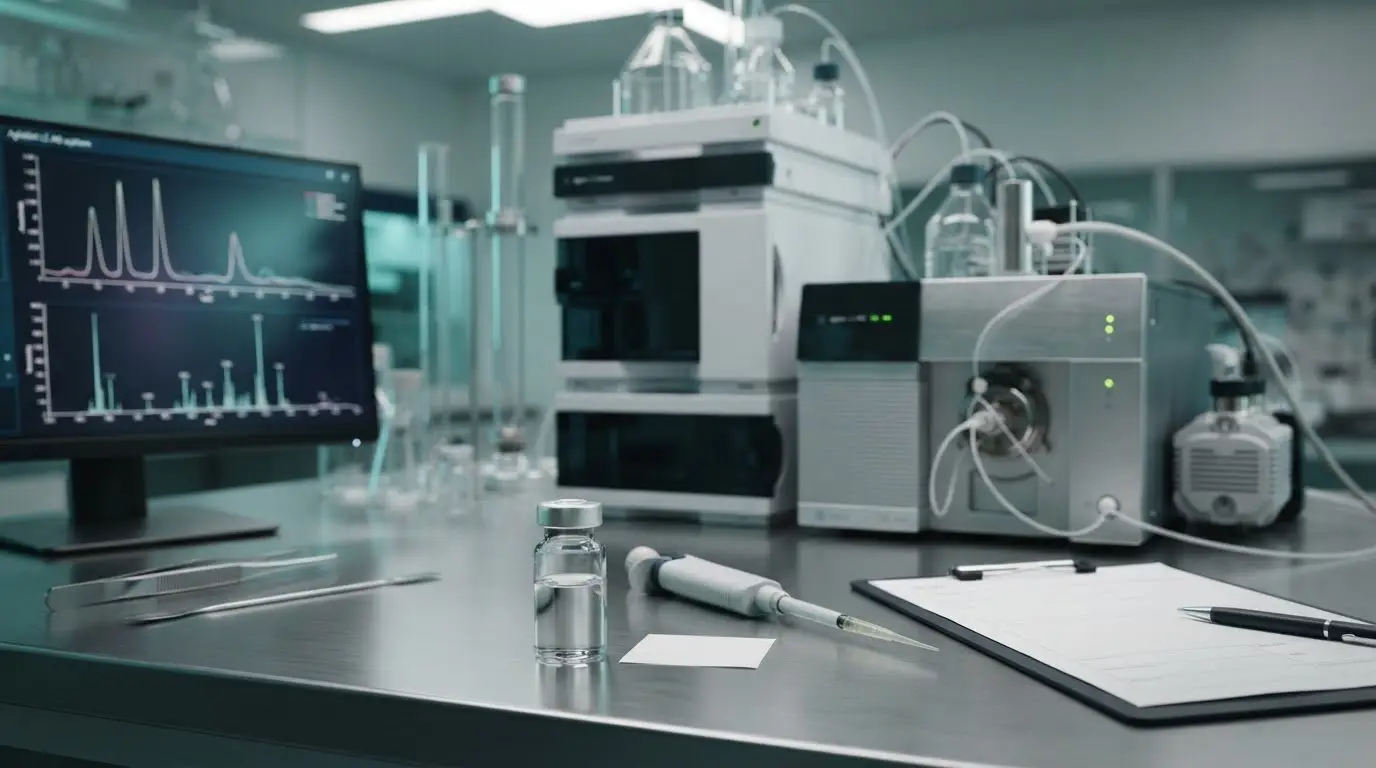
Does a peptide purity percentage prove that the vial matches the compound you ordered? Not by itself. If you’re deciding how to verify peptide purity, start by checking whether the report belongs to the exact product batch under review. A COA without a clear lot match, or a percentage without its analytical method, leaves important questions unanswered.
A purity result and an identity result answer different questions. HPLC can show the relative amount of detected peptide-related material under the stated test conditions, while mass spectrometry can help confirm molecular identity. Neither number alone tells you everything about the vial’s total contents or guarantees how a material will perform in an experiment.
This guide explains how to match a COA to a product and lot, what to look for in HPLC and mass spectrometry results, and when to ask for clarification. Solara Compounds provides batch-specific COAs and reports independent third-party testing through Kovera Labs. Use the same careful review for any supplier: research documentation supports evaluation, not experimental outcomes. Solara Compounds products are for laboratory research only, not for human or animal use, and are not drugs, medicines, or dietary supplements.
Key Takeaways
- Learn how to verify peptide purity by checking that the documentation matches the exact product and batch under review.
- Understand what HPLC and mass spectrometry can show, and why neither result should be treated as a complete account of a sample on its own.
- Use a consistent COA review sequence: confirm product identity, lot number, report date, analytical methods, and stated results.
- Separate document review from any additional analysis your laboratory may require before accepting a research material.
- Solara Compounds provides batch-specific COAs for inspection at solaracompounds.com. Products are for laboratory research only, not for human or animal use, and are not drugs, medicines, or dietary supplements.
What Does Peptide Purity Verification Actually Confirm?
A purity result is one piece of analytical evidence, not a complete description of a peptide sample. It estimates how much of the detected material corresponds to the target under the stated test method and conditions. That estimate is useful, but it doesn’t automatically confirm molecular identity, total quantity, or whether the report belongs to the batch a laboratory received.
Think of the review as four separate questions: Is the target material prominent among the detected components? Is its molecular evidence consistent with the intended peptide? How much material is present? And can the documentation be traced to the specific lot? A COA may address some of these questions, but check which results and methods it actually reports.
Purity, identity, and content are not interchangeable
A chromatographic purity percentage often reflects the relative signal assigned to the target peak compared with other detected peaks. High-performance liquid chromatography (HPLC) separates components so they can be measured and compared. The percentage is therefore method-dependent: it describes the detected components under those test conditions, not necessarily the target peptide as a fraction of everything in the vial by mass.
Identity testing asks a different question: does the measured molecular evidence align with the expected peptide? Mass spectrometry can support that assessment by measuring molecular mass. Quantity or content requires suitable quantitative evidence; an HPLC percentage alone doesn’t establish how much peptide is present in the sample. Keep the result tied to what the method actually measured.
Why batch-level documentation matters
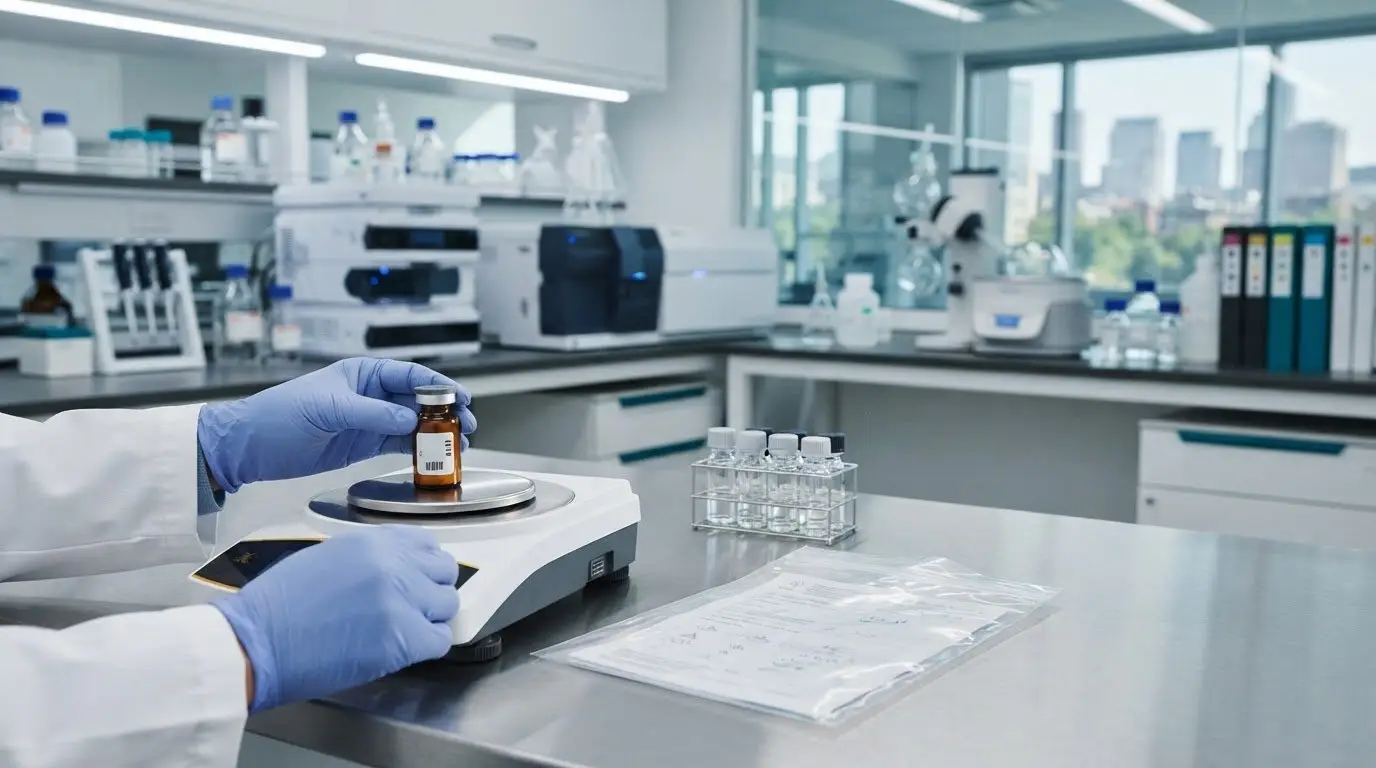
A lot number connects a report to a defined production batch. To understand how to verify peptide purity, first check that the product name and lot identifier on the COA match the label on the material under review. A general product-page purity statement may describe a supplier’s overall claim, but it doesn’t establish that a particular report applies to a particular lot.
If the lot number is absent, differs from the label, or appears in a format you can’t reconcile, pause and request clarification before procurement. The same applies when a report names a different product or doesn’t identify the test method. A clear match makes the paperwork more relevant to your review; it doesn’t guarantee experimental outcomes.
For example, a researcher can use the KPV product page to confirm the product name, then check that the batch documentation corresponds to the specific lot being evaluated. Solara Compounds states that batch-specific COAs are available through solaracompounds.com. Review the actual report rather than relying on a general claim.
COA data supports laboratory evaluation, but it can’t predict experimental results. Solara Compounds products are for laboratory research only, not for human or animal use, and are not drugs, medicines, or dietary supplements.
How HPLC and Mass Spectrometry Contribute Different Evidence
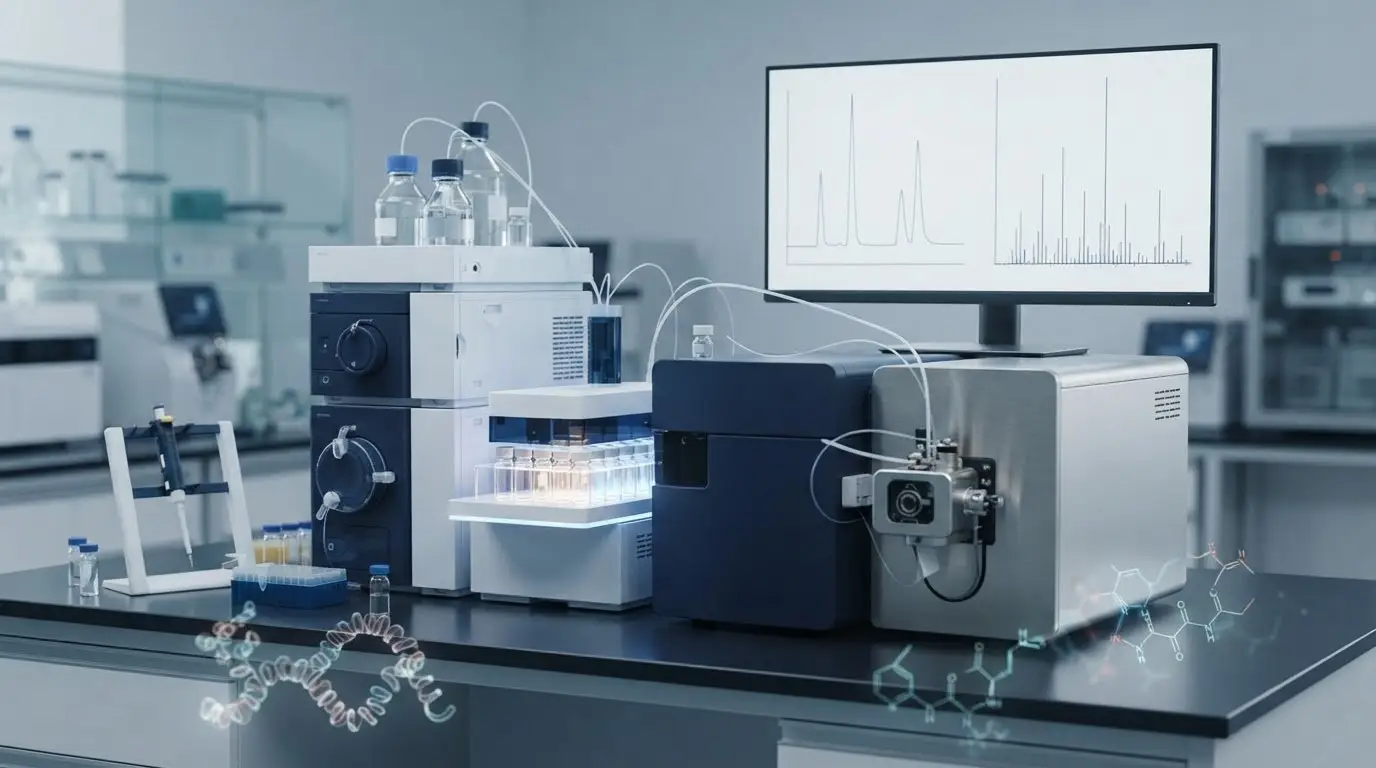
HPLC and mass spectrometry are useful because they address different analytical questions. HPLC separates components in a sample so a laboratory can review the resulting chromatogram, a graph showing detector signals over time. Mass spectrometry measures the mass-to-charge behavior of detected molecules, providing evidence that can support a molecular identity assessment.
Chromatographic purity describes the relative signal assigned to a component; molecular identity evidence assesses whether the measured mass is consistent with the intended peptide. Together, these methods provide complementary information. Neither one, on its own, establishes every attribute of a sample.
What to look for in an HPLC result
Check whether the COA names the analytical method and provides a readable chromatogram or a clear result summary. The chromatogram’s peaks represent detected components, while peak area reporting compares the detector response associated with those peaks. A stated area percentage is not automatically an absolute measurement of peptide mass or total sample content.
Interpret the result in context. The method, detector response, and information shown in the report affect what can reasonably be concluded. If the COA gives a percentage but omits the method or supporting result details, ask what the reported value represents before relying on it.
What MALDI-TOF or LC-MS can support
MALDI-TOF and LC-MS can provide molecular-mass evidence that helps researchers assess whether a detected molecule is consistent with the expected peptide. A mass match supports identity review, but it doesn’t by itself establish chromatographic purity, total quantity, batch traceability, or every other sample attribute. Review the method and reported result rather than treating a mass value as a complete quality assessment.
For a practical comparison, check whether a report lets you answer two separate questions: what components were separated and reported, and whether molecular mass is consistent with the target? If either result is unclear, request clarification. Additional analysis may be appropriate if a laboratory’s own requirements call for evidence beyond the available report.
Solara Compounds states that it uses HPLC purification and molecular confirmation by MALDI-TOF and LC-MS, with independent third-party testing through Kovera Labs. Buyers should review the documentation for the specific batch rather than assume that a general method statement describes every report detail. The research peptide catalog is a starting point for reviewing available materials and their documentation. Products are for laboratory research only, not for human or animal use, and are not drugs, medicines, or dietary supplements.
How to Read a Peptide COA Without Overreading Its Claims
A Certificate of Analysis (COA) is useful only when its details apply to the material being evaluated and its results are understood within the scope of the stated tests. To assess how to verify peptide purity, review the report in a consistent order rather than starting and stopping at the percentage.
Match the COA to the product and lot
Check these fields against the product and batch under consideration:
- Product identity: Does the report name the intended peptide or material?
- Lot number: Does its identifier match the label or batch record exactly?
- Report date: Is a date provided so the timing of the analysis is clear?
- Testing source: Does the COA identify who performed the analysis?
- Methods and results: Are the analytical methods and their stated findings clear?
A mismatch matters. A report for the same product name but a different lot doesn’t establish results for the lot being reviewed. If the identifier is missing, unclear, or inconsistent, request clarification rather than assuming the documents match. The same applies if the report doesn’t make clear what material was tested or which method supports a result.
Read the purity figure in context
Look at how the COA labels its purity value and which method supports it. A chromatographic percentage describes the result of that method; it is not, on its own, proof of molecular identity, total peptide quantity, or suitability for a particular research application. Consider the result alongside any identity evidence and the report’s stated scope.
Also distinguish supplier documentation from independent third-party results. A supplier-issued document and a report from an independent laboratory are different evidence sources. Check whether the COA identifies the testing laboratory, and describe evidence accurately rather than calling a result independently verified if the report doesn’t support that description.
A COA provides evidence for informed review, not a guarantee of experimental outcomes. It reports defined findings for tested material under stated conditions; it can’t establish how that material will perform in a particular experiment.
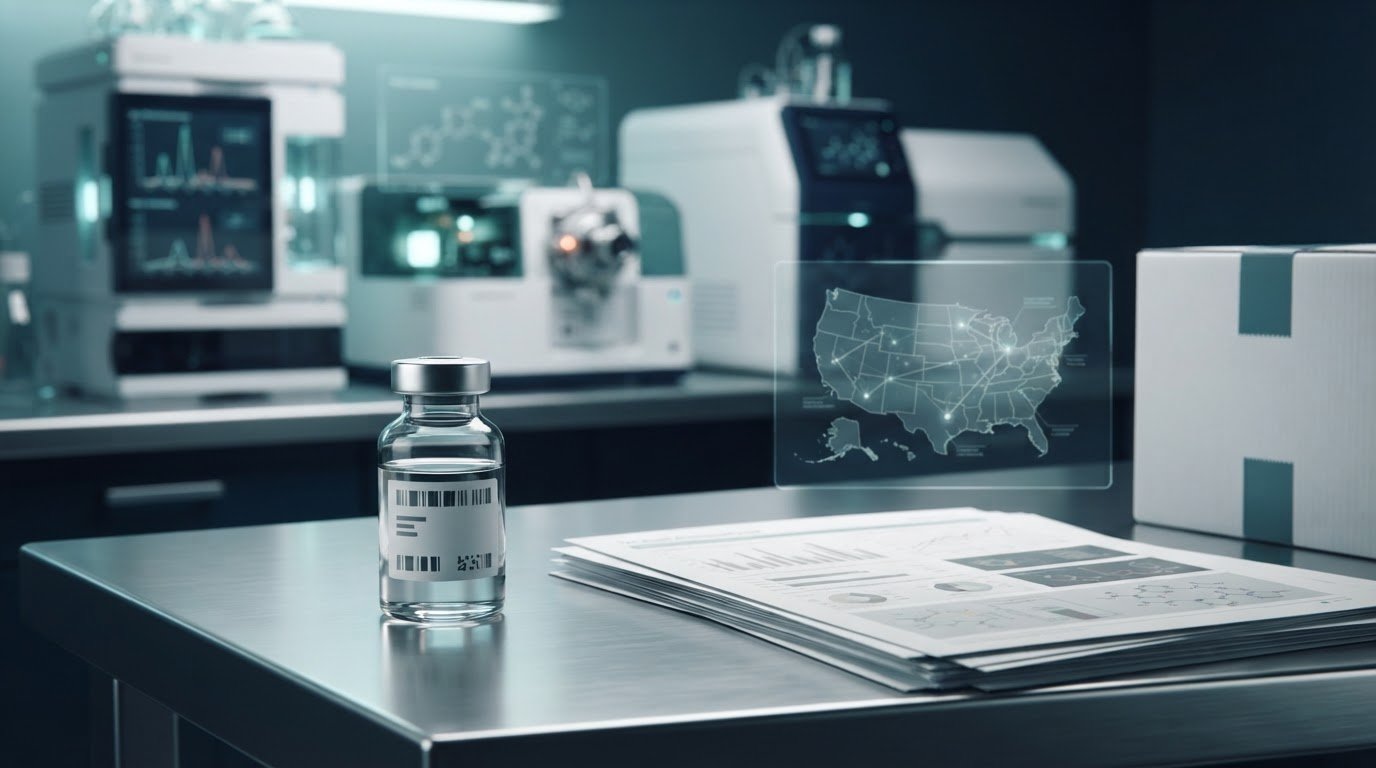
Solara Compounds states that batch-specific COA records are available online. Buyers can review the Solara batch COA records and check that the product and lot match the material under consideration. Treat any missing or unclear detail as a question to resolve before procurement. Solara Compounds products are for laboratory research only, not for human or animal use, and are not drugs, medicines, or dietary supplements.
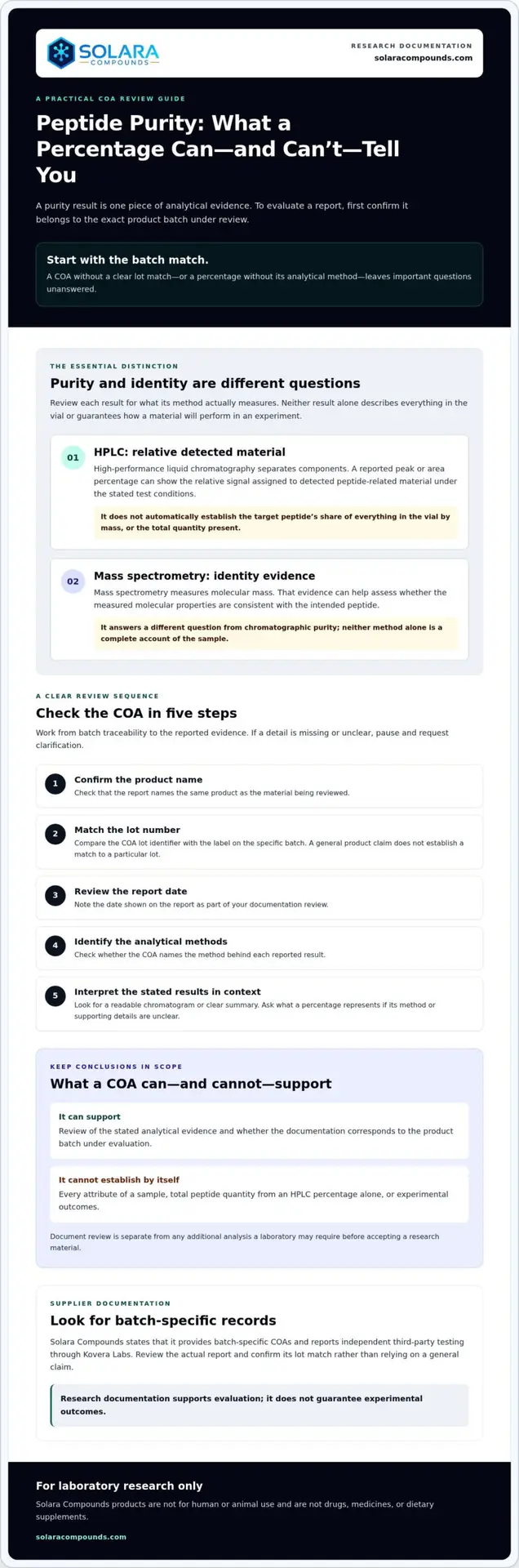
A Practical Workflow for Verifying a Peptide Batch
A repeatable review helps laboratory buyers keep product records, analytical evidence, and procurement decisions connected. The goal isn’t to infer more than a document shows. It’s to establish what batch the report refers to, what the report supports, and what still needs follow-up.
Use a repeatable document-review sequence
- Identify the intended material. Record the exact product name and the lot identifier shown on the item or batch record. Don’t rely on a similar name alone.
- Locate the matching documentation. Confirm that the COA identifies the same product and lot. If either detail is missing or inconsistent, mark the match as unresolved.
- Review the report details. Note the report date, analytical methods, testing source, and stated results. Check that the findings are presented clearly enough to understand what was assessed.
- Record open questions. Write down anything the report doesn’t establish, such as an unclear method or an unspecified result scope.
- Keep the record together. Retain the reviewed report with the procurement documentation for the batch considered, so the basis for the review remains traceable.
This sequence offers a practical answer to how to verify peptide purity at the document-review stage. For instance, a product page can identify the material being described, but it shouldn’t be treated as a substitute for checking batch-specific records. The KPV 10 mg product page can serve as a product-level reference; confirm its live details and review the relevant batch documentation separately.
Know when documentation leaves questions open
An incomplete or unclear report is a reason to pause and ask questions, not proof by itself that a batch has a specific defect. Keep the follow-up focused: Which lot does this report cover? What method supports the stated result? What does the result include or leave outside its scope? Ask the supplier to clarify before relying on an assumption.
Document review and further analysis are separate steps. A laboratory may independently require additional analytical work based on its research needs and qualified internal procedures. A COA can support an initial evaluation, but it doesn’t replace that judgment or guarantee experimental outcomes.
For a consistent starting point, review research peptides at Solara Compounds and check the documentation for the specific batch under consideration. Products are for laboratory research only, not for human or animal use, and are not drugs, medicines, or dietary supplements.
Choosing a Documentation-First Research Peptide Supplier
A supplier’s documentation process is part of the material review. Look for a clear path from the product under consideration to a batch-specific record, with enough method information to understand what the reported results support. This gives laboratory buyers a consistent basis for comparing documentation without treating a percentage or marketing statement as a complete assessment.
Questions laboratory buyers can ask suppliers
Use direct questions and assess whether the answers are specific, documented, and consistent with the COA:
- Does the available report identify the exact product and lot being considered?
- Which analytical methods were used, and what result does each method support?
- How can the batch record be accessed, and does it match the lot identifier on the material?
- Which analyses were performed by an independent laboratory, and which are supplier-reported?
Clear answers make the evidence easier to evaluate. If a supplier can’t explain a missing lot match, an unnamed method, or the source of a result, pause and seek clarification before proceeding. For more context on evaluating peptide sourcing, consult a dedicated high-purity peptide sourcing guide.
What Solara Compounds documents for research buyers
Solara Compounds states that it assigns unique lot numbers, provides batch-specific COAs, and uses independent third-party testing through Kovera Labs. Its stated methods include HPLC purification and molecular confirmation by MALDI-TOF and LC-MS. These are company-reported practices; researchers should inspect the current documentation and confirm that the report matches the specific product and lot being evaluated.
That distinction matters. A supplier’s general description of its testing process can help buyers understand its approach, but it isn’t a substitute for reviewing the batch record. Before attributing a specific purity or identity result to any material, check the live COA for that exact batch and note what the report does and doesn’t establish.
For laboratory buyers considering how to verify peptide purity, the practical standard is traceable records, transparent methods, and answers that can be checked against the documentation. Solara Compounds products are for laboratory research only, not for human or animal use, and are not drugs, medicines, or dietary supplements.
See the current research catalog.
Make Batch Documentation Part of Your Review
Reliable peptide evaluation starts with a match: the product and lot on the documentation should correspond to the material under consideration. Then read each result for what it establishes. HPLC supports a chromatographic purity estimate, while mass spectrometry provides molecular-mass evidence that can support identity review. Neither result alone confirms total sample content or predicts experimental outcomes.
That distinction is central to how to verify peptide purity. A percentage is meaningful only in context, with its method and batch connection clear. If a lot number, test method, or report detail is missing or inconsistent, ask for clarification before relying on the record.
Solara Compounds states that it provides batch-specific COAs with lot-number traceability and identifies Kovera Labs as its independent third-party testing provider. Review the documentation for the specific batch being considered. Products are for laboratory research only, not for human or animal use, and are not drugs, medicines, or dietary supplements.
See the current research catalog and use a consistent document review for each material. Careful checks help make procurement decisions more organized and evidence-based.
Frequently Asked Questions
How can I verify peptide purity from a COA?
To verify a peptide COA, match it to the exact product and lot under review, then check the stated analytical method and result. An HPLC purity figure is one piece of evidence; it doesn’t independently confirm every attribute of the material, such as molecular identity or total content. If the product name, lot identifier, or method is missing or unclear, ask the supplier to clarify before relying on the document.
What does an HPLC purity percentage mean for a peptide?
An HPLC purity percentage generally describes a chromatographic result under the method stated in the report. It reflects how the detected signal is distributed among separated components, not necessarily the total amount of target material in the sample. It also doesn’t prove molecular identity. Review the method and report scope, then consider identity evidence separately. Avoid treating any single purity threshold as universal across methods and research needs.
Can mass spectrometry confirm peptide purity?
Mass spectrometry can provide molecular-mass evidence that supports assessment of whether a detected molecule is consistent with the intended peptide. It isn’t interchangeable with an HPLC purity result: the methods address different analytical questions. Review the method and findings described in the report, and avoid treating a mass match as proof of every sample characteristic. A complete evaluation may require considering other documentation or analysis relevant to the laboratory’s requirements.
What should a peptide COA include?
A useful COA should let a buyer identify the tested material and connect the report to a specific batch. Review the product name, lot identifier, report date, analytical method, testing source, and stated result where provided. Report formats can vary, so an absent field doesn’t automatically establish what testing did or didn’t occur. Ask the supplier for clarification about missing details before relying on the COA in procurement review.
How do I know whether a COA matches my peptide batch?
Compare the product name and lot identifier on the COA with the specific batch being evaluated. Check that the report clearly associates its results with that material and identifies the analytical method. A matching product name alone isn’t enough if the lot differs or isn’t shown. If identifiers conflict or the relationship between report and batch is uncertain, ask the supplier to clarify before treating it as batch-specific evidence.
Does a high purity result prove a peptide is suitable for every research application?
No. A purity result is limited to the evidence and method described in its report. It doesn’t guarantee experimental outcomes or establish suitability for every research question. Researchers should evaluate the documentation against their laboratory’s requirements and keep purity, molecular identity, batch traceability, and research design distinct. A report can inform material review, but it can’t replace the judgment of qualified researchers or predict how a material will perform in an experiment.
Is third-party testing the same as a batch-specific COA?
No. Third-party testing describes who performed or supported an analysis, while a batch-specific COA documents findings associated with a particular batch. A general claim about independent testing doesn’t by itself show that a report matches the lot under review. Check the report’s product and lot identifiers, stated methods, and testing source. Compare supplier statements with current documentation, and ask for clarification if the connection isn’t clear.
Where can researchers check Solara Compounds batch documentation?
Researchers can visit the COA page and match its documentation to the exact product and lot under review. For help locating current batch records, contact Solara Compounds at support@solaracompounds.com or 1 (877) 388-9178, Monday-Friday, 8 AM-5 PM Eastern. Products are for laboratory research only, not for human or animal use, and are not drugs, medicines, or dietary supplements.