Research Articles
Cellular Repair Research Peptide: Laboratory Models, Mechanisms, and Quality Checks


What does “cellular repair” mean in a research setting? The phrase can refer to different biological questions, so a cellular repair research peptide’s laboratory context should not be confused with a predictable product outcome.
Researchers use controlled laboratory models to investigate how compounds interact with signaling pathways and cellular processes. Findings are limited to the model and methods used. This guide explains how to frame peptide research, distinguish proposed mechanisms from measured evidence, and review documentation for research materials.
Start with specifics: identify the model and methods behind a finding, then review the material’s identity, purity information, and batch records. Solara Compounds supplies laboratory research materials with lot-number traceability, batch-specific Certificates of Analysis (COAs), and third-party testing through Kovera Labs. All products are for Research Use Only (RUO), intended solely for laboratory research and not for human or animal consumption. They are not a drug, medicine, or dietary supplement. Learn more at solaracompounds.com.
Key Takeaways
- “Cellular repair” is a broad research topic. Define the specific process and question a study examines.
- Assess a cellular repair research peptide study by reviewing its model, controls, measurements, and the limits of its evidence.
- Batch records help connect research materials to reported identity and analytical data. A COA reports specified information about a particular batch.
- Solara Compounds provides batch-specific COAs, lot-number traceability, and third-party testing through Kovera Labs for research-material evaluation.
- All products are for Research Use Only (RUO), intended solely for laboratory research and not for human or animal consumption. They are not a drug, medicine, or dietary supplement.
What Does Cellular Repair Mean in Peptide Research?
Cellular repair in peptide research is a broad area of biological investigation, not a guaranteed effect of a compound. Researchers define a question, choose a laboratory model, and measure a specific endpoint. The phrase alone does not identify a pathway, assay, or expected result.
How Researchers Use the Term Cellular Repair
“Cellular repair” can refer to different processes, depending on the study. A researcher might examine cell survival under defined conditions, changes in gene activity, or cell movement in a particular model. Each question requires a suitable method and measurement. There is no single standardized cellular-repair outcome that every study tests.
A pathway is a chain of molecular signals inside a cell. Researchers may investigate whether a peptide is associated with a change in one part of that chain, then measure the change with an appropriate assay. Any result applies to the conditions and methods of that experiment. It does not establish a broad repair effect.
What a Peptide Research Question Can and Cannot Show
Peptides are short chains of amino acids, the building blocks of proteins. In controlled laboratory research, investigators can study a peptide’s interaction with cells and record a defined response. For example, an in vitro study examines cells or biological components outside a whole organism, under specified conditions. Its observations apply to that setup, including the cell type, conditions, methods, and endpoint tested.
When reviewing a finding, focus on what the study directly observed:
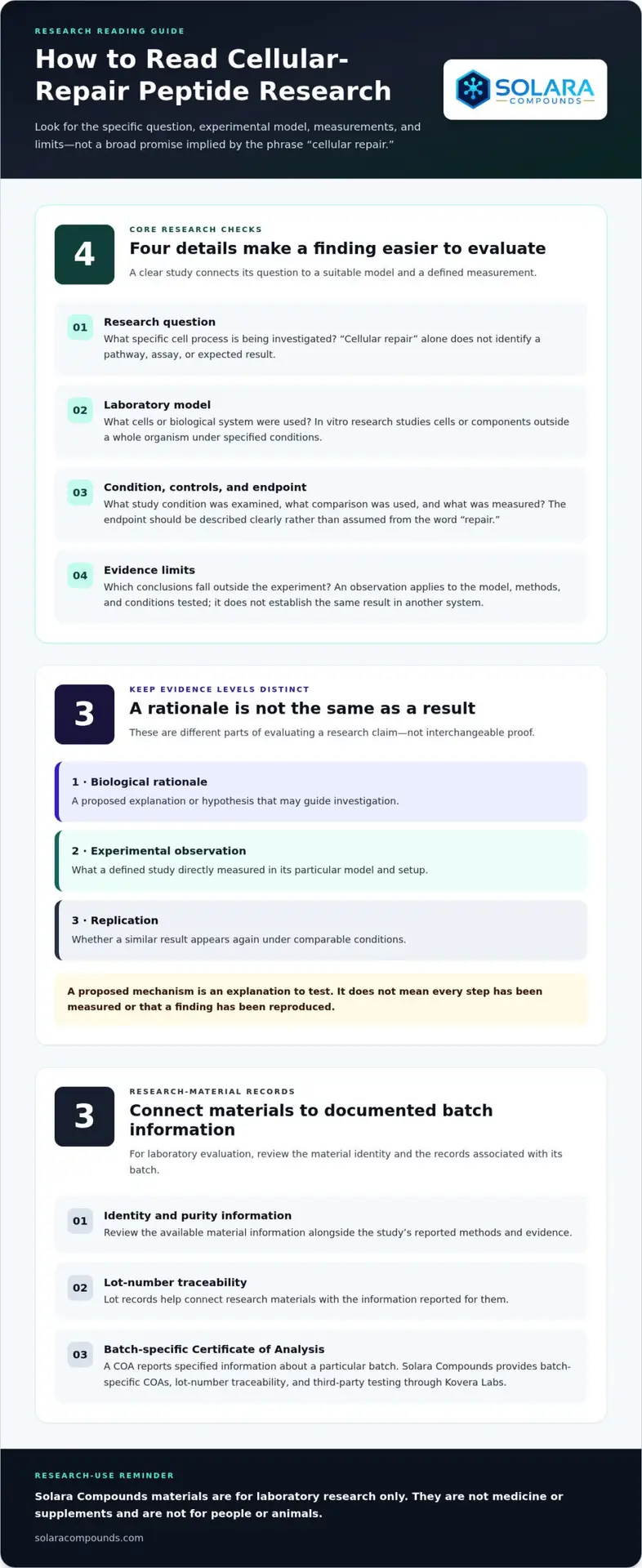
- Question: What specific cell process was under investigation?
- Model: What cells or other laboratory system were used?
- Endpoint: What was measured, and how?
- Limit: Which conclusions fall outside the scope of the experiment?
A laboratory observation does not establish the same result in a different model or demonstrate an effect in people or animals. Further research may test whether a finding can be reproduced or examined in another system, but each model answers a particular question. A KPV 10 mg product page identifies a research material; the listing itself does not demonstrate a biological result.
For lab buyers, “cellular repair research peptide” is best treated as a broad topic label. The study question, model, endpoint, and limits of the evidence provide the useful detail. All products are for Research Use Only (RUO), intended solely for laboratory research and not for human or animal consumption. They are not a drug, medicine, or dietary supplement.
How Peptide Studies Examine Cellular Processes
A well-designed peptide study connects a precise research question to a suitable model and a defined measurement. Researchers select what to investigate, choose the experimental system, apply the study condition, compare it with controls, and assess a planned endpoint. That structure helps readers distinguish what an experiment tested from broader claims attached to cellular repair.
Choosing a Laboratory Model and Measurable Endpoint
In vitro research examines cells or biological components outside a whole organism. It can help researchers investigate a focused question under controlled conditions, but the model must fit the question. A result in one cell system may not apply to another system or experimental setting.
The intervention is the condition being investigated. Controls provide a comparison and help researchers assess whether an observed difference is associated with that condition rather than another feature of the setup. The endpoint is the specific measurement used to address the research question. Look for a clear explanation of what was measured and how, rather than assuming that “repair” refers to one standard test.
Interpreting Pathways Without Overstating Findings
A pathway is a connected sequence of molecular events inside a cell. A receptor is a cellular structure that can receive a molecular signal, much like a receiver responding to a message. Harvard Health Publishing describes peptides as molecules that can orchestrate hormone activity, immune defense, tissue repair and growth. This general explanation does not establish that a particular research peptide produces a specific result in a given experiment.
A proposed mechanism is an explanation to test; an experimental result is what a defined study observed; replication asks whether that result appears again under comparable conditions. These are different levels of evidence. A pathway may be proposed to explain an observation, but that does not mean every step has been measured or that the finding has been reproduced. Avoid assigning a mechanism to a specific product without product-specific evidence.
For a cellular repair research peptide study, check whether the question, model, study condition, controls, and endpoint are clearly reported. Solara Compounds supplies research materials for laboratory use, and its research peptide catalog lists available products. Product information does not establish a study outcome.
How to Assess Cellular Repair Peptide Research and Its Limits
Evidence develops through testing. A biological rationale may suggest a hypothesis, but the hypothesis still needs to be examined. An in vitro observation describes what happened in a defined laboratory setup. Replication asks whether similar results appear when the work is repeated, while research using other model types can test whether observations hold under different conditions. Each stage adds context, but conclusions should remain within the scope of what was studied.
What Laboratory Findings Can Establish
A finding is bounded by its model, methods, controls, and measured endpoint. If an experiment measures one cellular marker, for example, it establishes an observation about that marker under the tested conditions, not a broad conclusion about cellular repair. Named pathways, proposed mechanisms, and study findings should be supported by citations to the underlying research so readers can assess what was actually measured.
Use this evidence guide to keep conclusions proportional to the data:
Hypothesis: Proposes an explanation or research question. It does not establish that the proposed effect occurs.
In vitro observation: Records a result in cells or biological components outside a whole organism. It does not establish the same result in other models.
Replication: Tests whether a finding can be observed again under comparable conditions. Differences in methods or models can still matter.
Evidence from other model types: Broadens the evidence base, but conclusions remain specific to the models and endpoints examined.
Common Interpretation Errors to Avoid
A plausible biological rationale is not proof of a specific outcome. A purity result also does not establish that a material is suitable for every experiment or that a study’s result is valid. Purity data helps characterize the material tested. It does not replace evaluation of study design or independent replication of findings.
Keep analytical and experimental evidence separate. A Certificate of Analysis reports specified information about a batch; it does not show that a biological finding has been independently reproduced or guarantee an experimental outcome. For a practical look at material documentation, review the batch COA information. Independent peptide lab testing may add material-characterization data, but it cannot substitute for replication of a research finding.
For any cellular repair research peptide claim, ask what the cited experiment directly observed, whether the finding was reproduced, and what remains unresolved.
How to Evaluate Research Peptide Materials for a Laboratory
Evaluating a material is separate from judging a study’s biological conclusions. A consistent review helps lab buyers assess the documentation for a research material without treating paperwork as proof of an experimental result.
- Define the study need: Identify the material and the documentation relevant to the planned laboratory work.
- Identify the material: Match its name and available identifiers to the research material being evaluated.
- Review batch records: Check that lot information connects the material to its documentation.
- Assess analytical data: Read the methods and reported results, and note what each can and cannot establish.
Reading a Batch-Specific COA
A Certificate of Analysis (COA) is a batch document that reports specified analytical information. Check that the lot number on the document matches the material being evaluated and that the document identifies the relevant material. A mismatch makes it difficult to connect the reported results to that batch.
Purity information describes a measured property of the tested sample. Identity data helps assess whether the sample’s molecular characteristics align with the reported material. Neither establishes suitability for every experiment or proves a biological effect. Solara Compounds provides batch-specific COA documentation for review.
Assessing Traceability and Testing Information
Analytical methods answer different questions. HPLC, or high-performance liquid chromatography, separates components in a sample and can be used to assess purity. LC-MS combines separation with mass analysis, while MALDI-TOF is a mass-spectrometry method used to examine molecular mass. Interpret each result in light of the method, sample, and data reported. Review the batch record rather than relying on a method name alone.
Solara Compounds uses solid-phase peptide synthesis in ISO 7 cleanrooms, with HPLC purification targeting greater than 98% purity minimum. Molecular confirmation uses MALDI-TOF and LC-MS. Each batch receives a unique lot number, and third-party testing is conducted through Kovera Labs. These quality details support material characterization. They do not verify a research hypothesis or guarantee an experimental outcome.
For more context on independent testing, consult the article on independent peptide lab testing alongside the batch paperwork. Solara Compounds’ research peptide sourcing information also explains its documentation approach. Review what a method measures, which lot it applies to, and what remains outside the scope of the result.
For laboratory research only. See the current research catalog.
Research Use Only Materials and the Solara Compounds Catalog
Research-material documentation helps laboratory buyers connect a sample to the analytical information reported for its batch. Solara Compounds provides lot-number traceability, supplier Certificates of Analysis (COAs), and third-party testing through Kovera Labs. These records support material review, not a predicted study outcome.
What Solara’s Research Documentation Provides
A unique lot number links a batch to its records, while a COA reports specified analytical information. Solara Compounds’ HPLC purification targets greater than 98% purity minimum. This quality information supports material characterization; it does not establish a biological effect or guarantee experimental results. Keep batch documentation distinct from evidence about a cellular repair research peptide in a particular study.
Catalog Review and Research-Only Reminder
The catalog includes BPC-157 (10 mg), TB-500 (10 mg), GHK-Cu (50 mg), and MOTS-C (10 mg) as materials for laboratory research. For questions about research materials, contact Solara Compounds at support@solaracompounds.com or 1 (877) 388-9178, Monday to Friday, 8 AM to 5 PM Eastern.
View the current research catalog.
Apply a Clear Standard to Your Research
“Cellular repair” is a broad research label, not a single measured outcome. Evaluate a cellular repair research peptide study by its question, model, controls, and endpoints, and keep conclusions within the limits of the evidence. Laboratory observations and proposed mechanisms do not establish effects in people or animals.
Material records answer a separate question: what information is available about a specific batch? Solara Compounds provides lot-number traceability and batch-specific COA documentation, with third-party testing through Kovera Labs. Its stated analytical methods include HPLC, MALDI-TOF, and LC-MS. These details support material review, not a guarantee of experimental results.
All Solara Compounds products are for Research Use Only, intended solely for laboratory research and not for human or animal consumption. Laboratory buyers in Boston, San Diego, San Francisco, New York, Houston, Miami, Los Angeles, Austin, Raleigh, Seattle, Chicago, Philadelphia, Baltimore, Dallas, Phoenix, Tampa, Atlanta, and Denver can review research materials and batch documentation at solaracompounds.com. View the current research catalog.
Frequently Asked Questions
What does cellular repair mean in laboratory research?
Cellular repair is a broad term for research into specific cell processes, not one standardized outcome. A study might focus on a defined molecular signal or a measured cellular feature, depending on its question and model. The phrase “cellular repair research peptide” does not identify what an experiment tested by itself. To interpret a claim, look for the model, methods, controls, and measured endpoint in the underlying research.
How do researchers study cellular processes with peptide research materials?
Researchers use controlled experiments to examine a defined question. They select a suitable model, apply the research material, use comparison controls, and measure a chosen endpoint. In vitro studies examine cells or biological components outside a whole organism. Researchers may also investigate pathways, which are linked molecular events inside cells. The method and endpoint should be clearly reported so readers can tell what was directly observed.
Can laboratory findings establish outcomes beyond the tested model?
No. A laboratory result is limited to the model, methods, controls, and endpoint used in that experiment. An in vitro observation does not establish that the same finding occurs in another model or in people or animals. Replication and research using other model types can add evidence, but conclusions should remain tied to what those studies actually measured. A proposed mechanism is not the same as a demonstrated or replicated result.
What does a batch-specific Certificate of Analysis show?
A batch-specific Certificate of Analysis (COA) reports specified analytical information about an identified batch. Depending on the tests reported, it may provide data used to assess material identity or purity. Check that the COA’s lot number and material details match the batch being evaluated. A COA supports material characterization and traceability, but it does not establish a biological effect, validate a study design, or guarantee an experimental result.
Does a purity result confirm a peptide’s identity?
No. A purity result and identity data address different questions. Purity information describes a measured property of the tested sample, while identity testing assesses whether molecular characteristics align with the stated material. Review the analytical methods and results rather than relying on a purity figure alone. Neither type of information establishes suitability for every experiment or demonstrates what a research study will find.
Why should laboratory buyers review lot-number traceability?
Lot-number traceability connects a research material to its batch-level records, helping laboratory buyers match the material under evaluation with the relevant COA and analytical data. Solara Compounds assigns a unique lot number to each batch and provides batch-specific documentation. Checking this link supports clear recordkeeping and material review. It does not replace evaluation of experimental evidence or guarantee consistent study outcomes.
Are Solara Compounds products intended for human or animal consumption?
No. Solara Compounds products are intended solely for laboratory research, including for laboratory buyers in Boston, San Diego, San Francisco, New York, Houston, Miami, Los Angeles, Austin, Raleigh, Seattle, Chicago, Philadelphia, Baltimore, Dallas, Phoenix, Tampa, Atlanta, and Denver. They are not for human or animal consumption, and are not a drug, medicine, or dietary supplement. See solaracompounds.com for research materials.