Research Articles
BPC-157 Stability in Solution: A Laboratory Research Guide


A high-purity result can still leave the key question unanswered: what happens after BPC-157 enters solution? BPC-157 stability in solution depends on the conditions tested, and a purity measurement from one point in time doesn’t establish how a sample changes during storage.
That distinction matters to researchers who need repeatable laboratory conditions. Assessing stability calls for evidence tied to details such as temperature, solution composition, light exposure, storage duration, and the analytical method used to measure change. Findings about a lyophilized powder also shouldn’t be treated as evidence about a prepared solution.
This guide explains how to separate established findings from assumptions, identify the conditions and time points a useful stability study should report, and interpret batch paperwork responsibly. Solara Compounds provides BPC-157 (10 mg) with batch-specific documentation, but a Certificate of Analysis supports assessment of identity and purity, not solution stability over time. Products are for laboratory research only and are not for human or animal consumption. Learn more at solaracompounds.com.
Key Takeaways
- BPC-157 stability in solution is a question about measured change under specified conditions, not just the starting material’s identity or purity.
- Temperature, pH, light, oxygen, concentration, and container contact are variables researchers may need to assess; don’t assume an effect without relevant evidence.
- Compare stability claims by sample state, tested conditions, analytical method, and time points before drawing conclusions.
- Keep evidence about lyophilized material separate from data on solutions, and treat general peptide guidance as distinct from BPC-157-specific findings.
- Use lot traceability and a batch-specific COA to review product documentation, while recognizing that these records don’t establish solution stability. Products are for laboratory research only, not for human or animal consumption.
What BPC-157 Stability in Solution Means for Laboratory Research
Stability describes the measured retention of relevant properties under specified conditions over time. For laboratory research, BPC-157 stability in solution is therefore not a single fixed shelf-life figure. It is a question about what was measured, in which formulation, under what conditions, and across what interval.
The starting material’s identity and purity are separate questions. A sample may be identified as BPC-157 and show a particular purity result at the time it was tested. That information alone doesn’t show whether its properties remain consistent after it is in solution. Results from lyophilized material, which is freeze-dried, also shouldn’t be assumed to describe a solution.
What does stability in solution measure?
Researchers assess changes in defined chemical or analytical characteristics using a stated method at specified time points. Degradation means a measurable change in the compound or its analytical profile. To interpret a reported result, readers need to know the sample state, formulation, storage environment, measurement method, and testing intervals. Without direct BPC-157 solution data and those details, a stability claim should be treated as unverified for that set of conditions.
The available information for this guide doesn’t establish a universal lifespan for BPC-157 in solution. A result from one tested formulation or environment can’t automatically be applied to another.
Why a purity result is not a stability result
An initial HPLC purity result describes the sample analyzed at a particular point. HPLC, or high-performance liquid chromatography, is a method that separates components in a sample so they can be measured. Unless the same relevant characteristics are assessed over time under documented conditions, that result doesn’t show how the sample changes during storage.
A batch-specific Certificate of Analysis (COA) may report identity and purity, but it isn’t necessarily a time-based stability study. Batch quality documentation describes what was tested in a batch; solution stability evidence shows how measured properties changed, or remained consistent, under specified conditions over time.
Solara Compounds provides BPC-157 (10 mg) as a lyophilized research peptide with lot traceability and batch-specific COA documentation. That paperwork supports review of batch information, not a claim about solution stability. For a high-level overview of the compound, see BPC-157.
Products are for laboratory research only and are not for human or animal consumption. Visit solaracompounds.com for research information.
Which Conditions Can Influence BPC-157 Stability in Solution?
A stability result applies to the conditions actually tested. For BPC-157 stability in solution, temperature, pH, light exposure, oxygen exposure, concentration, and contact with the container are all variables researchers may need to investigate. Naming a variable doesn’t prove it affects BPC-157; compound-specific effects and numeric ranges require direct evidence.
Environmental and formulation variables to report
A useful report describes the solution environment and formulation clearly enough for readers to understand what the findings cover. That includes the sample’s state and concentration, solution composition and pH, temperature, light conditions, and whether oxygen exposure was controlled or assessed. These are study-design details, not universal handling recommendations.
The FDA analysis of BPC-157 stability discusses chemical properties and a specific storage condition. Interpret that condition in the context of the sample state and evidence described in the document. A finding about material stored below a stated temperature does not, by itself, establish how a solution behaves under that condition. It also shouldn’t be used to infer a solution lifespan.
Controlled study conditions should be distinguished from general laboratory assumptions. For example, a general expectation about light or oxygen sensitivity isn’t a confirmed BPC-157-specific finding unless a relevant source supports it. Verify any reported BPC-157 effect or numeric range against primary evidence, including the formulation tested and how the measurement was made.
Container contact and measurement conditions
Container material and surface contact may also merit evaluation, depending on the research question. A study’s report should identify relevant container details rather than assume that results transfer unchanged between different materials or setups. Concentration and solution composition matter as context too, since they define the sample being assessed.
Interpretation also depends on how and when samples were measured. The analytical method determines which characteristics can be observed, while sampling time points show when any change was assessed. Without both, a reported difference may be difficult to compare or reproduce.
Stability findings are meaningful only alongside their tested conditions and method. A temperature or pH value without the sample state, formulation, analytical approach, and measurement interval is incomplete evidence, not a practical stability rule.
Solara Compounds’ research catalog includes BPC-157 (10 mg) as a lyophilized research peptide; batch documentation does not substitute for a solution stability study. See the research peptide catalog. Products are for laboratory research only and not for human or animal consumption.
How to Compare BPC-157 Stability Claims Without Assuming a Shelf Life
Stability claims are comparable only when they describe similar samples and measurements. Before applying a reported result to laboratory research, identify whether it concerns BPC-157 in solution, lyophilized material, or general peptide handling. Those are different evidence categories, not interchangeable estimates of a solution’s lifespan.
For compound background, the BPC-157 Chemical and Physical Properties entry provides chemical and physical information. A properties record can inform scientific context, but it isn’t automatically a time-course study of a specific solution. For a compound-specific stability claim, prioritize primary data over summaries that don’t identify their source.
What evidence makes a stability claim interpretable?
Look for the tested material and formulation, the conditions it experienced, the analytical method, and the observation interval. A result from one formulation shouldn’t be converted into a universal rule for other solutions. If any of these details are missing, mark the limitation rather than filling the gap with an assumption.
| Claim type | Sample state | Conditions, method, and time points to identify |
|---|---|---|
| Direct BPC-157 solution data | Solution | Formulation and tested environment; analytical method and measurement intervals |
| Lyophilized-material data | Freeze-dried material | Storage conditions; method and time points. Don’t treat this as solution evidence. |
| General peptide guidance | May vary or be unspecified | Check whether the source directly studied BPC-157 and reports a method and interval. |
| Supplier COA | Specific batch as tested | Review the reported identity and purity tests; a COA may not track change over time. |
How to read a COA alongside stability information
A batch-level Certificate of Analysis (COA) helps a laboratory buyer review the identity and purity results reported for a particular batch. It answers a different question from a stability study, which examines measured properties over time under specified conditions. A COA alone doesn’t establish solution shelf life or predict experimental performance.
No single solution duration follows from a purity result alone. Solara Compounds provides batch-specific COA documentation for batch-level review; it should be interpreted as product documentation, not a solution stability certification.
A Researcher’s Framework for Evaluating Solution Stability Evidence
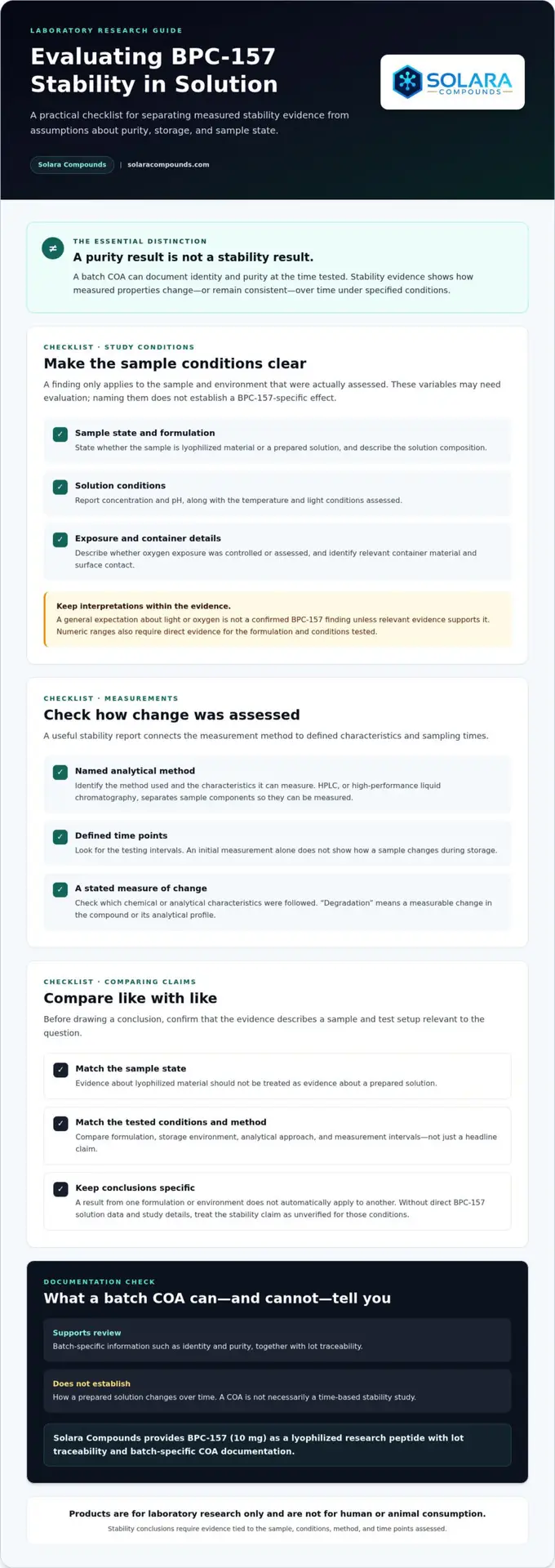
A careful review starts with the question the evidence is meant to answer. For BPC-157 stability in solution, researchers need to determine whether a source actually tested BPC-157 in solution, under conditions relevant to the question, and measured change over time. A broad statement about peptide stability isn’t a substitute for those details.
A stepwise evidence review
- Define the question. Identify which property or analytical characteristic the study evaluates and what kind of change matters to the research question.
- Confirm the sample state. Check that the material was BPC-157 in solution. Evidence on lyophilized material or other peptides doesn’t directly answer a solution-specific question.
- Inspect the conditions. Look for reported formulation and storage environment, including relevant temperature, pH, light, and oxygen conditions. Don’t treat unreported details as known.
- Review the method and interval. Identify the analytical method, measured outputs, and observation time points. Consider whether those measurements can support the claim being made.
- Assess the limits. Note what the study didn’t test, then avoid extending its result beyond the sample, conditions, and interval described.
If a source leaves a detail out, record it as unknown rather than estimating it. This framework is for evaluating published evidence, not for preparing or administering a solution.
What to document for reproducible interpretation
For a clear comparison, capture the source and its study type alongside the sample state, formulation, conditions, analytical method, time points, and reported results. Separate observed measurements from the authors’ interpretation. A measured change is a result; a proposed explanation or general recommendation is a separate claim that needs its own support.
Apply the same distinction to supplier language. Batch paperwork may describe identity or purity testing, while a stability study evaluates measured properties over time under defined conditions. Neither should be presented as evidence for the other. Keeping the source, measurements, and limitations together makes it easier for research teams to judge whether a claim applies to their question.
Solara Compounds supplies BPC-157 (10 mg) as a lyophilized research peptide with lot traceability and batch-specific documentation. This information supports batch review, not a claim about solution stability. Review the current research catalog.
BPC-157 (10 mg) Documentation and Responsible Research-Only Next Steps
Published stability evidence and supplier paperwork serve different purposes. For lab buyers reviewing BPC-157 stability in solution, batch documents can help identify and assess the supplied material, while a study of peptide integrity must report measured changes under defined conditions over time. One type of evidence shouldn’t be used as a substitute for the other.
What Solara Compounds documentation can and cannot establish
Solara Compounds provides BPC-157 (10 mg) as a lyophilized research peptide. Each batch receives a unique lot number for traceability, and batch-specific Certificates of Analysis (COAs) are available for review. The company also describes third-party testing through Kovera Labs.
A COA can help a researcher review the identity and purity results documented for a particular batch. It doesn’t, by itself, establish how a sample’s properties change after entering solution, demonstrate a solution shelf life, or guarantee experimental outcomes. Those conclusions require relevant time-based evidence that identifies the sample state, conditions, analytical method, and measurement interval.
For product-specific information, review the BPC-157 (10 mg) product details alongside the available batch COA resource. Use the lot information to connect the documentation to the relevant batch, then assess purity and identity results separately from any published stability findings. Third-party testing adds another documented quality assessment, but it isn’t a stability certification.
This distinction supports more responsible evaluation: supplier paperwork describes what was assessed for the batch, while stability evidence addresses measured change under specified conditions. If a document doesn’t report solution testing over time, treat that question as unanswered rather than inferring a result from a purity figure.
Research-only reminder and next step
All Solara Compounds products are for Research Use Only (RUO), solely for laboratory research, and not for human or animal consumption. They are not drugs, medicines, or dietary supplements.
Apply an Evidence-Led Approach to Your Research
BPC-157 stability in solution depends on the sample and conditions tested. A purity result alone can’t establish how a solution changes over time. For meaningful comparisons, review the sample state, formulation, test conditions, analytical method, and measurement intervals. Treat details missing from a source as unknown, not as grounds for estimating a shelf life.
Solara Compounds offers BPC-157 (10 mg) as a research catalog item, with lot-number traceability and batch-specific COA documentation. The company also describes third-party testing through Kovera Labs. These records support batch-level review, but they don’t establish solution stability or guarantee experimental outcomes. For assistance with research product information, contact support@solaracompounds.com, Monday-Friday, 8 AM-5 PM Eastern.
All They are not drugs, medicines, or dietary supplements. Careful documentation helps researchers make more informed, comparable evaluations. Shop research peptides.
Frequently Asked Questions
Is BPC-157 stability in solution established for one universal duration?
No. The available information doesn’t establish one universal duration for BPC-157 in solution. Stability findings depend on the sample state, formulation, tested conditions, analytical method, and observation interval. A result from one set of conditions shouldn’t be applied automatically to another. If a source gives a duration without explaining what was tested and how change was measured, treat that claim cautiously rather than as a general shelf-life rule.
Can a BPC-157 COA show how stable the compound is in solution?
Not by itself. A Certificate of Analysis (COA) typically reports batch-level test results, such as identity or purity, for the sample assessed. That information can help a laboratory buyer review a batch, but it doesn’t show how a solution changes over time unless the COA includes a relevant time-based study with conditions and methods. Don’t interpret a purity result as proof of solution stability or experimental performance.
What conditions should a BPC-157 solution stability study report?
A useful study should identify the sample state and formulation, along with tested conditions such as temperature, pH, light and oxygen exposure, concentration, and container contact where relevant. It should also describe the analytical method, the characteristics measured, and the time points assessed. These details let readers judge what the findings apply to. A listed variable is a study consideration, not proof of a BPC-157-specific effect.
How can researchers distinguish solution stability data from peptide purity data?
Check what was measured and when. Purity data describes the composition of a sample at the time of analysis. Solution stability data compares defined analytical characteristics across time under specified conditions. For example, a single HPLC purity result isn’t a time-course stability assessment. Researchers should look for the solution formulation, storage conditions, analytical method, and measurement intervals before treating a report as stability evidence.
Does lyophilized BPC-157 stability data apply to BPC-157 in solution?
Not automatically. Lyophilized material is freeze-dried, while a solution is a different sample state with its own formulation and test conditions. Findings for one state don’t establish how the other behaves. Before applying a claim, confirm which form was studied and review its conditions, method, and observation period. If the source tested only lyophilized material, it doesn’t directly answer a solution-specific stability question.
What if a stability source doesn’t report its test conditions?
Treat the missing conditions as unknown. Without details such as sample state, formulation, environment, analytical method, and measurement interval, readers can’t reliably determine what the claim covers or compare it with other evidence. Don’t fill those gaps with estimates or general peptide guidance. Record the limitation, and avoid applying the claim as a specific stability duration for laboratory research.
Is Solara Compounds’ BPC-157 (10 mg) intended for personal use?
No. Solara Compounds’ BPC-157 (10 mg) is for laboratory research only, not personal use or use in people or animals. Products are for Research Use Only (RUO), not drugs, medicines, or dietary supplements. Researchers in Boston, San Diego, San Francisco, New York, Houston, Miami, Los Angeles, Austin, Raleigh, Seattle, Chicago, Philadelphia, Baltimore, Dallas, Phoenix, Tampa, Atlanta, and Denver can review product information and batch documentation at solaracompounds.com.