Research Articles
Metabolic Research Peptides: A Laboratory Buyer’s Guide to Pathway Fit and Batch Documentation


The category label may be the least useful place to start. For metabolic research peptides, a label alone cannot tell laboratory buyers whether a material fits a specific pathway question or whether its batch documentation is sufficient for procurement review.
Product descriptions and supplier testing claims can be difficult to compare. A more reliable evaluation starts with the research question, then checks material identity and lot-specific evidence. This guide explains how to apply that sequence, including what to look for in analytical methods, Certificates of Analysis (COAs), and traceability records.
Solara Compounds serves U.S. laboratory buyers with research materials such as SOL‑3RT, SOL‑2TZ, and Cagrilintide. Its documentation includes batch-specific COAs, unique lot numbers, and third-party testing through Kovera Labs. Review these records as evidence about the material, not as a guarantee of experimental outcomes.
All products are for Research Use Only (RUO), intended solely for laboratory research and not for human or animal consumption, not a drug, medicine, or dietary supplement. The sections ahead will help researchers define pathway fit, assess batch records, and compare suppliers more systematically.
Key Takeaways
- Define the laboratory model and research question before comparing metabolic research peptides by category label.
- Separate published research about a molecule from claims about a supplier-branded product, then assess relevance to your project.
- Check exact compound identity, listed strength, lot number, and current batch documentation as distinct parts of procurement review.
- Purity and identity answer different analytical questions. Review the methods and records supporting each claim.
- Solara Compounds’ research materials are for laboratory research only, not for human or animal consumption. Review the current catalog and batch records at solaracompounds.com.
What Are Metabolic Research Peptides in Laboratory Research?
Metabolic research peptides is a broad label for research materials considered in laboratory studies of metabolism and related signaling. It is not a single compound or a standardized product class. The label can help researchers organize a catalog, but it does not establish that a material fits a study, supports a hypothesis, or comes with sufficient documentation.
In brief, metabolic research peptides are peptide-based materials considered for laboratory investigation of processes involved in cellular energy management and related signals. They are distinct from products intended for personal use. Peptides are molecules made from amino acid chains; peptides are short chains of amino acids, though their length and structure can vary.
What does “metabolic” mean in a research context?
Metabolism describes connected processes cells use to manage energy and carry out other essential chemical activity. Researchers may examine how molecular signals interact with those processes. A pathway is a sequence of related cellular events; a receptor is a structure on or within a cell that receives a molecular signal and helps trigger a response. These terms describe research questions, not evidence that a catalog item will produce a particular result.
For example, a project might investigate how a signal is received or how related cellular activity changes in a defined model. The model, endpoint, and experimental conditions shape what the findings can support. A broad category name cannot establish relevance on its own.
Which materials appear in metabolic research catalogs?
Catalogs may group materials by perceived research area, but groupings vary between suppliers and do not necessarily reflect a formal scientific classification. Solara Compounds lists SOL‑3RT (10 mg, 20 mg, and 30 mg), SOL‑2TZ (10 mg, 20 mg, and 30 mg), and Cagrilintide (10 mg) as research materials. Their presence in a catalog does not establish findings for Solara-branded products or determine whether a material suits a particular project. Assess the exact material and its documentation separately.
Start with the project, not the category. Identify the question the laboratory intends to examine, then evaluate whether the material’s identity and available records support procurement review. This keeps catalog language separate from experimental evidence.
Solara Compounds products are supplied solely for qualified laboratory research. They are not for human or animal consumption and are not drugs, medicines, or dietary supplements.
How Do Researchers Assess Pathway Relevance Without Overreading Claims?
A pathway label is a starting point, not a study plan. Before comparing metabolic research peptides, define the project’s model, the endpoint to be measured, and the question the experiment is designed to address. Then consider whether the proposed molecular target relates to that question and whether the material’s identity and documentation support procurement review.
How should pathway descriptions be interpreted?
Pathway relevance means a possible connection worth investigating, not proof of a predictable experimental effect. A receptor is a cell structure that receives a molecular signal. GLP-1, GIP, and glucagon receptors are distinct receptor types discussed in metabolic research literature. Check a paper’s description of their signaling against the paper itself, including the model and conditions studied.
Be precise about the evidence being described. Published research on a molecule does not automatically establish findings for a supplier-branded product, a particular production lot, or a laboratory’s own setup. A catalog description can help identify a material, but it does not replace primary literature or batch-specific identity records. Keep these evidence sources separate in research notes and purchasing discussions.
What evidence belongs in a responsible research overview?
Prioritize primary literature, such as original research reports, and record enough context to interpret each claim: the material studied, the model, the conditions, and the measured endpoint. A result from one defined model should not be presented as a general outcome. Attribute mechanistic statements, meaning claims about how a molecular signal may act, to a source and phrase them no more broadly than that source supports.
Use a clear distinction in summaries: A research hypothesis proposes a question to test; a verified finding is a result reported under the specific model and conditions studied. This helps prevent an early-stage idea from being mistaken for established evidence. Do not convert laboratory findings into claims about people or animals.
For procurement, match the literature review to the exact material under consideration, then review its product identity and lot records independently. A paper can inform pathway rationale; it cannot verify the contents of a supplier’s batch. That check belongs to the material’s documentation.
After defining the project’s question, review the research catalog to compare listed materials. All products are for laboratory research only, not for human or animal consumption.
How to Compare Metabolic Research Peptides and Supplier Documentation
Compare materials against the study requirements and records for the specific lot, not just a broad purity label. A useful review separates four questions: Does the material fit the research question? Is its identity stated precisely? Can the lot be traced? Do the records show how the reported results were assessed?
| Review area | What to check |
|---|---|
| Research fit | Does the material align with the project’s model and stated question? |
| Exact identity | Does the product record name the compound clearly and consistently? |
| Lot number | Can the material be matched to a unique lot identifier? |
| Documentation | Are methods, reported results, units, and document date provided? |
What should a batch-specific COA show?
First, match the lot number on the Certificate of Analysis (COA) to the lot being evaluated. Then review the reported identity and purity information, including units, analytical methods, and the document date. If a record omits information needed for your review, ask the supplier to clarify rather than assuming what the result means.
Solara Compounds provides batch-specific COA documentation and lot-number traceability. A COA supports material review, but it does not guarantee experimental outcomes. For broader context on independent peptide lab testing, compare the methods named in a report with the questions each method can address.
How can buyers compare analytical quality claims?
Purity and identity are different analytical questions. High-performance liquid chromatography (HPLC) separates components in a sample. Depending on the method and reporting, its output can support a purity assessment. A purity figure alone does not establish molecular identity.
Mass spectrometry helps assess identity by measuring molecular mass-related signals. LC-MS combines liquid chromatography with mass spectrometry, while MALDI-TOF is a mass spectrometry approach that can provide a molecular mass profile. What each result supports depends on the method, reference material, and report context. No single label should replace review of the actual record.
Solara Compounds describes third-party testing through Kovera Labs and lists HPLC, LC-MS, and MALDI-TOF among its quality information. Compare the available lot-specific records and methods rather than relying only on a general “high purity” claim. The products are for laboratory research only, not for human or animal consumption, and are not drugs, medicines, or dietary supplements.
What Should Laboratory Buyers Check Before Procurement?
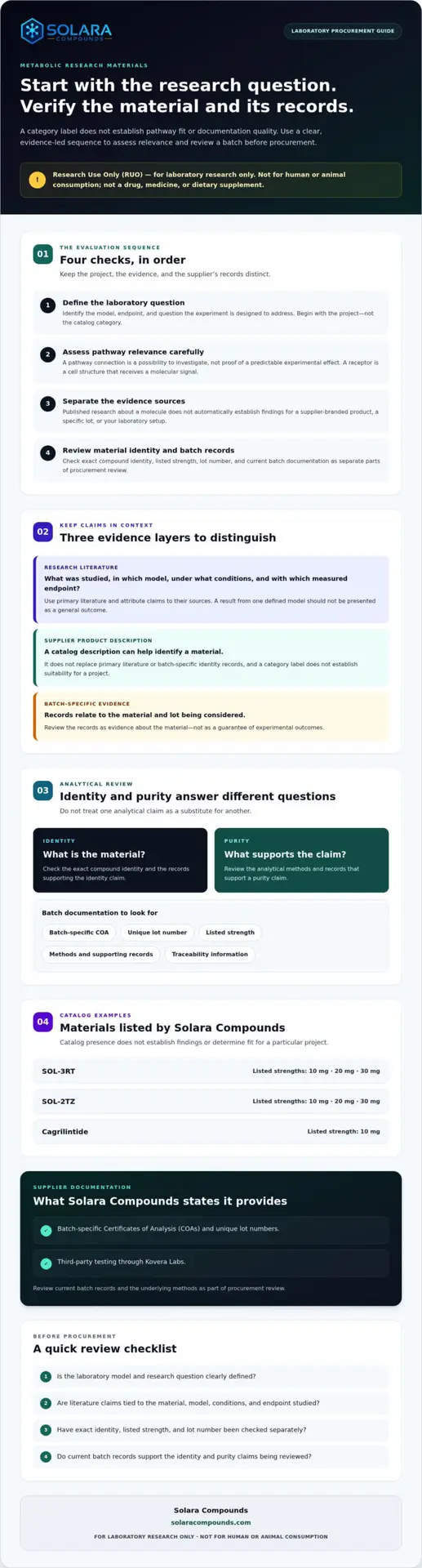
A consistent review sequence makes procurement decisions easier to explain and repeat. Use this checklist for metabolic research peptides, then apply your institution’s own purchasing and laboratory recordkeeping requirements.
- Define the research purpose. Record the question, model, and endpoint the material is intended to support. This ties the purchase rationale to the project rather than a broad catalog category.
- Confirm the exact compound name. Compare the product page name with the name on the supporting records. Do not treat similar labels as interchangeable.
- Check the listed strength. Verify that the product page and purchasing record identify the same listed strength. Do not infer details that are not stated.
- Review lot traceability. Confirm that the supplier identifies a lot number and that the number appears on the corresponding documentation.
- Review current records and supplier information. Check the COA, reported analytical methods, document date, and stated testing approach. Confirm shipping and support information on the live site before placing an order.
- Complete internal purchasing approval. Submit the research rationale and reviewed product and batch records through the institution’s established approval process.
Which supplier details should buyers verify?
Look for records tied to a specific batch, not only general quality statements. Confirm that the product page and COA refer to the same exact product and that the lot number matches. Reviewing high-purity research peptide sourcing information can help buyers understand a supplier’s stated approach, but assess claims and documentation for the particular material under review.
Verification supports an informed purchasing decision; it cannot guarantee how a material will perform in an experiment. If a record is unclear or a detail is missing, seek clarification before procurement rather than filling the gap with an assumption.
How can teams document a purchasing decision?
Keep a concise record of the research purpose, selected material, supplier, listed strength, lot number, and documents reviewed. Note when the review took place so the team can identify which product information and batch records informed the decision.
Follow institutional requirements for approval and recordkeeping. This checklist is general procurement guidance, not institution-specific approval or advice. Solara Compounds supplies research materials solely for qualified laboratory research. Its products are for laboratory research only, not for human or animal consumption, and are not drugs, medicines, or dietary supplements.
Once the project requirements are clear, see the current research catalog.
How Solara Compounds Supports Documentation-Led Metabolic Research Sourcing
For laboratory buyers, a useful supplier review connects the catalog entry to records for the material being considered. Solara Compounds serves laboratory buyers in the United States, with batch-specific Certificates of Analysis (COAs) and lot-number traceability. Its catalog includes SOL‑3RT (10 mg, 20 mg, and 30 mg), SOL‑2TZ (10 mg, 20 mg, and 30 mg), and Cagrilintide (10 mg) as research materials. Catalog inclusion alone does not establish suitability for a particular project.
What documentation can lab buyers review?
A batch-specific COA provides reported information buyers can examine, including identity and purity data where stated. Check that the lot number on the document matches the material under review, then note the analytical methods and date shown. Solara Compounds reports third-party testing through Kovera Labs.
The company’s website describes HPLC purification targeting >98% minimum purity and molecular confirmation by MALDI-TOF and LC-MS. Review these quality claims against current product and batch records. HPLC separates sample components to support purity assessment; mass spectrometry can support molecular identity assessment, depending on the method and report context. Neither a general claim nor a COA guarantees experimental outcomes.
For a product-level review, see the SOL‑3RT research product details and compare them with the current batch documentation relevant to the material being considered.
What are the next steps for an eligible research buyer?
Begin with the project’s research question, then compare the exact catalog name, listed strength, lot traceability, and current documentation. Confirm live product-page details before making a selection, since product information may change. Keep the product record and corresponding batch paperwork together as part of the laboratory’s procurement review.
Questions about catalog information or records can be directed to support@solaracompounds.com or 1 (877) 388-9178, Monday through Friday, 8 AM to 5 PM Eastern.
Research Use Only: Solara Compounds products are solely for qualified laboratory research. They are not for human or animal consumption and are not drugs, medicines, or dietary supplements. See the current research catalog.
Make Your Next Research Review Evidence-Led
Choosing metabolic research peptides starts with the laboratory question, not the catalog category. Define the model and endpoint first, then assess whether the material’s exact identity and available records fit the procurement review.
Keep two checks distinct: pathway relevance comes from appropriately scoped research evidence, while batch documentation helps assess the specific material under consideration. Review the lot number, COA, and analytical methods. Treat supplier testing claims as information to verify, not a guarantee of experimental outcomes.
Solara Compounds is a U.S. supplier serving laboratory buyers, with batch-specific COAs, unique lot-number traceability, and third-party testing through Kovera Labs. Products are for laboratory research only, not for human or animal consumption, and are not drugs, medicines, or dietary supplements.
When your research requirements are clear, view the current research catalog and review the relevant product and batch records. A careful, documented selection process gives your team a clear basis for its next procurement decision.
Frequently Asked Questions
What are metabolic research peptides?
Metabolic research peptides are peptide-based materials grouped by their relevance to laboratory questions about metabolism and related signaling. The term describes a broad research category, not one compound or a standardized product class. Treat the category as a starting point, then assess the exact material, the project’s model, and the evidence relevant to the research question. A catalog label alone does not establish that a material is suitable for a particular study.
How do researchers choose a peptide for metabolic pathway research?
Researchers begin with the project’s question, model, and measurable endpoint, then consider whether the material’s proposed pathway connection is relevant. A pathway is a series of related cellular events, while a receptor receives molecular signals. Review primary literature for the specific molecule and conditions studied, but do not treat that literature as proof about a supplier-branded product or a particular batch. Confirm exact product identity and documentation separately.
What should a COA for a research peptide include?
A useful Certificate of Analysis (COA) should let buyers connect the reported results to the material being reviewed. Check for a matching lot number, stated product identity, reported purity data and units, analytical methods, and document date. Then compare the COA with the product record for consistency. If a key detail is missing or unclear, ask the supplier for clarification. A COA supports review; it does not guarantee experimental outcomes.
How do HPLC and mass spectrometry differ in peptide analysis?
High-performance liquid chromatography (HPLC) separates components in a sample and can support purity assessment, depending on the method and reporting. Mass spectrometry measures molecular mass-related signals and can support identity assessment. LC-MS combines liquid chromatography with mass spectrometry, while MALDI-TOF is a mass spectrometry method. These approaches answer different questions, and results need to be interpreted in context. A reported purity figure alone does not establish identity.
Does third-party testing guarantee a research result?
No. Third-party testing can provide additional analytical information about a material, but it cannot predict or guarantee an experimental result. Findings depend on the research question, model, conditions, and measurement approach. Buyers should review the batch documentation, check which methods were used, and distinguish reported material data from study evidence. Solara Compounds reports third-party testing through Kovera Labs and provides batch-specific COAs for procurement review.
Are Solara Compounds products intended for human or animal consumption?
No. Solara Compounds products are supplied solely for qualified laboratory research and are not for human or animal consumption. They are not drugs, medicines, or dietary supplements. This Research Use Only status applies to catalog materials, including SOL‑3RT, SOL‑2TZ, and Cagrilintide. Buyers should keep product selection and documentation within the scope of laboratory research and follow their institution’s purchasing and recordkeeping requirements.
Where can laboratory buyers review Solara Compounds research peptides?
Laboratory buyers can review the current catalog at solaracompounds.com/shop/. Solara Compounds serves U.S. research buyers, including those in Boston, San Diego, San Francisco, New York, Houston, Miami, Los Angeles, Austin, Raleigh, Seattle, Chicago, Philadelphia, Baltimore, Dallas, Phoenix, Tampa, Atlanta, and Denver. Check live product details and relevant batch records before procurement. For questions, contact support@solaracompounds.com or call 1 (877) 388-9178, Monday through Friday, 8 AM to 5 PM Eastern.