Research Articles
Long term peptide stability testing: storage, conditions, and protocols

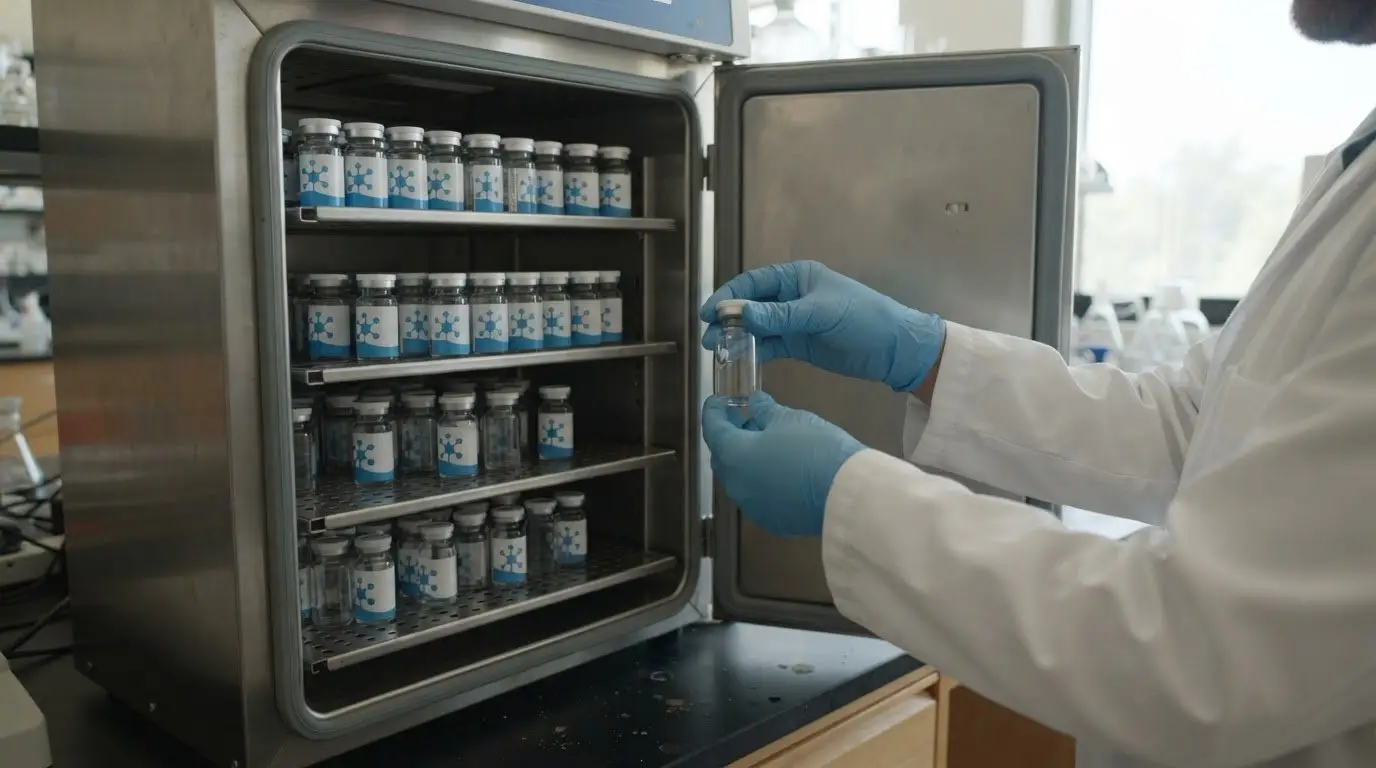
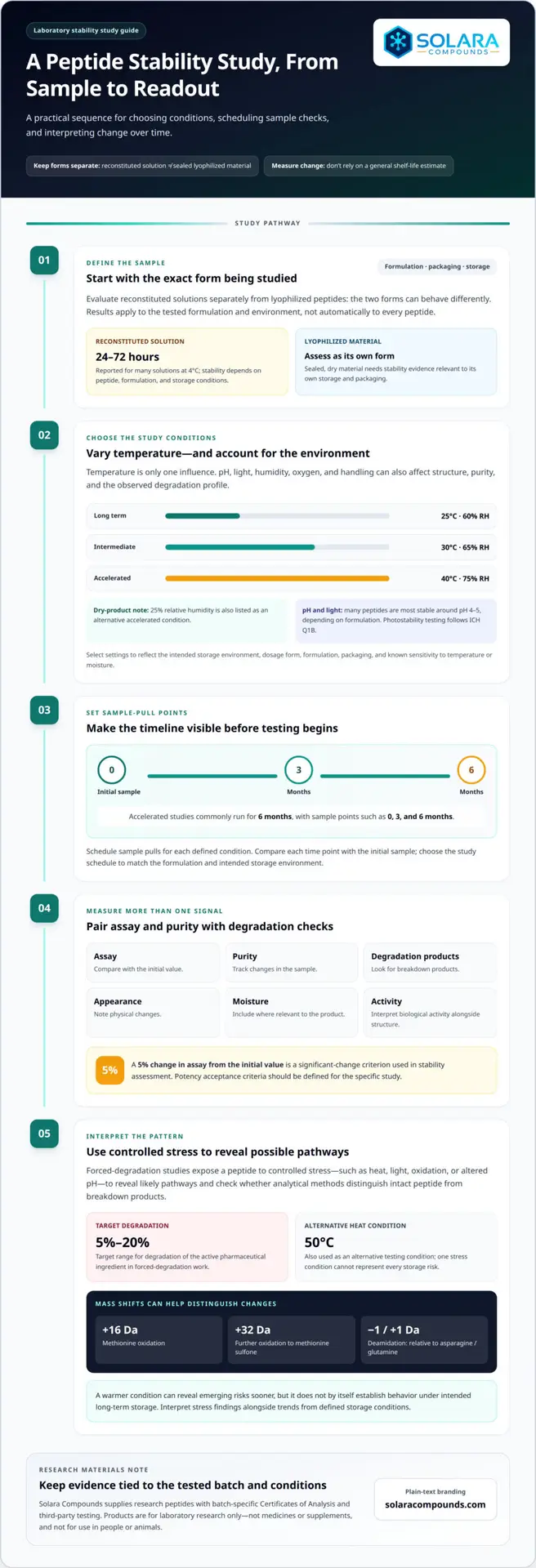
Reconstituted peptide solutions shouldn’t be assumed to remain stable for long-term storage. Many are reported to hold for 24-72 hours at 4°C, but stability depends on the peptide, formulation, and storage conditions. Long term peptide stability testing helps researchers measure those changes rather than rely on a general shelf-life estimate.
Refrigeration can slow degradation, but temperature alone does not determine stability. pH, light, moisture, and handling can also affect a peptide’s structure and purity. This guide explains how researchers assess these factors, choose testing conditions and time points, and use analytical methods to detect degradation. It also explains why reconstituted solutions must be evaluated separately from sealed, lyophilized material.
Solara Compounds supplies research peptides with batch-specific Certificates of Analysis and third-party testing. Its products are for laboratory research only; they aren’t medicines or supplements and aren’t for use in people or animals. Learn about stability testing alongside research materials at solaracompounds.com.
Key Takeaways
- Separate evidence for reconstituted solutions from stability data for lyophilized peptides; the two forms can behave differently during storage.
- Assess pH and light exposure alongside temperature, since each can influence peptide degradation and the results of a stability study.
- Use long-term, intermediate, and accelerated conditions to build a clearer picture of stability over time and identify potential risks earlier.
- Pair purity and assay measurements with methods that can detect degradation products, so changes are easier to interpret.
- Choose study conditions and sample-pull points that reflect the formulation, packaging, and intended storage environment.
Peptide degradation pathways
Peptide degradation changes a molecule’s structure, purity, or measured activity during storage. A single pathway may produce several related impurities, while different pathways can occur together. For example, a study can track a defined sample, such as a KPV peptide, under its intended storage conditions. Results apply to the tested formulation and environment, not automatically to every peptide.
Hydrolysis breaks chemical bonds through reaction with water, while oxidation alters susceptible amino acid side chains. Deamidation changes asparagine or glutamine residues. Other degradation pathways include aggregation, physical instability, and changes in measured biological activity. Aggregation occurs when peptide molecules associate into larger assemblies. Physical changes can also affect appearance or solubility, so a purity assay alone may not capture every relevant change.
Mass measurements can help distinguish specific chemical changes. Methionine oxidation adds 16 Da to a peptide’s mass; further oxidation to methionine sulfone adds 32 Da. Deamidation produces a net change of −1 Da relative to asparagine, or +1 Da relative to glutamine. These shifts give researchers clues about which degradation pathway may be active, especially when they compare stressed samples with an initial sample.
Temperature can accelerate storage degradation. As a practical estimate, many peptide degradation reactions roughly double or triple for each 10°C increase in temperature. This is a general relationship, not a fixed prediction for every molecule. The rate depends on the peptide and its environment. A warmer condition can therefore reveal emerging risks sooner, but it cannot by itself establish how a sample will behave under intended long-term storage.
Forced-degradation studies deliberately expose a peptide to stress, such as heat, light, oxidation, or altered pH. Their purpose is to reveal likely degradation pathways and show whether analytical methods can distinguish the intact peptide from its breakdown products. Stress should be controlled: the target is between 5% and 20% degradation of the active pharmaceutical ingredient. Excessive breakdown can obscure useful information about early degradation.
Temperature is one possible forced-degradation stress. A temperature of 50°C is also used as an alternative testing condition. Researchers compare stressed and unstressed samples to identify changes, then use the observed impurity pattern to guide further testing. The chosen stress matters: heat may accelerate one reaction, while light or oxidation may expose another. A single condition cannot represent every storage risk.
Interpret results in relation to the sample’s intended role in a laboratory study. Researchers can assess potency, purity, degradation products, and biological activity together, since a structural change may affect each measure differently. Forced degradation maps potential failure pathways, while long-term peptide stability testing tracks changes under defined storage conditions. Together, these studies help distinguish stress-related findings from trends under the intended storage environment.
Stability testing under varied pH and light conditions
A 5% change in assay from the initial value is a significant-change criterion used in stability assessment. Potency acceptance criteria should be defined for the specific study, with assay results interpreted alongside formulation and storage conditions.
Effects of pH and Environmental Conditions
Environmental conditions are the chemical and physical surroundings that influence a peptide molecule’s stability. Many peptides are most stable in slightly acidic conditions, around pH 4-5, but formulation affects the response. Temperature can accelerate degradation, while light can trigger photochemical changes. Humidity may affect moisture-sensitive material, and oxygen can promote oxidation. These factors matter because a sample’s degradation profile depends on the conditions tested.
Light exposure needs its own evaluation. Photostability testing for peptides follows ICH Q1B, which assesses changes under controlled light exposure. Oxygen deserves attention too: oxidation can alter susceptible residues, creating degradation products that differ from the intact molecule. Researchers can compare protected and exposed samples to distinguish light-related changes from other effects. Separating these influences helps explain why a formulation may behave differently across storage conditions.
Storage and Study Conditions
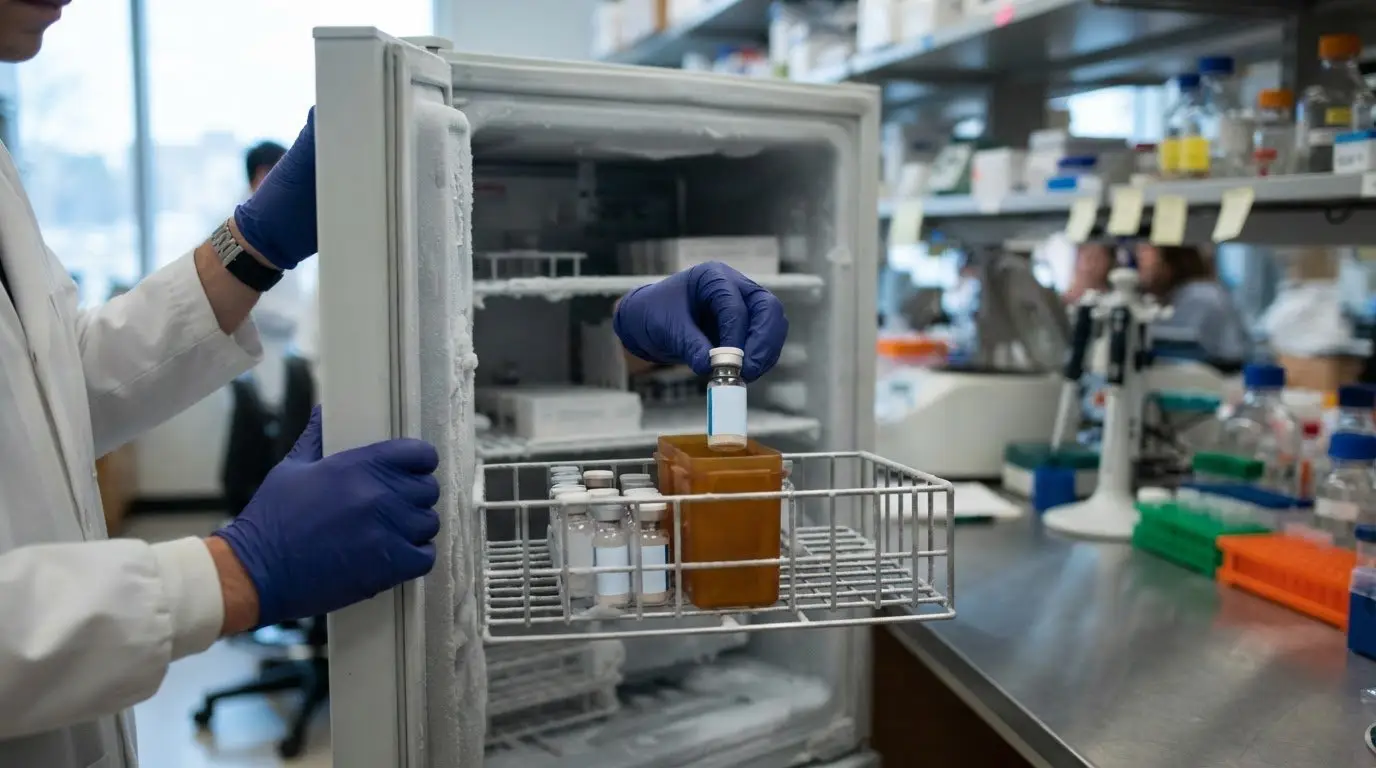
Storage and study conditions are defined temperature and humidity settings used to track change over time. They matter because results apply to the formulation and environment evaluated. Lyophilized research peptides stored at −20°C commonly have a stated shelf life of 2-5 years in original sealed vials. At 4°C, typical shelf life is described as months; at −80°C, years to decades.
For long-term studies, a common condition is 25°C with 60% relative humidity. Intermediate testing uses 30°C and 65% relative humidity, while accelerated testing uses 40°C and 75% relative humidity. Accelerated studies commonly run for 6 months, with sample points such as 0, 3, and 6 months. For dry products, 25% relative humidity is also listed as an alternative accelerated condition.
Study settings should reflect the intended storage environment, dosage form, formulation, packaging, and known sensitivity to temperature or moisture. Researchers evaluate samples at scheduled points, then compare assay, purity, degradation products, appearance, and moisture content. A 10% change in dissolution performance is a significant-change criterion for solid dosage forms. That measure does not replace peptide assay results, but it illustrates why acceptance criteria should match the material being studied.
pH and temperature conditions can be varied to reveal formulation differences, while ICH Q1B testing isolates light exposure. Comparing samples across these defined conditions helps distinguish environmental effects from changes linked to packaging or formulation. No single condition captures every risk. A study design that includes the relevant temperature, humidity, pH, and light exposures gives researchers a more useful basis for interpreting stability data.
ICH Q1A(R2) long-term, intermediate, and accelerated stability protocols
ICH Q1A(R2) protocols compare peptide stability across defined temperature conditions and study periods. Their value comes from interpreting accelerated results alongside intermediate and long-term data.
Accelerated Testing Purpose and Conditions
Accelerated stability testing applies elevated temperature to reveal potential changes sooner. It helps researchers compare formulations and packaging, examine degradation trends, and plan subsequent studies. Under ICH Q1A(R2), the accelerated temperature is 40°C ± 2°C. The data can support early development decisions, but it doesn’t replace evidence from longer storage studies.
Accelerated studies can provide preliminary shelf-life data in 3-6 months. Their purpose is to identify risks, not to reproduce every condition a sample may experience during storage. Forced-degradation testing has a different role: it applies deliberate stress to expose possible chemical changes and test whether analytical methods can detect them. These approaches answer related, but distinct, questions.
Comparing Stability Testing Protocols
Long-term testing measures change under intended storage conditions, while intermediate testing evaluates a less demanding condition than accelerated testing. ICH Q1A(R2) lists a long-term temperature of 25°C ± 2°C and an intermediate temperature of 30°C ± 2°C. Intermediate studies typically run for 6-12 months, depending on the stability profile.
Long-term studies at 25°C can run for 12-36 months. Accelerated studies typically run for 3-12 months, depending on stability. The shorter study can show early trends, while longer observations establish how those trends develop under intended storage. Neither timeframe should be interpreted alone when the purpose is to understand a peptide’s shelf life.
To compare the three data sets, use equivalent formulations, packaging, and analytical methods. For example, if an assay declines under accelerated conditions, researchers can look for related changes in intermediate and long-term samples. A trend found only under greater stress may have a different practical significance from one that continues under intended storage conditions.
Accelerated results can guide follow-up studies: researchers may compare packaging, select formulations for further evaluation, and refine sample assessments. Long-term peptide stability testing is still needed to observe the material over its intended storage period. The combined evidence is more informative than treating accelerated results as a direct prediction of shelf life.
Researchers selecting materials for laboratory studies can explore the research peptide catalog alongside these study-design considerations.
Stability-indicating analytical methods
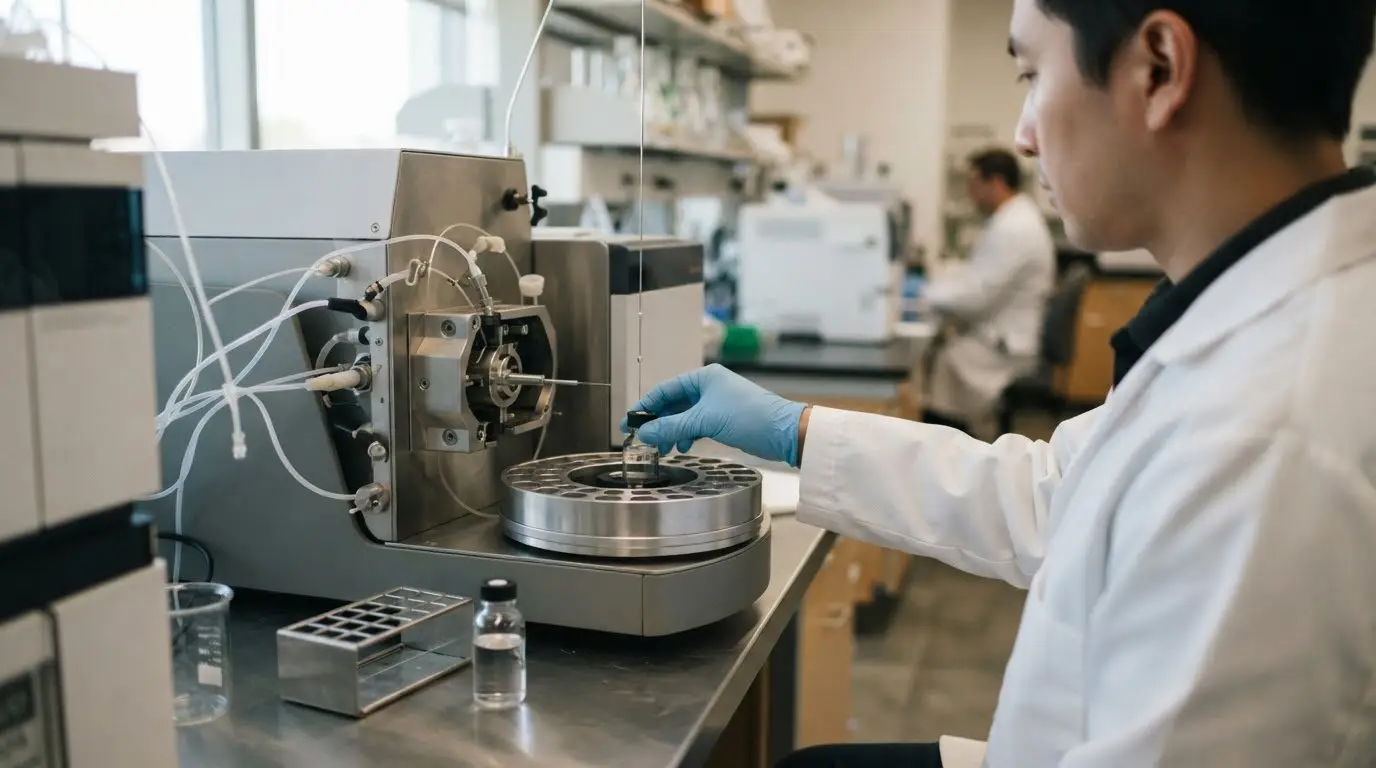
Stability data is useful only when analytical methods can distinguish the intact peptide from changes that develop during storage. Researchers commonly combine chromatography with mass analysis to measure purity and investigate emerging impurities. The method must suit the peptide, formulation, and study question; one result rarely describes every aspect of stability.
Separating intact peptide from impurities
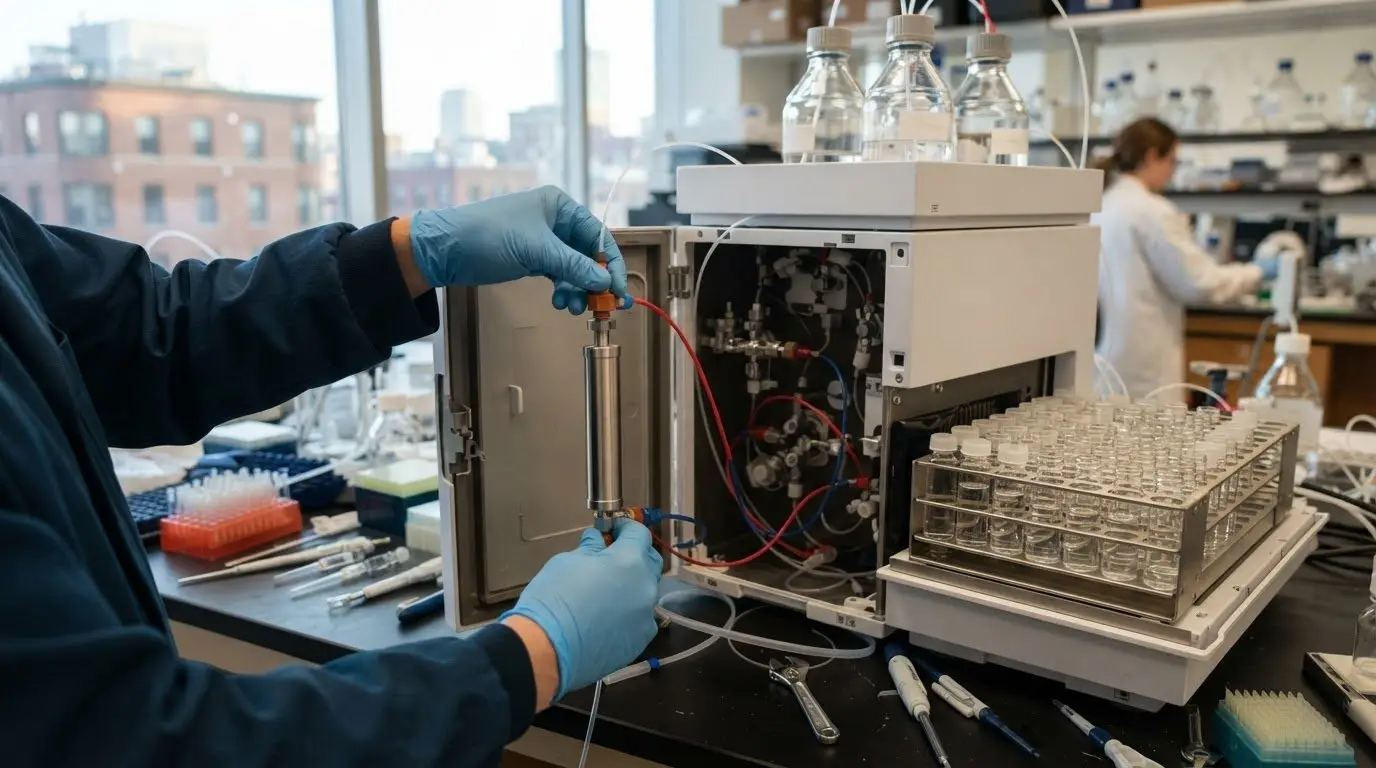
High-performance liquid chromatography with ultraviolet detection, or HPLC-UV, separates compounds before measuring how much ultraviolet light they absorb. It can support purity and assay measurements, with a reported detection-limit range of 0.1-1.0%. Researchers compare the peptide’s main peak with other peaks, then track changes across study samples. A growing impurity peak can signal a trend that warrants further investigation.
Liquid chromatography coupled with tandem mass spectrometry, or LC-MS/MS, adds information about molecular mass. Its reported detection-limit range for identifying degradation products is 0.01-0.1%. This can help distinguish related compounds that chromatography alone may not identify. For example, a researcher can compare a sample’s mass signals at baseline and later time points, then investigate signals that appear or increase.
HPLC-MS combines chromatographic separation with mass analysis, supporting separation and identification. HPLC-UV and LC-MS/MS address different analytical questions and may be used together. HPLC-UV can measure assay or purity changes; LC-MS/MS can help characterize degradation products. Consistent sample preparation is essential for comparing results across storage conditions.
Establishing method performance
Analytical method validation establishes whether a method is suitable for its intended measurement. Researchers assess characteristics such as specificity, accuracy, precision, and the ability to detect relevant changes. Specificity matters in stability studies because the intact peptide must be distinguished from impurities. Forced-degradation samples can help determine whether the method separates these signals instead of combining them into one result.
Validation also links instrument results to study decisions. Researchers define which assay or purity changes warrant investigation, then use the same method for baseline and later samples. A method that misses an impurity cannot establish a reliable trend, even if its readings appear consistent. Documented procedures support comparable sample handling, instrument settings, and data interpretation throughout the study.
Use multiple measures when the research question calls for them. Assay results describe measured peptide content, while purity profiles show the relative pattern of detected components. Mass analysis can provide clues about impurity identity. Researchers can consider these findings alongside appearance or biological activity data, where relevant, for a fuller interpretation. No single analytical method captures every aspect of stability.
For long-term peptide stability testing, a stability-indicating method should detect meaningful changes under the planned study conditions. Researchers can evaluate this by testing representative samples, comparing stressed with unstressed material, and confirming that the method resolves the signals of interest. This analytical foundation makes later results easier to interpret and compare across time points.
Short- and long-term stability testing
Short-term observations can reveal early changes but cannot show how a peptide behaves over its full storage period. Longitudinal studies collect data at defined intervals to connect early findings with longer-term trends. For research peptides, study duration and conditions depend on formulation, packaging, storage temperature, and the question being investigated. A useful protocol distinguishes these factors rather than treating every sample as equivalent.
Sample-pull points create a timeline for comparison. Stability studies may collect samples at 0, 3, 6, 9, 12, 18, and 24 months. Some protocols also use checkpoints at 0, 1, 3, 6, 9, and 12 months. The initial sample provides a baseline; later measurements show whether potency, purity, or degradation products change. Regular points help distinguish a gradual trend from a change seen at only one interval.
Duration depends on the storage condition and study purpose. Long-term studies at 25°C may run for 12-36 months. Refrigerated studies at 5°C ± 3°C commonly cover 12-24 months, while frozen studies at −20°C ± 5°C may extend up to 36 months. These are study-duration frameworks, not universal shelf-life claims. The formulation and measured stability profile remain central to interpretation.
Reconstituted solutions need separate evaluation from dry material. A typical reconstituted research peptide stored at 4°C has a stated shelf life of days to weeks; at room temperature, hours to days. Frozen aliquots at −20°C are described as lasting weeks to a few months. These ranges illustrate why sample form and storage condition belong in the protocol. A lyophilized peptide’s results can’t simply be assigned to its reconstituted solution.
Pharmaceutical development programs may combine long-term, intermediate, and accelerated studies with freeze-thaw, photostability, forced-degradation, and shipping evaluations. Each addresses a different potential source of change. Researchers can assess potency, purity, degradation products, biological activity, appearance, moisture, aggregation, and container-closure integrity. Selecting measurements suited to the formulation makes the resulting stability data more useful for laboratory planning.
For long term peptide stability testing, distinguish an observed result from a stated shelf life. A 24-month shelf life has been reported for a peptide analog after regulatory approval, but that case doesn’t set a general duration for other peptides. Study conditions, packaging, and data all matter. A practical approach to long term peptide stability testing matches the protocol to the sample form and intended storage, then interprets each time point within that design.
Researchers planning laboratory work can browse research peptides for laboratory use while considering which sample form and storage conditions their study requires.
Solara Compounds
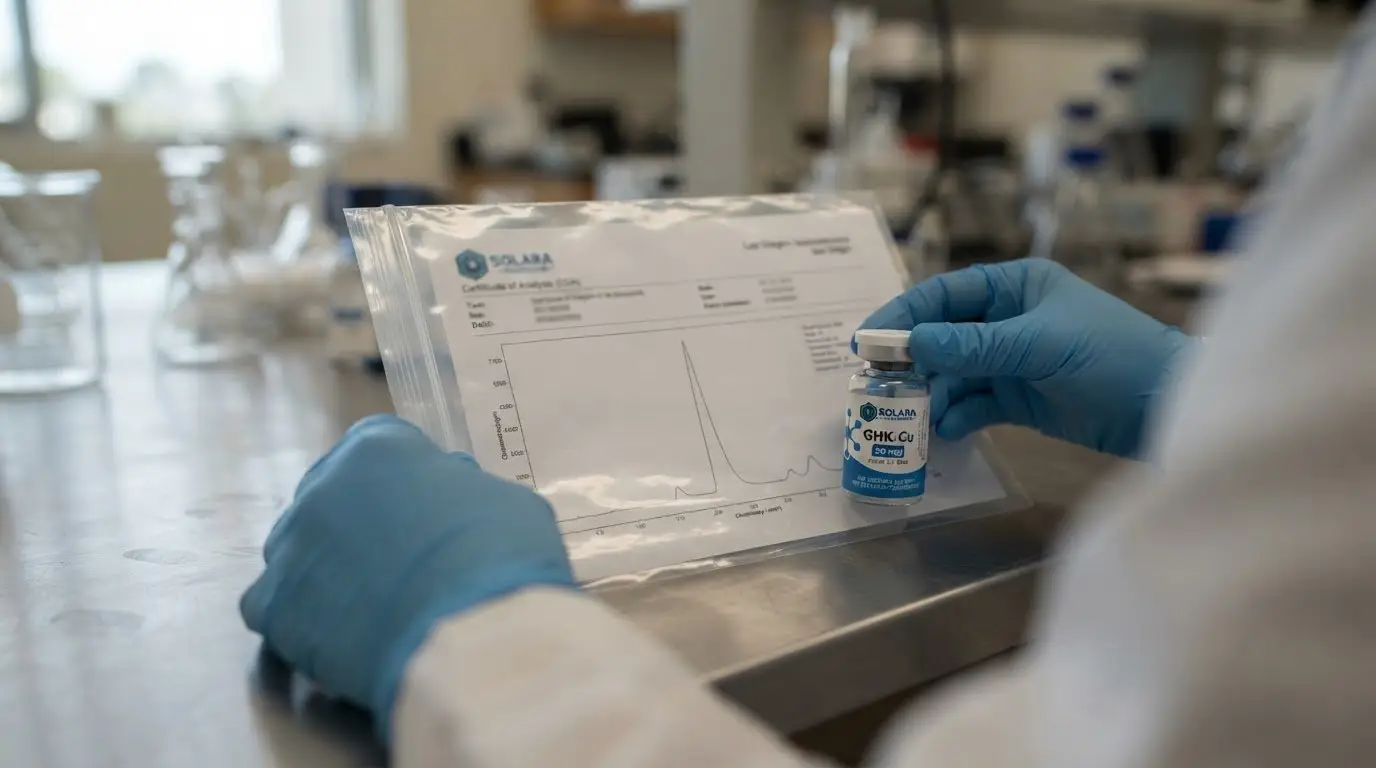
Solara Compounds supports laboratory buyers with research peptides, batch-specific Certificates of Analysis, and third-party testing by Kovera Labs. Each batch has a unique lot number, with its COA available for verification. For stability studies, this documentation helps researchers identify the material associated with a sample and organize records alongside study conditions and results.
The catalog includes SOL-3RT Retatrutide 10mg, SOL-2TZ Tirzepatide 10mg, GHK-Cu 50mg, and TB-500 5mg. Products are for laboratory research only, not medicines or supplements, and not for use in people or animals. A Certificate of Analysis provides batch-specific quality information; it doesn’t replace a stability study or establish a peptide’s storage period.
For questions about research materials or batch paperwork, contact Solara Compounds or email [email protected].
Turn the Findings Into a Study Plan
Turn general guidance into a plan tailored to the material and research question. Define what the study needs to measure, then choose a sample form and storage environment suited to that purpose. This keeps the plan focused on relevant observations rather than assumptions drawn from another peptide or formulation.
Long-term peptide stability testing is most useful when researchers know which decision the data should support. A laboratory comparison, formulation screen, and storage evaluation may each require different evidence. Matching the study design to its purpose helps researchers interpret results consistently and decide what to investigate next.
For materials intended for laboratory research, explore the research catalog. A focused question is a practical starting point for the work ahead.
Frequently Asked Questions
Can I store reconstituted peptide solutions long-term?
Do not assume a reconstituted solution can be stored long-term without data for that specific solution. Researchers need to distinguish peptide stability from effects related to the buffer, container, and handling conditions. One useful study question is whether the prepared solution remains suitable for its planned laboratory analysis over the intended storage period. Findings from a different formulation or preparation should not be treated as interchangeable.
Does freezing damage peptides?
Freezing does not necessarily damage a peptide, but the effect depends on the material and its handling history. Researchers can assess this by comparing a sample’s condition and analytical results before and after freeze-thaw handling relevant to their work. Visible changes, such as precipitation, are useful observations, but appearance alone cannot establish chemical integrity. Interpret freezing effects using measurements suited to the experimental question.
How long do lyophilized peptides last in storage?
No single storage duration applies to every lyophilized peptide. Researchers should distinguish a general estimate from evidence for a particular peptide, package, and storage history. For experimental planning, record the lot, vial condition, and relevant storage events, then interpret material-specific documentation accordingly. A duration established for one formulation should not be applied automatically to another.
What is the most common peptide degradation pathway?
No single degradation pathway is most common across all peptides. The dominant change depends on the molecule, formulation, and environment. Rather than assume one pathway, researchers can design studies to distinguish chemical changes from physical changes and changes in measured activity. This helps identify which process matters for a particular sample without treating one peptide’s profile as universal.
What tests are run at each stability timepoint?
Choose the test panel to match the study purpose and the sample attributes that matter. Researchers can define acceptance criteria before testing, then apply consistent procedures at each scheduled collection. Include suitable controls and document deviations in sample handling, since they affect how results can be compared. Not every study needs every possible measurement; the tests should answer the planned research question.
What is long-term peptide stability testing?
Long-term peptide stability testing is a structured way to determine how a peptide’s measured characteristics change under defined storage conditions over time. Researchers use the evidence to assess a particular material and study setup, rather than infer stability from appearance or from another peptide. The design links the research question, sample form, storage environment, and selected measurements so the findings have a clear scope.
Which storage conditions and time points are used for long-term peptide stability studies?
Researchers choose conditions and collection intervals to reflect the sample form, formulation, packaging, and intended storage environment. They also account for known sensitivities that could affect interpretation. Document the conditions actually applied and keep sample handling consistent across collections. The schedule is part of the study design, not a universal timetable for every peptide or laboratory project.
What analytical methods are used to measure peptide stability and degradation?
Choose analytical methods according to whether the study needs to measure peptide content, separate impurities, or investigate the identity of changes. Complementary approaches can help distinguish a change in the main peptide signal from a new impurity signal. Methods should suit the sample matrix and be assessed for their ability to detect relevant changes. This makes results more interpretable than relying on one measurement alone.