Research Articles
Mass Spectrometry Peptide Testing: Research Guide


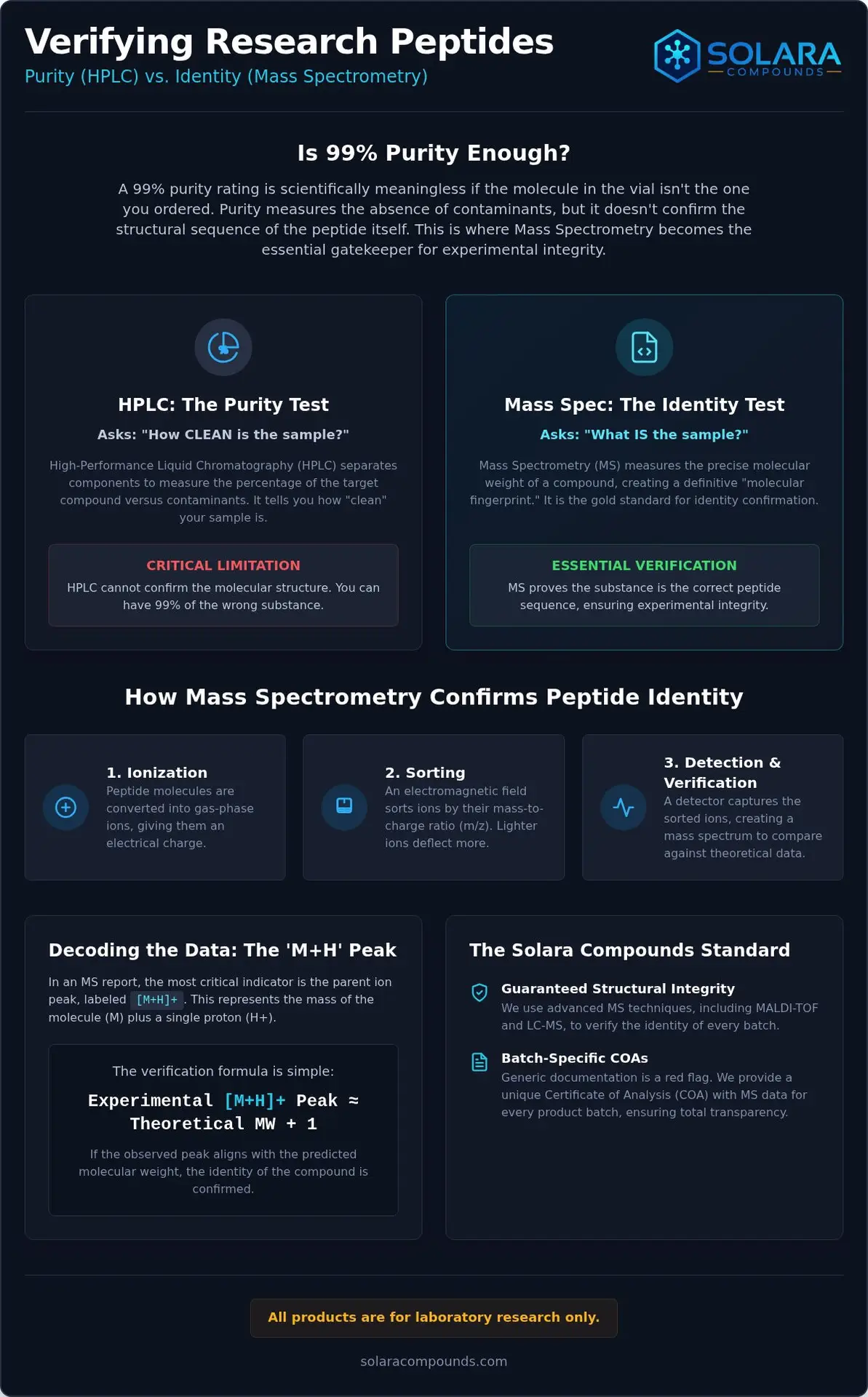
A 99% purity rating on an HPLC report is scientifically meaningless if the molecule in the vial isn’t the one you actually ordered. While purity measures the absence of contaminants, it doesn’t confirm the structural sequence of the peptide itself. This distinction is where mass spectrometry peptide testing becomes the essential gatekeeper for experimental integrity. Most researchers feel a justified sense of unease when reviewing complex supplier data, fearing that a single misidentified compound could lead to months of lost laboratory time. At Solara Compounds, we believe that technical transparency is the only path to scientific confidence. All products are for laboratory research only.
This guide will help you master the interpretation of mass spectrometry reports so you can verify molecular weights with total precision. You’ll learn to distinguish between identity and purity testing while developing a standardized protocol for reviewing every Certificate of Analysis (COA) you receive. By understanding the molecular fingerprint of your compounds, you ensure that your work at solaracompounds.com remains grounded in empirical truth. We will break down the technical nuances of mass peaks and Dalton deviations to provide the clarity your research demands.
Key Takeaways
- Learn why HPLC purity alone is insufficient for verifying the actual molecular sequence of your research compounds.
- Understand how mass spectrometry peptide testing uses ionization to create a definitive molecular fingerprint for identity confirmation.
- Gain a practical framework for comparing theoretical molecular weights against experimental peaks to validate supplier reports.
- Identify the risks associated with generic documentation and why batch-specific data is non-negotiable for laboratory experimental integrity.
- Discover the analytical standards used at Solara Compounds, including MALDI-TOF and LC-MS, to ensure the structural integrity of every batch.
What is Mass Spectrometry Peptide Testing?
Mass spectrometry is a sophisticated analytical technique used to measure the mass-to-charge ratio of ions. In the context of laboratory work, mass spectrometry peptide testing serves as the definitive method for validating that a synthesized compound matches its intended amino acid sequence. It’s the primary tool for identity confirmation. Without it, researchers are essentially working blind. All products from Solara Compounds are for laboratory research only. Mass-to-charge ratio, often abbreviated as m/z, is a measurement of how much an ion weighs relative to the electrical charge it carries. This data allows scientists to calculate the exact molecular weight of a compound with extreme precision.
The process involves ionizing chemical species and sorting the ions based on their mass and charge. This level of granularity is essential because even a single amino acid substitution can drastically alter a peptide’s behavior in a controlled environment. By utilizing Protein Mass Spectrometry, laboratories can ensure experimental repeatability. If the molecular weight doesn’t align with the theoretical mass of the sequence, the integrity of the entire study is compromised. It’s the gold standard for verifying that the material in the vial is exactly what was synthesized.
MS vs. HPLC: Identity vs. Purity
High-Performance Liquid Chromatography (HPLC) is a separation technique that measures the purity of a sample. It tells you how “clean” the material is by showing the percentage of the target compound versus any residual contaminants. However, HPLC cannot confirm the structural identity of the molecule. It only shows that a specific substance is present in a certain concentration. Mass spectrometry peptide testing provides the “ID card.” It confirms the molecular weight. A report showing 99% purity via HPLC is scientifically incomplete without an MS report. You might have 99% of a substance, but only MS proves that the substance is the correct peptide sequence.
Common MS Techniques: MALDI-TOF and LC-MS
Two primary techniques dominate the field. Matrix-Assisted Laser Desorption/Ionization-Time of Flight (MALDI-TOF) is highly effective for rapid molecular weight confirmation. It’s often the preferred choice for verifying lyophilized research peptides such as BPC-157 or TB-500 because it handles large molecules without breaking them apart. Liquid Chromatography-Mass Spectrometry (LC-MS) combines the physical separation of HPLC with the mass analysis of MS. It’s ideal for complex mixtures where multiple components must be identified. For standard research peptide procurement at solaracompounds.com, MALDI-TOF provides the necessary precision to confirm that each batch matches the theoretical specifications required for laboratory use.
The Mechanism of Peptide Identification in the Lab
A mass spectrometer functions as a high precision scale for molecules. The process begins with ionization, where peptide molecules are converted into gas-phase ions. This step is vital because the instrument uses electromagnetic fields to manipulate the particles. Once the peptides carry a charge, they are accelerated through a vacuum and subjected to deflection by a magnetic field. Because lighter ions are deflected more easily than heavier ones, the machine effectively sorts the particles based on their mass-to-charge ratio. This physical sorting allows for the identification of individual components within a sample with extreme accuracy.
The final stage of the mechanism involves detection and comparison. As the sorted ions strike a detector, the instrument captures electrical signals that form a mass spectrum. Researchers then perform mass spectrometry peptide testing by matching this experimental data against the theoretical mass of the specific peptide sequence. If the observed mass aligns with the predicted molecular weight, the identity of the compound is confirmed. All materials provided by Solara Compounds are for laboratory research only. This rigorous verification process ensures that the compound’s structural integrity remains intact for every experiment conducted at solaracompounds.com.
Molecular Weight and the ‘M+H’ Peak
In a typical MS report, the parent ion peak, often denoted as M+H, is the most critical indicator of a peptide’s identity. This peak represents the mass of the molecule plus a single proton. Researchers use this value to verify compounds such as BPC-157 or SOL-3RT. If the theoretical molecular weight is known, the M+H peak should appear exactly one unit higher. Minor variances are often expected due to naturally occurring isotopes. Specialized institutions like the Biomolecular Analysis Facility use these data points to confirm that a peptide sequence is accurate and free from structural errors before it reaches the lab bench.
Sensitivity and Detection Limits
Mass spectrometry provides a level of resolution that HPLC cannot match on its own. It detects trace contaminants or degraded fragments that might otherwise be overlooked during a standard purity check. Sensitivity in mass spectrometry is defined as the ability to distinguish a specific molecular signal from background electronic noise. This high level of sensitivity ensures that even minute impurities are identified, which is why many researchers review the current research catalog to source materials backed by comprehensive data. By identifying these trace elements, mass spectrometry peptide testing protects the validity of your laboratory results and ensures long term experimental consistency.
Interpreting Mass Spectrometry Reports for Identity Verification
Reviewing a Certificate of Analysis (COA) for research materials requires a methodical approach. While many focus solely on purity percentages, mass spectrometry peptide testing provides the essential structural confirmation needed for experimental integrity. When you receive a report from Solara Compounds, the first step is to locate the theoretical molecular weight of the peptide. This is the calculated mass based on the specific amino acid sequence, such as the sequence for BPC-157 or SOL-2TZ. All products are for laboratory research only.
A reliable report will clearly state this theoretical value alongside the observed experimental mass. If these numbers don’t align within a narrow margin, the identity of the compound is in question. Researchers should also scan the report for “red flags,” such as significant peaks at unexpected m/z values. These secondary peaks often indicate the presence of truncated sequences, residual solvents, or molecular fragmentation. At solaracompounds.com, we prioritize batch-specific documentation to ensure that every vial matches its analytical profile.
Reading the Spectrum Graph
The spectrum graph is the visual representation of the mass analysis. The horizontal X-axis represents the mass-to-charge ratio (m/z), which, for most single-charged research peptides, corresponds directly to the molecular mass. The vertical Y-axis shows the Relative Abundance, indicating the intensity of the ions detected at each mass point. A “clean” spectrum will feature one dominant, sharp peak that towers over the baseline noise. If you observe multiple tall peaks across the X-axis, it may suggest that the compound is unstable or contains significant impurities that a standard HPLC test might have missed.
Matching Theoretical vs. Experimental Mass
It’s rare for the experimental mass to perfectly match the theoretical mass to the third decimal point. In mass spectrometry peptide testing, a deviation of less than 1 Dalton (Da) is generally considered acceptable. These minor variances often stem from naturally occurring isotopes or the sensitivity settings of the instrument. However, any deviation greater than 1 Da should be viewed with caution. Always verify that the lot number printed on the MS report corresponds exactly to the lot number on your physical vial. This traceability is the only way to guarantee that the data you are reviewing actually applies to the material in your laboratory.
Why Batch-Specific MS Data is Essential for Experimental Integrity
A common pitfall in the procurement of research materials is the reliance on generic Certificates of Analysis. These documents often represent a single point in time or a “representative” sample rather than the specific lot delivered to your lab. Using unverified materials introduces variables that can invalidate months of work. Mass spectrometry peptide testing performed on every individual batch is the only way to confirm that the molecule in your vial matches the theoretical sequence precisely. All products from Solara Compounds are for laboratory research only.
Reproducibility is the cornerstone of scientific advancement. When in-vitro or biochemical studies fail to yield consistent results, the culprit is often the chemical identity of the peptide itself. Mislabeled or degraded compounds can mimic the behavior of the target molecule while producing anomalous data. By insisting on batch-level MS data, researchers can eliminate material identity as a potential source of error. This level of rigor ensures compliance with institutional standards and provides a solid foundation for complex experimental designs.
Traceability and Lot Tracking
Lot-number traceability is a non-negotiable requirement for modern laboratory standards. It creates a transparent audit trail that links every experimental result back to a specific production run. At Solara Compounds, we utilize lot tracking at solaracompounds.com to provide a direct connection between our analytical data and your research materials. We also rely on third-party validation through partners like Kovera Labs to verify our internal findings. This secondary layer of oversight ensures that the data on your COA is both accurate and objective. You can browse our research catalog to see how we prioritize lot-specific transparency.
Storage Stability and MS Verification
Peptide stability is highly dependent on proper storage and synthesis techniques. While lyophilization is used to preserve the molecular identity confirmed by MS, compounds can still degrade over time if exposed to moisture or temperature fluctuations. Mass spectrometry is an excellent tool for detecting this degradation, as it identifies the presence of fragmented ions that deviate from the parent peak. For more information on how we manage these standards, you can review our guide on Independent Peptide Lab Testing: Purity & Verification. Maintaining the structural integrity of your compounds is the only way to ensure that your laboratory outcomes are driven by your experimental variables rather than material failure.
Sourcing MS-Verified Peptides at Solara Compounds
At Solara Compounds, we recognize that the validity of your laboratory results depends entirely on the molecular integrity of your starting materials. Our commitment to analytical transparency isn’t just a marketing claim; it’s a fundamental part of our engineering process. We utilize both MALDI-TOF and LC-MS for identity confirmation on every single batch we produce. This ensures that the “fingerprint” of the peptide matches its theoretical sequence before it ever enters our inventory. All products from Solara Compounds are for laboratory research only.
While mass spectrometry peptide testing confirms the identity of the compound, we also prioritize purity. Every batch undergoes High-Performance Liquid Chromatography (HPLC) to target a minimum of >98% purity. These results are verified through rigorous third-party testing at Kovera Labs. By maintaining this dual standard of identity and purity, we provide researchers with the data-driven confidence required for high-stakes biochemical studies. This methodical approach to quality control is why serious laboratories trust solaracompounds.com for their material needs.
Our Documentation-First Approach
Transparency is achieved through lot-level traceability. Every batch of SOL-3RT, SOL-2TZ, and BPC-157 is assigned a unique lot number that corresponds to its specific analytical report. We don’t believe in generic documentation. Instead, researchers can Review the batch COA before initiating any experimental work. This allows you to verify that the experimental mass and purity profile align perfectly with your study requirements. By providing this data upfront, we eliminate the guesswork often associated with peptide procurement. It’s our way of acting as a reliable partner in your long-term scientific success.
Procurement for Laboratory Research
We offer secure U.S. shipping to ensure that your materials arrive in optimal condition. To support ongoing laboratory operations, we provide free shipping on orders over $200. It’s important to remember that these compounds are intended only for qualified researchers conducting in-vitro and laboratory work. All products from Solara Compounds are for Research Use Only (RUO) and are not for human or animal consumption. They are not medicines, supplements, or clinical treatments. When you are ready to expand your inventory, you can Shop research peptides at solaracompounds.com to access our full catalog of MS-verified compounds.
Advancing Laboratory Precision with Analytical Data
Experimental integrity is built on the foundation of verified molecular data. By mastering the interpretation of mass spectrometry reports, researchers move beyond basic purity percentages and confirm the structural identity of their compounds. This rigorous approach to mass spectrometry peptide testing ensures that every study is grounded in empirical truth, reducing the risk of experimental failure due to misidentified materials. At Solara Compounds, we prioritize this level of transparency by providing batch-specific COAs and third-party verification through Kovera Labs.
All products are for laboratory research only and are not intended for human or animal consumption. Our commitment to quality includes high-purity standards and fast U.S. shipping from our Florida facility. When you source your materials from solaracompounds.com, you’re choosing a partner that values scientific precision as much as you do. We invite you to view the current research catalog at solaracompounds.com to find the MS-verified compounds your laboratory requires. Your work deserves the certainty that only comprehensive analytical data can provide.
Frequently Asked Questions
What is the difference between MS and HPLC in peptide testing?
HPLC measures purity by separating the components of a sample to determine the concentration of the target peptide relative to impurities. In contrast, mass spectrometry peptide testing confirms the identity of the molecule by measuring its specific mass-to-charge ratio. While HPLC tells you how much of a substance is present, MS verifies that the substance actually matches the intended amino acid sequence. Both are essential for laboratory research in hubs like Boston or San Diego.
Can mass spectrometry determine the purity of a peptide?
Mass spectrometry can provide insights into purity by showing the relative abundance of different ions, but it isn’t the primary tool for calculating purity percentages. High-Performance Liquid Chromatography (HPLC) remains the industry standard for determining exact purity levels, such as the >98% standard used at Solara Compounds. Researchers in Miami and Houston use MS primarily to identify contaminants or degradation products that might share a similar retention time on an HPLC column.
Why is MALDI-TOF commonly used for research peptide verification?
MALDI-TOF is favored because it’s a soft ionization technique that allows for the analysis of large biomolecules without causing significant fragmentation. This method provides a clear and rapid confirmation of molecular weight for lyophilized research peptides. For laboratories in San Francisco and Seattle, this technique is indispensable for verifying that synthesized compounds like BPC-157 or SOL-3RT maintain their structural integrity. All products are for laboratory research only and not for human consumption.
How do I match an MS report to a theoretical peptide sequence?
You match the report by comparing the observed experimental mass, typically the M+H peak, to the theoretical molecular weight calculated from the peptide sequence. This theoretical value is often provided on the Certificate of Analysis (COA) at solaracompounds.com. If the values align within a standard margin of error, the identity is confirmed. Researchers in Austin and Raleigh rely on this comparison to ensure their materials meet the specific requirements of their biochemical models.
What does a ‘clean’ mass spectrometry peak look like?
A clean peak appears as a single, sharp, and dominant vertical line on the mass spectrum graph. It should tower significantly over the baseline, which represents background electronic noise or trace impurities. If you see multiple tall peaks, it suggests the presence of fragmented sequences or significant contamination. Maintaining this level of clarity is vital for researchers in Chicago and Philadelphia who require high-precision materials for repeatable in-vitro experiments.
Does Solara Compounds provide MS reports for every batch?
Yes, Solara Compounds provides batch-specific mass spectrometry reports for every lot of research material. We believe that transparency is non-negotiable for serious laboratory work in cities like Dallas and Phoenix. Researchers can access these reports through our digital COA portal. Every batch is assigned a unique lot number, ensuring that the analytical data you review matches the physical vial in your lab. All compounds are intended solely for laboratory research use.
What happens if the experimental mass in an MS report is slightly off?
A minor deviation, typically less than 1 Dalton, is generally acceptable and often results from naturally occurring isotopes or the calibration settings of the instrument. However, larger discrepancies suggest that the peptide sequence is incorrect or has significantly degraded. For laboratories in Tampa and Atlanta, verifying these tolerances is a standard part of the procurement process. If you have questions about a specific batch, you can contact research support at support@solaracompounds.com.
Is mass spectrometry necessary if the peptide is >99% pure by HPLC?
Yes, mass spectrometry is absolutely necessary because HPLC only measures the quantity of a substance, not its identity. A sample could be 99% pure but contain the wrong peptide sequence entirely. Mass spectrometry peptide testing provides the structural confirmation that HPLC lacks. Researchers in Denver and New York use both methods to ensure that their materials are both clean and correctly identified, protecting the integrity of their long-term experimental outcomes.