Research Articles
Peptide Sequence Verification: Batch Integrity Guide

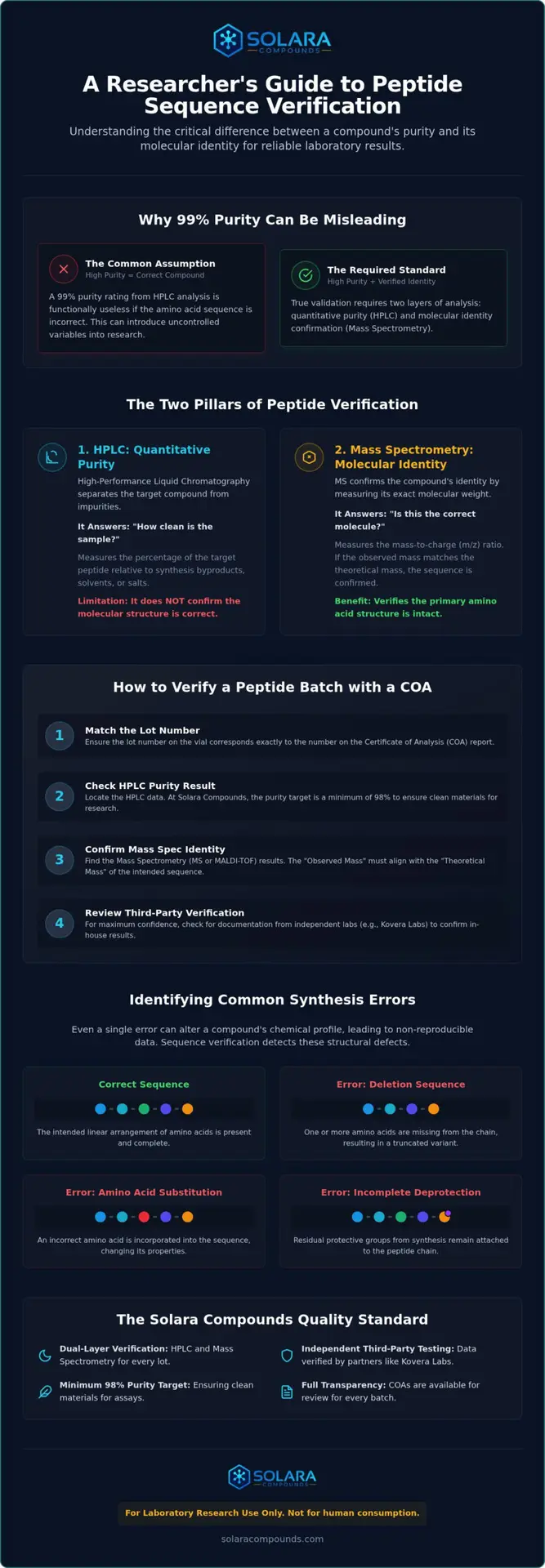
A 99% purity rating is functionally useless if the amino acid sequence is incorrect. For lab buyers, rigorous peptide sequence verification is the only way to ensure that the material in the vial matches the intended molecular design. The process of peptide sequence verification can often determine the success of your research outcomes.
This guide provides a technical framework for reading documentation and verifying the primary structure of synthetic research peptides. We’ll examine the specific methodologies used at Solara Compounds to confirm identity, such as MALDI-TOF and LC-MS molecular confirmation.
Performing peptide sequence verification is essential for validating your research materials and maintaining the integrity of your results.
Key Takeaways
- Distinguish between quantitative purity via HPLC and molecular identity via Mass Spectrometry to ensure a complete profile of your laboratory compounds.
- Learn to identify common synthesis errors, such as deletion sequences or incomplete deprotection, that can lead to unexpected variables in your research.
- Follow a structured framework for matching lot numbers to official batch reports at solaracompounds.com to verify the integrity of every vial.
- Understand why rigorous peptide sequence verification is the industry standard for maintaining reproducibility in complex biochemical assays, highlighting the importance of accurate peptide sequence verification.
- Gain confidence in your materials by reviewing third-party verification data provided by independent partners like Kovera Labs.
- The significance of peptide sequence verification cannot be overstated—it’s crucial for experimental accuracy.
Understanding Peptide Sequence Verification in Synthetic Compounds
In the context of laboratory work, peptide sequence verification serves as a guarantee that the synthetic compounds are exactly what researchers expect.
Sequence verification is the analytical process of confirming the exact linear arrangement of amino acids within a synthetic chain. It’s the definitive method for ensuring the molecule produced in the lab is the one you ordered. Understanding Peptide Sequence Verification provides the baseline for experimental integrity; without it, you’re working with assumptions rather than data. For researchers, this step is critical. It differentiates between a successful biochemical assay and an experimental failure caused by structural anomalies. All materials from Solara Compounds undergo this rigorous check to maintain high-grade engineering standards.
This rigorous peptide sequence verification ensures that the synthetic peptides meet strict quality assurance standards.
The Difference Between Purity and Identity
HPLC (High-Performance Liquid Chromatography) measures quantitative purity. It tells you the percentage of the target compound relative to impurities like residual solvents or salts. However, purity alone doesn’t confirm chemical identity.
Consequences of Sequence Errors in Laboratory Research
A single amino acid substitution can fundamentally alter the chemical profile of a compound. For example, in research involving BPC-157, a sequence error might prevent proper receptor binding or disrupt expected metabolic pathway interactions.
Analytical Methodologies: HPLC and Mass Spectrometry
Mass Spectrometry is a key technique for effective peptide sequence verification in modern laboratories.
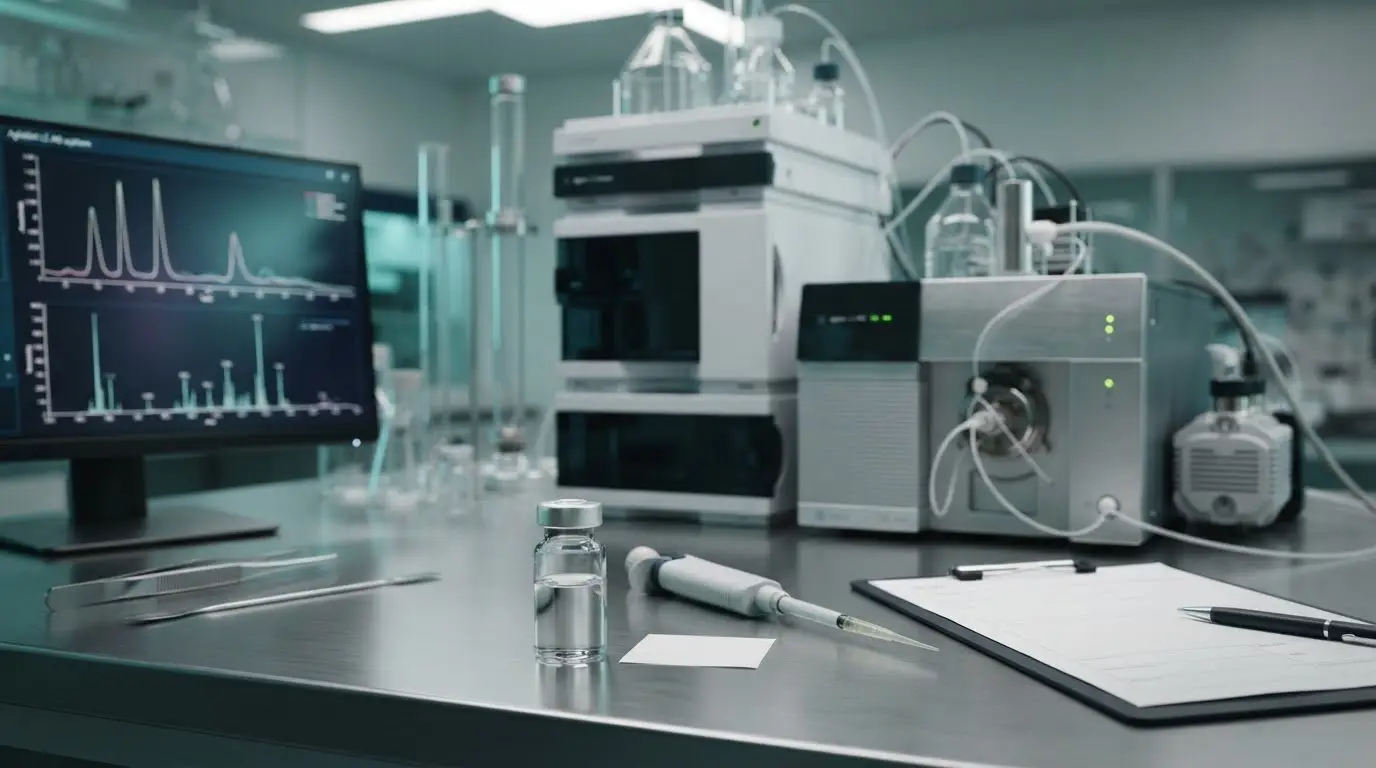
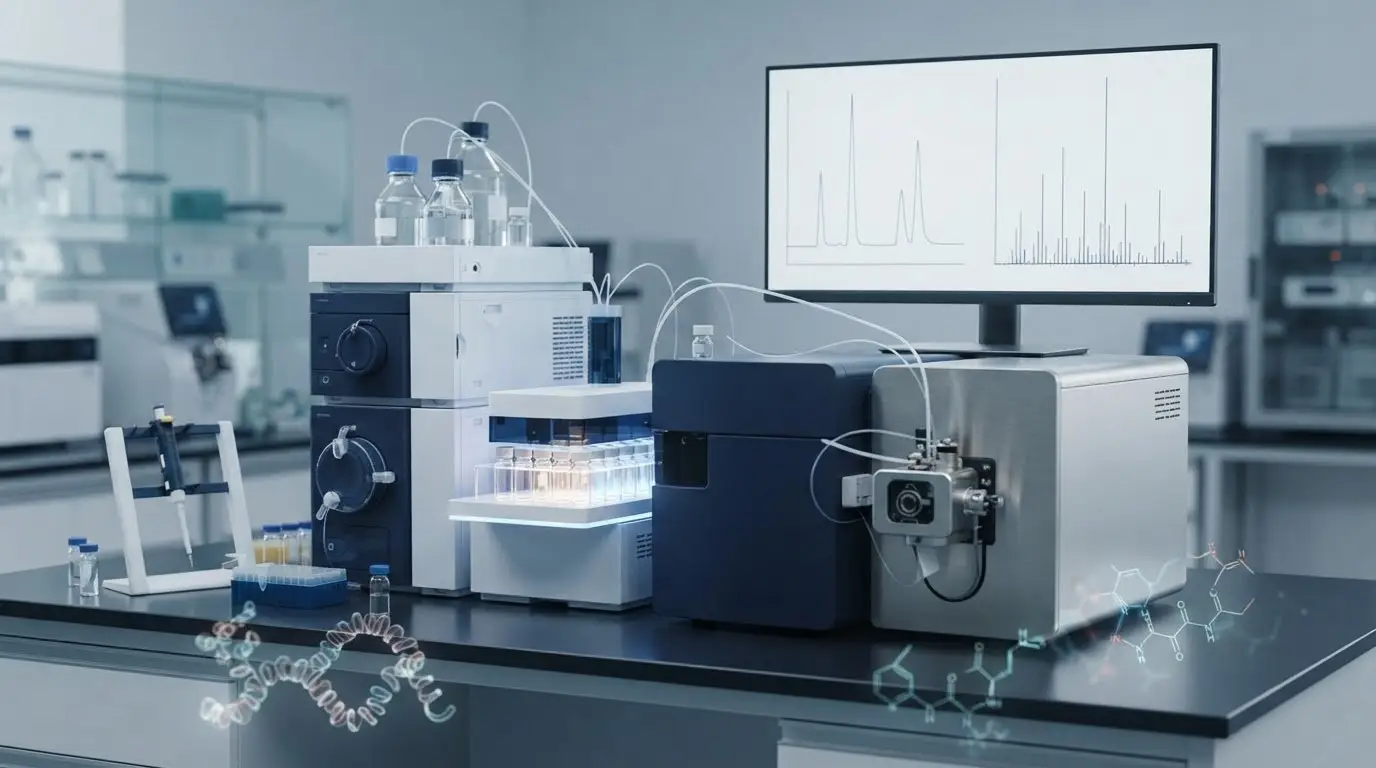
High-Performance Liquid Chromatography (HPLC) serves as the primary tool for determining the quantitative purity of a batch. It works by separating the target peptide from synthesis byproducts using a stationary phase and a pressurized liquid solvent. At Solara Compounds, we target a minimum purity of 98% to ensure that your laboratory research is based on clean materials. However, HPLC doesn’t tell us what the compound is; it only tells us how much of the main component is present. This is why peptide sequence verification requires a second, more specific diagnostic: Mass Spectrometry (MS). While MALDI-TOF is excellent for quick molecular weight checks, LC-MS is the standard for synthetic research peptides because it provides better separation of complex mixtures before they reach the mass analyzer.
Completing peptide sequence verification through Mass Spectrometry can significantly enhance data reliability.
The manufacturing environment is just as critical as the analysis itself. Synthesis occurs in ISO 7 cleanrooms to prevent cross-contamination from other compounds. This controlled atmosphere ensures that the chromatogram peaks observed in HPLC represent the intended product rather than environmental pollutants. For researchers looking to secure high-integrity materials, you can browse our research catalog to see currently available lots.
How Mass Spectrometry Confirms the Sequence
Mass Spectrometry confirms identity by measuring the molecular weight of the peptide. Most modern labs use the “mobile proton” model. In this process, the peptide is ionized, and protons move along the backbone, causing the chain to fragment at specific amide bonds. By analyzing these fragments, researchers determine the m/z (mass-to-charge) ratio. This ratio represents the mass of the molecule divided by its electrostatic charge. If the observed mass matches the theoretical mass of the intended sequence, the identity is confirmed. Recent developments in advanced machine learning models for peptide analysis have further improved our ability to interpret these complex data sets, making it easier to spot subtle variants.
Edman Degradation: When is it Still Relevant?
Edman Degradation was once the gold standard for sequencing. It’s a cyclical process where the N-terminal amino acid, which is the “start” of the chain, is removed and identified one by one. While precise, it has significant limitations. It’s slow; it often fails if the N-terminus is chemically blocked. It also struggles with longer chains. For modern synthetic compounds like SOL-3RT, LC-MS has largely superseded Edman Degradation. LC-MS provides faster, more comprehensive batch verification by analyzing the entire molecule simultaneously. All products are for laboratory research only and are not for human consumption. Researchers should always review the batch-specific COA to confirm identity before use.
How to Verify a Peptide Batch Using COA Documentation
Utilizing COA documentation is vital for ensuring that peptide sequence verification aligns with laboratory standards.
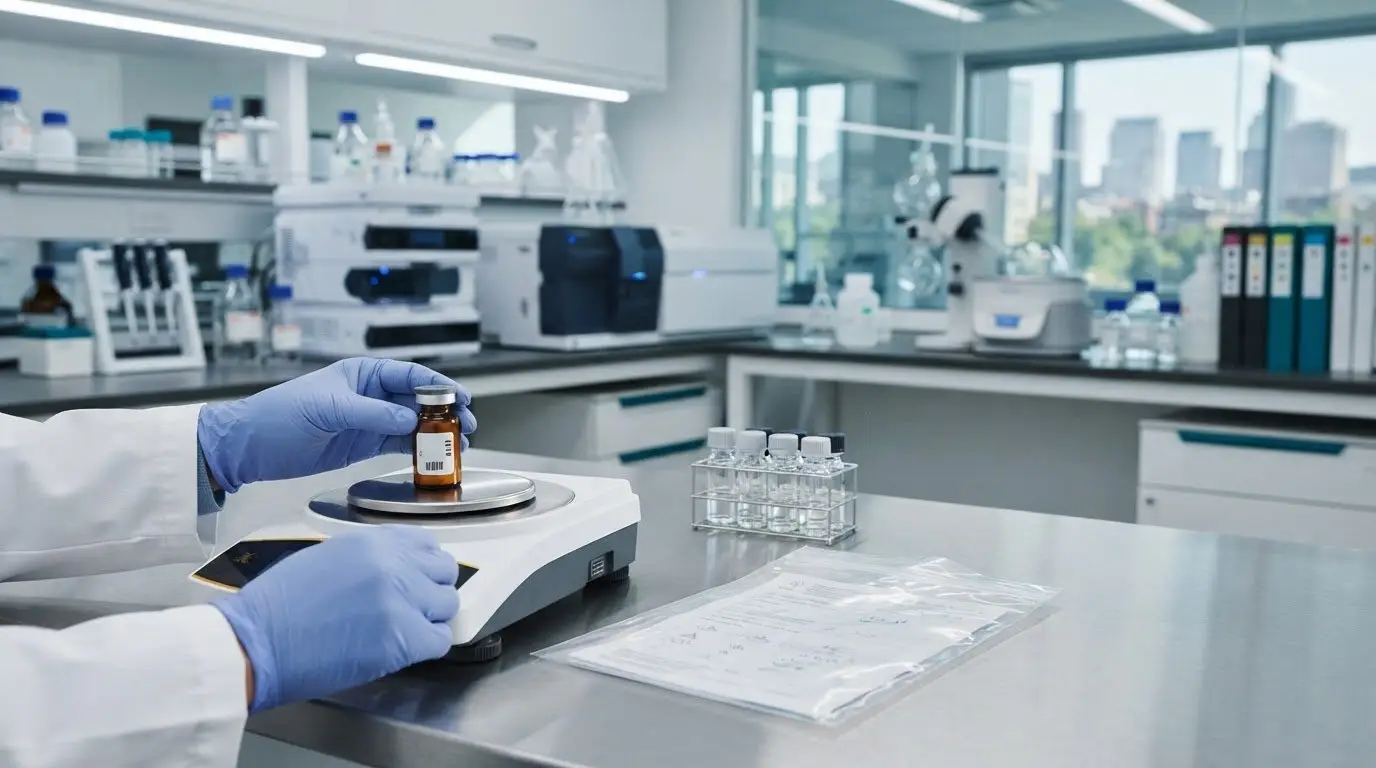
A Certificate of Analysis (COA) serves as the primary technical record for every lot produced. For lab buyers, the first step in any quality audit is matching the lot number printed on the vial to the digital Certificate of Analysis.
Accuracy in peptide sequence verification starts with comprehensive COA documentation, outlining all necessary details.
Step-by-step verification involves a logical flow. First, examine the HPLC results for a single, dominant peak that indicates high purity.
Interpreting the HPLC Chromatogram
HPLC is the standard for determining chemical purity in synthetic peptides. When you view the chromatogram, you should see one sharp, vertical peak. This represents the target peptide. Any smaller peaks or bumps along the baseline, known as baseline noise, represent impurities or byproducts from the synthesis process. The “Area %” column in the report is critical. It calculates the area under the target peak as a percentage of the total area of all detected peaks. We target an Area % of 98% or higher to provide researchers with consistent, high-grade materials for biochemical assays.
Analyzing Mass Spectrometry Charts for Identity
While HPLC confirms purity, the Mass Spec chart is where you perform actual peptide sequence verification. Look for two specific values: “Calculated Mass” and “Found Mass.” The Calculated Mass is the theoretical weight of the amino acid sequence. The Found Mass is what the machine actually detected. An acceptable variance is typically +/- 1 Dalton. This small difference accounts for the natural isotopic distribution of elements like carbon and nitrogen. Researchers should also look for “adducts,” which are ions like sodium or potassium that may attach to the peptide during the ionization process. These adducts can shift the peak by specific amounts, but they don’t indicate an incorrect sequence if the base mass is correct.
Identifying Common Synthesis Impurities and Variants
Synthesis is a complex chemical progression. Even when targeting high purity, specific variants can emerge during the coupling cycles. Deletion sequences occur when an amino acid fails to bond during a particular step of solid-phase synthesis, resulting in a shorter, “truncated” chain.
Racemization is a more subtle variant. It involves the conversion of L-amino acids into D-isomers. Because the molecular weight remains identical, standard mass spectrometry won’t always detect this change, yet the three-dimensional shape of the molecule is altered. This structural shift can significantly disrupt binding affinity in biochemical assays. Additionally, lab buyers should account for Trifluoroacetic acid (TFA) salts. TFA is a standard reagent used during the cleavage and purification stages. While it’s a normal component of lyophilized powders, its presence affects the net peptide content. Researchers must factor this into their calculations when preparing solutions for laboratory use. To secure materials that have undergone these rigorous checks, shop our catalog of research peptides.
The Risks of Truncated Sequences
Truncated sequences are incomplete versions of the intended target. On an HPLC report, these variants often appear as small “shoulder” peaks or minor spikes immediately adjacent to the primary peak. These impurities are problematic because they can compete for receptor sites, potentially interfering with cellular signaling experiments and producing non-reproducible data. Maintaining the stability of the intended sequence requires vacuum sealing and sterile lyophilization. This freeze-drying process removes moisture, which is the primary catalyst for peptide degradation. All products from Solara Compounds are for laboratory research only and must be handled by qualified professionals.
Chemical Stability and Storage Post-Verification
Successful peptide sequence verification is only the beginning of maintaining batch integrity. You must protect that integrity through proper peptide storage.
Sourcing Documented Peptides from Solara Compounds
Solara Compounds bridges the gap between high-level material science and practical laboratory application. Our commitment to batch-level LC-MS and MALDI-TOF confirmation ensures that researchers don’t have to guess about the identity of their materials.
Traceability is the cornerstone of our operations. By maintaining a strict chain of custody from synthesis to the final research vial, we eliminate the variables that often lead to experimental failure. Lab buyers can rely on our documentation to provide a clear technical roadmap of each compound’s molecular weight and purity profile. This documentation-first approach is designed to inspire trust through precision rather than marketing hype. All products are for laboratory research only and must be handled by qualified professionals in a controlled environment.
The Solara Transparency Model
We believe that data should be accessible before a purchase is made. Many suppliers provide a “representative” sample report, which is often a single test performed on a large master batch months or years prior. In contrast, Solara Compounds provides batch-specific COAs for every lot. This granular level of detail supports academic and institutional procurement, where reproducibility is the highest priority. To assist larger studies, we offer tiered pricing structures and provide fast U.S. shipping. Orders over $200.00 qualify for free shipping, ensuring that your laboratory budget is used efficiently. You can shop research peptides at solaracompounds.com with the confidence that the paperwork matches the product.
Procurement Checklist for Lab Buyers
When selecting a supplier for synthetic peptides, lab buyers should follow a standardized audit process. This ensures that the materials meet the technical requirements of the intended biochemical assays. Use the following checklist to evaluate your source:
- Does the supplier provide batch-specific MS data for peptide sequence verification?
- Is the purity verified by an independent third party like Kovera Labs?
- Are the compounds intended strictly for laboratory research use?
- Is there a clear chain of custody from synthesis to delivery?
Mandatory Disclaimer: All products are for Research Use Only (RUO). They are intended solely for laboratory research and not for human or animal consumption. If you have technical questions regarding a specific lot, please contact our team at support@solaracompounds.com or call 1 (877) 388-9178, Monday–Friday, 8 AM–5 PM Eastern. Before beginning your next study, review the batch COA to ensure your materials meet your required specifications.
Securing Experimental Reproducibility with Verified Compounds
Maintaining the integrity of your biochemical assays requires a commitment to rigorous documentation. As we have examined, a high purity percentage is only one part of the equation.
Ultimately, peptide sequence verification is integral to the design of successful research projects.
Solara Compounds prioritizes this technical precision by providing batch-specific COAs and independent third-party testing through Kovera Labs for every lot. We provide secure U.S. shipping for institutional researchers, maintaining a stable chain of custody from our ISO 7 cleanrooms to your laboratory. All products are for laboratory research only and are not for human or animal consumption. It’s essential to review all data before beginning your work. We invite you to view the current research catalog and batch COAs at solaracompounds.com to secure documented materials for your next study. Your commitment to empirical accuracy is the foundation of successful research, and we’re here to support that standard.
Frequently Asked Questions
Why is peptide sequence verification critical for research?
What is the difference between peptide purity and sequence identity?
Purity represents the percentage of the target peptide relative to synthesis byproducts like salts or water. Sequence identity confirms the exact arrangement of amino acids in the chain. While HPLC measures purity, mass spectrometry is required for peptide sequence verification to ensure the chemical identity matches the intended design. A batch can be 99% pure but contain an entirely incorrect sequence; therefore, researchers must evaluate both metrics to maintain experimental integrity.
Consequently, researchers must ensure that peptide sequence verification is conducted thoroughly to avoid pitfalls in experimental results.
How do I read a Mass Spectrometry (MS) report for BPC-157?
To analyze a Mass Spectrometry report for BPC-157, you should first locate the “Calculated Mass” which is the theoretical weight based on its amino acid sequence. Compare this to the “Found Mass” detected by the instrument. An acceptable variance is generally within 1 Dalton. If the found mass aligns with the target weight, the identity of the BPC-157 is confirmed. Always cross-reference the lot number on your vial with the batch-specific COA at solaracompounds.com.
What is an acceptable purity level for research-grade peptides?
Most high-quality research environments require a minimum purity level of 95% for synthetic peptides. However, for sensitive biochemical assays where variables must be strictly controlled, a purity of 98% or higher is preferred. Solara Compounds targets a minimum of 98% purity for its catalog items. Using compounds with lower purity can introduce uncontrolled variables into your laboratory research, potentially leading to non-reproducible data or interference with cellular signaling pathways during your study.
Can HPLC tell me if the amino acid sequence is correct?
HPLC cannot confirm if the amino acid sequence is correct. It is a separation technique that identifies how many distinct compounds are in a sample, providing a quantitative purity score based on the area under the primary peak. It doesn’t provide molecular weight or structural data. To confirm the sequence, you must use Mass Spectrometry, which analyzes the mass-to-charge ratio of the ionized peptide to verify its chemical identity against the theoretical model.
Why is MALDI-TOF used for peptide sequence verification?
MALDI-TOF is utilized for peptide sequence verification because it is a soft ionization method that allows for the measurement of large molecules without significant fragmentation. This technique provides a clear reading of the molecular weight of the peptide. By comparing the detected mass to the calculated mass of the sequence, researchers can definitively confirm that the synthesized batch matches the intended molecular structure. It’s an essential tool for verifying batch integrity in laboratory settings.
In summary, adopting the right methods for peptide sequence verification supports the accuracy and reliability of laboratory findings.
What are common impurities found in synthetic peptide batches?
Integrating peptide sequence verification into your workflow can safeguard against common pitfalls in synthetic peptide research.
Synthetic peptide batches often contain impurities such as deletion sequences, where an amino acid failed to couple during the synthesis cycle. Other common variants include truncated sequences or incomplete deprotection, where protecting groups remain attached to the peptide backbone. Additionally, residual reagents like trifluoroacetic acid (TFA) salts are often present in lyophilized powders. Identifying these impurities through batch-specific documentation is critical for maintaining the accuracy of laboratory research and biochemical assays.
How does Solara Compounds verify the quality of its research compounds?
Solara Compounds verifies every batch through a multi-stage analytical process. We utilize both HPLC for quantitative purity and LC-MS or MALDI-TOF for molecular identity confirmation.
Is a COA required for every batch of research peptides?
Thus, every lab should prioritize peptide sequence verification as part of their quality assurance protocols.
A Certificate of Analysis (COA) is essential for every batch of research peptides to ensure traceability and reproducibility. Without a batch-specific COA, a researcher cannot verify that the current lot matches the specifications of previous vials.