Research Articles
Institutional Peptide Procurement: A Guide to Sourcing Research-Grade Compounds in 2026


The true cost of a research compound is not found on a purchase order; it is measured in the weeks of lost data caused by a single impure batch. For organizations managing complex workflows, institutional peptide procurement has evolved into a rigorous exercise in risk mitigation rather than simple commodity sourcing. You have likely experienced the friction of opaque documentation or the uncertainty of international shipping timelines that threaten your project deadlines. At Solara Compounds, we recognize that experimental integrity depends on absolute transparency and domestic supply chain stability. It is essential to note that all products, such as SOL-3RT and BPC-157, are for laboratory research only and are not for human or animal consumption.
This guide outlines how to secure a stable source of research-grade compounds while simplifying your billing and documentation processes. We will analyze the critical role of batch-specific Certificates of Analysis, the necessity of 99%+ purity verified by HPLC, and why domestic sourcing is the baseline for 2026 compliance. By following these vetting standards, you can ensure your lab maintains the highest levels of structural integrity and repeatability. You may visit solaracompounds.com to review our documentation standards and secure the high-purity materials your research requires.
Key Takeaways
- Learn why modern standards prioritize verifiable data over unit price in institutional peptide procurement, focusing on batch-specific transparency.
- Understand the technical necessity of HPLC and LC-MS testing to confirm the purity and sequence identity of compounds like SOL-3RT and SOL-2TZ for laboratory research only.
- Identify the logistical risks of international shipping and the benefits of domestic, cleanroom-based synthesis for maintaining the structural integrity of research materials.
- Discover how to optimize your laboratory workflow by standardizing the purchase order process and leveraging tiered pricing for bulk institutional needs.
- Explore how Solara Compounds provides a documentation-first partnership through an accessible library of third-party batch COAs at solaracompounds.com.
The Landscape of Institutional Peptide Procurement in 2026
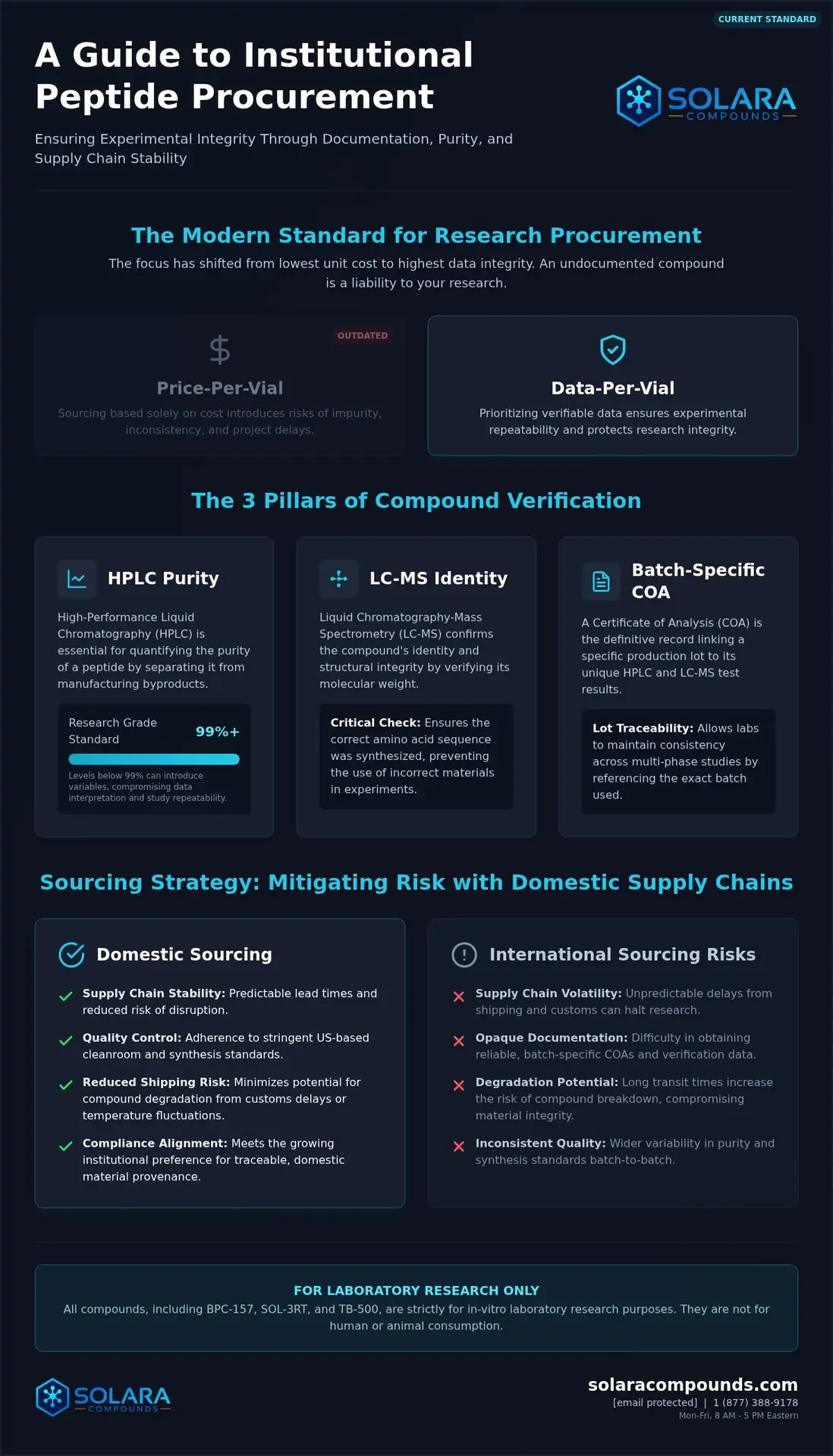
Procurement strategies have undergone a fundamental transformation. In 2026, the primary metric for success in institutional peptide procurement has shifted from the lowest price-per-vial to the highest “data-per-vial.” This change reflects a broader industry realization: an undocumented compound is a liability to experimental integrity. With the global peptide synthesis market valued at approximately USD 1.9 billion in 2026, the volume of available materials has grown, but so has the risk of inconsistency. Institutional buyers now demand comprehensive verification before a purchase order is even drafted. At Solara Compounds, we support this rigorous approach by providing batch-specific documentation for every research compound we offer. It’s critical to remember that all our products, including SOL-3RT and BPC-157, are for laboratory research only and are not for human or animal consumption.
Defining Institutional Standards for Research Compounds
The distinction between a retail vendor and an institutional supplier lies in the depth of their quality control frameworks. Retail vendors often focus on volume; institutional partners focus on repeatability. A core requirement for modern research is lot-number traceability. This allows lab buyers to maintain consistency across multi-phase studies, ensuring that the peptide used in month one possesses the same structural integrity as the batch used in month twelve. Most institutional SOPs now mandate this level of granularity to prevent batch-to-batch variability from skewing results. Understanding the nuances of chemical peptide synthesis is essential for vetting these standards, as it reveals the technical complexity required to maintain high purity levels consistently across different production runs.
The 2026 Compliance Environment for US Research Labs
Compliance in 2026 is defined by the “Research Use Only” (RUO) framework. This designation is a non-negotiable standard for both academic and private sectors. It ensures that compounds are utilized strictly within controlled laboratory environments and are not diverted for unauthorized purposes. Proper record-keeping has become a priority as institutional audits become more frequent and detailed. Labs must be able to prove the provenance of their materials, which has led to a strategic preference for domestic sourcing. By choosing a US-based supplier like Solara Compounds at solaracompounds.com, researchers mitigate the risks of international supply chain volatility and customs-related degradation. This transparency in the manufacturing source isn’t just about logistics; it’s about securing the long-term continuity of your research. Reliable institutional peptide procurement requires a partner who understands that the integrity of the compound is the foundation of the final data.
Essential Documentation: HPLC, LC-MS, and Batch-Specific COAs
Verification is the cornerstone of empirical research. Within the framework of institutional peptide procurement, a vial of lyophilized powder is only as valuable as the data supporting its identity and purity. High-Performance Liquid Chromatography (HPLC) and Liquid Chromatography-Mass Spectrometry (LC-MS) provide the technical evidence required to validate experimental results. At Solara Compounds, we prioritize this “documentation-first” approach by providing batch-specific Certificates of Analysis (COAs) for every lot. It’s vital to remember that all products, including BPC-157 and SOL-2TZ, are for laboratory research only and are not for human or animal consumption.
Interpreting HPLC Purity Metrics for Scientific Use
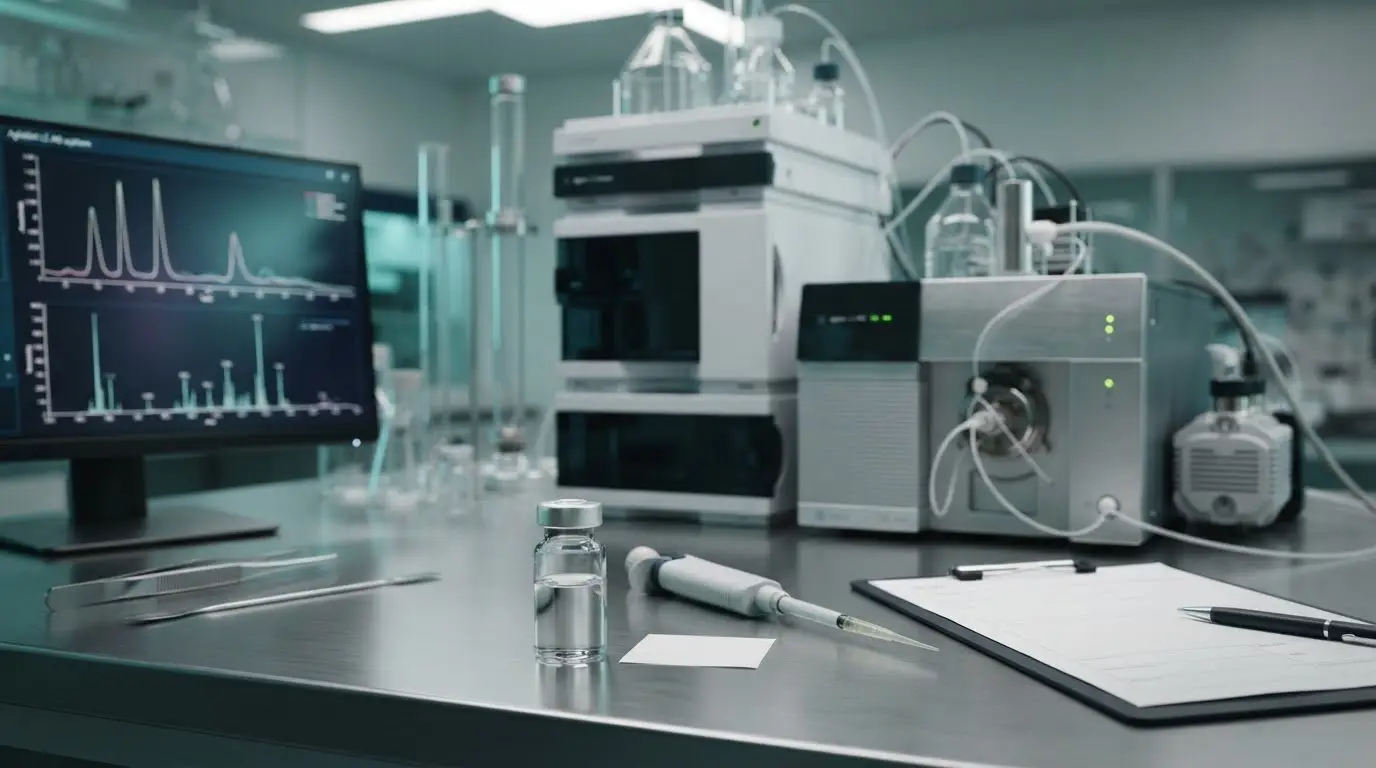
HPLC purity is determined through an Area-Under-the-Curve (AUC) calculation. This process involves passing the peptide through a specialized column to separate the target compound from any residual manufacturing byproducts. The resulting chromatogram displays peaks; the primary peak represents the target peptide, while smaller peaks indicate impurities. While a 98% purity level is the industry baseline, top-tier research requires 99% or greater to ensure that minor contaminants don’t interfere with in vitro models. Impurities can trigger unintended cellular responses, which complicates data interpretation and compromises the repeatability of your study. Researchers can view our catalog of documented compounds to see how these purity standards are applied to our current inventory.
Molecular Confirmation via Mass Spectrometry
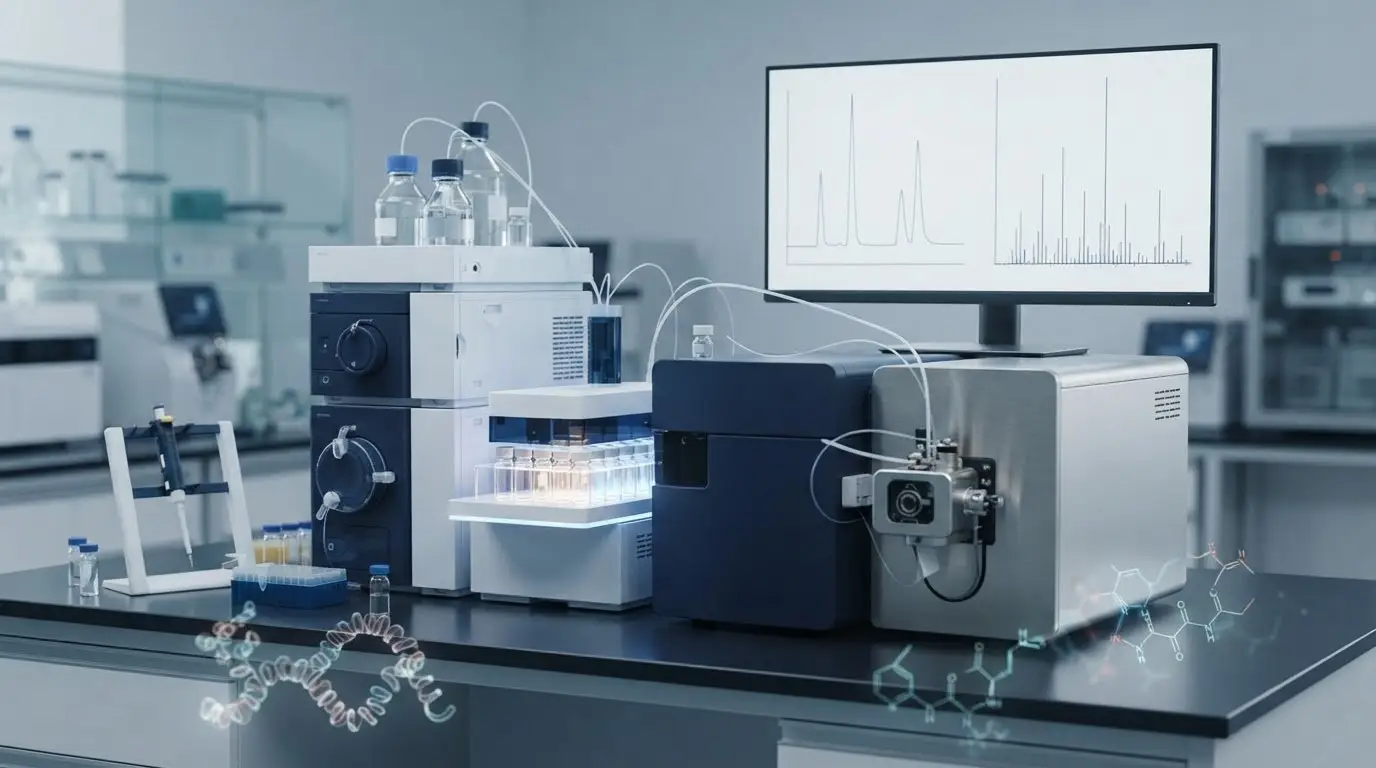
Purity testing alone is insufficient because it doesn’t confirm that the compound is the correct sequence. LC-MS serves as the definitive tool for ensuring research tool identity by measuring the molecular weight of the sample. This observed mass is compared against the theoretical molecular weight of the peptide sequence. Matrix-Assisted Laser Desorption/Ionization-Time of Flight (MALDI-TOF) is frequently utilized in this stage to validate the peptide sequence with high precision. If the observed mass deviates from the theoretical value, the compound is either degraded or incorrectly synthesized. Institutional compliance often involves following procedures for ordering and receiving controlled substances, and while many research peptides are not controlled, the same level of rigorous documentation and identity verification should be applied to all laboratory acquisitions.
The most common pitfall in procurement is the use of “representative” COAs. These documents show the results of a previous “perfect” batch rather than the specific lot you receive. Solara Compounds rejects this practice. We utilize Kovera Labs for independent, third-party verification, ensuring that every batch of SOL-3RT or TB-500 matches its specific paperwork. This commitment to transparency allows lab buyers to focus on their work rather than questioning the structural integrity of their materials. You can access our full library of reports at solaracompounds.com to verify the empirical data behind our compounds.
Evaluating Domestic vs. International Sourcing for Research
The decision between domestic and international sourcing is a critical pivot point in institutional peptide procurement. While international vendors may present lower initial unit costs, the hidden expenses of customs delays and potential product degradation often outweigh these savings. When a shipment of SOL-3RT or MOTS-C sits in a customs warehouse for ten days, the risk of ambient temperature exposure increases. This can lead to the loss of structural integrity, rendering the compound useless for precise laboratory applications. Solara Compounds mitigates these risks by operating entirely within the United States. It’s essential to remember that all our compounds are for laboratory research only and are not for human or animal consumption.
Domestic manufacturing provides a level of quality oversight that international vendors rarely match. Our ISO 7 cleanroom synthesis ensures that compounds like BPC-157 and GHK-Cu are produced in a controlled environment, minimizing the risk of contamination. For institutions located in major biotech hubs such as San Francisco, Boston, and San Diego, the proximity of a domestic supplier translates to increased experimental velocity. Establishing a redundant domestic supply chain ensures that your laboratory work continues without interruption, even when global logistics are strained. You can rely on solaracompounds.com for materials that haven’t been compromised by the unpredictability of international freight.
Risk Management in Peptide Sourcing
Risk management is about protecting the timeline of your study. Cold-chain failure is a significant concern during international transit, where fluctuating temperatures can destabilize sensitive lyophilized powders. Domestic shipping options, including next-day delivery, provide a level of security that international freight cannot offer. This speed is vital for time-sensitive projects where the arrival of high-purity compounds like TB-500 or NAD+ is the bottleneck for the next phase of research. Consistent domestic oversight ensures that every batch meets the required purity standards before it ever leaves our facility, protecting the integrity of your experimental data.
Supporting the US Biotech Infrastructure
Working with a US-based partner strengthens the domestic research ecosystem. As a Florida-based supplier, Solara Compounds is strategically positioned to serve East Coast labs with efficiency. Time-zone alignment is a practical advantage for procurement teams; it allows for immediate communication and technical support during standard business hours. You can learn more about Solara Compounds’ US-based mission and how we support the technical requirements of modern laboratories. By choosing a partner that prioritizes domestic reliability, you’re investing in a supply chain designed for the precision that institutional research demands.
Optimizing the Procurement Workflow for Laboratories
Efficiency in the lab isn’t just about the benchwork; it’s about the administrative pipelines that keep materials flowing. Standardizing the Purchase Order (PO) process is a critical component of institutional peptide procurement. By establishing clear protocols for acquisition, labs can bypass the common bottlenecks that delay experimental starts. This optimization includes implementing tiered pricing for bulk orders, which allows institutions to scale their research while maintaining strict budget controls. At Solara Compounds, we facilitate this by providing the necessary W-9 routing and managing tax-exempt status for universities and private research firms. All compounds, including SOL-3RT and BPC-157, are for laboratory research only and are not for human or animal consumption.
Steps to Establish a New Institutional Vendor Account
The transition to a new supplier requires a methodical vetting process to ensure SOP compliance. Initially, the Principal Investigator (PI) should review the batch-specific COA library at solaracompounds.com to verify testing protocols and purity standards. Once the technical requirements are met, coordination between the PI and the finance department is necessary to finalize vendor registration. We recommend requesting batch-level documentation early in the process. This ensures that every vial of SOL-2TZ or TB-500 matches the specific lot numbers required for institutional audits and longitudinal data integrity. A structured onboarding process prevents administrative friction from slowing down your scientific progress.
Logistics and Handling for Institutional Bulk Orders
Managing large quantities of research materials requires specialized storage and tracking procedures. Bulk lyophilized powders must be stored according to their specific stability profiles to prevent degradation over time, typically in a temperature-controlled environment. To optimize costs, lab buyers should take advantage of free shipping on orders over $200, which is a standard feature for most institutional acquisitions. Tracking lot numbers across multiple laboratory locations is another essential practice. It ensures that if a specific batch of MOTS-C or NAD+ is used in a multi-site study, the results remain comparable and reproducible. Researchers looking to streamline their supply chain can Shop research peptides to see how our workflow supports high-volume institutional needs.
Setting up standing orders is a final step for optimizing the workflow. For multi-phase experimental models, having a predictable delivery schedule prevents the sudden depletion of critical tools. This proactive approach to institutional peptide procurement ensures that your focus remains on the data, not the logistics of the next shipment. By aligning administrative efficiency with scientific rigor, your lab can maintain a steady pace of discovery without the risk of supply chain interruptions.
Solara Compounds: A Partner in Institutional Research
Solara Compounds positions itself at the intersection of material science and practical laboratory utility. We understand that institutional peptide procurement requires more than just a transaction; it demands a partner committed to long-term experimental success. Our role is to provide the structural integrity and batch-to-batch consistency that allow researchers to focus on their data. It’s essential to remember that all products, such as SOL-3RT and TB-500, are for laboratory research only and are not for human or animal consumption.
Featured Research Compounds for 2026
The Solara catalog is designed to support high-level investigative work across various scientific disciplines. Researchers investigating metabolic pathways, which are the chemical processes cells use to convert nutrients into energy, frequently utilize SOL-3RT and SOL-2TZ. These compounds are essential for understanding how energy regulation works at a cellular level. Similarly, BPC-157 and TB-500 are utilized in cellular signaling research, which studies how cells send and receive chemical messages to coordinate biological functions. You can View the current research catalog to see our full range of investigative materials.
The Solara Documentation Standard
Transparency is our baseline, not an added feature. We provide third-party validation through Kovera Labs for every batch, confirming both identity and purity before the compound enters your facility. Researchers can easily access these batch-specific reports at coa. This documentation ensures that the materials you use in your lab meet the rigorous standards required for publication and peer review.
Stability is another core focus of our manufacturing process. We utilize vacuum-sealed, sterile lyophilization to protect the molecular structure of our peptides. Lyophilization is a freeze-drying process that removes water from the compound while it’s frozen, which helps maintain its stability for long-term storage. For organizations with specific requirements, our team is available to discuss volume inquiries and customized procurement needs. You can contact research support at support@solaracompounds.com or 1 (877) 388-9178 to discuss how our approach to institutional peptide procurement can support your laboratory’s objectives. By prioritizing empirical data over marketing hype, we ensure that your research is built on a foundation of precision.
Strengthening the Integrity of Your 2026 Research
Successful research depends on the absolute consistency of your materials. By prioritizing batch-specific documentation and domestic supply chain stability, your lab can eliminate the variables that threaten experimental repeatability. Effective institutional peptide procurement is no longer just about inventory management; it is a strategic commitment to data integrity. Transitioning to a documentation-first model ensures that every compound matches its technical specifications, protecting your study from the hidden costs of impurities or logistical delays.
Solara Compounds serves as a reliable partner in this process. We provide batch-specific COAs on every lot and utilize Kovera Labs for independent third-party testing to verify both purity and identity. All our products, including SOL-3RT and BPC-157, are for laboratory research only and are not for human or animal consumption. We also offer free shipping on orders over $200 to help optimize your institutional budget. You can Shop research peptides at Solara Compounds to secure the high-grade materials your next project requires. We look forward to supporting your scientific breakthroughs with precision and transparency.
Frequently Asked Questions
What is institutional peptide procurement?
Institutional peptide procurement is the standardized process through which research organizations acquire high-purity compounds for laboratory use. This method prioritizes data integrity and lot-number traceability over simple unit costs. Laboratories in biotech hubs like Boston and San Francisco utilize these structured workflows to ensure that every experimental material meets strict internal SOPs. By standardizing acquisition through verified domestic suppliers, institutions can maintain the longitudinal consistency required for complex, multi-phase studies and rigorous academic investigations.
How do I verify the purity of a research peptide batch?
Researchers verify purity by analyzing the High-Performance Liquid Chromatography (HPLC) and Mass Spectrometry (MS) data provided in a Certificate of Analysis. The HPLC report uses an area-under-the-curve calculation to determine the percentage of the target compound. For institutional work in San Diego or Raleigh, a purity level of 99% or higher is the preferred standard. This level of precision prevents residual manufacturing byproducts from interfering with cellular signaling or metabolic pathway research in vitro.
Does Solara Compounds provide batch-specific COAs for all products?
Yes, Solara Compounds provides batch-specific COAs for every lot in our catalog. Unlike vendors who use representative reports, we don’t compromise on transparency. These reports are easily accessible at solaracompounds.com/coa/ for immediate review by your procurement team. This transparency is vital for labs in Austin and Seattle that require absolute verification of structural integrity before beginning time-sensitive experimental models or longitudinal studies. Every batch is assigned a unique lot number for complete traceability.
What are the shipping options for institutional buyers in the US?
We provide secure domestic shipping across the United States, with a focus on serving major research hubs like Houston, Tampa, and Chicago. Institutional buyers benefit from free shipping on all orders over $200, which helps optimize laboratory budgets. Because we ship from our Florida facility, we avoid the customs delays and temperature fluctuations associated with international freight. This reliability ensures that compounds like SOL-3RT and BPC-157 arrive at your facility without compromised structural stability.
Are Solara Compounds products intended for human consumption?
No, all products from Solara Compounds are strictly for Research Use Only (RUO) and are not intended for human or animal consumption. They are not medicines, drugs, or dietary supplements. Our compounds are supplied as lyophilized powders specifically for in vitro laboratory research and biochemical testing. Researchers in Philadelphia, Atlanta, and Miami must ensure that these materials are handled only by qualified professionals within a controlled laboratory setting to maintain safety and experimental standards.
How can our university set up a purchase order (PO) account?
Universities can establish a purchase order account by contacting our research support team at support@solaracompounds.com. We facilitate the onboarding process by providing necessary W-9 documentation and coordinating with your finance department to manage tax-exempt status. This streamlined workflow is designed for the high-volume needs of labs in Los Angeles and Baltimore. Standardizing your account allows for faster procurement of compounds like SOL-2TZ and TB-500, ensuring your research timelines remain on schedule without administrative delays.
What is the difference between SOL-3RT and SOL-2TZ for research use?
SOL-3RT and SOL-2TZ are distinct research tools used to investigate different metabolic pathways in laboratory models. SOL-3RT is the research designation for Retatrutide, while SOL-2TZ refers to Tirzepatide. Researchers in New York and Phoenix utilize these compounds to study cellular energy regulation and signaling mechanisms. While both are high-purity lyophilized powders, their specific chemical structures interact with different receptors in vitro, making them suitable for specialized, non-clinical comparative studies in molecular biology and metabolic research.
Why is third-party testing via Kovera Labs important for labs?
Third-party testing through Kovera Labs provides an independent layer of verification that is essential for scientific reproducibility. This objective analysis is a cornerstone of reliable institutional peptide procurement, as it confirms the data provided in our internal reports. For investigators in Denver or Dallas, this independent validation is a critical requirement for institutional audits and peer-reviewed publications. It guarantees that the structural integrity of your research materials is verified by the highest industry standards before experimentation begins.