Research Articles
How GHK-Cu May Signal Cellular Regeneration and Repair


GHK-Cu is studied for cellular signals associated with tissue structure, inflammation, and blood-vessel formation. GHK-Cu cellular regeneration studies examine these processes in laboratory and animal models, helping researchers investigate how distinct signals interact.
Researchers in Boston, San Diego, San Francisco, New York, Houston, Miami, Los Angeles, Austin, Raleigh, Seattle, Chicago, Philadelphia, Baltimore, Dallas, Phoenix, Tampa, Atlanta, and Denver can use this guide to distinguish model-based findings from conclusions about people. It covers research into tissue remodeling, oxidative signaling, and blood-vessel formation, and explains what cell and animal models can show. All products are for Research Use Only (RUO), intended solely for laboratory research and not for human or animal consumption; they are not drugs, medicines, or dietary supplements.
Key Takeaways
- Trace how GHK-Cu may influence tissue-remodeling signals, including the cells and structural proteins involved in repair.
- See how laboratory findings connect inflammatory and oxidative-stress signals with cellular responses.
- Understand why blood-vessel growth and growth-factor activity matter in wound-model research.
- Compare evidence from cell experiments and animal models, and keep those findings distinct from conclusions about people.
- Use the article’s evidence-focused framework to interpret what these models can reveal about repair, and what they cannot establish.
Stem cell and tissue regeneration signaling
Researchers have examined GHK-Cu in relation to gene activity involved in cell renewal and tissue structure. Such findings can help shape laboratory questions, but they do not demonstrate regeneration in people.
Stem-cell signaling and tissue renewal
Connectivity Map profiling identified changes in genes associated with stem-cell function. Expression increased by at least 50% for 57 genes and decreased by at least 50% for 46 genes. The profile suggests that gene-expression patterns related to stem-cell function may be affected. LIN28A expression decreased by 259%.
These values describe gene-expression patterns, not numbers of stem cells formed or tissues regenerated. A gene’s expression indicates its activity in a particular experimental context. Researchers can use such profiles to select follow-up markers, then test whether a gene shift corresponds with a separate cellular outcome. Human serum GHK levels average 80 ng/ml by age 60, according to Original study authors. That measurement provides context, not a personal-use guide.
Collagen and Connective Tissue Synthesis
Collagen and connective-tissue synthesis involves producing and organizing proteins that provide structural support. GHK-Cu has been associated with collagen, fibronectin, and elastin production in skin and connective-tissue cells. These components contribute to the extracellular matrix, the framework surrounding cells. Researchers can measure protein production separately from how the material is organized in a model.
Copper is a cofactor for lysyl oxidase, an enzyme involved in collagen and elastin cross-linking. This provides a specific mechanism to investigate alongside collagen formation, without assuming that a measured signal produces stronger tissue structure.
Wound Repair and Tissue Renewal
Wound-repair models examine coordinated changes at a damaged tissue site. In laboratory settings, keratinocytes may migrate across a wound bed, while fibroblasts contribute to connective-tissue activity. Measuring cell movement separately from cell growth helps researchers identify which process changes under the experimental conditions.
For example, a model can track keratinocyte movement across a defined gap. This describes cell behavior in that model; it does not establish tissue closure or function in people or animals.
Fibrosis and Scar Tissue Remodeling
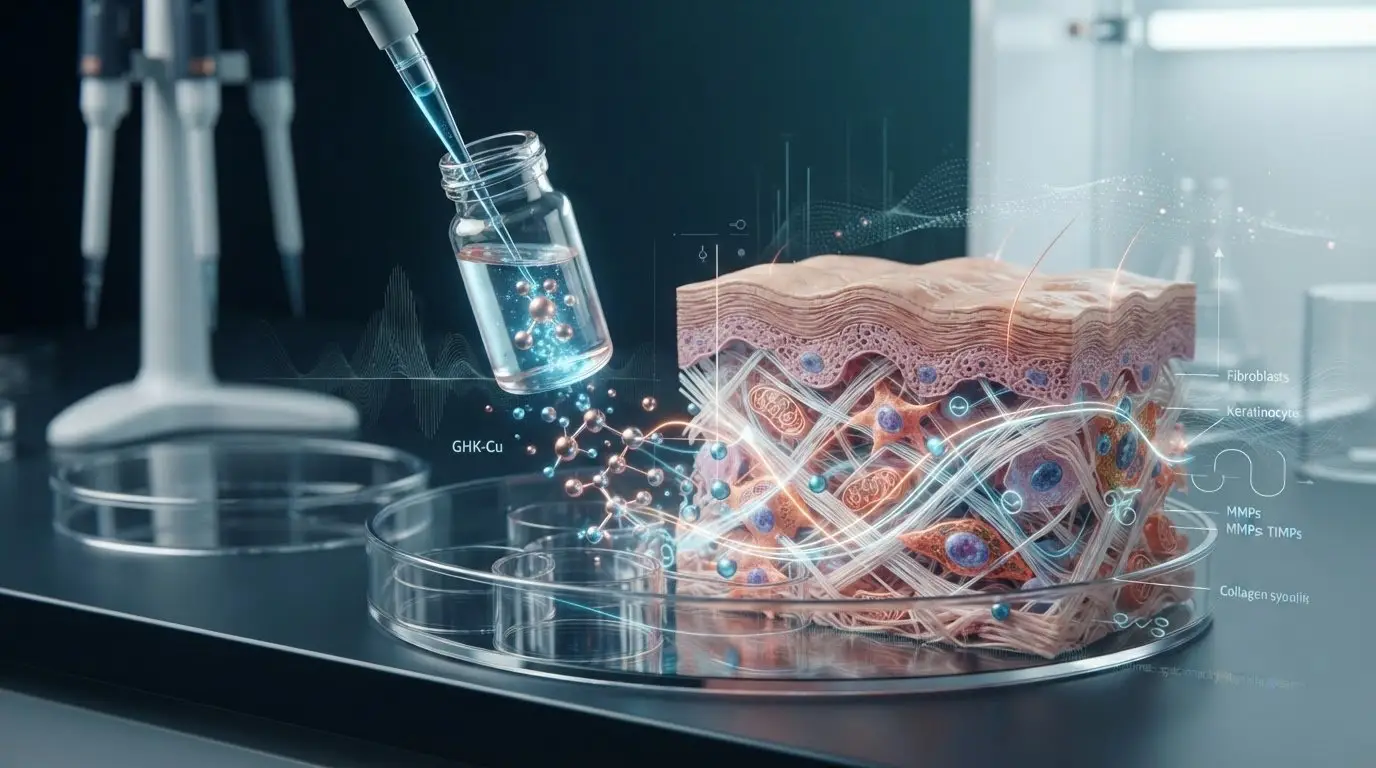
Fibrosis involves excess connective-tissue material that can alter tissue structure, while remodeling refers to changes in matrix composition over time. GHK-Cu has been associated with regulation of matrix metalloproteinases, enzymes that break down damaged dermal material, and with limiting excessive fibrotic-protein production.
Researchers can assess matrix formation and breakdown as separate outcomes. This helps distinguish altered turnover from increased material accumulation in a model.
Comparing Regeneration Treatments
GHK-Cu is studied for signals associated with matrix activity and cellular responses. Other compounds may involve different targets, so comparisons depend on the model and the outcome measured. No single experimental endpoint establishes broad superiority across tissues.
GHK-Cu is for Research Use Only (RUO), intended solely for laboratory research and not for human or animal consumption. Experimental findings do not establish an FDA-approved use for cellular regeneration.
Inflammatory and antioxidant signaling
Researchers have examined GHK-Cu in relation to inflammatory signals and oxidative stress. Cell experiments measure distinct outcomes, including cytokine release and reactive oxygen species levels.
Inflammation and Oxidative Stress
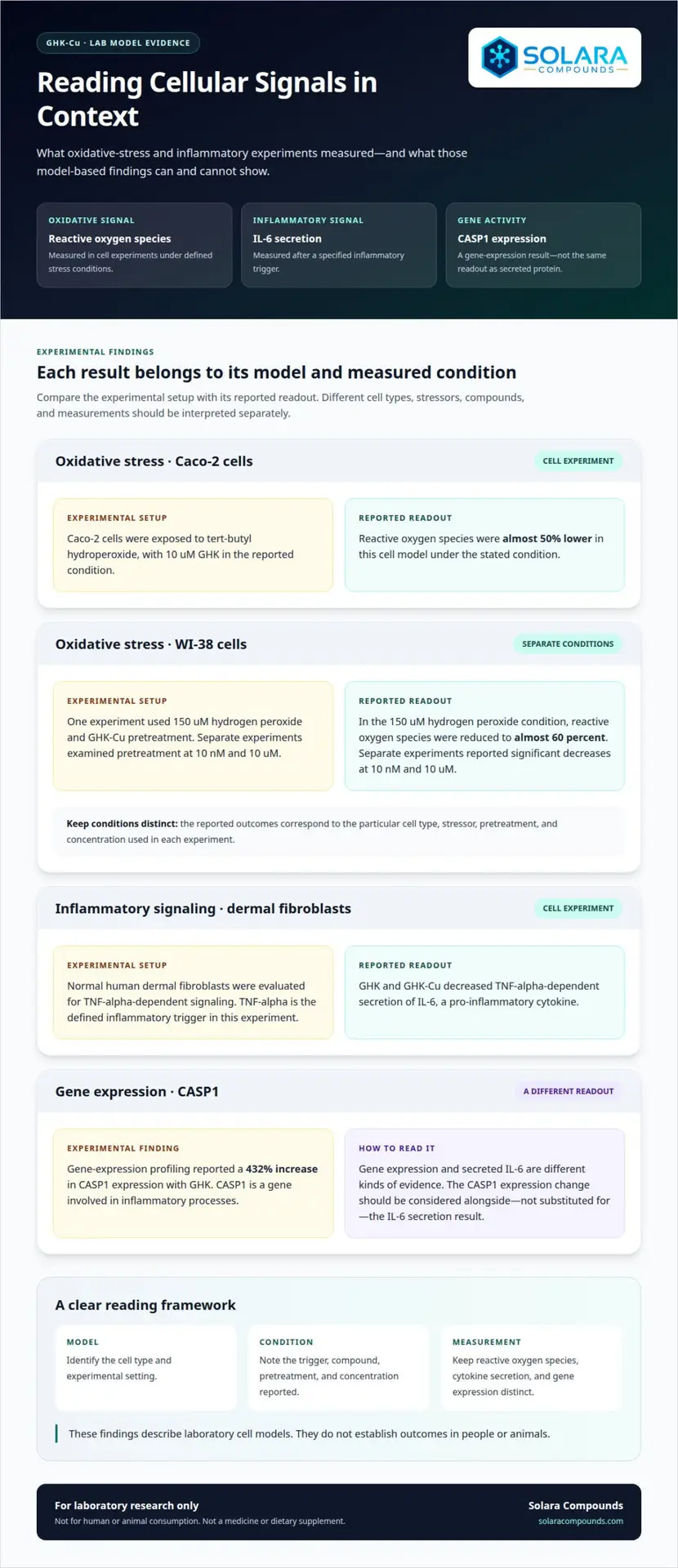
Inflammation is a coordinated cell response, while oxidative stress involves reactive oxygen species that can damage cell components. In laboratory experiments, researchers track both signals to distinguish inflammatory activity from oxidative changes. For example, Caco-2 cells exposed to tert-butyl hydroperoxide showed almost 50 percent lower reactive oxygen species with 10 uM GHK. This result describes that cell model and measured condition.
WI-38 cells offer another example. After exposure to 150 uM hydrogen peroxide, GHK-Cu pretreatment reduced reactive oxygen species levels to almost 60 percent. Separate WI-38 experiments found significant decreases after pretreatment at 10 nM and 10 uM. These different concentrations and conditions matter: the measured effect belongs to each experimental setup, not every tissue or model.
For useful interpretation, consider the stressor, cell type, pretreatment, and measured outcome together. A change in reactive oxygen species levels does not by itself show a change in cytokine signaling. Separating these measurements helps researchers determine whether copper-containing GHK-Cu affects oxidative signals, inflammatory signals, or both in a particular model.
Anti-Inflammatory Effects
Anti-inflammatory effects refer here to changes in signals that promote inflammation, not a general treatment outcome. In normal human dermal fibroblasts, GHK and GHK-Cu decreased TNF-alpha-dependent secretion of IL-6, a pro-inflammatory cytokine. The model connects a defined inflammatory trigger with a measured secreted signal, helping researchers examine how GHK-related compounds influence fibroblast responses.
Gene-expression profiling also reported a 432% increase in CASP1 expression with GHK. CASP1 is a gene involved in inflammatory processes, so its expression change should be considered alongside the IL-6 secretion finding. A gene-expression shift and a secreted-protein change are different kinds of evidence; neither substitutes for the other.
The copper component has also been associated with increased activity of superoxide dismutase (SOD), an enzyme involved in managing reactive oxygen species. Researchers can consider SOD activity alongside direct reactive oxygen species measurements and cytokine levels. Comparing these readouts clarifies how an experimental effect relates to oxidative and inflammatory signaling.
For laboratory buyers studying these pathways, the research compound catalog offers a starting point for selecting materials relevant to controlled experiments.
Angiogenesis and growth factors
Angiogenesis is the formation of new blood vessels, a process that can support tissue repair. Findings on GHK-Cu connect growth-factor signals with endothelial-cell activity in experimental models.
Blood-vessel formation and growth factors
In irradiated human dermal fibroblasts, GHK-Cu at 1 nM increased expression of basic fibroblast growth factor and vascular endothelial growth factor. These signals are commonly shortened to bFGF and VEGF. Their expression provides one way to examine how cells respond to GHK-Cu under a defined experimental stress.
Gene expression, released protein, and newly formed vessels are distinct measurements. Researchers can separate these steps by measuring growth-factor expression, then assessing endothelial-cell growth and movement. GHK-Cu has been associated with both endothelial behaviors, which are relevant to angiogenesis. Each endpoint captures a different part of the process.
This distinction matters when studying tissue remodeling. A change in VEGF expression alone does not demonstrate functional blood-vessel formation. Similarly, endothelial movement in a laboratory model does not establish how a wound would respond in an animal or person. Comparing cell signals with structural outcomes gives a clearer view of what the experiment measured.
Nerve growth and repair signaling
GHK-Cu has also been associated with increased production of nerve growth factor (NGF), a signal involved in neuronal growth and maintenance. This offers a separate research direction alongside collagen formation and vessel-related activity, not proof of nerve repair.
Researchers can assess NGF production alongside cell-specific responses, such as neuronal growth or movement in a model. They can also distinguish direct measurements from downstream outcomes. This helps clarify whether an observed signal relates to nerve cells, endothelial cells, or dermal fibroblasts, rather than grouping different responses under a broad label.
Oxidative stress can affect cell behavior in experimental systems and may shape how growth-factor results are interpreted. Comparing stressed and unstressed conditions can show whether a signal changes with the model’s environment. This comparison alone does not demonstrate angiogenesis or nerve growth in living tissue.
Hair growth and DHT
Hair-focused experiments require distinct endpoints, such as follicle-cell activity, hair-shaft formation, and local growth-factor signals. GHK-Cu has been discussed in relation to localized hair research, but blood-vessel or NGF findings alone cannot establish a hair-related outcome.
DHT, or dihydrotestosterone, is a separate variable researchers may examine in hair-related models. The angiogenesis and growth-factor findings described here do not establish that GHK-Cu changes DHT levels or blocks its activity. Keeping DHT measurements separate from VEGF, NGF, and endothelial responses helps prevent one experimental signal from being mistaken for another.
Potential repair effects beyond skin
GHK-related findings also touch on bone-matrix biology and DNA-repair signaling. These are distinct research questions, each requiring different cellular markers and experimental outcomes.
Bone repair and regeneration
Osteoblasts are cells that build bone matrix, the structural material surrounding bone cells. GHK-Cu has been associated with osteoblast activity, matrix deposition, and mineralization. These processes provide specific endpoints for investigating bone formation, rather than relying on a broad label such as repair and regeneration.
Matrix deposition and mineralization are related but separate steps. Deposition means producing and laying down the matrix; mineralization means adding mineral content that gives bone its structure. Measuring both can help distinguish increased matrix production from changes in mineral content. One marker alone cannot represent the entire sequence.
For example, a bone-focused experiment can assess osteoblast activity alongside matrix formation and mineralization. These measures help identify which part of the process changes in a model. They do not establish that GHK-Cu rebuilds bone in people or that findings in bone apply to skin, cartilage, or other tissues.
DNA repair signaling
DNA repair is the set of cellular processes that identifies and responds to damage in genetic material. In a reported gene-expression profile, GHK increased PARP3 expression by 253% and POLM expression by 225%. Both genes are associated with DNA-repair functions, so their expression changes provide a reason to examine repair signaling in laboratory models.
Gene expression measures a gene’s activity, not whether DNA damage has been repaired. To assess repair directly, researchers would distinguish gene activity from outcomes such as damage levels or repair efficiency. Keeping these measures separate prevents an expression shift from being presented as completed repair.
PARP3 and POLM also represent only specific parts of a broader cellular response. A controlled experiment can compare their expression with direct measures of DNA damage and recovery. That approach helps determine whether a signal aligns with a functional change, rather than assuming that increased expression automatically improves repair.
Bone and DNA findings therefore point to separate lines of inquiry. Osteoblast activity concerns matrix production and mineralization; PARP3 and POLM expression concerns repair-related signaling. These outcomes are useful for defining experimental questions, but neither establishes a general regenerative effect across tissues or demonstrates a result in people or animals.
Evidence from animal and laboratory wound models
Cell cultures and animal models provide different kinds of evidence. Their value depends on the measured endpoint, model design, and limits of comparison.
Cell Culture Studies of Tissue Repair
Cell-culture studies examine cellular responses under controlled laboratory conditions. In vitro findings report GHK-Cu-associated changes in keratinocyte and fibroblast growth and movement. These observations help answer whether cells respond in a simplified model, but do not establish what happens across intact tissue.
For interpretation, identify the cell type, experimental setting, and endpoint. A movement assay, for example, measures cell displacement, not tissue function. Results can guide further experiments, but should not be treated as evidence of an outcome in people or animals.
Collagen, Gene Expression, and Inflammation Evidence
Research on these topics uses different laboratory measurements. Assess each result in the context of its methods, controls, and model instead of combining separate findings into one conclusion. This preserves what each experiment actually tested.
For example, a study measuring one endpoint cannot establish a related outcome it did not measure. Cross-study comparisons also require attention to differences in cell type and experimental conditions. These principles help evaluate evidence without implying that separate measurements prove a broader effect.
Animal Models and Human Clinical Evidence
Animal models add context beyond isolated cells, while remaining specific to their design. In a mouse model of anterior cruciate ligament reconstruction, articular GHK-Cu at 0.3 mg/ml was associated with changes in selected study outcomes. This result belongs to that model and cannot establish outcomes for other tissues.
Findings from cell and animal models do not establish what human clinical trials show. The evidence discussed here does not support a claim that GHK-Cu has been tested in human trials for skin repair or regeneration. Keep clinical conclusions separate from preclinical observations.
Use these findings to frame further laboratory questions, not personal-use decisions. GHK-Cu products are for laboratory research only, not for people or animals. Researchers can explore the research catalog for laboratory materials.
Solara Compounds: SOL-3RT Retatrutide 10mg
SOL-3RT Retatrutide 10mg is a separate research compound, not a tissue-regeneration alternative to GHK-Cu. The findings discussed above concern specific laboratory and animal models; they don’t establish that one compound can replace another or serve the same research question.
For lab buyers whose work includes retatrutide, Solara Compounds provides SOL-3RT Retatrutide 10mg for laboratory research only. It is not medicine or a supplement, and it is not for use in people or animals. Solara Compounds provides third-party testing and batch-specific Certificates of Analysis to support review of research materials.
Visit solaracompounds.com to view the research catalog and relevant batch documentation.
GHK-Cu and retatrutide are separate research compounds. The findings discussed here do not establish that either replaces the other or addresses the same research question.
Turn the Evidence Into a Clear Research Question
GHK-Cu cellular regeneration studies are valuable for the research questions they help define. Choose a measurable endpoint, specify the model, and distinguish observed cellular activity from broader claims about tissue outcomes. This makes the next experiment more focused and easier to interpret.
Findings from laboratory and animal models may not predict outcomes in people. GHK-Cu and other research compounds are for laboratory research only, not medicine, supplements, or use in people or animals.
For laboratory work involving GHK-Cu, review the research materials and batch documentation before selecting a compound. Solara Compounds provides research compounds with third-party testing and batch-specific Certificates of Analysis.
Explore research compounds at Solara Compounds and take your next research question forward with care.
Frequently Asked Questions
How Does GHK-Cu Work?
GHK-Cu is studied as a copper-associated peptide that may influence cell signaling. Researchers examine it by measuring defined outcomes, such as gene activity, protein production, or cell movement. These measurements answer different questions: a change in a cellular marker does not by itself demonstrate a broader tissue-level effect. A useful experiment connects the selected marker to a specific research question.
How is GHK-Cu Used in Regenerative Medicine?
GHK-Cu is a laboratory research compound, not for personal use. In research settings, it may be examined in models involving tissue signals, cell behavior, or matrix activity. Keep these experimental questions distinct from medical applications. Products are for Research Use Only (RUO), not for human or animal consumption, and findings from a model do not establish outcomes in people.
What Exactly Is GHK-Cu?
GHK-Cu is a complex involving copper and the tripeptide GHK, whose amino acids are glycine, histidine, and lysine. Together, the peptide and copper make up the named compound. This distinction helps researchers describe materials accurately: GHK refers to the three-amino-acid peptide, while GHK-Cu identifies its copper-associated form. Precise naming matters when recording experimental materials and results.
What are the side effects of GHK-Cu?
GHK-Cu products are for Research Use Only (RUO), intended solely for laboratory research and not for human or animal consumption. This FAQ cannot provide personal-use side-effect assessments or use instructions. In an experiment, researchers define the model and measured endpoints, then document cellular responses within that setup. These observations are not a human or animal safety profile, and laboratory findings should not guide personal exposure.
What is GHK-Cu used for?
Researchers use GHK-Cu in laboratory work examining cellular signaling and tissue-related processes. A project might focus on how a selected cell model responds, or compare a signaling marker with a separate structural measurement. The compound isn’t a medicine, supplement, or product for personal use. Keeping the research question and model explicit helps prevent experimental observations from being mistaken for evidence of human benefit.
What is GHK-Cu?
GHK-Cu is the copper-associated form of GHK, a small peptide made from glycine, histidine, and lysine. It is studied as a research material, with laboratory questions focused on cellular responses under defined conditions. The name identifies the peptide-copper complex, not a promise of a particular result. Researchers should use the exact compound name when documenting materials and interpreting findings.
What is GHK?
GHK refers to the three-amino-acid sequence glycine, histidine, and lysine. It is distinct from GHK-Cu, which denotes the copper-associated complex. This distinction matters in research records, helping separate findings tied to GHK from those involving GHK-Cu. Neither name implies a product for personal use; both are intended solely for laboratory research.
What is GHK-Cu and how is it thought to affect cellular regeneration?
GHK-Cu is a copper-associated tripeptide studied for possible effects on cell signaling linked to tissue processes. Researchers can test a proposed connection by choosing a model, measuring a cellular response, and then assessing a separate functional outcome. This helps distinguish a change in a marker from a broader claim about regeneration. The compound is for laboratory research only, not for human or animal use.