Research Articles
Four ways to mitigate risks in chemical procurement through sourcing


A purchase order can be accurate while the supply behind it remains vulnerable. Mitigating risks in chemical procurement starts with qualifying suppliers, monitoring financial stability, mapping upstream dependencies, and reviewing quality and safety records. These controls help procurement teams spot problems before they interrupt supply or compromise a batch.
Supplier reliability is only one part of the picture. Financial strain, concentrated sourcing, and gaps in batch records can all create exposure. A sound process therefore looks beyond the immediate vendor and quoted material.
This guide covers four practical ways to strengthen procurement decisions: assess and diversify suppliers, monitor financial health over time, improve upstream supply-chain visibility, and make documentation part of quality review. Together, these steps give researchers and laboratory buyers a clearer basis for evaluating chemical inputs and responding when risks emerge.
Key Takeaways
- Reduce dependence on a single supplier or sourcing region by identifying alternative sources for critical materials.
- Monitor suppliers’ financial health and performance over time so emerging risks are visible before they disrupt supply.
- Map upstream dependencies, including lower-tier suppliers, to uncover vulnerabilities beyond your direct vendor.
- Make batch records and safety documentation part of quality review to catch gaps before materials enter laboratory workflows.
- For chemical handling in the United States, include applicable OSHA safety standards in procurement and operational planning.
1. Supplier diversification and regional sourcing
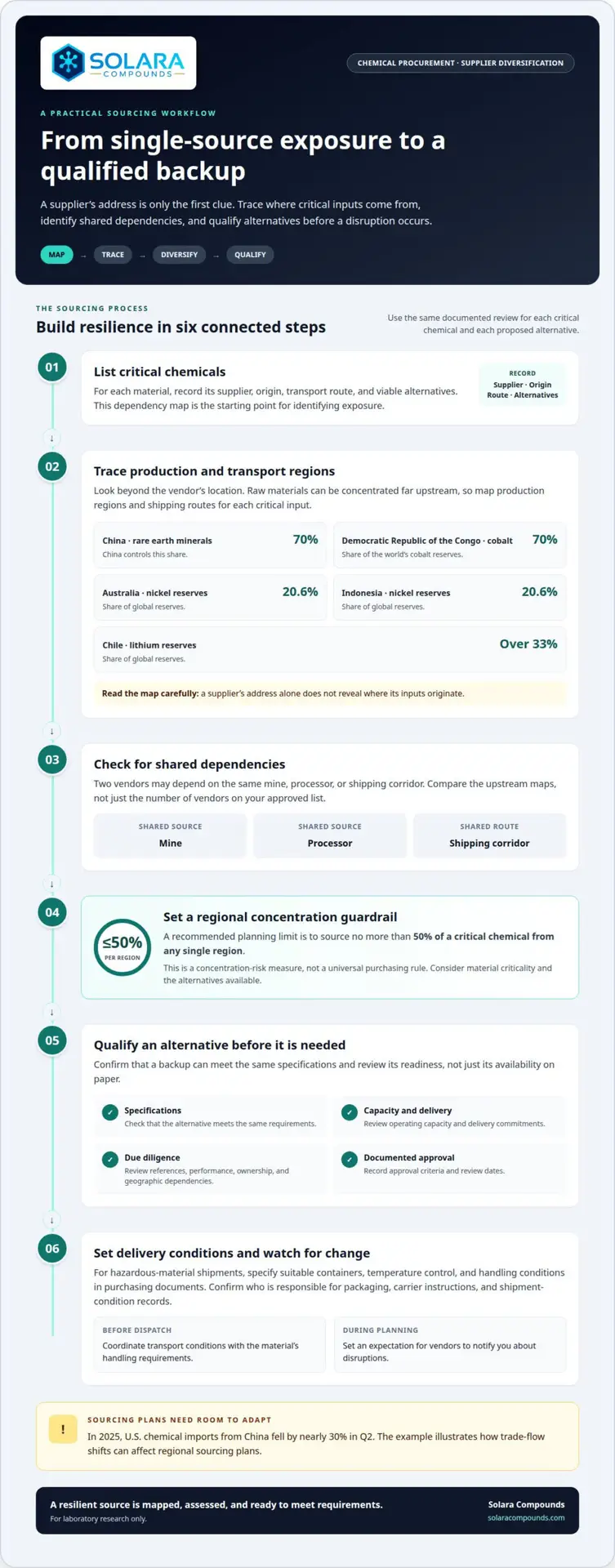
Single sourcing simplifies purchasing but leaves a laboratory dependent on one supplier’s capacity, finances, and location. A production interruption, transport delay, or liquidity problem can affect every order. Multiple qualified sources spread exposure, but require consistent specifications and quality review. Start by listing critical chemicals and recording each material’s supplier, origin, route, and viable alternatives. This dependency map is a practical first step in mitigating risks in chemical procurement.
Raw materials can be concentrated in particular regions. China controls 70% of rare earth minerals, while the Democratic Republic of the Congo holds 70% of the world’s cobalt reserves. Australia and Indonesia each account for 20.6% of global nickel reserves, and Chile has over 33% of global lithium reserves. These examples show why a supplier’s address alone cannot reveal where its inputs originate.
Map each critical material to its production and transport regions, then identify shared dependencies among vendors. Two suppliers may rely on the same mine, processor, or shipping corridor. A recommended planning limit is to source no more than 50% of a critical chemical from any single region. Treat this as a concentration-risk measure, not a universal purchasing rule; material criticality and viable alternatives should guide its use.
Qualify vendors through documented due diligence. Review financial exposure, ownership and control, negative media, operating capacity, and evidence of past performance. Request references and, where practical, visit the supplying facility. Compare specifications and delivery commitments with purchase requirements, then record approval criteria and review dates. This helps determine whether a backup source is genuinely ready, rather than simply available on paper.
To reduce disruption, maintain a qualified alternative for each critical input and test whether it can meet the same specifications. Check references, capacity, and geographic dependencies before approving that source. Procurement teams can also set a disruption-notification expectation with vendors. In 2025, U.S. chemical imports from China fell by nearly 30% in Q2, illustrating how trade-flow shifts can affect regional sourcing plans.
Hazardous-material shipments may need suitable containers, temperature control, and careful handling. Specify packaging and transport conditions in purchasing documents, and coordinate them with the material’s handling requirements. Confirm responsibility for packaging, carrier instructions, and shipment-condition records before dispatch. A qualified vendor must deliver the chemical in the required condition, not simply offer it.
2. Supplier financial stability and ongoing monitoring
A supplier’s financial condition can change after initial approval. Standard vendor reports may not reveal liquidity problems or debt exposure, so review the available evidence for each critical supplier. Document financial indicators, payment concerns, ownership changes, and reported operational strain. Compare new information with the supplier’s earlier profile to identify meaningful changes.
A Dun & Bradstreet credit score below 80 is identified as a critical threshold for financial stability in chemical procurement. Treat a score as one screening input, not a complete assessment. Combine it with due diligence on financial stability, past performance, operational capacity, compliance history, and the supplier’s ability to meet agreed specifications.
Replace a once-a-year review with monitoring at defined decision points, such as contract renewals, major order changes, missed deliveries, quality deviations, or ownership updates. At each point, update the supplier profile and record the evidence behind any change in risk status. This creates a decision trail instead of relying on an outdated approval when conditions have shifted.
Digital monitoring can organize supplier updates, financial reports, delivery records, and public information. Set alerts for changes such as worsening payment terms, repeated delays, or negative media, and assign someone to assess each alert. Automation can sort and route information, but a procurement specialist should evaluate context before changing a supplier’s status. Keep dated records of alerts, findings, and follow-up actions.
Connect monitoring to contingency planning. For each critical supplier, define the response if financial or performance indicators deteriorate, including who makes the decision and how purchasing shifts to an assessed alternative. Maintain alternative sources and review their readiness during supplier-risk reassessments. A backup that has not been evaluated against specifications, capacity, and delivery needs may not reduce exposure during a disruption.
Track a consistent set of relevant indicators: financial signals, on-time delivery, specification adherence, and responsiveness to corrective actions. Compare performance across review periods and investigate patterns rather than treating every isolated event as proof of failure. Set escalation thresholds in internal procedures, tailored to the material’s criticality and the impact of interrupted supply.
For laboratory buyers comparing research materials, the research catalog provides a product-level starting point for procurement review.
Make financial review part of routine supplier governance. Use due diligence to assess each vendor’s financial stability, then monitor it as conditions change. Reassess risk at key milestones and refresh vendor profiles when new information becomes available, so decisions reflect current evidence rather than outdated assumptions.
For critical suppliers, contingency plans, alternative sourcing options, and ongoing performance monitoring can strengthen resilience. Replacing annual evaluations with continuous monitoring, alongside flexible agreements with adjustment mechanisms, helps teams respond as supply conditions evolve.
3. Supplier relationships and upstream supply-chain visibility
A chemical procurement risk assessment should map critical materials, supplier dependencies, geographic and logistical exposure, and potential disruption impacts. Review supplier capacity, past performance, compliance history, and specifications; document the risks, assign owners, and define mitigation actions. Revisit the assessment whenever a supplier or supply route changes.
Visibility must extend beyond the company issuing the purchase order. Around 40% of supply-chain disruptions occur below a business’s direct supplier, making Tier 2 and Tier 3 suppliers important to assess. Ask direct vendors to identify key upstream sources, processing stages, and transport links for critical materials. A shared dependency, such as one processor serving several vendors, can turn apparent diversification into a single point of failure.
Build a material map linking each chemical to its business impact and upstream dependencies. Prioritize materials with few substitutes, long or vulnerable routes, or concentrated sources. For high-impact inputs, assess whether an alternative formulation could meet the laboratory specification. Technical teams should evaluate compatibility and performance before procurement treats a formulation as a viable substitute.
Supplier relationships make this information usable. Agree on communication channels, escalation contacts, and a notice process for anticipated disruptions. A 60-90 day notice period is recommended for expected supply interruptions, giving teams time to assess inventory, production needs, and alternatives. Set clear KPIs with vendors, then review delivery, specification adherence, and corrective-action progress during regular contract meetings.
Use audits and qualification records to test what vendors report. Assess operational capacity, quality controls, sustainability practices, and relevant compliance history. Supplier audits increasingly include environmental, social, and governance standards alongside quality and financial checks. Document findings, corrective actions, and closure evidence in the supplier record. This creates a traceable basis for continued approval and helps distinguish a documented control from an informal assurance.
Performance measures should reflect material requirements, not a generic scorecard. On-time delivery above 95% is a high-performing chemical supplier benchmark, but procurement teams should also track specification conformity and response to deviations. Investigate recurring delays or unresolved corrective actions, then agree on owners and deadlines with the vendor. Contract monitoring should compare performance with agreed KPIs and address deviations promptly.
Finally, test the response plan against a realistic scenario, such as a Tier 2 processor interruption. Confirm who contacts the supplier, which alternative source is qualified, and whether any approved formulation remains suitable. Record decisions and update the risk assessment afterward. This exercise turns supply-chain visibility into an operational plan rather than a static vendor map.
4. Chemical quality and regulatory documentation
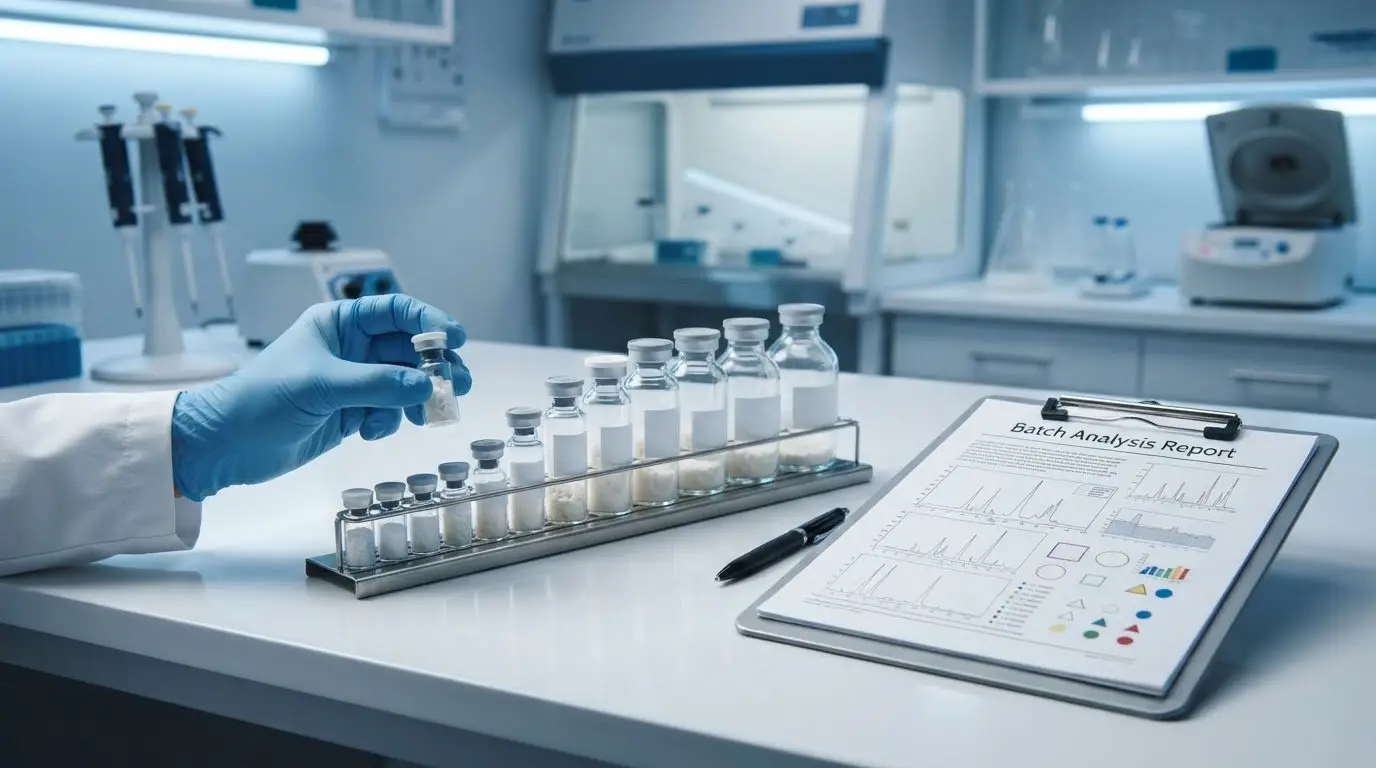
Require a current Safety Data Sheet (SDS), a batch-specific Certificate of Analysis (COA), and applicable compliance records. The SDS should align with GHS Revision 7 or higher; match every document to the chemical, supplier, and batch being purchased.
A Certificate of Analysis (COA) supports batch review by tying test results to a specific lot. Compare its identifiers with the container label and purchase records, then check reported results against the agreed product specification. Record discrepancies before accepting the material. A general quality statement cannot replace batch-level documentation when the purchase requires evidence tied to a particular lot.
Review the Safety Data Sheet (SDS) before laboratory receipt to understand hazards, handling precautions, storage conditions, and emergency information. Confirm that it describes the supplied chemical and its relevant hazards. If packaging, labels, and SDS details conflict, pause receipt and resolve the inconsistency through the established quality process. Retain the reviewed version with purchasing and receiving records.
Regulatory documentation depends on the chemical and its intended application. U.S. reviews may involve TSCA, FDA 21 CFR Parts 210/211, or California Proposition 65, where applicable. European suppliers follow REACH chemical registration requirements. Identify which requirements relate to the specific material and activity, then retain relevant records with the approved supplier and product files.
Build document review into each purchase workflow. Before release, verify the product name, batch identifier, specification, SDS revision, and required compliance evidence. At receipt, reconcile the delivered label and lot with the purchase order and COA. This comparison can reveal mismatched documents before the material enters inventory or laboratory work.
Documentation gaps have operational consequences. A documentation error or missed safety check can lead to rerouted shipments, spoiled product, or regulatory penalties. Rejected batches can consume 20-60 hours of quality-assurance time and delay production by 4-10 weeks. These impacts make pre-receipt review a practical procurement control, not an administrative afterthought.
Use measurable quality performance alongside document checks. Right-first-time quality above 98% is a high-performing chemical supplier benchmark. Track deviations, rejected batches, and recurring paperwork errors against each supplier’s records. When a discrepancy occurs, document its cause, corrective action, and closure before relying on the affected process again.
For research peptides, batch-specific paperwork and third-party testing help laboratory buyers evaluate material records. Products are for laboratory research only, not medicine or supplements, and are not for people or animals.
5. What regulations govern chemical purchasing, storage, transport, and reporting in the United States?
U.S. chemical buyers must comply with OSHA safety standards. Start before issuing a purchase order: identify the substance, intended laboratory task, hazards described in its Safety Data Sheet (SDS), and receiving location. For example, connect a solvent’s documentation to the specific material and planned storage area. Procurement records should show who reviewed these details and when.
Build a review step into the requisition process. Before approving an order, match the requested chemical to its SDS, product specification, and intended laboratory use. Check that supplier documents clearly identify the material, then retain them with the purchase record. This creates a traceable link between the item selected and the information laboratory staff use to handle it.
Plan storage before the shipment arrives. Use the SDS to identify stated storage conditions and handling precautions, then confirm the receiving area is suitable. Assign a designated storage location and ensure staff can access the relevant safety information. Record the material’s location and associated documents so teams can find them during routine work or an incident.
Transport brings its own practical checks. Confirm that packaging, handling instructions, and shipment conditions align with the material’s documented hazards and requirements. Chemical shipments may require specialized containers, precise temperature control, and strict handling procedures. Procurement and receiving teams should clarify responsibility for these controls, preserve shipment records, and investigate damage or condition concerns before accepting the material.
Integrate reporting and recordkeeping into the same workflow. Keep the purchase order, SDS, batch or lot documentation, receipt details, and any incident or corrective-action records together. Assign responsibility for updating files when the chemical, supplier, or handling conditions change. Clear records help laboratory teams follow internal procedures and review how a material was purchased, received, stored, and handled.
No checklist replaces a material-specific review. Before ordering, identify the chemical and its intended use. Before receipt, match the shipment to its documents. Before storage, follow the SDS, and during operations, retain relevant records. These steps help buyers apply OSHA safety standards consistently without treating every chemical or laboratory process as identical. Keep the procedure accessible to procurement, receiving, and laboratory personnel.
Once your purchasing workflow reflects these checks, review research materials for laboratory use as a separate procurement step. Research products are for laboratory research only, not medicine or supplements, and are not for people or animals.
Solara Compounds: SOL-3RT Retatrutide 10mg
Solara Compounds offers SOL-3RT Retatrutide 10mg for laboratory research use. When procurement controls call for clear batch records and supplier quality information, review the product’s batch-specific Certificate of Analysis and third-party testing documentation as part of your evaluation. These records help researchers assess the material and maintain traceability in laboratory purchasing workflows.
Solara Compounds also offers SOL-2TZ Tirzepatide 10mg, SOL-3RT Retatrutide 20mg and 30mg, and SOL-2TZ Tirzepatide 20mg and 30mg. Compare the relevant product information with your research requirements and documentation process before selecting materials. All products are for laboratory research only, not medicine or supplements, and not for use in people or animals.
Visit solaracompounds.com to review the research catalog and available batch documentation.
Build a Procurement Process That Holds Up Over Time
Make risk ownership part of routine purchasing, not a task reserved for urgent orders. Assign responsibility for reviewing supplier changes, documenting decisions, and keeping procurement criteria aligned with each laboratory project. This turns mitigating risks in chemical procurement into a repeatable practice that can adapt as research requirements evolve.
For laboratory buyers considering research materials, Solara Compounds offers GHK-Cu 50mg. Products are for laboratory research only, not medicine or supplements, and are not for people or animals. Select materials according to the needs of the research and the records your laboratory maintains.
When you’re ready to review research materials, explore the research catalog. A clear purchasing process and careful material selection can help your team move forward with confidence.
Frequently Asked Questions
What Are Procurement Risks?
Procurement risks are events or conditions that can prevent an organization from obtaining suitable materials when needed. For a laboratory, a late shipment may interrupt scheduled work, while a mislabeled container may require quarantine and review. Risks can arise before ordering, during transport, or after receipt. Assess both the likelihood of an issue and its potential effect on research schedules, material integrity, and purchasing continuity.
What are the main risks in chemical procurement?
Key risks include supplier failure, financial instability, interrupted supply, inconsistent material quality, incomplete records, and handling errors. These risks can overlap: a delayed shipment may arrive with damaged packaging, while a specification mismatch may make a batch unsuitable for planned laboratory work. Consider the impact on continuity, safety, and research requirements. Material criticality and the availability of alternatives help determine which exposures need attention first.
How can organizations vet chemical suppliers and verify credentials?
Build a qualification file linking the supplier’s legal business identity to its operating site, contact information, and the entity named on purchasing documents. Compare those records with references, operating capabilities, and past delivery performance. Record who reviewed the information and any unresolved discrepancies. For a Boston laboratory, this file gives procurement and receiving staff a consistent reference if a vendor changes its name, location, or order-processing details.
How can buyers assess chemical quality, purity, and authenticity before purchase?
Compare the supplier’s stated specification with the batch documentation and material label, checking that names and lot identifiers match. A Certificate of Analysis (COA) should relate to the actual batch under review, not just describe a general product. Check analytical methods and reported identity or purity results against the laboratory’s acceptance criteria. If an independent check is needed, define the testing requirement before purchase and retain the results.
How do chemical prices, contract terms, and total procurement costs vary by supplier and purchasing volume?
Supplier quotes can differ by chemical specifications, order volume, packaging, transport needs, and contract commitments. Compare the full scope, including delivery conditions, payment timing, minimum quantities, adjustment clauses, and responsibility for delays. Total procurement cost also includes receiving, inspection, storage, and quality review. Laboratories in Boston, San Diego, San Francisco, New York, Houston, Miami, Los Angeles, Austin, Raleigh, Seattle, Chicago, Philadelphia, Baltimore, Dallas, Phoenix, Tampa, Atlanta, and Denver can use the same comparison framework while accounting for their own routes and terms.
What controls prevent fraud, sanctions violations, and diversion of regulated chemicals?
Use vendor due diligence to assess ownership and control, negative media, compliance history, and ability to meet specifications, then monitor suppliers continuously. Structured approval workflows, appropriate automated checks, and regular audits with a clear audit trail can help identify fraud and compliance issues.