Research Articles
Guide to buying research chemicals online: duties and taxes


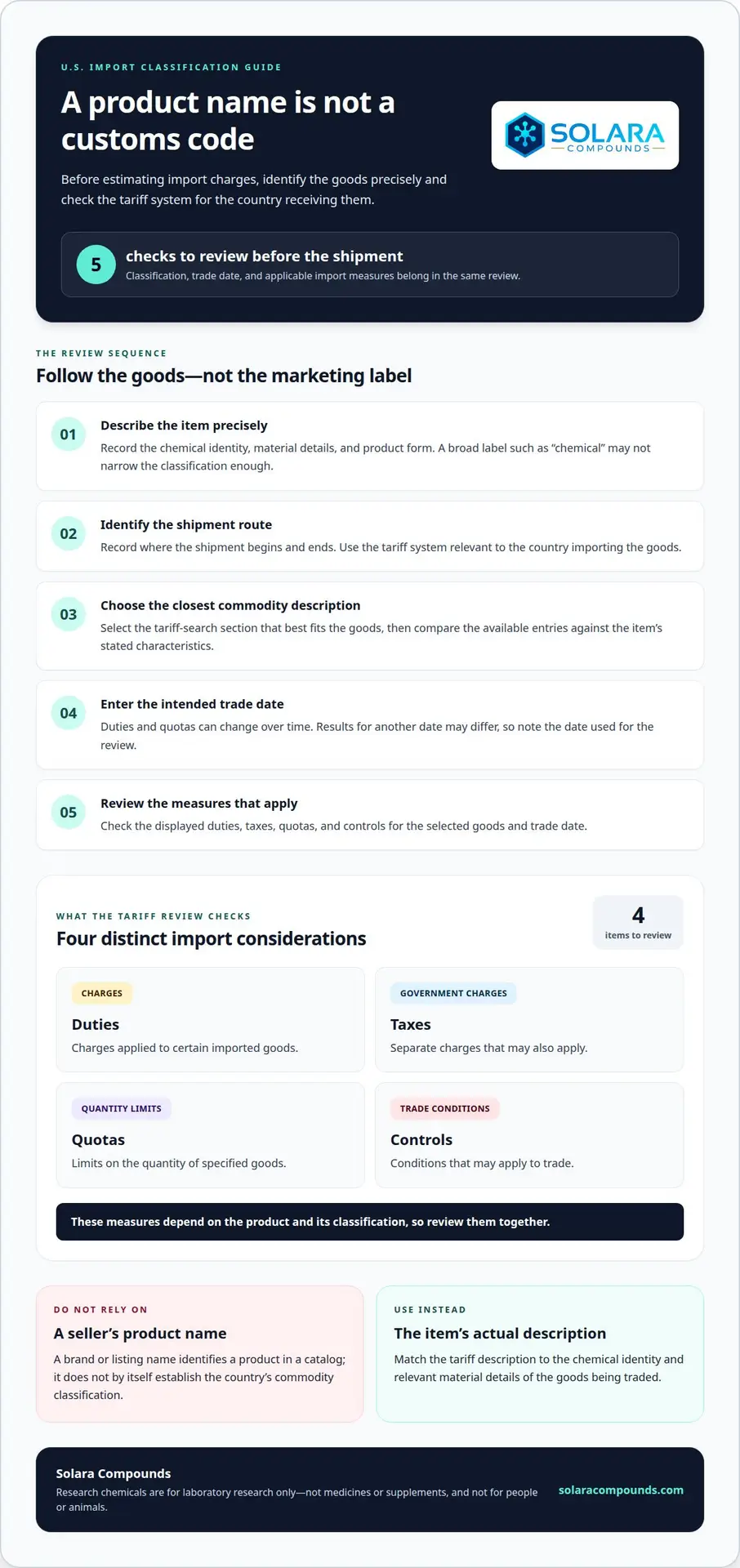
A seller’s product name isn’t a customs classification. A guide to buying research chemicals online should begin with this point: goods entering the United States need to be classified under the U.S. tariff system, because commodity codes vary by country. The correct classification helps identify duties, taxes, quotas, and controls that may apply.
A product label or seller-provided code may seem to settle the question, but classification depends on what the item is, not only how it is marketed. A precise product description and the importing country’s tariff system are essential when estimating import charges and identifying applicable controls.
This guide explains how to approach those checks, why the import date matters when reviewing duties and quotas, and how to distinguish a commodity code from a product name. Research chemicals discussed here are for laboratory research only, not for use by people or animals. They are not medicines or supplements. A structured review helps researchers make an informed purchasing decision before ordering.
Key Takeaways
- Start customs research with a precise description of the chemical and the country it will enter; product names alone may not identify the right classification.
- Review duties, taxes, quotas, and controls using the tariff information relevant to the import date, since trade measures can change over time.
- Assess supplier transparency through batch-specific Certificates of Analysis and details about third-party testing, not product claims alone.
- Understand how classification, testing, and product specifications can affect purchasing costs without relying on unsupported price averages.
- Keep research chemicals strictly for laboratory research; they are not medicines or supplements and are not for people or animals.
Checking import duties, taxes, quotas, and controls
A commodity code is a reference number that describes traded goods. Customs declarations use these codes to identify imports and exports. A chemical’s commercial name alone may not establish its classification. A guide to buying research chemicals online should start with the substance’s actual description.
Import duties are charges applied to certain imported goods. Taxes are separate government charges that may also apply. Quotas limit the quantity of specified goods, while controls set conditions on trade. These measures depend on the product and its classification, so review them together.
Start with tariff information for the country receiving the shipment. Select the search section that best describes the product. For raw materials, searching by material can help identify the relevant commodity. Then choose the entry that most closely matches the item. A broad description such as “chemical” may not narrow the classification enough.
Describe the goods precisely before searching. Include the chemical identity and relevant material details. Tariff searches require identification of the item, even when it is a gift. A seller’s brand name may not tell customs what the material is, so use the product description rather than its marketing label.
Enter the date the goods will be traded. Duties and quotas can change over time, so results for another date may differ. Review the displayed duties, taxes, quotas, and controls for the relevant trade date. Record that date alongside the classification information for later reference.
- Describe the chemical, material, and product form.
- Select the tariff-search section that best fits the goods.
- Choose the closest matching commodity description.
- Enter the intended trade date.
- Review applicable duties, taxes, quotas, and controls.
When comparing online suppliers, review batch-specific paperwork, testing evidence, stated shipping terms, and support channels. Broad quality claims alone don’t establish a batch’s composition.
What payment methods and shipping practices are safest when ordering research chemicals online? Use a secure checkout and retain the order confirmation and payment record. Review the stated shipping terms, and avoid requests to move payment outside the supplier’s documented checkout process.
What health, contamination, and handling risks are associated with research chemicals? Incorrect identity, contamination, and unintended exposure can create laboratory risks. These materials are for laboratory research only, not medicines or supplements, and not for people or animals. Follow applicable safety documentation and established laboratory procedures.
What steps should buyers take to review a product and supplier before placing an order? Confirm product identity, batch paperwork, tariff classification, trade date, and stated payment and shipping terms. Review these details together before purchase instead of relying on a label alone.
Choosing the correct country’s classification
A country classification is the commodity code used in a national tariff system. Commodity codes can vary between countries, so use the classification for the country importing or exporting the goods. A code supplied with a product may not match the destination’s system. A guide to buying research chemicals online should connect classification research to the shipment’s actual route.
First identify where the shipment begins and ends. For goods entering the United States, use the classification relevant to the United States. An export classification from the sending country doesn’t automatically establish the import classification. Record both locations so it’s clear which system you used.
Describe the chemical itself rather than relying only on a brand name. Include its identity and relevant physical form. Searching for “research chemical” is broad and may return unsuitable categories. A precise description gives the tariff search more useful information.
A tariff search organizes goods into classification sections and commodity descriptions. Choose the section that best describes the item, then compare its entries. Read the distinguishing words carefully. If descriptions seem similar, use the product’s stated characteristics to identify the closest match.
- Record the shipment’s origin and destination countries.
- Describe the chemical identity and physical form.
- Use the tariff system for the relevant country.
- Compare the available commodity descriptions.
- Keep the selected classification with product records.
Keep product identity separate from marketing language. A product name identifies a listing, but doesn’t establish its country classification. Different brand names may describe products with similar material characteristics, while one brand may cover products with different characteristics. The description must match the item being traded.
How can buyers recognize research chemical scams, counterfeit products, and misleading claims? Look for inconsistencies between product descriptions, batch paperwork, and supplier statements. Treat claims of a universal customs code or guaranteed clearance cautiously. Classification varies by country, so a seller’s broad claim cannot determine the destination’s code.
Laboratory buyers can use product descriptions to identify the named item in the research product catalog. Compare the listed identity with the substance being classified, rather than treating the catalog name as a customs decision. Keep supporting product records alongside the classification information.
Research chemicals are for laboratory research only, not medicines or supplements, and not for use by people or animals. Match the destination country’s system to the item’s description, then retain the result with purchasing records. This makes the basis for the classification easier to review later.
How can buyers verify a research chemical supplier’s legitimacy and product quality?
Supplier legitimacy involves clear, consistent business information and accountable ordering practices. Check that the supplier identifies its business, provides working support channels, and explains its order and shipping terms. A mismatch between the business name, checkout details, and order confirmation warrants attention before payment.
Product quality concerns whether a material’s identity and stated characteristics are supported by evidence. A product page can describe intended laboratory use, but promotional language alone doesn’t establish a batch’s contents. Compare the product name and batch details across the available paperwork.
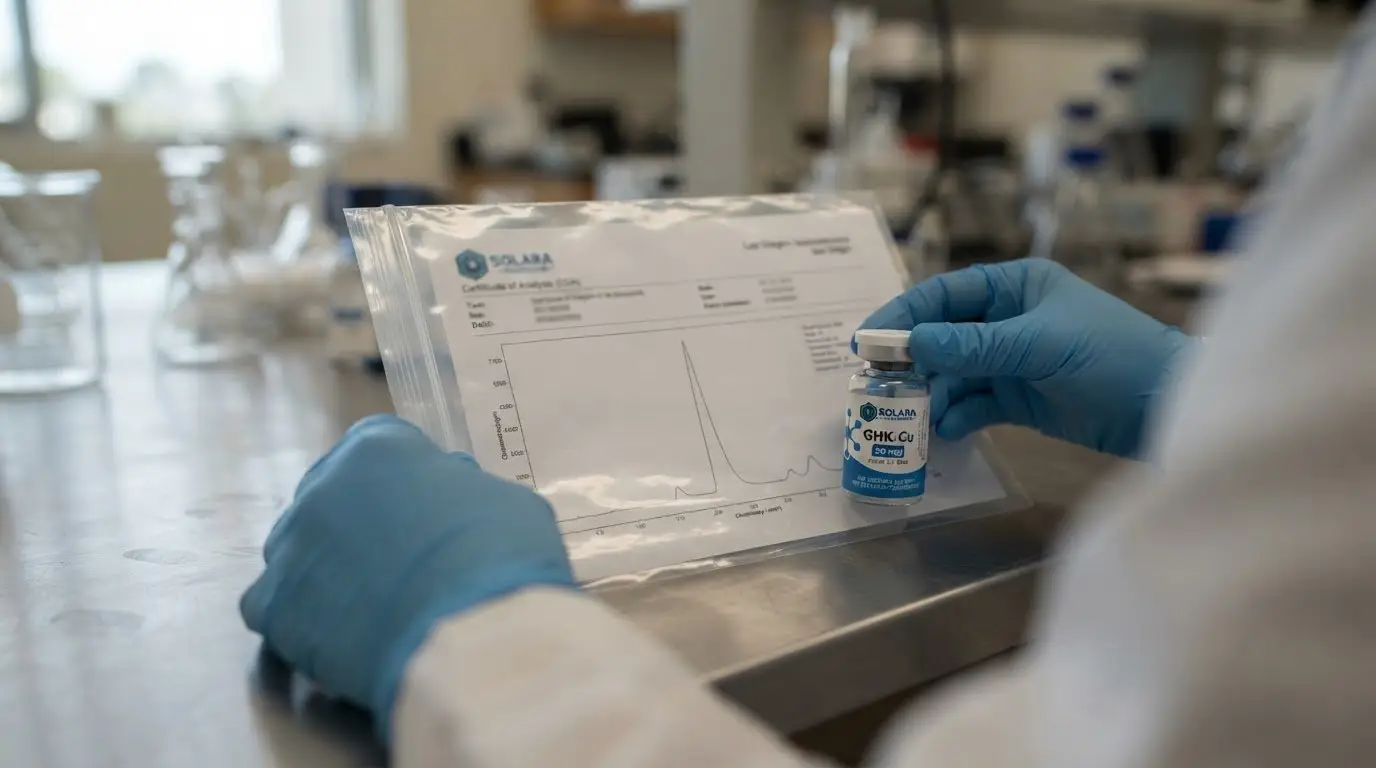
A Certificate of Analysis, or COA, reports test results for a product batch. Look for batch-specific paperwork that identifies the material and links the report to the product being offered. A generic document without a clear batch connection provides less useful evidence about a particular order.
Third-party testing is analysis performed outside the seller’s own testing process. It can add an independent quality check, especially when the report identifies the tested batch. Treat “third-party tested” as a claim to verify, not a substitute for a report or proof that every batch has identical characteristics.
- Match the product name on the listing and paperwork.
- Look for batch-specific documentation, not only a sample report.
- Check that testing claims have supporting documentation.
- Compare stated product details across the page and order record.
Consistency matters. If a product page names one compound while its paperwork names another, pause the purchase until the discrepancy is resolved. The same applies when batch identifiers differ or a report appears unrelated to the offered material. Clear records make research purchasing easier to document and reproduce.
Review supplier communications before ordering. A useful response should address a specific question, such as whether the available COA corresponds to the listed batch. Check that the answer is precise and consistent with the product information. Don’t rely on urgency claims or broad assurances instead of documentation.
Payment and shipping details also help assess an order’s transparency. Use the supplier’s stated checkout process, keep the order confirmation, and read the shipping terms before purchase. Be cautious of requests to move payment to an undocumented channel or claims promising outcomes that a product listing cannot establish.
Keep the intended use clear: research chemicals are for laboratory research only, not medicines or supplements, and not for use by people or animals. A careful supplier review combines business transparency, consistent product identification, and batch-level evidence. No single badge or phrase replaces these checks.
Every product claim requires proper documentation that cannot be supported by records alone. For cross-border orders, commodity codes are internationally recognized reference numbers that describe specific products when importing or exporting goods. When searching for a UK commodity code, users should describe the product rather than use a brand name. A product search should be specific, because a broad description such as clothing or electronics may not be enough to identify the commodity. Users should select the tariff search section that best describes the product they are importing or exporting. After selecting a section, users should choose the commodity that most closely matches their product.
What certificates of analysis and third-party testing should buyers request?
A Certificate of Analysis, or COA, reports analytical results for a product batch. Review a batch-specific document that matches the product under consideration. A general sample report may describe another batch, so it provides limited evidence about the material being purchased.
Third-party testing is analysis performed by a laboratory independent of the seller. It can provide an additional check on reported product characteristics. Review the report itself, not just a statement that testing occurred. The document should identify the tested sample and connect it to the product batch.
A batch identifier distinguishes one production batch from another. Look for that identifier on the COA and compare it with the product documentation. Matching identifiers connect test results to the material described. Without a clear batch reference, it is difficult to assess the report’s relevance.
An analytical method is the procedure used to examine a sample. A useful report names the method and describes the result. Different methods answer different questions, so interpret a result within the method’s stated scope. A single test result doesn’t establish every aspect of quality.
Review the COA in a consistent order:
- Match the product identity and batch identifier.
- Locate the testing laboratory and analytical method.
- Read the reported results and their stated units.
- Check which characteristics the analysis actually covers.
- Keep the report with the related order records.
Purity is the proportion of the identified compound in a tested sample. A reported purity result is meaningful only alongside the method, sample identity, and batch link. Don’t treat a high-purity phrase on a product page as equivalent to batch-specific evidence. The report’s scope matters as much as its headline result.
Third-party testing may examine identity, purity, or other characteristics, depending on the analysis performed. Don’t assume a report covers contaminants unless it says that testing was conducted. A purity result alone, for example, doesn’t show that every possible contaminant was assessed. Read the findings, not just the document title.
Retain the COA with procurement records so researchers can trace materials used in laboratory work. Compare documentation across batches when repeatability matters, while recognizing that each report applies to its identified sample. You can review the available batch COA documentation as part of evaluating paperwork.
Research chemicals are for laboratory research only, not medicines or supplements, and not for use by people or animals. A clear COA supports careful documentation, but it doesn’t replace appropriate laboratory handling or establish suitability for every research purpose.
The requested online service was unavailable at the time of the notice. Users should enter the date their goods will be traded because duties and quotas can change over time. Keep accessible batch documentation with the related order, and confirm that each report identifies the sample and batch before using it to support procurement decisions.
What are typical prices for research chemicals, and what affects the cost?
There’s no reliable single typical price for research chemicals as a category. Compound identity, quantity, form, documentation, and order terms vary, so compare specific listings rather than assuming one average applies.
Unit price is the cost relative to the listed quantity. Compare products only when their identities, quantities, and forms match. A vial and a different quantity of the same compound, for example, aren’t direct price comparisons. Check the stated amount first, then consider the documentation provided.
Batch testing is analysis associated with a specific production batch. Testing may affect a supplier’s operating costs, but price alone doesn’t prove that testing occurred. Review the batch paperwork and its scope. A Certificate of Analysis helps show which results were reported for the identified batch.
Packaging is the container and presentation used for a product. Requirements can vary with the product’s form and handling needs. Compare what each listing says is included rather than assuming similarly named items have identical contents or presentation.
Shipping cost is the charge for transporting an order. Delivery terms and destination can affect the final amount paid. Duties or taxes may also affect the total for an imported order. These charges depend on the shipment and applicable classification, not just the displayed product price.
Use this comparison sequence:
- Match the compound identity and stated quantity.
- Compare product form and included packaging.
- Review batch documentation and testing information.
- Read the shipping terms and destination details.
- Account for applicable import charges separately.
The displayed price is the amount shown for a listed product. Total order cost includes relevant shipping and import charges. Keep these figures distinct when comparing options. A lower displayed price may not mean a lower total once shipping and applicable charges are included.
A sound comparison weighs evidence alongside cost. Clear batch documentation, for example, gives researchers information that a price-only comparison misses. Don’t treat claims such as “premium” or “high purity” as substitutes for product-specific paperwork. Compare the reported evidence, not the adjectives.
Research chemicals are for laboratory research only, not medicines or supplements, and not for use by people or animals. Set purchasing criteria around the intended laboratory work, product identity, documentation, and order terms. Then compare equivalent listings against those criteria.
To compare product descriptions and listed quantities, review the research catalog. Use the listing details alongside batch paperwork and shipping terms to assess the full order, without relying on unsupported market averages.
Solara Compounds
Solara Compounds supplies research-grade compounds with independent testing performed by Kovera Labs. Each batch has a unique lot number and a batch-specific Certificate of Analysis available for verification. Researchers can review the documentation and connect reported results to the specific batch. View the current research catalog and check the batch COA before ordering.
The catalog includes SOL-3RT Retatrutide 10mg and SOL-2TZ Tirzepatide 10mg, among other research compounds. All products are for laboratory research only, not medicines or supplements, and not for people or animals. Review the batch paperwork and product details as part of your purchasing decision.
For questions about product documentation or ordering, contact Solara Compounds at [email protected] or 1 (877) 388-9178, Monday-Friday, 8 AM-5 PM Eastern.
Build a more consistent purchasing process
Make each order part of a documented laboratory workflow. Record the product identity, supplier paperwork, and relevant import information with the research project. These records provide a useful reference for future purchasing decisions and help keep project documentation orderly.
Use this guide to buying research chemicals online as a decision framework, not as a substitute for evaluating the specific material and shipment. Keep the intended laboratory application central, and ensure every research chemical is used only for laboratory research, not for people or animals.
When you’re ready to review products for laboratory work, take the next step at solaracompounds.com’s research catalog. Select materials according to your research requirements and review their product documentation as part of your purchasing process. A careful, repeatable approach supports better-organized research from order to recordkeeping.
Frequently Asked Questions
What are research chemicals, and what are they commonly used for?
Research chemicals are substances used by researchers to examine chemical properties or biological processes in controlled laboratory work. Examples include studying how a compound behaves in a biochemical assay or cell-culture model. Their purpose is investigation, not personal use. Materials supplied by Solara Compounds are for laboratory research and development only, not for human or veterinary use, clinical or diagnostic applications, or consumption.
What laws apply to buying, importing, and possessing research chemicals in the United States?
Requirements depend on the specific substance, shipment, and location; a “research use only” label doesn’t settle every legal question. Before an order, identify the compound and review the applicable federal, state, and local requirements for purchase, import, possession, and laboratory use. Import classification and controls can also affect a shipment. The purchaser assumes responsibility for compliance with applicable laws and regulations.