Research Articles
Retatrutide vs. Tirzepatide Research: A Comparative Analysis of Molecular Agonism


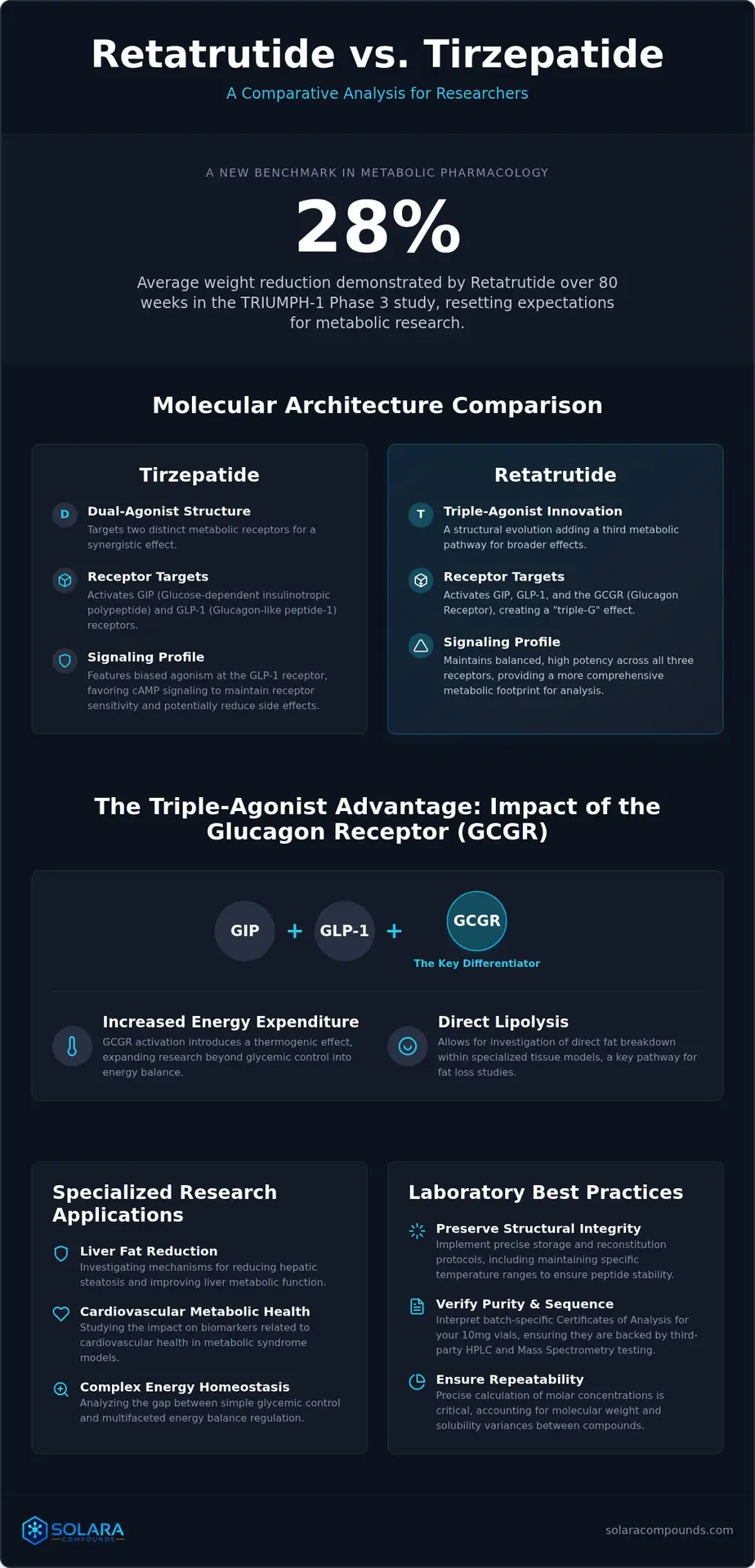
In the TRIUMPH-1 Phase 3 study, retatrutide demonstrated an average weight reduction of 28% over 80 weeks, a benchmark that resets expectations for metabolic pharmacology. This level of efficacy is driving a surge in retatrutide vs tirzepatide research as laboratories seek to understand the transition from dual-agonist to triple-agonist architectures. While tirzepatide remains the gold standard for GLP-1 and GIP receptor activation, the introduction of the glucagon receptor in retatrutide adds a third dimension to metabolic signaling. It’s common to feel overwhelmed by the technical nuances of these peptide sequences, especially when precision and repeatability are non-negotiable for your study.
This article provides a rigorous evaluation of both compounds to help you determine which architecture fits your specific research model. You’ll gain clarity on how triple-agonism influences energy expenditure and fat loss differently than dual-agonist benchmarks. We also address the practical challenges of sourcing, focusing on the necessity of third-party HPLC and MS testing to ensure peptide stability. By examining the structural integrity and metabolic pathways of these 10mg research vials, we’ll guide you toward a logical, data-driven conclusion for your laboratory applications.
Key Takeaways
- Distinguish between the dual-agonist structure of tirzepatide and the triple-agonist architecture of retatrutide to understand how the addition of glucagon receptor activation alters metabolic signaling.
- Evaluate EC50 values and receptor affinity markers to establish a baseline for retatrutide vs tirzepatide research in your laboratory environment.
- Identify how these compounds can be utilized in specialized research models, particularly those investigating liver fat reduction and cardiovascular metabolic health.
- Implement precise storage and reconstitution protocols, including maintaining specific temperature ranges, to preserve the structural integrity of your peptide samples.
- Verify the purity and sequence identity of your 10mg vials by interpreting batch-specific Certificates of Analysis backed by third-party HPLC and Mass Spectrometry testing.
Molecular Architecture: Comparing Dual and Triple Agonism
Scientists conducting retatrutide vs tirzepatide research must first address the fundamental divergence in their molecular blueprints. While both compounds are synthetic peptides designed to regulate metabolic pathways, their receptor targets define their utility in the lab. Tirzepatide functions as a dual agonist. It targets the glucose-dependent insulinotropic polypeptide (GIP) and glucagon-like peptide-1 (GLP-1) receptors. Retatrutide represents a significant structural evolution. By incorporating a third pathway via the glucagon receptor (GCGR), it expands the scope of metabolic inquiry into thermogenesis and lipid oxidation.
Tirzepatide: The GIP/GLP-1 Synergistic Model
Tirzepatide is a synthetic peptide consisting of a 39-amino acid chain. It’s engineered to emulate the native GIP sequence while maintaining high affinity for the GLP-1 receptor. A key feature is its biased agonism at the GLP-1 receptor. It favors cyclic adenosine monophosphate (cAMP) signaling over β-arrestin recruitment. This specific signaling profile is designed to minimize receptor internalization, which maintains sensitivity during prolonged assays. In in vitro studies, the GIP component enhances insulin secretion and improves glucose-dependent insulinotropic effects beyond what GLP-1 can achieve alone. The structural stability of this 39-amino acid chain is bolstered by a C20 fatty diacid moiety. This side-chain facilitates albumin binding. It significantly extends the compound’s half-life in research models, allowing for consistent observations over extended incubation periods.
Retatrutide: The Triple-Agonist Innovation
The transition to Retatrutide’s triple agonism introduces a sophisticated metabolic triad for laboratory analysis. By adding GCGR agonism, researchers can investigate increased energy expenditure and direct lipolysis within specialized tissue models. This GIP/GLP-1/GCGR triad alters metabolic signaling by balancing the anorectic effects of GLP-1 with the thermogenic properties of glucagon. Retatrutide is a 39-amino acid backbone modified with a C20 fatty acid side-chain, precisely engineered to function as a “triple-G” agonist with high potency across GIP, GLP-1, and glucagon receptors. This architecture allows for a more comprehensive analysis of metabolic flexibility. It provides a specialized solution for researchers looking to bridge the gap between simple glycemic control and complex energy homeostasis.
Both peptides utilize fatty acid side-chains to optimize bioavailability and structural integrity. While they share a similar sequence length, their specific residue substitutions result in distinct molecular weights and solubility profiles. These variances are critical when calculating molar concentrations for benchtop assays. Precision in these measurements ensures the repeatability of your data, especially when utilizing high-purity 10mg vials for comparative analysis.
Comparative Potency and Efficacy in Preclinical Research
Evaluating the potency of these compounds requires a close look at half-maximal effective concentration (EC50) values across their respective targets. In retatrutide vs tirzepatide research, the data reveals a shift in how receptor affinity dictates cellular response. Tirzepatide is engineered with a high affinity for the GIP receptor, often exceeding its potency at the GLP-1 receptor. This imbalance is intentional, as GIP signaling is believed to buffer the gastrointestinal side effects typically associated with GLP-1 activation. Retatrutide, conversely, maintains a balanced potency across three distinct receptors, providing a broader metabolic footprint for analysis in laboratory settings.
Signaling Potency and Receptor Affinity
The triple-agonist advantage is most evident in cellular assays quantifying cyclic adenosine monophosphate (cAMP) production. In GIP-receptor-expressing cells, both compounds exhibit robust signaling, yet retatrutide’s triple-G architecture allows it to engage the glucagon receptor (GCGR) with high specificity. This additional signaling layer doesn’t just add a third pathway; it modulates the internalization rates of the GLP-1 receptor. Research models show that by activating multiple pathways simultaneously, retatrutide may sustain signaling longer than dual-agonist benchmarks. This persistent activation is a critical variable for researchers measuring long-term metabolic shifts in vitro. Obtaining verified materials for these assays is a prerequisite for accuracy, and you can source high-purity research peptides to ensure your signaling data remains consistent.
Metabolic Pathway Impacts: Beyond Glucose Control
Glucagon receptor activation introduces a thermogenic response that is absent in dual-agonist models. While tirzepatide is highly effective at investigating adipocyte function and insulin sensitivity, retatrutide allows for the study of direct lipolysis and increased energy expenditure. This distinction is currently being explored in an ongoing head-to-head clinical trial, which aims to quantify the efficacy gap between these two architectures. While tirzepatide optimizes adipocyte function through dual-receptor synergy, retatrutide’s inclusion of glucagon receptor signaling provides a more direct pathway for investigating hepatic lipid reduction in metabolic models.
Data from Phase 2 and Phase 3 studies suggest that the triple-agonist model may achieve higher benchmarks for weight reduction, with retatrutide reaching 28% in the TRIUMPH-1 study compared to tirzepatide’s 22.5% in SURMOUNT-1. These figures aren’t just clinical outcomes; they’re indicators of the underlying biochemical potency researchers must account for. The ability to clear lipids and stimulate thermogenesis makes the triple-agonist model a specialized tool for advanced metabolic pathway analysis.
Research Applications: Metabolic Pathway Analysis and Bio-Activity
The transition from dual-agonist to triple-agonist models has opened new avenues for retatrutide vs tirzepatide research, particularly in the study of complex metabolic syndromes. While early GLP-1 research focused primarily on glycemic regulation, modern laboratory models now prioritize multi-organ signaling. Tirzepatide serves as a high-precision control in these studies. It allows researchers to isolate the effects of GIP and GLP-1 synergy before introducing the third variable of glucagon receptor (GCGR) activation found in retatrutide. This comparative approach is essential for understanding how specific hormone combinations influence systemic bio-activity.
Lipid Metabolism and Liver Fat Research
Retatrutide’s inclusion of the glucagon receptor makes it a specialized candidate for hepatic research models, specifically those targeting Non-Alcoholic Fatty Liver Disease (NAFLD) and NASH. Glucagon signaling in the liver promotes fatty acid oxidation and reduces the synthesis of new lipids. Preclinical data indicates that triple-agonist models may achieve a more profound reduction in intrahepatic triglycerides compared to dual-agonist benchmarks. Researchers utilize these peptides to observe the clearance of liver fat and the subsequent improvement in hepatic insulin sensitivity. By stimulating the GCGR, retatrutide drives a direct metabolic shift in the liver that tirzepatide, which lacks the glucagon component, cannot replicate in isolation.
Energy Expenditure and Thermogenesis
A primary differentiator in bio-activity research is the impact on resting energy expenditure (REE). Triple-agonist architectures are frequently employed to study thermogenesis and the activation of brown adipose tissue (BAT). While tirzepatide is an excellent model for studying caloric intake reduction via appetite suppression, retatrutide allows for the simultaneous analysis of energy output.
- Caloric Intake: Both compounds demonstrate robust suppression of appetite through GLP-1 and GIP pathways.
- Energy Output: GCGR activation in retatrutide models suggests an increase in metabolic rate, even during periods of caloric restriction.
- BAT Activation: Researchers investigate how triple-agonism may “brown” white adipose tissue to enhance lipid burning.
This dual-action mechanism of reducing input while increasing output provides a more comprehensive view of energy homeostasis.
Future directions for this research involve cardiovascular metabolic studies, where the goal is to determine how these peptides influence lipid profiles and heart health markers over time. Tirzepatide remains the benchmark for dual-agonist vs. single-agonist (such as semaglutide) comparisons, providing a stable foundation for metabolic research. As the field moves toward triple-agonism, the focus shifts to optimizing the ratio of receptor activation to maximize metabolic flexibility without compromising structural integrity. Utilizing high-purity 10mg vials ensures that these comparative observations are based on consistent peptide concentrations across all research cohorts.
Stability and Solubility: Practical Laboratory Handling
Precision in retatrutide vs tirzepatide research is contingent upon the stability of the peptide samples. Lyophilized peptides are generally resilient, but their structural integrity decreases once they’re exposed to room temperature or moisture. For short-term storage, maintaining 10mg vials at 2-8°C is sufficient. For any study exceeding a few weeks, researchers must store the dry powder at -20°C to prevent hydrolysis and oxidation. Light sensitivity is another critical factor. Peptides should be kept in amber vials or opaque containers to shield the amino acid chain from UV-induced degradation.
Reconstitution and Concentration Optimization
Reconstitution is a delicate phase where peptide shear stress can occur. Researchers should use bacteriostatic water or sterile saline, allowing the diluent to run down the side of the vial rather than dropping it directly onto the powder. This gentle approach prevents the formation of bubbles and protects the sequence length. Calculating molarity requires precise volume measurements, as the solubility profile can vary slightly based on the peptide’s specific residue substitutions.
- Bacteriostatic water: Ideal for multi-use vials due to antimicrobial properties.
- Sterile saline: Often preferred for specific in vitro assays to maintain osmotic balance.
- Concentration targets: Typical research models utilize concentrations between 1mg/mL and 5mg/mL for optimal solubility.
If you require high-purity compounds that meet these rigorous handling standards, you can buy 10mg research peptides that are shipped in secure, laboratory-grade packaging.
Longevity and Secondary Testing
The expected shelf life of a reconstituted peptide is significantly shorter than its lyophilized counterpart. Most researchers aim to use reconstituted solutions within 7 to 14 days when stored at 2-8°C. Beyond this window, the risk of deamidation increases. Post-shipping stability is a common concern in retatrutide vs tirzepatide research, making secondary testing via High-Performance Liquid Chromatography (HPLC) essential. This process verifies that a compound hasn’t degraded during transit. For long-term peptide preservation, the optimal storage temperature is -20°C or below in a dedicated laboratory freezer. Utilizing batch-specific Certificates of Analysis (COAs) ensures that your starting material possesses the structural integrity required for repeatable results.
Sourcing High-Purity Compounds for Institutional Study
The integrity of retatrutide vs tirzepatide research depends entirely on the quality of the starting material. Sourcing research peptides is a high-stakes decision for any laboratory, as minor impurities can lead to skewed signaling data or inconsistent metabolic observations. Reliable data requires more than a standard product label. It demands a transparent look into the chemical synthesis and verification process. By prioritizing domestic sourcing and rigorous analytical testing, institutions can maintain the continuity necessary for multi-phase studies.
Verifying Peptide Purity Standards
Purity isn’t just a metric. It’s the foundation of empirical validity. When a supplier claims 99%+ purity, they’re stating that the target peptide sequence dominates the sample with negligible residual solvents or truncated sequences. However, purity alone doesn’t confirm the compound’s identity. High-Performance Liquid Chromatography (HPLC) measures the purity level, while Mass Spectrometry (MS) verifies the sequence identity by matching the molecular weight to the theoretical blueprint. Batch-specific data is the only way to ensure that the 10mg vial in your lab matches the sample tested in the facility. Generic, “evergreen” marketing claims often mask inconsistencies that can compromise your results. At Solara Compounds, we provide batch-specific Certificates of Analysis (COAs) to bridge the gap between material science and your practical application.
Procurement Logistics for Labs
Research continuity often hinges on the reliability of the supply chain. Sourcing from a US-based facility eliminates the risks associated with international transit, such as prolonged temperature exposure or customs delays. Secure laboratory-grade packaging is essential to protect the lyophilized powder from light and moisture during the final miles of delivery. For larger institutional projects, bulk and wholesale options provide the scale needed to maintain identical batch numbers across different research cohorts, which is a critical factor for reducing variables in comparative analysis.
Precision is our hallmark. We understand that your study requires compounds that are as stable as they are pure. By maintaining a science-first approach, we ensure that every vial meets the rigorous standards required for advanced bio-analysis. You can secure high-purity Retatrutide and Tirzepatide for your next study at Solara Compounds, where we prioritize the integrity of the final result over marketing fluff. Our commitment to transparency provides you with the data-driven confidence needed to navigate complex metabolic challenges with ease.
Advancing Metabolic Science with Triple-Agonist Precision
The evolution from dual to triple agonism represents a pivot point in metabolic pharmacology. While tirzepatide provides a robust model for GIP and GLP-1 synergy, retatrutide’s inclusion of glucagon receptor activation introduces a third dimension for energy expenditure and lipid oxidation studies. Mastering the nuances of retatrutide vs tirzepatide research requires both a deep understanding of molecular signaling and a commitment to material integrity. Precision at the bench begins with the purity of your compounds.
Solara Compounds acts as your partner in research excellence by providing 10mg vials verified through rigorous third-party HPLC and Mass Spectrometry testing. We eliminate the uncertainty of procurement with batch-specific COAs and secure, domestic US shipping from our Florida facility. It’s this focus on repeatability that ensures your laboratory observations are grounded in empirical truth rather than chemical variance. You can Browse Research-Grade Peptides and HPLC-Verified Compounds to equip your next study with the highest standards of structural integrity. We’re ready to support your next breakthrough in metabolic science.
Frequently Asked Questions
Is retatrutide more potent than tirzepatide in research models?
Retatrutide demonstrates higher potency in specific metabolic benchmarks, achieving an average weight reduction of 28% in Phase 3 TRIUMPH-1 studies compared to 22.5% for tirzepatide in SURMOUNT-1. This increased efficacy is attributed to its triple-agonist architecture, which engages the glucagon receptor alongside GIP and GLP-1. While tirzepatide is a benchmark for dual-agonist stability, retatrutide’s broader receptor affinity makes it a more potent tool for investigating complex energy expenditure and lipid clearance.
What is the difference between a dual-agonist and a triple-agonist peptide?
The primary distinction lies in the number of metabolic pathways activated by the peptide sequence. Tirzepatide is a dual agonist targeting GIP and GLP-1 receptors to regulate insulin and appetite. Retatrutide is a triple agonist that adds glucagon receptor (GCGR) activation to this triad. This structural evolution allows researchers to study thermogenesis and direct lipolysis, providing a more comprehensive view of metabolic signaling than dual-receptor models can offer in isolation.
Can retatrutide and tirzepatide be used for in vitro cellular studies?
Both compounds are specifically designed for in vitro and preclinical research applications, including cellular signaling assays and tissue culture models. Researchers utilize these peptides to quantify cAMP production, receptor internalization rates, and downstream gene expression related to lipid metabolism. Because these are provided as lyophilized powders in 10mg vials, they allow for precise concentration adjustments required for high-sensitivity benchtop experiments across various metabolic research frameworks.
How should research-grade tirzepatide be stored for maximum stability?
For optimal stability, lyophilized tirzepatide should be stored in a freezer at -20°C for long-term preservation. Short-term storage in a laboratory refrigerator at 2-8°C is acceptable for periods under three weeks. It’s critical to keep the vials in a dark, moisture-free environment to prevent peptide degradation. Once reconstituted, the solution should be maintained at 2-8°C and utilized within 7 to 14 days to ensure maximum sequence integrity.
Does Solara Compounds provide HPLC reports for every batch of retatrutide?
Yes, Solara Compounds provides batch-specific Certificates of Analysis (COAs) for every order of retatrutide and tirzepatide. These reports include third-party HPLC and Mass Spectrometry data to verify both purity and sequence identity. This transparency is a core part of our commitment to retatrutide vs tirzepatide research, ensuring that laboratories receive compounds with 99%+ purity. We prioritize empirical verification over generic claims to support the repeatability of your experimental data.
What are the common solvents used for reconstituting these peptides in a lab?
Bacteriostatic water and sterile saline are the most common solvents used for reconstituting these lyophilized peptides. Bacteriostatic water is often preferred for multi-use vials because its benzyl alcohol content inhibits bacterial growth. Sterile saline is frequently chosen for in vitro assays where maintaining a specific osmotic balance is necessary for cellular health. Researchers should select the diluent based on the specific requirements of their assay and the desired final molar concentration.
Are these compounds intended for human consumption or clinical use?
No, these compounds are strictly intended for laboratory research and institutional study only. They aren’t for human consumption, medical use, or clinical application. Solara Compounds provides these materials as high-purity chemicals for preclinical analysis. Researchers must adhere to all local and federal regulations regarding the handling and study of research-grade peptides. These materials are sold exclusively to support the advancement of metabolic and material science in controlled environments.
How does the glucagon receptor agonism in retatrutide affect research outcomes?
Glucagon receptor (GCGR) agonism in retatrutide introduces a thermogenic component that alters the research outcome compared to dual-agonist models. While GLP-1 and GIP primarily influence appetite and insulin secretion, GCGR activation promotes fatty acid oxidation and increases resting energy expenditure. This allows researchers to investigate direct lipid clearance in hepatic models and the “browning” of white adipose tissue. This triple-action mechanism provides a specialized tool for studying energy homeostasis in advanced retatrutide vs tirzepatide research.