Research Articles
Scientific Grade Retatrutide: A Technical Profile for Laboratory Research


For researchers and procurement officers in the field of metabolic signaling, the integrity of laboratory materials is non-negotiable. The emergence of multi-agonist peptides has opened new frontiers, but it has also heightened the need for verifiable purity and structural consistency. Scientific grade Retatrutide stands at the forefront of this research, offering a complex molecular tool whose efficacy is directly tied to its quality. This technical profile provides a comprehensive analysis of its molecular structure, the benchmarks defining its scientific-grade status, and the handling protocols required to preserve its function in a laboratory setting.
Understanding Retatrutide: The Evolution of Triple-Agonist Peptides
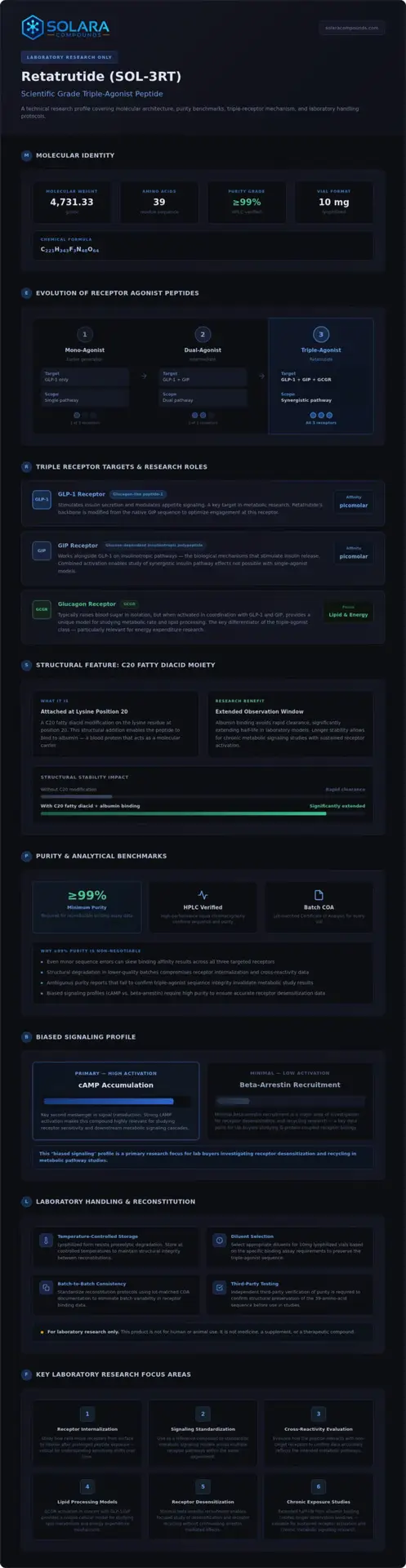
Retatrutide is a novel, 39-amino-acid synthetic peptide analog engineered for advanced metabolic research. Its development represents a significant evolutionary step from earlier incretin mimetics. The scientific journey began with mono-agonists targeting the glucagon-like peptide-1 (GLP-1) receptor. It then progressed to dual-agonists, such as Tirzepatide, which co-activated both the GLP-1 and glucose-dependent insulinotropic polypeptide (GIP) receptors. Retatrutide advances this paradigm by introducing a third mode of action: agonizing the glucagon receptor (GCGR) in addition to the GLP-1 and GIP receptors.
This triple-agonist mechanism is the primary focus of its application in laboratory research, allowing for the simultaneous investigation of complex, interconnected metabolic pathways. For these studies to yield valid, reproducible data, the peptide used must be of the highest quality. The term “scientific grade retatrutide” is not a marketing designation; it is a rigorous standard signifying a level of purity (typically ≥99%), structural integrity, and analytical verification essential for peer-reviewed scientific inquiry. Anything less introduces variables that can confound experimental results and undermine the validity of the research.
The Significance of Triple Receptor Agonism
The core value of Retatrutide in a research context lies in its ability to modulate three distinct but related receptor systems. This multi-faceted approach allows for the study of synergistic effects that cannot be observed with single or dual-agonist compounds.
- Synergistic Insulinotropic Effects: In vitro studies focus on how the combined activation of GIP and GLP-1 receptors influences insulinotropic pathways in pancreatic beta-cell models. Researchers can investigate the potentiation of glucose-stimulated insulin secretion and the underlying cellular signaling cascades.
- Glucagon Receptor’s Role in Energy Expenditure: The unique inclusion of GCGR agonism allows researchers to explore its impact on energy expenditure, hepatic glucose production, and lipid metabolism in cellular and tissue models. This provides a powerful tool for dissecting the nuanced role of glucagon signaling in metabolic homeostasis.
- Pivoting Toward Multi-Agonist Compounds: The limitations of single-target molecules have become apparent. Researchers are increasingly pivoting to multi-agonist compounds like Retatrutide to better model the complex, poly-hormonal regulation of metabolism, making it a critical tool for developing more comprehensive in vitro metabolic disease models.
Research Scope: In Vitro and Laboratory Applications
Scientific grade Retatrutide is exclusively intended for controlled laboratory applications. Its utility spans a range of sophisticated experimental designs aimed at understanding the fundamental mechanisms of metabolic control.
- Receptor Internalization and Recycling Kinetics: High-purity Retatrutide is used to study how the triple-agonist interaction affects the rate of receptor internalization, trafficking, and recycling for GLP-1R, GIPR, and GCGR. This is crucial for understanding signal duration and cellular desensitization.
- Cross-Reactivity and Selectivity Assays: Researchers use scientific-grade material to evaluate binding affinity, cross-reactivity, and functional selectivity across a panel of related G-protein coupled receptors (GPCRs), ensuring that observed effects are specific to the intended targets.
- Standardizing Metabolic Signaling Models: Consistent, batch-verified Retatrutide is essential for standardizing experimental models. It allows laboratories worldwide to generate comparable data on downstream signaling events, such as cAMP accumulation, ERK phosphorylation, and beta-arrestin recruitment.
Molecular Architecture and the Triple-Agonist Mechanism
The functional efficacy of scientific grade Retatrutide is a direct result of its meticulously designed molecular architecture. The compound is built upon a 39-amino-acid peptide backbone, which has been rationally modified to achieve balanced potency at all three target receptors. However, its structure includes more than just the amino acid sequence; a key modification is responsible for its extended duration of action, a critical feature for many experimental protocols.
This modification is the inclusion of a C20 fatty diacid moiety, which is attached to a lysine residue in the peptide sequence. This lipid component enables the molecule to reversibly bind to serum albumin, effectively creating a circulating reservoir. This mechanism dramatically extends the peptide’s half-life, protecting it from rapid renal clearance and enzymatic degradation. For laboratory research, this means that cellular models can be exposed to a stable concentration of the compound over longer incubation periods, better mimicking physiological conditions.
- Molecular Formula: C221H342N46O68
- Average Molecular Weight: Approximately 4730.5 g/mol
Verifying this exact molecular weight via Mass Spectrometry is a cornerstone of quality control, confirming that the full-length peptide, including the crucial C20 fatty diacid moiety, has been synthesized correctly.
Binding Affinities and Signaling Cascades
The defining characteristic of Retatrutide is its balanced affinity for the GLP-1, GIP, and glucagon receptors. Potency is typically quantified by the half-maximal effective concentration (EC50), which measures the concentration of the agonist required to elicit 50% of the maximum biological response. Retatrutide exhibits picomolar affinity for its target receptors, indicating extremely high potency and specific binding even at very low concentrations.
- EC50 Values: In recombinant cell lines expressing human receptors, Retatrutide demonstrates low picomolar EC50 values for cAMP accumulation, confirming its potent agonism at GLP-1R, GIPR, and GCGR. Researchers must consult the latest peer-reviewed literature for the most current, consensus values for their specific assay conditions.
- Signal Transduction Pathways: Beyond simple binding, research focuses on characterizing the downstream signaling pathways. This includes quantifying cAMP accumulation (the canonical pathway for these GPCRs) and assessing biased agonism through beta-arrestin recruitment assays. Understanding this signaling “texture” is key to interpreting experimental outcomes.
Structural Stability of Lyophilized Compounds
To ensure usability and long-term viability, scientific grade Retatrutide is supplied in a lyophilized (freeze-dried) state. This process is critical for preserving the complex three-dimensional structure of the peptide, which is essential for proper receptor binding.
- Preserving Secondary Structure: Lyophilization removes water without the heat stress of simple evaporation, locking the peptide into its native conformation. This prevents the aggregation and denaturation that can occur with peptides in solution.
- Integrity of the C20 Moiety: The stability of the bond linking the C20 fatty diacid to the peptide backbone is vital. Proper synthesis and lyophilization techniques ensure this covalent linkage remains intact, preserving the albumin-binding capability and extended half-life.
- Preventing Proteolytic Degradation: Advanced solid-phase peptide synthesis (SPPS) and purification techniques are employed to minimize the presence of truncated sequences or residual enzymes that could lead to proteolytic degradation during storage or after reconstitution.
Defining Scientific Grade: Purity Benchmarks and Analytical Verification
The distinction between a generic research chemical and scientific grade retatrutide lies in a rigorous, transparent, and multi-faceted process of analytical verification. For data to be considered publishable in peer-reviewed journals, the materials used must meet an uncompromising standard of quality. This standard begins with purity, but extends to identity, sequence, and batch-to-batch consistency.
The industry benchmark for high-quality research peptides is a purity level of ≥99%, as determined by High-Performance Liquid Chromatography (HPLC). This level of purity is required to minimize the risk of off-target effects caused by contaminants, ensuring that the observed biological activity is attributable solely to the Retatrutide molecule. The verification process relies on two primary analytical techniques:
- High-Performance Liquid Chromatography (HPLC): HPLC separates the components of a mixture based on their chemical properties. In a chromatogram for a high-purity sample, the vast majority of the signal will be contained within a single, sharp peak corresponding to the intact Retatrutide peptide. The purity percentage is calculated from the area of this main peak relative to the total area of all peaks.
- Mass Spectrometry (MS): Following HPLC, Mass Spectrometry is used to confirm the molecular identity of the compound in the main peak. It measures the mass-to-charge ratio of the molecule, providing a precise molecular weight that can be compared against the theoretical weight calculated from the chemical formula (C221H342N46O68). This confirms that the peak identified by HPLC is indeed the correct, full-length peptide.
Critically, these analytical reports must be batch-specific. A generic “purity guarantee” is insufficient for rigorous scientific work. A batch-specific Certificate of Analysis (COA) links the analytical data directly to the specific vial of material being used in an experiment, providing an unbroken chain of quality assurance.
Quality Control Protocols for Research Peptides
A reputable supplier’s quality control (QC) process is designed to identify and quantify potential impurities that can arise during synthesis and purification. These are not merely passive checks; they are active measures to ensure the final product meets the scientific-grade standard.
- Common Impurities: QC protocols screen for common impurities such as trifluoroacetic acid (TFA) salts (remnants from the purification process), residual solvents, and, most importantly, synthesis-related byproducts like truncated or deletion sequences.
- Third-Party Verification: The gold standard for quality assurance is independent, third-party laboratory verification. This removes any potential for internal bias and provides researchers with an objective confirmation of the peptide’s purity and identity.
- Domestic Sourcing and Transparency: Sourcing from a domestic supplier often provides greater supply chain transparency and regulatory oversight. It facilitates easier communication and faster resolution of any technical inquiries, which is crucial for institutional procurement.
Interpreting Certificates of Analysis (COA)
A Certificate of Analysis is the primary document that substantiates a product’s quality. For laboratory managers and researchers, knowing how to interpret it is a critical skill. The necessity of lot-matched COAs for institutional data integrity cannot be overstated, as they form the foundational proof of material quality for audits and publication.
- Key Metrics: When reviewing a COA, look for the HPLC purity percentage, the retention time of the main peak, and the corresponding Mass Spectrometry data confirming the molecular weight.
- Lot Number Traceability: Always verify that the lot number printed on the COA matches the lot number on the physical vial of the peptide. This ensures the data you are reviewing pertains directly to the material you are using.
- Peak Analysis: A clean HPLC chromatogram should show a dominant, well-defined main peak with minimal secondary peaks. The presence of significant secondary peaks may indicate impurities that could interfere with the experiment.
Best Practices for Laboratory Handling and Reconstitution
Even the highest-purity lyophilized peptide can be rendered useless by improper handling, reconstitution, or storage. The molecular integrity of scientific grade Retatrutide is sensitive to mechanical stress, temperature fluctuations, and chemical environment. Adhering to strict protocols is essential for achieving consistent and reproducible experimental results.
The following is a standard protocol for reconstituting a 10mg vial of lyophilized Retatrutide. Always perform these steps using aseptic techniques, preferably within a laminar flow hood.
- Equilibrate the Vial: Before opening, allow the lyophilized peptide vial to come to room temperature for 15-20 minutes. This prevents condensation from forming inside the vial, which can compromise the peptide’s stability.
- Select the Diluent: The most common diluent is bacteriostatic water (BAC water), which contains 0.9% benzyl alcohol to prevent microbial growth. For certain cell culture experiments, sterile water or a specific buffer like PBS may be required, but this can reduce the post-reconstitution shelf life.
- Introduce the Diluent: Using a sterile syringe, slowly inject the desired volume of diluent into the vial. Aim the stream against the side of the glass vial, not directly onto the lyophilized powder, to minimize mechanical stress.
- Gentle Reconstitution: Do NOT shake or vortex the vial. This can cause the peptide to shear or aggregate. Instead, gently swirl the vial or roll it between your palms until the powder is fully dissolved. If crystallization occurs, allow the vial to rest at room temperature and swirl intermittently.
- Calculate Concentration: Once dissolved, the concentration is determined by the volume of diluent added. For example, adding 1 mL of BAC water to a 10mg vial yields a concentration of 10 mg/mL. Further dilutions can be made for precise dosing in experimental models.
Storage and Longevity Protocols
Proper storage is paramount for protecting your research investment. The stability of Retatrutide differs significantly between its lyophilized and reconstituted states. For a more in-depth exploration of these principles, consult our Peptide Stability Guide: Maintaining Molecular Integrity.
- Lyophilized Storage: In its freeze-dried form, Retatrutide is highly stable. For long-term storage (months to years), it should be kept in a freezer at -20°C to -80°C, protected from light and moisture.
- Post-Reconstitution Shelf Life: Once reconstituted in BAC water, the solution is stable for approximately 2-4 weeks when stored at 2-8°C (refrigerated). Avoid repeated freeze-thaw cycles, which can degrade the peptide. If necessary, aliquot the solution into smaller volumes for single-use applications before the initial freeze.
- Light and Moisture Exposure: Peptides are sensitive to degradation from UV light and moisture. Always store vials in a dark container, such as the original box, and ensure the vial cap is securely sealed.
Mitigating Handling Errors in the Lab
Beyond the basics of reconstitution, several best practices can help prevent common errors that lead to wasted material and compromised data.
- Aseptic Technique: Always use sterile syringes, needles, and vials. Work in a clean environment, such as a laminar flow hood, to prevent bacterial or fungal contamination of your stock solution.
- Dealing with Crystallization: If the peptide does not dissolve immediately or forms crystals, do not apply heat. Patience is key. Allow the vial to sit at room temperature for a longer period, swirling gently every 15-20 minutes.
- Disposal and Safety: Retatrutide is a chemical compound for research use only. Follow all institutional guidelines and safety data sheets (SDS) for proper handling, personal protective equipment (PPE), and disposal of unused material and sharps.
Sourcing High-Purity Retatrutide for Institutional Study
For institutional research, where results are subject to intense scrutiny and projects span months or years, the choice of a supplier is as critical as the experimental design itself. Reliability, transparency, and consistency are the cornerstones of a successful supplier partnership. Sourcing must be treated as a strategic decision that directly impacts data integrity and project timelines.
Choosing a domestic supplier like Solara Compounds provides significant advantages in quality control and logistics. It ensures a transparent supply chain, adherence to high domestic standards, and faster turnaround times for both initial procurement and follow-up technical support. We offer scientific grade retatrutide in standardized 10mg vials, ideal for precise laboratory work and consistent scaling from pilot studies to large-scale projects.
- Institutional Support: Solara Compounds is equipped to handle the procurement needs of research institutions, offering support for bulk orders and tiered pricing structures for multi-phase projects.
- Compliance and Transparency: We operate with an unwavering commitment to the “Research Use Only” standard. All our products are sold exclusively for in vitro laboratory applications, and we provide the necessary documentation to support this standard.
The Solara Compounds Advantage
We differentiate ourselves by building our entire operation around the core needs of the scientific community: verifiable quality, documented proof, and reliable service.
- Strict Third-Party Testing: Every batch of Retatrutide 10mg undergoes rigorous independent testing for purity (HPLC) and identity (MS). We don’t just claim quality; we prove it with objective, third-party data.
- Batch-Specific COAs: A detailed, batch-matched Certificate of Analysis is provided with every order, ensuring full traceability from our facility to your laboratory bench.
- Secure Domestic Shipping: All orders are shipped securely from our facility in Florida, providing fast, trackable delivery across the United States and eliminating the uncertainties of international customs and shipping.
Transitioning from Pilot to Large-Scale Research
One of the greatest challenges in long-term research is ensuring that results are repeatable. This requires a consistent supply of materials with minimal batch-to-batch variability.
- Consistency Across Batches: Our stringent quality control processes are designed to ensure high consistency between manufacturing lots, giving you confidence that the material you use in year two of a study will perform identically to the material from year one.
- A Partner in Scientific Rigor: We understand the demands of institutional research. We are not just a vendor; we are a dedicated partner committed to providing the high-purity compounds and technical documentation your work demands.
Explore our technical specifications and procure Retatrutide 10mg for your laboratory study.
Frequently Asked Questions (FAQs)
- What is the primary difference between scientific-grade and lower-grade Retatrutide?
Scientific-grade Retatrutide is defined by a purity of ≥99% verified by third-party HPLC, confirmed molecular identity via Mass Spectrometry, and is accompanied by a batch-specific Certificate of Analysis (COA). Lower-grade materials often lack this level of verification, introducing a high risk of impurities that can confound research results.
- How should Retatrutide 10mg be stored to maintain maximum stability?
Before reconstitution, lyophilized Retatrutide should be stored at -20°C to -80°C in a dark, dry place. After reconstitution with bacteriostatic water, the solution should be refrigerated at 2-8°C and is typically stable for 2-4 weeks.
- Why is HPLC testing necessary for verifying Retatrutide purity?
High-Performance Liquid Chromatography (HPLC) is the gold-standard analytical method for separating the target peptide from any impurities, such as truncated sequences or residual chemicals from the synthesis process. It provides a quantitative purity value, which is essential for ensuring the quality of the research compound.
- Can Retatrutide be reconstituted with sterile water instead of bacteriostatic water?
Yes, but it will impact the shelf life. Sterile water lacks the preservative (benzyl alcohol) found in bacteriostatic water. If using sterile water, the solution is more susceptible to microbial growth and should ideally be used immediately or within 24 hours if stored under sterile, refrigerated conditions.
- What is the molecular weight of Retatrutide in its lyophilized form?
The average molecular weight of the Retatrutide peptide (formula C221H342N46O68) is approximately 4730.5 g/mol. This value should be confirmed on the batch-specific Mass Spectrometry report provided on the COA.
- How does the triple-agonist mechanism of Retatrutide differ from Tirzepatide in a research context?
Tirzepatide is a dual-agonist, targeting the GLP-1 and GIP receptors. Retatrutide is a triple-agonist, adding the glucagon receptor (GCGR) to that list. In a research context, this allows for the study of the additional metabolic pathways influenced by glucagon signaling, such as energy expenditure and hepatic glucose regulation.
- What are the signs of peptide degradation to look for in a reconstituted solution?
Signs of degradation or contamination in a reconstituted solution include cloudiness, discoloration, or the presence of visible particulate matter after the peptide should be fully dissolved. If any of these are observed, the solution should be discarded.
- Is a Certificate of Analysis (COA) provided with every order from Solara Compounds?
Yes. Solara Compounds provides a lot-matched, batch-specific Certificate of Analysis with every order, detailing the third-party verified HPLC purity and MS identity for that specific batch of Retatrutide.