Research Articles
Tirzepatide Research Peptide: A Comparative Analysis for Laboratory Study


The success of a metabolic study often hinges on a single variable that many researchers take for granted: the verifiable purity of the tirzepatide research peptide. While the dual-agonist mechanism offers a sophisticated “twincretin” approach to GIP and GLP-1 receptor signaling, these structural advantages are nullified if the compound lacks batch-specific stability. You likely understand the frustration of receiving a Certificate of Analysis that feels more like a generic template than a precise reflection of your specific vial. Inconsistent purity levels and ambiguous technical data don’t just delay timelines; they compromise the reproducibility of your entire scientific inquiry.
This comparative analysis evaluates the biochemical properties and stringent procurement standards required for high-level institutional research. We’ll examine the structural advantages of dual-agonism in metabolic models, establish a protocol for verifying peptide integrity through HPLC and mass spectrometry, and identify the markers of a reliable US-based supplier. By the end of this guide, you’ll have a clear framework for securing high-purity compounds that meet the rigorous demands of modern laboratory standards, ensuring your data remains beyond reproach.
Key Takeaways
- Understand the structural significance of the 39-amino-acid sequence and its role in facilitating precise metabolic signaling pathways within controlled laboratory models.
- Analyze the biochemical advantages of dual-receptor agonism, focusing on the synergistic activation of both GIP and GLP-1 receptors compared to single-agonist compounds.
- Establish a rigorous verification protocol for the tirzepatide research peptide by utilizing batch-specific HPLC and mass spectrometry data to ensure 99%+ purity.
- Compare the molecular weight and receptor target profiles of tirzepatide against other incretin mimetics like semaglutide and retatrutide to refine study parameters.
- Identify the logistical standards for domestic institutional procurement, emphasizing the importance of batch-specific COAs for maintaining long-term research repeatability.
Understanding Tirzepatide: A Synthetic 39-Amino-Acid Research Compound
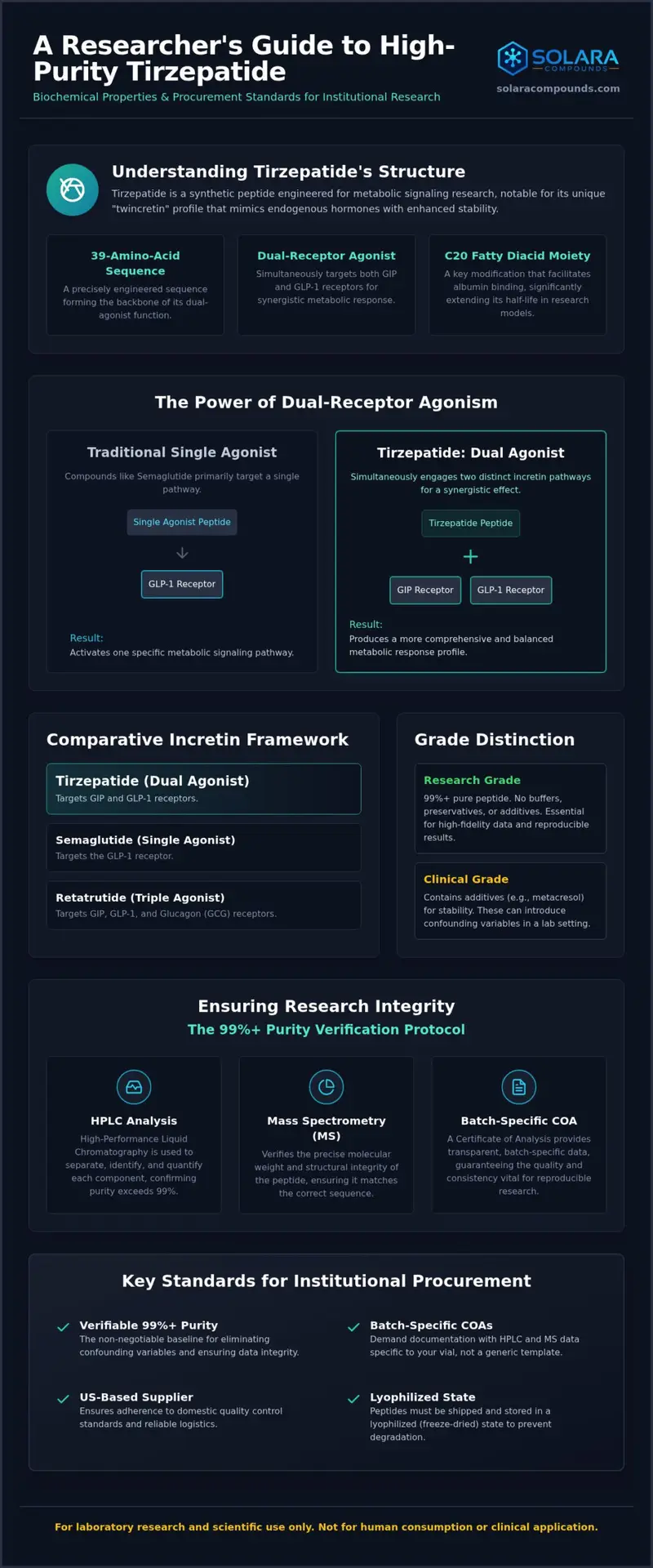
Tirzepatide is formally classified as a synthetic peptide designed for metabolic signaling research. It functions as a dual agonist, simultaneously targeting the glucose-dependent insulinotropic polypeptide (GIP) and glucagon-like peptide-1 (GLP-1) receptors. This “twincretin” profile makes the tirzepatide research peptide a critical tool for investigating synergistic pathways in in vitro and in vivo laboratory environments. By mimicking endogenous hormones with enhanced stability, it allows scientists to observe complex metabolic responses that single-agonist compounds cannot replicate. This categorization is essential for researchers focusing on insulin sensitivity and lipid metabolism.
Molecular Architecture and Sequence Integrity
The structural utility of this compound stems from its precise 39-amino-acid sequence. It’s engineered for stability, specifically when maintained in a lyophilized state to prevent degradation before reconstitution. One of its most distinctive features is the attachment of a C20 fatty diacid moiety. This modification facilitates high-affinity albumin binding, which significantly extends the effective half-life within research models. By slowing renal clearance, this architecture provides a sustained signaling window. It enables long-term observation of receptor interaction without the need for frequent dosing intervals. These intervals can often introduce unwanted variables into a study, so structural engineering is a vital consideration for study design.
Research Grade vs. Clinical Grade: The Distinction
Precision in laboratory data requires a clear distinction between clinical formulations and a pure tirzepatide research peptide. Clinical versions often contain buffers, preservatives, or additives like sodium phosphate or metacresol to ensure patient safety and shelf stability. These components are detrimental to high-fidelity scientific inquiry. They can interfere with assay results or cause unexpected cellular reactions that skew data. Pure research-grade material eliminates these confounding factors.
For institutional procurement, 99%+ analytical purity is the non-negotiable baseline. Achieving this standard requires rigorous verification through High-Performance Liquid Chromatography (HPLC) and Mass Spectrometry (MS). Solara Compounds ensures every batch meets these metrics, providing batch-specific Certificates of Analysis (COAs) to verify molecular weight and sequence integrity. This level of transparency is vital for maintaining the repeatability of multi-phase projects. Researchers must remember that these materials are strictly for laboratory research and scientific use only. They are not intended for human consumption or clinical application.
Dual Agonism Mechanism: GIP and GLP-1 Receptor Interaction
The efficacy of the tirzepatide research peptide lies in its ability to engage two distinct incretin pathways simultaneously. Most metabolic research has historically focused on single-target agonists, but this dual approach creates a synergistic environment. It activates both GIP and GLP-1 receptors, which leads to a more comprehensive metabolic response profile. Studies investigating insulinotropic responses often find that simultaneous activation provides a more nuanced view of glucose regulation than GLP-1 modulation alone. This dual signaling represents a significant shift from traditional models, offering a balanced agonism that mimics complex physiological processes.
For a technical breakdown of these biochemical interactions, the Tirzepatide Mechanism of Action documented by the NCBI provides essential context for receptor binding kinetics. Understanding these kinetics is vital for researchers who need to map out peptide-receptor activity and biochemical signaling response profiles. Establishing a reliable signaling baseline requires consistent chemical integrity. Domestic laboratories often choose to procure tirzepatide 10mg from suppliers that provide batch-specific verification to ensure these complex mechanisms remain predictable across multi-phase studies.
GIP Receptor Signaling in Metabolic Research
GIP signaling is a primary focus for studies involving energy homeostasis. Tirzepatide functions as a potent mimic of native GIP, triggering intracellular pathways that regulate nutrient storage. In laboratory environments, this allows for the detailed study of lipid metabolism within adipose tissue. Researchers use this peptide to observe how GIP receptor activation influences fatty acid synthesis and insulin sensitivity. Unlike GLP-1-only models, the inclusion of GIP signaling provides a more holistic view of how metabolic pathways adapt to chronic incretin stimulation. It’s an essential tool for investigating the role of GIP in energy expenditure and nutrient partitioning.
GLP-1 Pathway Modulation and Receptor Affinity
Measuring the affinity of synthetic tirzepatide for the GLP-1 receptor reveals a slightly lower potency compared to native GLP-1, but this is offset by the compound’s prolonged stability. This extended interaction triggers a robust production of cyclic adenosine monophosphate (cAMP) within target cells. These signaling cascades are essential for research models investigating pancreatic beta-cell function and gastric emptying rates. Because the interaction is far more stable than endogenous peptides, researchers can document the cumulative effects of receptor engagement over a 168-hour window. This stability provides data that single-agonist models cannot provide, specifically regarding long-term signaling cascades and receptor internalization rates.
Tirzepatide vs. Semaglutide vs. Retatrutide: A Comparative Framework
Selecting the appropriate compound for metabolic signaling objectives requires a clear understanding of the incretin mimetic hierarchy. At the foundation of this hierarchy is semaglutide, a 31-amino-acid mono-agonist that targets only the GLP-1 receptor. The tirzepatide research peptide elevates this complexity by functioning as a dual agonist. It targets both GIP and GLP-1 receptors through a 39-amino-acid sequence. This architectural shift from a single to a dual target profile is reflected in the molecular weight. Semaglutide maintains a weight of approximately 4113.6 Da, while tirzepatide increases this to approximately 4813.5 Da. These structural differences dictate how each compound interacts with cellular receptors and influences downstream metabolic outcomes.
The clinical relevance of these structural differences is substantial. This is evidenced by the FDA Approval for Chronic Weight Management granted to tirzepatide in November 2023. In a laboratory setting, researchers often transition from single-agonist models to dual-agonist frameworks to investigate more complex metabolic pathways. The choice between these compounds depends entirely on whether the study aims to isolate GLP-1 signaling or observe the synergistic effects of multiple receptor activations.
Tirzepatide vs. Semaglutide: Single vs. Dual Target
The primary distinction between these two compounds is the signaling complexity. Semaglutide is a highly effective tool for studying isolated GLP-1 pathway modulation. However, it lacks the GIP receptor engagement that defines tirzepatide. Researchers often switch to the dual-agonist model because it provides a more comprehensive dose-response curve in animal models. While semaglutide has a well-documented half-life of approximately 165 hours, the addition of the C20 fatty diacid moiety in tirzepatide provides a comparable 168-hour window with the added benefit of dual-pathway activation. This allows for the study of insulinotropic responses that are more physiologically representative of multi-hormone signaling.
The Emergence of Triple Agonists: Retatrutide 10mg
The current frontier of metabolic research involves triple-agonist profiles, specifically Retatrutide 10mg. This compound expands the dual-agonist framework by adding a third target: the glucagon (GCG) receptor. While tirzepatide balances GIP and GLP-1 activation, retatrutide introduces glucagon signaling to study its impact on energy expenditure and hepatic lipid metabolism. You should utilize Retatrutide over Tirzepatide when your research objectives require the investigation of triple-pathway synergies. The inclusion of the third receptor target significantly alters research outcomes. It shifts the focus from nutrient storage and insulin sensitivity toward a broader investigation of thermogenesis and total energy homeostasis. This makes it an essential tool for advanced, multi-phase metabolic studies.
Sourcing Quality: Verifying Tirzepatide Purity for Laboratory Use
Verification of the tirzepatide research peptide is a non-negotiable requirement for institutional scientific inquiry. Third-party testing serves as the primary defense against the inconsistent purity levels often found in domestic supply chains. Without independent verification, researchers risk introducing unknown chemical variables that can skew biochemical signaling profiles and invalidate long-term metabolic studies. A reliable procurement protocol relies on two analytical pillars: High-Performance Liquid Chromatography (HPLC) and Mass Spectrometry (MS). This secondary test confirms the molecular weight and sequence identity, ensuring the synthesized chain matches the expected 4813.5 Da profile.
Analyzing HPLC Purity Reports
Interpreting an HPLC chromatogram requires looking beyond the final percentage. The primary peak on the graph represents the intended peptide; its area relative to any secondary peaks determines the purity. In high-fidelity research, you should look for a clean, sharp primary peak with a baseline that remains stable. Any “shoulders” or small secondary peaks indicate the presence of truncated sequences or residual solvents. While some suppliers accept a 98% threshold, peer-reviewed standards often demand 99%+ purity to ensure that observed metabolic responses are solely attributable to the peptide. Generic “template” Certificates of Analysis (COAs) that don’t match the specific batch number of your vial are a significant red flag. They fail to account for the minute variations that occur during the synthesis of complex 39-amino-acid chains.
To maintain these rigorous standards in your own laboratory, you can procure high-purity tirzepatide 10mg with batch-specific COAs directly from Solara Compounds.
Stability, Lyophilization, and Handling Protocols
Maintaining the structural integrity of the peptide after procurement is just as critical as the initial purity. This compound is typically provided as a lyophilized, or freeze-dried, powder. This state is far more stable than a liquid solution because it prevents the peptide bonds from undergoing premature hydrolysis. For long-term storage, vials should be kept at -20°C and shielded from light to prevent photodegradation. When you’re ready to begin your study, the reconstitution process must be handled with care. Use a sterile solvent like bacteriostatic water or phosphate-buffered saline, and avoid mechanical stress. Vigorous shaking can denature the delicate peptide structure. Instead, gently swirl the vial until the powder is fully dissolved. These handling protocols ensure that the molecular identity remains intact throughout the duration of your research.
Procuring Tirzepatide 10mg for Institutional Research
The transition from pilot studies to large-scale institutional research requires a procurement strategy that prioritizes logistical stability and data integrity. Selecting a tirzepatide research peptide for multi-phase projects involves more than just verifying a single vial. It requires a partner capable of maintaining a rigorous chain of custody from the point of synthesis to the laboratory bench. Domestic laboratories often face significant hurdles when dealing with international supply chains, including unpredictable lead times and potential compound degradation during transit. By focusing on domestic institutional procurement, researchers can eliminate these external variables and ensure that their focus remains on metabolic signaling outcomes rather than logistical troubleshooting.
Reliability in institutional research is built on the foundation of repeatability. This is particularly true for compounds like tirzepatide, where the 39-amino-acid sequence must remain identical across every phase of a study. Solara Compounds positions itself as a specialized partner for these long-term inquiries. We provide the technical documentation and batch-specific transparency necessary to support peer-reviewed scientific standards. Every procurement decision should be viewed through the lens of scientific risk management. Securing a stable supply of high-purity material is a non-negotiable step in that process.
Bulk Procurement and Wholesale Agreements
Universities and large-scale scientific institutions often require customized supply solutions that go beyond standard retail bundles. Wholesale agreements are essential for streamlining the procurement process for high-volume research needs. These agreements don’t just offer tiered pricing advantages; they provide a guarantee of consistency across batches. When a study spans several months or years, the ability to pull from the same verified synthesis lot is the key to repeatable experimental results. Solara Compounds offers specialized wholesale options for institutional clients, ensuring that even the largest multi-phase projects have access to a stable, high-purity 10mg concentration. This approach allows researchers to plan their resource allocation with confidence, knowing their material supply is secured.
Domestic Supply Chain Reliability
Domestic supply chain reliability is a critical factor for laboratories that cannot afford delays in their research timelines. US-based shipping from our Florida facility ensures significantly faster lead times compared to international sources. This proximity also allows for tighter quality control over the shipping environment, protecting sensitive lyophilized powders from extreme temperature fluctuations. Compliance with research standards and laboratory safety protocols is easier to verify when working with a domestic partner that understands the specific regulatory landscape of US-based institutions. Reliability isn’t just about speed; it’s about the assurance that every vial arrives with its structural integrity fully intact. Explore high-purity Tirzepatide 10mg for your next research phase at Solara Compounds.
All compounds provided are strictly for laboratory research and scientific use only. They are not intended for human consumption or clinical application.
Advancing Metabolic Inquiry with Verified Precision
The evolution of metabolic signaling research demands a shift from single-target models to the sophisticated dual-agonism of the tirzepatide research peptide. This analysis has detailed how the 39-amino-acid sequence and the C20 fatty diacid moiety provide the structural stability required for high-fidelity studies. However, the integrity of your data relies entirely on the precision of your source material. Verification through batch-specific HPLC and Mass Spectrometry isn’t just an optional step; it’s the baseline for scientific repeatability in institutional environments.
Maintaining these standards requires a procurement partner that understands the rigorous demands of multi-phase scientific inquiry. Solara Compounds provides the transparency you need, offering strictly 99%+ purity verified for every order. With secure domestic shipping from our Florida facility, your laboratory can maintain consistent timelines without the risks associated with international logistics. We’re here to support your next scientific breakthrough with compounds that meet the highest analytical standards. Procure High-Purity Tirzepatide 10mg for Research and ensure your results remain beyond reproach. Your commitment to excellence deserves a supply chain that matches your standards.
Frequently Asked Questions
Is tirzepatide research peptide intended for human consumption?
No, it isn’t. The tirzepatide research peptide is strictly for laboratory research and scientific use only. Solara Compounds doesn’t sell products for human consumption or clinical application. Purchasing these materials for personal use is illegal under US federal law and violates institutional safety protocols. Researchers must handle these compounds as chemical reference materials within a controlled environment to ensure compliance with federal regulations and established laboratory safety standards.
What is the purity standard for Solara Compounds tirzepatide 10mg?
We verify every batch of tirzepatide 10mg to a 99%+ purity standard. This is achieved through third-party High-Performance Liquid Chromatography (HPLC) testing to quantify the primary peak. While many domestic suppliers accept 98% as the baseline, we maintain a higher threshold to ensure high-fidelity data. This rigorous standard prevents unknown chemical variables from interfering with metabolic signaling results, which is a non-negotiable requirement for peer-reviewed institutional research and repeatable experimental outcomes.
How should lyophilized tirzepatide be stored in a laboratory setting?
You should store lyophilized powder at -20°C for long-term stability. Vials must be kept away from light to prevent photodegradation of the 39-amino-acid sequence. While the freeze-dried state is stable during domestic transit, consistent sub-zero storage preserves the integrity of the peptide chain. Once you’ve reconstituted the compound, it’s best to keep the solution at 4°C. Use it within your specific study window to avoid hydrolysis or structural degradation that can occur in liquid form.
Does Solara Compounds provide batch-specific HPLC and MS reports?
Yes, we provide batch-specific Certificates of Analysis for every order. These include HPLC chromatograms to verify purity and Mass Spectrometry reports to confirm the molecular weight of 4813.5 Da. We don’t provide generic templates that fail to account for batch variations. This transparency ensures that the material you receive matches the exact chemical profile required for your study. It allows researchers to document the precise identity of their compounds, which is essential for maintaining scientific integrity.
Can I purchase tirzepatide research peptides in bulk for my institution?
We offer specialized wholesale agreements and bulk procurement options for universities and research institutions. These solutions are designed for high-volume needs where batch consistency is vital for repeatable results. By pulling from a single synthesis lot, laboratories can eliminate variables across different phases of a project. Our Florida facility manages these large-scale orders with secure domestic shipping, ensuring that institutions have a reliable, high-purity supply for their long-term metabolic studies and multi-phase scientific inquiries.
What is the difference between tirzepatide and retatrutide in a research context?
The distinction is the receptor target profile. Tirzepatide is a dual agonist targeting GIP and GLP-1 receptors. Retatrutide is a triple agonist that adds glucagon receptor activation. Researchers choose the tirzepatide research peptide when they need to investigate synergistic incretin signaling. Retatrutide is better suited for studies exploring thermogenesis and total energy homeostasis. Your choice should align with whether your signaling objectives require dual-pathway interaction or a more complex triple-pathway model for your specific laboratory study.
Does Solara Compounds ship research peptides internationally?
No, Solara Compounds doesn’t offer international shipping. We focus exclusively on serving US-based institutional clients from our Florida facility. This domestic focus allows us to guarantee faster lead times and maintain a secure chain of custody for every order. By avoiding international customs, we ensure that sensitive research-grade vials aren’t exposed to unpredictable delays or temperature fluctuations. This logistical stability is critical for laboratories that need to maintain strict multi-phase research timelines and compound integrity.
What solvent is recommended for the reconstitution of tirzepatide for in vitro study?
Bacteriostatic water or phosphate-buffered saline (PBS) are the standard solvents for reconstitution. The selection depends on your specific assay requirements and the necessary pH environment for your research model. You should add the solvent slowly and avoid shaking the vial, as mechanical stress can denature the peptide structure. Instead, use a gentle swirling motion. This careful handling ensures the structural integrity of the compound is preserved, providing reliable and accurate signaling data for your institutional laboratory study.