Research Articles
Peptides for Collagen Synthesis: Lab Guide 2026


An unexpected failure in an extracellular matrix assay doesn’t usually stem from flawed cell culture methodology; more often, it begins with an unverified vial. Selecting a reliable peptide for collagen synthesis research requires uncompromising analytical rigor, especially when batch-to-batch inconsistency can derail weeks of in vitro fibroblast testing.
You already know that measuring procollagen expression and cellular matrix remodeling demands dependable, sequence-verified compounds. Unfortunately, laboratory investigators constantly face vague supplier paperwork, missing raw HPLC traces, and ambiguous labeling that jeopardize experimental reproducibility.
This guide breaks down the core molecular signaling pathways governing in vitro collagen production, highlights leading candidate peptides, and details how to verify third-party analytical reports before placing an order. For teams sourcing documented compounds through Solara Compounds at solaracompounds.com, establishing rigorous analytical controls protects your downstream findings from day one. Please note that all compounds discussed in this guide are intended strictly for laboratory research only.
Key Takeaways
- Discover how to select an authentic peptide for collagen synthesis research by evaluating fibroblast signaling pathways and procollagen production markers in cellular models.
- Compare target pathways, sequence lengths, and extracellular matrix remodeling mechanisms for leading research candidates such as GHK-Cu, BPC-157, and TB-500.
- Identify how truncated synthesis artifacts distort in vitro binding data and create severe batch-to-batch inconsistencies across cell culture experiments.
- Apply a practical two-step procurement checklist to audit raw HPLC chromatograms and confirm exact molecular identity using LC-MS analytical documentation.
- Establish rigorous laboratory procurement standards that emphasize batch-specific Certificates of Analysis and domestic fulfillment for strictly research-use assays.
Extracellular Matrix Dynamics: Defining the Peptide for Collagen Synthesis Research
Extracellular matrix (ECM) biology focuses heavily on how cellular signaling cascades govern structural protein deposition. In cell culture assays, a peptide for collagen synthesis research serves as a targeted biochemical probe. Rather than acting as passive structural material, these short-chain amino acid sequences interact directly with surface receptors on cultured fibroblasts. Fibroblasts act as the primary cellular engine responsible for generating Type I and Type III procollagen precursors. Understanding the molecular pathways behind collagen synthesis gives bench researchers reliable, repeatable markers to evaluate matrix remodeling. All experimental models evaluate these pathways strictly in vitro and for laboratory research only.
Fibroblast Activation and Procollagen Transcription Cascades
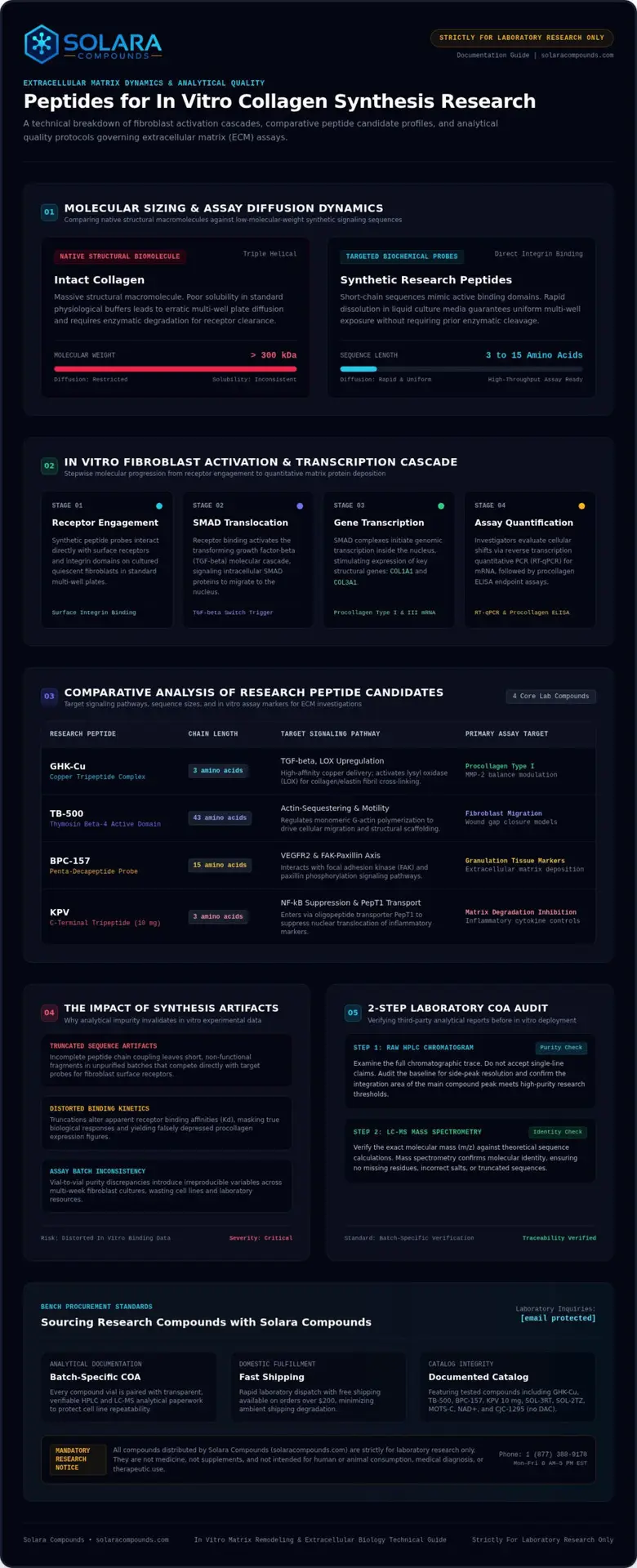
Fibroblast activation typically proceeds through the transforming growth factor-beta (TGF-beta) pathway, a critical molecular switch that directs the cell nucleus to produce structural matrix proteins. When activated, intracellular SMAD proteins move into the nucleus, initiating the transcription of the COL1A1 and COL3A1 genes.
Bench investigators quantify these shifts using reverse transcription quantitative PCR (RT-qPCR) to measure mRNA levels, followed by procollagen enzyme-linked immunosorbent assays (ELISA). Establishing stable baseline expression in quiescent fibroblast models is vital. Any cross-pathway testing, such as evaluating inflammatory matrix interactions with KPV 10 mg in cell culture, requires precise control over serum concentration and plating density to maintain assay validity.
Synthetic Peptides vs. Native Structural Biomolecules in Research
Assay design often falters when protocols confuse native structural proteins with synthetic signaling sequences. Intact collagen is a massive triple-helical molecule exceeding 300 kilodaltons. Its immense size and poor solubility mean it doesn’t dissolve cleanly in standard physiological buffers, creating inconsistent diffusion across multi-well plates.
Short synthetic peptides, typically spanning 3 to 15 amino acids, bypass these logistical hurdles. These low molecular weight fragments dissolve rapidly in liquid culture media, ensuring uniform exposure across every well. Because synthetic fragments mimic specific active binding domains, they interact with fibroblast integrin receptors without requiring enzymatic degradation. This chemical clarity makes a targeted peptide for collagen synthesis research an essential tool for high-throughput in vitro screening.
Comparative Breakdown: Leading Research Peptides Investigated in Collagen Pathways
Different peptide families target distinct stages of extracellular matrix deposition. Identifying the right peptide for collagen synthesis research depends on the exact cellular cascade your protocol evaluates. Below is a comparative breakdown of key compounds tested across fibroblast and structural remodeling assays.
| Peptide | Length | Target Signaling Pathway | Primary Assay Target |
|---|---|---|---|
| GHK-Cu | 3 amino acids | TGF-beta, LOX upregulation | Procollagen Type I, MMP-2 balance |
| TB-500 | 43 amino acids (active domain) | Actin-sequestering, cell motility | Fibroblast migration, wound gap closure |
| BPC-157 | 15 amino acids | VEGFR2, FAK-paxillin pathway | Granulation tissue, matrix deposition |
| KPV | 3 amino acids | NF-kB suppression, PepT1 transport | Inflammatory matrix degradation markers |
GHK-Cu Copper Tripeptide in Matrix Remodeling Models
GHK-Cu functions as a high-affinity copper transporter. By delivering copper directly to cultured fibroblasts, it upregulates lysyl oxidase (LOX), an essential enzyme that facilitates cross-linking between collagen and elastin fibrils. Investigators utilizing GHK-Cu for research assays also monitor matrix metalloproteinases (MMPs). The peptide doesn’t just stimulate structural matrix output; it maintains enzymatic equilibrium, preventing unorganized collagen accumulation in vitro.
Investigative Signaling Chains: TB-500, BPC-157, and KPV
TB-500 represents the active sequence of Thymosin Beta-4. In scratch assays, it sequesters G-actin, accelerating cellular mobility so fibroblasts migrate rapidly into disrupted plate zones. Meanwhile, laboratory protocols working with BPC-157 in laboratory models explore tendon and connective tissue remodeling via focal adhesion kinase (FAK) activation. Pairing structural probes with anti-inflammatory signaling molecules like KPV allows researchers to track matrix integrity under cytokine-induced stress.
Selecting the appropriate peptide for collagen synthesis research requires clean molecular profiles tailored to your specific assay endpoints. When planning your next series of cell culture runs, explore the full selection of analytical-grade sequences and browse high-purity research peptides available for laboratory purchase.
Overcoming Analytical Flaws: The Importance of High-Purity Research Compounds
Experimental failure in matrix biology rarely stems from poor laboratory technique alone. When an in vitro assay yields erratic procollagen readouts, uncharacterized chemical impurities are often the silent culprit. Solid-phase peptide synthesis (SPPS) requires precise deprotection and coupling cycles carried out in ISO 7 cleanroom environments. Without stringent controls, incomplete reactions introduce truncated sequences, deletion fragments, and chemical artifacts that undermine your assay data. Ensuring high analytical integrity for every peptide for collagen synthesis research protects against batch-to-batch inconsistency.
Assay Artifacts Caused by Truncated Peptide Sequences
Truncated sequences occur when an amino acid fails to couple during synthesis, yielding an incomplete chain. These fragments often retain partial binding affinity for target cell receptors. Rather than activating transcription cascades, they can competitively block intact sequences from receptor binding sites. This competitive inhibition skews concentration-response curves, creating false-negative signaling readouts.
Unpurified chemical residues introduce separate analytical confounders. Free coupling reagents and protecting groups induce cellular stress, skewing spectrophotometric baseline measurements like MTT or cell viability assays. When cell viability drops due to synthetic contaminants rather than the signaling agent, researchers mistakenly conclude the peptide exhibits cytotoxicity. Achieving an HPLC purity target of 98% minimum eliminates these misleading baseline fluctuations.
Residual Solvents and Counter-Ion Verification in Cell Assays
Peptide synthesis relies heavily on trifluoroacetic acid (TFA) for global cleavage from solid-phase resin. While necessary during manufacturing, residual TFA acts as an acidic counter-ion that alters media pH. Delicate primary cell lines, particularly human dermal fibroblasts, are acutely sensitive to trace acid levels:
- pH Drift: High TFA concentrations suppress basic fibroblast proliferation in low-buffered culture conditions.
- Endotoxin Spikes: Bacterial contaminants from unverified handling trigger non-specific toll-like receptor pathways.
- Batch Discordance: Variable salt content across orders disrupts osmotic stability in microplate wells.
Verifying rigorous counter-ion exchange and endotoxin controls safeguards fragile culture systems. Institutional investigators rely on third-party documentation to confirm trace purity before introducing materials into experimental wells. Reviewing independent analytical verification protocols, such as batch Certificates of Analysis, ensures your research compounds maintain chemical purity and deliver reproducible cellular signaling data.
Laboratory Procurement Checklist: How to Verify Certificates of Analysis
Procuring a dependable peptide for collagen synthesis research requires verifying analytical data rather than relying on vendor product summaries. Without raw instrument readouts, a stated purity figure is just a claim. Bench investigators should run through a standardized four-step verification checklist before introducing any lyophilized lot into cell culture runs:
- Step 1: Evaluate chromatographic peak resolution on analytical high-performance liquid chromatography (HPLC) traces.
- Step 2: Match observed mass-to-charge ratios against theoretical calculations via mass spectrometry (LC-MS or MALDI-TOF).
- Step 3: Confirm testing was executed by an accredited third-party facility like Kovera Labs rather than an in-house manufacturer.
- Step 4: Check that lot numbers printed on the analytical paperwork match the physical vial label exactly.
Reading High-Performance Liquid Chromatography (HPLC) Traces
Begin your audit by checking the analytical HPLC profile. The primary compound peak area must demonstrate greater than 98% purity based on total integrated peak area. Examine the baseline around the target retention window. Asymmetrical fronting, trailing split peaks, or satellite shoulders indicate co-eluting sequence isomers or deamidation products. Confirm that the run parameters specify a 214 nm or 220 nm UV absorbance wavelength; these settings detect peptide backbone bonds accurately, whereas 254 nm or 280 nm channels overlook impurities lacking aromatic rings.
Mass Confirmation via MALDI-TOF and Electrospray Ionization
HPLC confirms relative purity, but it cannot verify chemical identity. Mass spectrometry resolves this by measuring exact molecular mass. Match the reported mass-to-charge (m/z) spectrum against the theoretical molecular weight of your sequence. Watch out for secondary mass spikes offset by +16 Da or +22 Da, which reveal unwanted oxidation products and sodium adducts. Similarly, multimer peaks indicate peptide aggregation that can disrupt receptor binding dynamics in vitro.
Every authentic peptide for collagen synthesis research must provide accessible analytical records. Institutional researchers can audit publicly verifiable records using a dedicated peptide certificate of analysis portal to inspect raw traces prior to procurement. When you need fully documented lots backed by independent testing, see the current research catalog to select analytical-grade sequences for laboratory research only.
Sourcing Documented Research Peptides for Extracellular Matrix Assays
Biotechnology teams and institutional investigators face strict internal procurement guidelines. Ensuring assay reproducibility requires clear provenance, consistent lot numbers, and verifiable analytical paperwork. Procuring a reliable peptide for collagen synthesis research requires working with domestic partners that prioritize chemical integrity from synthesis through final delivery. All experimental protocols must operate within strict Research Use Only parameters, recognizing that these materials are intended exclusively for in vitro and cellular model research.
Domestic Supply Chains and Cold-Chain Handling Standards
Lyophilized peptides remain stable at controlled room temperatures, but prolonged transit under unregulated conditions exposes cakes to ambient thermal degradation and moisture ingress. Overseas shipping introduces lengthy customs holds, humidity shifts, and unmonitored handling that compromise fragile peptide bonds before delivery. Utilizing dedicated domestic supply chains prevents these vulnerabilities.
Reliable logistics protect your experimental timetable. Fast domestic dispatch minimizes transit duration, ensuring vials arrive sealed under vacuum with intact rubber stoppers and flip-off caps. Once received, unopened lyophilized vials should be cataloged and transferred immediately to manual-defrost storage at -20°C to preserve long-term chain integrity. For institutional labs managing high-throughput screening tiers, consistent fulfillment prevents costly testing delays.
The Solara Compounds Analytical Standard for Labs
Solara Compounds provides institutional and independent investigators with verified analytical standards for extracellular matrix signaling assays. Synthesis is executed via solid-phase peptide synthesis (SPPS) within controlled ISO 7 cleanroom suites to minimize environmental contaminants. Each manufactured lot undergoes independent third-party analysis by Kovera Labs to verify purity and molecular structure.
Documentation comes standard. Solara Compounds pairs every production run with publicly verifiable analytical paperwork, providing HPLC chromatograms targeting a minimum 98% purity alongside LC-MS and MALDI-TOF mass identity confirmations. Research teams can inspect batch documentation directly or review the full catalog of high-purity research peptides at solaracompounds.com, securing analytical certainty for downstream matrix deposition assays.
Standardizing Matrix Research with Analytical Precision
Achieving reproducible extracellular matrix data requires total control over your experimental reagents. Whether your protocol tracks TGF-beta activation cascades or quantifies procollagen deposition in primary fibroblast cultures, choosing a verified peptide for collagen synthesis research eliminates the blind spots caused by truncated sequence fragments and acidic counter-ion drift. Accurate in vitro modeling always starts with confirmed chemical identity.
Solara Compounds removes procurement guesswork by holding every production lot to strict analytical benchmarks. Every compound is verified through independent third-party batch testing via Kovera Labs, meeting a minimum greater than 98% HPLC purity standard and accompanied by lot-traceable batch Certificates of Analysis. Available exclusively at solaracompounds.com for laboratory research only, these documented sequences give investigators the structural consistency needed for confident benchwork.
View the current research catalog to select fully verified peptides for your next matrix assay series.
Frequently Asked Questions
What is the primary role of a peptide for collagen synthesis research in vitro?
In vitro, a peptide for collagen synthesis research acts as a biochemical probe to modulate specific receptor signaling pathways on cultured fibroblasts. Rather than providing structural bulk, these short sequences bind to cell receptors to upregulate procollagen gene transcription, such as COL1A1 and COL3A1. This allows investigators to analyze rate-limiting steps in matrix deposition, evaluate cross-linking dynamics, and observe cellular responses under controlled laboratory conditions without confounding tissue variables.
How do researchers measure collagen production in cell culture assays?
Investigators quantify collagen output using a combination of transcriptional and protein-level assays. Reverse transcription quantitative PCR (RT-qPCR) measures early-stage procollagen mRNA expression following peptide exposure. Downstream, researchers utilize enzyme-linked immunosorbent assays (ELISA) to detect soluble procollagen Type I C-peptide (PIP) secreted into the culture supernatant. For structural deposition over extended culture timelines, colorimetric assays such as Sirius Red staining provide clear visual and spectrophotometric quantification of insoluble extracellular matrix accumulation.
Why is HPLC purity testing critical before initiating fibroblast research?
High-performance liquid chromatography (HPLC) testing verifies that the material contains only the intended full-length sequence. Truncated peptide fragments from incomplete synthesis can bind target cell receptors without activating downstream transcription, creating competitive inhibition and skewing dose-response readouts. Low-purity lots often harbor residual synthesis chemicals and excess trifluoroacetic acid. These contaminants alter media pH and induce false cytotoxicity in sensitive primary cell lines, undermining assay reproducibility before data collection even begins.
Can GHK-Cu be evaluated in matrix metalloproteinase research models?
Yes, GHK-Cu is frequently investigated in cellular matrix metalloproteinase (MMP) assays. The copper tripeptide complex influences matrix turnover by modulating the balance between matrix-degrading enzymes, such as MMP-2, and tissue inhibitors of metalloproteinases (TIMPs). In laboratory models, researchers assess how the compound coordinates collagen deposition alongside controlled matrix degradation. This makes it a standard reference reagent for studying continuous extracellular matrix remodeling and enzyme-mediated tissue restructuring in cell culture plates.
What is the difference between research-grade peptides and clinical compounds?
Research-grade peptides are manufactured strictly for laboratory experimentation and in vitro assays, designated as Research Use Only (RUO). They aren’t certified or approved for clinical administration, human use, or animal testing. In contrast, clinical pharmaceutical products must undergo specialized cGMP manufacturing processes designated specifically for diagnostic or therapeutic applications. Qualified buyers working in academic and biotechnology labs utilize research-grade compounds solely to evaluate cellular pathways, molecular kinetics, and receptor binding characteristics at the bench.
How should lyophilized peptides be stored prior to laboratory reconstitution?
Lyophilized research peptides should be stored in a manual-defrost freezer at -20°C upon receipt to maintain long-term stability. Avoid auto-defrost units, as their daily temperature cycling introduces moisture and accelerates peptide degradation. Keep vials sealed with desiccant to prevent atmospheric humidity from hydrating the cake. Before reconstitution with laboratory-grade solvent or bacteriostatic water, allow the sealed vial to warm to room temperature. This step prevents ambient condensation from forming inside the container during handling.
What documentation should accompany research peptides ordered for institutional study?
Institutional research teams across major biotech hubs in Boston, San Diego, San Francisco, New York, and Raleigh require batch-specific Certificates of Analysis (COA) matching the vial’s unique lot number. Essential documentation must include raw analytical HPLC traces confirming greater than 98% purity alongside LC-MS or MALDI-TOF spectra validating theoretical molecular mass. Suppliers like Solara Compounds provide publicly accessible third-party reports from Kovera Labs, ensuring researchers verify chemical identity and purity before beginning sensitive cell culture runs.