Research Articles
Sourcing Reliable Research Peptide Vendors: A 2026 Laboratory Guide


In 2026, a static PDF is no longer sufficient proof of chemical integrity. Identifying truly reliable research peptide vendors requires a deep dive into batch-specific data and transparent synthesis protocols. Many lab buyers struggle with inconsistent purity levels that fluctuate between orders, often compounded by slow shipping from international resellers. These delays and documentation gaps don’t just stall timelines. They threaten the reproducibility of critical data. At Solara Compounds, we recognize that precision is the only currency that matters in a laboratory setting. All products available at solaracompounds.com, including SOL-3RT and SOL-2TZ, are strictly for laboratory research only and are not intended for human or animal consumption.
You deserve a procurement partner that operates with the same rigor as your own team. This guide outlines the essential quality metrics, from third-party HPLC/MS verification to the 2026 EMA reporting thresholds of 0.1% for synthetic impurities. We’ll explore how to verify lot-number traceability and ensure your supply chain remains robust for multi-phase in-vitro studies. By the end of this guide, you’ll have a framework for selecting a supplier that prioritizes structural integrity and consistent performance over marketing claims.
Key Takeaways
- It’s essential to understand why batch-specific HPLC and Mass Spectrometry are the non-negotiable benchmarks for verifying peptide purity and molecular weight.
- Learn to vet reliable research peptide vendors by looking for lot-number traceability and avoiding those using medical or consumer-focused language.
- Discover the logistical benefits of domestic US sourcing, which minimizes transit times and preserves the stability of lyophilized research compounds.
- Establish a long-term supply chain by selecting partners who provide third-party documentation from accredited facilities like Kovera Labs.
- All products found at solaracompounds.com are for laboratory research only and are not intended for human or animal consumption.
Criteria for Selecting Reliable Research Peptide Vendors in 2026
By 2026, the definition of reliable research peptide vendors has shifted from mere availability to radical transparency. A trustworthy supplier doesn’t just offer products; they provide verifiable identity and purity data for every unique production lot. Generic purity claims are insufficient for rigorous scientific inquiry because they fail to account for the variability inherent in chemical peptide synthesis. Without batch-specific data, researchers risk introducing variables that can skew results and invalidate months of laboratory effort. Remember that all products from Solara Compounds, including SOL-3RT and SOL-2TZ, are for laboratory research only and are not intended for human or animal consumption.
Reliability starts in the cleanroom. High-quality synthesis requires ISO 7 cleanroom standards to prevent cross-contamination during the production process. These environments limit the concentration of airborne particles, ensuring that the structural integrity of compounds like BPC-157 or TB-500 remains uncompromised. When a vendor lacks these controlled environments, the risk of impurities increases, which can interfere with delicate in-vitro pathways. At solaracompounds.com, we maintain a strict adherence to these standards to support institutional procurement readiness and data integrity.
Purity vs. Identity: Why Both Metrics Matter
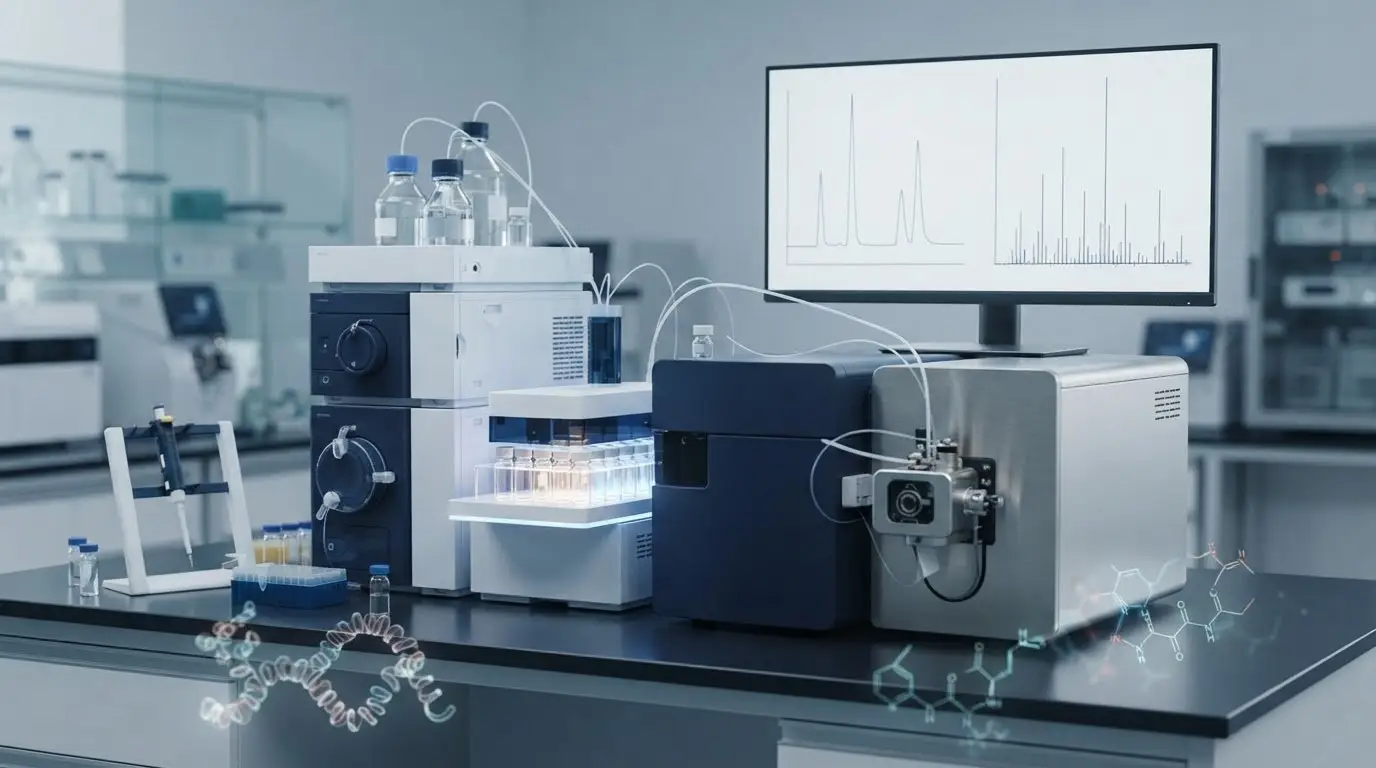
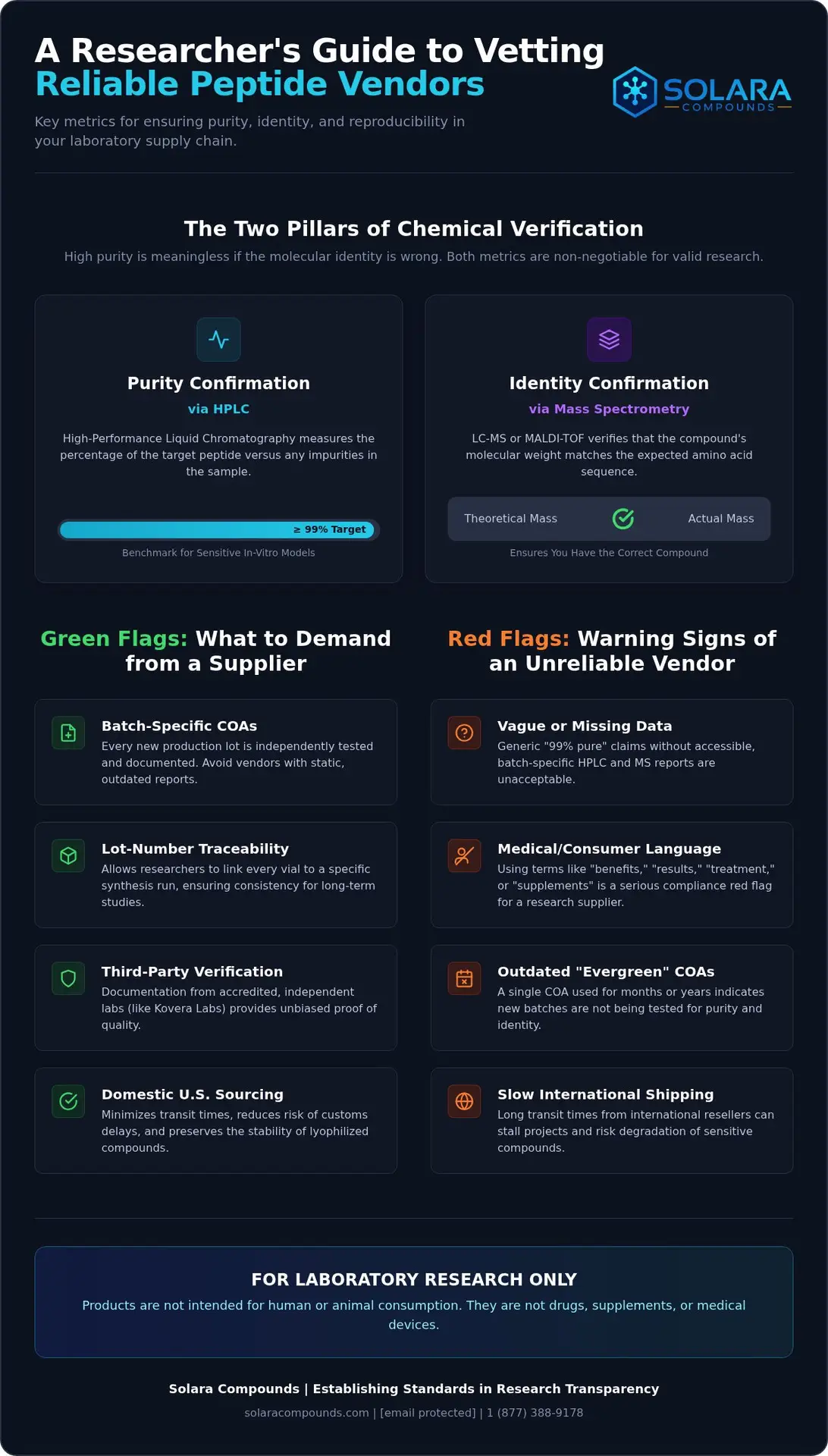
Many lab buyers mistake high purity for chemical accuracy. You might receive a report showing 99% purity, but if the molecular weight doesn’t match the target sequence, the experiment is compromised from the start. It’s why researchers must distinguish between HPLC and Mass Spectrometry. High-Performance Liquid Chromatography is the analytical standard used to measure the exact percentage of the target peptide relative to any impurities within a sample. While HPLC confirms how much of the substance is clean, Mass Spectrometry confirms that the substance is actually the specific peptide you ordered. Without both metrics, your data lacks a verifiable foundation.
The Necessity of Batch-Specific Documentation
Consistency is the backbone of long-term laboratory studies. Reliable vendors use lot-number traceability to allow researchers to link every vial back to its specific synthesis run. You should be wary of evergreen Certificates of Analysis (COAs) that appear unchanged for months or years. These outdated reports suggest the vendor is relying on old data rather than testing every new batch. This practice can lead to significant batch-to-batch variation that ruins reproducibility. We encourage all lab buyers to Review the batch COA before initiating any laboratory work to ensure the material meets your specific requirements.
Technical Verification: HPLC and Mass Spectrometry Standards
High-Performance Liquid Chromatography (HPLC) serves as the primary benchmark for verifying the purity of research compounds. For sensitive in-vitro models, targeting a purity level of ≥ 99% is essential to minimize confounding variables. When reliable research peptide vendors provide a Certificate of Analysis, they’re offering a snapshot of the chemical’s stability and concentration. This testing ensures that researchers aren’t inadvertently introducing unknown reagents into their study environments. All compounds sold by Solara Compounds at solaracompounds.com are for laboratory research only and are not for human or animal consumption.
While purity is critical, it only tells half the story. You also need to confirm the molecular identity. This is where methods like Matrix-Assisted Laser Desorption/Ionization-Time of Flight (MALDI-TOF) and Liquid Chromatography-Mass Spectrometry (LC-MS) become indispensable. These techniques verify that the amino acid sequence matches the theoretical mass of the compound. Without this confirmation, a sample could be 99% pure but consist of the wrong sequence entirely. You can review the batch COA for our current inventory to see these metrics in practice.
Interpreting HPLC Chromatograms
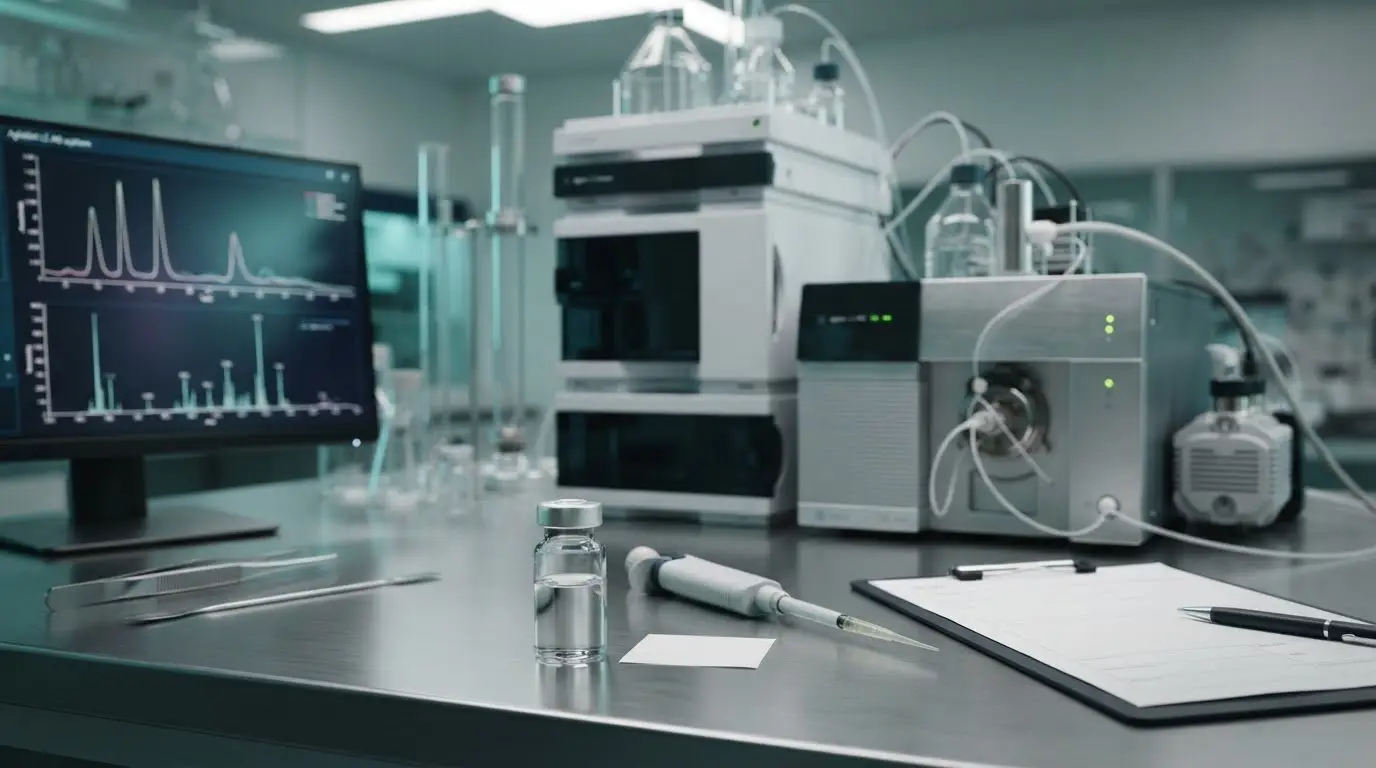
A standard HPLC chromatogram displays results as a series of peaks on a graph. The primary peak represents the target peptide, while any smaller secondary peaks indicate impurities or residual substances. It is vital to account for residual solvents or salts, such as trifluoroacetic acid (TFA), which can remain after the synthesis process. If these aren’t properly documented, they can alter the pH or chemical behavior of your research medium. To maintain integrity, look for compounds that undergo sterile lyophilization and are provided in vacuum-sealed vials. This process removes moisture and air to stabilize the compound for long-term storage.
Molecular Weight Confirmation via LC-MS
LC-MS testing is your first line of defense against mislabeled research chemicals. It provides a precise measurement of the compound’s mass, ensuring the sequence of amino acids is exactly what was intended during synthesis. This level of detail is a hallmark of transparency in the 2026 market. Regulators are increasingly active in monitoring the industry, as seen in this FDA Warning Letter on Unapproved Peptides, which highlights the risks of vendors who fail to maintain strict research-only standards or make illegal therapeutic claims.
Choosing a vendor that prioritizes these technical benchmarks ensures that your laboratory work remains reproducible and accurate. You can explore our full catalog of research peptides to see how these standards are applied across our entire inventory. By focusing on data-driven verification, Solara Compounds helps lab buyers secure the high-purity materials necessary for complex studies.
Common Red Flags in the Research Peptide Supply Chain
Identifying reliable research peptide vendors requires looking beyond the price tag and scrutinizing a supplier’s communication style. If a website uses consumer-focused marketing language like “fat loss” or “anti-aging,” it’s a clear indicator that the supplier isn’t prioritizing scientific rigor. These terms are designed to sell a result rather than a high-purity chemical reagent. Professional laboratories require reagents that are synthesized for precision, not marketed for transformation. It’s crucial to remember that all compounds from Solara Compounds, including SOL-3RT and SOL-2TZ, are for laboratory research only and are not for human or animal consumption. You can view our full research catalog at solaracompounds.com.
Accountability matters. A vendor that fails to list a physical US address or clear contact information is an anonymous entity that’s difficult to hold responsible for quality failures. Additionally, suspiciously low pricing should trigger an immediate investigation. High-grade solid-phase peptide synthesis requires expensive reagents and specialized labor. When prices drop significantly below the industry average, it often points to shortcuts in the purification process or the omission of critical identity testing. Precision has a cost.
Marketing Hype vs. Scientific Accuracy
Serious researchers should immediately disqualify any vendor using hyperbolic terms like “miracle” or “life-changing.” These descriptors have no place in a laboratory environment where data and empirical results are the only metrics of success. A professional vendor uses precise, technical language to describe a compound’s properties and its intended use in a lab. Avoid suppliers that provide human dosing instructions or “reconstitution for injection” guides. These materials demonstrate an intent for use that contradicts the strict “research only” designation and can put your laboratory’s regulatory standing at risk.
Opaque Testing and Verification Policies
The “missing lab” red flag is one of the most common issues in the 2026 supply chain. If a Certificate of Analysis (COA) doesn’t explicitly name the third-party testing facility, there’s no way to verify the data’s authenticity. Solara Compounds prioritizes transparency by utilizing Kovera Labs for independent verification of every batch. This allows lab buyers to confirm the results directly with the testing entity. To ensure research continuity, we maintain a 14-day window for reporting any damaged or incorrect shipments. This policy protects your study timelines and ensures that the compounds you receive meet the exact specifications required for your in-vitro models.
Domestic Sourcing Advantages for US-Based Laboratories
Logistical efficiency is a critical component of successful research. For laboratories located in major biotech hubs like San Diego, Boston, and Raleigh, sourcing from reliable research peptide vendors within the United States significantly reduces transit times. International shipping often introduces unpredictable delays, which doesn’t just stall timelines; it can jeopardize time-sensitive in-vitro models. By contrast, domestic procurement ensures a predictable supply chain. It’s a standard we maintain to support the rigorous schedules of modern labs. All products provided by Solara Compounds are for laboratory research only and are not intended for human or animal consumption. To further support institutional needs, we provide free shipping on orders over $200 for all domestic procurement.
Temperature stability is another major concern during long-distance international transit. While lyophilized peptides are robust, extended exposure to fluctuating temperatures in customs warehouses can impact the structural integrity of sensitive sequences. Domestic logistics allow for better control over the environment and faster delivery, preserving the quality of the compounds from the cleanroom to your facility. Solara Compounds operates from Florida, providing a centralized domestic point for rapid distribution. If technical questions arise regarding storage or handling, our team is available Monday–Friday, 8 AM–5 PM Eastern at 1 (877) 388-9178.
Bio-Availability and Storage Stability
Lyophilized powders are the industry standard for maintaining storage stability and handling precision in a lab setting. This format allows researchers to reconstitute only what is needed for a specific study phase, which reduces waste and ensures consistency across different trials. Domestic sourcing simplifies the maintenance of the cold chain, as compounds spend less time in transit compared to overseas shipments. For technical inquiries regarding specific batches, we maintain a standard response time of 24-48 hours. You can reach our specialists at support@solaracompounds.com for detailed information on any product in our catalog.
Institutional Procurement and Bulk Agreements
Multi-phase research projects in university and private settings require a stable, long-term supply of high-purity compounds. Tiered pricing structures support these extensive studies by allowing for cost-effective procurement when securing larger quantities. Lot-number traceability plays a vital role here, as it ensures that every vial used in a peer-reviewed study can be traced back to a specific synthesis run. This level of documentation is essential for verifying data reproducibility. For instance, when sourcing Research Grade Tirzepatide 10mg (SOL-2TZ), having batch-specific data allows researchers to account for every variable in their experimental design.
Maintaining a reliable domestic supply chain is a cornerstone of laboratory success. Selecting a partner that understands the technical and logistical requirements of modern science ensures that your focus remains on the data rather than the delivery. We invite you to Shop research peptides at solaracompounds.com to secure the high-purity materials needed for your next study phase.
Solara Compounds: Establishing Standards in Research Transparency
Solara Compounds was founded to bridge the gap between complex material science and practical laboratory application. Establishing a partnership with reliable research peptide vendors shouldn’t be a matter of guesswork. We distinguish ourselves by treating documentation as a core product feature rather than an afterthought. Our curated catalog focuses on high-demand sequences like SOL-3RT, SOL-2TZ, BPC-157, and specialized compounds such as GHK-Cu. Our commitment to HPLC purification targets a minimum of 98% for all research materials. All products found at solaracompounds.com are for laboratory research only and are not intended for human or animal consumption. You can Shop research peptides at solaracompounds.com to secure the materials needed for your next study phase.
The Solara Difference: Batch-Specific Verification
Precision is our standard. Lot-tracking ensures every vial of SOL-3RT or BPC-157 is accounted for within our internal quality control system. This system allows you to access lab reports directly via the unique lot number printed on each vial. Instead of relying on generic “typical” results, you receive data that corresponds to the exact physical material in your hands. This level of transparency is essential for researchers who must account for every variable in peer-reviewed environments. Solara Compounds maintains a strict commitment to ISO 7 cleanroom synthesis and third-party testing to ensure the structural integrity of every compound we provide.
Supporting the Scientific Community
We provide science-forward information that respects the technical literacy of our audience. You won’t find medical claims, patient testimonials, or consumer hype in our communications. We focus on the data. For institutional procurement needs or specific technical questions about our synthesis protocols, you can contact our research support team at 1 (877) 388-9178, Monday–Friday, 8 AM–5 PM Eastern. We also offer tiered pricing to support multi-phase research projects that require consistent, long-term supply chains. We invite you to View the current research catalog and review our available documentation to see how we support institutional readiness. Our goal is to serve as a knowledgeable guide, helping lab buyers navigate the technical challenges of compound sourcing with ease and confidence.
Securing the Foundation for Laboratory Precision
Identifying reliable research peptide vendors requires a commitment to verifiable data over marketing claims. The intersection of ISO 7 cleanroom synthesis and batch-specific HPLC/MS verification creates the necessary foundation for reproducible results. Relying on domestic logistics further ensures that your lyophilized compounds maintain their structural integrity throughout the transit process. Solara Compounds remains dedicated to this documentation-first approach, providing batch-specific COAs via Kovera Labs for every unique production lot.
It’s important to remember that all materials available at solaracompounds.com are for laboratory research only and are not intended for human or animal consumption. We provide US-based support at 1 (877) 388-9178 to assist with institutional procurement and technical inquiries. By prioritizing transparency and physical laboratory standards, you can establish a robust supply chain that supports long-term scientific objectives. We offer free shipping on orders over $200 to help streamline your laboratory procurement. If you’re ready to secure high-purity compounds for your next in-vitro study, we invite you to Shop research peptides at solaracompounds.com. We look forward to supporting your next phase of discovery with precision-engineered materials.
Frequently Asked Questions
What defines a reliable research peptide vendor?
Reliability is defined by a documentation-first approach including batch-level HPLC and LC-MS verification for every production lot. A vendor must provide lot-number traceability and use ISO 7 cleanrooms for synthesis. Transparency regarding third-party testing facilities is a key differentiator in 2026. For researchers in hubs like Boston or San Diego, local availability and domestic shipping are also critical markers of a dependable partner. Solara Compounds prioritizes these metrics to ensure every vial meets institutional standards.
How can I verify if a peptide vendor’s COA is legitimate?
Legitimate Certificates of Analysis (COAs) must include raw HPLC chromatograms and Mass Spectrometry data that correspond to a specific lot number. You can verify these reports by contacting the listed third-party facility directly. For example, Solara Compounds provides batch-specific reports via Kovera Labs. Avoid vendors that use “typical” reports or omit the lab’s name, as these documents lack the traceability required for rigorous laboratory work and peer-reviewed studies.
Why is third-party testing by labs like Kovera Labs important?
Independent verification by facilities like Kovera Labs removes conflict of interest and provides an unbiased assessment of purity and identity. This testing confirms that the chemical sequence and concentration match the vendor’s claims before the material reaches your laboratory. It’s a non-negotiable standard for maintaining data integrity in complex in-vitro models. Using third-party data allows researchers to account for every variable, ensuring that synthesis impurities don’t compromise experimental outcomes.
Does Solara Compounds provide batch-specific HPLC reports?
Yes, Solara Compounds provides batch-specific HPLC and LC-MS reports for every unique production lot in our inventory. These documents are accessible at solaracompounds.com/coa/ using the lot number found on your vial. This documentation ensures that compounds like SOL-3RT, SOL-2TZ, and BPC-157 meet a minimum purity threshold of >98%. This transparency supports researchers in major scientific hubs, from Raleigh to Seattle, who require documented proof of chemical integrity.
Are these peptides intended for human consumption or medical use?
No, all products available from Solara Compounds are for Research Use Only (RUO). These compounds are intended solely for laboratory research and are not for human or animal consumption. They are not drugs, medicines, or dietary supplements. It’s essential that lab buyers maintain these strict boundaries to comply with regulatory standards. Our materials are synthesized as chemical reagents for use in controlled environments like university labs or private biotechnology facilities.
What are the benefits of sourcing peptides from a US-based supplier?
Sourcing from reliable research peptide vendors based in the US, such as Solara Compounds in Florida, ensures faster shipping to hubs like San Francisco or Austin. Domestic shipping reduces the risk of temperature fluctuations that can occur during long international transits. It also provides access to technical support during standard US business hours. We offer free shipping on orders over $200 and provide direct assistance at 1 (877) 388-9178 for institutional procurement needs.
How do I interpret an LC-MS report for a research compound?
An LC-MS report confirms the molecular identity by measuring the mass-to-charge ratio of the compound. You should compare the observed mass peak against the theoretical molecular weight of the peptide sequence. If the numbers align, it confirms the identity of the sequence. This step is the first line of defense against mislabeled materials. When combined with HPLC purity data, LC-MS ensures that the research tool you’re utilizing is chemically accurate for your study.
Does Solara Compounds offer bulk pricing for institutional research?
Yes, we offer tiered pricing structures and bulk purchase agreements tailored for institutional clients and large-scale research projects. Whether you’re conducting studies in New York, Houston, or Chicago, our bulk options ensure a consistent supply of compounds like TB-500 or MOTS-C. Researchers can contact our support team at support@solaracompounds.com to discuss high-volume procurement needs. We provide the lot-number traceability required for documented, multi-phase experimental models in any laboratory setting.