Research Articles
Best Research Peptide Companies: A Guide to Sourcing High-Purity Compounds in 2026


In the precise environment of laboratory science, a supplier’s marketing claims are always secondary to their analytical data. Finding the best research peptide companies requires looking past aesthetic branding and focusing entirely on raw, verifiable documentation. You’ve likely faced the frustration of inconsistent batch results or the lack of transparent HPLC reports that make it impossible to verify compound integrity. It’s difficult to maintain experimental accuracy when you can’t confirm if a compound meets the 99% purity threshold required for your specific application.
This guide provides a structured framework for evaluating suppliers based on batch-specific Certificates of Analysis, third-party testing, and laboratory-grade purity standards. At Solara Compounds, we prioritize the intersection of material science and research utility by providing lot-specific data for every product. You’ll learn how to identify reliable US-based sources at solaracompounds.com that offer secure, fast shipping for time-sensitive projects. We’ll explore how to verify the structural integrity of compounds like SOL-3RT and BPC-157 through independent third-party labs. Please remember that all products are for laboratory research only and are not intended for human or animal consumption.
Key Takeaways
- Identify the best research peptide companies by prioritizing suppliers that provide batch-specific HPLC and Mass Spectrometry documentation for every compound.
- Understand why third-party testing through independent facilities is the only reliable method for verifying 99%+ purity and structural integrity in a laboratory setting.
- Discover the operational advantages of sourcing from US-based suppliers like Solara Compounds at solaracompounds.com to ensure secure, fast shipping and consistent batch quality.
- Utilize a structured vetting checklist to confirm that all materials, including SOL-3RT and BPC-157, are strictly for laboratory research only and not for human or animal use.
- Learn to evaluate technical support and storage standards, such as proper lyophilization, to maintain the stability of research compounds during transit and lab storage.
Key Criteria for Evaluating Research Peptide Suppliers
Reliable data starts with reliable materials. Identifying the best research peptide companies requires a focus on empirical data rather than marketing aesthetics. In 2026, the standard for laboratory sourcing has shifted toward total analytical transparency. This means a supplier shouldn’t just claim quality; they must prove it through accessible, verifiable documentation for every lot produced. When your experimental results depend on chemical precision, the background of your supplier is your most important variable.
Quality begins at the point of Peptide synthesis. Adherence to cGMP (Current Good Manufacturing Practice) standards is essential for maintaining research consistency across different projects. These standards ensure that variables such as environmental contaminants and cross-batch degradation are strictly controlled. A robust catalog, featuring compounds like SOL-3RT and BPC-157, indicates a supplier with a sophisticated manufacturing infrastructure capable of handling complex sequences. All materials from Solara Compounds are for laboratory research only and are not intended for human or animal use.
Defining Research-Grade Purity
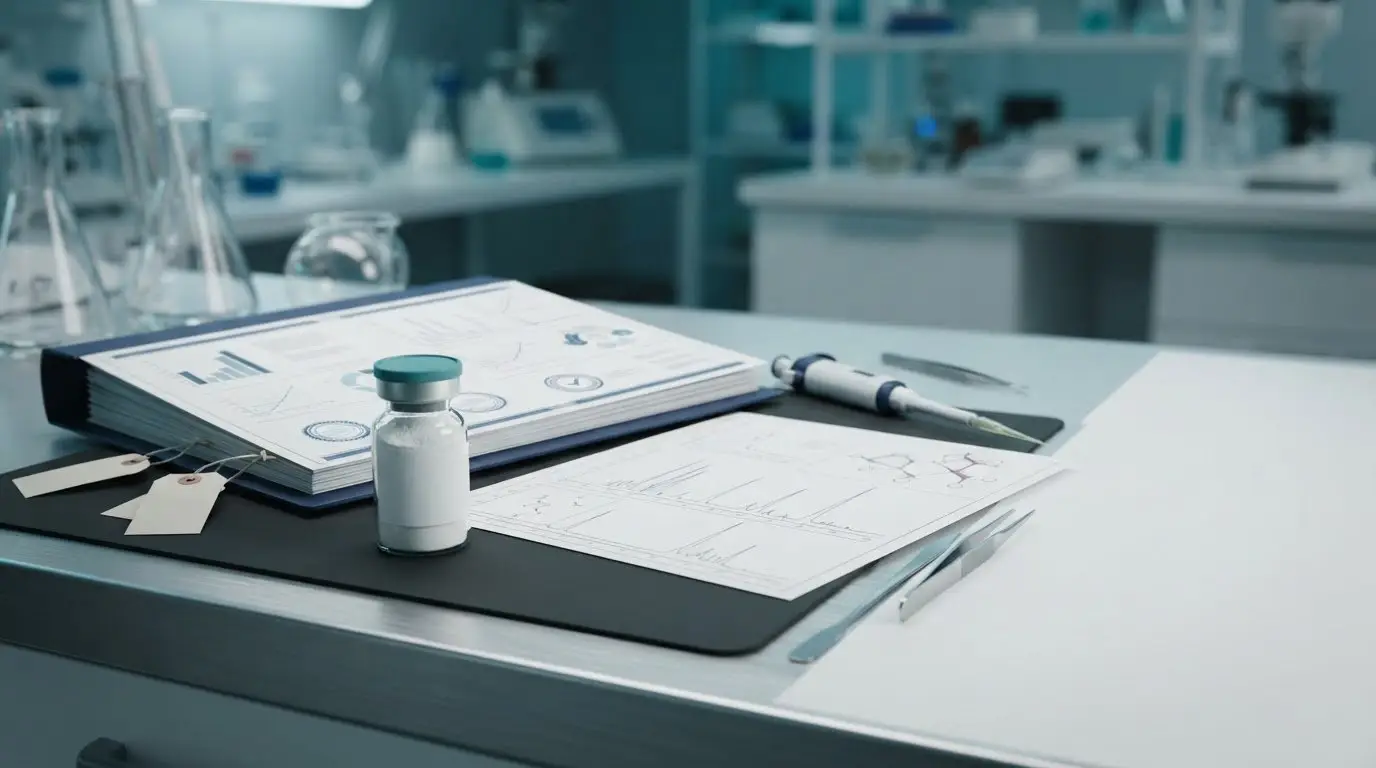
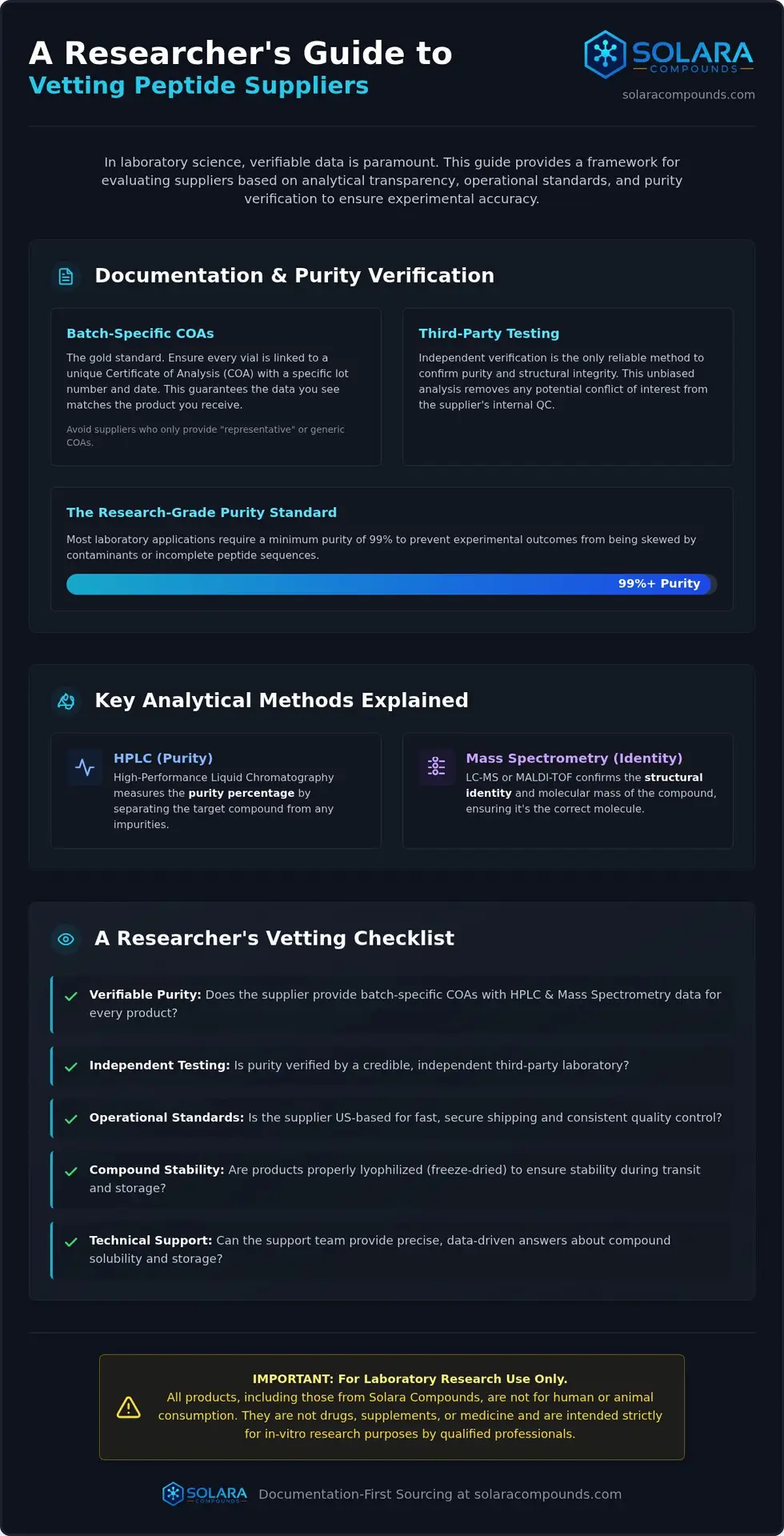
In a laboratory setting, purity isn’t a vague descriptor. HPLC purity is the primary metric for chemical identity. Most researchers require a minimum of >98% purity to ensure that experimental outcomes aren’t skewed by residual solvents or truncated peptide sequences. While some vendors provide generic or “representative” Certificates of Analysis (COAs), the most reliable suppliers provide batch-specific documentation. This ensures the vial you receive matches the chromatogram on the report, providing the structural integrity needed for repeatable science.
Supplier Transparency and Accountability
Accountability is built through lot-number traceability. Every vial should be linked to a specific production run, allowing researchers to track the history of their materials if an anomaly occurs during testing. The responsiveness of a supplier’s technical support team also serves as a key indicator of their expertise. You should be able to ask detailed questions about solubility or storage conditions and receive precise, data-driven answers. You can learn more about these standards by visiting the page About Solara Compounds. Maintaining a clear boundary between laboratory use and medical application is a hallmark of a professional supplier. We provide these high-purity compounds strictly for research purposes through solaracompounds.com to support the scientific community’s need for precision and stability.
Understanding HPLC and Mass Spectrometry Verification
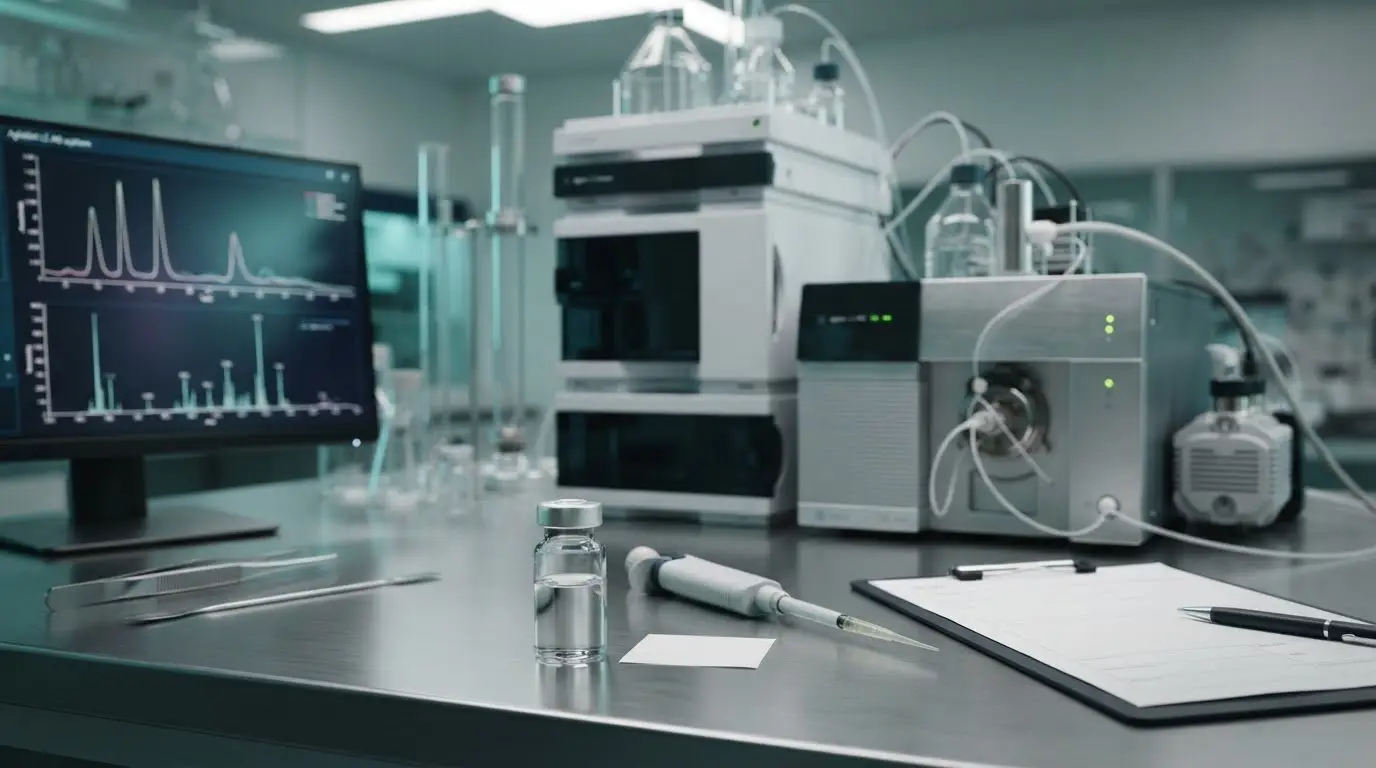
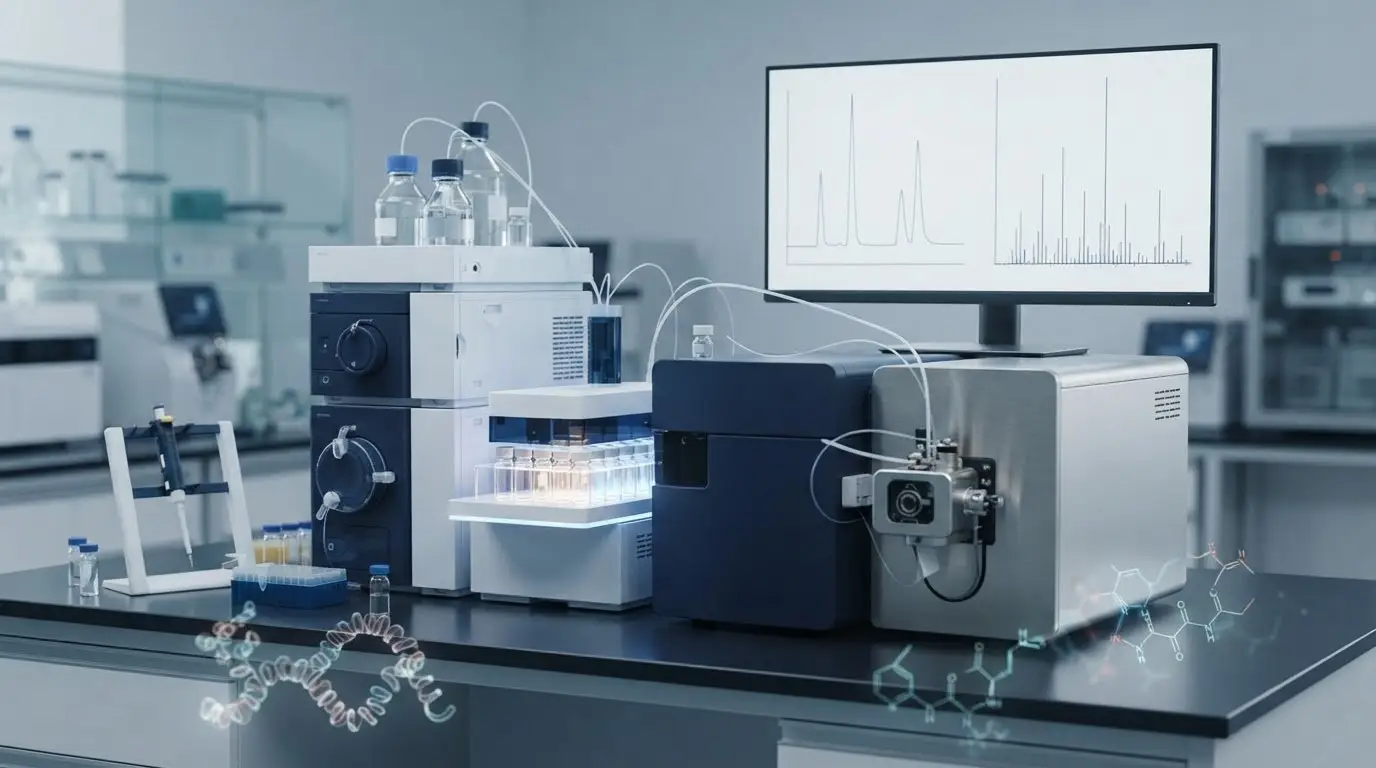
Analytical data is the only metric that separates the best research peptide companies from average suppliers. In a laboratory setting, purity isn’t a marketing claim; it’s a measurable value verified through High-Performance Liquid Chromatography (HPLC). This process functions as the gold standard for purity testing by separating the target peptide from residual solvents, reagents, or truncated sequences. The resulting chromatogram provides a visual representation of the sample’s composition, where the area under the primary peak determines the percentage of purity.
While HPLC measures the quantity of the target substance, Mass Spectrometry (LC-MS) confirms the chemical identity. LC-MS is the method for confirming the amino acid sequence identity by analyzing the mass-to-charge ratio of the ionized molecules. For larger, more complex sequences, MALDI-TOF (Matrix-Assisted Laser Desorption/Ionization-Time of Flight) is frequently employed to determine the precise molecular mass. Using both methods together ensures that a compound like SOL-3RT is not only 99% pure but is also structurally the exact molecule intended for your research. All products from Solara Compounds are for laboratory research only and are not for human or animal consumption.
How to Read a Peptide COA
A Certificate of Analysis (COA) is only useful if it’s lot-specific and verifiable. When you View Solara Compounds COAs, you should first identify the primary purity peak on the HPLC chromatogram. This peak should be distinct, with a baseline that’s free of significant noise or secondary spikes. It’s also essential to verify that the batch date and lot number on the documentation match the physical label on the vial you received. If these numbers don’t correlate, the report doesn’t provide valid proof of the material in your hands.
Why Third-Party Testing is Non-Negotiable
Relying solely on in-house manufacturer reports introduces a significant conflict of interest. Independent laboratories, such as Kovera Labs, provide an objective layer of accountability that prevents contaminated or sub-standard batches from reaching your lab. These third-party facilities operate without the bias of the production team, ensuring that every vial of BPC-157 or GHK-Cu meets laboratory-grade standards. This transparency is a core part of the mission at solaracompounds.com, where we bridge the gap between material science and practical utility. You can explore our current research catalog to see how we maintain these rigorous standards. Solara Compounds prioritizes empirical data to ensure your time-sensitive projects are never compromised by inconsistent materials.
Operational Standards: Logistics and Technical Support
Analytical precision depends on more than just the initial synthesis. The best research peptide companies integrate rigorous logistical standards into their operations to prevent degradation before the product reaches the lab bench. Sourcing from US-based suppliers offers a significant advantage in maintaining the stability of sensitive compounds like SOL-2TZ or TB-500. All materials provided by Solara Compounds are for laboratory research only and are not intended for human or animal consumption.
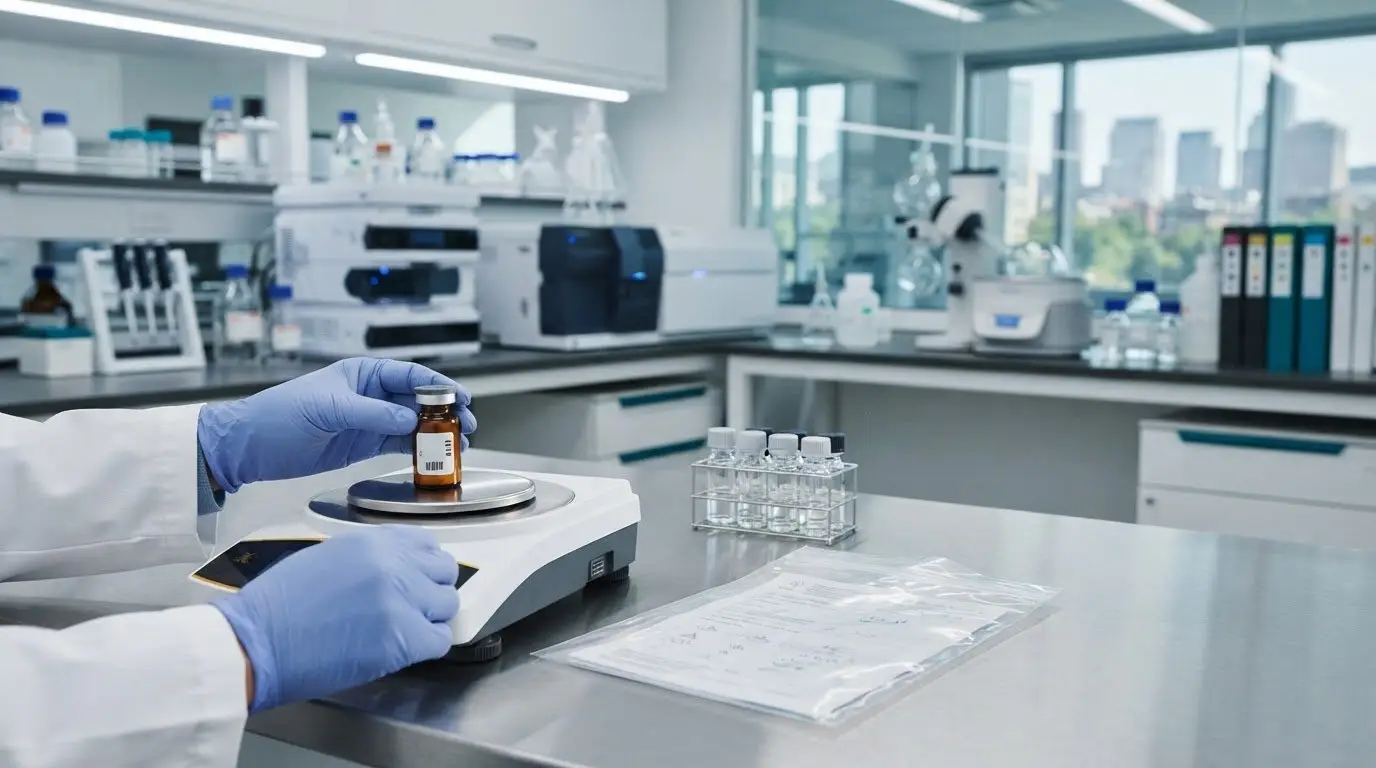
Peptides are typically distributed as lyophilized powders to ensure long-term structural integrity. This freeze-drying process removes moisture, which significantly reduces the rate of chemical breakdown at room temperature. However, even lyophilized materials require careful handling. Reliability in the supply chain ensures that time-sensitive laboratory projects aren’t compromised by environmental exposure or extended transit times. Professional vendors provide clear guidance on storage, emphasizing that while powders are stable, they should be kept in controlled environments to ensure repeatable results.
Domestic Shipping and Laboratory Timelines
Domestic logistics are a critical component of High Purity Research Peptides Sourcing. Choosing a US-based provider minimizes the time research materials spend in transit, which directly reduces the risk of thermal degradation. International shipping often introduces unpredictable variables, such as customs inspections that can leave sensitive vials in unmonitored warehouses for weeks. By sourcing domestically through solaracompounds.com, researchers can better manage institutional budgets and project deadlines. We offer free shipping on all orders over $200, allowing labs to optimize their procurement without sacrificing speed or security.
Customer Support for Scientific Buyers
A supplier’s value is often measured by their ability to provide technical assistance. Lab buyers require a partner who understands the nuances of chemical identity and lot-specific data. Identifying the best research peptide companies involves testing their willingness to share analytical insights. If you have questions regarding HPLC reports or need help with technical documentation, you can Contact Research Support directly. Our team is available Monday through Friday, 8 AM to 5 PM Eastern, at 1 (877) 388-9178 or via email at support@solaracompounds.com. Professional support ensures that your inquiries are handled by individuals who value accuracy and results. This level of accountability extends to our refund and return policies, providing a safety net for researchers if materials are damaged during the shipping process.
A Researcher’s Checklist for Vetting Peptide Vendors
Objective criteria must replace anecdotal evidence when selecting a supplier. The best research peptide companies operate with a level of transparency that mirrors a professional laboratory’s own quality control standards. Before finalizing a procurement decision, researchers should perform a systematic audit of the vendor’s documentation and operational claims. This process ensures that materials like SOL-3RT or MOTS-C arrive with the structural integrity required for precise experimental outcomes. All products are for laboratory research only and are not intended for human or animal consumption.
- Step 1: Verify a Live COA Database. A legitimate supplier maintains an accessible repository of batch-specific reports. Static or sample reports are insufficient for verifying the current lot in stock.
- Step 2: Confirm RUO Designation. Professional vendors strictly label and market products for Research Use Only. Avoid any company that blurs the line with medical or supplement terminology.
- Step 3: Check Third-Party Affiliation. Confirm that testing is performed by an independent facility, such as Kovera Labs, rather than an in-house manufacturing arm.
- Step 4: Audit US Presence. Verify the physical location and domestic operation of the company. A US-based presence ensures better accountability and faster logistical response times.
- Step 5: Review Purity Thresholds. Target batch-specific purity levels of ≥99%. While >98% is often acceptable, the highest standard of research requires the lowest possible impurity profile.
Identifying Supply Chain Red Flags
Marketing language is often the first indicator of a supplier’s legitimacy. Avoid companies that use hyperbolic terms like ‘miracle’ or ‘health-enhancing,’ as these descriptors have no place in a laboratory-grade environment. Be wary of vendors that don’t provide lot numbers on their vials. This indicates a lack of batch-specific tracking. Any mention of human dosing or body results is a direct violation of RUO standards and signals a lack of professional oversight. Solara Compounds maintains strict adherence to these boundaries at solaracompounds.com to protect the integrity of the research community.
Comparing Institutional Pricing
Cost-efficiency is essential for long-term projects, but it shouldn’t come at the expense of rigorous testing. When evaluating tiered pricing for bulk laboratory orders, consider the overhead required for independent HPLC and MS verification. A significantly lower price point often suggests that a vendor is cutting corners on analytical depth or manufacturing standards. Balancing budget requirements with the need for high-purity materials ensures that your data remains repeatable and accurate. You can Shop Research Peptides to see our current inventory of documentation-first compounds.
Solara Compounds: A Documentation-First Approach
Precision in chemical synthesis is meaningless without empirical verification. Solara Compounds distinguishes itself among the best research peptide companies by prioritizing analytical depth over marketing aesthetics. We provide lot-specific data for every vial, ensuring that researchers can verify the structural integrity of their materials before beginning an experiment. This commitment to transparency helps maintain the repeatability of laboratory results. All products are for laboratory research only and are not for human or animal consumption.
Our Quality Control Process
Quality begins with solid-phase peptide synthesis conducted in ISO 7 cleanrooms. This controlled environment minimizes the risk of cross-contamination and environmental impurities that could skew research data. Every batch of SOL-3RT and SOL-2TZ undergoes rigorous HPLC purification to achieve a target purity of 99% or higher. We don’t rely on representative reports; instead, we provide batch-specific documentation that links every vial to its specific analytical history. This ensures that the compound’s chemical identity is confirmed through both mass spectrometry and liquid chromatography before it enters our inventory.
Institutional Support and Bulk Procurement
Large-scale laboratory projects require a stable supply of verified compounds. We facilitate bulk procurement for institutional researchers who need consistency across multiple phases of a project. Our catalog, which includes BPC-157 10mg Laboratory Use and GHK-Cu, is curated to meet the demands of modern material science. You can access the complete research catalog at solaracompounds.com to review technical specifications and batch COAs. Every lot is tracked from synthesis to fulfillment, providing researchers with the data needed to validate their work.
Our US-based operations allow us to implement secure, fast shipping protocols that protect the stability of lyophilized powders. We manage the entire fulfillment process domestically to avoid the delays and degradation risks associated with international transit. By maintaining strict lot-number traceability, we act as a reliable partner in long-term scientific success. If you have questions regarding procurement or technical documentation, our team is available at support@solaracompounds.com to ensure your laboratory has the high-purity materials it requires. Solara Compounds remains committed to excellence in the research peptide industry through precision engineering and absolute transparency.
Securing Analytical Integrity in Future Research
The landscape of laboratory sourcing is defined by a shift toward total analytical transparency. Identifying the best research peptide companies requires a commitment to verifying every batch through independent, third-party testing. By prioritizing lot-specific HPLC and Mass Spectrometry documentation, you’ll ensure that your experimental work is built on a foundation of chemical precision. Reliable US-based operations further protect your materials from the degradation risks associated with extended international transit.
Solara Compounds provides this level of stability through a documentation-first approach. We offer batch-specific COAs for all products, including SOL-3RT and BPC-157, verified by Kovera Labs. Every compound is strictly for laboratory research only and is not intended for human or animal consumption. With free shipping on orders over $200, it’s possible to maintain institutional budgets while securing high-purity materials. We invite you to view the current research catalog at solaracompounds.com and see how we prioritize data-driven quality. We look forward to supporting your next scientific breakthrough with materials that meet the highest standards of the research community.
Frequently Asked Questions
How can I verify the purity of a research peptide batch?
Purity verification requires reviewing the lot-specific High-Performance Liquid Chromatography (HPLC) and Mass Spectrometry (LC-MS) reports provided by the supplier. These documents confirm the chemical identity and purity percentage of the specific batch. At Solara Compounds, every product is assigned a unique lot number for traceability. This allows researchers in hubs like Boston or San Francisco to audit the analytical data before starting work. All materials are for laboratory research only and are not for human or animal consumption.
What is the difference between a manufacturer COA and third-party testing?
A manufacturer Certificate of Analysis (COA) is generated by the production facility, while third-party testing involves an independent laboratory like Kovera Labs. Independent verification removes the conflict of interest inherent in self-reporting. The best research peptide companies utilize third-party labs to ensure that compounds like BPC-157 meet a minimum purity of 98%. This objective layer of oversight is essential for institutions in San Diego or Seattle that require high-grade, documented materials for experimental accuracy.
Why is lyophilized powder preferred for research peptide storage?
Lyophilized powder is the preferred format because the freeze-drying process removes moisture, which significantly slows down chemical degradation. This stable state ensures that research peptides maintain their structural integrity during transit and long-term storage. For laboratories in humid climates like Miami or Tampa, vacuum-sealed lyophilized vials provide a necessary barrier against environmental factors. These powders are intended strictly for laboratory research only and are not medicine, supplements, or for any form of human consumption.
How do I check if a peptide company is based in the US?
Researchers should verify the company’s physical address, toll-free phone number, and shipping origin points. Solara Compounds operates out of Florida and provides secure shipping across the entire United States, including major research corridors in Austin and Raleigh. Domestic companies are subject to US business regulations and offer more reliable logistics than international vendors. You can contact our support team at 1 (877) 388-9178 to confirm our operational status and domestic shipping protocols for laboratory buyers.
Are research peptides legal for laboratory use in the United States?
Research peptides are legal in the United States when they are sold and used strictly for laboratory research only. They are classified as Research Use Only (RUO) chemicals, meaning they aren’t intended for human or animal consumption. Laboratories in cities like Houston or Chicago must ensure their procurement follows these guidelines to maintain compliance. It’s the buyer’s responsibility to use these compounds, such as SOL-2TZ, within a controlled, scientific setting and never as a drug or supplement.
What should I look for in a peptide HPLC report?
A valid HPLC report should display a clear, dominant peak representing the target peptide with minimal secondary spikes or baseline noise. You must verify that the lot number on the report matches the label on your vial. The best research peptide companies ensure these reports are lot-specific rather than generic. This level of detail allows investigators in New York or Baltimore to confirm that the compound’s purity exceeds the 99% threshold required for high-precision experimental models.
How does shipping temperature affect peptide stability for research?
While lyophilized peptides are generally stable at room temperature for short durations during transit, extreme heat can accelerate degradation. Sourcing from a domestic supplier reduces the time materials spend in unmonitored environments. For researchers in Los Angeles or Phoenix, fast shipping protocols are essential to minimize thermal exposure. Once received, vials should be stored in a controlled environment to preserve their structural integrity. Remember, these materials are for laboratory research only and are not for human use.
Can I get batch-specific data for SOL-3RT and SOL-2TZ?
Yes, Solara Compounds provides lot-specific analytical data for every batch of SOL-3RT and SOL-2TZ. You can access these reports through our online database at solaracompounds.com/coa/. This transparency ensures that laboratories in Dallas or Denver have the exact purity and identity verification needed for their specific projects. Each batch undergoes molecular confirmation by MALDI-TOF and LC-MS to guarantee identity. These compounds are supplied strictly as lyophilized powders for laboratory research and are not for human consumption.