Research Articles
Peptide Stability Guide: Maintaining Molecular Integrity

Peptide degradation is not an inherent molecular limitation; it’s a manageable variable of environmental control. When inconsistent data or lost materials stall your progress, the culprit is rarely the compound itself. It’s the protocol. Maintaining peptide stability for research requires a precise understanding of how temperature, light, and pH interact with delicate amide bonds. You likely understand the frustration of seeing a high-purity batch of Tirzepatide 10mg or BPC-157 5mg lose its structural integrity due to a minor oversight in reconstitution or storage.
This guide provides the technical framework necessary to master these variables and ensure the absolute reproducibility of your laboratory findings. Precision matters. You’ll gain a standardized approach to extending the shelf life of your research compounds while eliminating the confusion surrounding storage timelines. We will examine the specific mechanics of lyophilization, the nuances of proper solvent selection, and the critical temperature thresholds required to preserve high-grade materials like Retatrutide 10mg. By the end of this evaluation, you’ll have the expertise to transform peptide stability from a source of anxiety into a controlled, predictable constant in your work.
Key Takeaways
- Identify the primary chemical pathways of degradation to effectively manage peptide stability for research and safeguard your molecular integrity.
- Control critical environmental stressors, including thermal energy and UV exposure, that compromise the structural stability of aromatic amino acids.
- Implement the Aliquot Method to eliminate destructive freeze-thaw cycles and maintain the functional consistency of your reconstituted compounds.
- Utilize lyophilization as the primary preservation standard for long-term storage of compounds like BPC-157 5mg.
- Verify the relationship between initial purity and long-term stability by mastering the interpretation of HPLC and Mass Spectrometry data.
Understanding Peptide Degradation Pathways in Research
Peptide stability is the preservation of a compound’s structural and functional integrity over time. It’s the baseline requirement for any rigorous study. When we discuss peptide stability for research, we’re referring to the molecule’s ability to resist chemical and physical transformations that would otherwise alter its biological activity. Stability is often the silent variable. It compromises scientific reproducibility because degraded samples introduce unquantified impurities into an experimental system, leading to data that cannot be replicated by other laboratories.
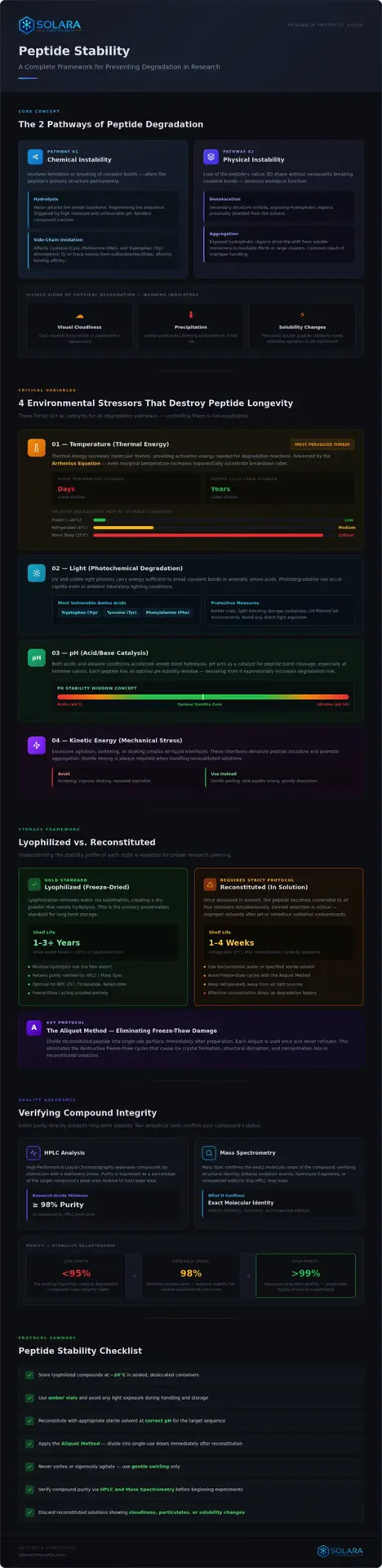
Degradation typically manifests through two distinct but interrelated pathways: chemical and physical. While chemical changes involve the formation or breaking of covalent bonds, physical instability refers to changes in the molecule’s spatial arrangement. Recognizing the early indicators of these shifts is vital for maintaining the high standards required for research-grade materials like Tirzepatide 10mg or BPC-157 5mg.
Chemical Instability: Hydrolysis and Oxidation
Chemical degradation is driven by the reactivity of the peptide’s primary structure. High moisture levels are particularly hazardous because they trigger the breakdown of the amide backbone. Hydrolysis is the chemical breakdown of a compound due to reaction with water, a process that frequently targets the amide linkage in pH-sensitive sequences. This peptide bond degradation results in the fragmentation of the sequence, rendering the compound inactive.
Side-chain oxidation represents another significant threat. Certain amino acids, specifically Cysteine (Cys), Methionine (Met), and Tryptophan (Trp), are highly vulnerable to oxidative stress. Exposure to atmospheric oxygen or trace metals can lead to the formation of sulfoxides or disulfides. These modifications change the molecule’s hydrophobicity and binding affinity, which fundamentally alters the experimental outcome.
Physical Instability: Aggregation and Denaturation
Physical instability involves the loss of the peptide’s native three-dimensional shape. This process often begins with denaturation, where the secondary structure unfolds. Once unfolded, hydrophobic regions that were previously shielded become exposed to the solvent. This exposure drives the transition from soluble monomers to insoluble fibrils or large clusters. Aggregation is a common consequence of improper handling.
Researchers can identify physical degradation through several signs:
- Visual Cloudiness: A transition from a clear solution to a turbid or opalescent appearance.
- Precipitation: The formation of visible particulates at the bottom of the vial.
- Changes in Solubility: A previously easily dissolved peptide suddenly requires extensive agitation or pH adjustment.
These physical changes destroy investigative accuracy. Starting an experiment with a compound that has begun to aggregate ensures that the effective concentration is lower than intended, leading to skewed results and wasted resources.
Key Environmental Stressors Affecting Peptide Longevity
Environmental variables are the primary drivers of molecular decay. While a peptide’s sequence defines its chemical potential, the laboratory environment dictates its actual lifespan. Managing peptide stability for research requires strict control over four critical stressors: heat, light, pH, and kinetic energy. These forces act as catalysts for the degradation pathways discussed previously, transforming a stable compound into an inert or even confounding variable within your study.
Thermal Dynamics and the Arrhenius Equation
Temperature is the most pervasive threat to structural integrity. Thermal energy increases molecular motion, which provides the activation energy necessary for degradation reactions to occur. The Arrhenius principle allows us to predict how these rates change; even a marginal increase in ambient temperature can exponentially accelerate chemical breakdown. For example, maintaining a compound at room temperature rather than in a dedicated cold chain can reduce its viable window from years to mere days. Consistent refrigeration or freezing is a technical necessity for preserving high-value sequences like Retatrutide 10mg. Fluctuations in temperature are equally damaging, as they can cause subtle shifts in the peptide’s hydration shell.
Photochemical and pH Considerations
Light exposure introduces a unique set of risks. UV radiation initiates free radical chains that specifically target aromatic amino acids such as Tryptophan and Tyrosine. This photodegradation can occur even under standard laboratory fluorescent lighting, leadng to side-chain modifications that are difficult to detect without advanced chromatography. Researchers should utilize amber vials or opaque secondary containers to shield sensitive solutions from ambient light.
The pH of the solvent also dictates the rate of deamidation and hydrolysis. Most peptides exhibit maximum stability near their isoelectric point, typically within a slightly acidic range of pH 4 to 6. Deviating from this optimal window can trigger rapid backbone fragmentation or promote aggregation. Selecting the correct buffer is not just about solubility; it’s about sequence preservation. To ensure your baseline is secure, it’s essential to source high-purity research materials that arrive with verified COAs and clear handling instructions.
Finally, mechanical stress during reconstitution often goes overlooked. Excessive vortexing or aggressive agitation creates air-liquid interfaces that promote protein shearing and denaturation. A gentle swirling motion is always preferable to high-speed mixing. When handling delicate materials like GHK-Cu 50mg, patience during the dissolution process is a prerequisite for maintaining molecular integrity.
Lyophilized vs. Reconstituted: Stability Frameworks
Lyophilization, or freeze-drying, is the fundamental method for preserving molecular integrity. By removing water through sublimation, we significantly limit the kinetic energy available for chemical reactions such as hydrolysis. This state is the gold standard for peptide stability for research. While in this powder form, compounds like BPC-157 5mg maintain a robust stability profile for extended periods, resisting the degradation pathways that typically plague aqueous solutions.
The Science of Lyophilization
The process involves freezing the material and then reducing the surrounding pressure to allow the frozen water to sublime directly from the solid phase to the gas phase. This dehydration prevents the amide backbone from reacting with solvent molecules. Cryoprotectants, such as specific sugars or polyols, are often utilized during this process to act as a molecular scaffold. They prevent the formation of ice crystals that could otherwise shear the delicate peptide chains, maintaining the peptide’s native structure as the hydration shell is removed. Lyophilized peptides are more stable at -20°C because the absence of liquid water and the reduction in thermal energy effectively arrest the molecular motion required for degradation.
Reconstitution and Solution Stability
The stability landscape shifts dramatically once a compound is introduced to an aqueous environment. Reconstitution initiates a “ticking clock” for the molecule. For instance, Retatrutide in its lyophilized powder form can remain stable for years if stored correctly, yet its half-life drops to mere days or weeks once dissolved. This rapid decline occurs because water acts as both a solvent and a reactant, facilitating the hydrolysis and oxidation pathways discussed in previous sections.
Solvent choice is a critical variable in this transition. Bacteriostatic water, which contains 0.9% benzyl alcohol, is frequently preferred for its ability to inhibit bacterial growth, whereas sterile saline may be used for specific short-term applications where pH balance is paramount. Even with optimal solvents, the structural integrity of the compound begins to erode. There are also notable stability variations between sequences. Highly resilient compounds like GHK-Cu 50mg often exhibit better longevity in solution compared to more complex sequences like Semaglutide 5mg or Retatrutide 10mg. This disparity is often due to the presence of specific amino acid residues that are more prone to deamidation. Researchers engaged in retatrutide vs tirzepatide research must account for these sequence-specific stability differences when designing multi-compound studies, as the degradation timelines for each agonist architecture can vary considerably. Researchers must establish rigorous “use-within” protocols to ensure that the data gathered on day seven is as reliable as the data gathered on day one.
Optimization Protocols for Laboratory Storage and Handling
Standardizing laboratory protocols is the most effective way to eliminate human error as a source of molecular decay. When a shipment arrives, your first priority is verifying the batch-specific Certificate of Analysis (COA) to ensure the initial purity meets your specific requirements. Logging these details is not just a matter of institutional compliance; it’s about establishing a baseline for peptide stability for research. Proper organization allows you to track the age and handling history of every vial, ensuring that no compound is used beyond its validated stability window. This methodical approach reduces waste and prevents the use of degraded materials in high-concentration studies.
The Aliquot Strategy for Long-Term Studies
The ‘Aliquot Method’ is the gold standard for preserving integrity during extended research projects. Repeated freeze-thaw cycles are physically destructive. As the residual moisture within a lyophilized cake or the solvent in a reconstituted solution expands and contracts, it can mechanically shear the peptide backbone. By dividing bulk orders into single-use portions immediately upon receipt, you minimize environmental exposure for the remaining stock. It’s essential to select low-protein-binding polypropylene tubes for this process. These specialized containers prevent the peptide from adsorbing to the plastic surfaces, a common issue that can significantly reduce the effective concentration of your sample.
Standardizing the thawing process is equally critical. Before opening a frozen vial, allow it to reach room temperature in a controlled environment. This prevents hygroscopy, which is the condensation of atmospheric moisture onto the cold compound. If moisture enters the vial before it has equilibrated, it can trigger the hydrolytic pathways that lead to rapid degradation. Taking this extra step ensures that the powder remains dry and stable until the exact moment of reconstitution.
Reconstitution Best Practices
Gentle dissolution is the only way to protect the delicate secondary structure of a compound. The ‘slow drip’ method involves introducing the solvent down the side of the vial wall rather than directly onto the lyophilized powder. This allows the compound to hydrate gradually without the stress of a direct impact. You should never shake a vial. Shaking introduces air-liquid interfaces that promote protein shearing and the formation of insoluble fibrils. Instead, use a gentle swirling motion to encourage dissolution.
Before proceeding with any in vitro analysis, you must verify the solution’s clarity. Any cloudiness, opalescence, or persistent particulates indicate that physical aggregation has occurred. If the solution isn’t perfectly clear, the sample’s integrity has been compromised. To maintain these high standards in your laboratory, you can order third-party tested research peptides that are shipped with the batch-specific documentation required for rigorous institutional tracking.
Ensuring Analytical Integrity with High-Purity Compounds
High initial purity is the foundation of long-term stability. While we’ve discussed environmental controls and handling protocols, the chemical baseline of the material itself is the ultimate limiting factor. Impurities are rarely inert. Residual solvents, truncated sequences, or synthesis byproducts often act as reactive sites that accelerate the degradation pathways discussed in previous sections. When you prioritize peptide stability for research, you’re selecting for a compound that lacks the internal catalysts required for its own decay. High-grade materials ensure that your results remain consistent across multiple trials.
Decoding the Certificate of Analysis (COA)
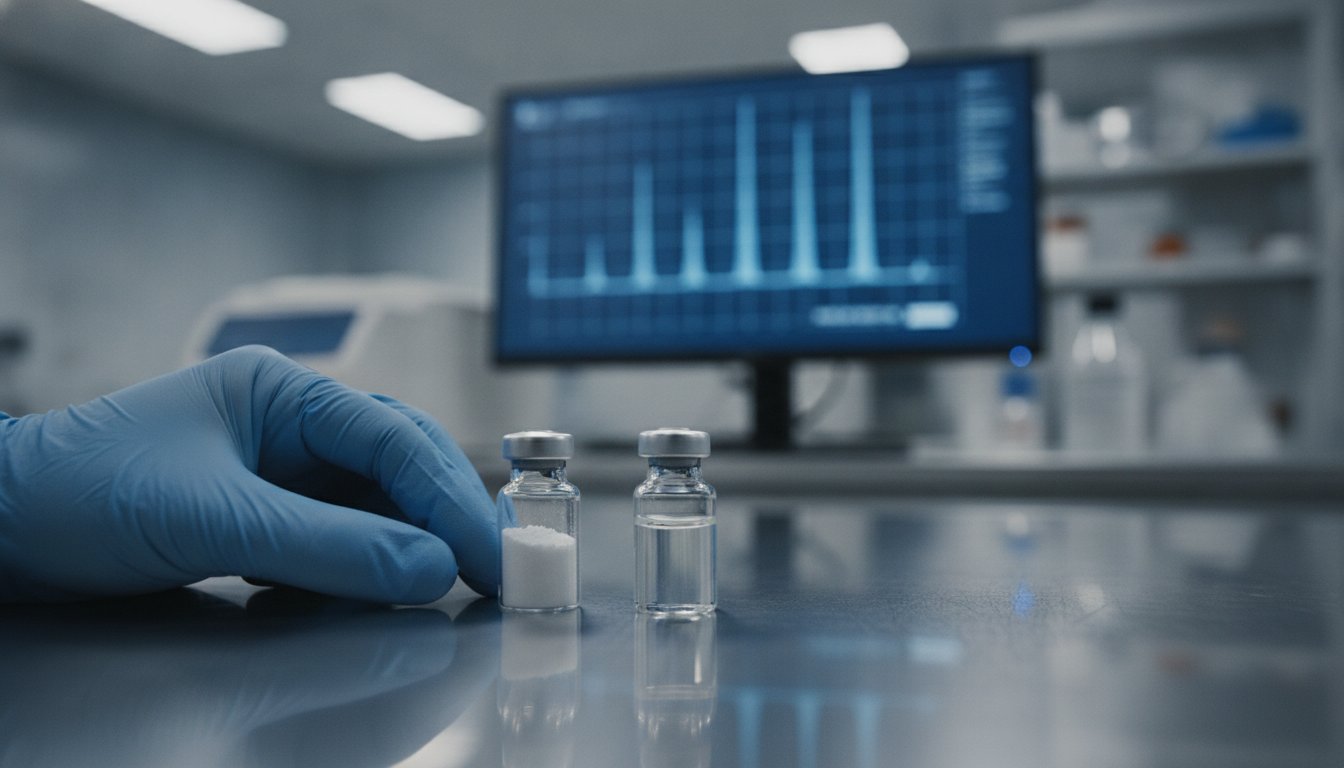
Interpreting an HPLC report for Tirzepatide 10mg requires a focus on the chromatographic profile. The main peak represents the target peptide, while smaller peaks indicate impurities or degradation products. You should evaluate the Area Under the Curve (AUC) to confirm the purity percentage. A 99%+ purity benchmark is the standard for sensitive research because it ensures that trace contaminants don’t interfere with your experimental outcomes or promote early aggregation.
Mass Spectrometry (MS) serves as the definitive verification of sequence identity. By checking the observed molecular weight against the theoretical value, you confirm that the compound in the vial is exactly what was ordered. Identity verification is a prerequisite for reliability. Batch-specific testing is the only way to guarantee this, as it eliminates the variability inherent in large-scale synthesis. Without a COA that matches your specific lot number, you’re introducing an unquantified risk into your laboratory environment.
Sourcing for Success: The Solara Standard
Solara Compounds maintains these rigorous standards through comprehensive third-party testing. Every batch of material, including Retatrutide 10mg and BPC-157 5mg, undergoes independent HPLC and Mass Spectrometry verification. This data-driven approach ensures that the structural integrity of the compound is verified before it ever reaches your bench. We provide the transparency required for institutional compliance and scientific repeatability.
Logistics also play a vital role in preserving integrity. Secure, domestic shipping from our Florida facility minimizes the time compounds spend in transit, which is critical for maintaining the cold chain. Faster transit times reduce the cumulative thermal stress on the compounds, protecting them from the environmental variables that drive molecular decay. You can secure your research integrity by sourcing high-purity peptides from Solara Compounds to ensure your baseline is as stable as your methodology.
Mastering Molecular Integrity for Long-Term Research Success
Mastering the technical variables of peptide stability for research is a prerequisite for any reproducible laboratory study. Precision at the bench is only as effective as the integrity of the compounds you utilize. By implementing standardized storage protocols such as the aliquot method and strictly maintaining the cold chain, you eliminate the environmental stressors that drive molecular decay. Reliability isn’t an accident. It’s the result of combining high-purity materials with methodical handling.
Every successful study begins with a verified baseline. You can ensure your materials meet the most stringent purity benchmarks by choosing a partner committed to transparency. Solara Compounds supports your work with batch-specific Certificates of Analysis and rigorous third-party HPLC and Mass Spectrometry verification for every order. Our secure domestic US shipping ensures your compounds arrive with their structural integrity intact.
Browse Our Catalog of Third-Party Tested Research Peptides to secure the high-grade materials your research demands. We look forward to supporting your next breakthrough with precision-engineered compounds.
Frequently Asked Questions
How long do lyophilized peptides stay stable at room temperature?
Lyophilized peptides generally remain stable at room temperature for approximately three to four weeks. While they are engineered to withstand ambient conditions during transit, prolonged exposure increases the risk of moisture-induced hydrolysis. For maintaining peptide stability for research, it’s best to transfer shipments to cold storage immediately. This proactive approach prevents the cumulative degradation that occurs when compounds are left at room temperature for extended periods.
Can I freeze reconstituted peptides to extend their shelf life?
Freezing reconstituted peptides is possible, but it requires a careful aliquot strategy to be effective. Ice crystal formation during the freezing process can create mechanical stress that shears delicate peptide chains. If you freeze a solution, you must ensure it’s only thawed once for immediate use. Repeatedly freezing and thawing a single vial will destroy the compound’s structural integrity and lead to failed experimental replications.
What is the best temperature for long-term storage of research peptides?
The standard for long-term preservation is storage at -20°C in a manual defrost freezer. These sub-zero conditions significantly reduce thermal energy, which arrests the molecular motion that leads to chemical decay. For storage exceeding twenty four months, many researchers prefer -80°C environments to provide an additional margin of safety. Maintaining these temperatures is the most reliable way to preserve the structural baseline of your lyophilized compounds.
Does light exposure affect the purity of my peptide samples?
UV radiation and intense ambient light can compromise the purity of samples by triggering photodegradation. This process specifically targets aromatic residues, leading to side-chain modifications and the formation of impurities. To protect peptide stability for research, you should always utilize amber vials or opaque secondary packaging. These simple shielding measures prevent the free radical chains that would otherwise erode the quality of your investigative materials.
What are the first signs that a peptide has begun to degrade?
Visual indicators like turbidity, particulates, or a shift in solution color often signal advanced physical degradation. These signs suggest the peptide has denatured and begun to form insoluble aggregates. It’s important to note that chemical instability, such as deamidation or oxidation, may not produce visible changes. Only regular analytical testing can confirm if the molecular structure remains intact when a vial appears clear to the naked eye.
Is bacteriostatic water better than sterile water for peptide stability?
Bacteriostatic water is the preferred solvent for research applications requiring multi-dose vials over several days. The 0.9% benzyl alcohol content serves as a preservative that prevents microbial proliferation. In contrast, sterile water lacks this protection, leaving the peptide vulnerable to rapid enzymatic degradation by bacteria. Choosing bacteriostatic water ensures that the compound remains uncontaminated and functionally consistent throughout the duration of your study.
How many freeze-thaw cycles can a peptide typically withstand?
Peptides are highly sensitive to kinetic energy and should ideally undergo no more than one freeze-thaw cycle. The physical transition between liquid and solid states creates significant pressure that can fragment the peptide backbone. To avoid this, divide your reconstituted solution into small, single-use volumes before the initial freeze. This practice ensures that every sample used in your research has maintained its original structural integrity without being compromised by repeated expansion.
Why is HPLC testing critical for determining peptide stability?
HPLC is the gold standard for stability testing because it provides a precise quantitative breakdown of a compound’s purity. By separating the target peptide from any degradation products, researchers can identify exactly how much of the original sequence is still present. This data is critical for ensuring that your experimental variables remain controlled. Without batch-specific HPLC reports, it’s impossible to verify the actual concentration and reliability of your research materials.