Research Articles
Interpreting Retatrutide COA: A Researcher’s Guide to Analytical Purity


A “99% purity” headline on a Certificate of Analysis is often the least informative data point for a rigorous laboratory study. While that number provides surface-level reassurance, it fails to account for the structural integrity or the specific impurities that can compromise your metabolic research. You likely understand the frustration of reviewing vendor-supplied reports and wondering if a specific peak represents a legitimate peptide fragment or merely baseline solvent noise. This uncertainty isn’t just a technical hurdle; it’s a direct risk to the reproducibility of your results.
Mastering the skill of interpreting retatrutide COA documentation allows you to move beyond the marketing summary and into the raw analytical reality. This guide provides a standardized protocol for verifying the 5263.09 Da molecular weight through Mass Spectrometry and analyzing HPLC chromatograms for batch-specific consistency. You’ll learn to identify the subtle red flags in third-party testing that others might overlook. By the end of this analysis, you’ll have the technical confidence to ensure your Retatrutide 10mg meets the exact requirements of your experimental design.
Key Takeaways
- Learn how to distinguish between a generic representative report and a batch-specific certificate to ensure your analytical data matches the physical product in your lab.
- Master the interpretation of HPLC chromatograms by understanding Area Under the Curve (AUC) calculations and identifying the difference between baseline noise and actual impurities.
- Gain precision in interpreting retatrutide COA data by cross-referencing observed mass spectra against the target molecular weight of 5263.09 Da for definitive identity verification.
- Develop a standardized protocol for spotting common red flags in third-party testing, such as mismatched lot numbers or missing analytical parameters that could compromise research integrity.
- Discover how to leverage transparent, third-party verified documentation to establish a reliable chain of custody for high-purity Retatrutide 10mg.
What is a Retatrutide COA and Why is it Critical for Research?
A Certificate of Analysis (COA) serves as the definitive identity card for a chemical compound. It isn’t just a receipt; it’s a verification of chemical architecture. In metabolic research, where precision dictates the validity of every result, a COA provides the necessary empirical proof that the substance in the vial matches the intended molecular design. For researchers, the process of interpreting retatrutide COA data is the first line of defense against experimental variability. It transforms a vendor’s claim into a verifiable scientific fact.
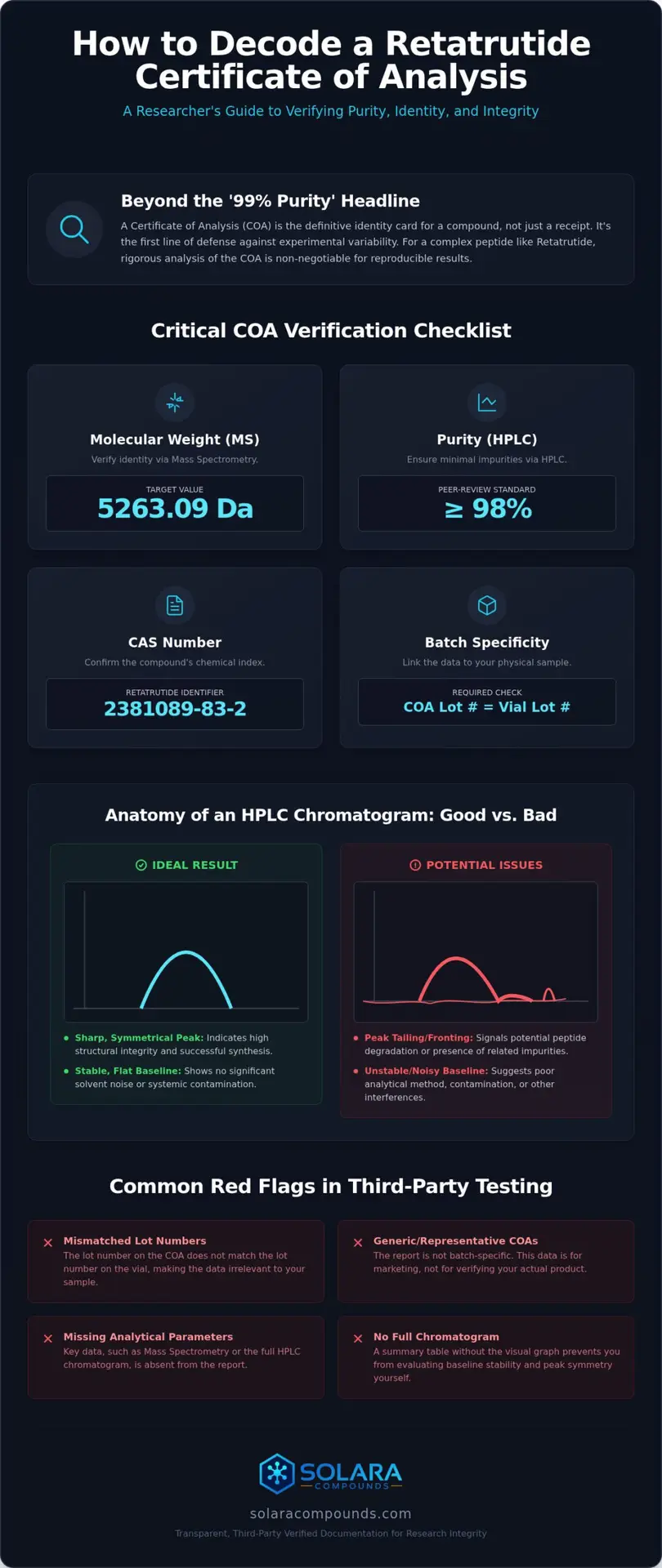
Retatrutide requires specific identifiers to ensure authenticity. You must verify the CAS number 2381089-83-2 to confirm the compound’s chemical index. Because Retatrutide is a complex triple-agonist targeting GLP-1, GIP, and glucagon receptors, its synthesis is significantly more demanding than simpler peptides. This structural complexity increases the risk of side-chain errors or incomplete sequences. Rigorous documentation is a prerequisite for any credible in vitro study because it accounts for the compound’s specific molecular weight, which should sit at approximately 5263.09 Da.
Anatomy of a Professional Laboratory Report
A legitimate report begins with a clear header detailing the vendor, the date of analysis, and the specific batch identification. It should also describe the physical state of the compound, typically as a white, lyophilized powder. Beyond identity, the report must outline solubility parameters and storage requirements to ensure laboratory longevity. These details allow you to standardize your reconstitution protocols and maintain the peptide’s structural integrity over time. Consistency in these factors is what separates high-grade research material from generic alternatives.
The Impact of Impurities on Scientific Outcomes
Impurities aren’t just “extra” material; they’re active variables that can skew your data. Residual solvents or truncated peptide sequences can interfere with receptor binding assays, leading to false positives or misleading potency results. High-grade research generally demands a purity threshold of 98% or higher to meet peer-review standards. The Lot Number serves as the primary link between the physical vial in your laboratory and the specific analytical data provided in the report. Without this direct connection, the provided data is merely representative rather than verified. By carefully interpreting retatrutide COA reports, you ensure that your findings are based on the compound’s actual performance rather than the influence of unknown contaminants.
Decoding HPLC Purity: Analyzing the Chromatogram
High-Performance Liquid Chromatography (HPLC) remains the gold standard for assessing the purity of research peptides. It provides a visual and mathematical representation of a compound’s composition. When interpreting retatrutide COA reports, the HPLC chromatogram is the primary tool for verifying that the substance is free from synthesis byproducts. The purity percentage is derived from the Area Under the Curve (AUC) calculation. This method measures the area of the main peak relative to the total area of all detected peaks. A purity level of 98% or higher ensures that your in vitro models aren’t influenced by unintended chemical variables.
The analytical rigor required for these reports aligns with the principles found in the FDA Good Manufacturing Practice Guidance. While research-grade peptides aren’t for human use, adhering to these high-level analytical standards is vital for data integrity. A flat baseline is critical. The HPLC report must show the full chromatogram, not just a summary table, to allow for a complete evaluation of the baseline and peak integration.
Evaluating Peak Symmetry and Baseline Stability
A sharp, symmetrical peak indicates high structural integrity and successful synthesis. If a peak displays “tailing” or “fronting,” it often signals peptide degradation or the presence of closely related impurities. Distinguishing between actual chemical impurities and baseline noise is essential. Baseline noise appears as small, jagged fluctuations, whereas impurities manifest as distinct, albeit smaller, peaks. You can examine the detailed chromatograms for our Retatrutide 10mg to verify the absence of these secondary peaks.
Retention Time as a Metric for Consistency
The x-axis of the chromatogram measures Retention Time, which is the duration the compound spends within the HPLC column. Consistency in retention time across different batches signifies manufacturing repeatability. If the retention time shifts significantly between reports, it may indicate a change in the chemical environment or a variance in the peptide’s hydrophobic properties. By tracking these values, you can confirm that each batch of Retatrutide 10mg provides the same chemical profile for your longitudinal studies. Interpreting retatrutide COA data through this lens ensures your research remains grounded in repeatable, empirical evidence.
Mass Spectrometry: Verifying Retatrutide’s Molecular Identity
HPLC confirms how much of the substance is there, but Mass Spectrometry (MS) confirms exactly what it is. While HPLC provides a purity percentage, it cannot distinguish between two different peptides with identical hydrophobic properties. For a researcher, interpreting retatrutide COA data requires a deep dive into the MS results to verify molecular identity. This process ensures that the compound in your laboratory isn’t just pure, but is also the correct sequence intended for your study. It acts as the final safeguard against mislabeled or incorrectly synthesized material.
Retatrutide presents a unique mass profile that reflects its complex engineering. The base peptide sequence has an approximate mass of 4731.33 Da. However, the high-purity Retatrutide 10mg used in metabolic research is typically conjugated with a C20 fatty diacid. This specific modification shifts the expected molecular weight to approximately 5263.09 Da. If the observed mass in the report deviates from this value beyond a standard tolerance, usually plus or minus 1 Da, the structural integrity of the batch is in question. Interpreting a Certificate of Analysis in this context means matching these observed values against the theoretical target with absolute precision.
Interpreting the MS Spectrum
The MS spectrum displays the mass-to-charge (m/z) ratio of the ionized peptide. Because peptides often carry multiple charges during ionization, the spectrum may show several peaks representing different charge states. Sophisticated reports provide a deconvoluted mass calculation, which translates these complex m/z values into a single, neutral molecular weight for easier verification. Confirming a clear, dominant primary molecular ion peak at the 5263.09 Da mark is non-negotiable for batch validation. Secondary peaks or significant fragmentation patterns can indicate sequence errors or the presence of truncated peptides that failed to reach full synthesis.
Confirming the Triple Agonist Sequence
Retatrutide’s triple-agonist functionality relies on specific structural modifications. It contains non-natural amino acids, such as Aib (alpha-aminoisobutyric acid) substitutions, which are critical for its receptor binding profile and enzymatic stability. These substitutions, along with the C20 fatty diacid conjugation, create a specific mass signature. When you’re interpreting retatrutide COA documentation, verify that these mass shifts are accounted for in the final observed weight. Cross-referencing your batch data with peer-reviewed literature ensures that the material in your laboratory aligns with established scientific benchmarks. This level of verification is the only way to guarantee that your in vitro studies are examining the intended triple-agonist interaction rather than a partial or degraded sequence.
Batch-Specific vs. Representative COAs: Identifying Vendor Integrity
A “representative” COA is a theoretical snapshot of a past success. A batch-specific report is a real-time audit. When you’re interpreting retatrutide COA data, the lot number on the report must match the vial in your hand. This direct link is the only way to ensure the analytical results reflect the physical material you’re using. Vendors often provide generic reports to save on testing costs, but this practice compromises the reproducibility of your study. You shouldn’t accept documentation that doesn’t explicitly reference the specific batch you received.
Look for blurry scans or pixelated text around the date and results. These visual inconsistencies are common indicators of digital manipulation or “photoshopping” of old data. Missing analysis dates or mismatched lot numbers suggest the vendor is using recycled data from a previous synthesis. You can verify the authenticity of any report by contacting the testing laboratory directly. Most reputable facilities provide a verification portal or will confirm a report’s validity via a quick email inquiry to protect their own reputation for accuracy.
The Dangers of Recycled Analytical Data
Using a report from August 2024 to justify a batch purchased in August 2026 is a significant research risk. Peptides are susceptible to environmental degradation and oxidation over time. Even if the initial synthesis was high-purity, the chemical profile can shift during long-term storage or improper transit. You should establish a protocol that rejects any documentation older than six months. This ensures the structural integrity of your Retatrutide 10mg remains constant across your experimental timeline and prevents the introduction of unknown variables into your metabolic models.
Third-Party Laboratory Standards
Integrity requires an independent perspective. Third-party testing removes the inherent bias of in-house quality control and provides an objective assessment of purity. Look for reports from established analytical facilities located within the United States to ensure compliance with domestic standards. A legitimate PDF report should feature a clear lab seal, the analyst’s signature, and often a QR code for immediate digital verification. If you’re conducting institutional audits, you shouldn’t hesitate to request raw data files from your vendor to perform your own peak integration analysis. You can view our batch-specific testing standards to see how we maintain this level of transparency for every order. Interpreting retatrutide COA documentation correctly means demanding this level of granular detail from every supplier.
The Solara Standard: Accessing and Verifying Your Retatrutide 10mg Data
Solara Compounds operates with a commitment to transparency that bridges the gap between material science and laboratory utility. We provide batch-specific Certificates of Analysis for every order, ensuring that the data you receive is a direct reflection of the physical vial in your hands. By integrating both HPLC and Mass Spectrometry into our standard quality control workflow, we remove the ambiguity often found when interpreting retatrutide COA documentation. This dual-verification protocol ensures that every 10mg vial of Retatrutide meets the 5263.09 Da molecular weight and the 98% purity threshold required for metabolic research. You can access the latest analytical reports through our secure platform, allowing for seamless institutional audits and data verification.
Domestic Sourcing and Quality Assurance
Choosing a US-based laboratory supplier provides a layer of accountability that international vendors often lack. Domestic sourcing ensures faster shipping times and a more secure chain of custody, which is vital for maintaining the stability of temperature-sensitive peptides. Solara Compounds supports institutional researchers through reliable bulk procurement and comprehensive documentation that simplifies the peer-review process. View the latest batch-specific COAs for Retatrutide 10mg at Solara Compounds to confirm the analytical integrity of our current inventory. Our focus on consistency helps eliminate the variables that can compromise long-term metabolic studies.
Preparing for Your Experiment
Accurate reconstitution is the foundation of a successful study. You should use the purity and mass data from the COA to calculate precise reconstitution volumes, ensuring your molar concentrations are exact. Analytical stability reports suggest that Retatrutide 10mg should be stored in a lyophilized state at -20°C for long-term preservation. Before initiating your in vitro protocols, use the following checklist:
- Confirm the Lot Number on the vial matches the provided COA.
- Verify the observed molecular weight is approximately 5263.09 Da.
- Check that the HPLC chromatogram shows a sharp, symmetrical primary peak with minimal baseline noise.
- Ensure the storage environment has remained consistent and within the recommended temperature range since arrival.
Following these steps ensures that your research results are reproducible and grounded in empirical fact. By prioritizing the structural integrity of the compound, you can focus on the performance of your metabolic models with absolute confidence in your material’s purity.
Advancing Research Precision through Analytical Transparency
The integrity of your metabolic study depends on the absolute verification of your research materials. By mastering the technical nuances of interpreting retatrutide COA reports, you move beyond surface-level purity claims and into the realm of empirical certainty. You now have the framework to cross-reference HPLC chromatograms for baseline stability and verify the 5263.09 Da molecular weight through Mass Spectrometry. This level of technical oversight ensures that your in vitro models are powered by the structural integrity they require for valid results.
Batch-specific transparency isn’t just a preference; it’s a scientific necessity. Solara Compounds provides the specialized documentation needed to eliminate vendor bias and confirm the identity of every 10mg vial. Our commitment to domestic sourcing and third-party verification provides a reliable framework for institutional audits and longitudinal success. We prioritize the intersection of material science and real-world utility so you can focus on your findings without doubting your source.
Secure High-Purity Retatrutide 10mg with Batch-Specific COAs to ensure your next experiment is built on a foundation of verified data. We’re proud to be your partner in the pursuit of reproducible, high-impact metabolic research.
Frequently Asked Questions
What is the minimum purity percentage required for Retatrutide research?
High-grade metabolic research typically requires a minimum purity threshold of 98%. This standard ensures that synthesis byproducts don’t interfere with receptor binding or metabolic assays. Peer-reviewed studies often reject data derived from materials with lower purity levels because the influence of unknown contaminants cannot be adequately controlled. Maintaining this threshold is essential for the reproducibility of your in vitro models and the overall integrity of your findings.
Can I use an HPLC report from a different batch if the vendor is the same?
No, you shouldn’t rely on an HPLC report from a different batch even if the vendor remains the same. Synthesis is a batch-specific process, and each production run can have different impurity profiles or purity levels. Interpreting retatrutide COA documentation correctly requires a direct link between the analytical data and the specific lot number on your vial. Using representative data instead of batch-specific reports introduces unnecessary risk to your research.
How do I verify that a third-party lab actually performed the test?
You can verify testing authenticity by contacting the laboratory listed on the report or using their digital verification portal. Most reputable third-party facilities maintain a database of their analyses and will confirm if a specific report matches their records. Look for a QR code or a unique report ID on the document. If a vendor refuses to provide the lab’s contact information, it’s a significant indicator of potential data forgery.
What does ‘lyophilized’ mean on a Retatrutide COA?
Lyophilized refers to the freeze-drying process used to stabilize the peptide for long-term storage and transport. This method removes moisture through sublimation, resulting in a porous, white powder that dissolves easily upon reconstitution. Lyophilization is critical because it prevents the degradation that occurs more rapidly in aqueous solutions. A COA should specify this physical state as a baseline indicator of proper post-synthesis handling and material integrity during the supply chain.
Why does the molecular weight on my MS report differ slightly from the theoretical mass?
Small variations between theoretical and observed mass often occur due to isotopic distribution and the specific calibration of the mass spectrometer. While the theoretical mass of modified Retatrutide is 5263.09 Da, observed values within a 1 Da tolerance are generally considered acceptable. If the deviation is larger, it may indicate a sequence error or the presence of a truncated peptide. Always ensure the report provides a deconvoluted mass for an accurate comparison of the results.
What are the common red flags in a forged peptide COA?
Common red flags include pixelated text around the results, mismatched lot numbers, and missing analysis dates. If the report header looks significantly sharper than the analytical data, it may have been digitally altered. Interpreting retatrutide COA reports also involves checking for consistent font styles and legitimate lab signatures. A professional report should be a clear, high-resolution PDF that allows for easy verification of the testing facility’s credentials and the raw data points.
Is a COA required for all research peptides, or just Retatrutide?
A COA is essential for all research peptides to ensure the validity of your experimental findings. Whether you’re working with Retatrutide, Tirzepatide, or BPC-157, you must have empirical proof of identity and purity. Without this documentation, you cannot account for the chemical variables that might influence your results. Providing batch-specific analytical data is the standard for transparency and accountability in any professional laboratory setting or institutional study.
How often should a new analysis be performed on stored Retatrutide batches?
You should perform a new analysis or request an updated report every six months for stored peptide batches. Peptides can degrade over time even when stored at -20°C, especially if they’ve been exposed to oxygen or moisture during reconstitution. Regular re-testing confirms that the structural integrity and purity remain within your required parameters. This practice ensures that the material used at the end of a long-term study is identical to the material used at the start.