Research Articles
Research Peptide Testing: Purity and Verification Guide

The most sophisticated laboratory equipment is effectively useless if the chemical foundation of your study is compromised by invisible impurities. You likely understand the frustration of receiving a batch where the actual concentration doesn’t match the labeled amount, or worse, where cross-contamination threatens to invalidate months of work. Implementing rigorous analytical testing for research peptides is the only way to bridge this gap and secure the reproducibility of your data. It’s a matter of technical necessity rather than a mere safety check.
You’ll master the technical standards of peptide analysis to ensure the integrity of your laboratory research and the reliability of your chemical sourcing. This guide provides a clear framework for evaluating peptide quality, allowing you to interpret batch-specific Certificates of Analysis (COA) with absolute precision. We’ll examine the functional differences between High-Performance Liquid Chromatography (HPLC) and Mass Spectrometry (MS) to show how they confirm structural integrity. By the end of this analysis, you’ll have the technical literacy required to verify that every lot meets the high-grade engineering standards your research requires.
Key Takeaways
- Learn why rigorous analytical testing for research peptides is essential for eliminating confounding variables and ensuring the reproducibility of your in vitro models.
- Understand the distinct roles of HPLC and LC-MS in verifying both the percentage purity and the specific amino acid sequence of your compounds.
- Identify how secondary assessments like endotoxin and sterility testing protect sensitive assays from pyrogenic interference and microbial contamination.
- Develop a systematic approach to interpreting Certificates of Analysis by linking batch numbers to physical products and analyzing chromatogram peaks for impurities.
- Recognize the value of batch-specific transparency as the primary differentiator when selecting a reliable supplier for high-purity research materials.
The Critical Role of Analytical Testing in Peptide Research
Analytical testing for research peptides is the systematic quantitative and qualitative assessment of a compound’s chemical composition. It serves as the primary gateway for ensuring that the molecule in the vial matches the sequence on the label. For compounds categorized under the Research Use Only (RUO) standard, comprehensive chemical documentation isn’t a luxury; it’s a fundamental requirement for scientific validity. The landscape changed significantly in early 2026 as regulatory bodies increased their focus on the integrity of research chemicals. While many suppliers provide data, there’s a vital distinction between manufacturer-generated reports and independent third-party verification. The former reflects an internal process, while the latter provides an objective scientific audit that protects your research from commercial bias.
Confounding Variables and Experimental Integrity
Impurities within a peptide batch act as silent variables that can easily derail in vitro models. Residual solvents or high levels of Trifluoroacetic acid (TFA), a common byproduct of the synthesis process, often compromise cell viability and lead to false results in toxicity assays. Similarly, peptide degradation products can significantly alter binding affinity studies by competing for receptor sites or inducing non-specific interactions. Maintaining batch-to-batch consistency is vital for multi-phase longitudinal research. Without it, researchers can’t distinguish between a biological response and a variation in chemical purity. Precision in the lab starts with precision in the vial.
The Limitations of Internal Quality Control
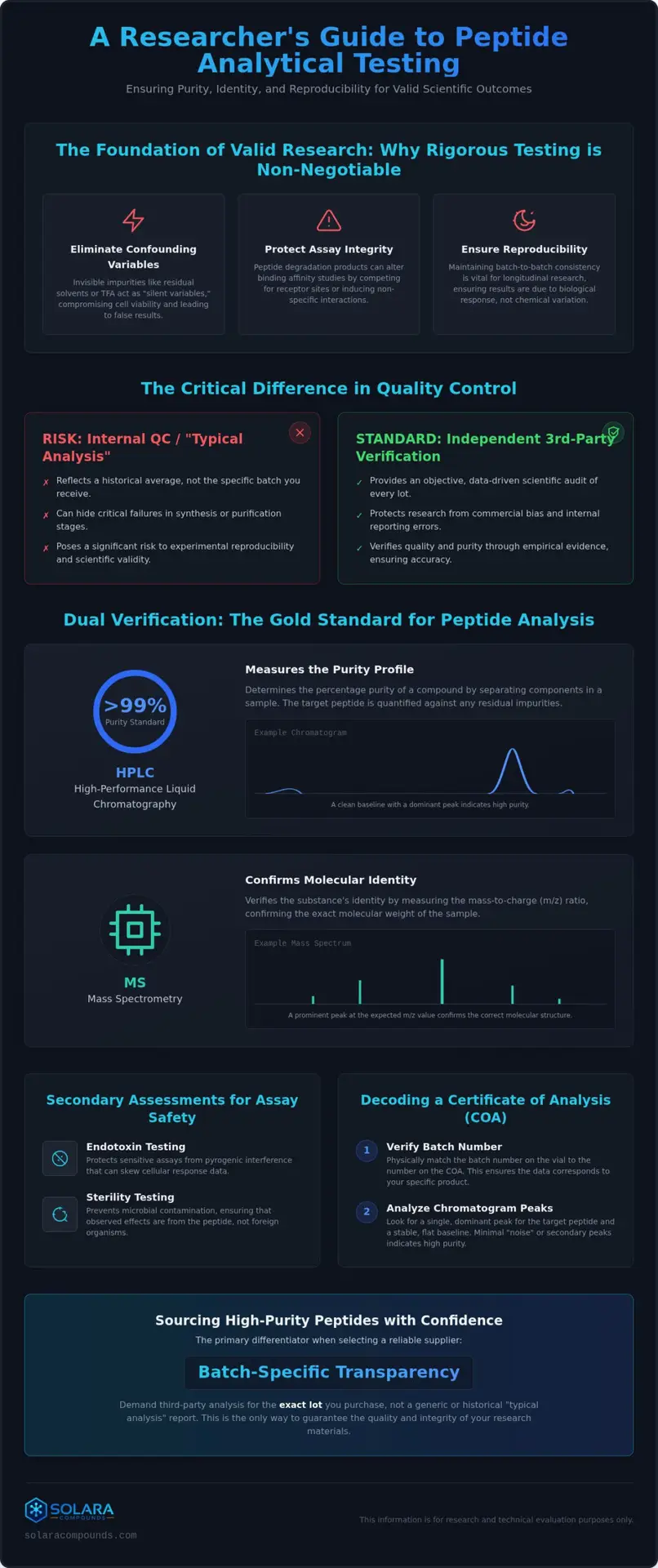
Relying solely on internal quality control poses a significant risk to experimental reproducibility. Many vendors provide a “typical analysis” report, which reflects a historical average rather than the specific characteristics of the batch you received. This lack of specificity can hide critical failures in the synthesis or purification stages. Independent laboratories utilize High-Performance Liquid Chromatography (HPLC) to provide a transparent, data-driven assessment of every lot. This external verification ensures that the purity levels cited are accurate and that the compound is free from structural anomalies. It’s the difference between assuming quality and verifying it through empirical evidence. Objective data remains the only reliable currency in high-level research.
Core Methodologies: HPLC Purity vs. LC-MS Identity
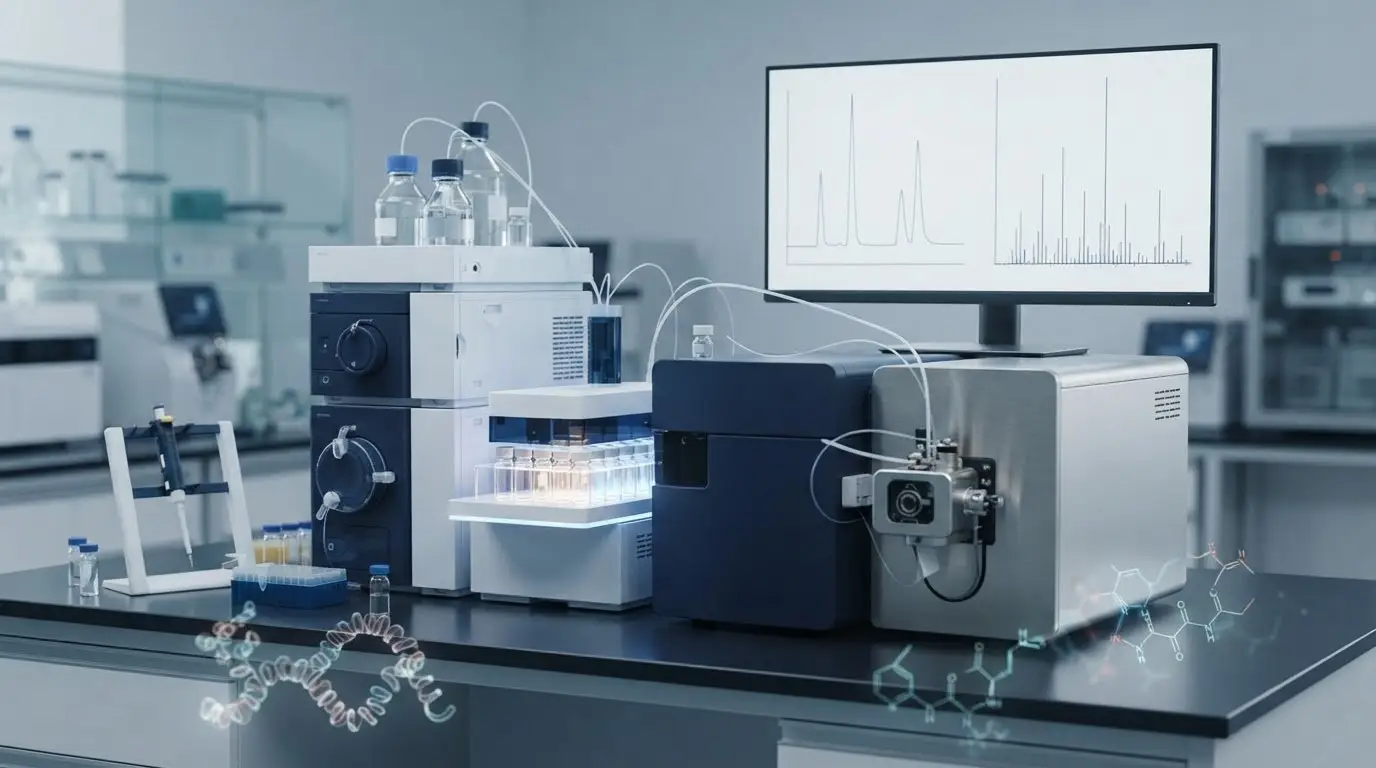
High-purity claims are scientifically hollow without a dual-verification approach. Analytical testing for research peptides relies on the technical synergy between separation and identification. While purity measures the concentration of the target compound relative to contaminants, identity confirms that the molecular structure itself is correct. A peptide batch can technically reach a high purity percentage while consisting of an entirely different sequence than intended. To establish a complete chemical profile, a laboratory must utilize both High-Performance Liquid Chromatography and Mass Spectrometry.
Understanding HPLC: Measuring the Purity Profile
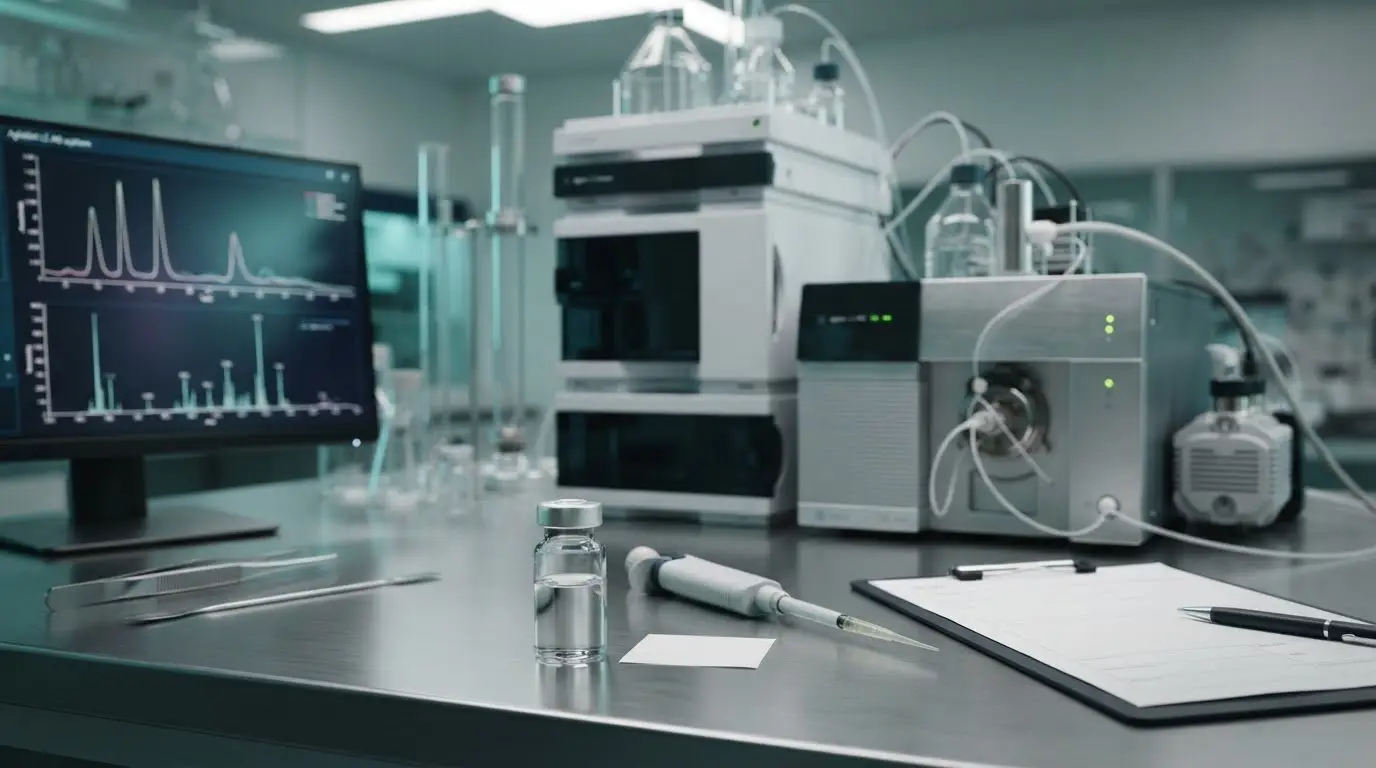
High-Performance Liquid Chromatography (HPLC) is the industry standard for determining the percentage purity of a compound. The process involves forcing a liquid sample through a column packed with specialized adsorbent material. Different molecules interact with this material at varying rates, causing them to elute at different times. This separation allows technicians to visualize every component within the vial. The primary metric for success is the Area Under the Curve (AUC). By integrating these peaks on a chromatogram, the lab calculates the percentage of the target peptide compared to any residual impurities. A stable baseline and minimal “noise” indicate a clean synthesis and effective purification. For research-grade amino acid chains, the 99% purity benchmark serves as the gold standard for experimental reliability.
Mass Spectrometry: Confirming Molecular Weight and Identity
While HPLC confirms how much of a substance is present, Mass Spectrometry (MS) verifies what that substance is. This method measures the mass-to-charge (m/z) ratio of ionized particles to determine the exact molecular weight of the sample. It’s a critical safeguard against sequence errors or incorrect amino acid substitutions that might elute at the same time as the target compound during HPLC. For instance, when verifying Retatrutide 10mg or Tirzepatide 10mg, the observed MS peak must align perfectly with the theoretical molecular weight of the peptide. Even a minor mass variance can signal a truncated sequence or an unintended chemical modification during synthesis. Detecting these discrepancies is essential for maintaining the integrity of your data. You can access batch-specific HPLC and MS reports for our entire inventory to verify these parameters before starting your next study.
Secondary Testing: Sterility, Endotoxins, and Quantity
While HPLC and MS confirm identity and purity, secondary analytical testing for research peptides ensures that the compound’s chemical environment is free from biological interference. These assessments are vital for maintaining the integrity of sensitive cell cultures and biochemical assays. Beyond the peptide sequence itself, researchers must account for the presence of residual manufacturing byproducts and microbial contaminants. Comprehensive verification requires looking past the primary peaks to ensure the stability and safety of the research material within a laboratory setting.
Sterility and Endotoxin Analysis for In Vitro Studies
Bacterial endotoxins are potent pyrogens that can trigger unintended inflammatory responses in cell cultures, effectively masking or skewing the results of a study. The Limulus Amebocyte Lysate (LAL) test is the industry standard for ensuring the absence of these contaminants. Adhering to standards like USP <85> for endotoxin limits and USP <71> for sterility provides a necessary layer of protection for complex protocols. Sterility testing becomes a non-negotiable requirement when your research involves long-term incubation or highly sensitive primary cell lines where even trace microbial presence could invalidate months of work. High-quality sourcing depends on these rigorous benchmarks to prevent pyrogenic interference.
Quantitation: Measuring Net Peptide Content
A common point of confusion in laboratory sourcing is the difference between lyophilized powder weight and actual peptide mass. When you receive a vial, the total gross weight includes the peptide, residual water, and counterions like acetate or trifluoroacetate (TFA) used during the stabilization process. Quantitation through Nitrogen Analysis or Amino Acid Analysis (AAA) reveals the net peptide content, which is the actual amount of the amino acid chain present. It’s common for a 10mg vial to contain a specific percentage of salts and moisture, meaning the net peptide might only represent 80% to 90% of the total mass. Understanding this distinction is critical for accurate dosing and concentration calculations in your experimental design.
Heavy Metal Screening and Elemental Purity
For high-concentration research compounds, Inductively Coupled Plasma Mass Spectrometry (ICP-MS) provides a detailed screening for heavy metals. This process detects trace amounts of catalysts or environmental contaminants like lead, arsenic, or mercury that may have been introduced during the synthesis phase. While often overlooked, elemental purity is a hallmark of high-grade engineering in chemical manufacturing. Ensuring your compounds are free from heavy metal toxicity is another way to stabilize the variables in your research environment. Reliable sourcing requires a commitment to this level of transparency across every batch.
How to Interpret a Certificate of Analysis (COA)
A Certificate of Analysis (COA) serves as the definitive technical document for any research compound. It isn’t just a verification of quality; it’s a bridge between the manufacturer’s claims and your laboratory results. When you perform analytical testing for research peptides, the final report must be tethered to the specific batch in your possession. Verification begins with the batch number. This unique identifier must match the label on your vial exactly. If the numbers don’t align, the data is irrelevant to your current study.
Analyzing the HPLC chromatogram requires looking beyond the purity percentage. A clean peak should appear as a sharp, symmetrical spike with a stable baseline. If you notice secondary peaks, “shoulders” on the main peak, or significant baseline noise, these are indicators of residual impurities or degradation products. These contaminants can introduce variables that compromise your data. You must also cross-reference the Mass Spectrometry data with the known theoretical molecular weight of the peptide. If the observed mass deviates by more than a negligible margin, the structural identity of the compound is in question.
The COA Checklist for Procurement Officers
Efficiency in sourcing requires a standardized approach to document review. Every report should meet these baseline criteria before the material is cleared for laboratory use:
- Third-Party Validation: Confirm that a recognized, independent laboratory performed the analysis to ensure an objective scientific audit.
- Dual-Data Presence: Ensure the COA includes both HPLC and MS results for that specific lot, as one cannot confirm purity and identity in isolation.
- Analysis Recency: Check the date of analysis to ensure the compound was tested recently; older reports may not reflect the current stability of the batch.
Red Flags in Analytical Reports
Identifying discrepancies early prevents costly experimental failures. Obscured laboratory names or missing batch numbers are immediate indicators of a lack of transparency. Professional analytical testing for research peptides provides the empirical foundation for these documents, and any deviation from standard reporting should be a cause for concern. Be wary of “representative” reports. These generic documents reflect a best-case scenario rather than the actual lot you received. If the chromatogram shows unstable baselines or poorly resolved peaks, the purification process was likely insufficient. You can view our batch-specific COAs to see how transparent, data-driven reporting should look for every compound in our inventory.
Sourcing High-Purity Research Peptides with Confidence
Selecting a reliable supplier is the final step in ensuring experimental reproducibility. While many vendors operate in a “grey market” with minimal oversight, Solara Compounds prioritizes transparency through rigorous batch-specific verification. Analytical testing for research peptides shouldn’t be a hidden internal metric; it must be a public trust signal. By providing direct access to third-party reports, we eliminate the ambiguity often associated with chemical sourcing. This commitment ensures that your laboratory work is built on a foundation of empirical certainty rather than marketing assumptions.
The relationship between a researcher and a supplier is most effective when it functions as a technical partnership. You need to know that the material arriving at your facility has undergone the same scrutiny you apply to your own data. Our process is designed to bridge the gap between complex material science and your practical application. We focus on repeatability and consistency, framing our role as a partner in your long-term success. Every batch we distribute is a reflection of our commitment to high-grade engineering and structural integrity.
The Solara Standard: Transparency and Precision
Every vial of Retatrutide 10mg or Tirzepatide 10mg in our inventory is backed by verifiable data. We understand that scientific institutions require more than just a label to proceed with complex studies. Our standard involves a meticulous scientific audit of every lot, allowing you to cross-reference the theoretical properties of the peptide with the actual chemical output. This focus on high-purity compounds supports the structural integrity of your research from the first assay to the final data point. By maintaining a science-first organization, we prioritize the integrity of the final result over mere visual appeal.
Streamlining Institutional Procurement
Domestic US shipping provides more than just a reduction in lead times; it ensures compliance and security for US-based laboratories. International logistics often introduce variables like temperature fluctuations or customs delays that can compromise sensitive compounds. Solara Compounds streamlines institutional procurement by offering secure, domestic fulfillment that maintains the cold chain when necessary. We also support bulk and wholesale agreements for large-scale projects, providing the same level of analytical testing for research peptides across every unit ordered. This methodical approach ensures consistency for longitudinal studies where batch-to-batch variation is unacceptable.
Review our batch-specific analysis and source your research peptides today to ensure your next study is backed by the highest standards of chemical verification.
Elevating Laboratory Standards Through Empirical Verification
Precision in the laboratory is a direct reflection of the chemical integrity of your starting materials. You’ve seen how the synergy between HPLC and Mass Spectrometry provides a complete structural profile, while secondary sterility and endotoxin assessments protect your assays from unintended variables. Relying on comprehensive analytical testing for research peptides isn’t just a best practice; it’s the foundational requirement for reproducible science. By prioritizing batch-specific data over generic manufacturer claims, you’re securing the validity of your future findings.
Solara Compounds remains committed to this level of technical transparency. We provide independent third-party verification for every lot and offer secure domestic shipping across the United States to maintain the stability of your compounds. You can access batch-specific COAs for our entire inventory to confirm that every vial meets your rigorous specifications. Secure high-purity research peptides for your laboratory today and move forward with the confidence that only empirical data can provide. Your research deserves a partner that values accuracy as much as you do.
Frequently Asked Questions
What is the difference between peptide purity and peptide content?
Peptide purity refers to the percentage of the target peptide relative to other peptide related impurities. Peptide content, or net peptide mass, measures the actual weight of the peptide relative to the total lyophilized powder. This powder often includes residual water and counterions like acetate. It’s common for a vial with 99% purity to have a peptide content of 80%. This distinction is vital for accurate molar concentration calculations.
Why is HPLC testing used for research peptides?
HPLC is the industry standard for determining the percentage purity of a compound. It uses a high pressure liquid phase to separate the target molecule from synthetic impurities within a specialized column. This analytical testing for research peptides allows laboratories to visualize every component on a chromatogram. It ensures that the concentration of the target peptide meets required benchmarks, providing the empirical data necessary for reproducible research results.
How do I know if a peptide Certificate of Analysis is authentic?
Authenticity is verified by cross referencing the batch number with the third party laboratory that issued the report. A legitimate Certificate of Analysis must include the laboratory’s contact information, a clear date of analysis, and raw data plots. You should avoid reports that lack a unique lot identifier or appear as generic documents. Contacting the lab directly to confirm the results is the most reliable way to ensure document integrity.
What are the common impurities found in synthetic peptides?
Common impurities include residual solvents, truncated peptide sequences, and counterions like trifluoroacetate. During synthesis, incomplete amino acid couplings can create deletion sequences that mirror the target peptide’s properties. Effective purification is required to remove these byproducts; their presence can introduce confounding variables that skew experimental data. High grade engineering in the synthesis phase is essential to minimize these contaminants and ensure the structural integrity of the final compound.
Does 99% purity mean the peptide is safe for research?
A 99% purity rating confirms chemical consistency but does not guarantee the absence of biological contaminants like endotoxins. While high purity is the gold standard for chemical integrity, secondary assessments like sterility testing are required for sensitive cell cultures. Comprehensive analytical testing for research peptides must evaluate both chemical composition and biological cleanliness. This dual layered approach ensures the material won’t interfere with the biological pathways being studied in your laboratory.
Why is batch-specific testing more important than a general analysis?
Batch specific testing is essential because chemical synthesis is subject to minor variations in temperature and reagent quality. General analysis reports only reflect a manufacturer’s historical averages rather than the specific lot in your possession. These discrepancies can lead to variations in peptide concentration or purity between orders. Verifying the exact batch you received ensures that your data remains consistent and that every vial meets the technical standards required for your study.
How should lyophilized peptides be stored after testing?
Lyophilized peptides should be stored in a freezer at -20°C or -80°C to maintain long term stability. Vials must be protected from light and moisture to prevent degradation. Before opening a vial, it’s important to allow it to reach room temperature. This step prevents condensation from forming on the powder; moisture can trigger hydrolysis and compromise the structural integrity of the amino acid chain during your research.
What is the role of mass spectrometry in peptide verification?
Mass spectrometry verifies the identity of a compound by measuring its mass to charge ratio. While HPLC confirms the purity level, mass spectrometry ensures the peptide sequence is correct by measuring the observed molecular weight. This process detects sequence errors or incorrect amino acid substitutions that might elute at the same time during HPLC. It provides the definitive proof that the molecule in the vial matches the intended chemical structure.