Research Articles
Sourcing Authentic Research Grade Peptides: A Guide to Quality Control Standards

A certificate of analysis isn’t a guarantee of quality; it’s merely the starting point of a rigorous verification process that many researchers overlook. In the field of material science, the distance between a labeled concentration and the actual molecular integrity of a compound can be the difference between a successful study and a failed experiment. You’re likely familiar with the frustration of inconsistent results that stem from under-dosed vials or hidden contaminants. These variables introduce noise into your data, making it difficult to achieve the repeatability required for high-level research. Mastering peptide synthesis quality control is the only way to eliminate these risks and ensure your laboratory operates with empirical certainty.
We’ll provide you with a clear framework for evaluating peptide purity and interpreting complex analytical reports. You’ll learn how to scrutinize HPLC and Mass Spectrometry data to verify that compounds like Retatrutide 10mg or Tirzepatide 10mg meet the strict standards your protocols demand. This guide details the essential steps for identifying reliable US-based suppliers who prioritize batch-specific transparency over marketing claims. By the end of this article, you’ll have the technical expertise to secure authentic research grade peptides that deliver consistent, verifiable outcomes for your scientific inquiries.
Key Takeaways
- Learn why relying on High-Performance Liquid Chromatography (HPLC) and Mass Spectrometry is essential for confirming the structural integrity of your research compounds.
- Understand the critical difference between lyophilized gross weight and net peptide content to ensure your laboratory dosages are accurate and repeatable.
- Discover the specific benchmarks used in peptide synthesis quality control to maintain a minimum purity threshold of 98% for all scientific applications.
- Identify the red flags in analytical reports and learn how to verify batch-specific Certificates of Analysis from accredited domestic laboratories.
- Gain insights into sourcing high-purity compounds like Retatrutide 10mg and Tirzepatide 10mg with the data-backed transparency required for institutional research.
What Defines Authentic Research Grade Peptides?
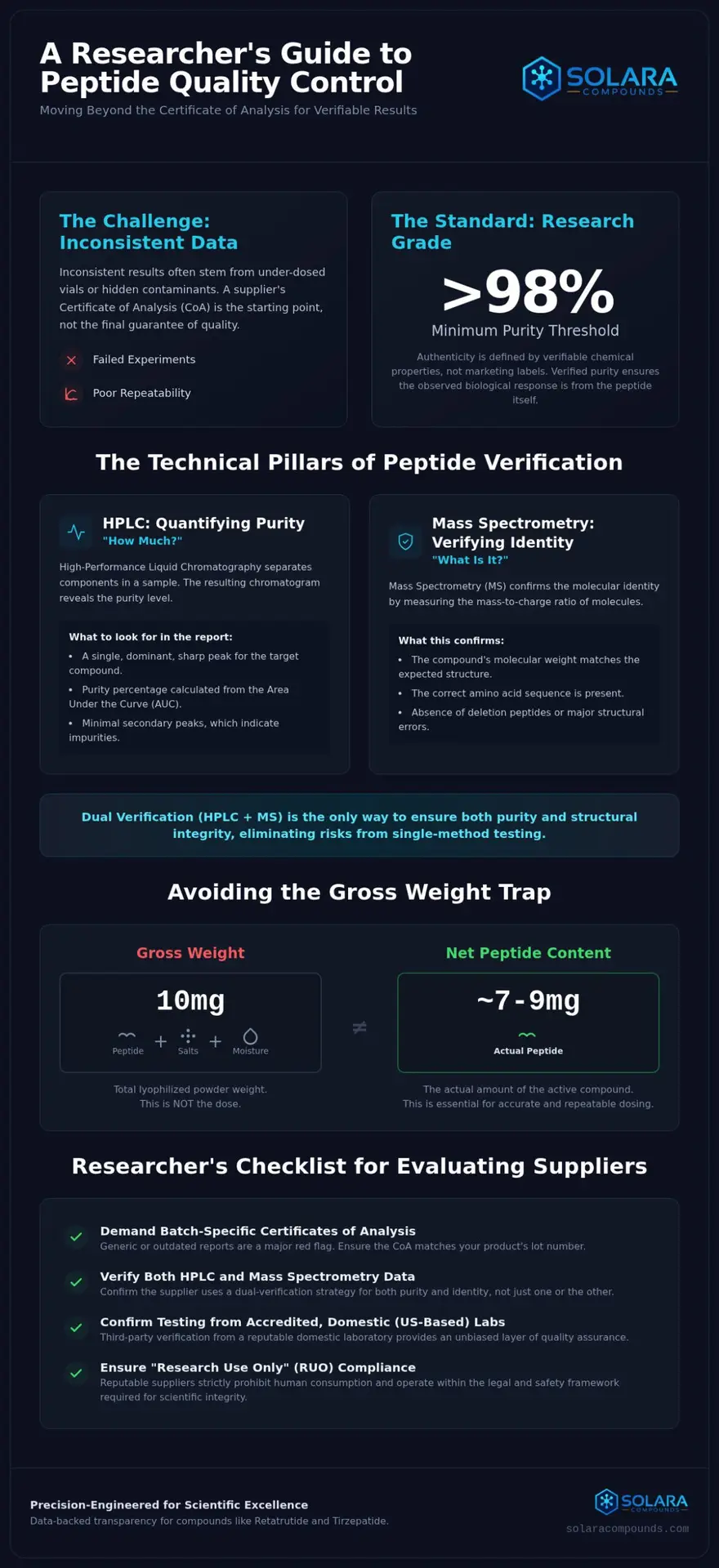
Authentic research grade peptides are characterized by a specific set of rigorous technical benchmarks. They aren’t defined by marketing labels but by verifiable chemical properties. In a professional laboratory setting, a compound is only considered research grade when it reaches a minimum purity threshold of 98% as confirmed through analytical chromatography. This level of refinement ensures that the observed biological response in your study is attributable to the peptide itself rather than residual reagents, solvents, or synthetic byproducts. Effective peptide synthesis quality control acts as the primary safeguard for this purity, moving beyond simple mass measurements to verify absolute chemical authenticity.
There is a critical distinction between chemical authenticity and mere concentration. A vial may contain the correct mass of lyophilized powder, yet the actual molecular integrity could be compromised by degradation or improper synthesis. This is why industrial or cosmetic grade substances are fundamentally insufficient for controlled scientific study. These lower grades often contain stabilizers, fillers, or impurities that are acceptable for topical applications but catastrophic for in vitro research. Without high-level structural integrity, achieving repeatable results becomes impossible, as these hidden variables introduce significant noise into your data sets.
The Importance of Sequence Precision
The primary structure of a peptide determines its entire biological profile. If the amino acid sequence is incorrect or if the chain contains truncated sequences, the peptide-receptor binding affinity will be fundamentally altered. Even a single substituted amino acid can lead to off-target effects that obscure your research findings. Verifying this sequence requires high-resolution analysis to ensure that compounds like Retatrutide 10mg or Tirzepatide 10mg possess the exact molecular identity required for your protocols. Precision in the synthesis phase prevents the accumulation of “deletion peptides” that can mimic the target compound’s mass while lacking its functional properties.
Research Use Only (RUO) Compliance
The Research Use Only (RUO) designation is a strict legal and safety framework designed to protect both the researcher and the integrity of the scientific process. Reputable suppliers like Solara Compounds strictly prohibit human consumption of their products, as these materials are intended exclusively for laboratory and scientific use. This compliance ensures that the peptides are handled within professional laboratory environments equipped with the necessary instrumentation for precise measurement and application. Maintaining this boundary is essential for the safety of the scientific community and the continued availability of high-purity compounds for legitimate research purposes.
The Technical Pillars of Peptide Quality Control
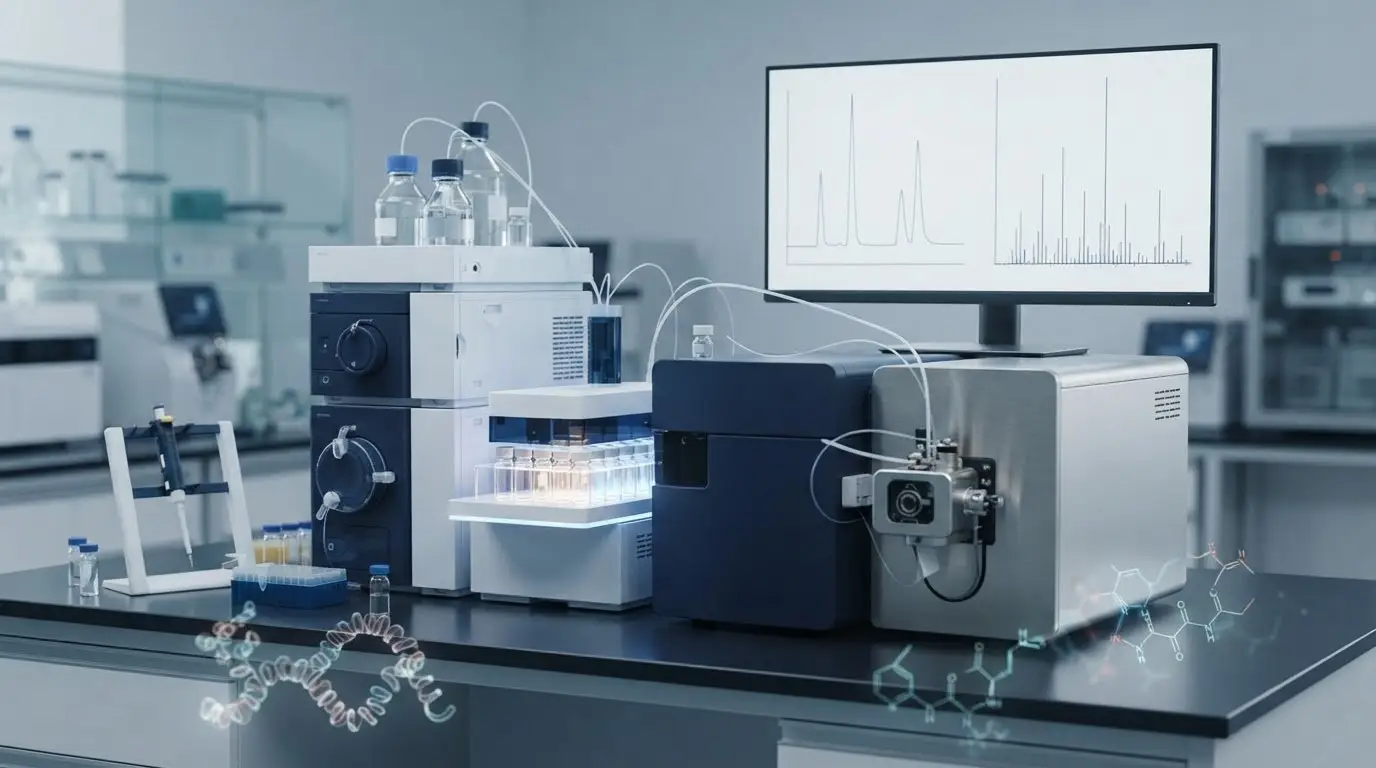
Verification isn’t a formality. It’s the foundation of empirical research. Relying on a single test method creates blind spots that jeopardize batch consistency and your overall data integrity. Robust peptide synthesis quality control requires a dual-verification strategy using both High-Performance Liquid Chromatography (HPLC) and Mass Spectrometry (MS). This combination ensures that you aren’t just looking at the amount of material in the vial, but the specific molecular identity and purity of the compound itself. One method measures the “how much,” while the other confirms the “what.”
High-stakes research demands more than a cursory glance at a PDF. Single-method testing can easily miss impurities that share similar physical properties with the target peptide. By utilizing a multi-faceted analytical approach, you eliminate the risk of using under-dosed or cross-contaminated samples. This technical rigor is what separates laboratory-grade compounds from generic market offerings. It provides a data-driven trail that connects the raw synthesis to the final physical outcome in your laboratory.
Interpreting HPLC Chromatograms
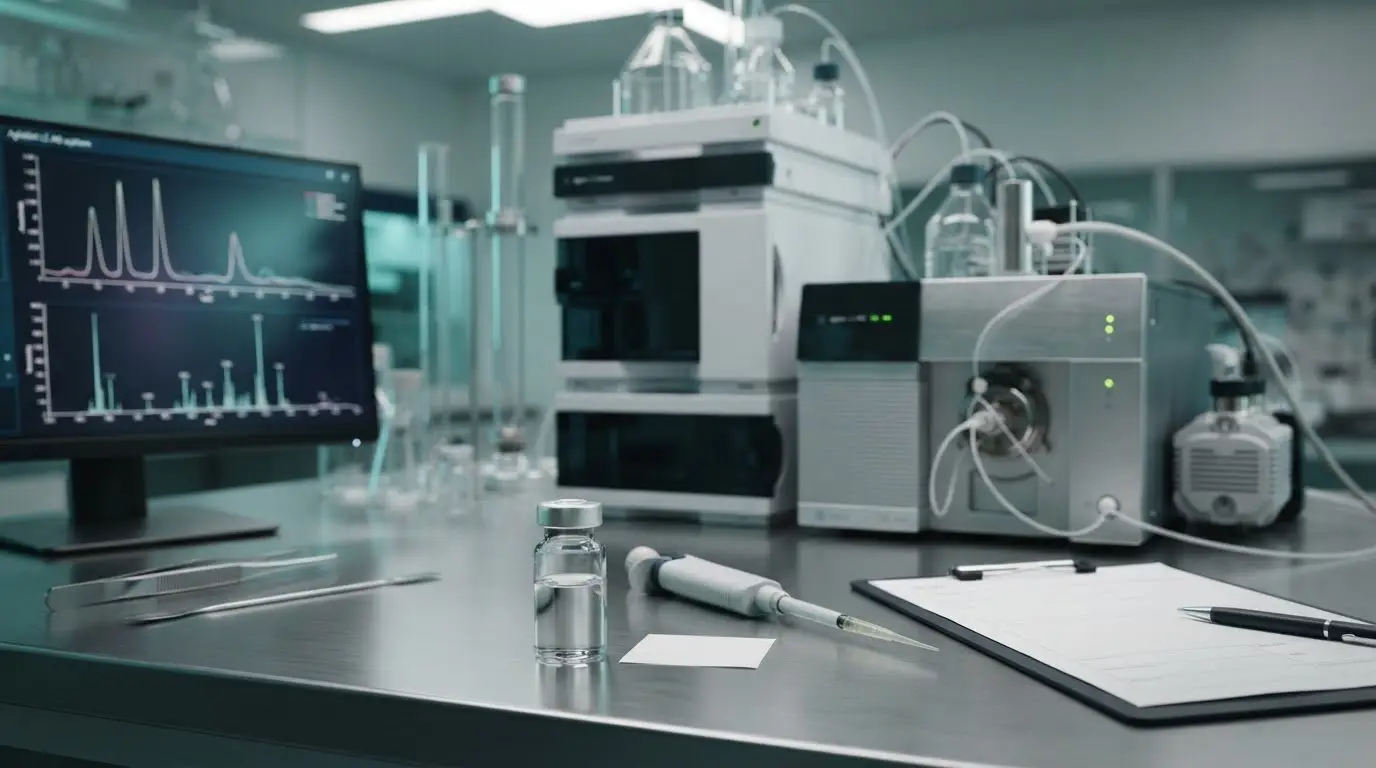
HPLC is a process for separating components based on molecular interaction with a stationary phase. In a standard analytical report, you should look for a single, sharp target peak that dominates the graph. The purity percentage is determined by calculating the area under the curve (AUC) for this primary peak relative to the total area of all peaks detected. Small “shoulder” peaks or secondary spikes indicate the presence of impurities, such as truncated sequences or residual solvents. If these peaks are prominent, the structural integrity of the sample is compromised. Consistent retention times across different batches are a strong indicator of compound stability and manufacturing repeatability.
Decoding Mass Spectrometry Reports
While HPLC measures purity, Mass Spectrometry (MS) confirms identity. It works by comparing the observed mass-to-charge ratio (m/z) against the theoretical molecular weight of the peptide. If the observed mass deviates significantly from the theoretical value, the sample is likely the wrong compound or contains significant synthetic errors. You’ll often see small variations due to ionization or the presence of salt adducts like TFA or acetate, which are common artifacts of the synthesis process. MS is particularly effective at identifying specific by-products that might have identical retention times in HPLC but different molecular masses. For researchers requiring this level of data-driven transparency, sourcing from a partner that provides batch-specific analytical reports is the only way to maintain laboratory standards. Using high-purity compounds like Tirzepatide 10mg or BPC-157 5mg ensures that your experimental variables remain controlled and your results stay credible.
Purity vs. Net Peptide Content: Avoiding the Gross Weight Trap
Gross weight is a deceptive metric in laboratory research. While HPLC purity measures the ratio of the target sequence against impurities, it doesn’t account for the non-peptide components within the lyophilized powder. Most researchers don’t realize that a vial labeled as 99% pure may only contain 70% to 80% actual peptide mass. The remaining weight consists of counterions and residual moisture. This distinction is vital for peptide synthesis quality control because it dictates the precision of your molar concentrations. If you calculate your dosages based on the gross weight of the powder, your experimental results will be fundamentally flawed due to under-dosing.
The discrepancy between purity and content isn’t a sign of poor manufacturing; it’s a byproduct of the chemical process. Peptides are typically synthesized as salts to ensure stability and solubility. These counterions, such as Trifluoroacetic acid (TFA) or Acetate, bind to the peptide and add significant mass. For a compound like BPC-157 5mg, a 99% purity rating simply means that 99% of the peptide present is the correct sequence. It doesn’t mean that 99% of the powder in the vial is BPC-157. Understanding this “Gross Weight Trap” is essential for maintaining the integrity of your dose-response curves.
Amino Acid Analysis (AAA) Explained
Amino Acid Analysis (AAA) provides the absolute quantification necessary for high-stakes studies. While HPLC tells you how clean your sample is, AAA tells you exactly how much peptide is there. This method involves hydrolyzing the peptide into its constituent amino acids and measuring them individually. It’s the preferred technique for determining Net Peptide Content (NPC) because it’s far more accurate than elemental analysis, which can be skewed by non-peptide nitrogen sources. When your research requires exact molarity, verifying the NPC through AAA is the only way to ensure your data remains robust and repeatable.
The Impact of Counterions on Research
The choice of counterion can significantly influence your experimental environment. TFA is the standard salt used during the purification phase, but it’s known to be cytotoxic and can alter the pH of sensitive in vitro systems. For studies where pH stability is critical, switching to an Acetate or HCl salt may be necessary to avoid artifacts in your data. Solara Compounds prioritizes this level of detail by providing high-purity lyophilized compounds with consistent salt profiles. Whether you’re working with GHK-Cu 50mg or Tirzepatide 10mg, knowing the counterion concentration allows you to adjust your buffers and maintain the structural integrity of your research model.
A Researcher’s Checklist for Evaluating Peptide Suppliers
Selecting a supplier is a critical decision that directly impacts the validity of your experimental data. It requires a methodical evaluation of operational standards to ensure your laboratory receives compounds that are chemically authentic and structurally sound. A reliable partner doesn’t just provide a product; they offer a verifiable data trail that begins with synthesis and ends with secure delivery. Use the following criteria to vet potential vendors and maintain the highest standards of peptide synthesis quality control in your facility.
- Requirement 1: Batch-specific Certificates of Analysis (COA). You must demand a report that corresponds exactly to the lot number on your vial. Generic or “representative” reports are insufficient for professional research.
- Requirement 2: Accredited Third-party Testing. Purity claims should be verified by an independent, domestic laboratory. This provides an unbiased second opinion on both purity and molecular identity.
- Requirement 3: Defined Storage and Shipping Protocols. Peptides are sensitive to thermal degradation. Confirm that your supplier utilizes appropriate climate-controlled storage and expedited shipping to protect the compound’s integrity.
- Requirement 4: Strict RUO Compliance. Reputable suppliers clearly label all products for “Research Use Only.” Any suggestion of human consumption is a major red flag that indicates a lack of professional laboratory standards.
- Requirement 5: Domestic US Accountability. A US-based presence ensures that the supplier operates within domestic legal frameworks and provides faster transit times, reducing the risk of environmental exposure during shipping.
Red Flags in Research Chemical Sourcing
The most common warning sign is the use of outdated or “representative” COAs. These documents are often used to mask inconsistencies between batches. If a supplier cannot provide the specific HPLC and MS data for the current lot of Tirzepatide 10mg or GHK-Cu 50mg you’re purchasing, the chemical integrity is unverified. Additionally, avoid vendors who use ambiguous language like “ultra-high purity” without providing a specific numerical percentage. Absolute transparency is the hallmark of a professional organization. You should also ensure the procurement process is handled through secure, encrypted systems to protect institutional data.
The Value of Domestic US Distribution
Domestic distribution is about more than just convenience; it’s about preserving the structural integrity of the material. International transit often involves extended periods in uncontrolled environments, which can lead to peptide deamidation or oxidation. By sourcing from a US-based facility, you minimize these risks and ensure compliance with domestic research standards. Furthermore, a domestic partner provides direct access to technical support. This is essential for institutional buyers who require rapid clarification on analytical reports or batch-specific metrics. You can order verified research peptides from our domestic facility to ensure your laboratory operates with maximum precision and reliability.
Solara Compounds: Precision-Engineered for Scientific Excellence
Solara Compounds operates as a technical consultant for the scientific community. We provide materials where purity isn’t a goal but a non-negotiable requirement. For high-demand sequences like Retatrutide 10mg and Tirzepatide 10mg, we maintain a purity benchmark of 99%+. This level of precision is achieved through rigorous peptide synthesis quality control that prioritizes empirical evidence over standard industry claims. We don’t provide generic or “representative” reports. Every order includes direct access to batch-specific Certificates of Analysis (COA) to ensure the compound in your vial matches the specific data on your screen. This transparency allows you to proceed with your research knowing the exact molecular profile of your material.
Our optimized lyophilization process removes residual moisture while preserving the structural integrity of the peptide chain. This specialized technique results in maximum compound longevity and stability during storage. From our Florida-based facility, we manage secure national shipping to laboratories across the United States. We understand that transit time and environmental conditions affect material science outcomes. Our logistics are designed to minimize exposure and maintain the baseline properties of every lyophilized compound we distribute. We take pride in the craftsmanship of our synthesis and the reliability of our delivery systems.
Supporting Specialized Research Projects
Our catalog supports a diverse range of laboratory protocols. We offer high-concentration compounds such as GHK-Cu 50mg and BPC-157 5mg alongside specialized research kits. Solara facilitates multi-phase laboratory studies by offering reliable supply chains and tiered pricing structures for institutional procurement. This ensures that bulk research projects have access to consistent batches without the risk of supply chain interruptions or batch-to-batch variance. We act as a stable partner for long-term scientific success by prioritizing the repeatability of your results. Our inventory management is optimized to provide high-demand compounds with the specific purity metrics your study requires.
Trust Through Empirical Transparency
We bridge the gap between complex material science and your final physical results. Our “no-nonsense” approach means we value data-driven descriptors over marketing fluff. We believe that trust is built through repeatability and the integrity of the final result. You shouldn’t have to guess about the quality of your research materials or struggle to interpret vague purity claims. We provide the technical “why” behind every batch we release. You can review our batch-specific analysis for Retatrutide 10mg and other compounds to verify the metrics for yourself and ensure your laboratory operates with absolute certainty.
Advancing Your Research with Empirical Certainty
Precision in the laboratory isn’t optional; it’s the baseline for credible data. You now have the technical framework to evaluate chemical authenticity by looking beyond gross weight to verify actual net peptide content. By demanding batch-specific HPLC and MS reports, you eliminate the noise caused by synthetic impurities or truncated sequences. Implementing these rigorous standards for peptide synthesis quality control ensures that your experimental outcomes are repeatable and your variables remain strictly managed. Success in complex material science depends on this level of data-driven scrutiny.
Solara Compounds serves as a dedicated partner in your scientific inquiries. We provide third-party verified purity of 99%+ and deliver batch-specific COAs with every order to maintain absolute transparency. Our domestic shipping protocols further protect the structural integrity of your materials from our facility to your laboratory. Secure high-purity peptides for your next research project at Solara Compounds and proceed with the confidence that only empirical data can provide. We’re ready to support your next breakthrough with the reliable materials your protocols demand.
Frequently Asked Questions
What is the difference between 98% and 99% peptide purity for research?
A 99% purity level reduces the concentration of unknown synthetic byproducts by half compared to a 98% benchmark. While 98% is often the standard for research grade, that extra 1% of refinement is critical for sensitive in vitro assays where minor contaminants can interfere with receptor binding. Higher purity levels minimize experimental noise and ensure that biological responses are strictly attributable to the target peptide sequence.
How do I read a peptide HPLC report to verify authenticity?
Focus on the primary peak’s sharpness and the calculated Area Under the Curve (AUC). A high-quality report will show a dominant peak with minimal “shoulders” or secondary spikes, which represent impurities. Effective peptide synthesis quality control is evidenced by a purity percentage derived from this AUC. Always cross-reference the batch number on the report with the label on your vial to ensure the data is lot-specific.
Why is mass spectrometry necessary if the HPLC shows a single peak?
HPLC measures purity based on retention time, but it cannot confirm molecular identity. Mass spectrometry is essential because it verifies the compound’s actual molecular weight against its theoretical value. It’s possible for an impurity to elute at the same time as the target peptide, creating a single HPLC peak. MS identifies these hidden contaminants by their mass-to-charge ratio, providing the final confirmation of chemical authenticity.
What does ‘Net Peptide Content’ mean on a Certificate of Analysis?
Net Peptide Content (NPC) represents the actual weight of the peptide relative to the total weight of the lyophilized powder. Most research vials contain counterions and residual moisture that add gross weight without adding biological activity. If a report indicates an 80% NPC, it means 20% of the powder consists of non-peptide components like TFA or acetate. Precise molar calculations require using the NPC rather than the gross mass.
How should lyophilized research peptides be stored to maintain quality?
Store lyophilized peptides in a dedicated freezer at -20°C for long-term stability. For immediate use over a few weeks, refrigeration at 4°C is generally sufficient, provided the vials remain sealed and protected from light. Peptides are sensitive to moisture and thermal cycles, so it’s best to avoid frequent temperature fluctuations. Maintaining a stable, cold environment prevents deamidation and oxidation, preserving the structural integrity of the compound.
Are Solara Compounds’ peptides tested by third-party laboratories?
Yes, every batch we distribute undergoes rigorous verification by independent, domestic third-party laboratories. We don’t rely solely on internal metrics. This external validation ensures that compounds like Retatrutide 10mg or Tirzepatide 10mg meet our strict purity benchmarks. This dual-layer testing protocol provides the empirical transparency required by institutional researchers who demand unbiased confirmation of material quality and molecular identity before beginning their studies.
Can I use research grade peptides for clinical trials or human study?
No, research grade peptides are strictly for laboratory and scientific use only. These materials are designated as Research Use Only (RUO) and are not manufactured under the cGMP conditions required for human administration or clinical trials. Solara Compounds explicitly prohibits the use of its products for human consumption. Our focus remains on providing high-purity compounds for in vitro and in vivo research within professional laboratory settings.
Does Solara Compounds provide batch-specific COAs for bulk orders?
We provide batch-specific Certificates of Analysis for every order, regardless of size. Whether you’re procuring a single vial of BPC-157 5mg or a bulk institutional shipment, you’ll receive the specific HPLC and MS data for that exact lot. This commitment to transparency ensures that multi-phase studies maintain consistency across different timeframes. You’ll never have to rely on generic representative reports when sourcing your materials from our facility.