Research Articles
Peptide Supplier Quality: Check COAs, Identity and Red Flags


A polished label is not evidence of peptide identity. A peptide supplier quality questionnaire should establish whether each batch has its own Certificate of Analysis, whether mass spectrometry supports the stated identity, and whether the supplier can explain its sourcing and business practices clearly. These checks help separate useful documentation from claims that are difficult to assess.
For laboratory buyers, consistency matters as much as a purity result. A batch-specific Certificate of Analysis (COA) gives researchers evidence to assess, while identity testing helps determine whether the material matches the intended peptide. This guide explains what to review in batch records, mass spectrometry results, sourcing practices, and supplier disclosures, including warning signs that merit closer scrutiny.
Solara Compounds provides batch-specific Certificates of Analysis and third-party testing for research compounds. Products are for laboratory research only, not medicine or supplements, and are not for use in people or animals. Learn how to assess the available documentation at solaracompounds.com.
Key Takeaways
- Use batch-specific Certificates of Analysis to connect test results to the material being evaluated.
- Read HPLC purity results as one part of quality assessment, not as proof of peptide identity.
- Consider independent laboratory testing and laboratory competence when assessing sourcing quality.
- Mass spectrometry can help determine whether a peptide’s measured molecular mass aligns with its expected identity.
- Look for clear, consistent documentation and business communication; research peptides are for laboratory research only, not for people or animals.
Batch-specific certificates of analysis
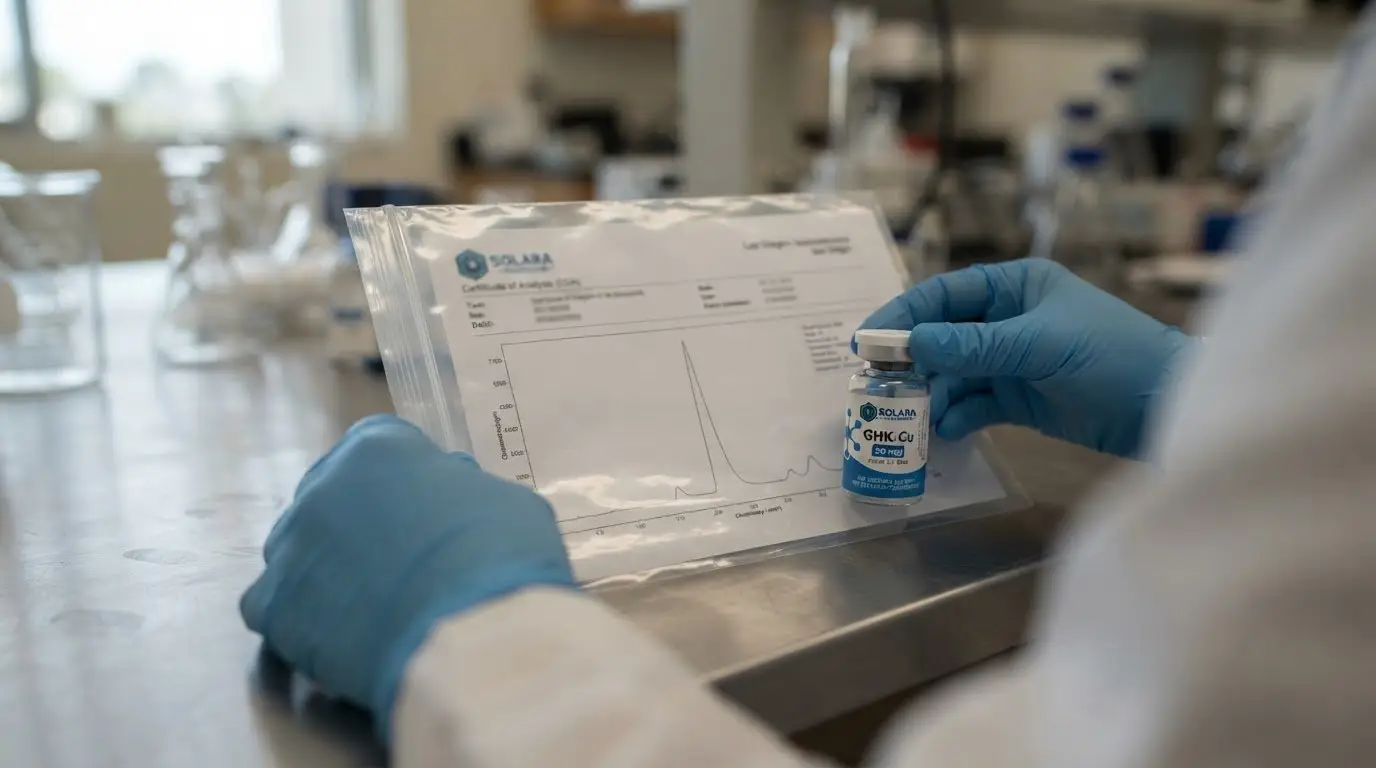
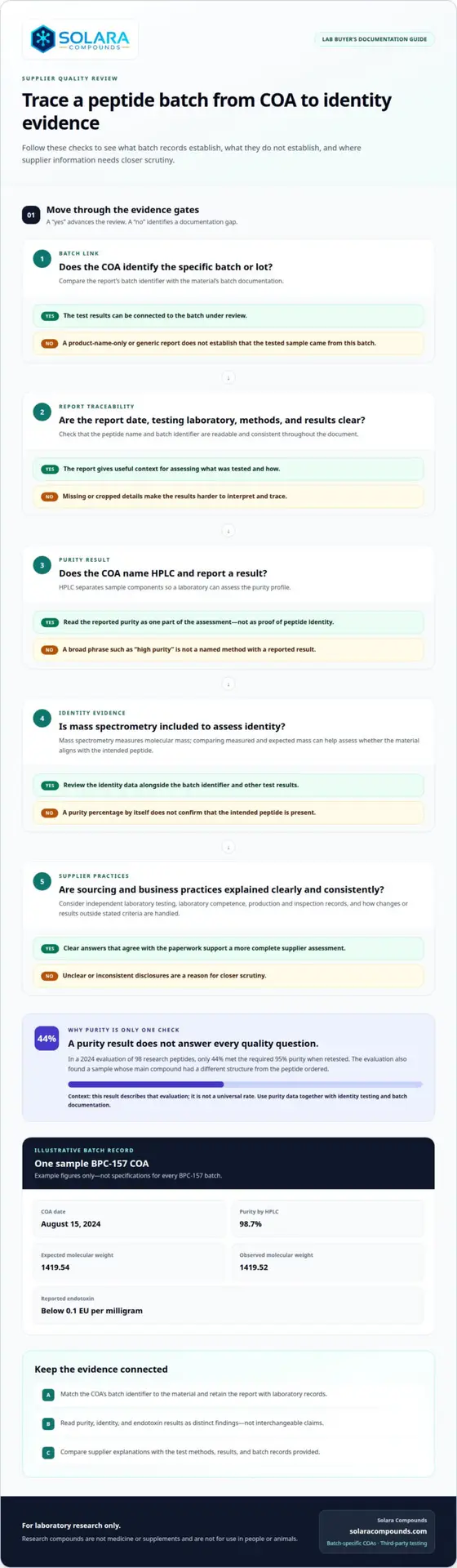
A COA records test results for a material. For peptide research, it should identify the specific batch or lot, not just the product name. This link matters because results from one batch do not establish the properties of another. A batch-specific COA gives researchers evidence to assess the material associated with their laboratory work and helps maintain traceability in research records.
Start with the identifiers. Check the report date, testing laboratory, methods, and results. A report without a batch identifier is difficult to connect to a particular order. A generic report may describe testing, but it does not establish that the tested sample came from the batch under review.
A sample BPC-157 COA dated August 15, 2024, illustrates how detailed results can appear. It lists purity of 98.7% by HPLC, an expected molecular weight of 1419.54, and an observed molecular weight of 1419.52. It also reports endotoxin below 0.1 EU per milligram. These figures belong to that example only; they are not specifications for every BPC-157 batch.
Review each result in context. HPLC, or high-performance liquid chromatography, separates sample components so a laboratory can assess the purity profile. The COA should identify the method and state a result rather than rely on a broad phrase such as “high purity.” A purity percentage alone does not establish identity, so interpret it alongside the other batch-specific tests.
- Batch link: Match the lot identifier on the COA with the material’s batch documentation.
- Test details: Look for named methods, reported results, and a test date.
- Result context: Distinguish purity findings from identity or endotoxin results.
- Document clarity: Confirm the peptide name and batch identifier are readable and consistent.
Next, assess whether the report is traceable and complete. A legible PDF naming the tests is more useful than an image cropped to show only a percentage. The document should make clear what was tested and which batch the results concern. Keep the COA with laboratory records so the batch identifier and results remain linked over time.
A useful peptide supplier quality questionnaire asks how often batch-specific COAs are issued, which tests they include, and how a buyer can access the matching report. Answers should be direct and consistent with the paperwork. A supplier quality overview can also explain the documentation process; see the research peptide supplier information for context on supplier practices.
COAs support informed laboratory evaluation, but they do not make research materials suitable for human or animal use. These materials are for laboratory research only, not medicine or supplements, and not for people or animals. Treat each report as batch-specific evidence, not as a blanket claim about every product or future batch.
What Does It Mean to Evaluate a Research Peptide Supplier?
Supplier evaluation combines product evidence with the processes behind it. HPLC purity testing is one useful measure, but it does not establish every quality attribute. A 2024 evaluation of 98 research peptides found that only 44% met the required 95% purity when retested. That result shows why buyers should assess reported results, testing methods, and batch documentation together.
HPLC separates compounds in a sample. Its chromatogram helps estimate the proportion represented by the main peak. A COA should name HPLC as the method and report the purity result. Check what the percentage represents: a purity result is not automatically the same as the amount of peptide in a vial.
Net peptide content describes the amount of peptide material, apart from the sample’s total mass. Residual water, salts, and other components can affect total mass. A label’s stated amount and an HPLC percentage answer different questions. Review them separately, and look for documentation explaining whether the stated quantity refers to peptide content or total material.
Typical qualification criteria include batch-linked test records, a defined HPLC method, identity data, and clear traceability. Buyers may also assess supplier records for production and inspections. The National Institute of Standards and Technology (NIST) describes supplier evaluation as extending beyond product quality.
A peptide supplier quality questionnaire should ask which methods assess purity, how results are linked to each batch, and how production or inspection records are maintained. It should also ask how the supplier handles results outside stated criteria and whether changes are documented.
Interpret purity figures against the stated research purpose and the method used. The available evaluation classified 95% to 98% as research grade and acceptable, and 98% or higher as pharmaceutical grade. These labels do not replace the method details or identity evidence. Avoid treating “pharmaceutical grade” as proof of regulatory approval or suitability for human use.
Purity is only one part of the assessment. In the 98-peptide evaluation, one sample’s main compound had a different structure from the peptide ordered. That example illustrates the distinction: HPLC can characterize a sample’s component profile, while identity testing addresses whether the intended peptide is present.
- Method: Identify HPLC and the reported purity result.
- Content: Clarify whether stated mass means peptide content or total sample mass.
- Traceability: Connect each result to its batch and documentation.
- Process: Ask how production records, inspections, and exceptions are handled.
Use these points to make supplier answers specific and comparable. For laboratory research only, research peptides are not medicine or supplements, and are not for people or animals. To explore available research materials alongside these evaluation criteria, view the research peptide catalog.
What Is Sourcing Quality in Research Peptides?
Sourcing quality involves the testing laboratory, sample traceability, and records supporting each batch. Independent testing adds an analytical check beyond supplier-generated paperwork. Its value depends on clear methods, identifiable samples, and results tied to the material under review. A laboratory’s name alone does not explain what was tested or how.
ISO/IEC 17025:2017 specifies general requirements for testing and calibration laboratory competence. For peptide testing, consider whether the laboratory’s relevant methods and work fall within its accreditation scope. Accreditation is not a substitute for reviewing results. The test method, sample identity, and reported findings still need to be clear.
Endotoxin and sterility tests address different questions. Endotoxin testing looks for bacterial toxins that may remain even when bacteria are no longer present. Sterility testing assesses whether viable microorganisms grow under specified test conditions. A result for one does not establish the other. Identify which test was performed and what the result covers.
Traceability links a test result to a specific lot. Record the lot identifier, peptide name, testing laboratory, method, and report date together. Then compare the COA date with the batch records and material release date. A clear date helps establish when the sample was tested, but does not alone prove current quality or proper storage.
Independent third-party testing is useful when the report identifies the testing organization and the sample tested. Look for a direct connection between the reported lot and the batch under review. A supplier quality questionnaire can ask how samples are selected, whether the testing laboratory is independent, and how deviations are documented. Specific answers make the testing process easier to assess.
Reassess suppliers periodically and after meaningful changes, such as a new testing laboratory, revised analytical methods, a production change, or a quality complaint. Monitoring can include reviewing new batch records, tracking test dates, and noting recurring documentation gaps. Set the reassessment interval according to supplier performance, the material’s role, and the consequences of inconsistent results.
- Testing: Identify the laboratory, method, sample, and result.
- Accreditation: Check whether the relevant testing work falls within scope.
- Safety-related results: Keep endotoxin and sterility findings distinct.
- Traceability: Connect lot identifiers and report dates to batch records.
- Monitoring: Reassess after changes or quality concerns.
For a peptide supplier quality questionnaire, include questions about independent testing, accreditation scope, endotoxin and sterility results, lot traceability, and how testing dates relate to batch records. The COA documentation should make relevant results and batch details accessible. Research peptides are for laboratory research only, not medicine or supplements, and not for people or animals.
Mass spectrometry identity confirmation
Mass spectrometry helps assess whether a sample’s molecular mass matches the intended peptide. The instrument measures ions, or charged molecules, and reports their mass-to-charge pattern. Analysts compare the measured molecular mass with the peptide’s expected value. This provides identity evidence that complements, but does not replace, purity testing.
A supplier report should identify the peptide, tested batch, analytical method, and result. It should show the expected and observed molecular masses clearly. The observed mass should match the expected mass within 0.1%. A result outside that range needs interpretation against the method and reported measurement conditions.
Mass alone is not a complete structural fingerprint. Peptides can have similar molecular masses, and a simple mass match may not resolve sequence changes. Tandem mass spectrometry can break ions into fragments, providing additional information about the peptide sequence. When stronger identity confirmation is needed, review whether the report includes this supporting analysis.
Identity, purity, and potency require different evidence. Mass spectrometry supports identity by comparing molecular mass and, where available, fragment patterns. HPLC estimates sample composition by separating components. Potency requires an appropriate functional assay measuring activity in a defined laboratory system. No single result answers all three questions.
To assess these attributes, match the report to the batch, review the mass result, examine purity testing, and identify any functional assay. The assay should explain what activity it measures and how results are interpreted. A report that gives only a purity percentage does not establish molecular identity or functional potency.
- Identity: Compare expected and observed molecular mass.
- Sequence support: Review fragment data from tandem mass spectrometry.
- Purity: Assess the reported separation method and sample profile.
- Potency: Look for a defined functional assay and its measured endpoint.
- Traceability: Connect each result to the tested batch and report.
A peptide supplier quality questionnaire can ask which mass spectrometry method is used, whether fragment analysis is available, and how results are linked to each batch. Clear documentation lets researchers interpret evidence without treating one test as a substitute for another. For laboratory research only, these materials are not medicine or supplements, and are not for people or animals.
Supplier red flags and business transparency
Supplier transparency shows how a business handles evidence, questions, and changes. A polished website cannot replace clear records or direct answers. Broad product claims, incomplete documentation, and vague replies can make materials harder to evaluate. A useful approach is to turn each concern into a specific question and assess whether the response is clear and consistent.
In August 2026, the FDA sent warning letters to online peptide vendors. The FDA concluded that website evidence outweighed research-use-only statements on product labeling. A label statement alone does not resolve concerns raised by a supplier’s wider website claims. Evaluate the supplier’s overall presentation, rather than relying on one phrase in isolation.
Other warning signs include product names that differ across records and results that cannot be linked to the material under review. A report without a named method or date offers limited context. Treat broad claims such as “guaranteed purity” cautiously when they lack supporting batch evidence. Clear documentation should explain what was tested and what the result means.
Business transparency is also reflected in how a supplier handles questions and communicates changes. Ask who responds to quality inquiries, how document requests are managed, and how material changes are communicated. Compare the answers with the supplier’s records and published information. Direct explanations should point to a process or document rather than rely on general assurances.
Review audit history, deviations, corrective and preventive actions (CAPA), and change controls through dated records, documented findings, and closure evidence. CAPA refers to steps taken to address a problem and reduce recurrence. Check whether audit findings have assigned actions, investigations document outcomes, and process changes include approval and implementation records.
Organize potential warning signs by their effect on documentation and confidence in supplier practices:
- Inconsistent records: Product names or identifiers differ across supplier documents.
- Thin explanations: Quality claims lack an identified basis or supporting detail.
- Open findings: Deviations lack documented investigation or follow-up actions.
- Unclear changes: Revised processes lack a recorded review or approval trail.
- Conflicting messaging: Product descriptions and research-use statements send different signals.
Ask how audits are documented, how deviations are investigated, and how corrective actions are reviewed. Ask how changes to testing or production are recorded. Specific answers help researchers understand supplier quality practices and distinguish documented processes from broad marketing claims.
Research peptides are for laboratory research only, not medicine or supplements, and not for people or animals. To review research materials and available product information, browse the research catalog.
Solara Compounds
Solara Compounds helps laboratory buyers assess research materials through third-party testing and batch-specific Certificates of Analysis. These records support review of identity, purity, and traceability before materials are selected for laboratory work.
The catalog includes SOL-3RT Retatrutide 10mg and SOL-2TZ Tirzepatide 10mg, alongside other research compounds. Review the relevant batch paperwork as part of the same evidence-based assessment described above. Product documentation supports laboratory research only; these products are not medicine or supplements and are not for people or animals.
For questions about research materials or batch documentation, contact Solara Compounds.
Build a consistent sourcing process
A repeatable supplier review can become part of laboratory planning. Set evaluation criteria before making a sourcing decision, then record how the available evidence supports project requirements. This gives research teams a shared basis for documenting decisions as projects evolve.
Make the review useful beyond purchasing. Include fields for the project’s material requirements, the records considered, and the person responsible for retaining them. This structure supports continuity when project responsibilities change, without treating one assessment as a permanent endorsement of a supplier.
Solara Compounds provides research materials for laboratory use only. Products are not medicine or supplements, and are not for use in people or animals. Explore research materials and choose the next step that fits your laboratory work. A clear sourcing record supports more consistent decisions over time.
Frequently Asked Questions
What Product Information Should a Reliable Supplier Provide?
A reliable supplier should provide a clear product name, stated amount, physical form, and handling information. Researchers should also understand the intended laboratory context and any limitations the supplier describes. Record the product name exactly as supplied rather than using an informal abbreviation. Consistent naming helps prevent confusion in project files, sample inventories, and communication among laboratory team members.
What Quality Signals Should Researchers Look For?
Look for precise answers, consistent records, and a clear process for handling questions. One useful indicator is whether support can explain a document’s purpose without making claims beyond its evidence. Note how clearly supplier responses address the original question. Keep communications with project records so later team members can understand the basis for a sourcing decision.
What Red Flags Should Researchers Watch For?
Watch for personal-use claims, pressure to purchase before reviewing product information, or promises of experimental outcomes. Another warning sign is a response that changes materially when the same quality question is asked through different channels. Record the wording and context so the research team can distinguish a genuine documentation concern from a misunderstanding.
What quality documents should peptide suppliers provide, such as COAs and batch records?
Useful quality files may include a COA, product specification, and records describing the applicable review process. For practical recordkeeping, save documents with a clear filename that includes the product name and document date. Keep the supplied label and order paperwork in the same project folder. This helps laboratory staff retrieve the correct version during internal reviews without relying on email searches.
What analytical methods are used to test peptides, including HPLC and mass spectrometry?
Ask which analytical methods support the supplier’s stated quality attributes and what each method is designed to assess. The report should provide enough context for a laboratory reviewer to interpret its scope, including method references or relevant data outputs where available. Researchers can also ask whether the testing approach has limitations for the material and whether additional analysis is used when needed.
What GMP, ISO, FDA, or other certifications should peptide suppliers have in the United States?
Assess each credential by its issuer, scope, and relevance to the activity being evaluated. ISO/IEC 17025:2017 describes competence requirements for testing and calibration laboratories, but a logo alone does not establish that a particular method falls within scope. Do not assume that FDA involvement means a research peptide is approved. These materials are for laboratory research only and have not been evaluated by the FDA for safety or efficacy.
How should a peptide supplier questionnaire assess manufacturing controls and contamination risks?
Ask how production areas are monitored, how equipment cleaning is recorded, and how materials remain identifiable during handling. Questions can also cover staff training, contamination investigations, and follow-up documentation after a process issue. Request descriptions of controls relevant to the material and its production steps. Specific process records provide more useful context than a broad statement that controls exist.
What questions should cover peptide storage, shipping, and cold-chain handling?
Ask for the recommended storage conditions, protection from light and moisture, and the steps used to manage temperature during shipping. Solara’s stated handling guidance for relevant products is to store at −20 °C or below, protected from light and moisture. Laboratories in Boston, San Diego, San Francisco, New York, Houston, Miami, Los Angeles, Austin, Raleigh, Seattle, Chicago, Philadelphia, Baltimore, Dallas, Phoenix, Tampa, Atlanta, and Denver can record receipt and storage conditions with project files.