Research Articles
Independent Analysis of Research Peptides: Testing and COAs


A certificate of analysis is useful only when it ties test results to the specific batch being evaluated. Independent analysis of research peptides helps laboratory buyers assess that link, interpret reported findings, and distinguish documentation from meaningful evidence.
Reviewing a COA before selecting a research compound is a sound first step. Check what was tested, which analytical methods were used, and whether the report is traceable to the batch. HPLC can show the relative profile of components in a sample, while mass spectrometry can help assess molecular identity. Neither method alone provides a complete quality assessment.
This guide explains how to read COAs and batch identifiers, what third-party testing can clarify, and how to compare research compounds, including GLP-1 agonists, without confusing one test result for another. It also covers the limits of analytical reports. All compounds discussed are for laboratory research only, not medicine or supplements, and are not for use in people or animals.
Key Takeaways
- Assess whether a certificate of analysis identifies the specific batch, names the tests performed, and reports results clearly.
- Understand how HPLC and mass spectrometry provide different kinds of evidence about a peptide sample.
- Compare GLP-1 receptor agonists by compound identity and research context rather than treating them as interchangeable.
- Distinguish independent testing of peptide identity or purity from broader claims that a report may not establish.
- Keep all compounds discussed strictly for laboratory research only, not for people or animals.
Weight-loss peptides and GLP-1 receptor agonists
GLP-1 receptor agonists are compounds that interact with receptors, or cell signals, involved in glucose regulation. Comparing them requires separating molecular identity, research context, and regulatory status.
Molecular Formulas and Weights
A molecular formula counts the atoms in a molecule, while molecular weight expresses their combined mass. These details can help distinguish related compounds, but a matching molecular weight alone cannot confirm identity or sequence.
Exenatide has a listed molecular weight of 4187 g/mol, and mazdutide has a listed molecular weight of 4476 g/mol. Those figures are not interchangeable specifications. A researcher comparing either compound should consider its named identity and sequence alongside molecular weight; a formula should not be inferred from weight alone.
As of 2021, five GLP-1 receptor agonists and one insulin analog had been commercialized for subcutaneous delivery systems. That count describes a historical market category, not current approval status or equivalence between compounds. GLP-1 receptor agonists interact with a receptor, a cell structure that receives a chemical signal, while an insulin analog is a different category.
Names and labels matter. A synthetic peptide may be derived from a naturally occurring sequence, but that relationship doesn’t establish the same effects or approved use. Sermorelin and delta sleep peptide, for example, should not be classified as GLP-1 receptor agonists simply because both appear in peptide discussions. Amino-acid sequence is one factor in molecular identity, not a substitute for compound-specific evidence.
For laboratory comparisons, FDA-approved GLP-1 receptor agonist medicines are the relevant approved category, not products sold as research peptides. Approval applies to a specific medicine and its approved use; it does not transfer to every molecule with a similar sequence or proposed effect.
In the United States, one stated condition for a compounded drug under Section 503A is use of a drug product included on the FDA’s 503A bulks list. That specific condition does not by itself establish a general rule for every research peptide sale or purchase.
Does a research-use label establish that research peptides are legal to buy for personal use in the United States? No. A research-use label does not authorize personal use. These compounds are intended solely for laboratory research, not for human or animal consumption, and are not drugs, dietary supplements, food, or cosmetics.
Health Risks and Side Effects
Using research compounds outside laboratory settings can expose a person to material whose identity, composition, or effects differ from expectations. A certificate or molecular-weight match does not establish safety for human use.
For example, a result reporting a sample’s molecular weight does not establish how it affects a person or whether unwanted effects may occur. Research-only materials belong in laboratory work, not as alternatives to approved medicines.
Certificates of analysis and batch traceability
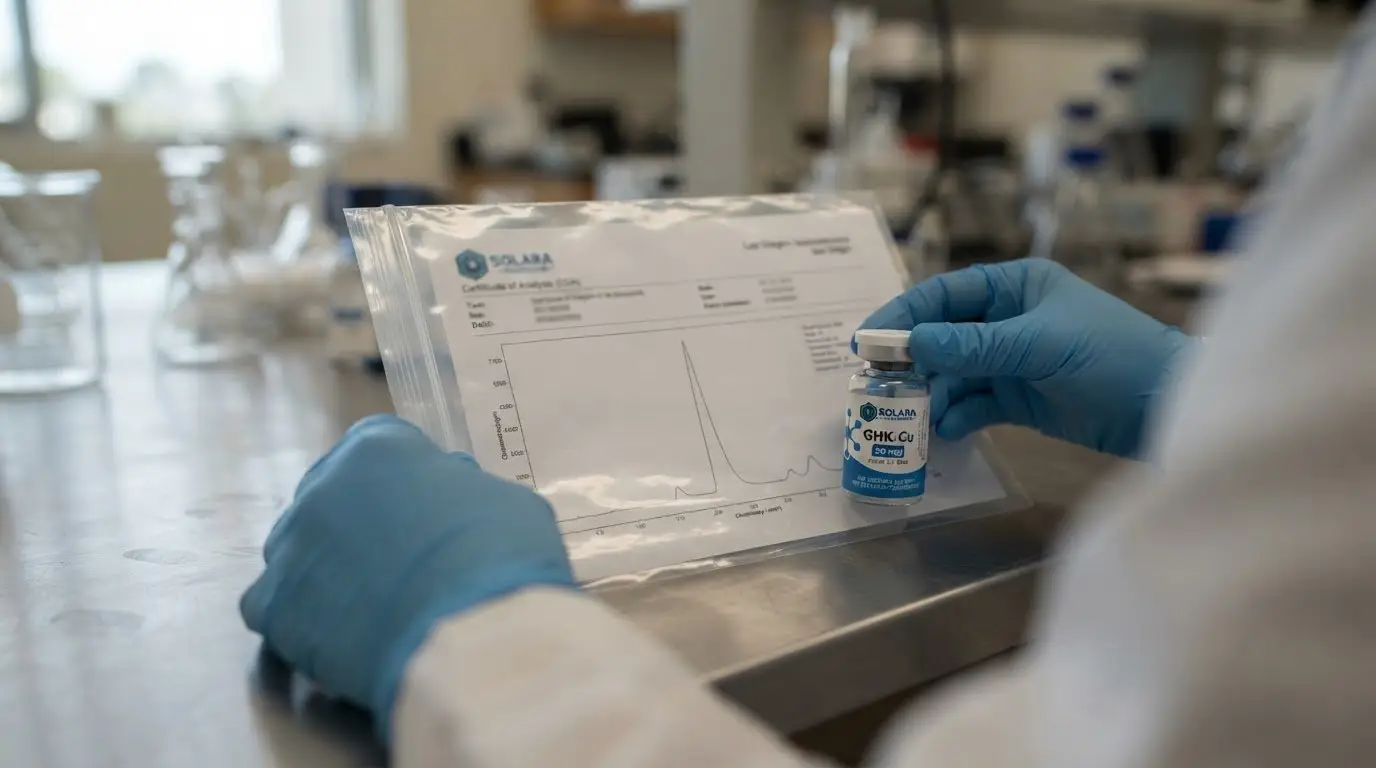
A certificate of analysis (COA) records analytical results for a sample; batch traceability links those results to a specific lot. For peptide powder, the COA is relevant only when its compound name and batch identifier match the material being evaluated. Without a clear lot connection, the document offers limited evidence about a particular sample.
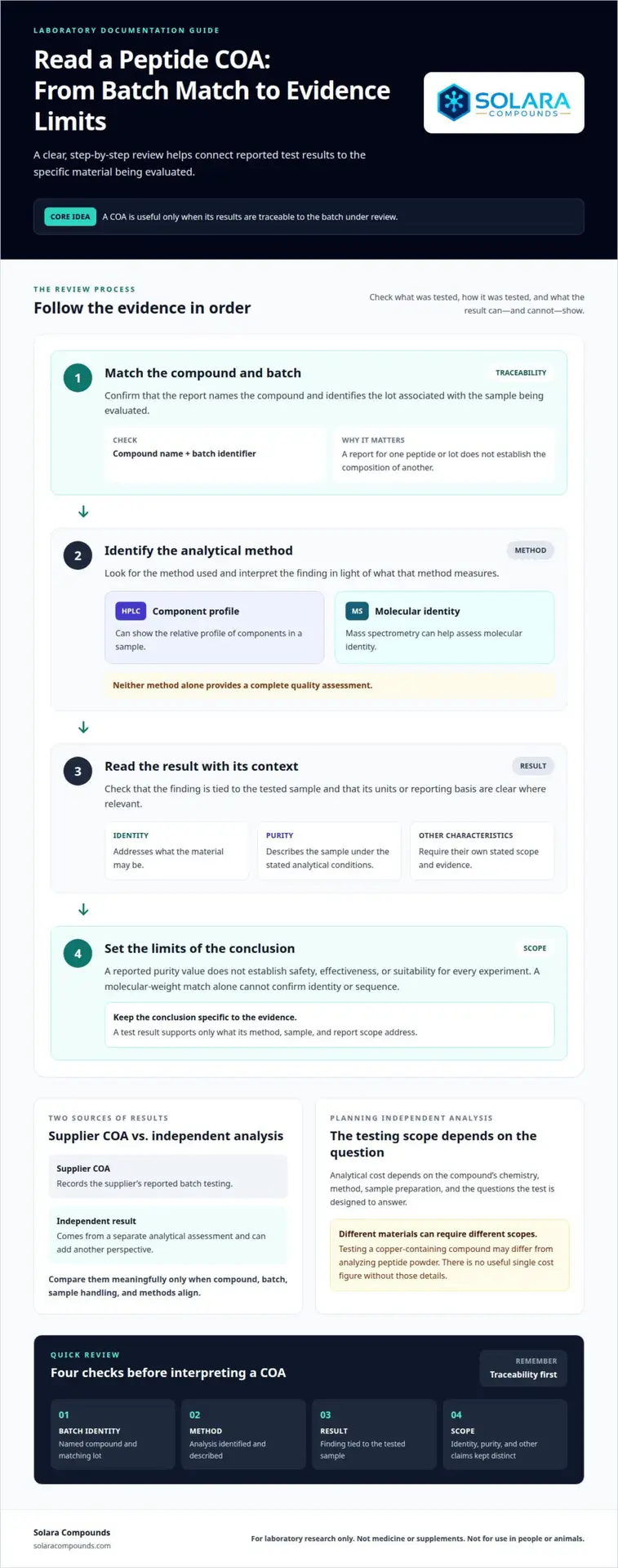
Begin with compound identity. The report should name the material tested, identify its batch, and describe the analytical method and result. A COA for Ipamorelin, for example, is not evidence about another peptide. Likewise, a test performed on one lot cannot automatically establish the composition of a different lot.
Interpret each result in light of its method. A reported purity value describes the sample under the stated analytical conditions; it does not establish safety, effectiveness, or suitability for every experiment. Identity testing and purity testing address different questions. The appropriate method depends on the compound’s structure and the laboratory question.
- Batch identity: Does the report name the compound and identify the lot associated with the sample?
- Method: Does it explain which analysis was performed, rather than presenting a result without context?
- Result: Is the finding tied to the tested sample, with units or a clear reporting basis where relevant?
- Scope: Does the report distinguish identity, purity, and other characteristics?
How do independent test results compare with supplier certificates of analysis? A supplier COA records the supplier’s reported batch testing; an independent result comes from a separate analytical assessment. Independent analysis of research peptides can add another perspective, but comparisons are meaningful only when the compound, batch, sample handling, and methods align. Differences may reflect these factors rather than a direct contradiction.
How much does third-party peptide testing cost in the United States? The cost depends on the compound’s chemistry, analytical method, sample preparation, and the questions the test is designed to answer. Testing a copper-containing compound may require a different scope from analyzing peptide powder. There is no useful single cost figure for independent analysis of research peptides without these details.
Independent results add value when they address a defined uncertainty. A second report can support batch evaluation, but it cannot replace traceability or extend what a method measures. For laboratory buyers, the practical question is whether the documentation and test scope match the material being considered.
For laboratory research, a report is one piece of evidence, not a universal quality verdict. Explore the research compound catalog as one place to consider materials alongside their documentation.
Compound guides and comparisons
A useful peptide comparison begins with the research question, then distinguishes structure, identity, and reported test results. Names alone are not enough: an analog may share features with another compound while differing in sequence or structure.
Sequence length gives one concrete comparison point. BPC-157 is a synthetic 15-amino-acid peptide, while CJC-1295 without DAC is a synthetic 29-amino-acid analog. MOTS-C is a 16-amino-acid mitochondrial-derived research peptide with a molecular weight of 2174.55. These distinctions help researchers describe what they are comparing without treating compounds as interchangeable.
Other examples show why labels need context. Ipamorelin is a synthetic pentapeptide, meaning its structure contains five amino acids. TB-500 is a synthetic seven-residue acetylated peptide corresponding to a fragment of thymosin beta-4. IGF-1 LR3 is an engineered 83-residue polypeptide, a longer chain of amino-acid building blocks. Each description identifies a structural feature, not a shared research effect.
Literature comparisons should match the exact compound and form named in the study. For example, a result for CJC-1295 without DAC should not automatically be attributed to a different analog. A test result also needs its own scope: an identity finding does not establish every characteristic relevant to a research design.
- Confirm the name: Distinguish similarly named compounds and analogs before comparing results.
- Compare structure: Use sequence length or a stated molecular weight when available, not a nickname alone.
- Match the evidence: Relate each literature finding or test to the same compound form.
- Define the question: Decide whether the comparison concerns identity, structure, or another measured property.
Selank is a named research peptide, but its name alone does not show how it compares with a tripeptide. A tripeptide contains three amino-acid units; evaluate Selank by its own identity and evidence rather than assigning it that structural label. An inducing peptide, by contrast, describes a functional category in a research context, not a sequence length.
Some peptide comparisons also involve potential immunogenicity, meaning the possibility of provoking an immune response. The FDA identifies growth hormone releasing peptide-2, growth hormone releasing peptide-6, ipamorelin acetate, and kisspeptin-10 as peptides that may pose a significant risk of immunogenicity. This is a risk consideration, not a conclusion that every tested sample has the same properties.
In laboratory work, keep compound identity separate from intended application. A sequence description, literature reference, and analytical result each answer different questions. Considered together, they provide a more precise basis for comparing peptide materials.
Other structural comparisons can include Humanin, a 24-residue mitochondrial-derived peptide with an average molecular weight of approximately 2687.2 g/mol. Semax is a synthetic heptapeptide with a molecular weight of 813.93. ARA-290 (cibinetide) is a synthetic 11-amino-acid peptide whose sequence corresponds to a surface region of erythropoietin.
Melanotan-1 is a synthetic 13-amino-acid peptide analog of alpha-melanocyte-stimulating hormone. Some cell-targeting peptides bind their receptors with affinity in the nanomole range. These features offer distinct comparison points: sequence description, molecular weight, and receptor-binding affinity. A reported value or structural description should be interpreted in relation to the particular peptide and research question, rather than treated as evidence that another compound shares its properties.
HPLC and mass spectrometry methods
HPLC and mass spectrometry answer different analytical questions about a peptide sample. Their value depends on the method, sample, and reported result.
Laboratories and Testing Methods
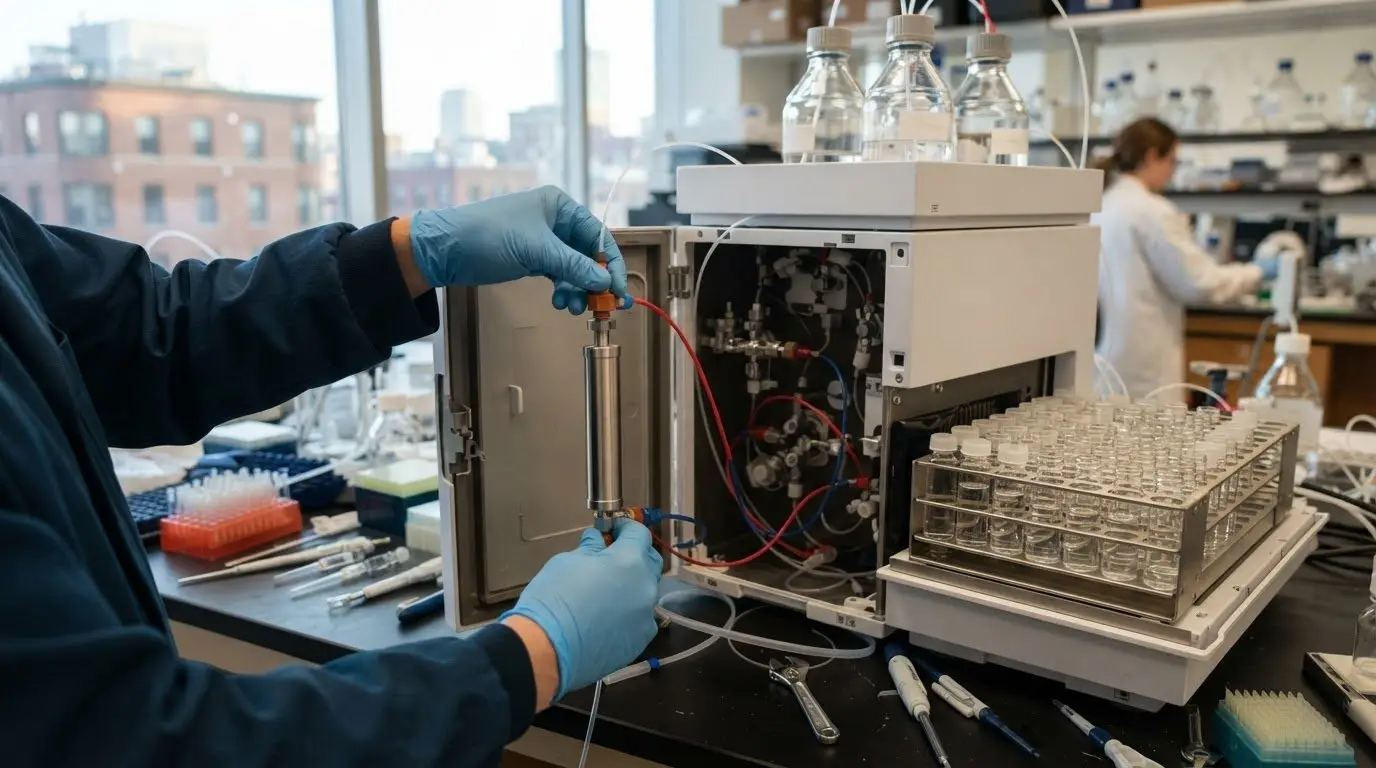
Independent analytical laboratories may offer high-performance liquid chromatography (HPLC) and mass spectrometry, often combined as LC-MS. HPLC separates sample components and produces a chromatographic profile that can show peaks. Mass spectrometry measures ions by mass-to-charge ratio, helping assess whether detected material matches an expected molecule.
Which independent laboratories offer peptide testing, and what methods do they use? Laboratories conducting peptide analysis may use HPLC for separation and LC-MS or MS for molecular characterization. The appropriate method depends on the compound and analytical question, so a report’s method description is more informative than a test label alone.
HPLC results require careful interpretation. A peak’s area can indicate its relative contribution to the detected chromatogram, but the profile depends on the method and detector. It does not automatically establish the sample’s complete composition. For a complex sample, a clear report should explain what the method measured and how the result was expressed.
Mass spectrometry provides a different type of evidence. The instrument detects ions and their mass-to-charge ratios; fragmentation patterns can support molecular identification. A peptide fragment, for example, may help characterize a larger molecule, but fragment data must be interpreted in context. A mass match alone does not establish every feature of the original sample.
Combining methods can strengthen interpretation because separation and molecular characterization address distinct questions. For a growth hormone releasing compound, HPLC may separate components while MS assesses whether a detected ion aligns with the expected identity. “Growth hormone secretagogue” describes compounds that signal the body to release growth hormone; it is not an analytical method.
Studies of Purity and Identity
Independent studies of peptide purity and identity use analytical methods to examine defined samples and report what was measured. Their usefulness depends on sample traceability, method descriptions, and conclusions that stay within the test’s scope.
A study involving a thymosin fragment or mitochondrial-derived peptide should identify the tested material and explain its analytical approach. HPLC evidence may describe a separation profile; MS evidence may support molecular identity. Neither result alone establishes safety or suitability for human use.
In each report, distinguish “identity” from “purity.” Identity asks whether the measured signal is consistent with the target molecule. Purity describes the sample under the stated analytical conditions. A derived peptide can produce related signals, so interpret results against the intended structure and method.
This distinction makes independent analysis more useful: HPLC can show separation behavior, while mass spectrometry adds molecular evidence. Together, clearly reported findings help researchers assess a laboratory sample without treating one test as proof of every quality attribute.
What independent studies have tested the purity and identity of research peptides?
Independent analytical studies can assess whether a peptide sample’s measured identity and purity align with its stated composition. The key is the study’s scope: a result applies to the sample and methods described, not automatically to every batch or product carrying the same name.
For example, a study may analyze AOD-9604, a synthetic 16-amino-acid peptide analog derived from human growth hormone’s C-terminal region. An identity assessment can compare measured signals with expected molecular characteristics. A purity assessment examines the sample’s analytical profile. These are related questions, but one result does not answer both by default.
Study independence matters because the sample’s source and control of the analysis shape how readers interpret results. Strong reporting identifies the sample, describes analytical methods, and distinguishes observed measurements from conclusions. A paper that names a compound but provides little information about sample handling gives readers less context for reproducing or comparing its findings.
- Sample scope: Determine whether the analysis concerns a defined batch, a single sample, or multiple samples.
- Identity evidence: Look for methods and measured signals that support the stated molecular identity.
- Purity evidence: Check how the study defines and calculates purity, rather than treating the word as self-explanatory.
- Interpretation: Keep conclusions within the study’s methods, sample, and reported measurements.
Independent studies can also show why apparently conflicting results need context. Reports based on different samples may vary because of differences in samples, analytical conditions, or reporting basis. Distinguish a batch-specific observation from a general claim about all material sold under a compound name.
Peer-reviewed literature and laboratory reports serve related but different purposes. A published study may explain its research question and methods in detail, while a batch report may focus on a particular sample. Judge neither by its title alone. Clear method descriptions, traceable sample identity, and conclusions that match the evidence provide more useful context.
Analytical findings are for laboratory research only and do not establish suitability for people or animals. A purity or identity result does not establish medical use, safety, or clinical effects. Keeping these limits clear prevents laboratory measurements from being mistaken for approval or personal-use guidance.
Use published evidence to understand what a method can establish, then keep each finding tied to its specific sample and question. To explore research compounds with batch documentation, view the research peptide catalog.
Product specifications and study findings should also be kept distinct. GHK-Cu is supplied at ≥99% HPLC purity, while L-glutathione is supplied at greater than or equal to 99 percent HPLC purity. Those stated purity values do not, by themselves, identify the tested batch or show which analytical procedures produced the result. Independent evaluation still depends on traceable sample details and a described method.
Elamipretide (SS-31) has an intravenous half-life of ~4-5 hours in human studies. That pharmacokinetic observation addresses a different question from analytical identity or purity and should not be treated as evidence about the composition of a research-peptide sample. Keeping specifications, sample-level measurements, and human-study findings separate helps prevent one kind of evidence from being used to answer another.
Solara Compounds
Solara Compounds supports laboratory buyers with research peptides, third-party testing, and batch-specific Certificates of Analysis. For researchers comparing GLP-1-related compounds, its catalog includes SOL-3RT Retatrutide 10mg and SOL-2TZ Tirzepatide 10mg. Batch documentation connects analytical results with the material being evaluated.
Use these products for laboratory research only. They are not medicine or supplements, and are not for people or animals. Researchers can review product information and batch paperwork through solaracompounds.com.
Support is available at [email protected] or 1 (877) 388-9178, Monday-Friday, 8 AM-5 PM Eastern.
Make the next research decision with care
Use analytical documentation as part of a broader research decision, not as a substitute for a defined experimental question. Select a compound whose identity and documentation fit the intended laboratory work, and keep its research-only status clear throughout the process.
Solara Compounds offers SOL-3RT Retatrutide 10mg, SOL-2TZ Tirzepatide 10mg, and GHK-Cu 50mg for laboratory research only. These materials are not medicine or supplements, and are not for use in people or animals. Researchers can consider the relevant product information and batch paperwork when planning laboratory evaluation.
Independent analysis of research peptides supports more disciplined decisions when findings are interpreted within the scope of the method and sample. Select materials deliberately according to your research needs.
Explore research peptides at Solara Compounds.
Frequently Asked Questions
What are research peptides and what are they used for?
Research peptides are compounds studied in controlled laboratory work to examine molecular structure and biological processes. Researchers may use them in in-vitro or ex-vivo experiments, depending on the research question. They’re intended solely for laboratory research and development, not for people or animals, and aren’t intended as drugs, dietary supplements, food, or cosmetics. They haven’t been evaluated by the FDA for safety or efficacy.
How can buyers verify a research peptide supplier and interpret lab reports?
Buyers can assess a supplier by reviewing batch-specific documentation, independent testing information, and clear lot identification. Match the report’s compound and lot details to the material being considered, then note which method was used and what the result measures. An identity result and a purity result, for example, answer different questions. Researchers in Boston, San Diego, and other U.S. research hubs should keep conclusions within the report’s scope.