Research Articles
Avoiding Counterfeit Research Chemicals: A Laboratory Verification Guide


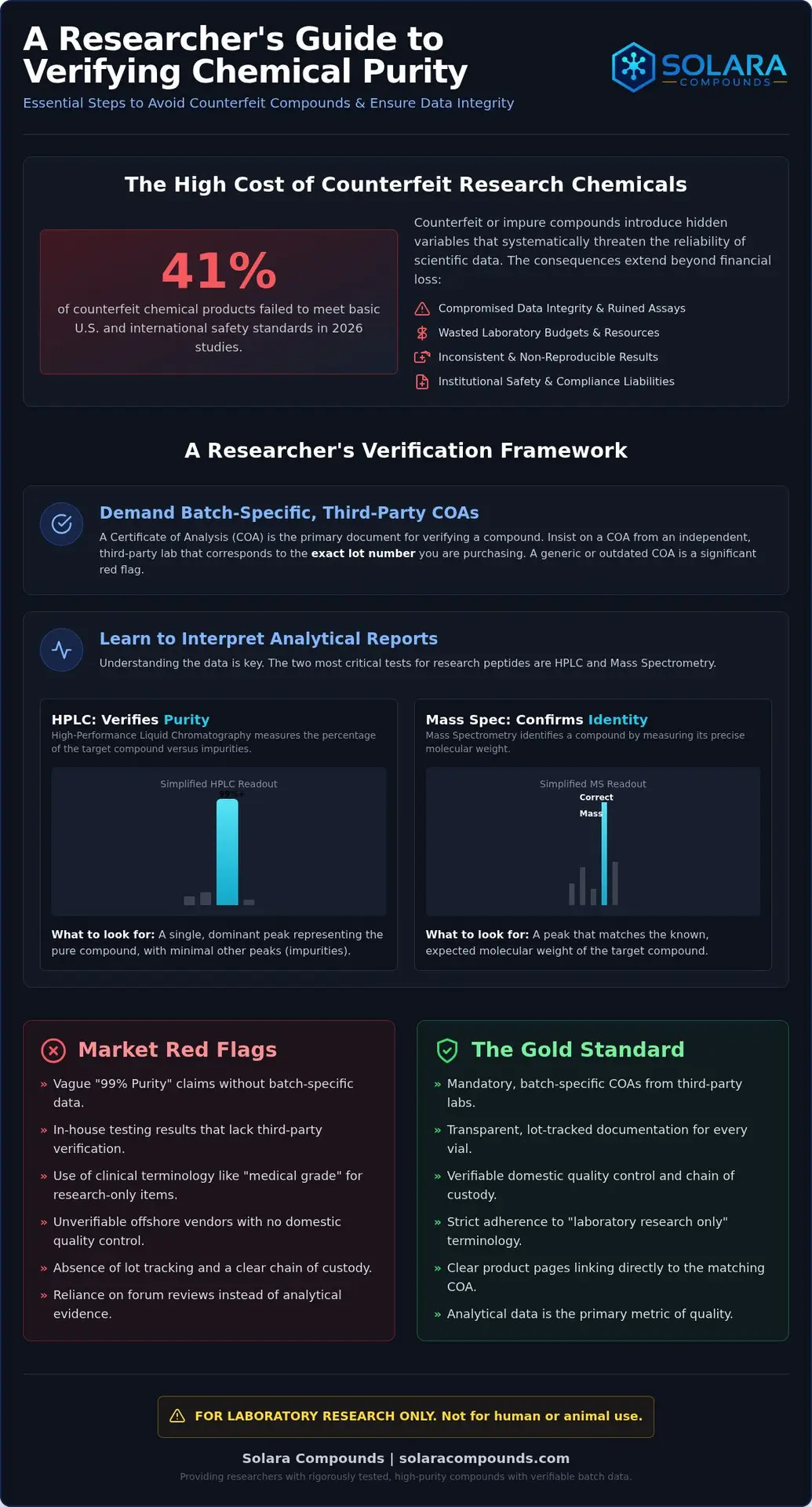
Did you know that in 2026 safety studies, over 41 percent of counterfeit chemical products failed to meet basic U.S. and international safety standards? For a dedicated researcher, these statistics represent more than just a logistical hurdle. They are a direct threat to the integrity of your data and the longevity of your laboratory budget. Avoiding counterfeit research chemicals is essential for maintaining the precision your work requires. You’ve likely experienced the frustration of inconsistent experimental results or the lack of transparency common with offshore vendors.
At Solara Compounds, we believe that analytical transparency is a fundamental requirement for scientific repeatability. It’s vital to remember that all products are for laboratory research only; they’re not for human or animal use. This guide will teach you the rigorous analytical protocols and documentation standards required to verify research peptide purity. You’ll learn a reliable framework for vetting suppliers and gain the ability to accurately read HPLC and Mass Spectrometry reports. By the end of this article, you’ll be equipped to secure a consistent supply of research-grade materials like BPC-157 or GHK-Cu for your facility. Visit solaracompounds.com to see how we prioritize verified batch data for every compound.
Key Takeaways
- Master the analytical protocols necessary for avoiding counterfeit research chemicals to ensure the repeatability and integrity of your laboratory data.
- Understand why batch-specific Certificates of Analysis (COA) from third-party labs are the only reliable way to verify compound purity and identity.
- Learn to interpret High-Performance Liquid Chromatography (HPLC) and Mass Spectrometry (MS) reports to confirm the structural integrity of your research materials.
- Identify common market red flags, such as vendors using clinical terminology like “medical grade” for materials intended strictly for laboratory use.
- Discover how Solara Compounds standardizes procurement through domestic quality control and transparent, lot-tracked documentation for researchers.
The Impact of Counterfeit Chemicals on Research Integrity
In a controlled laboratory environment, the smallest variable can compromise months of work. Counterfeit research chemicals represent more than just a financial risk. They’re a systematic threat to the reliability of scientific data. Avoiding counterfeit research chemicals is essential for maintaining the precision your work requires. These materials often fall into three categories: mislabeled compounds, under-dosed vials, or impure mixtures containing synthesis byproducts. While the concept of counterfeit medication is well-documented in the public health sector, the research chemical market faces unique challenges regarding technical transparency.
Establishing a rigorous verification process is the only way to ensure your findings are reproducible. When a vendor claims “99% purity,” it’s often used as a static marketing label rather than a dynamic reflection of a specific batch. Without rigorous analytical evidence, such as a Certificate of Analysis (COA) for the exact lot you received, these numbers are essentially speculative. For researchers using compounds like BPC-157 or TB-500, the presence of even 2 percent unknown impurities can lead to inconsistent baseline measurements in cell signaling assays.
Chemical Impurities and Experimental Variance
Low-grade peptide synthesis frequently leaves behind residual solvents or Trifluoroacetic acid (TFA). TFA is a reagent, or a substance used to trigger a chemical reaction, that stabilizes peptides during the purification process. However, excessive levels can unintentionally alter the pH of your media. This shift in the chemical environment can skew in vitro data, leading you to attribute a response to the peptide when it actually stems from the contaminated solvent. Structural analogs, which are molecules that look nearly identical to your target compound but behave differently, can also result in false positives.
Cross-contamination is another significant risk in multi-product facilities. In this context, cross-contamination is the unintentional transfer of chemical substances from one product line to another during the manufacturing, weighing, or packaging stages. This can introduce trace amounts of unrelated compounds into your sample, creating noise in your data that’s impossible to filter out post-experiment. These impurities represent a hidden cost that far outweighs the savings of cheaper compounds, potentially leading to ruined assays and compromised peer reviews.
The Legal and Ethical Risks of Misidentified Compounds
Sourcing from unverified offshore vendors carries institutional liability. If a laboratory inadvertently introduces an unknown or restricted substance into its workflow, the resulting safety and compliance issues can be severe. It’s vital to maintain a verifiable chain of custody, which is the documented chronological history showing the seizure, custody, control, transfer, and analysis of a chemical substance. This documentation ensures that the material on your bench is exactly what was ordered and meets established safety standards.
At Solara Compounds, we prioritize these standards because we understand that your research depends on consistency. All materials provided are for laboratory research only; they’re not for human or animal use. By providing batch-specific testing, we help lab buyers maintain compliance and protect their experimental integrity. You can review our current standards and shop for verified materials at solaracompounds.com to ensure your facility succeeds in avoiding counterfeit research chemicals through verified sourcing.
Evaluating Vendor Transparency: Beyond the Website
Trust in the scientific community often relies on peer reputation, but for laboratory procurement, empirical data must supersede social proof. While online forums might suggest a vendor is reliable, these platforms are susceptible to manipulation through biased reviews. High-level transparency requires a hierarchy of trust where third-party analytical results are the primary metric. Avoiding counterfeit research chemicals requires moving beyond a vendor’s marketing claims and verifying the raw data behind every vial. In-house testing results are insufficient because they lack the objective oversight provided by an independent facility.
Many Research Chemicals are marketed with vague purity claims that lack specific lot traceability. A generic Certificate of Analysis (COA) that remains unchanged on a website for years is a significant red flag. For researchers, a batch-specific COA is non-negotiable because synthesis runs can vary in quality. If you’re sourcing BPC-157 or TB-500, the documentation must match the specific lot number on your product label. This level of detail ensures that the material you’re using in your assays is consistent with previous batches, protecting the repeatability of your work.
The Anatomy of a Genuine Certificate of Analysis
A valid COA should include the testing date, a unique batch number, and the specific compound name. You should also verify the credentials of the third-party laboratory performing the analysis. Fraudulent vendors often use “recycled” reports from years prior or photoshopped headers to mimic legitimacy. Professional organizations will allow you to cross-reference the report directly with the independent testing facility to confirm its authenticity. If a vendor refuses to provide the raw analytical files or the contact information for the testing lab, it’s a clear sign to look elsewhere.
Direct Communication and Technical Support
Don’t hesitate to test a vendor’s technical knowledge. Ask for specific synthesis methods or storage protocols for sensitive compounds like MOTS-C or NAD+. A vendor with a professional supply chain will provide clear, technical answers rather than evasive marketing language. Domestic shipping is another critical factor in maintaining compound stability. Overseas transit often involves extreme temperature fluctuations that can degrade delicate peptides before they reach your bench. Professional suppliers prioritize fast, climate-controlled domestic logistics to ensure structural integrity.
Solara Compounds maintains a commitment to this level of transparency by providing batch-specific documentation for every product in our catalog. All materials are strictly for laboratory research only; they’re not for human consumption or medical use. You can review the batch COA for our current inventory to see how we prioritize data-driven quality for every researcher we serve.
How to Interpret HPLC and Mass Spectrometry Reports
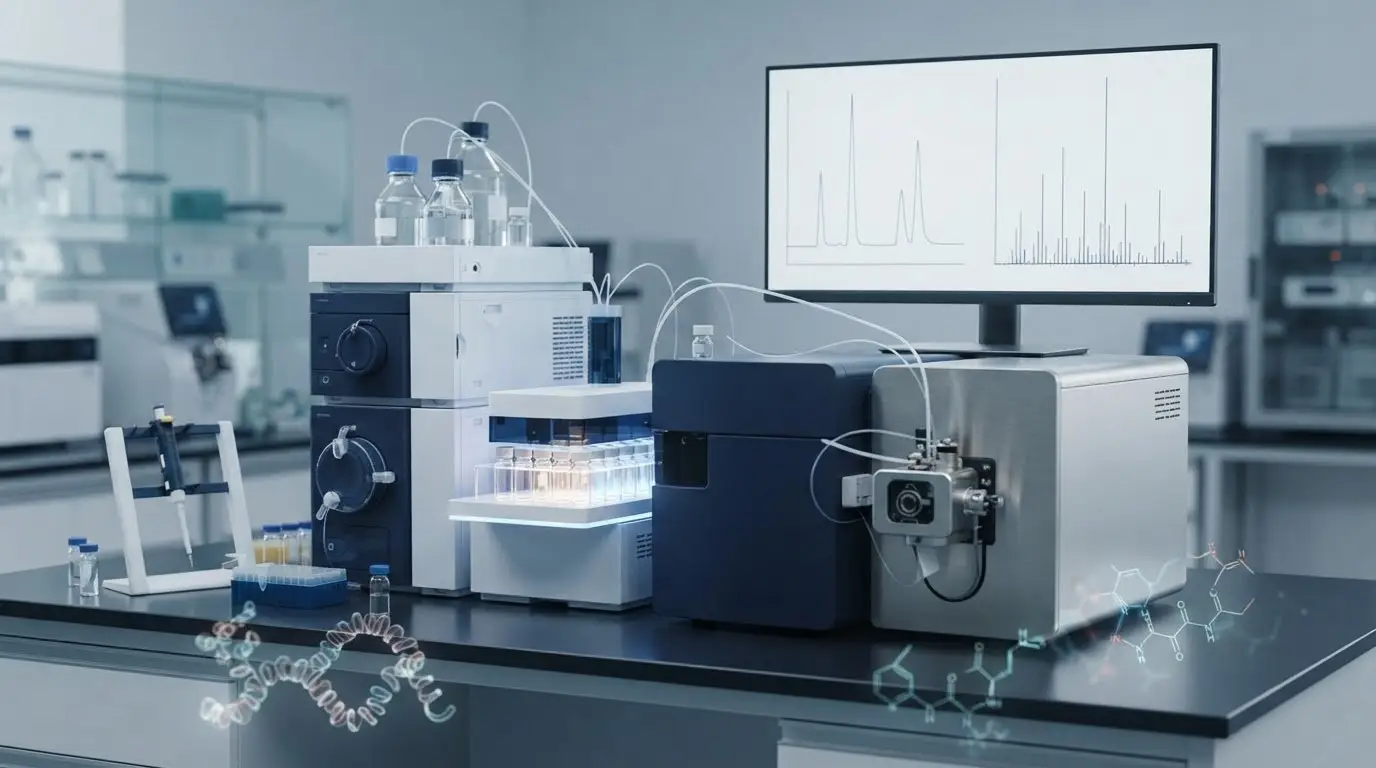
Analytical verification is the final line of defense for any lab buyer. While previous sections discussed vendor transparency, true security comes from understanding the raw data provided in third-party reports. High-Performance Liquid Chromatography (HPLC) and Mass Spectrometry (MS) are the industry standards for assessing the quality of research peptides. Mastering these reports is a critical skill for avoiding counterfeit research chemicals and ensuring your experimental outcomes remain valid. These reports provide the empirical evidence needed to move beyond a supplier’s marketing claims.
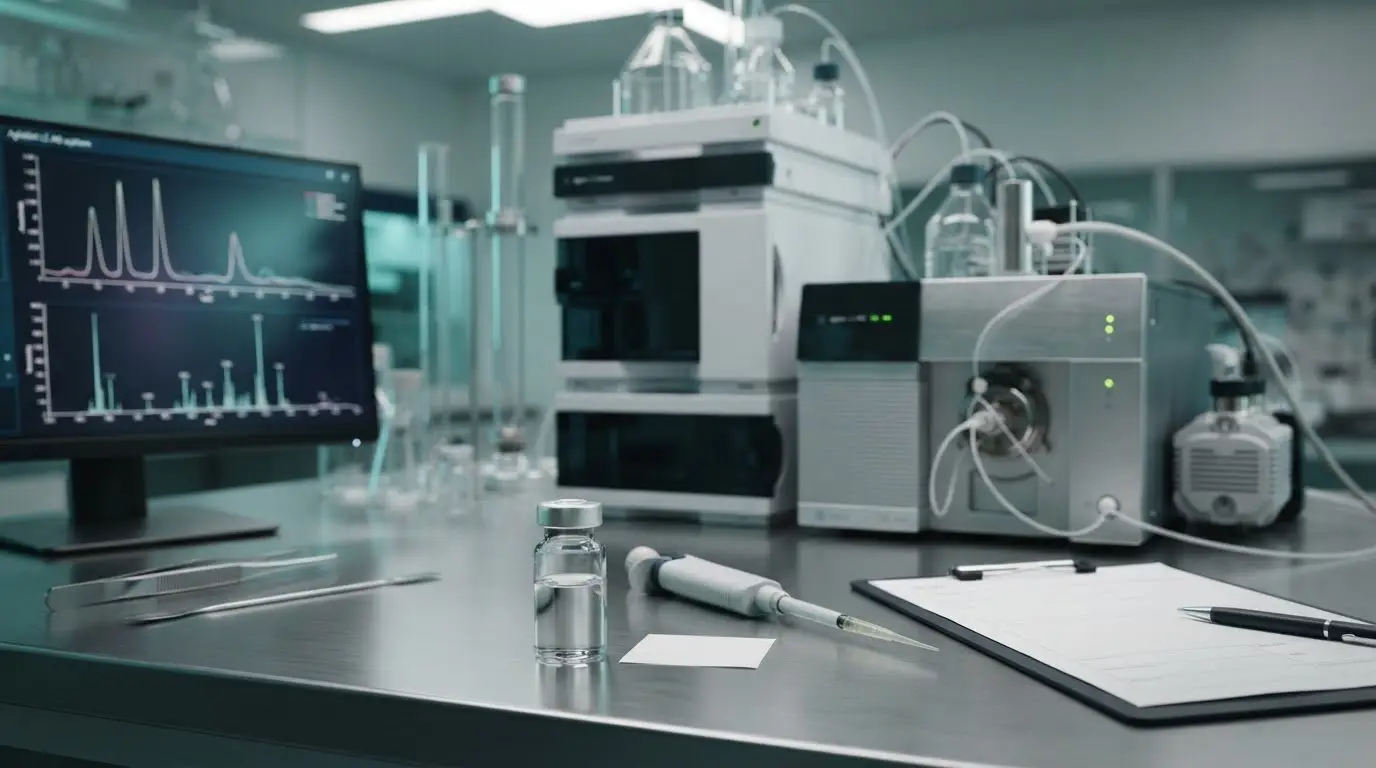
HPLC is primarily used to determine the purity of a substance. It works by pushing a liquid solvent containing the sample through a column filled with adsorbent material. Different chemical components interact with the material at different rates, causing them to separate. The result is a chromatogram, a visual graph where each detected substance appears as a peak. For high-purity materials like BPC-157, you expect to see one dominant peak with minimal baseline noise.
Reading the HPLC Chromatogram
The HPLC chromatogram tracks intensity on the vertical axis and time on the horizontal axis. You’ll primarily look for a single, sharp main peak that towers over the rest of the graph. Smaller peaks or “shoulders” attached to the main peak indicate the presence of impurities or synthesis byproducts. The integration table at the bottom of the report provides the “Area %” for each peak. This value is the ratio of the target compound’s peak area to the total area of all peaks detected. A report showing 99% purity means the target substance accounts for 99% of the detectable material in the sample.
Retention Time is the specific duration it takes for a compound to travel through the chromatography column, and consistent values across different batches confirm the chemical identity remains stable. If the retention time shifts significantly between two orders of the same compound, it may indicate a change in the manufacturing process or a different substance entirely. This consistency is vital for long-term studies where batch-to-batch variance can ruin your data.
Verifying Identity with Mass Spectrometry
HPLC measures purity, but Mass Spectrometry confirms identity. It’s possible to have a 99% pure substance that isn’t the compound you ordered. MS works by ionizing the sample and measuring the mass-to-charge ratio of the resulting particles. In a report for a compound like TB-500, you’ll see an “observed mass” which should match the “theoretical molecular weight” provided in the product specifications. These numbers don’t have to be identical, but they should be within a very narrow margin of error.
Understand that MS reports often show charge states rather than the raw molecular weight. The most common notation is [M+H]+, which indicates the mass of the molecule (M) plus a single hydrogen ion (H). Identity confirmation is just as critical as the purity percentage; without it, you can’t be certain that your lab data reflects the specific peptide you intended to study. Solara Compounds provides these detailed analytical files for every batch, ensuring you can verify the structural integrity of your materials before they reach your bench. Review the batch COA for our current inventory at solaracompounds.com to see our commitment to data-driven research. All products are strictly for laboratory research only and are not for human or animal use.
Common Red Flags in the Research Chemical Market
Identifying a sub-standard supplier requires a keen eye for inconsistencies that go beyond simple price comparisons. While some vendors are obviously amateur, others utilize sophisticated tactics to appear legitimate while cutting corners on quality control. Avoiding counterfeit research chemicals involves scrutinizing the terminology and operational standards a company maintains. If a vendor’s presentation feels more like a retail storefront than a technical consultancy, the integrity of their compounds is likely compromised.
One prevalent red flag is the use of clinical or “medical” terminology. Terms like “Medical Grade,” “Pharma Grade,” or “Therapeutic” are inappropriate for substances intended strictly for laboratory research only. These products are not medicine or supplements, and professional suppliers will always maintain this distinction. When a vendor uses “flashy” marketing or bodybuilding slang, it indicates they are targeting a non-scientific audience and likely lack the rigorous analytical standards your work requires.
Marketing Red Flags: Hype vs. Science
Researchers should be wary of any vendor offering “proprietary blends.” In a controlled environment, you must know the exact concentration and identity of every molecule to ensure repeatable results. A blend introduces unknown variables that can ruin an entire series of assays. Furthermore, excessive discounts often correlate with a lack of batch-specific testing. The cost of independent HPLC and Mass Spectrometry is a fixed operational expense; if a product is significantly cheaper than the market average, the vendor has likely skipped these critical verification steps for peptides like BPC-157 or TB-500.
Operational Red Flags
Operational transparency is just as vital as chemical purity. Many vendors claim to be “domestic” but ship from offshore locations, which exposes sensitive compounds like MOTS-C or NAD+ to extreme temperature fluctuations and transit delays. A more subtle but dangerous trend is the domestic reseller who sources bulk material from overseas and resells it without performing independent re-testing. Simply passing along a manufacturer’s Certificate of Analysis (COA) is insufficient because it doesn’t verify that the specific batch you receive is what the factory claimed it was.
A professional business structure should include secured payment methods and a registered US presence. If a vendor is unable to provide batch-specific COAs or raw analytical files upon request, they are failing the most basic requirement of a research partner. At Solara Compounds, we eliminate these risks by performing our own third-party verification on every lot. You can shop research peptides at solaracompounds.com to access materials that are fully documented and domestic-verified for your laboratory needs.
Standardizing Your Procurement: The Solara Compounds Approach
Standardizing procurement protocols is the most effective defense against the inconsistencies found in the current market. While earlier sections of this guide focused on identifying risks, establishing an internal sourcing standard ensures long-term data integrity. By standardizing your sourcing, you take a proactive step in avoiding counterfeit research chemicals. Solara Compounds provides this stability by focusing on high-purity, scientific-grade materials backed by verifiable batch data. We believe that analytical transparency isn’t a marketing feature but a fundamental requirement for scientific repeatability.
Consistency is the hallmark of any successful laboratory. When your research relies on compounds like Retatrutide 10mg or Tirzepatide 10mg, the structural integrity of the material must be absolute. Our approach treats every batch as a unique entity requiring its own verification cycle. This methodical process ensures that researchers can focus on their experimental variables without questioning the baseline quality of their reagents. It’s vital to remember that all products are for laboratory research only; they’re not for human or animal use.
The Solara Purity Guarantee
Our commitment to transparency begins with a strict protocol for selecting third-party analytical laboratories. We don’t rely on manufacturer-provided data. Instead, we submit every lot for independent HPLC and Mass Spectrometry analysis. This rigorous approach ensures that every vial of BPC-157 or GHK-Cu in your lab performs as expected within your specific experimental models. We provide researchers with the raw analytical data, allowing for full peer-review level scrutiny of our materials. This transparency supports both institutional and independent research projects by removing the variable of chemical impurity.
Streamlining Laboratory Supply Chains
Maintaining a consistent supply of materials is essential for multi-phase research projects. Bulk procurement options allow laboratories to secure a single, verified batch for the duration of a study, minimizing the risk of inter-lot variance. Secure domestic logistics prevent the degradation often seen during international customs delays, where temperature control is impossible to maintain. By centralizing our quality control in Florida, we offer a transparent alternative to the opaque practices of offshore reselling. Our US-wide shipping maintains the stability of lyophilized peptides, ensuring they reach your bench in optimal condition. Lyophilized refers to the freeze-drying process used to preserve the chemical structure and shelf-life of research compounds.
You can Shop research peptides at solaracompounds.com to secure verified materials for your next study. For technical inquiries or procurement assistance, our support team is available at support@solaracompounds.com or 1 (877) 388-9178, Monday–Friday, 8 AM–5 PM Eastern.
Securing the Future of Your Laboratory Research
The reliability of your experimental data is the cornerstone of scientific progress. By implementing the verification standards discussed in this guide, from scrutinizing batch-specific paperwork to interpreting complex chromatograms, your facility can maintain a higher threshold for quality control. Avoiding counterfeit research chemicals requires constant vigilance and a refusal to compromise on analytical documentation. This methodical approach ensures that every assay conducted in your laboratory remains repeatable and scientifically sound.
Solara Compounds remains a dedicated partner in this mission, providing high-purity materials like BPC-157 and TB-500 that are backed by rigorous third-party testing and secure US-based logistics. It is vital to remember that all products are strictly for laboratory research only and are not for human or animal use. We prioritize the structural integrity of every compound to help you focus on your research outcomes rather than the quality of your reagents.
If you have any questions regarding our batch documentation or procurement process, please contact our team at support@solaracompounds.com or 1 (877) 388-9178, Monday–Friday, 8 AM–5 PM Eastern. We are committed to supporting your facility with precision and reliable data.
Shop research peptides at solaracompounds.com
Frequently Asked Questions
What is the difference between research grade and pharmaceutical grade?
Research grade materials are produced strictly for laboratory use only and don’t undergo the clinical regulatory approvals required for pharmaceutical grade drugs. While both require high purity, pharmaceutical grade is manufactured specifically for human consumption in a medical setting. Research grade compounds are synthesized for experimental models, such as in vitro assays or animal studies. Researchers choose these materials based on their documented purity and identity for scientific exploration.
How can I tell if a Certificate of Analysis (COA) is fake?
Identifying a fraudulent Certificate of Analysis requires checking for inconsistent fonts, blurry logos, or recycled dates that don’t match the current batch. A genuine report should feature a unique lot number and the contact information of the third-party analytical laboratory. You can often verify the results by contacting the lab directly. Professional vendors prioritize this transparency to help lab buyers in avoiding counterfeit research chemicals.
Why is third-party testing better than in-house testing for research chemicals?
Third-party testing provides an objective, unbiased assessment of a compound’s purity and identity. In-house testing lacks this external oversight and can be subject to internal bias or a lack of standardized equipment. Independent laboratories use advanced HPLC and Mass Spectrometry to provide a neutral “claim and verify” structure. This process is essential for maintaining the integrity of your data and ensuring that the materials meet the required scientific specifications.
Can I use a research chemical if the HPLC shows 98% purity instead of 99%?
While 98% purity may seem high, the 2% of unknown impurities can introduce significant noise into sensitive laboratory experiments. Most researchers prefer 99% purity to minimize variables that could skew data in receptor binding or cell signaling assays. You should review the HPLC chromatogram to see if the impurities are baseline noise or specific synthesis byproducts. Choosing the highest purity available is always the safer approach for consistent results.
What are the most common contaminants in synthetic peptides?
Synthetic peptides often contain residual solvents, moisture, or Trifluoroacetic acid (TFA), which is used during the purification process. Other common contaminants include structural analogs, which are molecules that look identical to the target compound but have slightly different chemical properties. These impurities can interfere with the compound’s behavior in a lab setting. High-performance purification is necessary to ensure these substances don’t compromise your experimental models.
How should I store research chemicals to prevent degradation before testing?
To prevent degradation, store lyophilized research chemicals in a freezer at -20°C for long-term use or a refrigerator at 4°C for shorter durations. Lyophilized refers to the freeze-drying process that stabilizes the peptide’s structure. It’s important to keep the vials away from direct light and moisture, as these can break down the chemical bonds. Maintaining a stable temperature environment is critical for ensuring the compound’s integrity remains intact before you begin testing.
Does Solara Compounds provide batch-specific COAs for all peptides?
Solara Compounds provides batch-specific Certificates of Analysis for every product we offer, including compounds like BPC-157 and TB-500. We believe that researchers deserve full transparency regarding the materials they use in their laboratories. By providing third-party verified data for every lot, we help our clients maintain the highest standards of scientific repeatability. All our materials are strictly for laboratory research only and are not intended for human or animal use.
What should I do if my laboratory analysis contradicts the vendor COA?
If your internal analysis contradicts a vendor’s COA, you should immediately pause your work and contact the supplier’s technical support team. Provide them with your raw analytical files so they can compare them with their third-party results. A reliable vendor will investigate the lot number and help resolve the discrepancy to protect your research data. This situation underscores why sourcing from transparent, US-based suppliers with clear quality control protocols is vital.