Research Articles
Lyophilized Peptides: 2026 Procurement & Verification

In a global peptide market projected to reach $164 billion by the end of 2026, the lack of official USP standards for most research compounds leaves the burden of verification entirely on the laboratory buyer. You likely recognize the frustration of sourcing lyophilized peptides for laboratory use only to find that the “high purity” promised in a catalog doesn’t match the reality of your results. It’s a common pain point for researchers who face inconsistent batch quality or degradation issues during transit. When your experimental repeatability is on the line, a generic certificate isn’t enough to guarantee structural integrity.
We’ve developed this professional procurement guide to help you establish a rigorous verification protocol. You’ll learn how to interpret batch-level HPLC and mass spectrometry data to ensure you’re working with compounds that meet a 98% purity threshold. We will also cover why domestic shipping and ISO 7 cleanroom synthesis are non-negotiable for maintaining stability. At Solara Compounds, we prioritize this level of transparency by providing third-party testing via Kovera Labs for every product, including SOL-3RT and BPC-157. All products mentioned are for laboratory research only and are not for human or animal consumption. You can find our full technical catalog and batch-specific documentation at solaracompounds.com.
Key Takeaways
- Understand how lyophilization preserves molecular integrity by inhibiting chemical reactivity and preventing peptide degradation during long-term storage.
- Learn to evaluate lyophilized peptides for laboratory use by analyzing batch-specific HPLC and mass spectrometry data to confirm purity levels.
- Develop standardized protocols for sterile handling and temperature-controlled storage to protect the stability of your research compounds.
- Identify the documentation requirements for reliable procurement, including third-party testing and batch-level COAs available at solaracompounds.com.
- Ensure all procurement aligns with “Research Use Only” standards, as products from Solara Compounds are not for human or animal consumption.
Understanding Lyophilized Peptides in Laboratory Research
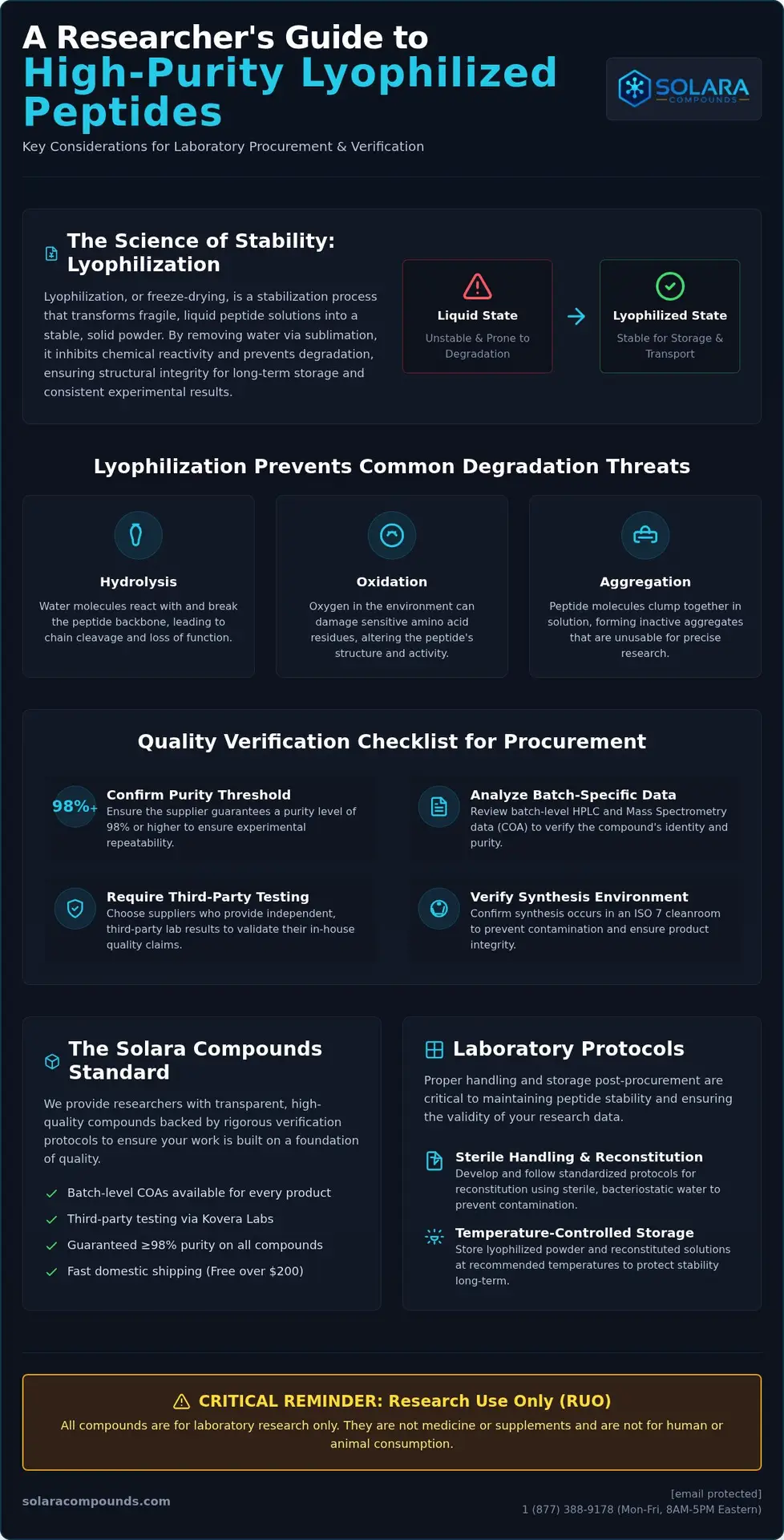
Lyophilized peptides for laboratory use are synthesized to withstand the rigors of storage and transport without compromising their chemical identity. In their raw state, many peptide sequences are inherently fragile. They are susceptible to environmental factors that can trigger unwanted chemical reactions. Lyophilization, or freeze-drying, transforms these delicate sequences into a stable, solid powder. This state is preferred by researchers because it ensures experimental consistency across multiple trials. When you source compounds from Solara Compounds, you receive materials that have undergone this rigorous stabilization process to maintain their structural integrity from the synthesis lab to your facility.
Liquid solutions often suffer from rapid degradation because water acts as a medium for hydrolysis and oxidation. By removing this moisture, the peptide remains in a state of “suspended animation” where molecular motion is significantly reduced. This is a critical requirement for maintaining high-purity levels in compounds like BPC-157 or SOL-3RT. Every product offered at solaracompounds.com is for laboratory research only and is not intended for human or animal consumption.
The Process of Sublimation
The transition from a frozen solid to a gaseous state without passing through a liquid phase is known as sublimation. This is the core mechanism behind The Science of Stability: Why Freeze-Drying is the Gold Standard. During this process, the peptide solution is frozen at extremely low temperatures. A vacuum is then applied to pull the frozen water molecules out of the sample. This method is superior to traditional heat-drying because it protects the peptide’s secondary structure. Heat can cause denaturing, which effectively ruins the compound’s utility in a lab setting. By using low-temperature condensers, the resulting powder retains the exact molecular arrangement required for precise scientific observation.
Research Use Only (RUO) Classification
The Research Use Only (RUO) classification is a fundamental regulatory boundary that defines how these compounds are handled and documented. These are laboratory-grade materials meant for in-vitro studies or animal model research within a controlled setting. They are not medicine, nor are they supplements. Institutional compliance requires that lab buyers source materials that are clearly labeled for non-clinical use to ensure laboratory safety and data validity. Solara Compounds adheres strictly to these standards. We provide the necessary batch-level documentation and third-party testing to help researchers maintain compliance with their internal review boards. Using RUO compounds ensures that your focus remains on empirical data rather than navigating the complexities of therapeutic regulations.
The Science of Stability: Why Freeze-Drying is the Gold Standard
Peptides are chains of amino acids held together by amide bonds. In an aqueous environment, these bonds are constantly under threat. The primary drivers of degradation in liquid states are hydrolysis, oxidation, and aggregation. Hydrolysis occurs when water molecules react with the peptide backbone, leading to chain cleavage. Oxidation typically targets specific residues like methionine or cysteine. Aggregation happens when peptide molecules clump together, rendering them useless for precise laboratory work. These processes can compromise the purity of a sample within hours if it’s not stabilized correctly.
Freeze-drying solves these issues by removing the solvent. When researchers purchase lyophilized peptides for laboratory use, they are acquiring a compound where molecular motion is almost entirely arrested. This lack of movement prevents the chemical collisions necessary for degradation to occur. Vacuum sealing the vials further protects the sample by removing oxygen. This prevents oxidative damage to sensitive amino acid chains during storage and transport. Maintaining the quality of lyophilized peptides for laboratory work requires an understanding of these chemical boundaries.
Inhibiting Hydrolysis and Oxidation
The stability of sequences like SOL-3RT depends heavily on low water activity. By eliminating moisture, the shelf-life of these sensitive compounds is extended from days to years. This is especially important for sulfur-containing amino acids, which are highly reactive to oxygen species. Lyophilized powders don’t suffer from the immediate loss of potency seen in liquid formulations. They also exhibit superior thermal stability profiles, which allows them to withstand ambient temperatures during domestic US shipping without compromising their structural integrity.
Structural Integrity in In Vitro Models
For lab buyers conducting receptor-binding studies, maintaining the native conformation of a peptide is paramount. If the three-dimensional shape of the molecule changes, the data from in vitro models will be unreliable. Following established Laboratory Protocols: Reconstitution and Long-Term Storage helps maintain this integrity after the vacuum seal is broken. Lyophilization ensures that the peptide returns to its functional shape upon reconstitution. This consistency is why freeze-drying is considered the gold standard for experimental repeatability in cellular research.
Solara Compounds provides these high-purity materials to ensure lab results are based on stable, verified compounds. All products at solaracompounds.com are for laboratory research only and are not for human or animal consumption. To restock a facility, researchers can view the high-purity research catalog to see available batch-specific data and third-party testing results.
Quality Verification: HPLC and Mass Spectrometry Standards
High-purity standards are the foundation of reliable data. When you’re sourcing lyophilized peptides for laboratory work, a purity level of at least 98% is the industry gold standard. Anything lower introduces unknown variables that can skew results or cause inconsistent receptor binding. Verification isn’t just a suggestion; it’s a requirement for scientific integrity. Solara Compounds addresses this by providing batch-specific documentation for every compound in our catalog, ensuring researchers have the data needed for experimental repeatability.
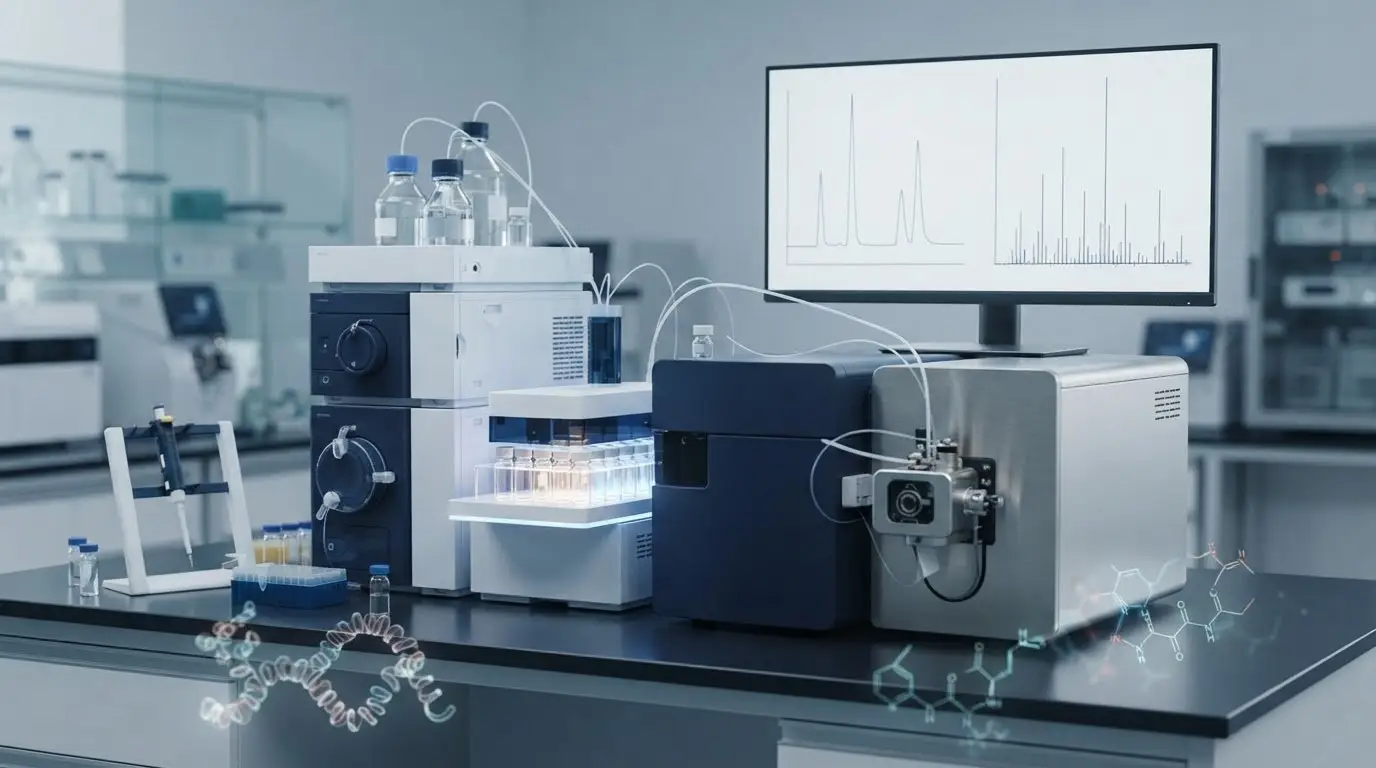
High-Performance Liquid Chromatography (HPLC) is the primary tool used to measure purity. It works by separating the components of a sample based on their chemical properties. The resulting report shows a chromatogram with various peaks. The largest peak represents the target peptide, while smaller peaks indicate impurities or truncated sequences. Truncations are incomplete chains that failed during the synthesis process. Researchers must evaluate the area-under-the-curve (AUC) percentages to determine the exact purity of the batch. High peak resolution is essential in HPLC analysis because it ensures that the target compound is clearly separated from closely related impurities. For a deeper look at these processes, you can review our resources on independent lab testing for peptides.
Molecular Confirmation via LC-MS
Confirmation of identity requires a different analytical approach. While HPLC tells you how pure a sample is, it doesn’t confirm that the sample is actually the correct molecule. Mass Spectrometry (LC-MS) or MALDI-TOF analysis is used to match the observed molecular mass of the sample against its theoretical mass. This step verifies the amino acid sequence’s accuracy. If the mass doesn’t align with the known molecular weight of a compound like TB-500 or MOTS-C, the batch is compromised. Researchers focused on MOTS-C peptide research applications should pay particular attention to this verification step, as even minor sequence-related impurities can skew metabolic signaling data in cellular models. You can find technical details in our mass spectrometry peptide testing guide.
Transparency is maintained through the Certificate of Analysis (COA). A COA shouldn’t be a generic document; it must be batch-specific and issued by an independent facility. We partner with Kovera Labs to provide third-party verification for all our lyophilized peptides for laboratory use. This documentation-first approach allows researchers to proceed with confidence. All products at solaracompounds.com are for laboratory research only and are not for human or animal consumption. You can review current batch records at solaracompounds.com/coa/ to verify the integrity of our research compounds.
Laboratory Protocols: Reconstitution and Long-Term Storage
Procurement is only the initial stage of a successful research project. Maintaining the viability of lyophilized peptides for laboratory research requires strict adherence to aseptic techniques. Microbial contamination can occur in seconds if a vial is handled in a non-sterile environment, leading to degraded samples and unreliable data. Researchers should record lot numbers and batch data in their lab notebooks immediately upon receipt. This practice ensures that every experimental result can be traced back to the specific analytical data provided by Solara Compounds.
Consistency in handling is just as important as the purity of the compound itself. All materials sourced from solaracompounds.com are for laboratory research only and are not intended for human or animal consumption. Using standardized protocols for reconstitution and storage prevents the common pitfalls of peptide degradation that can occur post-procurement.
Standard Reconstitution Procedure
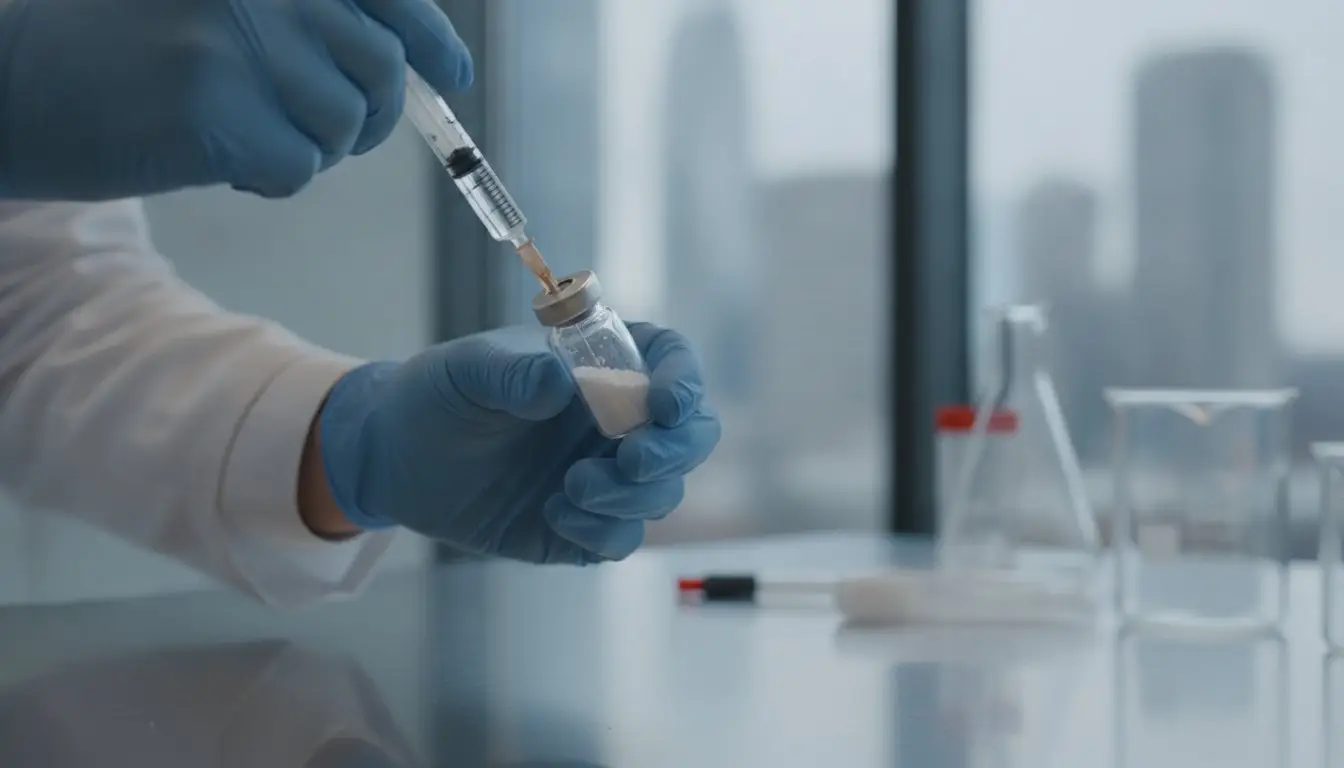
Reconstitution is the process of returning the freeze-dried cake to a liquid state for use in in vitro assays. Researchers typically use BAC Water (10ml) as a diluent due to its bacteriostatic properties. The liquid should be added gently, allowing it to run down the side of the vial wall rather than being injected directly onto the powder. Swirling the vial is preferred over vigorous shaking. Shaking can create air-liquid interfaces that may denature the peptide, effectively breaking down its structural conformation. Denaturing refers to the process where a peptide loses its specific shape, which makes it unable to interact with receptors correctly. Determining the correct concentration is essential for the accuracy of cellular or mitochondrial research models.
Optimizing Storage Conditions
The stability of lyophilized peptides for laboratory use is highly temperature-dependent. While freeze-dried powders can withstand ambient temperatures during short-term shipping, long-term storage requires colder environments. Maintaining vials at -20°C or -80°C ensures multi-year stability by further arresting molecular motion. Moisture ingress is a significant threat even in a frozen state. Using desiccants within storage containers can help prevent the “hygroscopic” effect, which is the tendency of a substance to absorb moisture from the air. Researchers must also monitor the vacuum seal status of each vial. A compromised seal often indicates that air and moisture have entered, which can lead to rapid oxidation. Avoiding repeated freeze-thaw cycles is a critical rule; if the entire vial won’t be used at once, the reconstituted solution should be divided into smaller aliquots before freezing.
Maintaining high standards in the lab requires high-quality materials. To ensure your research begins with verified, high-purity compounds, you can Shop research peptides at solaracompounds.com.
Sourcing High-Purity Research Compounds from Solara Compounds
Solara Compounds operates as a technical consultant and reliable partner for the scientific community. We provide high-purity lyophilized peptides for laboratory use that are synthesized under rigorous ISO 7 cleanroom conditions. This controlled environment is essential for preventing atmospheric contaminants from compromising the structural integrity of the compounds. By focusing on empirical data over marketing rhetoric, we ensure that researchers in major hubs like Boston, San Diego, and Austin have access to materials that support experimental repeatability. All products are for Research Use Only (RUO) and are not intended for human or animal consumption.
Maintaining a domestic US presence allows us to bridge the gap between complex material science and your practical application. While international suppliers often lack transparency, Solara Compounds prioritizes a documentation-first approach. This ensures that the compounds you receive, such as SOL-3RT or BPC-157, meet the exact specifications required for high-level research. Every article and product listing serves as a guide for lab buyers who value accuracy and results above all else.
The Solara Verification Framework
Reliability in the lab depends on full experimental traceability. Every batch produced by Solara Compounds is assigned a unique lot number, allowing lab buyers to track the specific synthesis and purification history of their samples. This framework is anchored by third-party testing conducted by Kovera Labs, ensuring that our HPLC and Mass Spectrometry data is independent and unbiased. You can access these detailed lab reports directly via solaracompounds.com/coa/ to verify the purity and identity of your specific batch. This transparency supports institutional procurement by providing the documentation necessary for internal compliance and peer-reviewed publication standards. Researchers preparing funding applications will also find this traceability essential when citing peptide suppliers in grant proposals to satisfy NIH and NSF reviewer requirements for reagent integrity.
Domestic Logistics and Support
International sourcing often introduces variables like long lead times and uncontrolled shipping conditions that can lead to peptide degradation. Solara Compounds mitigates these risks through a domestic US logistics network. We provide temperature-monitored shipping to ensure that lyophilized peptides for laboratory work remain stable during transit. For institutional orders, we offer free shipping on laboratory orders exceeding $200. This domestic focus allows for faster turnaround times, which is critical for time-sensitive cellular and mitochondrial studies.
If you have technical questions regarding batch specifications or specific compound properties, our team is available at support@solaracompounds.com or 1 (877) 388-9178, Monday through Friday, 8 AM to 5 PM Eastern. We’re committed to acting as a knowledgeable guide, helping you navigate the technical challenges of peptide procurement with precision. To review our current offerings, you can Shop research peptides at solaracompounds.com.
Advancing Research with Verified Stability
Standardized procurement protocols are essential for maintaining the integrity of your experimental data. By prioritizing lyophilized peptides for laboratory work, researchers ensure that molecular stability is preserved through the rigorous sublimation process, preventing the degradation common in liquid solutions. Verification remains the cornerstone of this process. Relying on batch-specific COAs and third-party testing from Kovera Labs provides the transparency needed to confirm a minimum of 98% purity before research begins.
Solara Compounds remains a dedicated partner in your long-term success, offering high-grade compounds synthesized in ISO 7 cleanrooms. We simplify institutional procurement with reliable domestic shipping and a commitment to data-driven quality. Please remember that all products are for laboratory research only and are not for human or animal consumption. You can access our full technical documentation and batch records at solaracompounds.com. We invite you to View the current research catalog at solaracompounds.com to secure the high-purity materials your project requires. We also provide free shipping on all orders over $200. We look forward to supporting your next scientific breakthrough with precision and reliability.
Frequently Asked Questions
What are lyophilized peptides and why are they used in laboratory research?
Lyophilized peptides are freeze-dried powders created by removing moisture through sublimation to enhance molecular stability. Researchers in hubs like San Diego and Boston prefer this form because it inhibits chemical reactions like hydrolysis or oxidation. Removing water effectively arrests molecular motion, ensuring the peptide maintains its structural integrity during storage. This stability is vital for experimental consistency in metabolic or cellular research models. All products from Solara Compounds are for laboratory research only.
How should lyophilized peptides be stored to maintain maximum stability?
Long-term storage of lyophilized powders requires temperatures of -20°C or -80°C to minimize any remaining chemical reactivity. For short-term use, refrigeration at 4°C is generally acceptable if the vial remains vacuum-sealed. Researchers in Austin and Seattle should use desiccants to prevent moisture ingress, which can trigger degradation. Once reconstituted, peptides should be aliquoted and frozen to avoid repeated freeze-thaw cycles. These compounds are not for human or animal consumption.
What is the difference between 98% and 99% purity in research peptides?
While both are considered high-grade, a 99% purity level indicates fewer truncated sequences or residual solvents that could interfere with sensitive in vitro assays. In precise laboratory settings in Los Angeles or Raleigh, even a 1% difference in purity can impact receptor-binding affinity or cellular signaling data. Solara Compounds targets a minimum of 98% purity, with many batches reaching higher thresholds. Researchers should always review batch-specific data at solaracompounds.com before beginning experiments.
Can lyophilized peptides be shipped at room temperature without degrading?
Yes, high-purity lyophilized peptides for laboratory use are stable at ambient temperatures for the duration of domestic shipping. The freeze-drying process removes the water necessary for rapid thermal degradation. Solara Compounds utilizes secure, temperature-monitored logistics to ensure compounds reach research centers in San Francisco or New York without structural compromise. For multi-year stability, vials should be moved to a freezer immediately upon arrival. These materials are for research use only.
What documentation should I look for when sourcing peptides for my lab?
Lab buyers should prioritize batch-specific Certificates of Analysis (COA) that include HPLC and Mass Spectrometry (LC-MS) data. A generic COA is insufficient for verifying the identity and purity of a specific lot. Look for third-party testing from accredited facilities like Kovera Labs to ensure unbiased results. This documentation provides the traceability required for institutional compliance in cities like Houston and Chicago, and is equally critical when citing peptide suppliers in grant proposals to meet NIH and NSF standards for material reproducibility. Solara Compounds provides these reports for every product in our catalog.
How do I reconstitute lyophilized peptides for in vitro experiments?
Reconstitution involves gently adding a sterile diluent, such as BAC Water (10ml), to the lyophilized cake within the vial. It’s best to let the liquid trickle down the side of the glass and swirl the vial slowly until the powder is fully dissolved. Avoid vigorous shaking, as it can denature the peptide’s secondary structure. This process is standard for preparing lyophilized peptides for laboratory research in Miami or Atlanta. These products are not medicine or supplements.
Is a Certificate of Analysis (COA) required for every batch of research peptides?
A batch-specific COA is essential for confirming that the compound meets the required purity and identity standards for scientific work. Relying on a single report for multiple batches can lead to experimental errors if synthesis quality fluctuates. At solaracompounds.com, we assign unique lot numbers to every batch to ensure full traceability. This practice supports researchers in Philadelphia and Tampa who require consistent, high-purity materials for their laboratory studies.